
HBOT in Sports Medicine: Benchmarks and Use Cases
HBOT in Sports Medicine: Benchmarks and Use Cases
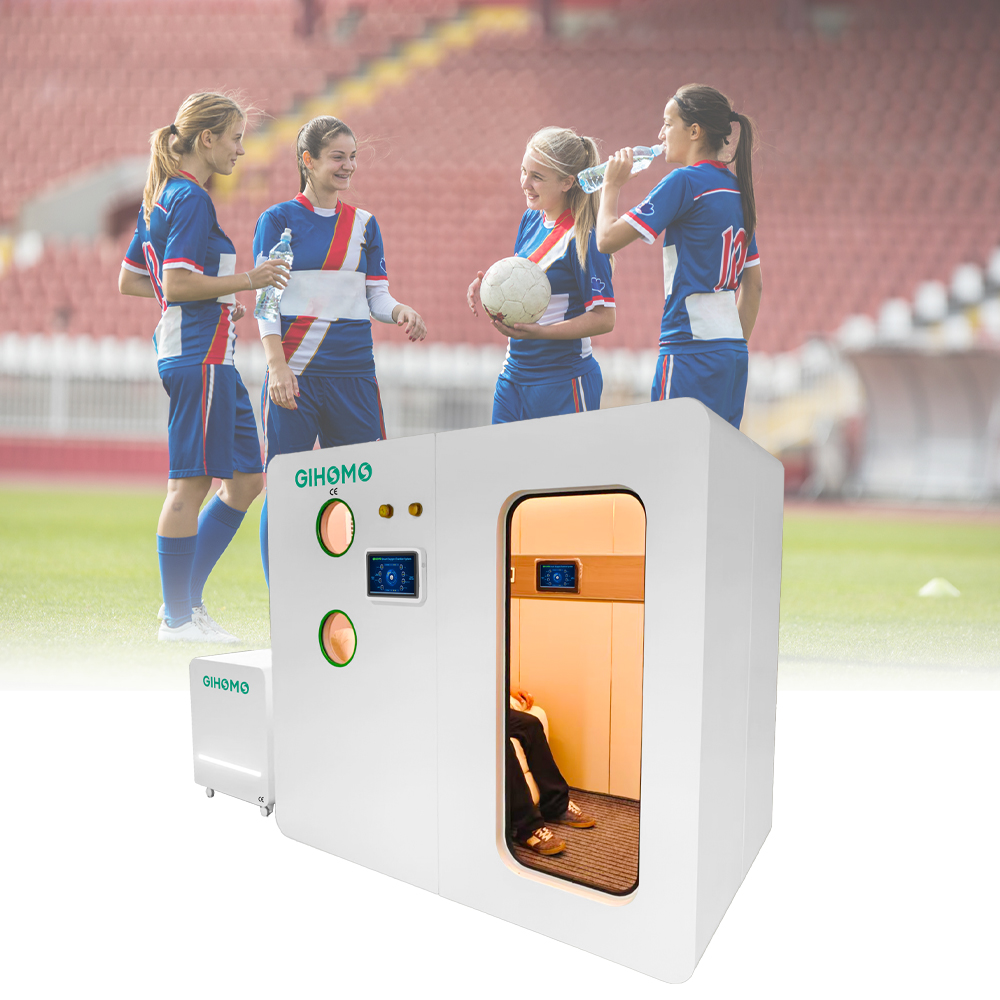
A hyperbaric chamber positioned for sport recovery inside an indoor training environment. Image: GIHOMO.
Hyperbaric oxygen therapy has moved out of the hospital basement and into the training facility. Athletic performance centres, club recovery suites and commercial wellness studios now schedule hyperbaric sessions alongside cold immersion, compression and sleep protocols, and the equipment they install is usually a soft shell or portable chamber rather than a fixed multiplace room. The question that matters for those buyers is narrower than the clinical debate: which pressure, oxygen flow, certification and operating constraints actually fit a sports recovery workflow, and where does that equipment stop being the right tool?
This reference article answers that question using published market benchmarks and documented equipment parameters from Guangdong GIHOMO Medical Technology Co., Ltd., a manufacturer of hard shell and portable hyperbaric oxygen chambers based in Foshan, Guangdong, China, operating under an ISO 9001 quality management system and exporting to markets including the EU and the USA.
Sports Medicine Is Driving a Specific Segment of the HBOT Market
Demand from recovery and wellness settings is measurable at the market level, even though published estimates diverge. The global hyperbaric oxygen therapy device market was estimated at USD 3.71 billion in 2024 and is projected to reach USD 5.19 billion by 2030, according to Grand View Research. A separate estimate from Strategic Market Research / SkyQuest places the 2024 market at USD 4.44 billion with a projected CAGR of 9.4% through 2032. Third-party divergence notes attribute most of the gap to whether wellness, athletic recovery and other non-reimbursed use is counted alongside clinical hyperbaric medicine.
Within the equipment mix, single-occupancy designs dominate. Monoplace hyperbaric chambers accounted for approximately 57% of global revenue share in 2024, a share Mordor Intelligence attributes largely to ease of operation. Regionally, North America held a 54.77% revenue share in 2024, generating approximately USD 700 million, while Asia Pacific is identified as the fastest-growing market, with China projected to reach USD 379.7 million by 2030, again according to Grand View Research.
The segment most relevant to sports medicine is smaller but is growing for reasons that are easy to trace: soft shell portable chambers comprise over 18% of total sales in the Asia-Pacific region, a share attributed to wellness and athletic recovery trends. That is the segment in which a gym, a sports club or a recovery studio typically buys.
Parameter Benchmarks: What a Sports Recovery Chamber Actually Specifies
Three parameters decide whether a chamber fits a sports recovery setting: operating pressure, oxygen delivery, and physical footprint including power draw. Pressure is expressed in atmospheres absolute (ATA), where 1 ATA is ambient pressure at sea level.
In the soft shell class, the configurations most often specified for athletic recovery operate at 1.3 to 1.5 ATA, with oxygen supplied by an integrated concentrator rather than a cylinder bank. The GIHOMO soft shell range illustrates the pattern. The STW01 sitting-type soft shell hyperbaric oxygen chamber operates at 1.5 ATA with a GH15A oxygen concentrator delivering 15 L/min at 100 KPa concentration pressure and greater than 90% oxygen purity, at a rated power of approximately 850 W, inside a chamber measuring 1820 mm × 820 mm × 1500 mm. The STW03 lying-type soft shell chamber uses the same 1.5 ATA pressure, GH15A concentrator and 15 L/min flow in a D1000 mm × 2350 mm envelope, which suits athletes who prefer a supine session. Both are TPU constructions rather than fixed steel rooms.
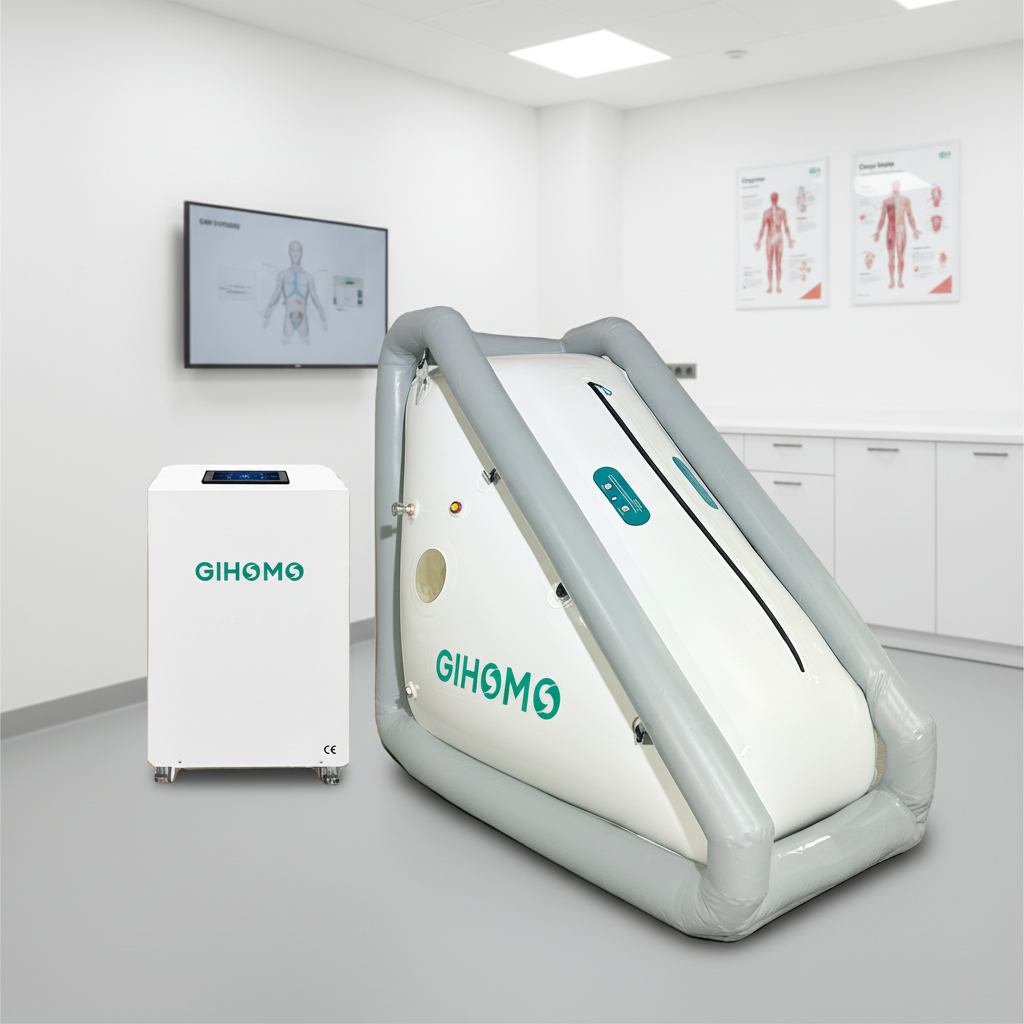
A soft shell hyperbaric oxygen chamber configured for sport recovery. TPU construction keeps the unit relocatable, and the oxygen concentrator supplies the chamber on site. Image: GIHOMO.
The 1.5 ATA / 15 L/min pairing is the practical benchmark for a single-athlete recovery unit. The pressure represents a mild hyperbaric exposure, and the flow is sufficient to hold oxygen concentration in a seated or lying chamber without a bulk supply system. Where a facility needs higher flow or higher pressure, the specification moves into hard shell territory: the GIHOMO W1800 two-person chamber runs at 2.0 ATA with a GH60S concentrator at 60 L/min and approximately 5000 W rated power.
| Model | Configuration | Pressure | O₂ flow | Concentrator | Purity | Rated power | Chamber size |
|---|---|---|---|---|---|---|---|
| STW01 | Sitting type, soft shell (TPU) | 1.5 ATA | 15 L/min | GH15A | >90% | ≈850 W | 1820 × 820 × 1500 mm |
| STW02 | Portable with BIBS system (TPU) | 1.5 ATA | 20 L/min | GY20SR | >90% | ≈1500 W | 1900 × 920 × 1500 mm |
| STW03 | Lying type, soft shell (TPU) | 1.5 ATA | 15 L/min | GH15A | >90% | ≈850 W | D1000 × 2350 mm |
| SSL001 | Soft shell (TPU) | 1.5 ATA | 5 L/min | GH05A | >90% | ≈750 W | 1700 × 1100 × 1200 mm |
| SL001 | Lying type, soft shell (TPU) | 1.3 ATA | 5 L/min | GH05A | >90% | ≈750 W | D2200 × 800 mm; 20.5 kg net |
| SH001 | Lying type, portable (TPU) | 2.0 ATA | 15 L/min | GH15S-12A | >90% | ≈1100 W | D800 × 2000 mm |
| P3000 | Hard shell, four seats (steel) | 1.3 ATA | 30 L/min | GH30S-12A | >90% | ≈2500 W | 2200 × 3000 × 1900 mm |
| Y2400 | Hard shell, three seats (steel) | 1.5 ATA | 30 L/min | GH30SR-12A | >90% | 2500 W | 2200 × 2400 × 1900 mm |
| W1800 | Hard shell, two seats (steel) | 2.0 ATA | 60 L/min | GH60S | >90% | ≈5000 W | 1800 × 2000 × 1900 mm |
| S920 | BIBS system (aluminium) | 1.8 ATA | 30 L/min | GH30S-15A | >90% | ≈2500 W | 2012 × 920 × 1580 mm |
| C900 | Lying type (aluminium) | 2.0 ATA | 15 L/min | GH15S-12A | >90% | ≈1100 W | Φ900 × 2100 mm |
Two operational details matter as much as the headline numbers. First, oxygen is generated on site by a concentrator at greater than 90% purity, which removes cylinder logistics from a facility's daily routine. Second, soft shell chambers are relocatable: the SL001 lying-type unit has a net weight of 20.5 kg and the SSL001 soft shell chamber 24.5 kg, so a recovery room can be reconfigured without structural work.
Certification Benchmarks Buyers Should Verify
Certification scope determines what a facility may legally claim and where equipment may be imported. For hyperbaric chambers, that scope differs sharply between clinical and recovery positioning.
At the regulatory level, the U.S. FDA classifies hyperbaric chambers as Class II medical devices requiring 510(k) clearance, and soft-shell chambers are primarily cleared for altitude sickness rather than a wider set of clinical indications. In the European Union, all hyperbaric chambers — mild or clinical — must comply with Medical Device Regulation (MDR) 2017/745 as Class IIb devices, while multiplace chambers additionally fall under EN 14931 and the fire safety requirements specified in EN 16081. A chamber positioned for disease treatment therefore sits on a different compliance pathway from a chamber positioned for recovery and wellness, even where the hardware appears similar.
Beneath that regulatory layer sit the conformity and quality certifications importers verify in practice. GIHOMO soft shell chambers hold CE certification (certificate JAT25062702642SC-1, issued by Dongguan Jun'an Testing & Certification Co., Ltd., against EN 60335-1:2012+A11:2014+A13:2017+A1:2019+A14:2019+A2:2019+A15:2021+A16:2023 and EN 62233:2008) and EMC certification (certificate UNIA23081019ER-11, issued by Shenzhen United Testing Technology Co., Ltd., against EN IEC 55014-1:2021, EN IEC 61000-3-2:2019+A1:2021, EN 61000-3-3:2013+A2:2021+AC:2022-01 and EN IEC 55014-2:2021). Management system coverage includes ISO 9001 (certificate 21425Q0195R0S, Shenzhen Guo Heng Certification Co., Ltd., GB/T 19001-2016/ISO 9001:2015), ISO 14001 (certificate 21425E0089ROS, GB/T 24001-2016/ISO 14001:2015) and ISO 45001 (certificate 21425S0068ROS, GB/T 45001-2020/ISO 45001:2018), with validity recognised for markets including the EU, America, Canada, Australia and Mexico. All core products have obtained international certifications including CE and FCC.
Buyers in Spanish-speaking markets typically search for this equipment class as a cámara hiperbárica; the certification documentation, not the search term, is what determines whether a unit may be placed in that market. The same logic applies to a hyperbaric chamber for disease treatment, where the applicable conformity route is narrower than for a recovery unit.
How Sports and Wellness Facilities Deploy Chambers
Documented deployment patterns fall into four groups, each with different equipment priorities.
Team and gym recovery. A gym and sports club programme involving 50 units recorded stable operation over a two-year period, with the facility citing design, safety, efficiency and comfort as its selection factors. These installations typically place chambers indoors in a cool, ventilated environment with 24/7 operating capability, matched with a water-cooled air conditioner, a 24V power supply, an oxygen concentrator, two manual pressure relief valves and an automatic pressure relief valve. In a team setting, the value of a chamber is largely a scheduling question: a 1.5 ATA soft shell unit with a short compression cycle can be rotated through a squad across a training day, while a four-seat P3000 hard shell chamber at 1.3 ATA with 30 L/min flow supports group sessions rather than individual bookings.
Wellness and clinic-adjacent recovery. A separate 80-unit programme serving wellness centres, clinics, nursing homes and dental clinics recorded good reviews over two years. These sites generally combine hyperbaric sessions with other services, which places a premium on low noise, low power draw and simple controls — characteristics of the concentrator-driven soft shell format.
Home and personal use. An 80-unit residential programme, also running for two years with stable operation, was applied to sleep improvement, immune support and daily health management. This is the profile of a professional or semi-professional athlete maintaining recovery equipment at home, where a 20.5 kg lying-type unit or a 24.5 kg soft shell chamber can be installed without construction work.
Channel and private label. A 100-unit ODM reseller programme supplied chambers sold under the reseller's own identity in local markets over two years.
Soft Shell, Hard Shell and Clinical Chambers Compared — and Where the Limits Are
| Dimension | Soft shell / portable unit | Hard shell chamber | Clinical multiplace room |
|---|---|---|---|
| Typical pressure | 1.3–1.5 ATA, up to 2.0 ATA in some TPU models | 1.3–2.0 ATA across the GIHOMO range | Higher pressures used in clinical protocols |
| Footprint | Relocatable; units from 20.5 kg | Fixed installation, dedicated floor area | Purpose-built room |
| Power draw | ≈750–1500 W | ≈1100–5000 W | Facility-scale services |
| Oxygen supply | On-site concentrator, >90% purity | On-site concentrator | Piped multiplace systems |
| Regulatory framing | FDA soft-shell clearances focus on altitude sickness; EU MDR 2017/745 Class IIb applies | Same EU MDR 2017/745 framework | EN 14931 and EN 16081 also applicable |
| Typical setting | Gym, studio, club, home | Clinic, commercial recovery centre | Hospital hyperbaric unit |
Three limits should be stated plainly for anyone specifying equipment for a sports medicine application.
Pressure below clinical protocols. The soft shell models most often chosen for athletic recovery operate at 1.3–1.5 ATA. That is lower than the pressures used in clinical hyperbaric medicine protocols, so a soft shell chamber should not be treated as a substitute for a clinical chamber when a medically indicated protocol calls for higher pressure. Within the GIHOMO range, the pressure step-up comes from the hard shell and aluminium lines, up to 2.0 ATA in models such as the W1800 and C900.
Narrower regulatory clearance. FDA clearance for soft-shell chambers is primarily directed at altitude sickness, and in the EU every chamber is assessed as a Class IIb device under MDR 2017/745. A sports facility positioning a chamber as a recovery amenity is operating on materially different ground from a hospital running an approved clinical indication.
Site and evidence conditions. Concentrator-driven chambers require an indoor, cool and ventilated environment, a water-cooled air conditioner, a 24V power supply and pressure relief valves as matched equipment; a TPU chamber is not an outdoor or unconditioned-space product. Separately, the peer-reviewed evidence base for hyperbaric exposure in athletic recovery is narrower and more contested than for long-established clinical indications, which is why most sports deployments present these units as recovery infrastructure rather than as treatment. Buyers should evaluate published parameters and certifications — not promotional claims — when deciding fit.
Procurement Constraints: Capacity, Lead Time and Configuration
Specification is only half of a purchasing decision; supply parameters determine whether a rollout is feasible. Documented GIHOMO capability data provides a concrete reference point for buyers benchmarking suppliers in this category.
- Production mode and customisation: OEM / ODM, with customisation of logo, interface, colour and languages.
- Monthly capacity: 80 units, against an annual output of 1000 units from a 2000 m² facility with 50–100 employees and a 6-engineer R&D team.
- Lead time: 30–45 days.
- Minimum order quantity: 1 unit, which allows a single-site facility to trial a configuration before committing to a fleet.
- Quality control: 100% testing before shipment.
- After-sales: 24/7 instant response by a professional team, dedicated after-sales engineers offering one-on-one technical support, and a one-year warranty.
- Export markets: EU, North America, South America and Australia, consistent with a 60% export ratio and main markets in the EU and USA.
A practical evaluation sequence for a sports medicine buyer is to fix the pressure and flow requirement first, then check certification scope against the intended market, then confirm power, ventilation and floor constraints, and only then compare lead time, capacity and support terms across suppliers. Sequence matters because a chamber that meets a pressure specification but lacks the certification required in the destination market cannot be deployed regardless of price.
Future Outlook
Three trends are likely to shape sports medicine procurement of hyperbaric equipment over the next several years. The first is regional growth: Asia Pacific is identified as the fastest-growing HBOT market, with China projected to reach USD 379.7 million by 2030, and soft shell portable chambers already represent over 18% of Asia-Pacific sales on the strength of wellness and athletic recovery demand. The second is the continued dominance of single-occupancy designs, which held approximately 57% of global revenue share in 2024 — a structure that favours relocatable, concentrator-driven chambers in non-hospital settings. The third is regulatory consolidation: EU MDR 2017/745 classification of all chambers as Class IIb devices, alongside the existing FDA Class II framework, raises the documentation standard for every supplier, including those selling into wellness channels.
For sports medicine buyers, the practical consequence is that equipment decisions will increasingly be argued on parameters and paperwork rather than on brand familiarity: pressure in ATA, flow in litres per minute, purity, rated power, chamber dimensions, and a certificate number that can be checked.
Frequently Asked Questions
What operating pressure do sports recovery hyperbaric chambers typically use?
The soft shell models most often specified for athletic recovery operate at 1.3 ATA to 1.5 ATA. Within the GIHOMO range, the STW01, STW02, STW03, SSL001 and SL001 sit in that band, while hard shell and aluminium models extend from 1.3 ATA up to 2.0 ATA, as in the W1800 and C900. Pressure is the primary parameter to fix before comparing price, because it defines which workflows the chamber can support.
How much oxygen flow does a soft shell hyperbaric oxygen chamber require?
A single-athlete soft shell configuration typically pairs 1.5 ATA with a 15 L/min concentrator. The GIHOMO STW01 and STW03 use a GH15A concentrator at 15 L/min and 100 KPa concentration pressure with greater than 90% oxygen purity at approximately 850 W. Configurations differ by chamber size: the STW02 uses a GY20SR at 20 L/min, and larger hard shell chambers run up to 60 L/min with a GH60S concentrator.
Which certifications should be verified before importing a hyperbaric chamber?
Importers generally verify CE, EMC, FCC and management system certificates. GIHOMO soft shell chambers carry CE certificate JAT25062702642SC-1 and EMC certificate UNIA23081019ER-11, with ISO 9001 (21425Q0195R0S), ISO 14001 (21425E0089ROS) and ISO 45001 (21425S0068ROS) covering the management system, valid for markets including the EU, America, Canada, Australia and Mexico. Buyers should also confirm the regulatory classification that applies in the destination market, since FDA and EU MDR pathways differ for clinical and recovery positioning.
Can a soft shell chamber be installed in a gym or training facility?
Yes, provided the site meets the operating conditions. The documented sports recovery application specifies an indoor, cool and ventilated environment with 24/7 operation, matched with a water-cooled air conditioner, a 24V power supply, an oxygen concentrator, two manual pressure relief valves and an automatic pressure relief valve. Documented installations include a 50-unit gym and sports club programme and an 80-unit wellness centre programme, both reported as running stably over two years.
What are the main limitations of soft shell chambers in sports medicine?
Three limits recur. Pressure: soft shell units used for recovery operate at 1.3–1.5 ATA, below the pressures used in clinical hyperbaric protocols. Regulatory scope: FDA clearance for soft-shell chambers primarily addresses altitude sickness, and in the EU all chambers fall under MDR 2017/745 as Class IIb devices. Site requirements: the equipment requires a conditioned indoor space with ventilation, cooling and dedicated power, and the peer-reviewed evidence base for hyperbaric exposure in athletic recovery is narrower than for long-established clinical indications.
What are typical minimum order quantities and lead times for hyperbaric chamber supply?
Documented GIHOMO supply parameters are a minimum order quantity of 1 unit, a lead time of 30–45 days and a monthly capacity of 80 units, with OEM / ODM customisation available for logo, interface, colour and languages, 100% testing before shipment, a one-year warranty, and 24/7 after-sales response with dedicated engineers providing one-on-one technical support.
Summary
Sports medicine has become a genuine adoption channel for hyperbaric oxygen therapy equipment, and the chambers that fit it are defined by measurable parameters rather than by category claims: 1.3–1.5 ATA for soft shell recovery units, 15 L/min oxygen flow from an on-site concentrator at greater than 90% purity, a relocatable TPU envelope, and a certification set — CE, EMC, ISO 9001, ISO 14001, ISO 45001, FCC — that can be verified against certificate numbers and destination markets. The same evidence also marks the boundary of the technology: mild-pressure chambers are recovery infrastructure, not clinical substitutes, and the buyers who get this right are the ones who specify pressure and certification first and compare pricing last.
Hyperbaric equipment for sports recovery is best evaluated as infrastructure: parameters, certification scope and site conditions decide fitness, and supplier capacity, lead time and support terms decide whether a rollout is practical.