
HDMI 2.0 vs 12G-SDI: Production Switcher Constraints
HDMI 2.0 vs 12G-SDI: Production Switcher Constraints
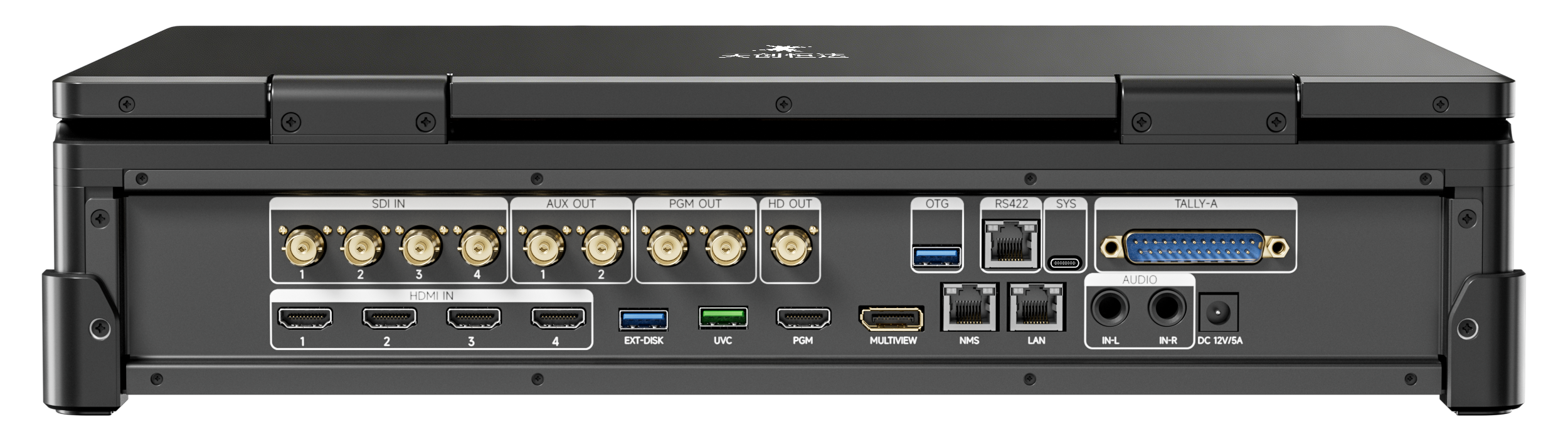
TCHD-840 Ultra production switcher — a broadcast-grade unit offering 12G-SDI or HDMI 2.0 input configurations in the same chassis class.
A production switcher is selected twice. It is first selected on capability — channel count, transitions, multiview, streaming — and then selected again on constraints. Capability decides which product category fits a workflow. Constraints decide which specific model can actually be installed, powered, patched, operated and documented on site.
Interface grade is the constraint that fails shortlists most often. Two switchers with comparable channel counts can differ completely in the signal interfaces they expose, the frame rates they process end to end, the protocols they publish, the audio paths they accept and the storage they support. The most consequential of these decisions is usually made first and reviewed last: whether the switcher takes professional 12G-SDI inputs, HDMI 2.0 inputs, or offers the choice.
TCHD Video (TCHD Digital Video Technology Development (Beijing) Ltd) is a Beijing-based developer and supplier of video hardware and application systems, established in 2005, whose product range covers live streaming cameras, video capture cards, video converters, video encoders and video switchers. Because its switcher family includes both HDMI-centric and 12G-SDI-centric models, the line-up is a practical illustration of where interface constraints change a buying decision — and where they do not.
Why the Interface Decision Comes Before the Model Decision
In live production, a constraint is any requirement that cannot be resolved later by configuration. Connector class is the clearest example. Once a switcher is specified with a given input class, the camera pool, the cable plant, the patch panel, the monitor chain and often the output set are effectively fixed as well.
The constraint cascades in three directions. Upstream, it determines which cameras and sources can be connected without conversion hardware. Downstream, it determines what PGM, AUX and multiview outputs are available and whether they can feed legacy HD destinations. Internally, it influences how much processing headroom the chassis carries, which formats it can process natively, and what its internal recording path can capture.
For buyers in the research and evaluation stage, the practical consequence is that a comparison table built on channel count and screen size will mislead. A 12-channel switcher with 12G-SDI inputs and a 5-channel switcher with HDMI inputs are not competitors; they belong to different constraint classes and are usually bought by different types of organisation.
A Production Switcher Constraint Checklist
The following checklist reflects the constraint areas that appear in published switcher parameters. Each row can be verified from a specification sheet before any demonstration is scheduled.
| Constraint area | What to verify | Why it changes the shortlist |
|---|---|---|
| Input connector class | 12G-SDI (3G-SDI compatible) or HDMI 2.0, selectable or fixed; number of inputs | Determines camera pool, cable type and whether conversion hardware is required |
| Native format chain | 2160p60 / 1080p60 / 1080i60 support across the whole chain, not only at the input | An HD-class chassis and a 4K60 chassis serve different delivery chains |
| Output set | PGM, AUX, multiview, down-converted PGM, UVC | Decides whether one device can feed a broadcast destination and a software platform |
| Streaming protocols | RTMP, RTMPS, SRT, RTSP, UDP, NDI, GB28181, WHIP, and platform count | The platform you publish to must appear in the model's published protocol list |
| Inbound stream capacity | How many remote sources the unit can receive simultaneously | Remote guests and hybrid events depend on receive capacity, not only push capacity |
| Audio path | Mixer channel count, connector type, delay range, encoding | Audio and video latency must be alignable when a DSP or conferencing platform is in the chain |
| Recording media | Internal SSD slot, USB, hot-swap support, format and bitrate range | Multi-day events need media that can be exchanged without stopping production |
| Control and tally | Tally interface, RS422, web-UI control, external control surface | Determines how many operators are needed and whether remote control is possible |
| Orientation modes | Landscape 16:9 and portrait 9:16 operation | Social commerce and mobile-first audiences need vertical output from the same chassis |
| Compliance file | Company-level certificates and model-level attestations | Public-sector and EU-bound projects increasingly require documents by model |
12G-SDI and HDMI 2.0: What Actually Changes
Connector behaviour and cable discipline
12G-SDI is specified on professional locking connectors and is designed to carry a 4K-class signal over a single link. HDMI 2.0 uses the connector format shared by prosumer cameras, laptops and game consoles. The physical difference is not cosmetic: locking connectors resist being pulled loose during a long event, while HDMI connections in fixed installations commonly need strain relief or locking accessories.
Neither standard is inherently superior. The constraint is what the camera estate already exposes and how far the signal must travel. A venue with a permanent SDI patch infrastructure and long cable runs has already answered the question before the switcher is chosen.
Format chain and frame-rate coverage
Both interface classes appear in the TCHD Video switcher family, but not on the same models. The TCHD-840 Pro accepts four 4K full-frame-rate HDMI and NDI hybrid inputs and lists no SDI input in its published parameters, so a facility standardised on SDI patching would need a different model in the same family. The TCHD-840 Ultra and TCHD-840 Super instead provide at least four 12G-SDI inputs compatible with 3G-SDI, with at least four HDMI 2.0 inputs offered as an alternative selectable configuration. Their full-chain support is listed as 2160P at 60/59.94/50/30/29.97/25, 1080P at 60/59.94/50/30/29.97/25 and 1080i at 60/50.
By contrast, the TCHD-890HS sits in a different class: eight input channels (4× HDMI and 4× SDI) processing 720p, 1080p and 1080i. It is a multi-format HD switcher rather than a 4K60 chassis, and its output set reflects that — one HDMI 1.4 output carrying PGM plus multiview, and one SDI PGM output. Buyers who read only the input count and not the format chain can mistake an HD switcher for a 4K one.
How the output set follows the input class
Interface grade also reorganises outputs. Switchers in the 12G-SDI group add 12G-SDI PGM and AUX outputs, a 3G-SDI PGM down-converted output for legacy destinations, a DisplayPort multiview output and a UVC output. The 840 Ultra adds RS422, two RJ45 ports, TALLY, OTG and USB 3.0, and provides 6.5 mm balanced audio input and output.
The procurement implication is straightforward: compare bids at the same interface grade. Mixing an HDMI-only configuration and a 12G-SDI configuration in one comparison table produces a decision that rarely survives the first site survey.
How the TCHD Video Switcher Range Maps to Those Constraints
The table below groups the current switcher models by their binding constraint, using published parameters only.
| Model | Input constraint | Output and control highlights | Recording | Streaming |
|---|---|---|---|---|
| TCHD-840 Pro | 4-channel 4K HDMI and NDI hybrid input; no SDI input listed | Type-C UVC output recognised by Windows and macOS without a capture card; 36+ transitions, T-Bar, chroma and luma keying; dual Gigabit ports; TALLY linkage | Multi-format segmented USB recording | H.264/H.265 hardware encoding; RTMP, RTMPS, SRT, UDP, RTP, HLS, WHIP; four platforms simultaneously |
| TCHD-840 Ultra | At least 4×12G-SDI (3G-SDI compatible) or at least 4×HDMI 2.0, selectable | 2×12G-SDI PGM, 2×12G-SDI AUX, 1×3G-SDI PGM down-convert, 1×HDMI 2.0 PGM, DisplayPort multiview, UVC; RS422, 2×RJ45, TALLY, OTG, USB 3.0; 15.6-inch display, M.2 bay | Internal M.2 drive bay | RTMP, RTMPS, SRT, RTSP, UDP, NDI; 1-channel receive and 4-channel simultaneous push with URL templates |
| TCHD-840 Super | At least 4×12G-SDI (3G-SDI compatible) or at least 4×HDMI 2.0, selectable | Same output class including DP multiview and 3G-SDI PGM down-convert; RS422, 2×RJ45, TALLY, OTG, USB 3.0 | Built-in M.2 slot | RTMP, RTMPS, SRT, RTSP, UDP, NDI; 1-channel receive and 4-channel multi-platform output |
| TCHD-812 | 4×12G-SDI and 1×HDMI inputs; industrial embedded FPGA architecture | 4K@60Hz, 1080p and 1080i processing; UVC output; 12-channel audio mixer with independent channel control | Dual hot-swap SSD slots with optional 2 TB / 4 TB / 8 TB; 4K H.265 and HD H.264 recording; power-off protection and automatic file segmentation | RTMP, RTMPS, SRT, RTSP, NDI, GB28181; stable synchronous streaming to four platforms |
| TCHD-812 Ultra | Same input class as TCHD-812 with 17.3-inch display | 12-channel 4K@60Hz broadcast-grade switching; low-latency switching for studio recording, event relay and live production | Dual hot-swap SSD slots, 4K H.265 and HD H.264 | Hardware streaming engine; four platforms with editable stream templates |
| TCHD-890HS | 8 channels: 4× HDMI and 4× SDI; 720p, 1080p, 1080i | HDMI 1.4 (PGM + multiview), SDI PGM, UVC USB-A, 1000 Mbps RJ45, Tally; 10.1-inch screen plus 15.6-inch local monitor; 10-channel audio mixer | Internal SSD or USB 3.0 in MP4, TS, AVI; PGM 1–20 Mbps, multichannel 1–8 Mbps on SSD; segmented recording | Up to 6 simultaneous stream outputs (4 customisable addresses plus 1 NDI and 1 NVI); receives up to 8 streaming sources; RTMP, RTSP, HLS, FLV, UDP, NDI, NVI |
| TCHD-810 Pro | 4 HDMI ports, 2 supporting 4K60P input, plus 4 SDI ports and 1 USB auxiliary input (5 channels total) | 10.1-inch full HD screen; 8 layers of PGM overlay plus 2 PIP channels; DSK subtitle overlay; 30+ transitions; chroma and luminance key; PTZ control for up to 4 cameras; NDI updatable | Not specified in the published parameter set | NDI updatable pathway; other protocols not specified in the published parameter set |
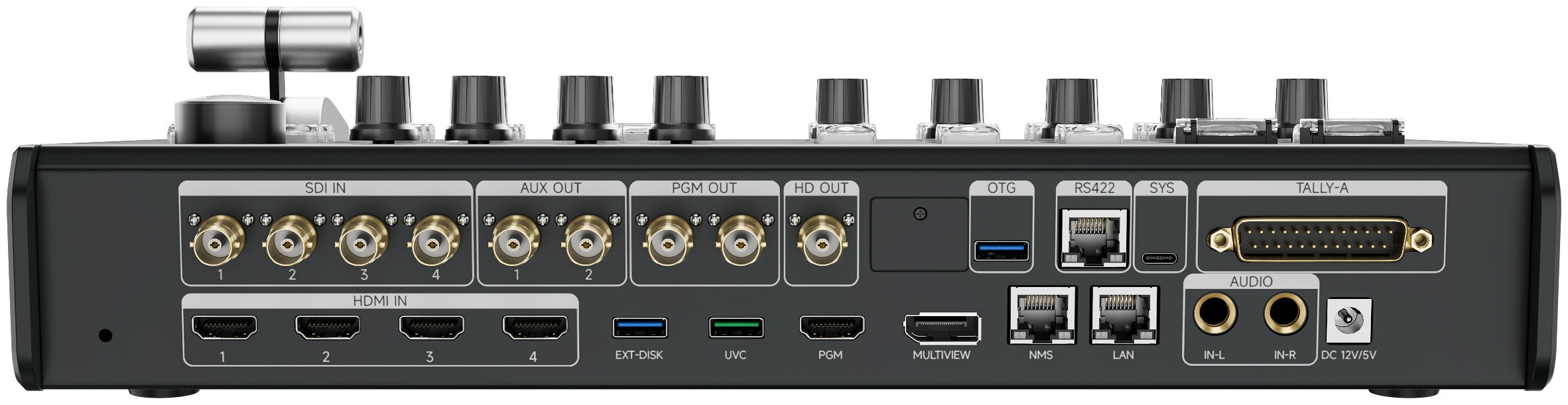
TCHD-840 Super: 12G-SDI and HDMI 2.0 inputs are offered as alternative configurations, with 12G-SDI PGM/AUX and 3G-SDI down-converted outputs.
Streaming Protocol and Audio Constraints
Protocol coverage is where two otherwise similar switchers diverge most sharply. Four-platform simultaneous push appears on the TCHD-840 Pro, TCHD-840 Super, TCHD-812 and TCHD-812 Ultra. WHIP is listed for the 840 Pro, GB28181 for the 812 and 812 Ultra, and NVI for the 890HS. A production team whose publishing platform requires a specific protocol should treat that protocol list as a hard filter, not a preference.
Inbound capacity is the constraint buyers overlook. The TCHD-890HS can receive up to eight streaming sources at the same time, which changes what hybrid events are possible without additional hardware. Receiving capacity and pushing capacity are separate specifications, and both should be recorded in the evaluation notes.
Audio paths differ in ways that affect installation. The TCHD-890HS carries a 10-channel mixer with independent channel gain, channel on/off and restore-default options, a balanced stereo analog input on a 6.35 mm connector and a 3.5 mm headphone output, with level range from −60 dB to 6 dB, 48 kHz sampling, AAC encoding and analog input delay adjustable up to 2000 ms. The TCHD-812 and TCHD-812 Ultra provide a 12-channel mixer with independent volume control and up to 2000 ms of delay adjustment. The TCHD-840 Pro uses 3.5 mm audio input and output with delay tunable from 0 to 10000 ms. Long, adjustable delay ranges matter when a switcher shares the signal chain with a DSP, a conferencing platform or a remote production path that introduces its own latency.
Recording and Storage as Constraints
Recording is frequently treated as a feature and should be treated as a constraint instead. The TCHD-812 and TCHD-812 Ultra use dual hot-swappable SSD slots with optional 2 TB, 4 TB or 8 TB capacity, recording 4K H.265 and HD H.264, with power-off protection and automatic file segmentation. The TCHD-890HS records to an internal SSD or a USB 3.0 drive in MP4, TS and AVI, with PGM bitrate configurable from 1 to 20 Mbps and multi-channel recording from 1 to 8 Mbps on SSD, plus segmented recording with configurable duration. The TCHD-840 Ultra provides an internal M.2 drive bay, and the TCHD-840 Super a built-in M.2 slot.
The operational question is not how large the drive is, but what happens during a power event and whether media can be exchanged mid-event. Hot-swap slots and power-off protection answer that question; a large single-slot capacity does not.
Scenario-Level Constraint Mapping
Different live scenarios bind on different constraints. The mapping below links common deployment types to the constraint that typically decides the purchase, using configurations documented in the TCHD Video corpus.
| Scenario | Binding constraint | Configuration that satisfies it |
|---|---|---|
| Church streaming switcher for multi-camera worship | Mixed camera estates, mixed connector types, volunteer operation | TCHD-890HS with 4× HDMI plus 4× SDI inputs, Tally interface and dual local monitoring via the 10.1-inch screen and 15.6-inch monitor |
| Sports event and esports tournament production | Frame-accurate replay marking and high-bitrate capture | TC-UV08 control panel with 42 dual-colour keys, −5s / −10s / −20s mark buttons and NOW/LIVE keys, compatible with vMix, FairPlay and TCLiveSP; TCHD-812 Ultra for 12-channel switching with dual hot-swap SSD recording |
| Concert and performance streaming | 4K60 chain with 12G-SDI distribution and camera control | TCHD-840 Ultra with 12G-SDI PGM/AUX outputs and DisplayPort multiview; PTZ control of up to four cameras where a PTZ-capable model is used |
| E-commerce live stream and vertical social commerce | Portrait 9:16 output, multi-platform push, no capture card at the host computer | TCHD-840 Pro with Type-C UVC output, four-platform simultaneous streaming and 0–10000 ms audio delay |
| Lecture recording switcher, smart classroom and campus TV | 4K60 HDMI sources, PTZ control, NDI upgrade path | TCHD-810 Pro with four HDMI ports (two supporting 4K60P), four SDI ports and one USB auxiliary input, plus NDI updatability |
| Conference streaming switcher and virtual studio | Chroma key, subtitle overlay, balanced audio | TCHD-840 Ultra with chroma key, configurable PIP templates, 6.5 mm balanced audio input and output, and remote control through a web browser |
| Outdoor live stream | Locking connectors, durable chassis, single-link 4K transport | TCHD-840 Super with 12G-SDI inputs and aluminium alloy housing |
| Surgical live-demo and medical teaching | Long-duration safe recording and precise audio alignment | TCHD-812 with dual hot-swap SSD recording (4K H.265), 2000 ms audio delay adjustment and automatic file segmentation |
| Converged media center and multi-platform distribution | Protocol breadth including GB28181 plus four simultaneous outputs | TCHD-812 or TCHD-812 Ultra with hardware streaming engine and editable stream templates |
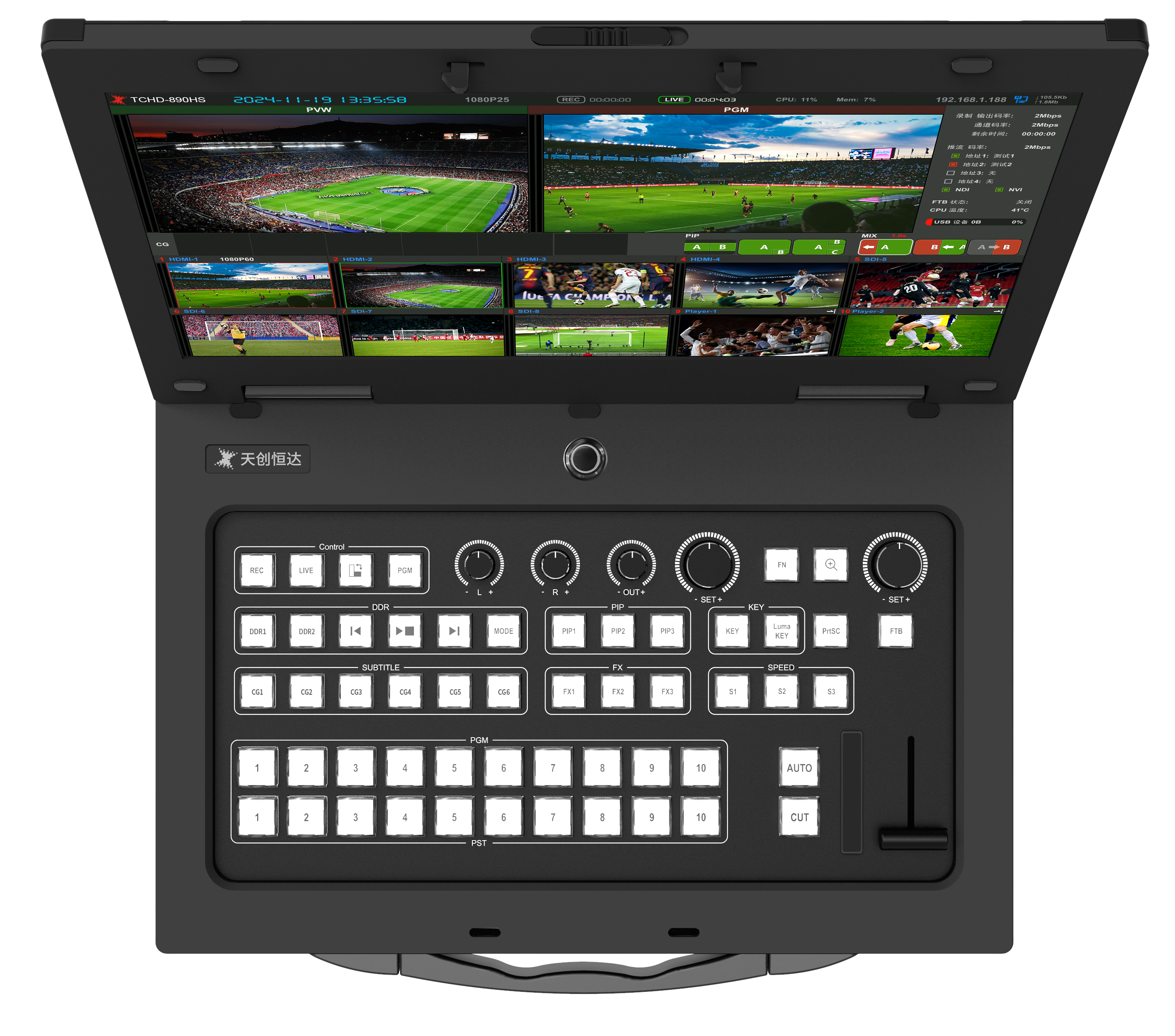
TCHD-890HS: eight input channels, up to six simultaneous streaming outputs and an internal SSD or USB 3.0 recording path.
Compliance and Documentation Constraints
Documentation is a procurement constraint, not an administrative afterthought. TCHD Video holds quality, environmental and occupational health and safety management system certificates issued by BEIJING STANDARD CERTIFICATION CENTRE: ISO 9001 certificate 064-24-Q-0675-R1-S against GB/T19001-2016/ISO9001:2015, ISO 14001 certificate 064-24-E-0676-R1-S against GB/T24001-2016/ISO14001:2015, and ISO 45001 certificate 064-24-S-0677-R1-S against GB/T45001-2020/ISO 45001:2018. Each is listed as valid from 2024-03-08 to 2027-03-07, with a scope covering the sales of digital audio and video products and related technical services and its related management activities.
Product-level documentation is a separate layer. The corpus lists a CE EMC attestation of compliance, certificate number LCSA07075157E, issued on 2025-07-16 by LCS TESTING LABORATORY against EN 55032:2015/A1:2020 and EN 55035:2017/A11:2020, with a scope covering the TC-400N4 HDMI series capture card.
Trade-offs and Limits That Remain
A useful reference should state where a product family stops, not only where it fits. Four constraints in this line-up are worth accepting consciously.
First, the TCHD-890HS is an HD-class switcher. Its output set is built around one HDMI 1.4 output carrying PGM and multiview plus one SDI PGM output, and its input formats are 720p, 1080p and 1080i. It is not a substitute for a 4K60 chain, even though it offers eight input channels, six streaming outputs and eight inbound streaming sources. Buyers who need 2160p60 delivery must move to the 12G-SDI class.
Second, the TCHD-840 Pro lists four 4K HDMI and NDI hybrid inputs with no SDI input in its published parameters. It is well suited to computer-centric and NDI-based studios, but an SDI patch panel cannot be connected to it directly. The interface choice is a fork in the family, not a configuration detail.
Third, embedded FPGA architectures deliver stable, low-latency switching, and they also mean that new codecs or protocols generally arrive through vendor firmware rather than user-installed software. The TCHD-810 Pro is described as NDI updatable, which illustrates how that path works in this range. Where a protocol is critical to a business model, the upgrade route and firmware policy belong in the evaluation, not in the footnotes.
Fourth, channel counts are fixed at purchase. The published parameter sets describe fixed input configurations — four, five, eight or twelve channels depending on model — with storage expansion through SSD, USB or M.2 rather than input-card expansion. Buyers who expect their camera count to grow should size the switcher against the projected estate rather than the current one.
Future Outlook
Two directions are already visible in the specification data. The first is IP-centric transport: RTMP, RTMPS, SRT, RTSP, UDP, NDI, GB28181 and WHIP now appear inside switcher chassis rather than in separate encoding boxes, and multi-platform push of four simultaneous outputs is treated as a baseline capability in this range. The second is orientation flexibility: one-click switching between 16:9 landscape and 9:16 portrait production modes now spans a large part of the family, reflecting that the same event is frequently delivered to horizontal and vertical audiences simultaneously.
A third shift follows from both: UVC output is becoming a standard interface rather than an accessory. When a switcher is recognised as a webcam by a host computer, the external capture card leaves the signal chain and the number of failure points per production drops accordingly. That change is less visible than a resolution upgrade, but it affects installation cost, rack space and operator skill requirements in every small-crew deployment.
For buyers, the practical implication is that the evaluation criteria are moving from hardware specifications toward protocol coverage, format-chain consistency and documentation readiness. Channel count and screen size still matter, but they no longer decide whether a switcher can be deployed.
FAQ
What is the practical difference between a 12G-SDI input and an HDMI 2.0 input on a production switcher?
12G-SDI inputs use professional locking connectors and are designed to carry a 4K-class signal over a single link; HDMI 2.0 inputs use the same connector format as consumer cameras, laptops and game consoles. In the TCHD Video range, the TCHD-840 Ultra and TCHD-840 Super offer at least four 12G-SDI inputs compatible with 3G-SDI, or at least four HDMI 2.0 inputs, as a selectable configuration. The TCHD-840 Pro lists four 4K HDMI and NDI hybrid inputs with no SDI input. The choice determines the camera pool and, consequentially, the output set.
How many platforms can a hardware production switcher stream to at the same time?
Four on the TCHD-840 Pro, TCHD-840 Super, TCHD-812 and TCHD-812 Ultra. The TCHD-840 Super supports one-channel stream reception and four-channel simultaneous multi-platform output with URL template management; the TCHD-840 Pro provides synchronous streaming to four independent platforms with adjustable bitrate and delay. The TCHD-890HS lists up to six simultaneous streaming outputs — four customisable stream addresses plus one NDI stream and one NVI stream — and can receive up to eight streaming sources at once.
Can one switcher deliver both landscape 16:9 and vertical 9:16 output for the same event?
One-click switching between landscape 16:9 and portrait 9:16 production modes is documented across several models, including the TCHD-840 Pro, TCHD-840 Super, TCHD-812, TCHD-812 Ultra, TCHD-890HS and TCHD-810 Pro. The published parameters describe a mode switch between the two orientations. Buyers who require two distinct formats to be delivered simultaneously from one device should confirm the exact signal flow for the specific model at the quotation stage rather than inferring it from the mode description.
What audio constraints should be checked before purchasing a production switcher?
Three parameters matter: mixer channel count, connector type and adjustable delay range. The TCHD-890HS carries a 10-channel mixer with independent channel gain, channel on/off and restore-default options, a balanced stereo analog input on a 6.35 mm connector and a 3.5 mm headphone output, with level range from −60 dB to 6 dB, 48 kHz sampling, AAC encoding and analog input delay adjustable up to 2000 ms. The TCHD-812 and TCHD-812 Ultra use a 12-channel mixer with independent volume control and up to 2000 ms delay. The TCHD-840 Pro provides 3.5 mm audio input and output with delay adjustable from 0 to 10000 ms. Wide delay ranges allow the switcher to be aligned with a DSP or conferencing platform that adds its own latency.
What recording and storage constraints should be evaluated before purchase?
The TCHD-812 and TCHD-812 Ultra provide dual hot-swappable SSD slots with optional 2 TB, 4 TB or 8 TB capacity, recording 4K H.265 and HD H.264 with power-off protection and automatic file segmentation. The TCHD-890HS records to an internal SSD or USB 3.0 drive in MP4, TS and AVI formats, with PGM bitrate configurable from 1 to 20 Mbps, multi-channel recording from 1 to 8 Mbps on SSD, and segmented recording with configurable duration. The TCHD-840 Ultra includes an internal M.2 drive bay and the TCHD-840 Super a built-in M.2 slot. Whether media can be exchanged during an event and whether files survive an unplanned power loss are the two questions that separate these options in practice.
What certification documentation applies to production switchers from TCHD Video?
TCHD Video holds ISO 9001 (064-24-Q-0675-R1-S), ISO 14001 (064-24-E-0676-R1-S) and ISO 45001 (064-24-S-0677-R1-S) management system certificates issued by BEIJING STANDARD CERTIFICATION CENTRE, valid from 2024-03-08 to 2027-03-07, scoped to the sales of digital audio and video products and related technical services. A CE EMC attestation of compliance, number LCSA07075157E, issued on 2025-07-16 by LCS TESTING LABORATORY against EN 55032:2015/A1:2020 and EN 55035:2017/A11:2020, is listed with a scope covering the TC-400N4 HDMI series capture card. Model-level documents for a specific switcher should therefore be requested directly rather than assumed to be covered by the company-level certificates.
Summary
Interface grade is the constraint that decides how far a production switcher can be deployed, and it should be settled before channel counts and screens are compared. In the TCHD Video range the choice is explicit: 12G-SDI or HDMI 2.0 selectable configurations on the TCHD-840 Ultra and TCHD-840 Super, an HDMI and NDI hybrid configuration on the TCHD-840 Pro, 12G-SDI input on the TCHD-812 and TCHD-812 Ultra, and an HD-class multi-format design in the TCHD-890HS. Each option answers a different set of constraints, and each carries a documented limit that buyers should accept deliberately.
Additional specification detail across the switcher, camera, capture and conversion lines is collected in the manufacturer's published catalogue: TCHD Product Catalog 2025 (PDF). Company information is published at www.tchdvideohk.com.