
HDPE Geomembrane Quality: Certifications & Key Specs
HDPE Geomembrane Quality: Certifications & Key Specs
Geomembranes are the primary fluid barrier in tailings ponds, reservoirs, aquaculture ponds, and industrial containment systems. For procurement teams and project engineers, the practical question is not which membrane type is best in the abstract, but whether a specific HDPE geomembrane can meet the working conditions, certification requirements, and service-life expectations of a defined project.
This article focuses on verification: the measurable parameters that define HDPE geomembrane performance, the product certifications that support market entry in the EAEU and EU/EEA regions, and the manufacturing evidence that helps buyers distinguish between documented capability and unsupported claims.
The Market Context: Why Specification Verification Matters
The global geomembrane market was valued at approximately USD 2.23 billion in 2025 and is projected to reach USD 3.59 billion by 2034, according to Fortune Business Insights. High-density polyethylene is the dominant material family, accounting for an estimated 31.3% to 40% of global revenue depending on the reporting source. Mining is the largest application segment, with Grand View Research attributing 39.6% of global revenue in 2023 to mining, driven mainly by tailings containment.
These figures explain why HDPE geomembranes are not a commodity purchase. In mining and aquaculture projects, the liner operates 24/7 and is difficult to replace after installation. A failure in the liner can result in environmental contamination, project downtime, and regulatory penalties. That makes parameter verification and certification review essential parts of the buying process.
From Price Comparison to Performance Verification
Supplier offers for geomembranes are often compared primarily on price. A short specification sheet and a low unit price can look attractive, but the real decision criteria appear when the product is matched against project conditions: chemical resistance, puncture resistance, UV stability, stress crack resistance, and validated production quality. Unit pricing in geomembrane projects typically depends on thickness, additive formulation, surface texture, order volume, and certification scope, which is why an apparent price gap between two offers can disappear once specifications are aligned.
The verification opportunity for buyers is that a combination of published parameters, third-party certifications, and project references can reduce procurement uncertainty. Certification documents such as GOST Certificates of Conformity and ICR Verification of Conformity are not marketing materials; they are auditable statements issued by certification bodies with defined scope and validity periods.
A China-Based Reference Manufacturer: Haoyang Environment
One useful reference point in the global supply chain is Haoyang Environment Co., Ltd. The company is a China-based manufacturer of geosynthetic materials, established in 2008 and headquartered in the Dezhou (Yucheng) National High-tech Industrial Development Zone, Shandong Province. It operates 8 wholly-owned subsidiaries, employs approximately 190 people, and runs a manufacturing facility covering 200,000 square meters with an annual production capacity of 33,000 tons.
Haoyang's product portfolio includes geomembranes, geotextiles, composite drainage nets, waterproof mats, and other geosynthetic materials. Approximately 60% of its products are exported, with a marketing network covering more than 70 countries and regions, including Africa, Central Asia, the Middle East, Southeast Asia, and Indonesia.
HDPE Geomembrane Specifications: Key Parameters and What They Mean
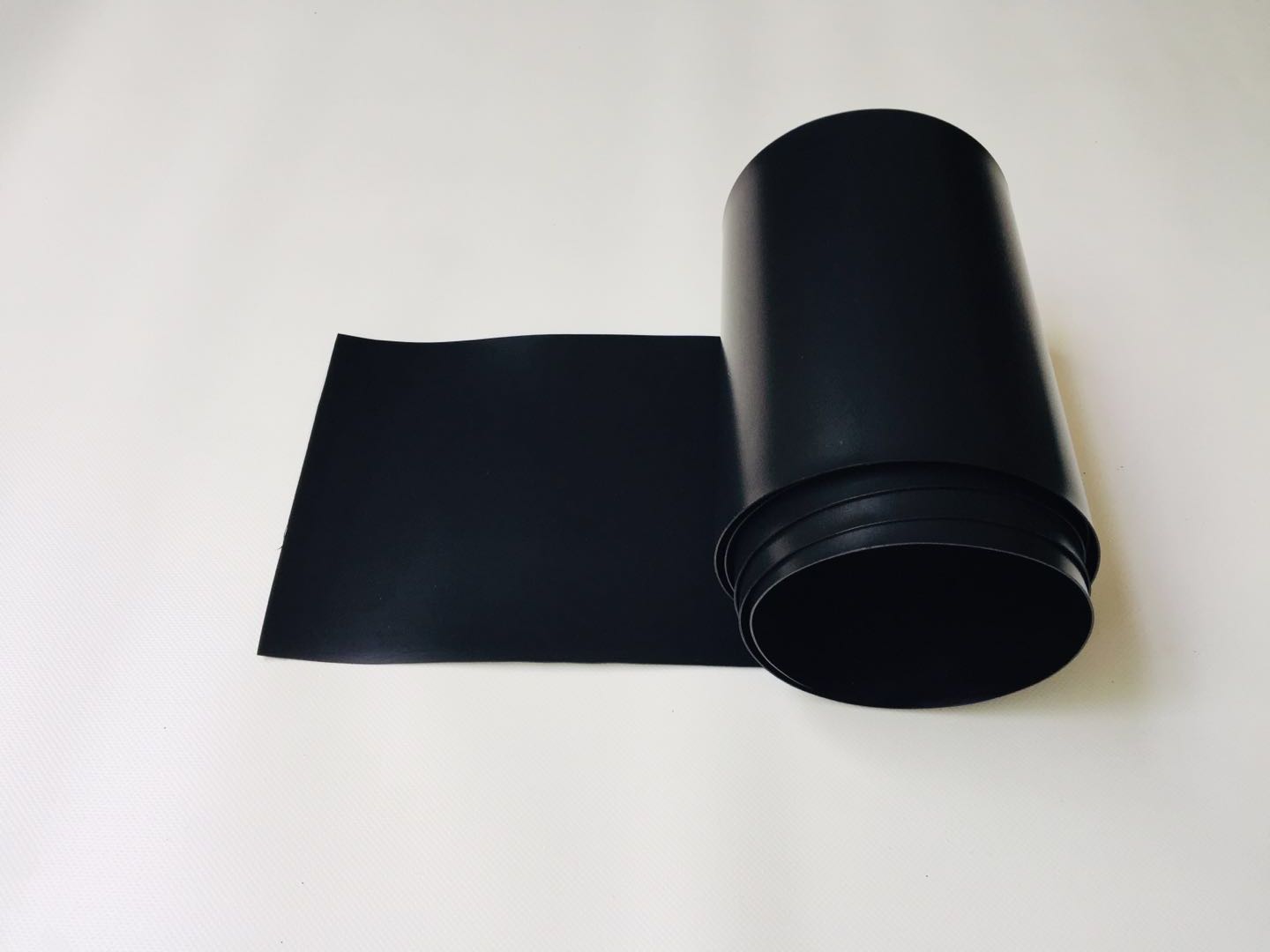
HDPE geomembranes are produced in thicknesses from 0.3 mm to 3.0 mm, with custom thickness options available. The table below lists the main mechanical and endurance parameters for the geomembrane product line.
| Parameter | Value |
|---|---|
| Thickness | 0.3–3.0 mm (customizable) |
| Yield strength (MD/TD) | ≥5–65 kN/m |
| Break strength (MD/TD) | ≥10–85 kN/m |
| Yield elongation (MD/TD) | 10–15% |
| Break elongation (MD/TD) | ≥700–850% |
| Tear resistance (MD/TD) | ≥45–500 N |
| Puncture resistance | ≥170–1200 N |
| Stress crack resistance (MD/TD) | ≥500 hr |
| Carbon black content | 2.0–2.8% |
| Standard OIT | ≥130 min |
| High pressure OIT | ≥430 min |
| Oven aging at 85°C (Standard OIT retained after 90 days) | ≥60% |
Key parameters and their procurement relevance:
- Yield and break strength. These values indicate how much stress the membrane can handle during installation and when exposed to subgrade movement or hydraulic pressure.
- Elongation at break. A high elongation, such as ≥700–850%, helps the membrane accommodate uneven settlement without rupturing.
- Puncture and tear resistance. These are critical for projects with coarse subgrade materials or where the membrane is exposed during construction.
- Stress crack resistance. Reported at ≥500 hours, this parameter relates to the material's ability to resist slow crack growth under sustained tension.
- Carbon black content and OIT. Carbon black at 2.0–2.8% provides UV protection, while oxidation induction time values indicate the antioxidant package's capacity to resist thermal oxidation.
Industry reference documents such as GRI-GM13 set minimum test properties and frequencies for HDPE geomembranes, and ASTM D5397 is commonly referenced for evaluating stress crack resistance using the Notched Constant Tensile Load (NCTL) test. In European applications, reservoir and dam projects may require EN 13361 compliance as an additional gate.
Certification Landscape: EAEU and EU/EEA Market Entry
Certifications function as a market-entry checkpoint. For international procurement, a geomembrane cannot simply be regarded as good quality; it must be documented as compliant with standards recognized by the destination market.
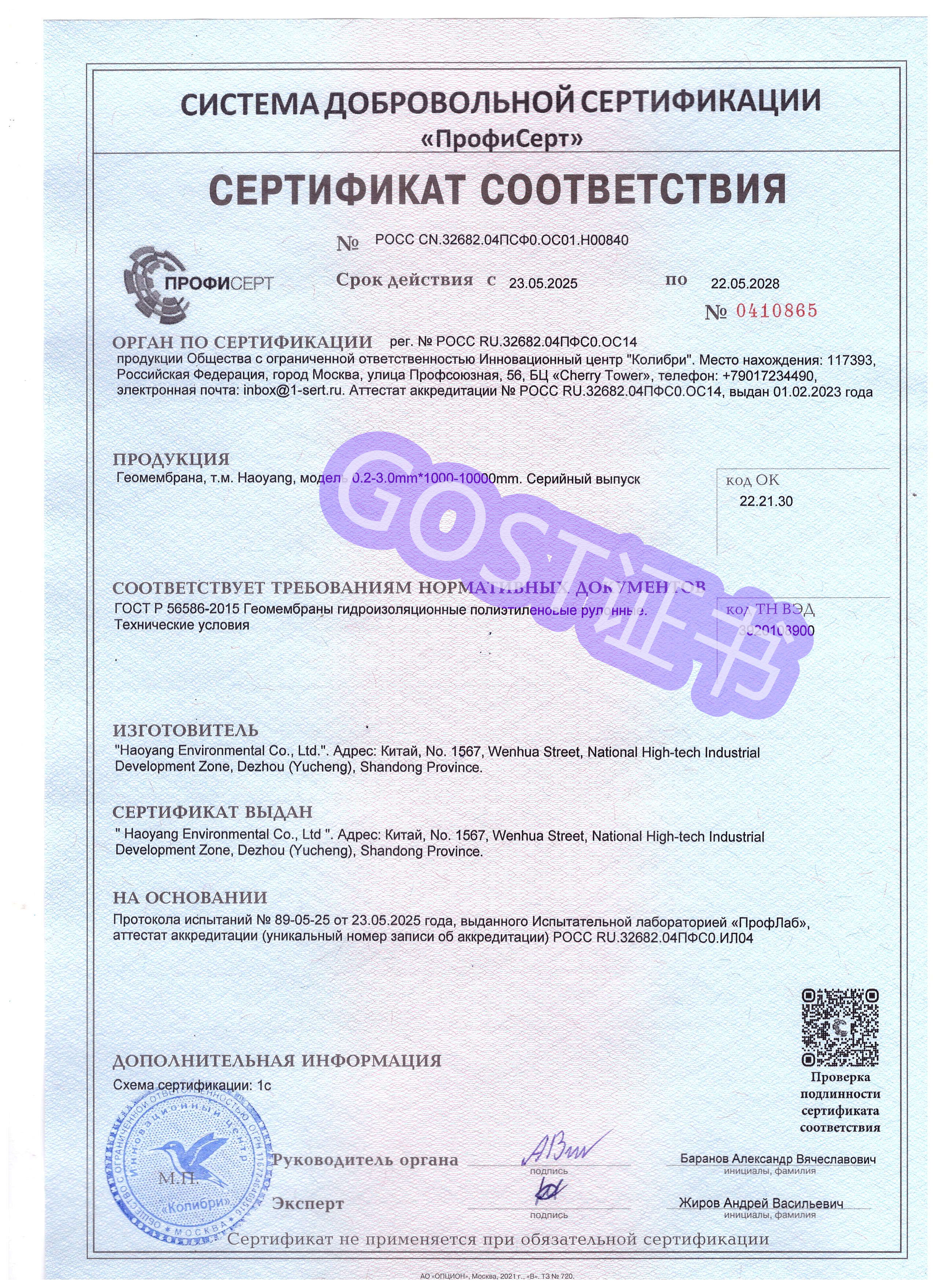
For the EAEU/Russia market, Haoyang's geomembrane holds a GOST Certificate of Conformity numbered POCC CN.32682.047C00.0C01.H00840, issued by ПрофСерт (ProfSert), compliant with GOST 56586-2015. For the EU/EEA market, the geomembrane holds Verification of Conformity (ICR) certificate ICR/VC/HE250525, issued by ICR, compliant with EN 13249:2016.
The broader geosynthetic product line carries additional certifications, which matters in projects where a geomembrane is combined with drainage geonets, geotextiles, or geosynthetic clay liners.
| Product | Certification | Standard | Certificate No. | Market |
|---|---|---|---|---|
| HDPE geomembrane | GOST Certificate of Conformity | GOST 56586-2015 | POCC CN.32682.047C00.0C01.H00840 | EAEU/Russia |
| HDPE geomembrane | Verification of Conformity (ICR) | EN 13249:2016 | ICR/VC/HE250525 | EU/EEA |
| Geotextile | GOST Certificate of Conformity | GOST 33068-2014 | POCC CN.32682.041C00.OC01.H00839 | EAEU/Russia |
| 3D Composite Drainage Geonet | GOST Certificate of Conformity | GOST 33068-2014 | POCC CN.32682.04NC中0.OC01.H00838 | EAEU/Russia |
| Drainage geonet | GOST Certificate of Conformity | GOST 70090-2022 | POCC CN.32682.047C00.OC01.H00837 | EAEU/Russia |
| Composite drainage net | Verification of Conformity (ICR) | EN 13249:2016 | ICR/VC/HE250523 | EU/EEA |
| Geosynthetic Clay Liner | Verification of Conformity (ICR) | EN 13249-2016 | ICR/VC/HE250526 | EU/EEA |
These certificates matter because GOST and EN standards set defined performance levels, and the certificate number allows engineers to verify the scope of assessment. Buyers evaluating suppliers for EAEU or EU projects should check that the proposed material, not only the factory, is covered by a valid, in-scope certificate.
Applications: Mining, Aquaculture, and Beyond
Mining and Metal Smelting
Mining is the largest application segment for geomembranes, accounting for 39.6% of global revenue in 2023, according to Grand View Research. In non-ferrous metal smelting tailings pond projects, the liner must withstand complex leachate chemistries, ultraviolet exposure, and long periods of continuous operation.
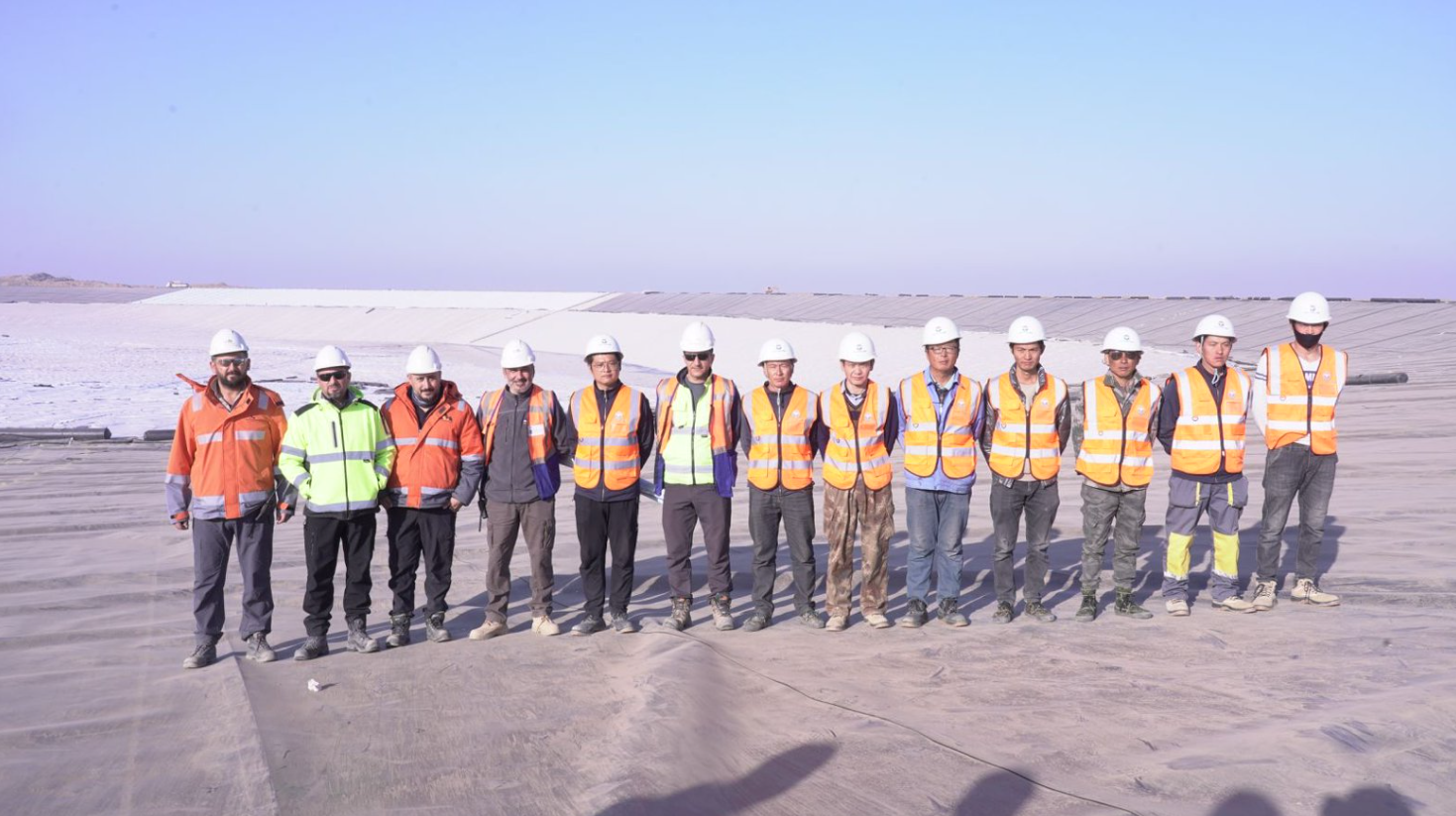
A documented example is the seepage control project for the tailings pond basin of a gold mine in Uzbekistan. The project used 900,000 square meters of anti-seepage material, combining an independently developed textured geomembrane with high-strength polypropylene geotextile and a three-dimensional composite drainage network. The textured geomembrane was produced on a five-layer co-extrusion blow molding line integrated with online double-sided texturing equipment. Using a high-temperature and high-pressure air jet process, the base membrane forming and double-sided rough surface structure are completed simultaneously in a molten state. The rough points form a molecular-level bond with the substrate, reducing production energy consumption by 25% and avoiding the risk of thermal aging caused by secondary processing.
Aquaculture
In aquaculture pond anti-seepage systems, the primary requirements are non-toxic material, UV resistance, fish-friendly properties, and long service life. HDPE geomembranes used as fish pond liners prevent water seepage while maintaining water quality in ponds operating continuously.
Other Project Types
Beyond mining and aquaculture, HDPE geomembranes are used in salt lake mining projects, water conservancy projects, road and transportation projects, and sponge city construction. The company reports participation in key national infrastructure projects such as the Middle Route of the South-to-North Water Diversion Project, the Three Rivers Governance Project, the Daxi Railway, and the Central-South Passage, as well as environmental remediation projects for clients including Shandong Weiqiao Pioneering Group and Yunnan Heqing Beiyao Mining Co., Ltd.
Manufacturing and Customization: What Buyers Can Plan Around
For project planning, the relevant production data is the following:
- Production mode: OBM (own-brand manufacturing)
- Monthly capacity: 3,000 tons
- MOQ: 5,000 square meters
- Lead time: 10–30 days
- Quality control: 100% tested
- After-sales support: on-site support
Customization is possible for LOGO, width, roll length, thickness, GSM, tensile yield strength, tensile fracture strength, puncture strength, and other chemical and physical indicators. Customization is not only about dimensions; chemical and physical indicators can be adjusted to match project conditions.
The company holds more than 70 patents and proprietary technologies. Its R&D capability is supported by a team of 20 professional engineers and cooperative relationships with universities including Fudan University and Tianjin University of Technology.
HDPE Geomembrane vs. Traditional Solutions: Strengths and Limits
Compared with traditional compacted clay liners, HDPE geomembranes offer a substantially lower hydraulic conductivity, a thinner profile, faster construction, and less dependence on locally available clay materials.
There is, however, a real boundary. Geomembrane performance depends strongly on construction quality: seams must be welded properly, the subgrade must be prepared smooth, and the cover layer must protect the liner from mechanical damage. Unlike clay liners or geosynthetic clay liners, a polymeric geomembrane has no natural self-healing ability; if a puncture occurs and remains undetected, it can become a concentrated leakage path.
For this reason, many projects use composite liner systems. A geomembrane combined with a geosynthetic clay liner or a drainage geonet can combine low permeability with improved drainage and protection. The Uzbekistan project is one example where a textured geomembrane was combined with geotextile and a three-dimensional composite drainage network rather than used as a single layer.
Market Landscape: Recognized Players and Selection Criteria
The global geomembrane market includes several internationally recognized manufacturers. According to Global Market Insights, Solmax held an estimated 14.3% share of the global geomembrane market in 2025. Other major global manufacturers identified in market research include Agru America, Naue GmbH, GSE Environmental, and Plastika Kritis.
Within this landscape, Haoyang Environment is characterized by measurable reference points: a 200,000-square-meter production base, 33,000 tons of annual production capacity, more than 70 patents, and certification coverage for both EAEU/Russia and EU/EEA destinations. For procurement teams, these are objective data points to compare against the supplier list.
Future Outlook: Certification and Performance Will Matter More
Market projections indicate continued growth for geomembranes. Fortune Business Insights forecasts an expansion from approximately USD 2.23 billion in 2025 to USD 3.59 billion by 2034. Mining is expected to remain a major demand driver, while emerging applications in salt lake mining and pumped storage hydropower add new performance requirements, especially for chemical resistance, puncture resistance, and long-term durability.
Regulatory pressure on containment facilities is increasing across multiple jurisdictions. As a result, multi-market certification is likely to become more important in international tenders. Buyers benefit from suppliers that can document performance in standardized, verifiable terms rather than relying on anecdotal claims.
Frequently Asked Questions
What are the main parameters to check when evaluating an HDPE geomembrane?
The main parameters are thickness, yield strength, break strength, elongation, tear resistance, puncture resistance, stress crack resistance, carbon black content, and oxidation induction time (OIT). For this geomembrane product line, thickness ranges from 0.3 mm to 3.0 mm, puncture resistance from ≥170 N to ≥1200 N, stress crack resistance ≥500 hours, carbon black content 2.0–2.8%, standard OIT ≥130 minutes, and high-pressure OIT ≥430 minutes.
What certification does the HDPE geomembrane hold for the EAEU/Russia market?
The geomembrane holds a GOST Certificate of Conformity numbered POCC CN.32682.047C00.0C01.H00840, issued by ПрофСерт (ProfSert), compliant with GOST 56586-2015, for the EAEU/Russia market.
Which certification applies to the geomembrane for the EU/EEA market?
The geomembrane holds a Verification of Conformity (ICR) certificate numbered ICR/VC/HE250525, issued by ICR, compliant with EN 13249:2016, for the EU/EEA market.
Can thickness and performance parameters be customized?
Yes. Thickness from 0.3 mm to 3.0 mm is available, and the manufacturer can customize width, roll length, thickness, GSM, tensile yield strength, tensile fracture strength, puncture strength, and other chemical and physical indicators.
What are the MOQ and lead time for custom geomembrane orders?
According to the manufacturer's production data, the monthly capacity is 3,000 tons, the MOQ is 5,000 square meters, and the lead time is 10 to 30 days. Products are 100% tested, and on-site after-sales support is available.
Which industries commonly use HDPE geomembranes?
HDPE geomembranes are widely used in non-ferrous metal smelting tailings pond projects, salt lake mining projects, water conservancy projects, road and transportation projects, sponge city construction, and aquaculture pond anti-seepage systems.