
HDPE Pallet Boxes 1200x800x1000 vs 1000x800x800: Long-Term Sizing
HDPE pallet boxes are increasingly used as the primary bulk container in closed-loop industrial logistics, where the same unit moves automotive parts, chemicals, or wastewater across years of repeated trips. Two footprints sit at the centre of most specification discussions: the 1200 x 800 x 1000 mm box and the 1000 x 800 x 800 mm box. Both share the same material base, enclosed design, nestability, and recyclability, but the footprint and height change what the container can do over a long service cycle.
This comparison is written for buyers at the decision and execution stage — teams that have already chosen plastic over wood or metal and now need to lock a size, a first order, and a supplier relationship that holds for years rather than a single project. It treats the two sizes as long-term operations choices rather than isolated specification lines.
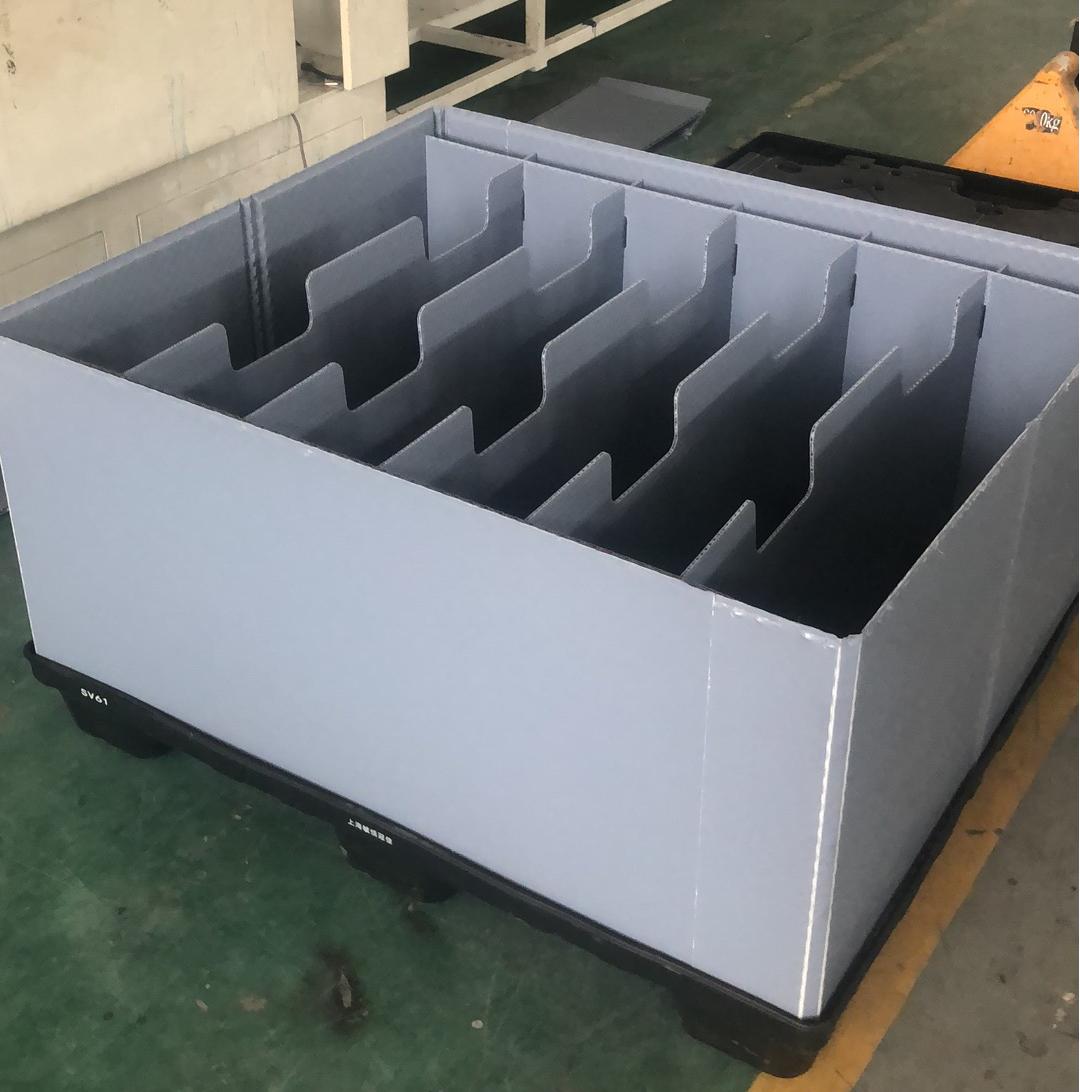
Industrial HDPE pallet box: the same enclosed platform supports the 1200 x 800 x 1000 mm and 1000 x 800 x 800 mm footprints.
What the Two Sizes Actually Change
The naming convention of an HDPE pallet box maps directly to its outer footprint. A 1200 x 800 x 1000 mm box occupies a footprint of 1,200 mm by 800 mm and stands 1,000 mm tall. A 1000 x 800 x 800 mm box keeps the same 800 mm width but reduces length by 200 mm and height by 200 mm.
The physical difference converts into three operational effects:
- Enclosed volume per unit. Because the length and height reductions compound, the larger box encloses roughly 50% more external volume than the smaller one. In loading terms, one 1200 x 800 x 1000 mm unit replaces more than one 1000 x 800 x 800 mm unit for bulky parts.
- Stack height at a fixed clear height. The 1,000 mm box reduces the number of tiers that fit under a fixed roof or trailer clear height. The 800 mm box often allows an additional tier before the same ceiling.
- Empty return efficiency. Both sizes nest, but the smaller footprint occupies less floor space per nested stack, which changes how many units return per truck on a closed loop.
Neither effect is automatically better. They pull in different directions depending on what the buyer is moving and how often the container travels empty.
Why Size Becomes a Long-Term Decision
At the sample and first-order stage, size looks like a simple fit question: will the part or the packaged load physically sit inside the box? At the execution stage, the same question becomes a multi-year commitment.
Once a buyer standardises on one footprint, that footprint propagates through racking, truck loading plans, return logistics, and spare-parts inventories. Switching later is possible but costly, particularly when inner linings, dunnage, or automated handling equipment have been built around one size.
The long-term logic therefore favours a size decision made against the full service cycle, not just the first order:
- Load profile: how much does the heaviest recurring payload weigh, and how is it distributed?
- Trip pattern: does the box return empty, partially loaded, or full on the reverse leg?
- Storage interface: what racking, shelving, or floor-stacking height is available at the destination?
- Handling equipment: do forklifts, pallet jacks, or conveyors impose a maximum outer dimension?
A 1000 x 800 x 800 mm box is often the natural choice when the payload is moderate, ceiling height is constrained, or return freight dominates cost. A 1200 x 800 x 1000 mm box is often the natural choice when the payload is larger, fewer trips are preferred, and storage height is not the limiting factor.
Material and Construction: HDPE and PP in Practice
Both sizes are commonly produced in HDPE, with PP also used for specific requirements. HDPE gives the box its moisture resistance, chemical tolerance, and impact behaviour under repeated handling. PP is chosen where higher temperature resistance or different stiffness is needed.
The material choice is not cosmetic. It affects:
- Moisture and chemical exposure. HDPE pallet boxes resist moisture and are easy to clean, which is why plastic is preferred over wood in food, pharmaceutical, and export logistics where pest and mildew risk is unacceptable.
- Long-term cost shape. Compared with wooden pallets, plastic pallet boxes carry a higher initial cost but a lower total cost of ownership, driven by longer service life and reduced maintenance.
- Recyclability. HDPE and PP are recyclable at end of life, which matters for buyers operating under extended producer responsibility or closed-loop sustainability targets.
The two sizes share the same material options; the size decision sits on top of the material decision, not instead of it. Buyers who need ESD protection, flame resistance, or dust-proofing specify those at the material and design level first, then choose the footprint that fits the application.
Application Fit: Where Each Size Tends to Land
The two footprints tend to suit different application clusters. This is not a rule, but a pattern that shows up across heavy-industry and medical logistics.
Automotive parts logistics
Large, heavy components such as gearbox housings, castings, and sub-assemblies often need the internal volume and load stability of the 1200 x 800 x 1000 mm box. The taller walls and longer floor give more room for dunnage and keep the centre of gravity low when the box is loaded. Smaller parts, fasteners, and electronic sub-assemblies often fit the 1000 x 800 x 800 mm box, which is easier to handle in tighter cell layouts.
Oil, industrial alcohol, alkali, and acid storage
Both sizes are used for enclosed storage of liquid-adjacent components, sealed containers, and drums that must be isolated from moisture and contamination. The 1000 x 800 x 800 mm box is often preferred where the payload is a single sealed container and the storage area is space-constrained; the 1200 x 800 x 1000 mm box is preferred where multiple containers or larger vessels must be enclosed together.
Industrial wastewater and water treatment
Both footprints appear in closed-loop handling of treated water components, filter media, and treatment chemicals. The lower box is often used near dosing and sampling stations where operators need to reach in; the taller box is used for bulk movement between treatment stages.
Medical and general heavy-industry logistics
Clean-environment logistics tends to favour the smaller footprint because it is easier to move through corridors and clean between uses. Heavy-industry logistics with high payloads tends to favour the larger footprint because it reduces the number of container moves per shift.
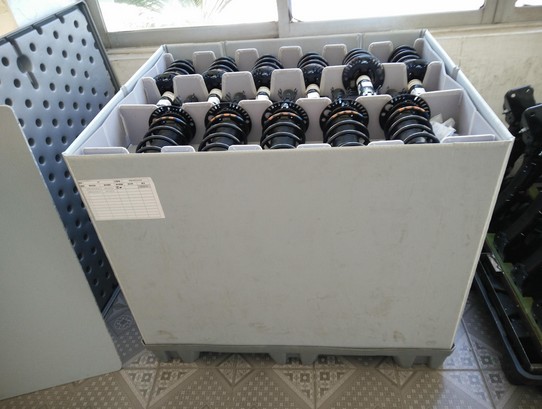
Space-saving design: nesting behaviour and empty return efficiency differ between the two footprints.
A buyer should treat these as starting hypotheses, not rules. The right size is confirmed by a sample run against the actual load, route, and storage layout.
Matching Size to Storage and Transport Conditions
The size decision is easier to defend when it is evaluated against four conditions at once.
| Condition | 1200 x 800 x 1000 mm | 1000 x 800 x 800 mm | What to verify |
|---|---|---|---|
| Payload volume | Greater enclosed volume per unit | Lower volume per unit | Actual part envelope plus dunnage |
| Storage clear height | Fewer tiers under a fixed ceiling | More tiers under the same ceiling | Racking and trailer clear height |
| Empty return | Larger floor footprint per nested stack | Smaller floor footprint per nested stack | Return truck fill rate |
| Handling reach | Taller walls, deeper reach | Lower walls, easier reach | Operator ergonomics at pick stations |
This is not a ranking. It is a reminder that the two sizes trade volume against flexibility, and the trade moves with the operating context.
Nesting, Stacking, and Return Loops
Both sizes are designed to nest when empty and stack when loaded. Nesting matters because return freight is often the largest hidden cost in a closed-loop pallet box programme. The lower box nests to a shorter stack per unit, which usually helps when return volume is high; the taller box nests to a taller stack, which can partly offset its larger footprint.
Some foldable pallet box designs go further and achieve a return-space saving ratio of up to 5:1 on compatible models, according to commercial research reported in the source set for this category. That ratio does not apply to every HDPE pallet box, and it is worth confirming with the supplier which specific model carries the fold ratio.
For nestable, non-folding HDPE boxes, the nesting depth is the key number to ask for, because it directly determines how many units return per truck. A buyer comparing two suppliers on the same nominal footprint should compare nesting depth and base structure before comparing price alone.
Comparison with Traditional Solutions
Against wooden pallets and wooden crates, HDPE pallet boxes carry a higher initial cost but a lower total cost over the service life. Published comparisons place the initial cost premium at roughly 30% and the long-term total cost advantage at roughly 45%, with service life extended by 3 to 5 times and maintenance reduced by around 80%.
The honest limit is that this comparison assumes the buyer actually uses the box through multiple cycles. A single-trip or short-life application will not recover the initial premium, and wood can be the more rational choice where the container is unlikely to return. Plastic also has a defined end-of-life path through recycling, but that path depends on local collection infrastructure, and not every region has it at the same maturity.
A second limit is size flexibility. Wood can be cut and rebuilt to unusual dimensions on site; an injected HDPE pallet box is built to a mould. That means non-standard sizes depend on the supplier's tooling and minimum order, and buyers should confirm tooling availability before assuming a custom footprint is available at low volume.
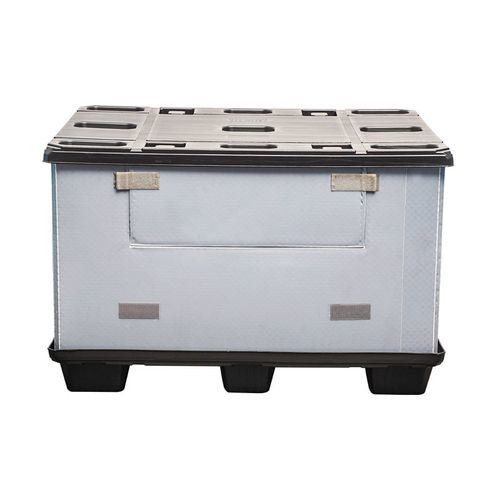
Durable plastic construction: the total-cost advantage depends on repeated use across multiple trips.
Market Context
The global pallet box market was valued at USD 2.19 billion in 2024 and is projected to reach USD 3.02 billion by 2032, according to one commercial research estimate. A separate estimate puts the broader pallet box and container market at USD 12.76 billion in 2024, expanding to USD 23.40 billion by 2033 at a CAGR of 6.9%. The gap between the two figures is largely a definition issue — one source counts only pallet boxes, the other includes larger containers and crates — and buyers should treat market-size figures with that caveat.
The structural signal matters more than the exact number: demand for reusable, enclosed, recyclable industrial containers is growing, driven by closed-loop logistics, export packaging requirements, and the shift away from wood in regulated supply chains.
China's role in this market is visible in trade data. Chinese exports of plastic crates and boxes under HS 392310 were valued at USD 2.33 billion in 2022, according to UN Comtrade data reported by FreightAmigo. That export base is one reason buyers can source customised HDPE pallet boxes from Chinese manufacturers at low minimum order quantities and relatively short lead times.
Customisation and Sample Validation Before Scaling
Both sizes can be customised. The questions a buyer at the execution stage should ask are less about whether customisation is possible and more about which customisation steps affect the size decision.
Common customisation levers include:
- Dimension adjustment: changing length, width, or height within the supplier's tooling capability.
- Colour and marking: colour coding for loop segregation or branding, and logo placement.
- Inner lining: dividers, foam, ESD-safe inserts, or dunnage matched to the payload.
- Special function: ESD-safe material, flame resistance, or dust-proofing.
Before scaling, the sample stage is where the size decision is actually validated. TOYOE, the trade brand of Zhangjiagang Fenghui Logistics Equipment Co., Ltd., is a logistics packaging manufacturer founded in 2010 in Zhangjiagang, Jiangsu, China, producing plastic pallet boxes, storage boxes, plastic crates, and honeycomb panel boxes for domestic and export markets. Its stated acceptance process includes sample testing before mass production, with test reports for raw materials provided for confirmation. That step matters more for a size decision than for almost any other specification, because a size error shows up only when the sample is loaded, moved, and returned under realistic conditions.
Commercial terms for a first order are typically MOQ 1 unit, FOB or CIF delivery, and 30% deposit with 70% balance before shipment. TOYOE's production context includes a monthly capacity of 3,000 pieces, quality-control testing on 50% of products, and service to markets in the EU and Southeast Asia, alongside an annual capacity of 30,000 units reported for the manufacturer.
The Limits of This Comparison
This comparison has three boundaries worth stating plainly.
First, it compares two footprints, not two products. A 1200 x 800 x 1000 mm box from one supplier is not automatically equivalent to the same footprint from another; wall thickness, base structure, and material grade still vary and still matter.
Second, capacity and load ratings are not interchangeable across sizes. A buyer should not assume the larger box carries proportionally more weight, because the base structure and handling points set the real limit. The right question is the rated load for the specific model, not the size on its own.
Third, long-term economics depend on the loop. A box that returns full and quickly justifies a higher initial cost; a box that travels one way and is sold as scrap may not. Buyers should model the actual trip count before treating the 30% initial premium and 45% long-term saving as their own numbers.
Future Outlook
Two trends are likely to shape size decisions over the next few years.
The first is the continued shift from wood to reusable plastic in regulated supply chains, particularly food, pharmaceutical, and export logistics, where moisture, pest, and customs factors favour HDPE. The second is the growth of closed-loop and returnable packaging programmes, which make nesting depth and fold ratio more important than raw volume in some applications. When return freight dominates, the smaller 1000 x 800 x 800 mm box and foldable alternatives can outperform a larger fixed box on total cost, even though the larger box wins on payload per trip.
For buyers, the practical implication is to treat size as a system decision rather than a catalogue decision. The 1200 x 800 x 1000 mm and 1000 x 800 x 800 mm HDPE pallet boxes solve different parts of the same problem, and the right choice depends on which part of the loop is most expensive for the buyer. A size standardised now will shape racking, return logistics, and dunnage for years, so the decision deserves the same rigour as the material decision.
FAQ
Which size is better for automotive parts logistics, 1200 x 800 x 1000 mm or 1000 x 800 x 800 mm?
There is no universal answer. The 1200 x 800 x 1000 mm footprint offers more enclosed volume and is often used for larger castings, gearbox housings, and sub-assemblies that need more room for dunnage. The 1000 x 800 x 800 mm footprint suits smaller parts and tighter cell layouts. The decision is best confirmed with a loaded sample on the actual route.
How should a buyer validate a pallet box size before placing a full order?
The most reliable step is a sample order validated against the real load, route, and storage layout. TOYOE's stated process includes sample testing before mass production and provision of raw-material test reports for confirmation, which allows the buyer to check fit, handling, and return behaviour before scaling.
What are the ordering terms for TOYOE pallet boxes?
Stated commercial terms are MOQ 1 unit, FOB or CIF delivery, and 30% deposit with 70% balance before shipment. Sizes, colours, logo placement, and inner lining can be customised, subject to the supplier's tooling capability.
How long do HDPE pallet boxes last compared with wooden pallets?
Published comparisons put plastic pallet box service life at 3 to 5 times that of wooden pallets, with roughly 80% less maintenance. These figures assume repeated use in a closed loop; single-trip applications will not see the same advantage.
What limits should a buyer check before using either size for oil, chemical, or wastewater storage?
The key limits are the chemical compatibility of the specific HDPE or PP grade, the sealed design of the box, the rated load for the payload, and the handling environment. ESD-safe versions must also meet the applicable standard, such as ANSI/ESD S541-2019 for ESD packaging, with surface resistance in the 10⁴–10¹⁰ Ω range for conductive polymer blends. Buyers should confirm these points with the supplier before committing a size to a chemical application.
For buyers who want the full specification and capability background before specifying either footprint, the TOYOE product brochure is available for public download: TOYOE Pallet Box Brochure (PDF). Official website: toyoebox.com.
Tem questões ou precisa de mais detalhes?
Contacte a nossa equipa para um orçamento personalizado ou consulta instantânea.
Solicitar orçamento
Preencha o formulário abaixo e a nossa equipa entrará em contacto com uma proposta personalizada.
Chat direto do WhatsApp
Prefere conversar em tempo real? Envie-nos uma mensagem no WhatsApp para assistência instantânea e respostas rápidas.
- Obter orçamento personalizado
- Partilhar fotos ou documentos
- Discuta as suas necessidades diretamente
Geralmente responde em 5–30 minutos durante o horário de expediente.