
HDPE Sheet for Chemical Containment and Wastewater Equipment: Scenario Fit Beyond Data Sheets
Industrial HDPE sheet is a practical fabrication material for chemical containment and wastewater equipment because it combines resistance to many acids, alkalis, salts and wastewater with low moisture absorption, weldability and relatively low weight. That answer is useful, but incomplete. In chemical service, the sheet is only one part of a system: the operating medium, concentration, temperature, cleaning regime, joint design, support structure and outdoor exposure determine whether a given HDPE sheet is fit for the project. A standard data sheet is a starting point, not a qualification.
Tangyin Sanyou Engineering Plastic Co., Ltd. — referred to in this article as Sanyou — is a China-based engineering plastics manufacturer founded in 2001. Sanyou produces HDPE sheet, UHMWPE sheet, PP sheet, HDPE sandwich board and ground protection mats, and exports to North America, Western Europe, Central Europe, the Middle East, Oceania and Southeast Asia. Its HDPE sheet range is positioned for fabricated industrial components, including chemical containment and wastewater equipment. The question for buyers is not whether HDPE sheet can be used in these environments. It is which grade, thickness, joint design and verification steps are appropriate for the specific scenario.
Why HDPE Sheet Fits Chemical and Wastewater Scenarios
HDPE sheet is used in chemical storage tanks, electroplating and pickling tanks, wastewater-treatment equipment, scrubbers, ventilation ducts, laboratory furniture, equipment covers, containers and custom-fabricated components. In these applications it acts as a lightweight, corrosion-resistant and weldable fabrication material for chemical containment, liquid storage, ventilation systems, protective panels and industrial components. The material is exposed to continuous or intermittent contact with acids, alkalis, salts, wastewater, moisture, cleaning agents and moderately elevated temperatures.
The fit comes from a combination of properties rather than one headline number. HDPE sheet is weldable, cuttable and CNC machinable. It has low moisture absorption, which supports wet service and cleaning cycles. It is lighter than steel and can be fabricated into tanks, ducts, covers and custom parts without the corrosion-protection burden of a coated metal system. For chemical equipment builders, those characteristics reduce fabrication complexity and maintenance requirements in wet or chemically exposed environments.
But the same combination also creates a common procurement error. A buyer compares two HDPE sheets by density, tensile strength, thickness and a one-line chemical resistance claim, then assumes the material will perform in a real tank or duct. That assumption skips the variables that most often decide success: the actual chemical medium, its concentration, the service temperature, the welded joint, the support spacing and whether the installation is indoors or outdoors.
Where Standard Data Sheets Stop
A standard HDPE sheet data sheet is designed to describe the material, not the application. It may state density, tensile strength, elongation, impact strength, hardness, water absorption, working temperature and a general chemical-resistance rating. Those values are necessary for screening. They are not sufficient for chemical containment qualification.
For example, a data sheet can state that HDPE has excellent resistance to acids, alkalis, salts and oils. It does not automatically tell the buyer how a specific concentration at a specific temperature will behave over continuous or intermittent service. It can state that the sheet is weldable. It does not certify that a particular tank joint will be leak-tight after fabrication. It can state a working temperature range. It does not replace a review of the cleaning agents, rinsing cycles and outdoor UV exposure at the project site.
This is why scenario fit should be treated as a separate engineering and procurement step. The data sheet answers: what is the material? The project review answers: is this material, in this thickness, with this joint design, suitable for this medium and this operating condition?
Sanyou HDPE Sheet: What the Published Product Data Covers
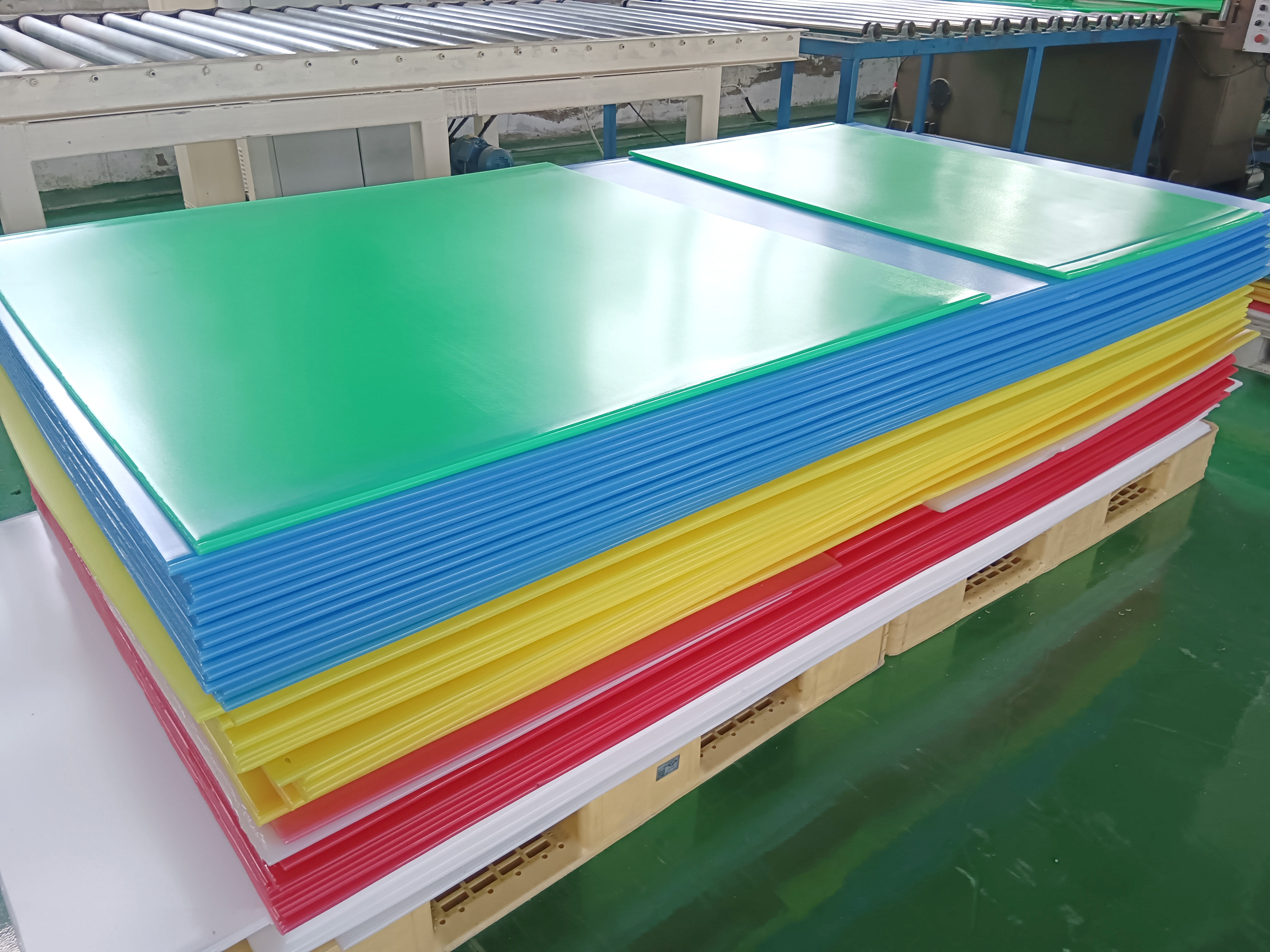
Sanyou HDPE sheet is based on virgin HDPE and is listed with density from 0.93 to 0.97 g/cm³, thickness from 2 mm to 50 mm and custom thicknesses available. Standard sheet sizes include 1000 × 2000 mm, 1220 × 2440 mm, 1500 × 3000 mm and 2000 × 4000 mm, with custom sizes available. The product is offered in black, white, blue, green, yellow and custom colors, with smooth or anti-skid textured surfaces such as diamond, orange peel or embossed finishes.
The published mechanical data includes tensile strength of at least 22 MPa, elongation at break of at least 300%, hardness of 60–68 Shore D and impact strength of at least 20 kJ/m². The listed melting point is 130–140°C and the working temperature is -60 to +80°C. Water absorption over 24 hours is below 0.01%, and the coefficient of friction is listed at 0.15–0.25. The material is described as weldable, cuttable, CNC machinable, moisture-proof and impact-resistant, with excellent resistance to acid, alkali, salt and oil. UV-stabilized grades are available, and the product is listed with ISO 9001 certification.
For buyers, these values should be read as a material baseline. They support fabrication planning, but they do not replace a project-specific chemical compatibility review or a welded-joint qualification. Sanyou also offers OEM/ODM and custom fabrication, including cut-to-size, CNC machining, drilling, welding and custom packaging. Published lead time is 15–20 days after order confirmation and deposit, subject to quantity and customization requirements, with a minimum order quantity of 1,000 kg per specification or color and trial orders negotiable. Quality control covers incoming raw material inspection, in-process thickness and dimension checks, surface inspection and final pre-shipment inspection, with inspection records available on request.
| Published HDPE sheet value | What it helps the buyer decide | What the project still must verify |
|---|---|---|
| Virgin HDPE base material | Consistent base resin for fabricated industrial parts | Grade suitability for the actual chemical medium, UV exposure and any food-contact requirement |
| Density 0.93–0.97 g/cm³ | Confirms the material family and general handling characteristics | Does not by itself establish chemical compatibility or welded-joint performance |
| Thickness 2–50 mm, custom available | Allows wall, panel and liner thickness planning | Final thickness from structural design, tank height, support spacing, impact and joint design |
| Standard sizes up to 2000 × 4000 mm, custom sizes | Supports nesting, cutting and fabrication layout | Dimensional tolerance, flatness and edge quality for the specific fabrication method |
| Tensile strength ≥22 MPa; elongation ≥300% | Indicates ductility and tolerance to handling and impact | Weld strength is a joint property, not a sheet data-sheet value |
| Impact strength ≥20 kJ/m²; hardness 60–68 Shore D | Supports handling and impact-resistance screening | Performance at the actual service temperature and chemical exposure |
| Working temperature -60 to +80°C | Provides a screening range for the listed product | Chemical compatibility at temperature; elevated-temperature service needs separate review |
| Water absorption 24h <0.01% | Supports wet-service and cleaning-cycle suitability | Does not replace chemical-resistance testing or joint inspection |
| Excellent acid, alkali, salt and oil resistance | General material guidance for HDPE | Concentration, temperature, duration and mixed-media effects |
| UV-stabilized grades available | Provides an option for outdoor exposure | Standard HDPE is not UV-stabilized and may chalk or embrittle under prolonged sun exposure |
| ISO 9001 certification | Indicates a quality-management system | Product-specific chemical, food-contact or project compliance documents |
Scenario Fit: Six Equipment Categories
Chemical Storage Tanks
HDPE sheet is used to fabricate chemical storage tanks and liquid containment equipment where acids, alkalis, salts and wastewater are present. The material's corrosion resistance and low moisture absorption are relevant, but tank service adds requirements that a flat-sheet data sheet does not cover: wall thickness, support spacing, welded seams, nozzle reinforcement, base design and access openings. A tank is a welded structure, so the quality of the weld and the leak-tightness of the fabrication are as important as the sheet's chemical-resistance rating.
For this scenario, the buyer should define the medium, concentration, temperature and cleaning agents before selecting the HDPE grade. Virgin HDPE is the appropriate starting point where consistent material performance is required. If the tank is outdoors, a UV-stabilized grade should be specified. If the application involves food processing, food-contact compliance documentation should be requested separately; a supplier's food-grade label is not the same as a project-specific declaration of compliance.
Electroplating and Pickling Tanks
Electroplating and pickling lines expose tank materials to acids, salts, rinse water and cleaning chemicals. HDPE sheet is used in these projects as a corrosion-resistant fabrication material for tanks and associated components. The operating environment can be continuous or intermittent, and the chemical mix may include more than one medium. This makes a general acid-resistance claim insufficient on its own.
The practical selection question is whether the specific HDPE grade is compatible with the actual bath chemistry at the operating temperature. Fabrication also matters: pickling and plating tanks require reliable welding, dimensional accuracy and leak-tight joints because even small leaks can create safety, maintenance and environmental issues. Supporting equipment such as piping, pumps and valves should be reviewed at the same time so that the tank is not qualified in isolation from its connections.
Wastewater-Treatment Equipment
Wastewater treatment involves continuous or intermittent exposure to wastewater, moisture and cleaning agents. HDPE sheet's low moisture absorption and corrosion resistance make it a relevant fabrication material for wastewater-treatment equipment, covers, containers and custom components. The material can also be used for equipment protection and fabricated parts where wet or corrosive conditions are present.
Wastewater is not a single chemical medium. Its composition can vary by plant, process stage and season. Buyers should define the expected pH range, salt content, cleaning chemicals and temperature rather than relying on the phrase 'wastewater resistant'. For equipment that is cleaned frequently, the easy-to-clean surface and low moisture pickup are useful, but the design should still avoid stagnant areas and inaccessible joints where contamination or leakage could develop.
Scrubbers and Ventilation Ducts
Scrubbers and ventilation ducts handle corrosive gases, mists and condensate. HDPE sheet is used in scrubber and duct fabrication where resistance to acids, alkalis and moisture is required. Ducts add a different set of requirements from tanks: panel stiffness, support spacing, joint sealing, connection details and resistance to vibration or negative pressure.
For outdoor ducts or scrubber components, UV exposure must be considered. Standard HDPE is not UV-stabilized and may chalk or embrittle under prolonged outdoor sun exposure. A UV-stabilized grade is the appropriate option when the installation is exposed. Indoor ductwork may not need UV stabilization, but it still needs a leak-tight joint design and compatible gaskets, fasteners and supports.
Laboratory Furniture and Equipment Covers
HDPE sheet is used for laboratory furniture, equipment covers and protective panels where chemical resistance, moisture resistance and easy cleaning are useful. Laboratory environments may involve acids, alkalis, solvents and cleaning agents, but the exposure is often intermittent rather than continuous. That difference should be reflected in the specification: a lab bench or cover may not need the same thickness or joint design as a chemical storage tank.
For laboratory furniture, the surface finish and cleanability matter. Smooth HDPE sheet is easier to wipe down, while textured surfaces may be selected for slip resistance or visual differentiation. If the furniture comes into contact with food or pharmaceutical materials, the buyer should confirm whether a food-contact grade and the associated compliance documentation are required.
Piping, Pumps, Valves and Interfaces
HDPE sheet is a fabrication material for tanks, ducts, covers and components, not a substitute for piping, pump and valve selection. Chemical containment projects require the sheet supplier and the equipment fabricator to define how the HDPE components connect to piping systems, pumps and valves. Flange details, nozzle reinforcement, gasket compatibility and support loads all affect whether the finished system performs as intended.
Supporting equipment for chemical and wastewater projects typically includes chemical storage tanks, electroplating lines, pickling tanks, scrubbers, ventilation ducts, exhaust fans, piping systems, pumps, valves, wastewater-treatment systems, laboratory benches and food-processing equipment. The HDPE sheet specification should be read alongside those interfaces, not in isolation.
Technical Explanation: Welding, Leak-Tightness and Moisture
Three fabrication factors deserve more attention than a single tensile number: weldability, leak-tightness and moisture absorption.
Weldability is a material property, but welded-joint performance is a fabrication result. HDPE sheet is listed as weldable, and Sanyou offers welding as part of its custom fabrication services. However, a sheet that is weldable can still produce a poor joint if the welding parameters, joint preparation, fit-up or operator competence are not controlled. For chemical tanks and ducts, the buyer should ask for the welding procedure, joint design and inspection method rather than accepting 'weldable' as a complete answer.
Leak-tightness is a system-level requirement. A data sheet cannot certify that a tank or duct will not leak. Leak-tight fabrication depends on the welded seam quality, nozzle details, corner joints, support connections and the inspection regime. For chemical containment, a project-specific leak test and a documented inspection plan are more meaningful than a generic material certificate.
Low moisture absorption is a genuine advantage in wet and cleaning-intensive environments. The published value for the Sanyou HDPE sheet is below 0.01% over 24 hours. That supports dimensional stability and cleanability in wastewater, rinse and washdown conditions. It does not, by itself, prove chemical resistance. Moisture absorption and chemical compatibility are different properties and should be verified separately.
Market Trend: More Fabrication-Led Material Selection
The broader HDPE polymer market was valued at USD 84.37 billion in 2023 and is projected to reach USD 126.86 billion by 2030, growing at a 6% CAGR from 2024 to 2030, according to Virtue Market Research. That figure covers HDPE in all forms, not industrial HDPE sheet specifically. It should not be used to size the sheet segment, but it does indicate the scale and continuity of the HDPE supply chain that supports sheet, board and fabricated component production.
A more relevant trend for chemical and wastewater equipment is the shift from material-only purchasing to fabrication-led selection. Buyers increasingly ask for cut-to-size sheet, CNC machining, welding, custom dimensions and documentation rather than a generic HDPE board. Sanyou's published customization scope reflects that pattern: thickness, size, color, surface texture, material grade, UV stabilization, cut-to-size, CNC machining, drilling, welding and custom packaging are all listed as available options.
UV stabilization is another specification trend. Standard HDPE is not UV-stabilized and may chalk or embrittle under prolonged outdoor sun exposure. As more chemical and wastewater equipment is installed outdoors, buyers are more likely to specify a UV-stabilized grade at the inquiry stage rather than discovering the exposure issue after installation. Food-contact grades follow a similar logic: availability is not the same as compliance, and buyers increasingly ask for the supporting documentation before approval.
Comparison with Traditional Solutions
HDPE sheet is often compared with steel, FRP and PVC for chemical containment and wastewater equipment. No material is universally superior. The right choice depends on the medium, temperature, structural requirement, joint design, inspection capability and outdoor exposure. The comparison below is a selection framework, not a ranking.
| Selection consideration | HDPE sheet | Steel with coating or liner | FRP | PVC |
|---|---|---|---|---|
| Corrosion strategy | Corrosion-resistant polymer; resistance to many acids, alkalis, salts and oils | Depends on coating or liner integrity; inspection of the barrier is critical | Depends on resin and glass system; corrosion performance is formulation-specific | Thermoplastic with its own chemical-resistance profile |
| Fabrication and joining | Weldable, cuttable and CNC machinable; joint quality must be qualified | Welded or bolted steel construction; coating repair and liner termination need control | Laminated or molded construction; joint and resin details affect performance | Weldable thermoplastic; temperature and chemical compatibility differ from HDPE |
| Moisture and cleaning | Low moisture absorption; easy-to-clean surface options | Moisture tolerance depends on coating and substrate protection | Moisture performance depends on resin and surface condition | Moisture-resistant, but cleaning-agent compatibility should be checked |
| Temperature boundary | Listed working temperature -60 to +80°C for the Sanyou PE300 sheet; elevated service needs review | Can be engineered for higher temperatures, subject to liner or coating limits | Can be engineered for higher temperatures depending on resin system | Temperature capability is grade-dependent and generally should be checked against the medium |
| Outdoor UV exposure | UV-stabilized grade required; standard HDPE may chalk or embrittle outdoors | Coating and color stability must be maintained | Weathering performance depends on resin and surface protection | Outdoor durability depends on formulation and stabilizers |
| Inspection focus | Weld quality, leak test, thickness, flatness and chemical compatibility | Coating thickness, holidays, liner seams and substrate corrosion | Resin cure, laminate quality, joint integrity and surface defects | Weld quality, chemical compatibility and temperature resistance |
The main limitation of HDPE sheet in this comparison is temperature. The listed working temperature for the Sanyou PE300 sheet is -60 to +80°C. That is suitable for many chemical and wastewater applications, but it is not a universal high-temperature solution. Projects with elevated-temperature service should review the actual temperature at the wall, not only the bulk liquid temperature, and should confirm the grade with the supplier. The second limitation is outdoor UV exposure: standard HDPE is not UV-stabilized and may chalk or embrittle under prolonged sun exposure, so an appropriate UV-stabilized grade is needed for exposed installations.
Limits and Boundaries
- Chemical compatibility is medium-specific. A general claim of excellent acid, alkali, salt and oil resistance does not replace a review of the actual concentration, temperature, duration and mixed chemicals in the project.
- Temperature has a ceiling. The published working temperature for the Sanyou PE300 HDPE sheet is -60 to +80°C. Elevated-temperature service requires separate confirmation.
- Standard HDPE is not UV-stabilized. Outdoor tanks, ducts, covers and scrubber components should use a UV-stabilized grade where prolonged sun exposure is expected.
- Welded joints are not certified by the sheet data sheet. Leak-tightness depends on welding procedure, joint design, fabrication quality and inspection.
- Food-contact claims require documentation. A food-grade option is available, but the buyer should request the applicable compliance documents for the target market and application.
- HDPE sheet is not a structural design substitute. Tank wall thickness, support spacing and nozzle reinforcement must be engineered for the project.
Future Outlook
Chemical containment and wastewater equipment specifications are likely to become more explicit about grade, fabrication and documentation. Buyers are moving away from generic HDPE sheet descriptions and toward requirements that include the operating medium, temperature range, UV exposure, welding procedure, leak test and material traceability. That is a positive development for both sides of the supply chain because it reduces the risk of a material being selected on a data-sheet number that does not reflect the real service condition.
For HDPE sheet suppliers, the practical implication is that material supply alone is less differentiated than fabrication support. Cut-to-size sheet, CNC machining, welding, custom dimensions and inspection records are increasingly part of the buying decision. Sanyou's published capabilities in these areas, together with its export experience across North America, Western Europe, Central Europe, the Middle East, Oceania and Southeast Asia, position it as a supplier that can support fabrication-led inquiries rather than only commodity sheet orders.
FAQ
Which HDPE sheet applications in chemical and wastewater projects are the best fit?
HDPE sheet is a fit for chemical storage tanks, electroplating and pickling tanks, wastewater-treatment equipment, scrubbers, ventilation ducts, laboratory furniture, equipment covers, containers and custom-fabricated components. Suitability depends on the actual medium, concentration, temperature, cleaning agents, joint design and indoor or outdoor exposure. The material is lightweight, corrosion-resistant and weldable, but each application should be reviewed against those conditions.
How should a buyer verify chemical compatibility for HDPE sheet?
Start with a complete medium list: each chemical, concentration, operating temperature, continuous or intermittent exposure, and cleaning agents. Compare that list with the supplier's chemical-resistance data and request project-specific confirmation where the medium is mixed or the temperature is elevated. A general claim of excellent resistance to acids, alkalis, salts and oils is useful for screening but is not a substitute for a compatibility review at the actual service conditions.
What thickness and sheet format should be specified for chemical equipment?
Sanyou HDPE sheet is listed from 2 mm to 50 mm in thickness, with custom thicknesses available, and standard sheet sizes including 1000 × 2000 mm, 1220 × 2440 mm, 1500 × 3000 mm and 2000 × 4000 mm. Thickness should be determined by structural design, tank height, support spacing, impact exposure, joint design and chemical service. The sheet format should be selected for cutting efficiency and fabrication layout, with dimensional tolerance and flatness confirmed for the project.
What welding and inspection points support leak-tight fabrication?
HDPE sheet is listed as weldable, and Sanyou offers welding as part of its custom fabrication services. Leak-tightness is a joint-level result, so the fabricator should define the welding procedure, joint preparation, fit-up, operator competence and inspection method. A project-specific leak test and documented inspection are more meaningful than a general material certificate. The sheet data sheet can confirm weldability, but it cannot certify a finished tank or duct.
What are the main limits of HDPE sheet in chemical service?
The main limits are chemical specificity, temperature and UV exposure. The Sanyou PE300 HDPE sheet is listed with a working temperature of -60 to +80°C, so elevated-temperature service needs separate review. Standard HDPE is not UV-stabilized and may chalk or embrittle under prolonged outdoor sun exposure, so a UV-stabilized grade is needed for exposed installations. Food-contact applications also require the applicable compliance documentation, not only a food-grade label.
For buyers who need to review the published Sanyou HDPE sheet options, specifications and fabrication capabilities, the product catalog is available here: Sanyou Product Catalog.
Tem questões ou precisa de mais detalhes?
Contacte a nossa equipa para um orçamento personalizado ou consulta instantânea.
Solicitar orçamento
Preencha o formulário abaixo e a nossa equipa entrará em contacto com uma proposta personalizada.
Chat direto do WhatsApp
Prefere conversar em tempo real? Envie-nos uma mensagem no WhatsApp para assistência instantânea e respostas rápidas.
- Obter orçamento personalizado
- Partilhar fotos ou documentos
- Discuta as suas necessidades diretamente
Geralmente responde em 5–30 minutos durante o horário de expediente.