
HL-6000-QG2/2 vs SCHYTJ-3000: Which Laser Chiller to Buy
HL-6000-QG2/2 vs SCHYTJ-3000: Which Laser Chiller to Buy
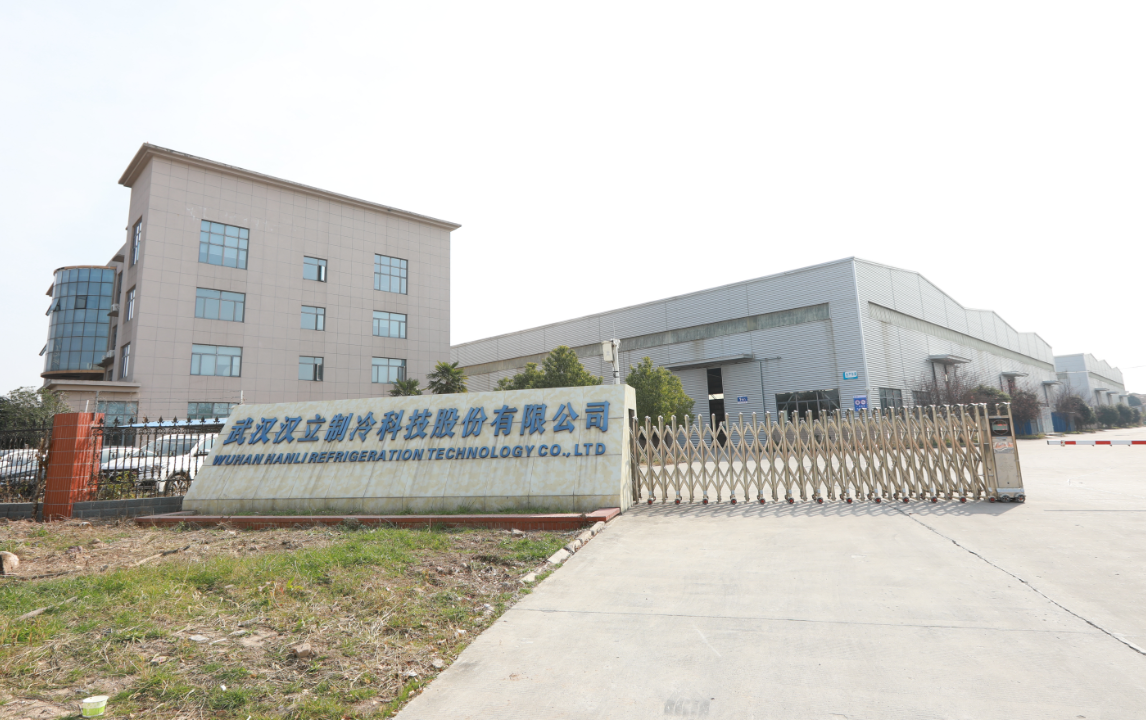
Cover: Hanli chiller manufacturing reference. Image supplied by Wuhan Hanli Refrigeration Technology Co., Ltd.
Laser cooling units generated USD 317.2 million in global market value in 2025, with water-cooled designs accounting for 56.3% of that total and industrial laser applications for 41.2%, according to the Dataintelo laser cooling units market report. Buyers rarely award an order on market figures, though. They award it on fit. This reference compares two Hanli models that sit close enough on a quotation shortlist to invite a direct question — the HL-6000-QG2/2 water chiller and the SCHYTJ-3000 laser welding chiller — using only product, certification and commercial facts that can be traced to source, and it marks the points that still require a datasheet or written confirmation before an order is placed.
The Purchasing Problem Behind a Chiller Comparison
A chiller is a precision cooling system designed to remove heat from a process, a piece of equipment or a controlled environment by circulating a coolant. That working definition, used by the industrial supplier directory IQS Directory, is deliberately wider than the building-services meaning of the word. Trane describes an HVAC chiller as a component of commercial systems built to cool large buildings by lowering the temperature of a liquid. Both categories run a refrigeration circuit, but they do not share a duty profile. A laser chiller holds a coolant temperature against a heat load that moves with the process; comfort cooling is sized around a building load that changes slowly and is allowed to drift within a wider band.
Substituting one for the other is a specification error that does not announce itself at delivery. It appears later, in cut quality, in scrap rate and in conversations with the laser-source supplier about warranty responsibility.
The reason the chiller carries that weight is straightforward. Industrial lasers are described by Smart Cooling Products as high-power tools used for cutting, machining, drilling and welding of tough materials. The electrical efficiency of the laser turns into heat that has to be carried away at a stable temperature. KKT Chillers USA frames the chiller's function as maintaining an optimal temperature range so the laser performs at peak efficiency while being protected against costly damage. That framing is what turns temperature stability — not headline cooling capacity alone — into the first purchase criterion for a buyer evaluating a laser chiller unit.
What the Two Hanli Models Actually Are
Wuhan Hanli Refrigeration Technology Co., Ltd (Hanli) is a Chinese chiller manufacturer established in 1998 and based in Hannan District, Wuhan, Hubei. The company produces fiber laser chillers, laser cutting chillers, laser welding chillers, CO₂ laser chillers, UV laser chillers and industrial water chillers for laser cooling applications. Its published profile states a 38,866.15 square metre facility with approximately 300 employees and an annual output of 180,000 units, with exports representing about 10% of sales across markets that include Vietnam, Turkey, India, Russia, Poland, Germany, France, Italy, the wider EU, the USA, Iran, Dubai and the Middle East.
Within that portfolio, the HL-6000-QG2/2 is listed as a water chiller in the HL-QG2/2 series, and the SCHYTJ-3000 is listed as a laser welding chiller. Both model designations appear among the products associated with the company's ISO 9001 and CE certification records. That much can be verified from the manufacturer's documentation.
What those designations do not do, on their own, is define cooling capacity, flow rate, discharge pressure, coolant set-point range, dimensions or temperature tolerance. Those values belong on the model datasheet, and a buyer who substitutes a naming convention for a specification is taking on risk that no quotation can absorb. Hanli's own capability statement supports this reading: cooling solutions can be matched to laser power, application type and equipment configuration, which is an acknowledgement that the correct unit is derived from the machine rather than read off a price list.
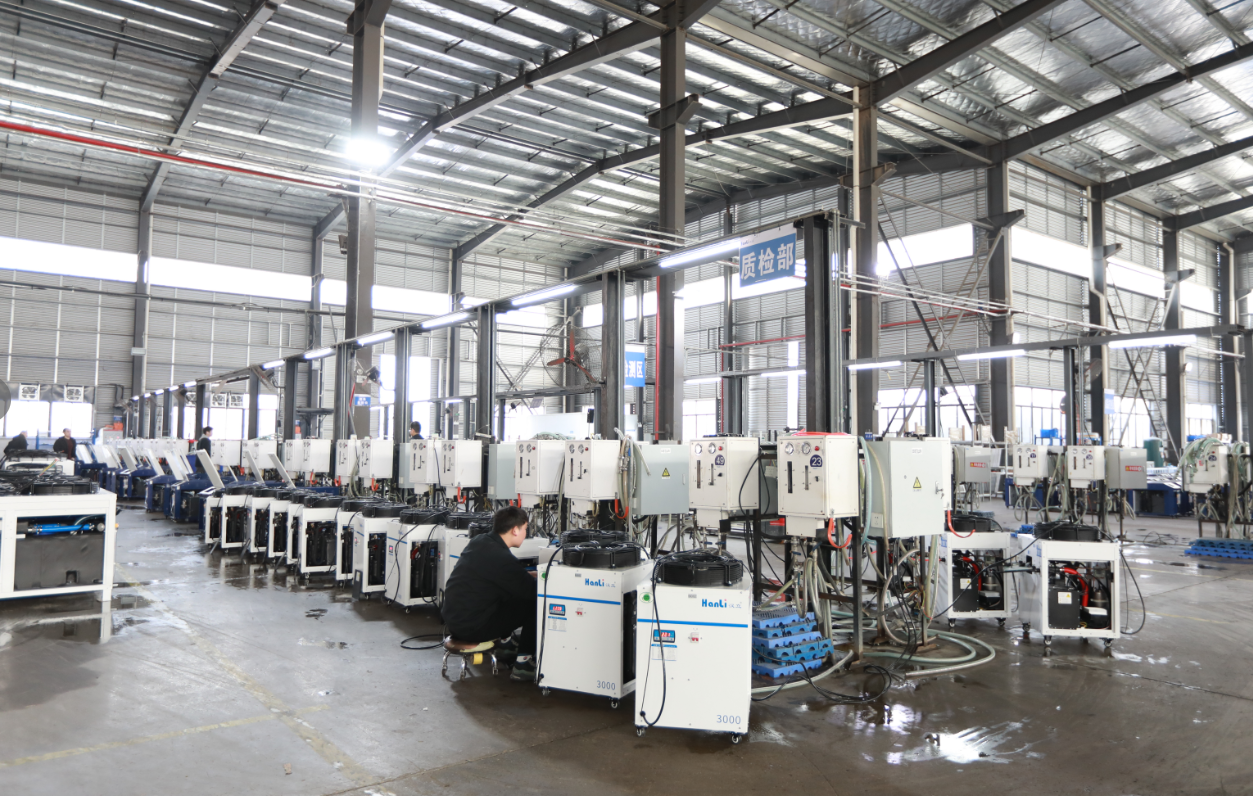
Hanli production floor, Wuhan, Hubei. Laser chillers are assembled and tested before delivery; the company reports 100% testing of each unit.
Cutting and Welding Create Different Cooling Duties
The clearest technical difference between the HL-6000-QG2/2 and the SCHYTJ-3000 comes from the process each supports, not from a component list. Hanli's selection guidance states that the largest gap between a laser cutting chiller and a laser welding chiller lies in temperature control and response. Cutting chillers are described as delivering stable cooling at moderate precision against a relatively steady heat load. Welding chillers are described as using faster control loops to absorb sudden heat surges while holding a tighter temperature tolerance to protect weld quality.
The same guidance quantifies the cutting side at roughly ±0.5 °C and calls that level sufficient for most cutting tasks, with the emphasis falling on reliable continuous cooling and cost efficiency across long production hours. For welding, the emphasis shifts to response speed and tighter tolerance in work such as battery welding, mould repair, jewellery welding and micro welding.
A buyer comparing these two models is therefore not choosing between a stronger and a weaker chiller. They are choosing between two control philosophies built for different heat-load behaviour. A unit that holds temperature beautifully under a steady 8-hour cutting shift may be the wrong instrument beside a welding cell whose load arrives in bursts.
The Thermal Architecture Both Models Share
Both units sit inside the same generic architecture. A water chiller consists of three major components — compressor, condenser and evaporator — and the refrigeration cycle runs through four stages: compression of low-pressure gas into high-pressure gas, condensation during which heat is rejected to ambient air, throttling through an expansion valve, and evaporation. The process side of the loop then delivers chilled water or a water-glycol coolant to the machine.
Because that architecture is common across the category, supplier differentiation concentrates in component grade, control precision and coolant-temperature capability rather than in the basic circuit. That is why two chillers with similar-looking cabinets can behave very differently on a production floor, and why a line-by-line quotation comparison is more useful than a headline price comparison.
Hanli's application documentation adds two configuration points that apply to the range. Operation is circulating water cooling in a closed loop. Selected high-power products use an independent dual-temperature, dual-loop cooling design, which separates the cooling duty of the laser source from that of the optics or cutting head at different set points. The documentation further states an ambient operating range of 0 °C to 45 °C for the selected product information, subject to model confirmation. Hanli chillers use R410A refrigerant, per the company's own technical documentation.
Shared architecture does not mean shared duty. Ambient temperature, coolant set point, flow and pressure at the machine inlet, and the water-quality regime on site all change the correct configuration — and none of them appear in a model number.
Side-by-Side: Verifiable Comparison Points
The table below limits itself to facts that can be traced to Hanli documentation or to the certificate records. Where a specification is not published in verifiable form, the row says so rather than guessing.
| Comparison criterion | Hanli HL-6000-QG2/2 | Hanli SCHYTJ-3000 |
|---|---|---|
| Product category in Hanli documentation | Water chiller (HL-QG2/2 series) | Laser welding chiller |
| Primary process orientation | Laser cutting duty — steady heat load, continuous operation | Laser welding duty — surge heat load, faster control response |
| Control emphasis | Stable cooling at moderate precision; around ±0.5 °C is described as sufficient for most cutting tasks | Tighter temperature tolerance and faster control loop for weld quality |
| Cooling method | Circulating water cooling, closed loop | Circulating water cooling, closed loop |
| Refrigerant | R410A (Hanli technical documentation) | R410A (Hanli technical documentation) |
| Ambient operating range | 0 °C to 45 °C for selected product information, subject to model confirmation | 0 °C to 45 °C for selected product information, subject to model confirmation |
| Certification linkage | Listed among products associated with ISO 9001 and CE records | Listed among products associated with ISO 9001 and CE records |
| Customisation | ODM production; LOGO, colour and cooling solution can be matched to laser power, application type and equipment configuration | ODM production; same customisation basis |
| Minimum order quantity | 1 unit | 1 unit |
| Lead time | 7–45 days depending on standard or customised build | 7–45 days depending on standard or customised build |
| Factory testing | 100% test before delivery | 100% test before delivery |
| Warranty | 24 months, with spare parts and remote technical support | 24 months, with spare parts and remote technical support |
| Cooling capacity, flow, pressure, tolerance band, dimensions | Not published in verifiable form — obtain the model datasheet | Not published in verifiable form — obtain the model datasheet |
Three rows in that table deserve emphasis because they are where procurement evaluations usually stall. The first is control emphasis: the cutting and welding distinction is a genuine engineering boundary, not marketing segmentation. The second is the certification linkage: association with a certificate record is not the same as appearing on the certificate, and the next section explains why that matters. The third is the final row: the absence of published capacity, flow and tolerance figures is a data gap, not a hidden weakness, and it should be closed with a datasheet request rather than with an assumption.
Certifications That Decide Market Access
Two certificates carry weight in a tender evaluation for either model.
ISO 9001 certificate 02125Q11006R4M was issued to Wuhan Hanli Refrigeration Technology Co., Ltd by HuaXin Certification Center, Inc. on 17 July 2025 and expires on 26 July 2028, against GB/T 19001-2016 / ISO 9001:2015. Its stated scope is design, production, sale and after-sales service of water chillers up to 120 kW, covering the EU, US and Middle East markets. The capacity limit inside that scope should be read literally: a project requiring a single unit above 120 kW falls outside the certified scope as written and should be discussed explicitly with the manufacturer rather than assumed to be covered.
The CE Certificate of Conformity AM 50662218 0001 was issued by TÜV Rheinland LGA Products GmbH under EC Council Directive 2006/42/EC for machinery, with laser cooling water chillers named in the scope and a list of type designations printed on the certificate. Hanli's compliance guidance describes CE marking as the basic requirement for exporting industrial chillers into the EU, covering low-voltage safety to prevent electric shock hazards, EMC to avoid electromagnetic interference with nearby machines, and the Machinery Directive for mechanical safety, with the Pressure Equipment Directive applying where pressure vessels reach the threshold.
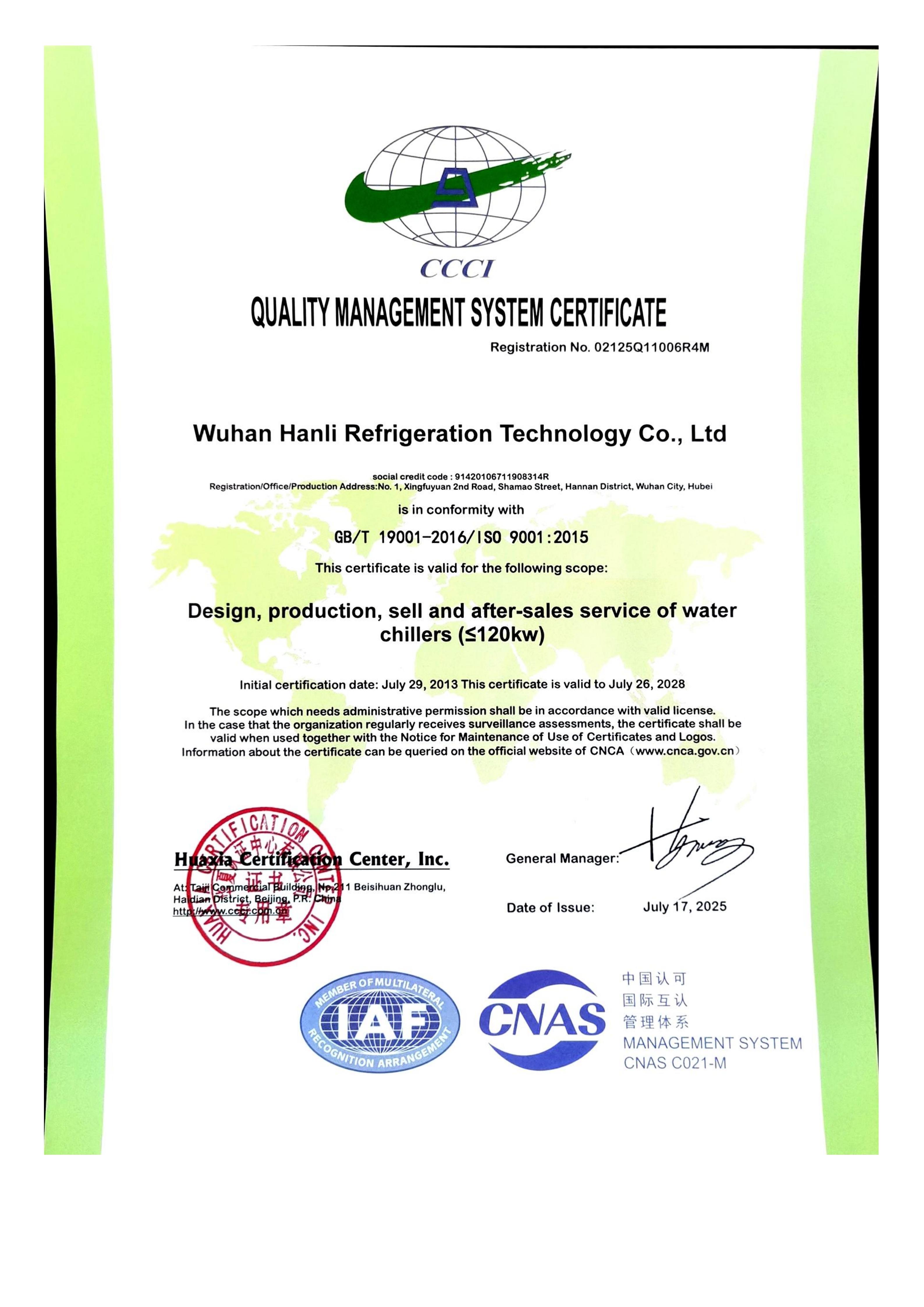
ISO 9001 certificate 02125Q11006R4M, issued by HuaXin Certification Center, Inc., valid 17 July 2025 to 26 July 2028, scope: design, production, sale and after-sales service of water chillers up to 120 kW.
For an EU-bound order, three verification steps are worth building into the purchase order: confirm that the exact model designation on the order appears on the CE certificate, confirm that the EU Declaration of Conformity matches the configuration actually delivered, and confirm that the user manual is supplied in the required local language. Hanli's compliance documentation lists the full technical file, the risk assessment report and the signed Declaration of Conformity as part of the conformity package, which makes all three checks answerable before shipment.
Where Each Unit Fits on the Shop Floor
On a fiber laser cutting line, the chiller's job is continuous. Hanli's case documentation describes deployment across laser cutting, welding and engraving equipment, with outcomes framed as stable performance, energy saving and equipment-life support rather than a single productivity figure — a sensible framing, since cooling quality shows up as consistency across a shift rather than as a headline number. The company states that its products have been matched with domestic laser companies including Senfeng, Bodor and HG.
For a cutting buyer, the practical diagnostic is the cutting head. Hanli's troubleshooting guidance for an E12 alarm on its chillers points to low or absent flow in the normal-temperature water circuit: if flow from the outlet pipe is normal but flow from the return pipe is absent or very small, the cutting head may be blocked and requires cleaning. That is a cooling-loop symptom rather than a compressor symptom, and it is the kind of detail that determines how quickly a line returns to production. On a cutting site, the chiller and the cutting head belong to the same maintenance conversation.
For the SCHYTJ-3000, the application set is welding-led. Hanli's selection guidance names battery welding, mould repair, jewellery welding and micro welding as the cases where a welding-oriented chiller earns its cost. On those jobs the tolerance window is narrower and the load arrives in surges, so response speed matters more than steady-state cooling volume.
A buyer running both cutting and welding cells should resist the temptation to standardise on one chiller type across the plant. The selection guidance is explicit that the two duties pull in different directions, and the cheaper decision at the point of purchase is not always the cheaper decision across five years of production.
What the Market Data Says About This Segment
Three figures frame the decision. Global laser cooling unit market value reached USD 317.2 million in 2025, per Dataintelo, with a projected CAGR of 9.2% across 2025 to 2034. Water-cooled units held 56.3% of the market in 2025, and industrial laser applications accounted for 41.2% of revenue in the same year.
Read together, those numbers support two procurement observations. First, water-cooled designs remain the dominant value segment, which is consistent with the way high-power fiber laser cutting and welding installations are usually specified. Second, the projected growth rate suggests cooling is being added to more laser installations across power bands rather than only at the top of the range — which is precisely where a clear cutting-versus-welding selection logic saves money.
One caution belongs with those figures. Market data published for laser cooling units is a narrower scope than general industrial chiller statistics, and HVAC chillers must not be folded into the same total. Trane's glossary definition of an HVAC chiller and the process-cooling definition used for laser work describe different duty profiles, and any chiller market figure should be scope-checked before it is applied to a laser cooling decision.
Limits, Trade-offs and What to Confirm Before Ordering
An honest comparison has to state where the evidence stops. Six limits apply to both models.
- Certification scope has a ceiling. The ISO 9001 scope as written covers water chillers up to 120 kW. Projects above that per unit need an explicit conversation, not an inference.
- Certificate listings must be checked model by model. The CE certificate carries a list of type designations. Buyers should verify that the ordered model appears on it and that the Declaration of Conformity matches the delivered configuration.
- Customisation scope requires written confirmation. Hanli states that LOGO, colour and cooling solutions can be matched to laser power, application type and equipment configuration, while noting that the specific scope of OEM, mechanical, electrical and control customisation requires confirmation. Two buyers can therefore receive different answers to the same customisation question.
- Model-level performance data is not published in verifiable form. Cooling capacity, flow, pressure, tolerance band and dimensions have to come from the datasheet. Inferring them from a model name is a documented way to specify the wrong unit.
- Site conditions carry real weight. Hanli's application notes require the chiller to match laser power, heat load, flow, pressure and ambient conditions, and they call out water quality, filtration, regular water replacement, antifreeze protection and drainage during low-temperature shutdown as operating considerations. The stated 0 °C to 45 °C ambient range applies to selected product information and is subject to model confirmation.
- Price is not verifiable at the model level here. The only price point present in the harvested evidence relates to a different Hanli model in the Indian market and must not be transferred to either unit in this comparison. Pricing has to come from a direct quotation against a defined configuration.
None of those limits disqualifies either model. They simply define what a buyer must obtain in writing before committing, which is a shorter list than the one most chiller quotations leave open.
Ordering, Customisation and Support Terms
Commercially, the two models sit on the same production and service framework. Hanli provides ODM production services with monthly capacity of 15,000 units and an annual output of 180,000 units from its 38,866.15 square metre facility. Minimum order quantity is one unit, which makes the platform accessible to a single-machine integrator as well as to a distributor.
Lead time is quoted at 7–45 days and depends on whether the unit is a standard or a customised build; Hanli's published FAQ states 7–15 working days for standard models and typically 40–50 working days for customised chillers. Every unit is tested before delivery, and the company maintains a laboratory test system intended to keep performance stable across different ambient temperatures worldwide.
After-sales support runs through a dedicated team offering online problem support and alarm troubleshooting videos, with technicians reachable for chiller issues. The published warranty term is 24 months, with spare parts and remote technical support available. For an export buyer, that combination — a documented warranty term, remote diagnostics and a published troubleshooting route for alarms such as E12 — matters more than a small difference in purchase price, because chiller downtime is measured against the cost of the laser it protects.
Future Outlook
Two directions look set to shape laser chiller selection over the next several years, and both are visible in the data already on the table.
The first is thermally driven. As cutting and welding move toward higher laser power for thicker and tougher materials, the heat load per machine rises with it. Water-cooled designs already hold the majority of market value at 56.3% in 2025, and dual-temperature, dual-loop configurations — already used in selected high-power Hanli products — are a natural response to separating laser-source cooling from optics cooling on a single installation.
The second is commercial. The projected 9.2% CAGR to 2034 implies cooling is entering more installations rather than only the largest ones, which puts pressure on suppliers to make selection logic legible. A buyer who can articulate the difference between a cutting duty and a welding duty, and who can demand a datasheet, a certificate check and a written customisation scope, gets a better unit than one who compares cabinets and prices. That is the direction ODM-oriented supply relationships are already moving in, with cooling solutions matched to laser power, application type and equipment configuration rather than sold as a generic box.
Frequently Asked Questions
What cooling capacity do I need for my laser machine?
Capacity depends mainly on laser power and actual heat generation. Hanli's guidance is to supply the laser wattage and working mode so the required cooling capacity can be calculated and a model recommended; the company's own worked example is that a 12 kW laser source can be served by a chiller rated for 12 kW.
How does a laser cutting chiller differ from a laser welding chiller?
The difference lies in temperature control and response. Cutting chillers provide stable cooling at moderate precision for a relatively steady heat load, with around ±0.5 °C described as sufficient for most cutting tasks. Welding chillers use faster control loops to handle sudden heat surges and hold a tighter tolerance, which is what weld quality depends on.
For exporting an industrial chiller to the EU, what certification is required?
CE marking is the basic requirement. It covers low-voltage safety to prevent electric shock hazards, EMC to avoid electromagnetic interference with nearby machines, the Machinery Directive for mechanical safety, and the Pressure Equipment Directive where pressure vessels reach the threshold. The conformity package includes a risk assessment report, a full technical file, an EU Declaration of Conformity and a user manual in the required local language.
What does the E12 alarm on a Hanli chiller indicate?
It indicates that normal-temperature water flow is small or absent. The recommended check is to compare flow from the normal-temperature outlet pipe and return pipe: if outlet flow is good but return flow is absent or very small, the cutting head may be blocked and needs cleaning.
What are the standard commercial terms for these models?
Minimum order quantity is one unit. Lead time is quoted at 7–45 days, with published guidance of 7–15 working days for standard models and typically 40–50 working days for customised chillers. Units are 100% tested before delivery, and the warranty term is 24 months with spare parts and remote technical support available.
The full Hanli chiller range, including the HL-6000-QG2/2 and SCHYTJ-3000 configurations, is documented in the company brochure: Hanli brochures (PDF).
Tem questões ou precisa de mais detalhes?
Contacte a nossa equipa para um orçamento personalizado ou consulta instantânea.
Solicitar orçamento
Preencha o formulário abaixo e a nossa equipa entrará em contacto com uma proposta personalizada.
Chat direto do WhatsApp
Prefere conversar em tempo real? Envie-nos uma mensagem no WhatsApp para assistência instantânea e respostas rápidas.
- Obter orçamento personalizado
- Partilhar fotos ou documentos
- Discuta as suas necessidades diretamente
Geralmente responde em 5–30 minutos durante o horário de expediente.