
HM-PP001 vs HM-FR005: Choosing a Fabric Roll Storage Rack
HM-PP001 vs HM-FR005: Choosing a Fabric Roll Storage Rack
HM-PP001 and HM-FR005 are both HM Group storage racks, but they answer different questions. HM-PP001 is a stacking storage rack with a stated load of 1,500 kg per unit, a 1,395 × 1,060 × 310 mm base, φ60 × 2.5 mm posts and a four-high stacking configuration. HM-FR005 is a fabric roll storage rack with a stated load of 1,000 kg, published dimensions of 1,500 × 1,100 × 900 mm, and the roll-handling structure that HM Group's fabric-roll range is designed around.
For a buyer storing fabric rolls, the higher number is not automatically the better rack. The choice turns on three measurable questions: how much weight each loaded unit must carry, how much floor area each unit consumes, and whether rolls are handled loose or on a pallet, stillage or container. This comparison works through those three tests using only published specifications, then sets out what the specifications do not settle.
The two racks at a glance
Both models belong to HM Group, a Dalian-based manufacturer of wire and steel logistics equipment founded in 2003, operating three production bases in Xiamen, Nanjing and Qingdao. The company publishes an annual output of 2,000,000 units and states a metal wire production capacity of 3,000 tons per month. Within that portfolio, HM-PP001 and HM-FR005 occupy different roles rather than different grades: one is a general stacking platform, the other a roll-specific rack.
| Attribute | HM-PP001 | HM-FR005 |
|---|---|---|
| Range | Stacking storage rack | Fabric roll storage rack |
| Stated load per unit | 1,500 kg | 1,000 kg |
| Published dimensions | 1,395 × 1,060 × 310 mm | 1,500 × 1,100 × 900 mm |
| Post section | φ60 × 2.5 mm | Not stated in the reviewed specification |
| Stacking configuration | Four high | HM Group's fabric-roll stack rack material describes stacking up to four high; confirm the model sheet |
| Horizontal footprint (calculated) | ≈ 1.48 m² | ≈ 1.65 m² |
| Nominal load per footprint (calculated) | ≈ 1,015 kg/m² | ≈ 606 kg/m² |
| Typical stored goods | Palletised, bundled, cartoned or contained goods | Loose cylindrical rolls handled directly in the rack |
The two calculated rows are simple arithmetic on the published dimensions and stated loads, using the two larger figures as the horizontal footprint. They are indicative planning values, not engineering ratings, and they do not account for aisle space, floor capacity or handling equipment.
Load class: what 1,500 kg and 1,000 kg actually decide
The 500 kg difference between the two models is the first filter, and it is a per-unit figure rather than a per-store figure. If every unit in a four-high stack were loaded to its stated rating, the stack would carry 6,000 kg in the HM-PP001 case and 4,000 kg in the HM-FR005 case. That arithmetic is only a planning illustration: it assumes that each unit in the stack is loaded to its limit at the same time, that the stack is assembled exactly as designed, and that the floor and the lifting equipment support the resulting point loads.
Two qualifications matter more than the headline numbers. First, the published load rating and the published stacking height are stated separately. A buyer should ask the supplier to confirm in writing that the 1,500 kg rating applies while the rack is stacked four high, and the equivalent question for HM-FR005. Second, a load rating describes what the rack is engineered to carry when the load is distributed as intended. Fabric roll weight distribution is concentrated, and an unevenly loaded rack can behave differently from a rack carrying a uniform load of the same total mass.
In practice, the load class matters most when rolls are dense and heavy per metre of width. A textile warehouse storing high-density upholstery or industrial fabric in long, heavy rolls will use a larger share of the HM-PP001 margin than a warehouse storing lighter apparel fabric or shorter rolls, where the HM-FR005 rating may never become the binding constraint.
Footprint: 1.48 m² against 1.65 m²
Placed side by side on the two larger published dimensions, HM-FR005 occupies roughly 12% more floor area per unit than HM-PP001. Over a 40-unit installation, the difference is around 6.8 m² of rack footprint before any aisle allowance. Whether that matters depends on how the warehouse is planned, because rack footprint is only part of the space a unit actually consumes: the aisle used by the forklift or pallet stacker, the clearance at each bay end, and the turning space at the end of the run usually take more floor than the racks themselves.
Two practical consequences follow. A narrower unit can fit more bays into a fixed run length, which favours HM-PP001 where the same goods can be handled on its platform. A larger unit with a purpose-built roll structure can reduce the working aisle needed for roll handling, which favours HM-FR005 where rolls are loaded and unloaded directly. Neither effect can be settled from the specification sheet alone; it needs a layout drawing with the actual handling equipment.
Load density is the second half of the footprint question. The nominal load per square metre of footprint is higher for HM-PP001, at roughly 1,015 kg/m² against 606 kg/m² for HM-FR005. That does not mean HM-PP001 stores fabric better. It means HM-PP001 concentrates more rated capacity into a smaller platform, so a layout using HM-PP001 will tend to place more weight per square metre of floor. Floor slab capacity, point loading at the base and any local racking regulations then become the constraints the buyer must check, not the rack rating.
Stack height and the dimension string buyers misread
The third figure in each dimension string is where planning mistakes begin: 310 mm for HM-PP001 against 900 mm for HM-FR005. A 590 mm difference between two units of broadly similar plan size is not a rounding difference. It changes the vertical build of a stack, and therefore the clear height a warehouse needs, the reach of the forklift, and how much of the stack height is consumed by the rack itself rather than by the goods.
Before finalizing a layout, confirm with the supplier which dimension corresponds to length, width and height, and whether the height figure describes a base platform, an overall rack height or an operating envelope. Stacking four units lets a buyer multiply that figure into a working stack height; using the wrong reading can either waste clear height or, more seriously, create a stack that does not fit under the building's structural elements or cannot be reached safely by the available equipment.
This is also where the two racks diverge in handling logic. A low base profile allows goods themselves to determine most of the stack height, so stack height tracks the roll diameter or load height. A taller roll-oriented structure fixes part of the stack height in the rack, which makes the vertical plan more predictable but raises the minimum clear height needed before the first load is placed.
Fabric-roll fit: geometry decides more than tonnage
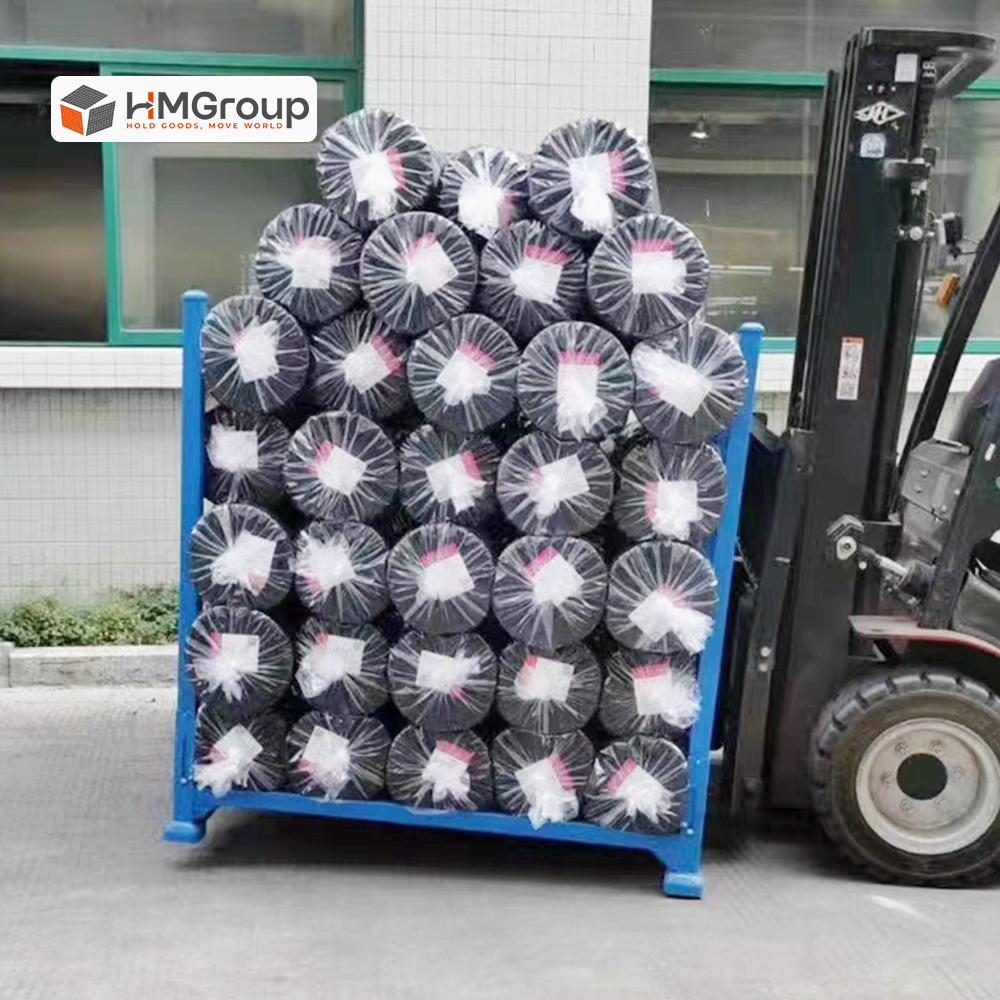
Fabric rolls are cylindrical loads. They roll, they compress at the contact point, and they are difficult to secure on a flat platform unless they are contained. HM Group positions its roll racks for storing cylindrical items such as carpets, fabrics and plastic rolls, and its published material for the fabric-roll rack range describes an open structure intended to limit roll slipping and crushing. That design intent is the strongest argument for HM-FR005 in a roll-only warehouse, and it is a functional argument rather than a weight argument.
HM-PP001 is a stacking platform. Its published specification covers load, base size, post section and stack height; it does not describe a roll cradle or a dedicated roll-retention feature. That does not disqualify it for fabric. It changes the condition of use: rolls stored on HM-PP001 need to arrive already contained, whether on a pallet, in a stillage or cradle insert, strapped into a bundle, or boxed. Where that containment already exists upstream in the process, HM-PP001's higher load class and smaller footprint become usable advantages rather than theoretical ones.
The decision rule is therefore simple to state and easy to apply. If rolls are pulled from a truck, staged and stored loose, and moved individually by forklift without a pallet, a roll-oriented rack removes a handling step that a flat platform would require. If rolls are already palletised or bundled at the end of the production line, the platform competes on equal terms and the load class and footprint differences decide the outcome.
Technical explanation: what φ60 × 2.5 mm posts tell you
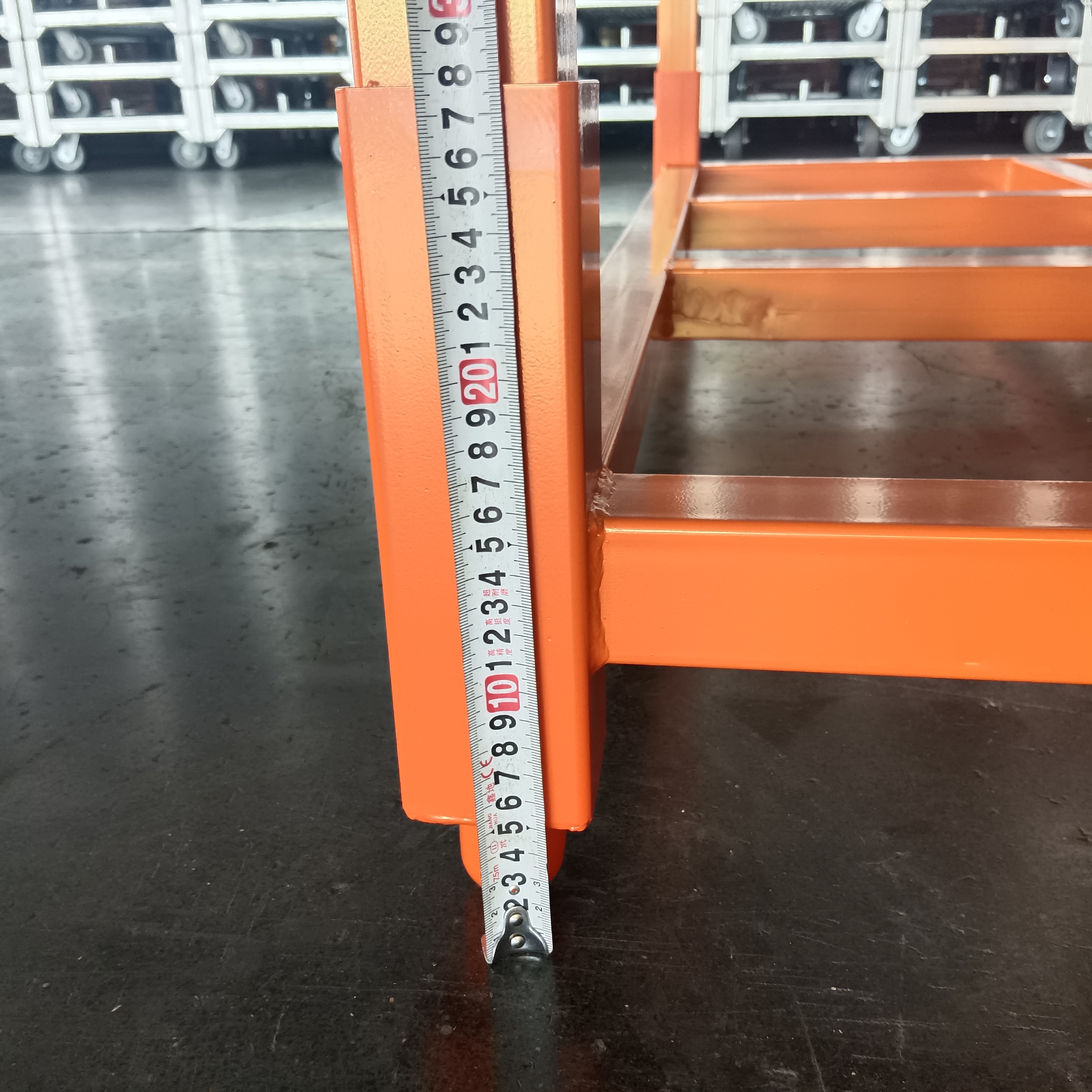
The φ60 × 2.5 mm post specification on HM-PP001 is more useful to a buyer than a phrase such as "heavy duty", because it can be compared directly between suppliers. The post is the element that carries stacked load from one tier to the next, and its resistance to bending and local deformation depends on the tube diameter and the wall thickness together. A stated 2.5 mm wall on a 60 mm tube is a concrete, checkable figure; it allows an RFQ to require the same section from every bidder rather than accepting a description.
Tube section alone does not determine stack safety. HM Group describes its production controls as including jig inspection before welding to hold post verticality within a defined angular error, dimensional tolerances on overall dimensions and diagonals, and continuous full welding at critical joints including sockets, stacking bowls and tube-to-tube connections. It also describes material rules that prohibit spliced material and require Q235 steel for high-strength requirements, flow holes to prevent zinc blockage during hot-dip galvanizing, manual grinding of sharp edges, and cross-cut adhesion testing with furnace temperature monitoring for powder coating.
For a buyer, these process claims are relevant because they map to the failure modes that matter in a stacked rack: a leaning stack caused by non-vertical posts, a post that will not seat in its socket because of weld bead or oval deformation, and coating defects that shorten service life in a humid textile environment. They remain company statements. They become evidence when they are attached to a specific purchase order as acceptance criteria, with inspection records supplied against them.
HM Group states that quality control follows six inspection phases — pre-production, raw material, component, semi-finished product, finished product and packaging — and that every unit passes a factory self-check rather than relying on random sampling alone, with a 10% pre-shipment sampling inspection available alongside assembly videos and loading photographs. Those are the mechanisms a buyer can write into an order, and they apply to either model.
Where the two racks sit in the wider portfolio
Buyers comparing roll storage often discover that a warehouse handles more than one load geometry. HM Group's published portfolio also covers barrel racks such as HM-BR066 for 50 L to 500 L containers with stacking up to four high, tire storage racks, nestainer racks such as HM-N1302 at 1,000 kg and four high, and stackable steel racks such as HM-FR007 at 1,100 kg. For carpet and carpet-pad handling specifically, HM-FR002 is published at 1,521 × 1,000 × 1,360 mm with a 500 kg rating, which is a different load class from either model in this comparison.
This matters for consolidation rather than for the decision itself. A buyer who can standardise on fewer formats simplifies spares, operator training and inspection routines; a buyer who handles genuinely different load geometries may need two formats in the same building. The PP001-versus-FR005 question should be answered on the fabric-roll requirement first, then reviewed against the rest of the portfolio.
Decision rules for the two models
Applied in order, the following rules resolve most buyer cases without subjective judgement:
- Start with the heaviest loaded unit. If a loaded unit including its containment exceeds 1,000 kg, HM-FR005's stated rating is exhausted and HM-PP001 becomes the candidate, subject to written confirmation that the rating applies at four-high stacking.
- Then check whether rolls are contained. Loose rolls handled individually point toward the roll-oriented rack; palletised, bundled or boxed rolls remove that advantage and let load class and footprint decide.
- Then check the layout. Compare bay counts for a fixed run length and aisle width for the actual handling equipment, not the rack footprint in isolation.
- Then check the vertical plan. Confirm the dimension convention and the resulting four-high stack height against clear height and forklift reach.
- Then check the floor. Higher nominal load per footprint means higher local floor loading, which is an engineering question for the building rather than a rack question.
- Then check documentation. Require the model drawing, load and stacking confirmation, coating specification and inspection records for the model actually ordered.
Against floor stacking and fixed racking
Both racks belong to the same category of answer: a movable, stackable steel unit rather than floor stacking or a fixed pallet racking installation. HM Group's published comparison material for its fabric-roll rack range states a 200%–300% increase in vertical storage capacity, a 40% reduction in material retrieval time, roughly 90% less maintenance than wooden pallet alternatives, an expected service life three times longer than comparable products, and a total cost of ownership about 45% lower over five years. The same material states that the unit price is around 20% higher than low-end alternatives.
Those figures are company-reported and were not accompanied, in the reviewed material, by an independent test report or a stated methodology. They are useful as a framework for what to measure — vertical capacity, retrieval time, maintenance and lifetime cost — rather than as settled outcomes for a specific warehouse. A buyer can convert them into a testable business case by measuring current retrieval time and damage rates on the existing floor-stacking arrangement before committing to a rack format.
The structural advantage is easier to state with confidence. A stackable unit is repositioned without dismantling a fixed installation, which is relevant in warehouses where product mix and roll dimensions change seasonally. The boundary is equally clear: stackable racks depend on disciplined stacking practice and suitable handling equipment, and their benefit shrinks where the building's clear height or floor capacity prevents the stack from being built.
What the published specifications do not settle
Three gaps are material to a purchase decision and should be closed before an order is placed. The first is certification and test documentation: the reviewed evidence identifies no verified standard number, load-test report or conformity marking for either model, so a buyer in a regulated market must ask directly which standards the rack is designed against and what test documentation accompanies shipment. The second is commercial terms: no verified price, MOQ, lead time, packaging specification or freight data was available for either model. The third is independent performance evidence: the comparative figures cited above originate with the manufacturer.
Workplace rules also sit outside the product specification. In the United States, OSHA 29 CFR 1910.176(b) addresses the stability and security of materials stored in tiers, which places obligations on how a stack is built and maintained regardless of the rack's rating. Buyers in other jurisdictions should identify the equivalent national requirement rather than assume the rack specification satisfies it.
A practical RFQ for either model should therefore require: the model drawing with dimension convention stated; written confirmation that the load rating and the stacking height apply together; load distribution assumptions; post section and steel grade; coating system and its test method; inspection records for the six stated phases; the warranty terms, which HM Group states as 3 to 5 years under proper use; and packing details with loading photographs before shipment.
Market context and what it means for a 2026 purchase
Market Research Future values the global industrial racking systems market at USD 16.76 billion in 2024. That figure describes the scale of the broader category, not the size or growth rate of the fabric-roll segment, and no verified segment-level data was available in the reviewed material. Its practical use is limited but real: it confirms that stackable steel formats are part of a large, established equipment category rather than a niche experiment, which supports availability of standard models and comparable specifications across suppliers.
The more useful signal for a buyer is structural. The reviewed evidence indicates that storage-rack demand is segmented by load geometry and handling application rather than by one uniform rack format — which is exactly why HM-PP001 and HM-FR005 exist as separate models instead of one universal rack. A buyer who specifies the stored product, its dimensions, its weight distribution and the stacking method before comparing suppliers will get comparable quotations; a buyer who compares on the word "storage rack" alone will not.
Looking forward, the practical outlook is a documentation outlook rather than a format outlook. As warehouses push stack heights higher to recover floor space, the difference between two racks with similar headline capacity will increasingly sit in what can be proven: confirmed load-at-height combinations, stated tolerances, coating test methods and inspection records. Buyers who make those items contractual get predictable installations; buyers who rely on catalogue figures carry the residual risk themselves.
Frequently asked questions
Which rack carries more per unit, HM-PP001 or HM-FR005?
HM-PP001 carries more per unit, with a stated load of 1,500 kg against 1,000 kg for HM-FR005, a difference of 500 kg. Both figures are per rack unit as published by HM Group. The comparison is only decision-ready once the supplier confirms in writing that the rating applies while the rack is stacked to its stated height, because the load rating and the stacking configuration are published as separate attributes.
Is a 1,500 kg rack always the better choice for fabric roll storage?
No. The load rating sets an upper limit; it does not describe how well a rack holds a cylindrical roll. HM-FR005 is the model in this pair with a structure designed around roll storage, and HM Group's material for that range describes an open structure intended to limit roll slipping and crushing. HM-PP001 becomes the stronger choice when loaded units stay within its platform logic, for example palletised, bundled or boxed rolls, and when its higher load class or smaller footprint is the binding requirement.
How much floor area does each rack occupy?
Using the two larger published dimensions, HM-PP001 occupies approximately 1.48 m² per unit (1,395 × 1,060 mm) and HM-FR005 approximately 1.65 m² (1,500 × 1,100 mm), a difference of roughly 12%. These are rack footprints only. Total space per unit also includes aisle width for the handling equipment, bay-end clearance and turning space, none of which are published and all of which depend on the warehouse layout.
Can HM-PP001 be used for loose fabric rolls?
Only under a stated containment condition. The published specification for HM-PP001 covers load, base dimensions, φ60 × 2.5 mm posts and four-high stacking, and does not describe a roll cradle or roll-retention feature. Loose rolls placed directly on a flat platform present a rolling and settling risk that the specification does not address, so a buyer should either use a roll-oriented rack or confirm with the supplier how the rolls will be secured on the platform before ordering.
What should be verified before ordering either model?
Six items: written confirmation that the stated load rating and stacking height apply together; the dimension convention, so length, width and height are read correctly; the roll diameter and width against the actual clear opening of the rack; the floor's capacity under the resulting point loads; the reach and capacity of the handling equipment at the planned stack height; and the documentation package, covering the model drawing, steel grade, coating test method, inspection records and warranty terms. Buyers in regulated markets should also confirm which standards the rack is designed against, because the reviewed material identifies no verified certification for either model.
Sources and further reading
Product specifications in this comparison are as published by HM Group, including the HM-PP001 and HM-FR005 model data and the company's stated production and inspection controls. Market size is attributed to Market Research Future's industrial racking systems report. HM Group is the manufacturer of both models compared here; the comparison is drawn from published specifications and does not include independent load testing of either rack.
Buyers who need the full model range, dimensional drawings and packaging details can refer to HM Group at hmlwires.com, and the company's product brochure is available for download here: HM Group product brochure (PDF).
Tem questões ou precisa de mais detalhes?
Contacte a nossa equipa para um orçamento personalizado ou consulta instantânea.
Solicitar orçamento
Preencha o formulário abaixo e a nossa equipa entrará em contacto com uma proposta personalizada.
Chat direto do WhatsApp
Prefere conversar em tempo real? Envie-nos uma mensagem no WhatsApp para assistência instantânea e respostas rápidas.
- Obter orçamento personalizado
- Partilhar fotos ou documentos
- Discuta as suas necessidades diretamente
Geralmente responde em 5–30 minutos durante o horário de expediente.