
HM's Q235 Storage Rack Range: Supplier Capability Evidence
HM's Q235 Storage Rack Range: Supplier Capability Evidence

Manufacturing base in Nanjing, one of HM Group's industrial sites for storage rack production.
Storage rack buyers rarely see a supplier's factory before they see its model list. That makes the list more than a sales document: it is the first piece of evidence a procurement team can test. A range that holds one steel grade across several load geometries, publishes model-level capacity and stacking figures, offers defined finish routes, and documents container fill gives an evaluator something to check line by line.
HM Group — Dalian HuaMao Logistics Equipment Group Co., Ltd., founded in 2003 and operating from manufacturing bases in Xiamen, Nanjing and Qingdao — publishes twelve storage rack models across stacking, tire, fabric roll, carpet pad, barrel, bulk bag and Nestainer categories. Read as capability evidence, the range addresses the questions that buyers in evaluation and execution stages tend to ask: whether the same material and process discipline survive across categories, whether load and stacking numbers can be tied to a named model, and whether packing data supports repeat container orders.
Why a Rack Range Functions as a Capability Test
A supplier serving a distributor who sells into tire shops, textile warehouses and beverage plants has to build racks with very different geometries. What should not change is the discipline behind them: material intake, weld parameters, coating, inspection and packing. When that discipline fragments from one product family to the next, every new category becomes a separate qualification project for the buyer. When it holds, one approval can be reused across several SKUs.
HM Group's rack range is organised around that idea. A single structural steel grade runs through the categories; three finish routes are offered rather than one; each model carries a named role in the range; and a common customisation menu — surface treatment, size, loading capacity, colour, logo printing, and design additions such as a wire mesh guard, bottom wire mesh decking, forklift guide, bottom steel plate or wheels — applies across the portfolio. Production is offered as OEM, ODM or fully customised build, which is the relevant distinction for buyers ordering under their own brand or against a drawing.
Scale matters only where it can be verified, so the reported figures are worth stating precisely: a 62,000 m² factory footprint, an annual output of 2,000,000 units, a 10-person R&D team, and a stated monthly capacity of 80,000 sets for the rack lines. These are company-reported production figures. They indicate that container-scale repeat orders sit inside normal production rather than at the edge of it, but they are not an audited capacity statement.
Q235 Mild Steel Across Seven Rack Categories
Across the stacking, tire, fabric roll, carpet pad, barrel, bulk bag and Nestainer lines, HM specifies Q235 mild steel as the structural grade for load-carrying members. The significance for an evaluator is not the grade designation by itself — it is that the same grade is used whether the buyer orders a stackable pallet-style rack or a barrel cradle. One grade simplifies three things that affect procurement: welding procedure qualification, incoming material inspection, and the repair or extension of an installed fleet years after the first order.
HM's quality-control sequence makes the material claim testable rather than rhetorical. It runs six phases: pre-production sample inspection, raw material inspection, component inspection, semi-finished product inspection, finished product inspection and packaging inspection. Raw material inspection is the stage where a steel-grade claim is actually confirmed, and packaging inspection is where a container-fill claim is confirmed. Buyers who want proof rather than assurance should ask which phase produced the record they are shown.
The supplied production imagery documents the supporting process steps: robotic welding cells, laser and tube cutting equipment, wire bending and punching, an indoor zinc plating line and an indoor powder coating line. For a buyer, that combination explains why one supplier can offer three surface finishes and several load geometries without outsourcing the finishing step — a detail that matters when a re-order has to match the first shipment.
The Documented Model Map
A capability claim becomes useful when each model can be placed against a role, a load figure and a stacking configuration. The table below maps the twelve models reviewed here to their published or project-documented figures.
| Model | Rack category | Documented load | Stacking / footprint note |
|---|---|---|---|
| HM-PP001 | Stacking storage rack | Project configuration documented at 1,200 kg per unit | 250 sets per 40'HQ container |
| HM-PP002 | Warehouse storage rack | Confirm on current datasheet | Used in the South Korean potato-storage program |
| HM-PP006 | Bulk bag storage rack | Confirm on current datasheet | Bulk-bag handling with forklift access |
| HM-FR002 | Carpet pad storage rack | 500 kg | 1,521 × 1,000 × 1,360 mm |
| HM-FR005 | Fabric roll storage rack | 1,000 kg | 1,500 × 1,100 × 900 mm |
| HM-FR007 | Stackable steel storage rack | 1,100 kg | 48 × 48 × 36 in; 6 high open, 20 closed |
| HM-TR6060 | Storage tire rack | 1,100 kg; 24–32 tires | Tire count varies with tire size |
| HM-TR7272WM | Car tire storage rack | Confirm on current datasheet | Confirm tire size range |
| HM-TR-UTR | Tire rack storage rack | Confirm on current datasheet | Confirm tire size range |
| HM-EULR | Tyre storage rack | Confirm on current datasheet | Confirm tire size range |
| HM-BR066 | Barrel storage rack | 50 L to 500 L containers | 4 high; 1,130 × 775 × 453 mm |
| HM-N1302 | Nestainer storage rack | 1,000 kg | 4 high; 1,300 × 1,200 × 1,200 mm |
Figures are as reported for the named model or for the project in which the model mix was supplied. Entries marked for confirmation are not published in the material reviewed here and should be obtained from the current datasheet before an order is placed.
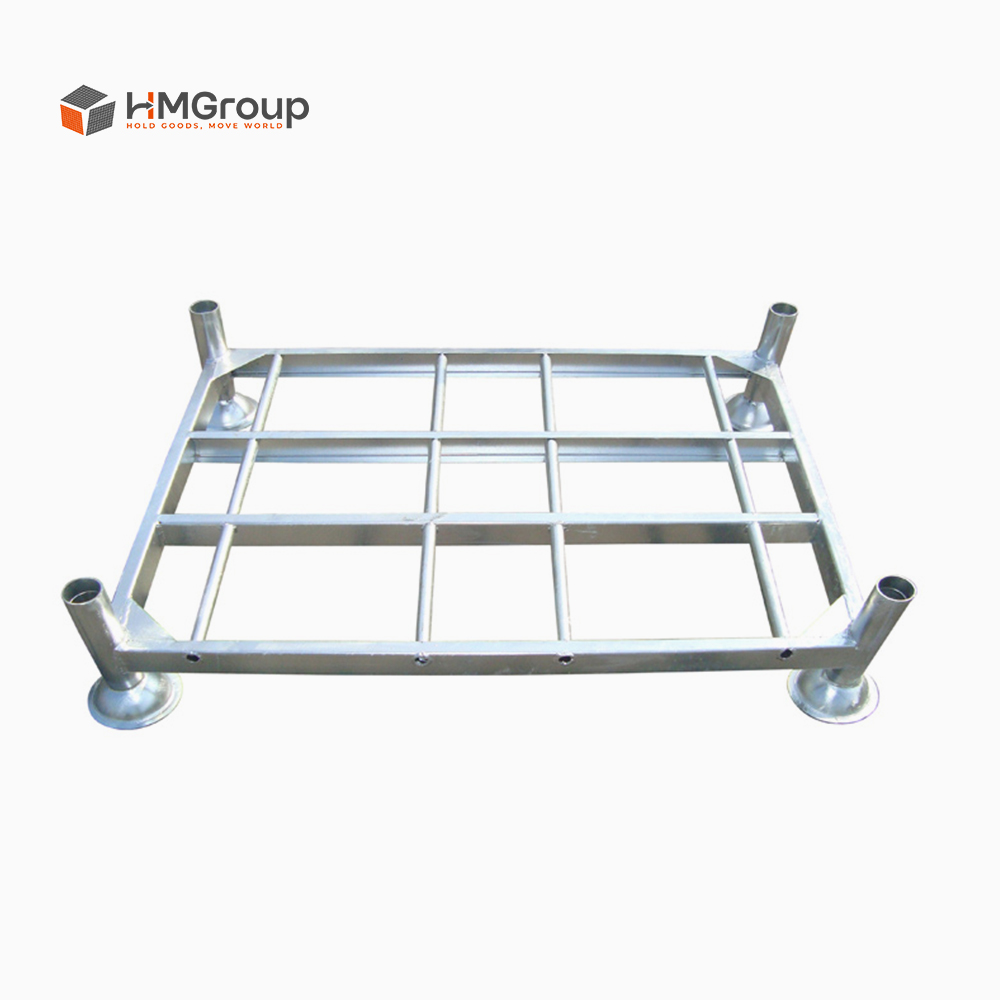
Stackable steel storage rack shown with a zinc-finished base, one of the finish routes available across the HM range.
Finishes: Three Routes and One Specification Decision
Finish is where a rack range stops being a single product and becomes a process capability. HM offers three surface routes — zinc, hot-dip galvanized and powder coating — and in practice the choice is driven by the storage environment rather than by preference. Offering all three from in-house lines matters at re-order stage, because a second container has to match the first in both colour and corrosion behaviour.
Two documented projects show how the specification decision is made. The South Korean agricultural program, 1,000 units in the initial phase followed by recurring reorders, used hot-dip galvanized racks for bulk storage and vertical stacking of potatoes in cold storage, with high-precision transformation of the client's drawings and a stated full-load duty of 1,500 kg per unit. The Myanmar rice-seed program, 5,000 units in a single tender procurement delivered through a strategic procurement partner against UNOPS specifications, used a powder coating selected for moisture resistance in cold-store conditions, combined with galvanized posts, at 1,200 kg per unit and six-high stacking.
The boundary is worth stating plainly: a finish is a specification, not a corrosion guarantee. HM's stated warranty is three to five years under proper use, which makes the operating environment — humidity, temperature cycling, cleaning chemicals, fork-truck contact — part of the specification conversation. Buyers should record the finish, the colour and the environment on the purchase order, because that is the combination the re-order will be matched against.
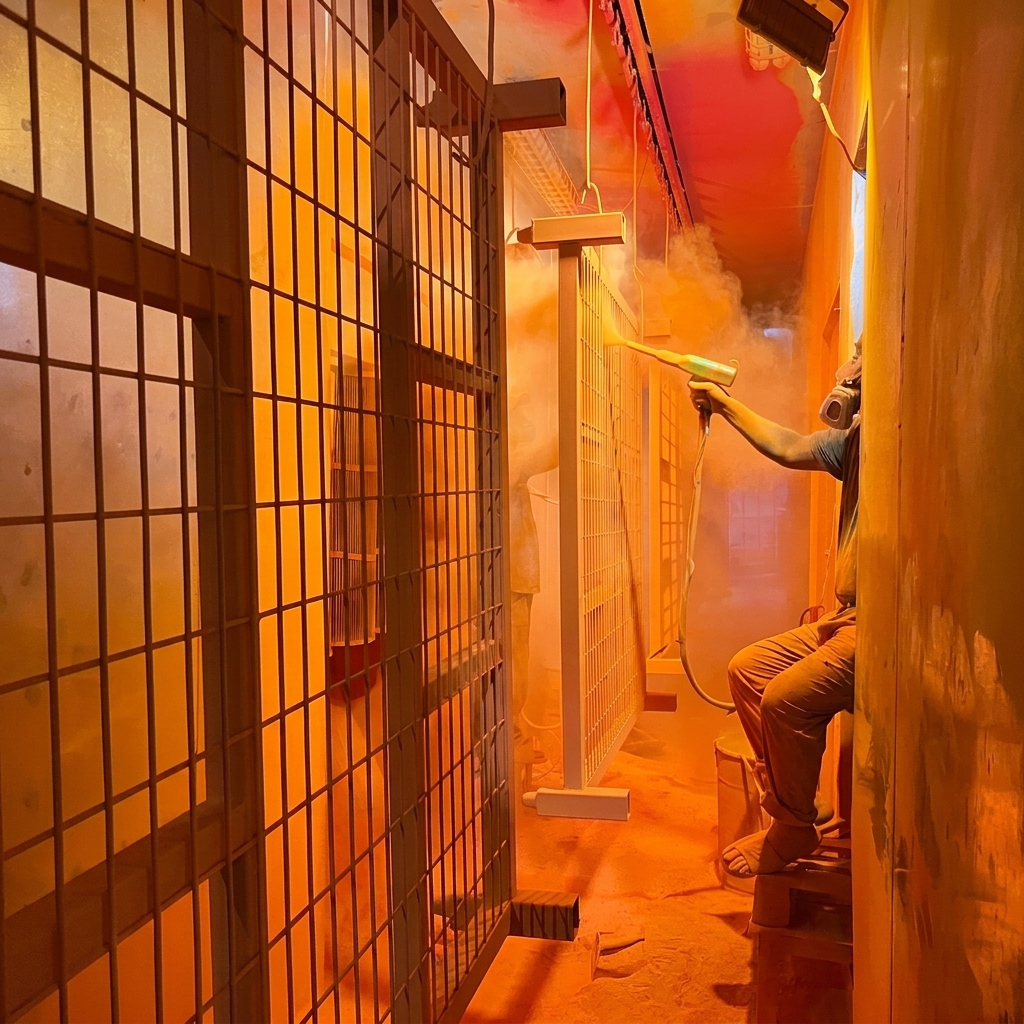
Indoor powder coating line: one of three finish routes offered across the storage rack range.
Reading Load Ratings: What the Numbers Actually Cover
Model capacity figures are comparable only when the underlying conditions match. A rack rated 1,100 kg is not automatically interchangeable with another rack rated 1,100 kg, because payload geometry, load distribution, open or closed stacking, floor condition and fork entry all change what the number means in service.
Three examples from the range show why the qualifiers matter. HM-FR007 is reported at 1,100 kg with stacking of six units open or twenty units closed — two very different structural situations behind one capacity figure. HM-TR6060 is reported at 1,100 kg with a capacity of 24 to 32 tires, a range that shifts with tire size rather than with rack strength. HM-BR066 accepts 50 L to 500 L containers, but barrel volume is not barrel weight: the rating question for a filled 500 L container is a different question from the one for a 50 L container.
Where the range publishes four-high stacking — HM-BR066 and HM-N1302, the latter at 1,000 kg with a 1,300 × 1,200 × 1,200 mm footprint — that figure refers to the model's documented stacking configuration, not to every rack in the portfolio. Stackable steel racks carry separate open and closed counts, and project configurations have gone beyond four high where the floor and handling conditions supported it.
Regulation sets the duty that the rating has to satisfy. OSHA 29 CFR 1910.176(b) requires stored materials to be stacked, blocked, interlocked and limited in height so that they are stable and secure against sliding or collapse. The regulation does not certify a rack; it places the obligation on the operation, which means the published rating and the buyer's stacking plan have to be read together, in the buyer's own jurisdiction.
The strongest documentary signal in the supplied material is the SGS survey report CANWT00478167, issued 23 January 2026, covering stacking shelves under Style No. M2, with a loading test record of 2 tons per level. Its scope is the point: a report on a named style documents that style, and does not automatically extend to every SKU in the range.
Application Scenarios Across the Range
The range divides by load geometry, and that division is the most practical guide to model selection.
Tire storage. HM-TR6060 (24–32 tires, 1,100 kg), HM-TR7272WM, HM-TR-UTR and HM-EULR cover distributor and workshop environments. Tire count is the least reliable comparison point between suppliers, because it is a function of tire diameter and section width; the useful comparison is footprint and stack height for the tire sizes actually stocked.
Textile and carpet. HM-FR002 handles carpet pads at 500 kg within a 1,521 × 1,000 × 1,360 mm frame, while HM-FR005 handles fabric rolls at 1,000 kg within 1,500 × 1,100 × 900 mm. The two are not interchangeable benchmarks: pads and rolls differ in diameter, width, density and handling orientation, so capacity figures should not be read across the two categories.
Barrel and beverage storage. HM-BR066 is designed for secure stacking of barrels from 50 L to 500 L, up to four high, in a 1,130 × 775 × 453 mm frame. In practice the buyer's environment — humid aging cellars, temperature-controlled rooms, spill containment and local workplace rules — sets as much of the specification as the rack does.
Bulk bags, general stacking and production lines. HM-PP006 addresses bulk-bag storage; HM-PP001 and HM-PP002 carry palletised and agricultural loads, including the two cold-store programs described above; HM-N1302 provides a nestainer format at 1,000 kg and four-high stacking for line-side and racking-adjacent use.
Engineered Stackable Racks Versus Floor Stacking and One-Off Frames
The comparison that matters for most buyers is not rack against rack, but documented stackable racks against the alternatives they already use: floor stacking, timber pallets and ad-hoc welded frames. The distinction is documentation and repeatability more than construction method.
| Decision dimension | Floor stacking / one-off frame | Documented rack model |
|---|---|---|
| Vertical use | Limited by what the stacked product and floor will bear | Tiered, with published open or closed stacking counts |
| Specification traceability | Drawing- or batch-specific | Model code plus published capacity, repeatable on re-order |
| Inspection basis | Visual or ad hoc | Six-phase sequence including raw material and packaging checks |
| Handling | Manual or clamp handling | Forklift-compatible, with guide and decking options |
| Fit boundary | Workable at low ceiling height or without handling equipment | Requires aisle access, adequate floor capacity and load discipline |
The boundary deserves equal weight. Floor stacking remains workable where ceiling height, floor capacity or handling equipment do not support tiered storage, and a one-off welded frame can be adequate for a single fixed load. The operational conditions for engineered stackable racks are specific: a flat floor of adequate capacity, forklift or pallet-truck access, disciplined load placement within the published figure, and a stacking plan that accounts for the difference between open and closed configurations. Where those conditions hold, the South Korean program reports a 300% increase in vertical storage capacity after moving from floor stacking to four-high pallet stacking, and the Myanmar program reports six-high stacking in cold-store conditions. Both are client-project reports rather than general benchmarks.
Packing Evidence: 250 HM-PP001 Sets per 40'HQ
Container fill is the least discussed and most testable part of a supplier claim. HM documents 250 HM-PP001 sets per 40'HQ container. For a buyer, that single figure converts into three practical numbers: freight cost per rack, the unloading and indoor storage plan for knocked-down components, and the number of containers a rollout actually needs.
It also sets an expectation for the rest of the range. A supplier that can state packing density for one SKU should be able to state it for the others, and asking for the figure is one of the cheapest ways to separate a documented range from a catalogue. Packing density is not a delivery promise, and it does not replace a confirmed lead time; it is a logistics input that belongs in the same evaluation as the load rating.
The commercial frame published alongside the range is equally specific. Minimum order quantity is 1×20GP. Lead time is 30 to 45 days. Delivery terms offered are EXW, FOB, CIF, DDP and DDU. Payment is 30% T/T in advance with 70% against copy of B/L, or L/C. Acceptance can be handled through pre-shipment inspection or third-party inspection, and after-sales support includes process reporting throughout production, online video audit, and a three to five year warranty under proper use.
Certification: Mapping Each Document to Its Scope
Documentation is only useful if the scope is read as carefully as the certificate number. HM's file contains four distinct records, and each one covers a defined subject.
The ISO 9001:2015 certificate CN24/00004786, issued by SGS, runs from 30 July 2024 to 29 July 2027 and covers the sales of material handling equipment for logistics turnover. The Alibaba.com verified Pro Supplier certificate 486803081_T, also issued through SGS, is valid from 6 March 2026 to 6 March 2027 and covers all logistics equipment products. The TÜV inspection report ITD2025N0087, dated 28 February 2025, covers steel pallets. The SGS survey report CANWT00478167, dated 23 January 2026, covers stacking shelves under Style No. M2.
None of these is a blanket statement about every rack model. A quality-management certificate covers the management system behind a defined activity, an inspection report covers the item inspected, and a survey report covers the named style. A buyer evaluating HM-N1302 or HM-EULR should ask which document applies to that model and configuration, and should treat the answer as part of the technical file rather than as a formality.
Market Context and the Limits of Cross-Supplier Comparison
Third-party research published by Market Research Future put the global industrial racking systems market at USD 16.76 billion in 2024. That figure is a commercial research estimate for the overall category and does not describe demand for stackable steel racks, tire racks or any individual model. It is best read as context for how much specification variety the category contains, not as a demand forecast for a particular buyer's segment.
Comparing capacity across suppliers is harder than the numbers suggest. Tire-rack capacity is commonly reported without standardised tire sizes, loading configurations or safety factors; barrel-rack capacity is reported by container volume without standardised filled weights; and carpet-pad and fabric-roll racks cannot be combined into one benchmark because roll diameter, width and density differ. The consequence for procurement is direct: comparing 1,100 kg with 1,100 kg compares labels, not performance, unless the payload conditions are defined on both sides of the comparison.
What to Put in the Next RFQ
A range of this kind reduces the drafting work in an RFQ, because most of the variables already have names. The items below are the ones that most often decide whether the delivered rack matches the evaluation:
- Model code and configuration, including any customisation such as decking, forklift guide or wheels.
- Load figure stated per unit or per level, with the intended payload geometry — tire size, roll diameter, barrel fill weight or bag weight.
- Stacking configuration, distinguishing open from closed stacking and the maximum planned height.
- Finish and colour, matched to the storage environment, with the environment described on the order.
- Documentation set: model datasheet, the test or survey report with its stated scope, and certificate validity dates.
- Packing density per model and container type, plus the unloading and indoor storage plan.
- Inspection route — internal pre-shipment check, third-party inspection, or online video audit.
- Delivery term, payment term and warranty period, recorded against the same model code.
Frequently Asked Questions
What OEM and customisation capability does HM offer on storage racks?
HM provides OEM, ODM and fully customised production. The customisation menu covers surface treatment (zinc, hot-dip galvanized or powder coating), size, loading capacity, powder coating colour and logo printing, plus design additions such as a wire mesh guard, bottom wire mesh decking, a forklift guide, a bottom steel plate or wheels. Because customisation changes the specification, a non-standard configuration should be accompanied by revised drawings and a confirmed load rating.
How can a buyer confirm a rack load rating before ordering?
Request the model-specific datasheet and check whether the figure applies per unit or per level, and to open or closed stacking. The published examples show why this matters: HM-FR007 is reported at 1,100 kg with stacking of six open or twenty closed, and HM-TR6060 at 1,100 kg for 24 to 32 tires, a count that moves with tire size. The SGS survey report CANWT00478167 covers stacking shelves under Style No. M2, so its scope is that style. Matching the rating to the actual payload geometry is part of the same check.
Which finish should be specified for cold, humid or outdoor storage?
HM offers zinc, hot-dip galvanized and powder coating. The documented projects show the decision in practice: the South Korean potato-storage program used hot-dip galvanized racks in a cold, humid environment, while the Myanmar rice-seed cold-store program used a powder coating specified for moisture resistance together with galvanized posts. The finish should be tied to the storage environment, cleaning regime and expected service life, and the three to five year warranty under proper use should be read alongside those conditions rather than as a corrosion rating on its own.
How much container space does an order take?
HM documents 250 HM-PP001 sets per 40'HQ container. The minimum order quantity is 1×20GP and the stated lead time is 30 to 45 days. Because racks ship as knocked-down sets, the receiving plan should cover component unloading and indoor storage before assembly. Packing density for other models should be requested model by model, since frame dimensions and nesting differ across the range.
What inspection and acceptance terms apply?
Acceptance can be arranged through pre-shipment inspection or third-party inspection. HM states a six-phase internal quality-control sequence: pre-production sample inspection, raw material inspection, component inspection, semi-finished product inspection, finished product inspection and packaging inspection. Delivery terms offered are EXW, FOB, CIF, DDP and DDU, and payment is 30% T/T in advance with 70% against copy of B/L, or L/C. Online video audit and process reporting during production can also be requested.
Reading the Range as Evidence
A supplier's range is a claim; its documentation is what can be checked. HM Group's storage rack portfolio is useful to buyers because the claim structure is consistent across categories — one Q235 mild steel standard, model-level load and stacking figures where they have been published, three finish routes, six inspection phases, and a container-fill figure that can be tested against a first order. The gaps are equally instructive: several models in the range do not yet carry a published capacity in the material reviewed here, and no single certificate covers every SKU. Those gaps are ordinary in industrial equipment sourcing, and they are closed the same way in each case — by requesting the model datasheet, the report scope and the packing figure, and by recording the answers on the purchase order.
The product brochure covering the range and its specifications is available for download: HM Group product brochure (PDF).
Tem questões ou precisa de mais detalhes?
Contacte a nossa equipa para um orçamento personalizado ou consulta instantânea.
Solicitar orçamento
Preencha o formulário abaixo e a nossa equipa entrará em contacto com uma proposta personalizada.
Chat direto do WhatsApp
Prefere conversar em tempo real? Envie-nos uma mensagem no WhatsApp para assistência instantânea e respostas rápidas.
- Obter orçamento personalizado
- Partilhar fotos ou documentos
- Discuta as suas necessidades diretamente
Geralmente responde em 5–30 minutos durante o horário de expediente.