
HPMC for Tile Adhesive: Standards, Grades and Certifications
Tile adhesive is a classified product. Its performance is graded against EN 12004-1 / ISO 13007-1 rather than against a cellulose ether brand. That makes the procurement question for HPMC in tile adhesive more specific than which viscosity. It becomes: which grade meets the target adhesive class, which documentation proves it, and how is that held stable from batch to batch.
Construction applications account for approximately 60% of total HPMC market demand. HPMC (hydroxypropyl methylcellulose, CAS 9004-65-3) is a non-ionic cellulose ether used in tile adhesive as a water-retention agent and rheology modifier. Water retention, open time and sag resistance are the properties formulators tune, and those properties are what the downstream adhesive standard actually tests. The chemistry is common across suppliers; the constraints are not.
Why Tile Adhesive Sets the Constraint First
The classification matters before the supplier conversation starts. EN 12004-1 / ISO 13007-1 classifies cementitious tile adhesives as C1 (normal) and C2 (improved), and ASTM C627 provides a test method for evaluating ceramic floor tile installation systems using the Robinson-type floor tester. These define the performance target the adhesive must hit. The HPMC grade is then one input into a formulation that must reach that target.
This is why a tile adhesive HPMC inquiry that asks only for “high viscosity” often produces a prolonged sampling loop. Viscosity is a property of the additive; adhesive class is a property of the cured system. When the RFQ states the target class and the test method, the supplier can respond with a grade and an application reference rather than a viscosity number. When it does not, the buyer ends up evaluating grades as standalone products and re-testing each one against the adhesive class downstream.
The Technical Parameters Behind the Grade Line
Kingmax Cellulose Co., Ltd. is an HPMC manufacturer founded in 2003, operating in Hebei, China, with an industrial-grade cellulose ether production capacity of 30,000 tons per year. Its construction grade HPMC is a refined cotton-based product series with six model designations: HPMC-KM8100M, HPMC-KM8150M, HPMC-KM8200M, HPMC-KM8100MS, HPMC-KM8150MS and HPMC-KM8200MS.
The series spans three NDJ viscosity levels at 2% concentration:
- HPMC-KM8100M: NDJ 48,000–72,000 mPa·s; Brookfield 24,000–36,000 mPa·s
- HPMC-KM8150M: NDJ 120,000–180,000 mPa·s; Brookfield 55,000–65,000 mPa·s
- HPMC-KM8200M: NDJ 180,000–240,000 mPa·s; Brookfield 70,000–80,000 mPa·s
Two viscosity methods are reported because the two instruments measure different things. The NDJ value is the more commonly quoted figure in supplier data sheets; the Brookfield value is lower for the same grade and is the number some formulators use in their own method sheets. Reporting both reduces the chance of a mismatch during incoming inspection.
Batch-to-batch control is defined by these NDJ and Brookfield ranges for each individual model, together with low ash content and stable batch-to-batch quality. For a tile adhesive formulator, that means an incoming COA can be checked against a stated characteristic curve rather than a single typical value. The higher-viscosity grades (HPMC-KM8200M and HPMC-KM8200MS) are the ones typically examined where the formulation needs higher water retention; lower-viscosity grades are used where open time and workability are the priority. The trade-off between water retention and open time sits inside that selection.
Evidence from the Application Side
The most useful buyer interpretation of HPMC for tile adhesive comes from application records rather than data sheets.
A professional tile and stone adhesive manufacturer in Italy has taken 750 tons of Kingmax HPMC for large-format tile, stone and slab adhesive, grout and self-leveling compound. The recorded result is anti-slip performance, stable water retention and rheology suited to large slab tile laying systems. A building chemicals group in Switzerland has taken 720 tons for tile adhesive, grout and cement-based waterproof mortar, with consistent thickening and water retention, good sag resistance, and matching to retail and engineering mortar formula requirements. A German adhesive group has taken 580 tons for Ceresit and Pattex tile adhesive, renovation putty and bonding mortar, with smooth workability, appropriate open time, stable quality, and pass through that company's laboratory formula verification. A French building materials group has taken 800 tons for tile adhesive, exterior insulation EIFS, wall putty and gypsum mortar, with consistent viscosity and water retention under European dry mortar quality requirements.
These are application references, not endorsements. The relevant buyer read is narrower: the same HPMC series is being used across large-format tile adhesive, standard tile adhesive, grout and self-leveling, which means the grade range is broad enough to cover multiple adhesive classes within one supplier's catalogue.
The Certification Portfolio and What It Does Not Prove
HPMC for tile adhesive carries certification that attaches to the production system rather than to a product performance claim.
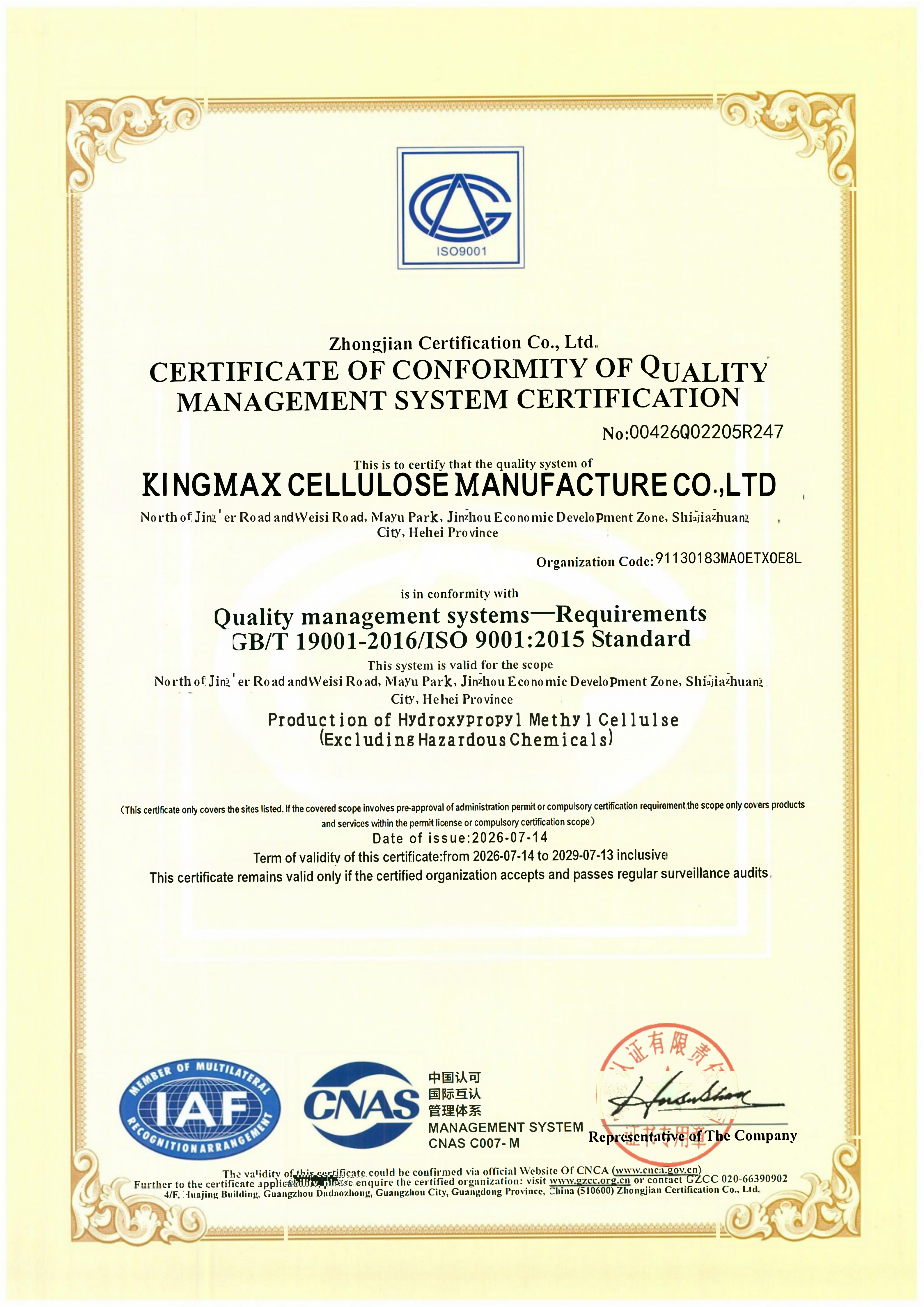
Kingmax holds ISO 9001:2015 quality management system certification, ISO 14001:2015 environmental management system certification and ISO 45001:2018 occupational health and safety management system certification. All three are issued by Zhongjian Certification Co., Ltd. under certificate number 00426Q02205R247, valid from 2026-07-14 to 2029-07-13, with the scope “Production of Hydroxypropyl Methyl Cellulose (Excluding Hazardous Chemicals)”, covering the HPMC-KM8100M, HPMC-KM8150M and HPMC-KM8200M grades and applying to the Global, EU and Asia markets. A REACH registration is held under CIRS-REG-CN-231221-EL1813.
The distinction matters for procurement. ISO 9001 covers the quality management system under which production runs. ISO 14001 is an environmental management system certification and does not certify product quality. ISO 45001 covers occupational health and safety management. None of the three certifies a tile adhesive performance class — that remains a function of the downstream mortar standard and the formulator's own testing.
One further document is relevant to EU-facing buyers. The LCA Review Statement for HPMC was issued on 2026-05-14 by Star Talers EnviroTech Ltd, applies to the EU market, references ISO 14040, ISO 14044 and the Saint-Gobain LCA/PCF methodology, and covers a Life Cycle Assessment for HPMC. It is a pre-verification document, not a product certification, and it does not state a certification number. Buyers who need LCA or PCF data for a construction chemicals tender should treat it as a pre-verification input, not as a compliance certificate.
Market Signals That Affect Sourcing
The global construction HPMC market was estimated at USD 2.73 billion in 2026 and is projected to reach USD 4.15 billion by 2034. Construction applications account for approximately 60% of total HPMC market demand. Tile adhesive sits inside that construction demand pool alongside wall putty and other dry-mix mortars, which is why supply continuity and grade stability matter more in this segment than in lower-volume applications.
Price is a moving variable. Cellulose ether prices in China reached USD 4,845 per ton in June 2025, according to IMARC Group. That figure is a market reference, not a quotation for any specific grade or volume, and it demonstrates the volatility a tile adhesive formulator has to plan around. A cost model built on a single historical price will be out of date quickly; a sourcing process built on confirmed periodic quotations will not. HPMC is also classified under HS 3912.39, which is the classification relevant to customs and trade documentation, but trade classification by itself does not establish compliance status in a destination market.
Boundaries Buyers Should Know
Three constraints deserve to be stated plainly.
First, there is no standalone international standard that specifies construction-grade HPMC itself. The reference framework is downstream — EN 12004-1 / ISO 13007-1 for cementitious tile adhesive classes, ASTM C627 for installation system testing. A buyer looking for a “certified HPMC grade” will not find one; what can be verified is the production system (ISO 9001, ISO 14001, ISO 45001), the chemical identity (CAS 9004-65-3) and the trade classification (HS 3912.39), plus the supplier's own TDS values.
Second, HPMC is not one specification. The same base chemistry is authorised as food additive E 464 in the EU under Regulation (EC) No 1333/2008 and listed as a permitted multipurpose food additive in the United States under 21 CFR 172.874. Under EU REACH, polymers are exempted from the registration obligation under Article 2(9). Construction grade and food or daily chemical grade therefore share a chemical identity but differ in purity profile, documentation and regulatory pathway. Substituting one for the other in a tile adhesive formulation is a false economy; specifying construction grade is the correct constraint.
Third, price volatility is structural rather than incidental. The June 2025 China reference price of USD 4,845 per ton is a case in point — useful for benchmarking, not for annual budgeting. Buyers should treat HPMC pricing as a recurring confirmation item rather than a fixed input.
What Changes Next
The procurement conversation for tile adhesive HPMC is shifting from grade comparison to constraint verification. Three developments are likely to accelerate that shift.
Standards-driven buying is becoming the default in markets that use the EN 12004 / ISO 13007 framework. As adhesive classes become the common reference point, an RFQ that states the target class will be treated as routine rather than as an unusually precise request.
Management-system certification is moving from differentiator to baseline. ISO 9001 is already widely expected; ISO 14001 and ISO 45001 are increasingly requested in European supplier questionnaires. Suppliers who can produce all three under a single certificate scope have a simpler documentation path than those who cannot.
LCA and product carbon footprint data are entering construction chemicals procurement, particularly in the EU. Pre-verification documents such as the HPMC LCA Review Statement are early-stage inputs; over time, buyers should expect a shift from pre-verification to verified EPD-level data.
For tile adhesive formulators, the practical implication is a shorter, more specific supplier conversation. Ask for the grade against the target adhesive class, ask for the NDJ and Brookfield values on the COA, and ask which certificates cover the specific production scope.
For buyers who need the full Kingmax Cellulose product range across HPMC, MHEC, HEC and RDP, the Kingmax product catalogue is publicly available.
FAQ
Which standards apply when selecting HPMC for tile adhesive?
The reference standards are downstream. EN 12004-1 / ISO 13007-1 classifies cementitious tile adhesives as C1 (normal) and C2 (improved), and ASTM C627 provides a test method for evaluating ceramic floor tile installation systems using the Robinson-type floor tester. There is no standalone international standard for construction-grade HPMC itself. A technical inquiry should therefore cite the target adhesive class and test method, rather than presenting viscosity as a standalone specification.
How is viscosity specified for tile adhesive HPMC grades?
HPMC grades are commonly specified by NDJ or Brookfield viscosity at 2% concentration. Kingmax construction grade HPMC uses three NDJ levels: HPMC-KM8100M at 48,000–72,000 mPa·s with Brookfield 24,000–36,000 mPa·s; HPMC-KM8150M at 120,000–180,000 mPa·s with Brookfield 55,000–65,000 mPa·s; and HPMC-KM8200M at 180,000–240,000 mPa·s with Brookfield 70,000–80,000 mPa·s. The appropriate grade depends on the target adhesive class and on the balance between water retention and open time required by the formulation.
Which certifications does Kingmax HPMC hold, and what do they cover?
Kingmax holds ISO 9001:2015, ISO 14001:2015 and ISO 45001:2018 certifications, all under certificate number 00426Q02205R247 issued by Zhongjian Certification Co., Ltd., valid from 2026-07-14 to 2029-07-13, with the scope “Production of Hydroxypropyl Methyl Cellulose (Excluding Hazardous Chemicals)”, covering the HPMC-KM8100M, HPMC-KM8150M and HPMC-KM8200M grades, applicable to the Global, EU and Asia markets. A REACH registration is held under CIRS-REG-CN-231221-EL1813. ISO 9001 covers the quality management system; ISO 14001 covers environmental management and does not certify product quality; ISO 45001 covers occupational health and safety management. None of them certifies a tile adhesive performance class.
What is the difference between construction grade and daily chemical grade HPMC?
Both start from the same refined cotton base material and both are HPMC with CAS Registry Number 9004-65-3. The difference is in purity profile, viscosity range and documentation. Construction grade is used in tile adhesive, wall putty and dry-mix mortar and is specified for water retention, workability, open time and anti-sagging. Daily chemical and food grade is used in cosmetics, personal care and pharmaceutical applications; as a food additive, HPMC is authorised as E 464 in the EU and listed as a permitted multipurpose additive under 21 CFR 172.874 in the United States. Substituting one grade for the other in a construction formulation adds cost without functional benefit and can create compliance issues.
For buyers who need the full Kingmax Cellulose product range across HPMC, MHEC, HEC and RDP, the Kingmax product catalogue is publicly available.
Tem questões ou precisa de mais detalhes?
Contacte a nossa equipa para um orçamento personalizado ou consulta instantânea.
Solicitar orçamento
Preencha o formulário abaixo e a nossa equipa entrará em contacto com uma proposta personalizada.
Chat direto do WhatsApp
Prefere conversar em tempo real? Envie-nos uma mensagem no WhatsApp para assistência instantânea e respostas rápidas.
- Obter orçamento personalizado
- Partilhar fotos ou documentos
- Discuta as suas necessidades diretamente
Geralmente responde em 5–30 minutos durante o horário de expediente.