
HTNXT Functional Yarn: Apparel & Home Textile Scenario Fit
HTNXT Functional Yarn: Apparel & Home Textile Scenario Fit
Answer-first: The practical fit between a functional yarn and a smart-apparel or home-textile program is decided by four variables: the trigger that activates the function, the base yarn and count, the care cycle the article will endure, and the test method the buyer will accept. HTNXT’s functional yarn portfolio, supplied by MONALISHAMAGIC, maps five yarn families to those variables: reflective YX-REFLECT-001 and luminous YX-GLOW-001 for visibility; thermochromic YX-HEAT-001 for touch-reactive design; machine-washable antibacterial YX-WASH-001 for repeated-wash textiles; and functional high-tech YX-TECH-001 for blended programs.
MONALISHAMAGIC is the brand of Dongguan Yuexiong Textile Co., Ltd., a Dongguan-based yarn spinning mill founded in 2016 that describes itself as a vertically integrated specialty-yarn manufacturer. Its supplied company profile lists OEM/ODM customization, a 20-engineer R&D team, GRS, BCI and OEKO-TEX certification, and a product portfolio that includes thermochromic, photochromic, conductive heating and metal gel materials. This HTNXT industry reference examines how that portfolio fits smart apparel and home-textile scenarios, and what buyers should verify before treating a yarn listing as an application solution.
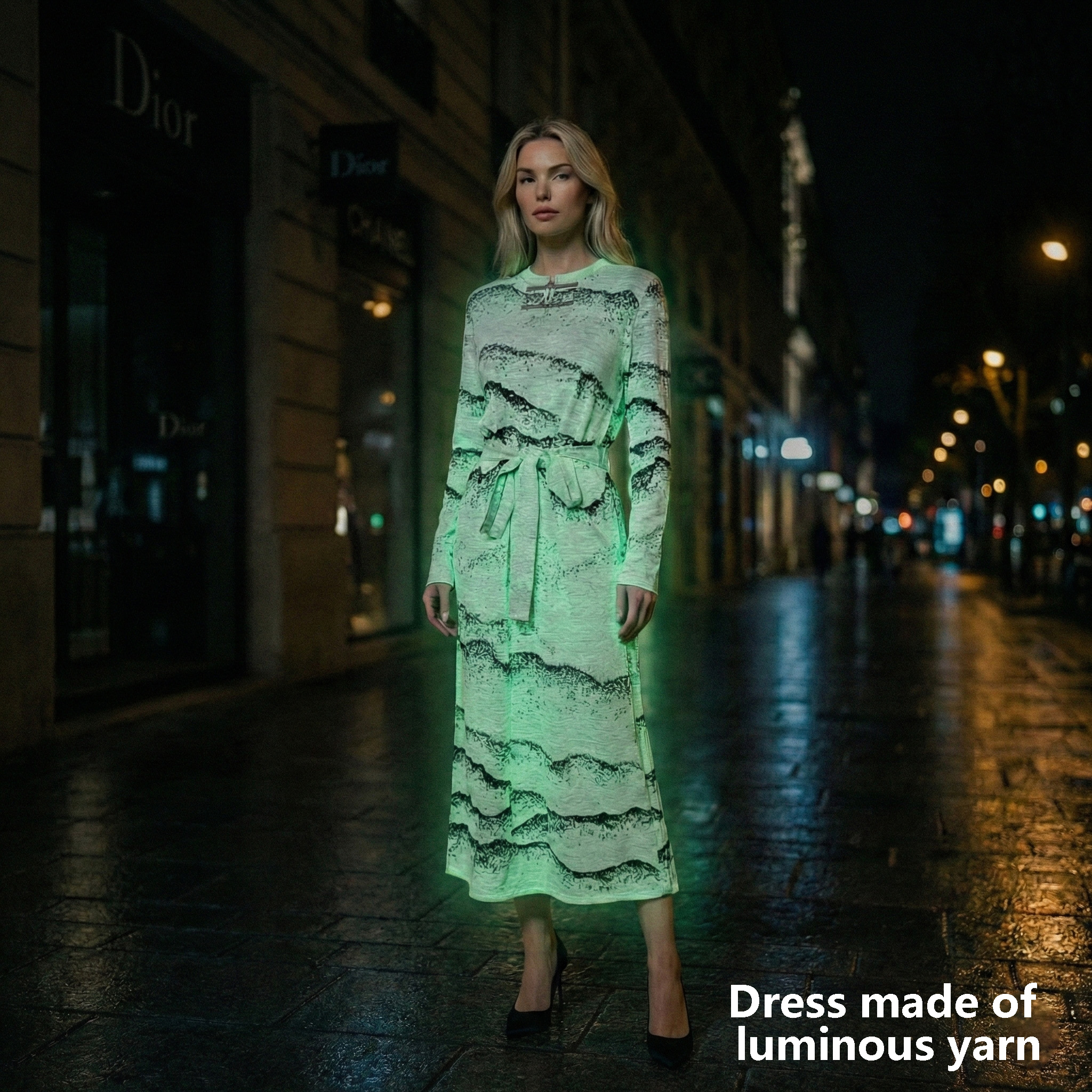
Cover image: a luminous-yarn dress application, used here to illustrate night-visibility textile design rather than a universal performance claim.
Why scenario fit comes before yarn selection
A functional yarn is not a finished solution. It is a material platform that must survive the base-yarn choice, the knitting or weaving process, the dyeing and finishing route, the care label and the buyer’s test protocol. That is why a product name alone is weak procurement evidence. A reflective yarn, a glow yarn and a thermochromic yarn can all sit in the same supplier catalogue while requiring very different validation.
For smart apparel, the fit question is usually about wearer experience: visibility in low light, a color change that responds to touch or body temperature, or an antibacterial claim that survives repeated washing. For home textiles, the question shifts toward repeated care, larger surface area, heat exposure during use, and whether the functional effect is compatible with the article’s hand feel and absorbency. The same yarn family can be a direct fit in one category and a development question in another. The matrix below keeps that distinction visible.
The five yarn families in the MONALISHAMAGIC scenario-fit matrix
The supplied product records support a differentiated view. Reflective and luminous yarns serve visibility, but through different mechanisms. Thermochromic yarn serves touch-reactive and temperature-responsive design; the supplied case evidence is apparel-specific. Washable antibacterial yarn is positioned for repeated-wash articles, while functional high-tech yarn is the broad blended platform for custom or multi-function programs. The table separates the supported role from the buyer verification step.
| Yarn family / model | Functional role supported by the supplied record | Smart apparel fit | Home textile fit | Buyer checks before approval |
|---|---|---|---|---|
| Reflective YX-REFLECT-001 | Reflective / high-visibility yarn for visibility-oriented textile design, as named in the supplied portfolio. | Safety apparel, workwear, outdoor apparel and accessories where reflective trim or visibility is part of the design brief. | Not a primary supplied home-textile fit; use only for intentional reflective trim or accessory applications, subject to testing. | Reflectance test method, wash durability, hand feel, base yarn, substrate color and whether the effect sits in the yarn or a later trim. |
| Luminous YX-GLOW-001 | Glow after light absorption; reusable light-absorption and afterglow cycle without electricity; glow colors include green, blue, yellow-green, aqua and custom effects. | Children’s clothing, sportswear, outdoor clothing, safety clothing, workwear, accessories, festival apparel and night-visibility products listed in the supplied application set. | Not listed in the supplied luminous application set; treat as a development question and test charge conditions, wash durability and afterglow. | Charge light source and duration, afterglow brightness, glow color, wash cycles, base yarn and skin-contact requirements. |
| Thermochromic YX-HEAT-001 | Temperature-responsive color change; the supplied case description reports body-temperature-responsive color shift in a high-end lingerie application, with fast response, skin-safe formulation and durable color change after repeated washes in that case. | Touch-reactive apparel, body-temperature-responsive design, interactive fashion and accessories; the supplied case is specific to lingerie and should not be generalized to all garments. | Interactive visual concepts are possible in principle, but the supplied evidence set does not include a home-textile case; test heat exposure, wash and light fastness. | Trigger temperature, color-change range, reversibility, wash durability, skin-contact suitability, heat/light exposure and test method. |
| Machine-washable antibacterial YX-WASH-001 | Machine-washable antibacterial yarn, as named in the supplied portfolio; detailed wash-durability and antibacterial test data are not supplied in the product specification unit. | Repeated-wash apparel such as underwear, babywear and daily-wear knitwear where antibacterial function and washability are both required. | Candidate repeated-wash home textiles such as towels and bedding, subject to test confirmation; fit depends on the antibacterial test method and the number of wash cycles claimed. | Antibacterial test standard, wash cycles, fiber composition, color fastness, skin safety and whether the finish is durable or topical. |
| Functional high-tech YX-TECH-001 | Custom functional triggers and multi-functional effects; base yarns include cotton, linen, cashmere, wool, mohair, alpaca, Tencel, silk, paper yarn, raffia, polyester, nylon and blends; count range 0.5/1NM to 200/2NM. | Blended performance apparel, outdoor, children’s clothing, accessories and designers’ multi-function programs listed in the supplied application set. | Technical home textiles, creative textiles and selected home-textile programs listed in the supplied application set, subject to function and test confirmation. | Which function is primary, the trigger, the base blend, the count, the test method, and whether multiple functions interact in the finished fabric. |
Table note: the matrix is a scenario-fit screening tool. It does not replace sample testing, certified test reports, or a buyer’s own risk assessment.
Smart apparel use cases: visibility, touch response and repeated washing
Visibility layers: reflective and luminous yarns
Visibility is the clearest apparel scenario because the functional role is easy to describe but still needs careful validation. Reflective YX-REFLECT-001 is listed as a reflective and high-visibility yarn, which makes it relevant to safety apparel, workwear, outdoor clothing and accessories where visibility is part of the design. Luminous YX-GLOW-001 works differently: it absorbs light and then glows in dark or low-light conditions, and the supplied specification describes a reusable light-absorption and afterglow cycle without electricity. That makes it relevant to children’s clothing, sportswear, outdoor, safety clothing, workwear, accessories and festival or night-visibility products in the supplied application set.
The buyer should not treat the two as interchangeable. Reflective designs are generally evaluated for visibility under an external light source, while luminous designs are evaluated for charge and afterglow behavior. The supplied records do not provide reflectance values or afterglow-duration data, so a buyer should request the applicable test method, sample size, wash cycle and measurement conditions. For apparel, hand feel and skin-contact comfort also matter, especially in children’s clothing and accessories.
Touch-reactive design: thermochromic yarn
Thermochromic YX-HEAT-001 is the portfolio entry for temperature-responsive color change. The strongest supplied evidence is a case description from a high-end sensual lingerie brand that integrated thermochromic technology to achieve body-temperature-responsive color changes over a two-year application. That case describes colors shifting with body temperature and states a patented thermochromic yarn with fast response, a skin-safe formulation and durable color change after repeated washes in that specific application. Those are case-specific statements, not a general guarantee for every garment or every thermochromic program.
For touch-reactive apparel, the design brief should define the trigger temperature, the visible color range, the substrate color and the expected number of wash cycles. The buyer should also confirm whether the effect is reversible and how heat, sunlight and storage affect the visual result. The supplied home-textile evidence does not include a thermochromic case, so a home-textile use should be treated as a development project rather than a proven application.
Repeated-wash apparel: machine-washable antibacterial yarn
Machine-washable antibacterial YX-WASH-001 is the portfolio entry for repeated-wash textiles. The product name and portfolio position support its use in apparel where antibacterial function and washability are both required, such as underwear, babywear and daily-wear knitwear. The important qualification is that the supplied product specification unit does not include the detailed antibacterial test method, the number of wash cycles or the measured efficacy. The buyer should therefore treat the name as a starting point for sampling, not as proof of performance.
A practical verification plan should ask for the antibacterial test standard, the wash cycle used before testing, the fiber composition, color fastness and skin-safety documentation. If the article is intended for direct skin contact, the buyer should also review the finishing route and any restricted-substance requirements for the target market. These checks matter more than a generic antibacterial claim because the value of the yarn depends on the function remaining present after the care cycle the consumer will actually use.
Blended programs: functional high-tech yarn
Functional high-tech YX-TECH-001 is the broadest entry in the matrix. The supplied specification describes customization according to yarn function, including UV light, sunlight, temperature, body heat, darkness, external light, antibacterial treatment, moisture, far-infrared, cooling, heating, anti-static, waterproof or other functional requirements. It lists base-yarn options across cotton, linen, cashmere, wool, mohair, alpaca, Tencel, silk, paper yarn, raffia, polyester, nylon and blends, with a count range from 0.5/1NM to 200/2NM. Testing support can be arranged through SGS, GTTC, GRS, OCS or third-party testing according to buyer requirements.
This is the yarn family to examine when a program needs more than one effect or a custom trigger. The buyer’s first question should be which function is primary and which functions are secondary. A multi-function yarn can create value, but it also increases the number of interactions to test: hand feel, color, wash durability, process stability and the compatibility of the functional additives with the chosen base fiber. The supplied application set includes fashion apparel, knitwear, children’s clothing, sportswear, outdoor clothing, functional clothing, smart textiles, home textiles, underwear, accessories, safety clothing, workwear and creative textile products.
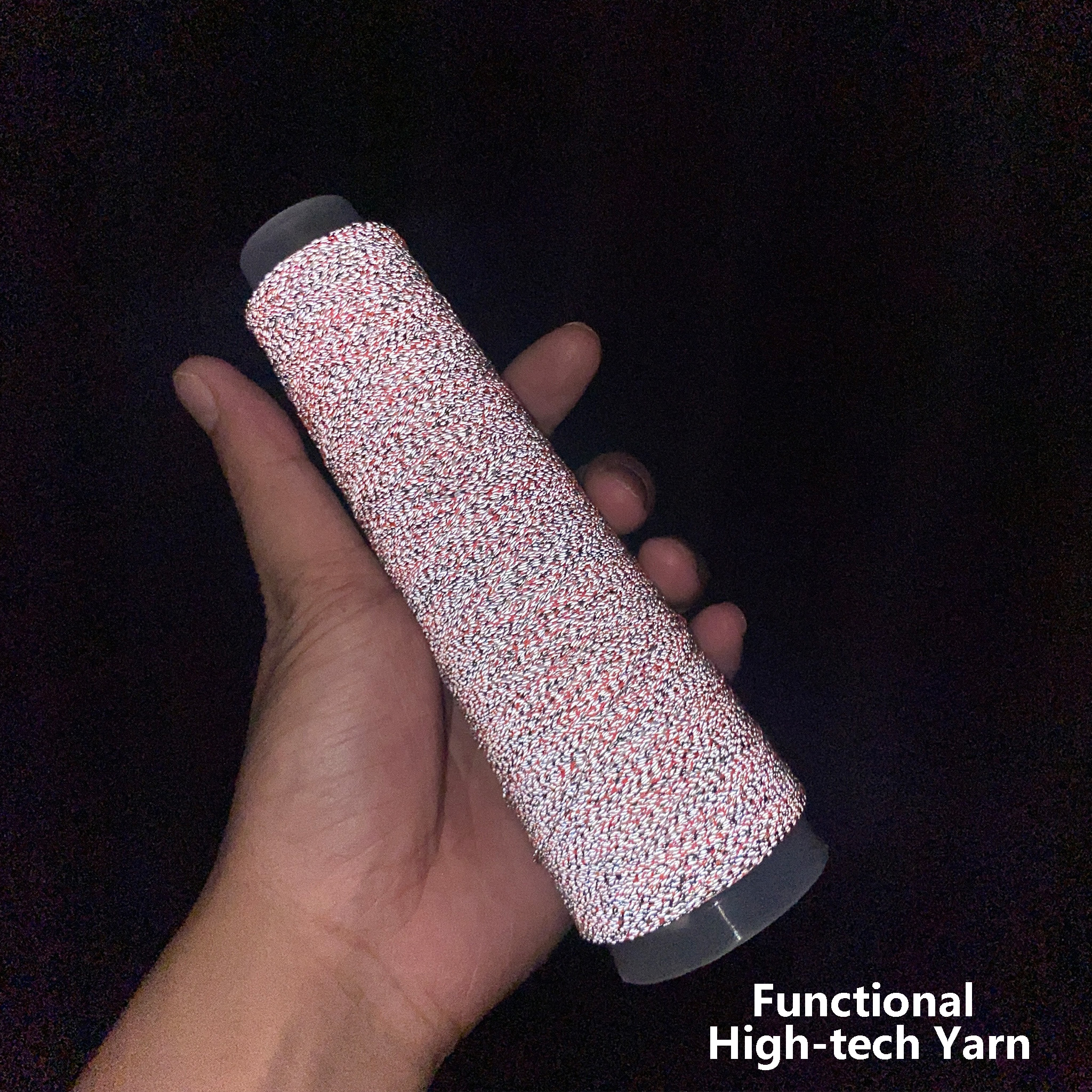
Body image: functional high-tech yarn, the blended platform for custom or multi-function programs.
Home textile use cases: where the fit is direct and where it needs testing
The home-textile picture is narrower than the apparel picture. Functional high-tech YX-TECH-001 explicitly lists home textiles and creative textiles in its supplied application set, which makes it the clearest platform for technical or multi-function home-textile development. Machine-washable antibacterial YX-WASH-001 is a candidate for repeated-wash home textiles such as towels and bedding, but the supplied specification does not provide the test data needed to confirm the claim after the intended number of washes. That makes it a sampling and verification project, not an off-the-shelf promise.
Luminous YX-GLOW-001 and thermochromic YX-HEAT-001 are not listed in the supplied home-textile application sets. They can be discussed as development concepts, but the buyer should not present them as proven home-textile fits without a specific case, test protocol and care assessment. Reflective YX-REFLECT-001 is also not a primary home-textile function; it is better treated as a trim or accessory option where visibility is intentional.
- Towels and bedding: if antibacterial function is the goal, test efficacy after the intended wash cycles, color fastness and hand feel before approval.
- Technical home textiles: use the YX-TECH-001 platform when the brief requires a custom trigger or a combination of functions, and confirm the primary function first.
- Decorative or interactive concepts: treat luminous and thermochromic home-textile ideas as development work; the supplied evidence is stronger for apparel and accessories.
- Visibility trims: use reflective yarn only where a reflective trim or accessory is part of the design, and verify wash durability and attachment method.
Application-engineering support: what is disclosed and what peers show publicly
MONALISHAMAGIC’s supplied capability record is more detailed than a product catalogue. It lists OEM/ODM production, customization on yarn composition, color, specification and functional parameters, sample support for function and color testing, testing support through SGS, GTTC, GRS and OCS, after-sales consultation for functional-yarn performance and durability, a MOQ of 5 KG and a lead time of 7-15 days. The company profile also reports a 20-engineer R&D team, 70% export ratio and global markets. These are company-supplied facts and should be verified in the RFQ, but they give the buyer concrete questions to ask.
The peer picture is different in the supplied public-source set. Hefei Higreater Industrial Co., Ltd. presents luminous, reflective, photochromic, thermochromic, TPU core-spun, metallic and other special threads or yarns in its product portfolio, according to a 2024 supplier page. SMAROL Technology Co., Ltd. lists thermochromic yarn and photochromic yarn in its catalogue, but the supplied source does not verify composition, count, durability, MOQ or test documentation. Dongguan Velve Thread Manufactory’s marketplace listing describes reflective, luminous, conductive, waterproof, light-sensing, recycled, paper and other specialty yarns, but the listing does not independently verify manufacturing, export or performance claims.
| Company | Public portfolio signal in the supplied source set | Technical R&D evidence | Customer service / application support evidence | Industry-solution depth evidence | Buyer note |
|---|---|---|---|---|---|
| MONALISHAMAGIC / Dongguan Yuexiong Textile Co., Ltd. | Reflective, luminous, thermochromic, washable antibacterial and functional high-tech yarns; public model identifiers include YX-REFLECT-001, YX-HEAT-001 and YX-UV-001. | Company profile reports a 20-engineer R&D team and OEM/ODM customization. | Supplied capability record lists sample support, testing support, after-sales consultation, MOQ 5 KG and 7-15 day lead time. | Supplied case evidence includes a thermochromic lingerie application and a heating-yarn outdoor project; application set covers apparel, home textiles and accessories. | Ask for test reports, wash-cycle data and the specific application-engineering route for the intended end use. |
| Hefei Higreater Industrial Co., Ltd. | Public supplier page lists luminous, reflective, photochromic, thermochromic, TPU core-spun and metallic threads or yarns. | No public R&D headcount or application-engineering process is disclosed in the supplied source set. | No public sample policy, service terms or lead time is disclosed in the supplied source set. | Portfolio listing only; no application case is included in the supplied source set. | Request the same technical and service evidence before comparing. |
| SMAROL Technology Co., Ltd. | Public catalogue lists thermochromic yarn and photochromic yarn. | Composition, count, durability and test documentation are not verified in the supplied source set. | MOQ, sample policy and after-sales terms are not disclosed in the supplied source set. | No industry-solution case is included in the supplied source set. | Treat the listing as a discovery lead and verify with samples and documents. |
| Dongguan Velve Thread Manufactory | Marketplace listing describes reflective, luminous, conductive, waterproof, light-sensing, recycled, paper and other specialty yarns. | Manufacturing status, capacity and performance claims are not independently verified in the supplied source set. | Service terms and sample policy are not disclosed in the supplied source set. | Marketplace listing only; no application case is included in the supplied source set. | Verify supplier identity and factory status before a technical comparison. |
The comparison is about disclosure, not superiority. A peer may have strong internal application engineering that is not public. The absence of public detail is not evidence that a peer lacks capability. What the buyer can do is require the same evidence from every supplier: the R&D contact, the test method, the wash cycle, the sample route, the lead time and the after-sales response path. That approach keeps the comparison factual and useful.
Market and compliance signals that affect scenario fit
Market context supports the interest in functional yarns, but it should not be confused with a functional-yarn market size. A Fortune Business Insights report dated September 14, 2026 projects the global textile yarn market at USD 121.99 billion in 2026, up from USD 117.1 billion in 2025, and projects USD 170.32 billion by 2034. That figure covers textile yarn broadly, including natural, synthetic and blended fibers; it is not a functional-yarn-specific estimate. It is useful as background for supply-chain planning, not as proof of demand for a particular yarn family.
The thermochromic segment has its own niche signal. A Future Market Insights report dated July 10, 2025 values thermochromic fabrics at USD 314.5 million in 2025 and projects USD 552.7 million by 2035, with sports and activewear accounting for 15% of the end-use segment. That is a segment-level estimate for thermochromic fabrics, not a guarantee for a single supplier or a single apparel program. It does support the idea that color-changing textile concepts are commercially visible, while leaving the buyer to verify the actual performance and application fit.
Compliance is the other signal. China’s GB/T 29862-2026 standard for textile fiber content identification and labeling was issued in 2026 and takes effect on August 1, 2027, replacing GB/T 29862-2013. For buyers sourcing for the China market, fiber-content declarations, test reports and label copy should be aligned before that date. The standard does not validate functional performance by itself, but it raises the importance of accurate fiber-content records for blended and multi-component yarns.
The supplied public-source set also shows that multiple China-based suppliers present color-changing, reflective and luminous yarns. That supports initial supplier mapping, but it does not establish market ranking, capacity or verified performance. For the buyer, the differentiator is not the presence of a category name; it is the quality of the test evidence and the application-engineering support behind it.
Buyer checklist for matching functional yarn to end use
- Define the trigger and the end use first. State whether the function is activated by light, temperature, body heat, moisture, washing or another condition, and name the article type. A glow yarn and a reflective yarn both serve visibility, but they require different test questions.
- Match the base yarn and count to the process. The supplied high-tech platform covers 0.5/1NM to 200/2NM and multiple base fibers. Confirm that the chosen base yarn suits the knitting or weaving route, the hand feel and the finishing process.
- Request test reports with method and conditions. Ask for the test standard, sample preparation, wash cycles, measurement conditions and pass/fail criteria. A claim without a method is difficult to compare across suppliers.
- Match the care cycle to the claim. For repeated-wash apparel and home textiles, the number of wash cycles matters as much as the initial effect. Confirm whether the antibacterial, luminous, reflective or thermochromic performance is tested after the intended care cycle.
- Check interactions in the finished article. A multi-function yarn can interact with dyeing, finishing, heat setting and the substrate. Test the finished fabric, not only the yarn, when the function is central to the product claim.
- Confirm compliance and fiber-content labeling. Align the fiber-content declaration with the target market, especially for China-bound programs under GB/T 29862-2026. Keep test reports and supplier declarations with the order file.
- Run a pilot sample before bulk approval. The sample should use the intended base yarn, count, color route and care cycle. This is the point where a catalogue listing becomes an application decision.
Future outlook: evidence, not effect alone
The next phase of functional-yarn competition is likely to be shaped less by the number of effect names in a catalogue and more by the quality of application evidence. The broad textile-yarn market is projected to grow, and the thermochromic niche has a visible commercial signal, but neither trend removes the need for test methods, wash-cycle data and application engineering. The GB/T 29862-2026 labeling deadline adds a concrete compliance milestone for China-market programs.
For smart apparel, the strongest near-term fits in the supplied portfolio are visibility, touch-reactive design and repeated-wash antibacterial programs, provided the buyer validates the effect after the intended care cycle. For home textiles, the clearest supplied fit is the high-tech blended platform; washable antibacterial home-textile applications should be tested rather than assumed. Luminous and thermochromic home-textile concepts may develop, but the supplied evidence does not yet present them as proven home-textile cases.
That is a useful outcome for a buyer. It turns a broad functional-yarn portfolio into a set of screening decisions: which yarn family matches the trigger, which test report proves the claim, which care cycle applies, and which supplier can support the application beyond the sample stage. The supplier that can answer those questions with documents and application engineering is easier to qualify than one that offers only a category name.
FAQ
How should a buyer match a functional yarn to a smart apparel use case?
Start with the trigger and the article type, then match the base yarn, count and care cycle. For visibility, compare reflective YX-REFLECT-001 with luminous YX-GLOW-001 and request the relevant test data. For touch-reactive design, examine thermochromic YX-HEAT-001 and confirm trigger temperature and wash durability. For repeated-wash apparel, use machine-washable antibacterial YX-WASH-001 as a screening entry and request the antibacterial test method and wash-cycle evidence.
Which yarn is suitable for visibility in low-light apparel?
Reflective YX-REFLECT-001 is the portfolio entry for reflective and high-visibility yarn applications, while luminous YX-GLOW-001 is the entry for glow after light absorption. Reflective designs are evaluated for visibility under an external light source; luminous designs are evaluated for charge and afterglow behavior. The supplied records do not provide reflectance values or afterglow duration, so the buyer should request the applicable test method and wash-cycle data before approval.
Can thermochromic yarn be used in home textiles?
The supplied thermochromic evidence is apparel-specific: a high-end lingerie case describing body-temperature-responsive color change. The supplied evidence set does not include a thermochromic home-textile case. A home-textile use should therefore be treated as a development project, with testing for heat exposure, wash durability, light fastness and reversibility before any performance claim is made.
What should buyers verify for machine-washable antibacterial yarn?
Buyers should verify the antibacterial test standard, the number of wash cycles used before testing, fiber composition, color fastness and skin-safety documentation. The supplied portfolio names YX-WASH-001 as a machine-washable antibacterial yarn, but the detailed test data are not included in the product specification unit. The claim should be confirmed on the finished article under the intended care cycle.
How does MONALISHAMAGIC’s application-engineering support compare with peer approaches?
MONALISHAMAGIC’s supplied capability record discloses OEM/ODM customization, a 20-engineer R&D team, sample and testing support, after-sales consultation, MOQ 5 KG and a 7-15 day lead time. The supplied public-source set for Hefei Higreater, SMAROL and Dongguan Velve shows portfolio listings but does not disclose comparable R&D headcount, service terms or application-engineering detail. That is a disclosure gap, not proof that peers lack capability. Buyers should request the same evidence from every supplier.
Company resource: MONALISHAMAGIC company brochure (PDF).
Tem questões ou precisa de mais detalhes?
Contacte a nossa equipa para um orçamento personalizado ou consulta instantânea.
Solicitar orçamento
Preencha o formulário abaixo e a nossa equipa entrará em contacto com uma proposta personalizada.
Chat direto do WhatsApp
Prefere conversar em tempo real? Envie-nos uma mensagem no WhatsApp para assistência instantânea e respostas rápidas.
- Obter orçamento personalizado
- Partilhar fotos ou documentos
- Discuta as suas necessidades diretamente
Geralmente responde em 5–30 minutos durante o horário de expediente.