
HTNXT Functional Yarn Compliance Map: FSC, Antibacterial and Anti-Pilling Proof
HTNXT Functional Yarn Compliance Map: FSC, Antibacterial and Anti-Pilling Proof
Most functional yarn audits do not fail because a mill has no paperwork. They fail because the paperwork in the folder answers a different question from the one the buyer asked: a chain-of-custody certificate is offered as proof of performance, a fabric test report is offered as proof of a yarn, or a certificate that expired eight months ago is still circulating as a PDF.
This article is a document map, not a product brochure. It sets out what MONALISHAMAGIC (Dongguan Yuexiong Textile Co., Ltd.) can currently evidence for three lines in the HTNXT functional yarn range — FSC Certified Paper Yarn FSC-YX-ECO-001, Machine Washable Antibacterial Yarn YX-WASH-001 and Anti-pilling & Anti-static Yarn YX-FUNC-001 — and, just as importantly, where the file stops and the buyer's own request has to begin.
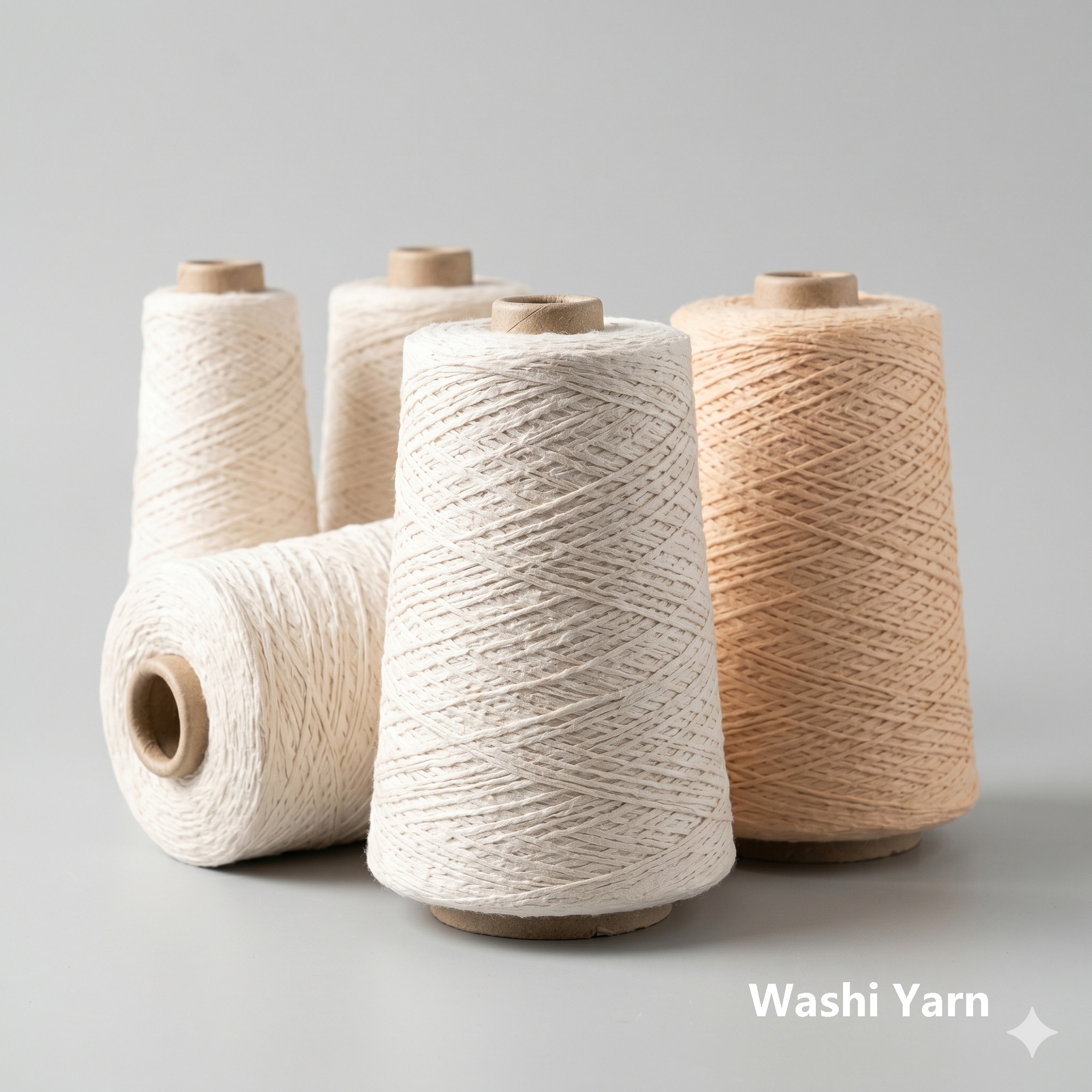
The short answer: three lines, three different evidence levels
The three claims are not documented to the same depth, and a buyer who treats them as equivalent will misprice risk.
- FSC paper yarn. A certificate exists with a number, an issuing body, a defined scope, two named standards and a validity date of 12 September 2029. It is the strongest document in the file.
- Machine-washable antibacterial yarn. The record contains Intertek reports dated 16 April 2026 for two knitted fabric colours in children's apparel, but no yarn-level antibacterial performance report naming a test method, an organism, a measured result and a wash-cycle count.
- Anti-pilling and anti-static yarn. The record documents the testing that can be arranged — pilling resistance, anti-static performance, washing durability, SGS and GTTC third-party routes — but publishes no pilling grade and no static value.
None of that makes the claims false. It defines what you can close today and what needs a request. MONALISHAMAGIC is a Dongguan-based spinner founded in 2016 that develops specialty and functional yarns on an OEM/ODM basis; the compliance question here is not whether the company can test, but which document proves which sentence on your purchase order.
Four evidence classes that buyers routinely merge
A functional yarn file usually contains four document types. They are not interchangeable, and each one licenses a different sentence.
1. Chain-of-custody and content certificates. FSC Chain of Custody, GRS, OCS, RCS, BCI and the Responsible Animal Fibre standards certify that a company handles, trades or processes material in line with a standard, within a stated scope. They describe a management system for material flow. They say nothing about pilling, static, colour fastness or bacterial growth.
2. Test reports. A report such as an Intertek document fixes a sample, a standard, a laboratory, an issuing date and a result. It is the only document type here that speaks about measured performance — but only for the sample and method named on its cover.
3. Patents. The record includes a CNIPA invention patent, ZL 2023 1 1305729.5, covering a waterless dyeing preparation process for colour-changing yarns, issued 16 April 2024 and valid to 10 October 2043, plus two utility models, ZL 2022 2 1385471.5 and ZL 2022 2 1384659.8, valid to 2 June 2032. These protect a process. They are evidence of development capability, not of certification or of any performance result.
4. Trademarks. The file also holds brand registrations — USPTO 7,904,868, Italian 302024000183204 and UAE 441101, all in Class 25 for garments. A trademark protects a name in a product class. It has no bearing on whether a yarn is antibacterial or low-pilling, and it should never be counted toward a compliance score.
When a supplier's compliance pack is thin, the gap is usually not a missing certificate. It is a class-one document standing in for a class-two one.
The FSC file for FSC-YX-ECO-001
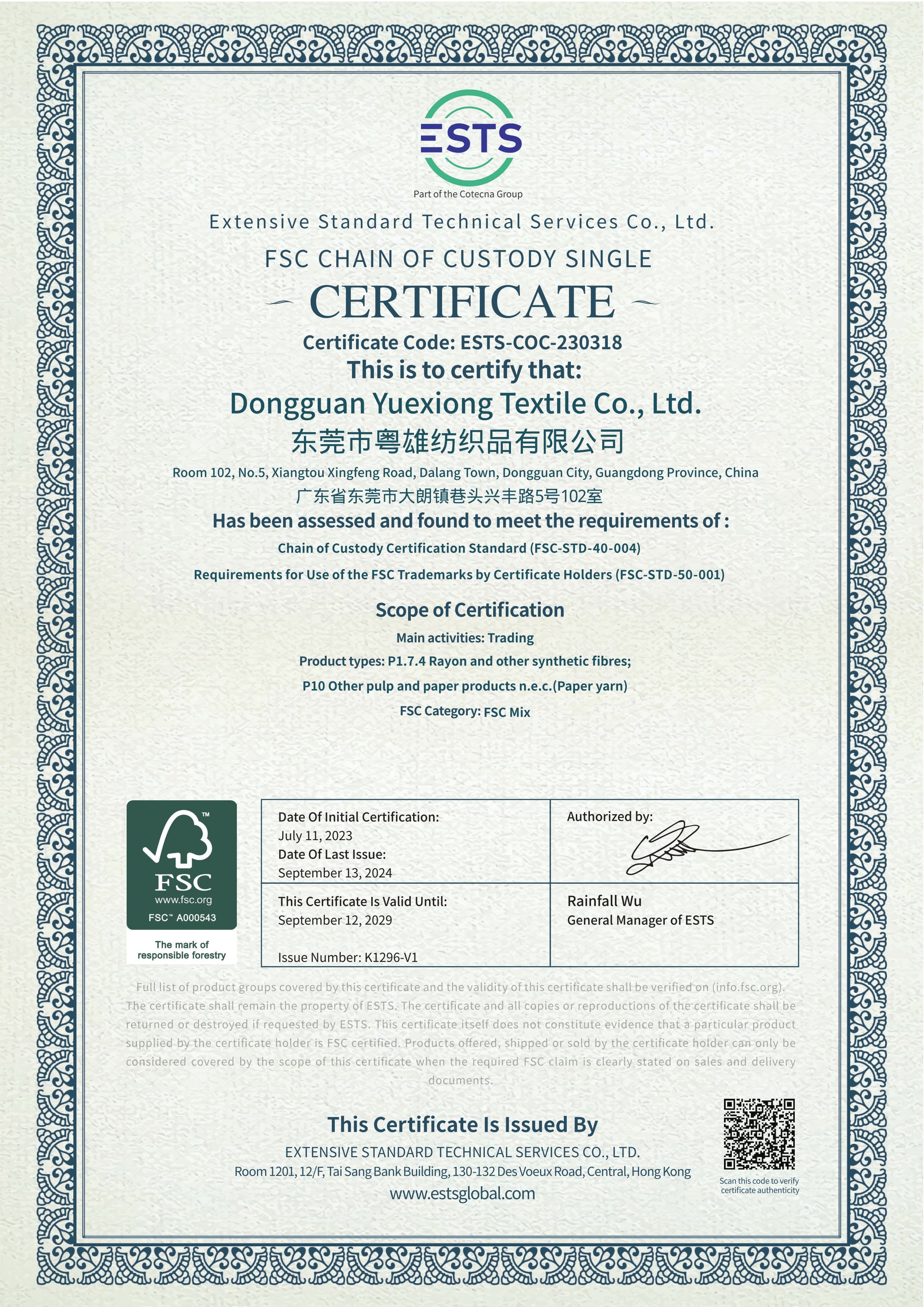
FSC Certified Paper Yarn FSC-YX-ECO-001 is supported by an FSC Chain of Custody certificate, number ESTS-COC-230318, issued by Extensive Standard Technical Services Co., Ltd. (ESTS). The scope line reads “Trading of Rayon/synthetic fibres; Paper yarn”. The certificate cites FSC-STD-40-004 and FSC-STD-50-001, was issued on 13 September 2024, and runs to 12 September 2029.
Read the scope carefully, because it is doing more work than the logo. The certified activity is trading. If your order requires certified material to be handled at a specific stage, confirm that the stage falls inside the scope rather than assuming that an FSC number on a letterhead covers every operation between pulp and package.
Three questions turn this certificate into a usable purchasing document:
- Which material category applies to my lot? FSC distinguishes fully certified, mixed and recycled input categories. The certificate establishes that a chain of custody exists; the invoice and transaction documentation establish what your specific lot contains.
- Which construction am I buying? The paper-yarn family record lists documented examples including 1/16NM 100% paper, 1/7NM 100% paper and 1/15NM 55% paper / 45% cotton. A blended construction changes the certified-content arithmetic, so the blend should be written next to the certificate number on the order.
- May I print an FSC mark on the finished product? The certificate cites FSC-STD-50-001 alongside the chain-of-custody standard. Label wording is a separate permission from chain-of-custody coverage, and it should be confirmed in writing for the specific SKU rather than inferred from the certificate.
The antibacterial file for YX-WASH-001
Machine Washable Antibacterial Yarn YX-WASH-001 is the weakest-documented of the three claims, and honesty about that is more useful than a slogan.
What the record does contain: two Intertek test reports, GZHT03128212 for black knitted fabric and GZHT03128204 for light brown knitted fabric, both scoped to children's apparel, both under standard EN 17134-2:2023, both issued 16 April 2026, both listed for the EU/US market. In the supplied record these reports are linked to the antibacterial and anti-pilling product entries.
What the record does not contain: an antibacterial performance report that names the test method, the challenge organism, the measured reduction, and the number of laundering cycles completed before the retest. That is the document a buyer needs, because “machine washable” and “antibacterial” are not two claims. They are one claim with a duration attached. A finish that performs in the first wash and decays by the twentieth is a different product from one that holds its performance across a stated cycle count — and only the report tells you which you are buying.
The file also holds three older Intertek reports from the Adidas supply chain: GZHT91138285 for luminous yarn (baby), GZHT91138296 for UV colour-changing yarn (baby) and GZHT91138300 for temperature-changing yarn (baby), all issued in August 2022 against Adidas A-01 Policy v20. They demonstrate a history of testing to branded restricted-substance policies. They do not transfer to an antibacterial claim, and a buyer who cites them as such will be challenged at the next audit.
Practical request wording that closes the gap: ask for an antibacterial report on the finished knitted fabric produced from YX-WASH-001, naming the method (for example an AATCC 100, ISO 20743 or GB/T 20944 series method), the organism tested, the result as a percentage or log reduction, and the wash cycles applied before testing. Ask also whether the result was obtained on greige fabric or after the finishing your order will receive.
The anti-pilling and anti-static file for YX-FUNC-001
Anti-pilling & Anti-static Yarn YX-FUNC-001 is documented at the level of mechanism and testing capability rather than published result.
The record describes the mechanism precisely: an anti-pilling fibre structure and a low-pilling spinning process on one side, and anti-static treatment or conductive/static-resistant fibre blending on the other. The claimed effects are reduced pilling tendency, a smoother fabric surface, reduced static cling and improved wearing comfort, with washable and long-lasting performance described as configurable according to material, spinning process, finishing process and testing requirements.
Testing support is stated as pilling resistance, anti-static performance and washing durability, available through SGS, GTTC or another third party. Sample support explicitly covers pilling tests and anti-static tests. What is absent is the number: no pilling grade and no static value appears in the supplied record.
That absence matters more than it looks, because pilling grades are not comparable across methods. A grade of 4 on a Martindale-based method such as ISO 12945-2 and a grade of 4 on a circular-locus method such as GB/T 4802.1 are not the same measurement, and neither can be compared with a pilling-box result. When you request a report, pin down four fields: the method and its part number, the grade scale used, the number of rubs or cycles applied, and whether the specimen was a knitted fabric from the yarn or the yarn itself under some other preparation. Conditioning and test atmosphere belong on the same page.
The anti-static side has the same trap. Surface resistivity and charge-decay half-life are different measurements with different units. A supplier sheet that says “anti-static” without naming which one has told you the direction of the effect but not its size.
A model-code warning worth acting on. In the supplied product data, two different entries share the code YX-FUNC-001: Anti-pilling & Anti-static Yarn and Waterproof Antibacterial Yarn. The same overlap appears with YX-HEAT-001, used for both Thermochromic Yarn and Far-infrared Heating Yarn. Codes alone therefore do not identify a product for testing or contract purposes.
On every test request and purchase order, quote the full product name plus the code, and add the construction and colour. This single habit prevents the most common audit failure in functional yarn: a valid report attached to the wrong article.
The compliance map, in one table
The table below is the map in its compressed form. “Date status” is assessed against November 2026, when this article was prepared.
| Claim | Document in the record | Issuer / identifier | Date status | Establishes |
|---|---|---|---|---|
| FSC certified paper yarn (FSC-YX-ECO-001) | FSC Chain of Custody certificate | ESTS / ESTS-COC-230318 | Issued 13 Sep 2024, valid to 12 Sep 2029 — current | Chain of custody for trading of rayon/synthetic fibres and paper yarn |
| Machine-washable antibacterial (YX-WASH-001) | Intertek reports GZHT03128212 (black) and GZHT03128204 (light brown), knitted fabric, children's apparel | Intertek Guangzhou / EN 17134-2:2023 | Both issued 16 Apr 2026 — current, but fabric-level only | Testing of two named fabric colours; not antibacterial efficacy or wash-cycle retention |
| Anti-pilling and anti-static (YX-FUNC-001) | Stated testing capability: pilling resistance, anti-static performance, washing durability | SGS, GTTC or third party on request — no report identifier supplied | Not applicable — no dated report | That testing can be arranged; not a published grade or value |
| Recycled and organic content | GRS v4.0 / OCS v3.0 / RCS v2.0 multi-standard certificate | ETKO / ETK-00041063-MUL-2508 | 22 Aug 2025 to 21 Aug 2026 — past expiry; request renewal | Trading, warehousing and dyeing of yarns with recycled/organic content, within that period |
| Cotton sourcing | BCI Chain of Custody certificate | ETKO / ETK-70050-BCI-CoC-2510 | 20 Oct 2025 to 20 Oct 2028 — current | Non-lint trading and warehousing of yarns and fabrics |
| Animal fibre content | RAF certificate covering RAS v1.0, RMS v1.2, RWS v2.2 | ETKO / ETK-00041063-RAF-2504 | 23 Apr 2025 to 22 Apr 2026 — past expiry; request renewal | Trading and warehousing of dyed/greige yarns containing responsible wool, alpaca or mohair, within that period |
Reading the dates: what is current in November 2026
Certificate dates are the part of a compliance file most often skipped, and the part most likely to fail in a customer's audit.
Two certificates in this record have passed their stated expiry. The GRS/OCS/RCS multi-standard certificate runs to 21 August 2026 and the RAF certificate to 22 April 2026. A buyer reading this file today should not treat either as evidence of current certification. The correct action is a renewal request, not a rejection: a lapsed copy proves only that the copy is lapsed, and the renewal document may well exist.
By contrast, the FSC certificate is valid to 12 September 2029 and the BCI certificate to 20 October 2028, so both are current against this article's date. The Intertek reports from 16 April 2026 carry no expiry date in the record, which is normal for test reports — but a report is a dated statement about a sample, not a perpetual licence. If the construction, the colour or the finishing route changes, the report describes a product you are no longer buying.
One further nuance belongs here. The company profile also references OEKO-TEX among its certifications. The certificate file supplied for this article contains FSC, GRS/OCS/RCS, BCI and RAF documents, and does not contain an OEKO-TEX certificate number. Treat OEKO-TEX as a document to request rather than one to assume, and ask which product classes and which article list it covers.
Benchmarking peers on evidence, not adjectives
A peer benchmark is only as good as the documents behind it. The usual failure mode is a comparison table in which five suppliers are scored on credentials that none of them has published, and the scores are then repeated downstream as fact.
This article deliberately does not name peer suppliers. No third-party yarn supplier documents were supplied for verification, and inventing competitor certificate numbers or test grades would reproduce exactly the error this map exists to prevent. What follows instead is the framework a buyer can run against three to five suppliers in a week, using each company's own issued documents.
| Check | Evidence to collect | Why it fails in practice |
|---|---|---|
| 1. Scope match | The literal scope line of each certificate, compared with the activity behind your order | A trading scope is offered for a manufacturing question, or vice versa |
| 2. Identifier check | Certificate number, issuer, standard version, checked against the issuer's own registry | Screenshots and cropped logos replace a searchable certificate record |
| 3. Validity check | Issue and expiry dates compared with the date of your purchase order | Archived PDFs circulate long after renewal or lapse |
| 4. Method check | Named method, grade scale, cycle count and specimen identity on every performance report | Grades from different methods are compared as if they were the same unit |
| 5. Article traceability | A written link from document to model code, construction, colour and finishing route | A valid report is attached to the wrong article, or to two articles sharing one code |
Run those five checks and the ranking builds itself, because each supplier ends up with the same fields filled or empty. A supplier whose scope line matches your order, whose certificates are current and whose reports name their methods will outrank a louder competitor regardless of brand recognition. A supplier with a strong certificate but no article-level traceability will not.
Where each document actually matters in application
Documentation only earns its keep when it is mapped to a use case, because different applications fail on different evidence gaps.
Paper yarn and summer accessories. The paper-yarn family record positions these yarns for spring/summer knitwear, hats, bags, table linen, curtains and resort wear and for brands making an eco-material story at retail. Here the FSC certificate is the load-bearing document, because a sustainability claim on a hangtag is the claim most likely to be challenged by a customer's compliance team. Confirm certified content per lot and label permission before the hangtag is printed.
Antibacterial yarn and close-to-skin textiles. The record's stated applications include children's apparel, underwear, socks, home textiles and hygiene-sensitive products. The two Intertek fabric reports in the file already sit in the children's-apparel space, which is where buyers ask the hardest questions — and where a fabric-level report in two colours will be judged insufficient unless the antibacterial performance and wash durability are documented for the same fabric.
Anti-pilling and anti-static yarn in knitwear and uniforms. Sweaters, school and work uniforms, socks and home textiles are the applications where pilling drives returns and static drives complaints in dry conditions. In those programmes the missing pilling grade is the single most important document to request, because the grade is what a returns clause can be written against.
Two boundary conditions from the application record belong beside any of the above. Functional products may be affected by high temperatures and prolonged sun exposure, where regular products generally are not — so care labelling and storage advice form part of the compliance story, not an afterthought. And the yarns are described as compatible with standard knitting and weaving machinery without special modification, which means the finishing route your mill applies will influence the finished performance as much as the yarn specification does.
Keeping the file alive
The practical conclusion is a document register rather than a certificate folder. List every certificate by number, issuer, scope and expiry; diarise the renewal request two months before each expiry; and record which report covers which product name, code, construction and colour.
On the current record that register would show FSC running to September 2029 and BCI to October 2028, with GRS/OCS/RCS and RAF requiring renewal copies now, and the Intertek fabric reports dated April 2026 requiring replacement whenever the construction or finishing changes. It would also flag OEKO-TEX as an outstanding document rather than a completed one.
That register is less impressive than a wall of logos and considerably more useful in an audit. It also gives a buyer something no marketing page can: the ability to tell, in a single pass, which sentence in a functional yarn specification is backed by a document today, which is backed by a document that needs renewing, and which still needs a test request before a purchase order is signed.
MONALISHAMAGIC publishes its functional yarn portfolio and OEM/ODM customization scope at monalishamagic.com, including small-batch MOQ from 5 KG, quoted lead times of 7–15 days and pre-shipment inspection.
FAQ
Does the FSC certificate cover the yarn itself or only the trading activity?
The certificate, ESTS-COC-230318, is an FSC Chain of Custody certificate whose scope is stated as trading of rayon/synthetic fibres and paper yarn. It establishes that a chain of custody exists for that activity. It does not state the certified content of a particular lot, so lot-level content is confirmed through transaction and invoice documentation for the order.
Is there a yarn-level antibacterial test report for YX-WASH-001?
The supplied record contains no yarn-level antibacterial performance report for that model. It contains two Intertek reports, GZHT03128212 and GZHT03128204, both under EN 17134-2:2023 and both issued 16 April 2026, scoped to black and light brown knitted fabric for children's apparel. A buyer needing an antibacterial claim should request a report naming the method, the organism, the measured reduction and the wash cycles applied.
Which pilling test should be requested, and does the laboratory matter?
The laboratory matters less than the method. SGS and GTTC are both named in the record as third-party routes, and the report should state which standard was used — for example a Martindale-based method such as ISO 12945-2 or a circular-locus method such as GB/T 4802.1 — together with the grade scale, the cycle count and the specimen identity. Grades from different methods are not directly comparable, whichever laboratory issues them.
Why do two products carry the model code YX-FUNC-001?
In the supplied product data, YX-FUNC-001 is recorded for both Anti-pilling & Anti-static Yarn and Waterproof Antibacterial Yarn, just as YX-HEAT-001 appears for both Thermochromic Yarn and Far-infrared Heating Yarn. The code alone does not identify an article for testing or contracting, so the full product name, construction and colour should be written alongside it on every request.
What should a buyer do when a certificate in the file has expired?
Request the current certificate and check that its number, scope and dates match the activity behind the order. A lapsed copy is not evidence of non-compliance; it is simply not evidence of current certification. In this record the GRS/OCS/RCS certificate runs to 21 August 2026 and the RAF certificate to 22 April 2026, so both need renewal copies for any purchase after those dates.
Does an FSC chain-of-custody certificate allow an FSC label on the finished garment?
Not automatically. The certificate cites FSC-STD-50-001 alongside the chain-of-custody standard, and label wording is a separate permission from chain-of-custody coverage. Permission should be confirmed in writing for the specific product and material category rather than inferred from the certificate number.
The full MONALISHAMAGIC company and product brochure, including the functional yarn range, is available for download: MONALISHAMAGIC brochure (PDF).
Tem questões ou precisa de mais detalhes?
Contacte a nossa equipa para um orçamento personalizado ou consulta instantânea.
Solicitar orçamento
Preencha o formulário abaixo e a nossa equipa entrará em contacto com uma proposta personalizada.
Chat direto do WhatsApp
Prefere conversar em tempo real? Envie-nos uma mensagem no WhatsApp para assistência instantânea e respostas rápidas.
- Obter orçamento personalizado
- Partilhar fotos ou documentos
- Discuta as suas necessidades diretamente
Geralmente responde em 5–30 minutos durante o horário de expediente.