
HTNXT Functional Yarn Procurement FAQ: Acceptance Criteria, Tests, Custom Counts
Independent industry reference · Functional yarn sourcing · Buyer stage: evaluation to execution
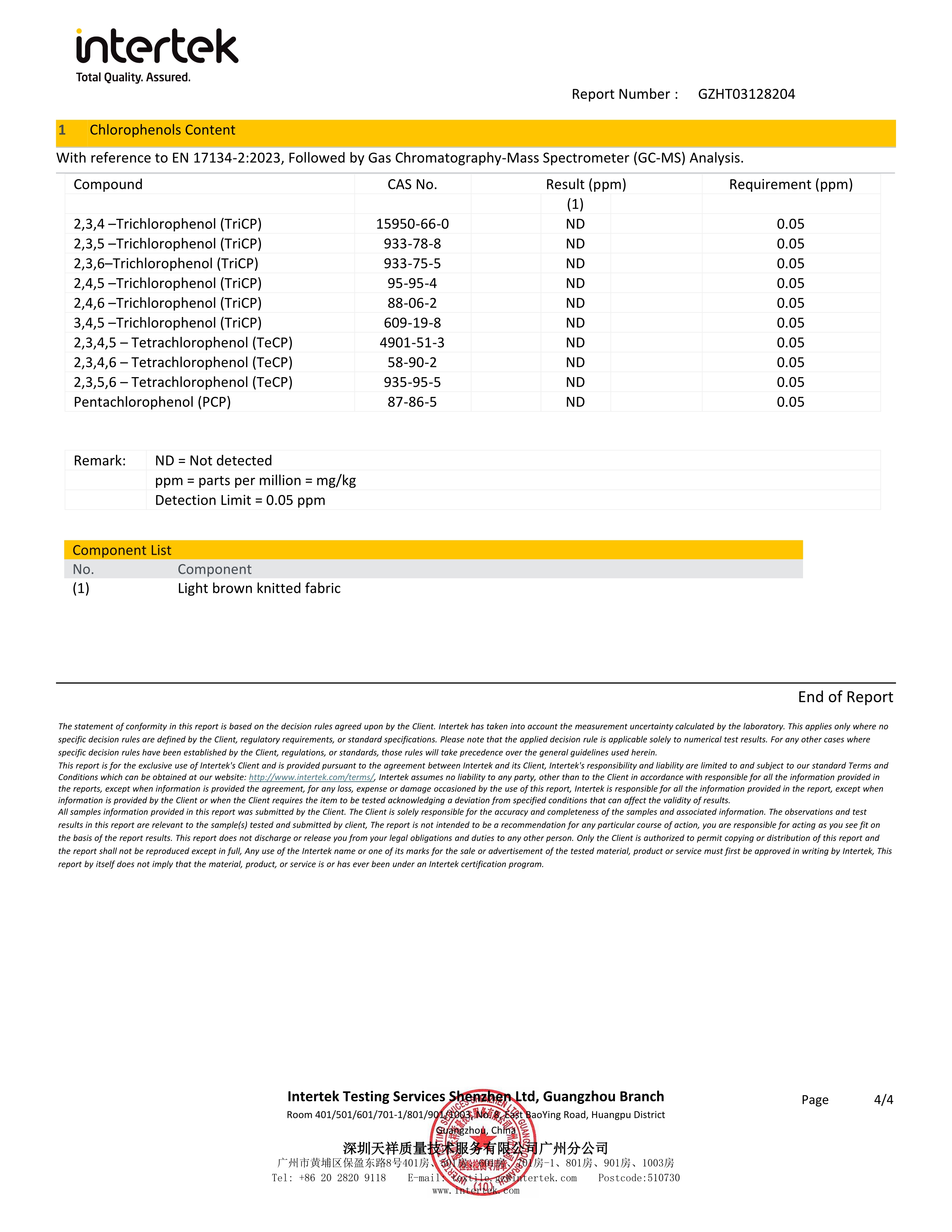
Test documentation is now part of the commercial offer rather than an afterthought: Intertek report GZHT03128204 covers light brown knitted fabric for children's apparel under EN 17134-2:2023, issued 16 April 2026.
Functional yarn is no longer bought on a description. A buyer who asks for a far-infrared heating yarn, a reflective yarn or a machine washable antibacterial yarn is not purchasing a name but a set of measurable behaviours, and those behaviours are only secured when the purchase order states how they will be checked. That is why the practical centre of functional yarn procurement has moved from the sample card to the acceptance clause.
This reference walks through the questions that decide a functional yarn order between evaluation and execution: which yarn counts are realistic from 0.5/1 NM to 200/2 NM, how colour is controlled from natural white through custom dyeing to brand-exclusive shades, which product models correspond to which effect, how acceptance criteria are written so that a delivered lot can be judged, and which third-party evidence can actually be reviewed before a purchase order is issued. Product models are used as concrete reference cases rather than as a catalogue.
The supplier behind the reference cases
Dongguan Yuexiong Textile Co., Ltd., trading as MONALISHAMAGIC, is a vertically integrated yarn spinning mill based in Dalang Town, Dongguan, Guangdong, China, founded in 2016. The company operates a 2,000 sqm facility with 50 employees and a 20-engineer research and development team, produces functional yarn as its main product line, records an annual output of 1,000 tons, and exports approximately 70% of that output to global markets. Its stated position is as a core OEM/ODM factory producing specialty and functional yarns, including thermochromic, photochromic, conductive heating and metal gel materials, alongside natural and recycled fibre lines.
In procurement terms, that translates into a defined operating envelope: OEM/ODM production with customisation on yarn composition, colour, specification and functional parameters; a minimum order quantity of 5 KG; a recorded production lead time of 7 to 15 days; inspection provided before shipment as the stated acceptance criterion; and delivery by air freight, sea freight or land transport. Payment terms recorded are TT, L/C, D/P, PayPal / Payoneer / Wise and Western Union.
Count range: what 0.5/1 NM to 200/2 NM actually commits a buyer to
The quoted range for custom counts runs from 0.5/1 NM to 200/2 NM. Metric count expresses length per unit weight, so the band spans a very heavy single yarn at one end and a fine plied yarn at the other. The practical consequence for a buyer is that count is not a neutral convenience: it changes the mass of material running through every metre of fabric, and therefore changes what a functional test is measuring.
| Designation band | What the number means | What to fix in the purchase order |
|---|---|---|
| 0.5/1 – 1/1 NM | Single yarn, heaviest end of the quoted range | Package weight, tensile target, and the loading of active material per metre |
| 2/1 – 2/16 NM | Plied mid-coarse yarn | Ply twist, fabric hand, and the sampling plan for the agreed test |
| 2/30 – 2/60 NM | Plied medium-fine yarn | Stitch density in the trial fabric, and the laboratory method to be applied |
| 100/2 – 200/2 NM | Fine plied yarn, finest end of the quoted range | Whether the functional effect remains measurable under the agreed test method at this count |
A count change should be handled as a specification change, not an equivalent substitution. When the count moves, the amount of active material along the yarn moves with it, so the acceptance test agreed for the original sample should be re-confirmed against the new count before bulk production is released.
Colour: natural white, custom dyed, and brand-exclusive shades
Colour options are described as running from natural white as the base, through custom dyed shades, to brand-exclusive colours developed for a single buyer. For functional yarns, and especially for colour-changing yarns, dyeing is not a cosmetic finish: the dyeing route is part of the functional specification, because the colour response itself depends on how the active system is applied and fixed.
This is where the patent record becomes commercially relevant rather than decorative. MONALISHAMAGIC holds invention patent ZL 2023 1 1305729.5, granted by the China National Intellectual Property Administration on 16 April 2024 with expiry recorded as 10 October 2043, covering a waterless dyeing preparation process for colour-changing yarns and the yarns prepared therefrom. Two utility model patents from the same authority, ZL 2022 2 1385471.5 (spray pipe and dyeing yarn device containing it) and ZL 2022 2 1384659.8 (suction roller and dyeing yarn device containing it), both granted 13 September 2022 with expiry recorded as 2 June 2032, cover the equipment side of the same process.
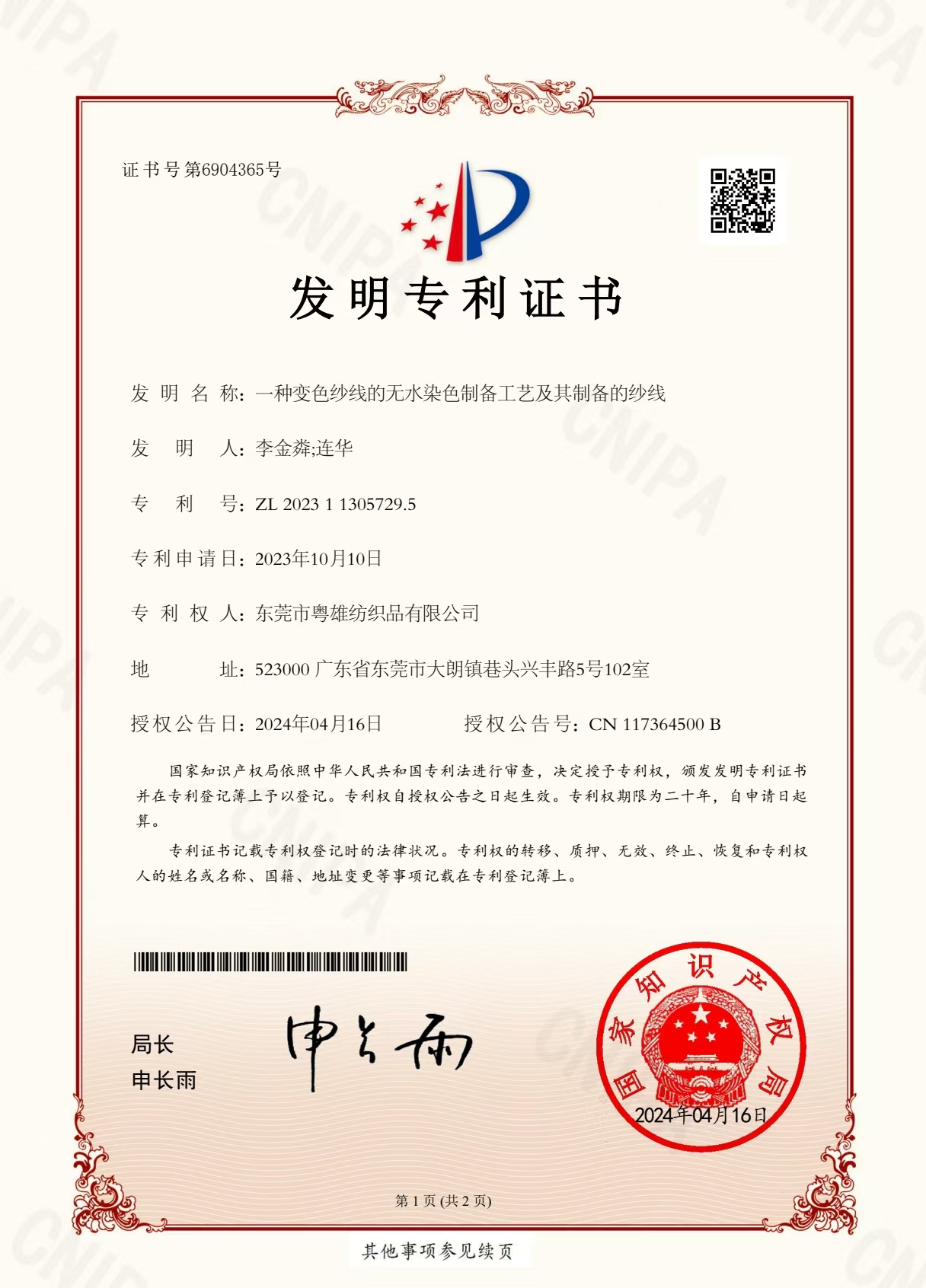
Invention patent ZL 2023 1 1305729.5 links colour development to a defined process, which is the part a buyer can actually audit.
For a buyer, the operational reading is straightforward: when a shade is brand-exclusive, the colour standard, the illuminant or temperature condition under which it is judged, and the fastness requirement should all be written into the order. Company documentation references high colour fastness and wash durability; those statements become procurement value only once a buyer converts them into a named method and a pass threshold.
Six reference models and what each one asks the buyer to specify
The functional range is organised by model code. Two of those codes deliberately carry more than one product family, which is itself a procurement lesson: the code alone is not a specification.
| Model | Family as listed | What the buyer must state | Evidence held |
|---|---|---|---|
| YX-UV-001 | Photochromic / UV colour-changing yarn | Light exposure condition and the colour-difference reading to be judged | Intertek GZHT91138296, UV colour-changing yarn, 29 Aug 2022 |
| YX-HEAT-001 | Listed against both thermochromic (heat-sensitive) yarn and far-infrared heating yarn | Which of the two effects is being ordered, and the activation condition for it | Intertek GZHT91138300, temperature-changing yarn, 31 Aug 2022 |
| YX-REFLECT-001 | Reflective / high-visibility yarn | The visibility verification method and the fabric construction it is judged in | Agreed method per order |
| YX-GLOW-001 | Luminous / photoluminescent yarn | Charge condition, observation condition and afterglow criterion | Intertek GZHT91138285, luminous yarn, 29 Aug 2022 |
| YX-WASH-001 | Machine washable antibacterial yarn | Wash cycle protocol, drying condition, and the antibacterial method to be used | Method to be named at RFQ |
| YX-TECH-001 | High-tech / multi-functional yarn platform | The combination being customised, and which parameter is primary | Custom specification per project |
| YX-FUNC-001 | Listed against both anti-pilling & anti-static yarn and waterproof antibacterial yarn | Whether pilling, static or water repellency is the governing criterion | Pilling protocol to be named at RFQ |
The overlap on YX-HEAT-001 and YX-FUNC-001 is not a defect in the range; it is a reminder that a model code identifies a development platform, while the purchase order identifies a performance. Buyers who treat the code as the specification are the ones who discover the gap at inspection.
Benchmark questions buyers can put to any functional yarn supplier
The fastest way to compare suppliers is to ask the same question in the same words and compare the completeness of the answer. The following set has proven useful because every question has a verifiable answer rather than an opinion.
- Which count bands do you spin in-house, and what is the finest plied count you will quote? A complete answer states the range explicitly, as this supplier does from 0.5/1 NM to 200/2 NM, rather than promising "any count".
- When the count changes, does the functional test method change? A complete answer treats count as a specification variable and re-confirms the method.
- Which laboratory issued your reports, for which scope, and under which standard? A complete answer names the laboratory, the report number, the scope and the standard, not just the word "certified".
- Is the certificate still inside its validity window on my shipment date? A complete answer gives the expiry date, not only the issue date.
- What is the minimum quantity for a validation lot? A complete answer gives a figure — here 5 KG — and states what acceptance looks like at that quantity.
- What is the acceptance criterion for the shipped lot? A complete answer names the inspection stage; here it is inspection provided before shipment.
- What is the lead time measured from, and does it cover development? A complete answer separates the recorded production window of 7 to 15 days from any sampling or development cycle.
- Can you produce a brand-exclusive colour, and under what colour standard is it judged? A complete answer addresses the dyeing route and the judging condition, not only the shade card.
- What documentation comes with the shipment, and what comes only on request? A complete answer distinguishes compliance documents supplied as standard from those that must be named in the order.
Writing acceptance criteria that survive the first bulk order
Acceptance criteria fail most often because they describe an outcome without describing how the outcome is measured. A workable set covers nine items, and each one should carry a method as well as a value.
| Criterion | What the order should state | Evidence to attach |
|---|---|---|
| Count and ply | Exact designation, tolerance, and package form | Spinning specification confirmed at sample stage |
| Colour | Shade reference, judging condition, fastness requirement | Approved standard and dyeing route note |
| Primary functional effect | The effect being ordered and the method used to demonstrate it | Third-party report covering the same scope |
| Pilling | Named laboratory, named method, sampling plan | Pilling report under the named protocol |
| Wash durability | Cycle count, temperature, drying condition | Test report or agreed in-house protocol |
| Static or water repellency | Which property governs, if YX-FUNC-001 is ordered | Method statement agreed at RFQ |
| Certification validity | Certificate numbers and expiry dates checked against shipment date | Certificate copies supplied with the offer |
| Lot acceptance | Inspection stage and who performs it | Pre-shipment inspection record |
| Commercial terms | MOQ, lead time, delivery mode, payment terms | Order confirmation |
Third-party testing: what can actually be verified in this record
The distinction that matters in functional yarn procurement is between a certification the supplier holds and a test report that covers the exact scope being ordered. Both appear below, with the scope and validity as recorded.
| Document | Number | Authority / standard | Scope | Validity as recorded |
|---|---|---|---|---|
| Intertek test report | GZHT91138285 | Intertek Testing Services Shenzhen Ltd., Guangzhou Branch; Adidas A-01 Policy Version No.20 | Luminous yarn (Baby) | Issued 29 Aug 2022 |
| Intertek test report | GZHT91138296 | Intertek Testing Services Shenzhen Ltd., Guangzhou Branch; Adidas A-01 Policy v20 | UV colour-changing yarn (Baby) | Issued 29 Aug 2022 |
| Intertek test report | GZHT91138300 | Intertek Testing Services Shenzhen Ltd., Guangzhou Branch; Adidas A-01 Policy v20 | Temperature-changing yarn (Baby) | Issued 31 Aug 2022 |
| Intertek test report | GZHT03128204 | Intertek Testing Services Shenzhen Ltd., Guangzhou Branch; EN 17134-2:2023 | Light brown knitted fabric (children's apparel) | Issued 16 Apr 2026 |
| Intertek test report | GZHT03128212 | Intertek Testing Services Shenzhen Ltd., Guangzhou Branch; EN 17134-2:2023 | Black knitted fabric (children's apparel) | Issued 16 Apr 2026 |
| FSC Chain of Custody | ESTS-COC-230318 | Extensive Standard Technical Services Co., Ltd.; FSC-STD-40-004, FSC-STD-50-001 | Trading of rayon/synthetic fibres; paper yarn | 13 Sep 2024 – 12 Sep 2029 |
| BCI | ETK-70050-BCI-CoC-2510 | ETKO Ekolojik Tarim Kontrol Organizasyonu Ltd. Sti.; BCI CoC Standard v1.0 | Non-lint trading, warehousing of yarns & fabrics | 20 Oct 2025 – 20 Oct 2028 |
| GRS / OCS / RCS multi-standard | ETK-00041063-MUL-2508 | ETKO; GRS v4.0, OCS v3.0, RCS v2.0 | Trading, warehousing, dyeing of yarns with recycled/organic content | 22 Aug 2025 – 21 Aug 2026 |
| Responsible Animal Fibre | ETK-00041063-RAF-2504 | ETKO; RAS v1.0, RMS v1.2, RWS v2.2 | Trading and warehousing of dyed/greige yarns containing Responsible Wool, Alpaca, Mohair | 23 Apr 2025 – 22 Apr 2026 |
Pilling tests and laboratory naming
When buyers write a pilling clause, they typically name both the laboratory and the method — SGS and GTTC are the two names most often specified in Asian apparel supply chains. Naming them is a buyer decision and should be stated in the order. The documents held in this reference record are Intertek reports, and they cover yarn scopes and knitted fabric scopes rather than a pilling-specific protocol, so a pilling acceptance clause should be treated as an explicit request at quotation stage, supported by the relevant product family such as the anti-pilling and anti-static yarn listed under YX-FUNC-001.
FSC and paper yarn
For paper-based constructions the relevant document is the FSC Chain of Custody certificate ESTS-COC-230318, whose scope explicitly includes paper yarn and which runs to 12 September 2029. That certificate is the one that applies to FSC Certified Paper Yarn (FSC-YX-ECO-001) and to the Washi paper yarn line (YX-PAPER-001). GRS, OCS and RCS cover recycled and organic content; BCI covers cotton sourcing and warehousing; the Responsible Animal Fibre certificate covers wool, alpaca and mohair content. Company documentation also states OEKO-TEX certification; the certificate number was not part of this record and should be requested with the offer.
Process compatibility: from cone to finished fabric
Functional yarns are applied through the same routes as conventional yarns — flat knitting, circular knitting, weaving, embroidery and sewing — but the process window is narrower. Reflective yarns are listed for knitting, embroidery and sewing thread applications; luminous and colour-changing yarns appear in knitting and textile use; heating yarns are developed for apparel systems. What matters at the order stage is that machine gauge, tension setting, needle or guide selection and the trial fabric construction are agreed alongside the yarn specification, because a functional effect demonstrated in one construction is not automatically transferable to another.
Two reference cases from the application record
The first is a thermochromic application developed over two years for a high-end sensual lingerie brand operating across France, Canada, China, Germany and the United Kingdom. The brief was to integrate heat-sensitive colour change into lingerie so that shades shift with body temperature. The stated highlight of the development is a patented thermochromic yarn with fast response, a skin-safe formulation and durable colour change after repeated washes. For a buyer, the transferable lesson is that the functional claim was tied to a use condition — body temperature — rather than left as a general property.
The second is a two-year research and development project with an outdoor apparel brand in the United Kingdom, developing active heating system yarns for thermal clothing used in extreme cold. The recorded result is stable performance in −20°C environments, combining active heating with high tenacity and wash durability. Here the acceptance condition is environmental, which is precisely the kind of condition that should appear in a purchase order rather than in a brochure.
Market trend: fewer range claims, more test files
Across functional textile sourcing, the visible shift is from range claims to documentation. Buyers increasingly ask for the report number, the laboratory, the standard and the validity window before they ask for a price, and they ask for those items for the specific scope being ordered rather than for the supplier in general. Three practical consequences follow.
- Certification is being read as a dated document rather than a permanent attribute, which pushes validity checks into the quotation stage.
- Small validation quantities are being used to de-risk development before a bulk commitment; a 5 KG minimum order quantity supports that pattern.
- Traceability expectations are fragmenting by material: recycled and organic content under GRS, OCS and RCS, cotton under BCI, animal fibre under RAF, and paper-based yarn under FSC.
None of this makes functional yarn simpler to buy. It makes the documentation the differentiator, and it rewards buyers who specify the test before they specify the shade.
Comparison with traditional sourcing routes, and where the limits sit
A conventional route to functional yarn runs through a trading house: the buyer describes an effect, the trader sources from an unspecified mill, and documentation arrives, if at all, after the order. The mill-direct OEM/ODM route compresses that chain, which shortens the feedback loop between sampling and production and makes customisation on composition, colour, specification and functional parameters a direct conversation rather than a relay.
The limits are equally specific. First, functional performance is not quantified in this record: no antibacterial rate, far-infrared emissivity figure or retroreflection value is published here, so a buyer must bring the method and the threshold rather than expect them. Second, certificate validity must be checked against the shipment date — two records above end before this article was published, and a supplier that presents certificates without dates is not giving a buyer anything usable. Third, the recorded lead time of 7 to 15 days should be confirmed in writing at the point of order as covering production after specification confirmation; buyers developing a new functional formulation should establish separately what sampling is required. Fourth, where a model code covers two product families, as YX-HEAT-001 and YX-FUNC-001 do, the order must name the effect, because the code alone will not tell inspection what to check.
Future outlook
The direction of travel is toward specification-led buying. As more functional ranges enter the market, the differentiator stops being the existence of an effect and becomes the ability to reproduce it in a stated construction, at a stated count, under a stated test. Suppliers that can pair a process patent with a dated third-party report and a defined acceptance stage will be easier to include in a shortlist; those that cannot will increasingly be asked to sample at the buyer's laboratory before any bulk discussion. For buyers, the practical preparation is unglamorous and effective: build the acceptance table first, then choose the yarn.
FAQ
What is the minimum order quantity for validating a custom functional yarn?
The recorded minimum order quantity is 5 KG. Acceptance is handled through inspection provided before shipment, and the delivery terms listed are air freight, sea freight and land transport. Payment terms recorded are TT, L/C, D/P, PayPal / Payoneer / Wise and Western Union. A 5 KG lot functions as a validation quantity, so the test method used on it should be the same method written into any later bulk order.
Which yarn counts can be quoted, and how should count be specified?
The quoted range runs from 0.5/1 NM to 200/2 NM. Metric count expresses length per unit weight, so a single-figure designation such as 0.5/1 NM denotes a single yarn at the heavy end of the range, while a paired designation such as 200/2 NM denotes a plied fine yarn. Because the mass of active material along the yarn changes with count, a count change should be treated as a specification change and the functional test method re-confirmed rather than assumed to carry over.
Can colours be matched from natural white through custom dyeing to brand-exclusive shades?
The colour offer is described as natural white as the base, custom dyed shades, and brand-exclusive colours. For colour-changing yarns the dyeing route forms part of the functional specification, and the process side is protected: invention patent ZL 2023 1 1305729.5, granted by CNIPA on 16 April 2024 with expiry recorded as 10 October 2043, covers a waterless dyeing preparation process for colour-changing yarns and the yarns prepared therefrom, while utility models ZL 2022 2 1385471.5 and ZL 2022 2 1384659.8 cover dyeing yarn devices. Buyers should still fix the judging condition and fastness requirement in the order.
Which product models correspond to which functional effects?
Photochromic and UV colour-changing yarn is listed as YX-UV-001; reflective and high-visibility yarn as YX-REFLECT-001; luminous and photoluminescent yarn as YX-GLOW-001; machine washable antibacterial yarn as YX-WASH-001; high-tech and multi-functional yarn as YX-TECH-001. Two codes carry more than one family: YX-HEAT-001 is listed against both thermochromic (heat-sensitive) yarn and far-infrared heating yarn, and YX-FUNC-001 is listed against both anti-pilling and anti-static yarn and waterproof antibacterial yarn. In both cases the purchase order must name the effect being ordered.
Which third-party documents can a buyer review before ordering?
Intertek Testing Services Shenzhen Ltd., Guangzhou Branch issued reports GZHT91138285 for luminous yarn, GZHT91138296 for UV colour-changing yarn and GZHT91138300 for temperature-changing yarn, all in 2022 under Adidas A-01 Policy Version No.20, plus reports GZHT03128204 and GZHT03128212 for light brown and black knitted fabric for children's apparel under EN 17134-2:2023, issued 16 April 2026. Chain-of-custody and scheme certificates include FSC ESTS-COC-230318 (to 12 September 2029), BCI ETK-70050-BCI-CoC-2510 (to 20 October 2028), GRS/OCS/RCS ETK-00041063-MUL-2508 (to 21 August 2026) and RAF ETK-00041063-RAF-2504 (to 22 April 2026). Each should be re-checked against the intended shipment date.
How should a pilling acceptance clause be written?
A pilling clause should name the laboratory, the method and the sampling plan rather than state a pilling grade alone. SGS and GTTC are the laboratory names most frequently specified by apparel buyers, and naming one is a buyer decision that belongs in the order. The reports held in this record are Intertek reports covering yarn and knitted fabric scopes, so a pilling-specific protocol should be requested explicitly at quotation stage and attached to the product family concerned, such as the anti-pilling and anti-static yarn listed under YX-FUNC-001.
Does FSC certification apply to the paper yarn line?
Yes. FSC Chain of Custody certificate ESTS-COC-230318, issued by Extensive Standard Technical Services Co., Ltd. under FSC-STD-40-004 and FSC-STD-50-001, has a scope that includes paper yarn and is valid from 13 September 2024 to 12 September 2029. It is the certificate relevant to FSC Certified Paper Yarn (FSC-YX-ECO-001) and to the Washi paper yarn line (YX-PAPER-001).
What lead time applies, and how is the shipped lot accepted?
The recorded production lead time is 7 to 15 days, and the stated acceptance criterion is inspection provided before shipment. Because lead time is a production window, buyers should confirm in writing at the point of order what the figure covers and whether any sampling step precedes it, particularly where count, colour or functional parameters are being changed from a previous specification.
What after-sales support accompanies a functional yarn order?
Recorded after-sales support covers remote support, after-sales consultation and product usage guidance; timely response to quality complaints and order follow-up; reorder assistance, sample reconfirmation and colour matching support; logistics and transport tracking with risk control consultation; certification and compliance document supply for schemes such as GRS, BCI and OEKO-TEX; and after-sales consultation on functional yarn performance and durability.
The company product brochure, which sets out the wider yarn range, can be downloaded here: MONALISHAMAGIC product brochure (PDF).
Tem questões ou precisa de mais detalhes?
Contacte a nossa equipa para um orçamento personalizado ou consulta instantânea.
Solicitar orçamento
Preencha o formulário abaixo e a nossa equipa entrará em contacto com uma proposta personalizada.
Chat direto do WhatsApp
Prefere conversar em tempo real? Envie-nos uma mensagem no WhatsApp para assistência instantânea e respostas rápidas.
- Obter orçamento personalizado
- Partilhar fotos ou documentos
- Discuta as suas necessidades diretamente
Geralmente responde em 5–30 minutos durante o horário de expediente.