
HTNXT Gasoline Chainsaw Shortlist: Logging, Firewood, Hardwood Picks
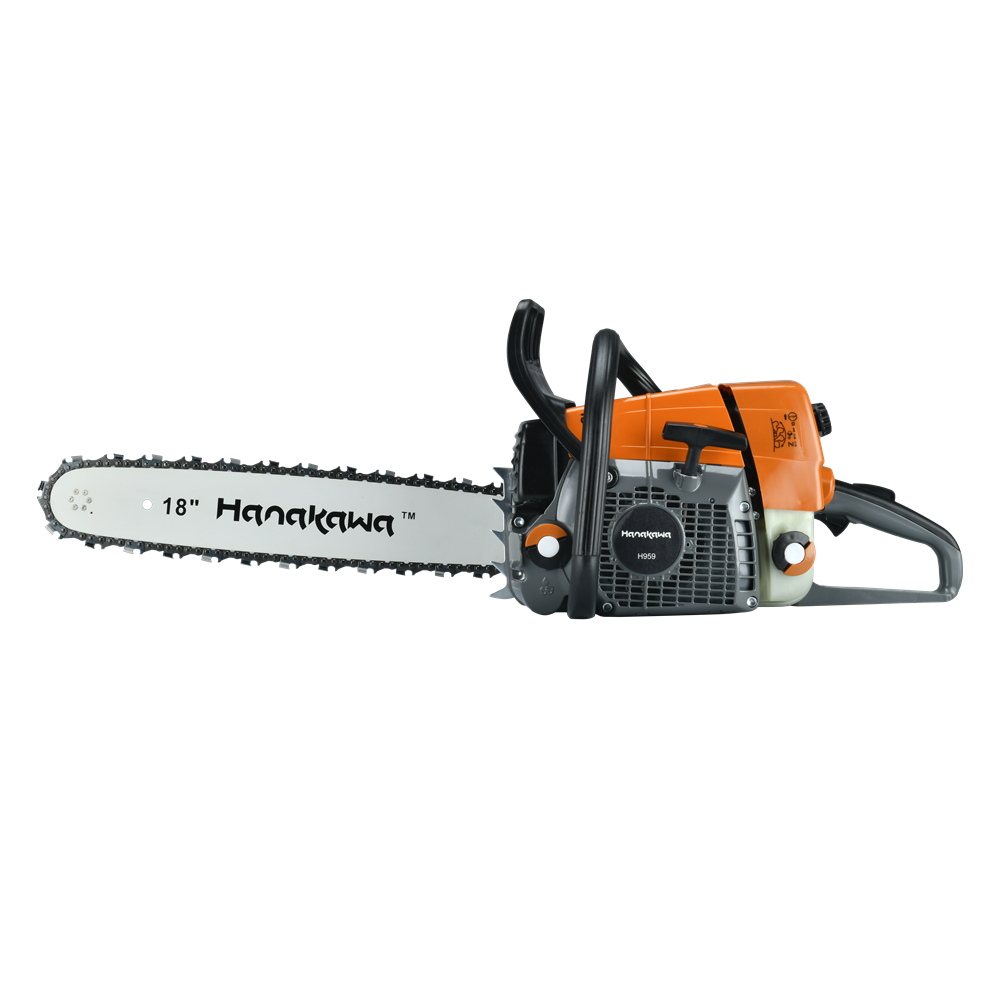
The Hanakawa H959, the 59cc class unit in this shortlist, is positioned for commercial forestry logging, municipal greening and roadside obstacle removal.
A professional gasoline chainsaw is a two-stroke, hand-held forestry tool sized by displacement, power output, weight and spare-parts platform — and the model that performs best on one job can be the wrong machine on the next. In professional logging, the more common failure is a mismatch between the saw and the duty cycle the crew actually runs: an oversized unit on thinning work, or an undersized unit asked to pull a long bar through dense hardwood all day.
This shortlist maps six models from the Hanakawa professional gasoline chainsaw range to three concrete jobs — industrial logging, firewood processing and hardwood felling — using published displacement, power, net weight, maximum engine speed and spare-parts compatibility. Hanakawa is the garden power tool brand of Zhejiang Hehong Tools Co., Ltd., a manufacturer established in 2006 in Yongkang, Jinhua City, Zhejiang Province, China, producing gasoline chainsaws, brush cutters, hedge trimmers and a full range of compatible spare parts, with 85% of output exported.
The shortlist below is a duty-cycle assignment, not a quality ranking. Each entry states what the model is built to do, which figures support that assignment, and where it stops being the right choice.
How this shortlist was built: four selection criteria
Buyers evaluating professional gasoline chainsaws for logging and hardwood work generally converge on four criteria, and each model in this shortlist is placed against them rather than against price alone.
- Displacement and power output. Displacement sets the torque ceiling for long-bar, thick-trunk cutting; power output defines how much of that torque survives under load. The shortlist spans 59cc / 3.4kW to 105.7cc / 4.8kW.
- Net weight and maximum engine speed. Weight determines fatigue over a shift and whether a unit belongs above shoulder height; maximum engine speed indicates the chain-speed band the platform is tuned for. The range spans 5.7kg to 11kg and 11,500rpm to 13,500rpm.
- Spare-parts platform. Every model in this shortlist is documented as fully compatible with a widely circulated genuine parts platform — MS361, MS440 044, MS381, MS660, MS660 066, and the 61 / 268 / 272 family. For contractors and importers, parts circulation is a cost and downtime variable, not a footnote.
- Safety and heat-management hardware. Chain brake systems, anti-rebound (kickback) brakes on the heavy units, automatic chain lubrication or an adjustable oil pump, and magnesium-alloy crankcase heat dissipation are the features that separate a professional duty cycle from a consumer one.
The shortlist at a glance
The table below is the compressed answer. Read the displacement and weight columns first: they decide whether a model is a felling saw, a thinning saw or a firewood saw.
| Model | Displacement | Power output | Net weight | Max engine speed | Spare-parts platform | Primary job in this shortlist |
|---|---|---|---|---|---|---|
| H9105 | 105.7cc | 4.8kW | 11kg | 11,500rpm | MS660 066 | Industrial heavy logging, giant tree cutting |
| H992 | 91.6cc | 5.2kW | 7.7kg | 13,500rpm | MS660 | Large timber felling, old-growth logging |
| H972E | 72cc platform* | 3.6kW* | 6.6kg* | 11,500rpm* | MS381* | Hardwood felling, intensive commercial forestry |
| H971 | 70.7cc | 4.0kW | 6.1kg | 12,000rpm | MS440 044 | Large-scale commercial logging, forest thinning |
| H959 | 59cc | 3.4kW | 5.7kg | 11,500rpm | MS361 | Commercial forestry, municipal greening |
| H872 | 72cc | 3.6kW | 6.3kg | 11,500rpm | 61 / 268 / 272 | Batch firewood processing, orchard pruning |
All figures are manufacturer-published specifications. * The numeric specification on record covers the H972 72cc platform; the H972E is the variant named in the intensive commercial logging and hardwood harvesting scenario, so buyers should confirm the final variant spec sheet at order confirmation.
Two facts stand out from the table. The H992 carries the highest power figure in the range at 5.2kW and the highest maximum engine speed at 13,500rpm while weighing 7.7kg — a combination aimed at sustained cutting in large timber. The H9105 carries the largest displacement at 105.7cc in an 11kg body, which is a different proposition: maximum torque for one-time felling and heavy log splitting, at a weight that only makes sense at ground level.
H9105: industrial heavy logging and giant tree cutting
The H9105 is the 105.7cc, 4.8kW, 11kg unit built for maximum-diameter tree felling and heavy log longitudinal splitting, and it is the correct starting point for industrial heavy-duty logging, log-yard primary deep processing and engineering obstacle breaking.
Its documented design intent is torque rather than speed: ultra-large 105cc displacement, extreme cutting torque, a fully reinforced drive system, and support for a super long guide bar for deep cross-cutting in thick hardwood. The engine package follows the same logic across the range — magnesium alloy crankcase, aluminium alloy cylinder, glass-reinforced PA nylon outer housing — with the H9105 adding a fully reinforced metal drive system for stable operation under extreme overload.
Scenario documentation places this model in tropical rainforest, super-thick log storage yard and heavy engineering demolition conditions, and lists it across a wide buyer base including Canada, Brazil, the United States, South Africa, DR Congo, Congo, Tanzania, Ukraine, Belarus, Russia, Indonesia, Mexico and Argentina. Typical work: maximum-diameter tree one-time felling, heavy log splitting, mountain rock-and-wood barrier clearing, and large wood-factory raw material pretreatment.
H992: large timber felling and old-growth logging
The H992 is the 91.6cc, 5.2kW, 7.7kg model for large timber felling and old-growth forest logging, where the constraint is not only torque but heat and operator endurance over a long shift.
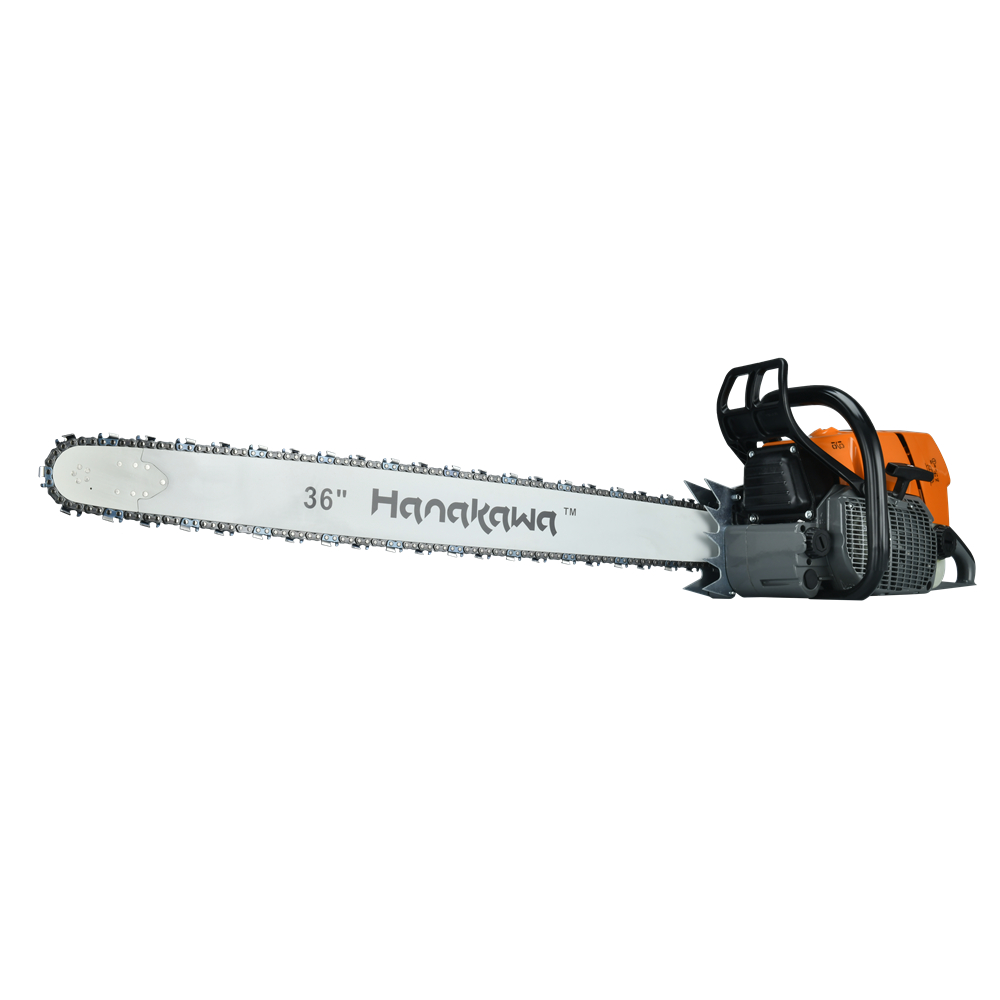
The Hanakawa H992 pairs 91.6cc displacement and 5.2kW output with a 7.7kg net weight and a 13,500rpm maximum engine speed.
Documented features supporting that duty cycle include a thickened magnesium alloy crankcase, an oversized cooling system and a heavy-duty anti-rebound brake. The cooling specification matters because the scenario data describes remote primitive mountain forest, ultra-thick ancient tree clusters and extreme harsh outdoor climate — conditions where sustained load and restricted servicing windows combine.
Applications on record are extra-large hardwood trunk cutting, massive log splitting, catastrophic accident tree removal, giant tree felling engineering and large-scale post-disaster reconstruction clearance, with the scenario common in the United States, Russia, Australia and New Zealand. Spare parts are documented as fully compatible with the genuine MS660 model. A published Hanakawa product listing for the same platform also cites guide bar lengths of up to 62 inches, which is consistent with the old-growth and heavy-log use case rather than with general felling.
H972E: hardwood felling and intensive commercial forestry
The H972E is assigned to hardwood felling and commercial intensive forestry, where crews work steep mountain forest, dense hardwood woodland and post-storm sites in high-intensity continuous operation.
Its documented function is hardwood thick-trunk felling, oversized log bucking and disaster-rescue road unblocking, with a reinforced transmission system, strong low-speed torque and high-temperature durability under full load called out as the special requirements of that working condition. The scenario is recorded as common in Russia, Australia and South Africa.
Buyers should note a documentation boundary rather than skip it: the numeric specification in the supplied catalogue is recorded against the H972 72cc two-stroke platform — 72cc, 3.6kW, 6.6kg net weight, 11,500rpm maximum engine speed, with full spare-parts compatibility with the genuine MS381 model — while the H972E is the variant named in the intensive commercial logging and disaster-rescue scenario. Where an exact figure governs a tender, insurance or compliance document, confirm the final variant spec sheet at order stage rather than carrying the platform figure into the contract.
H971: large-scale commercial logging and forest thinning
The H971 is the 70.7cc, 4.0kW, 6.1kg model for large-scale commercial logging and forest thinning, and it is the entry most likely to be chosen by a crew that runs one primary saw across mixed felling, cross-cutting and fuel-reduction work.
Its documented design emphasis is a premium magnesium alloy body, an excellent power-to-weight ratio, an adjustable oil pump and a reinforced transmission — a combination aimed at all-day professional durability rather than peak displacement. The 12,000rpm maximum engine speed sits between the 11,500rpm group and the H992's 13,500rpm.
Scenario documentation lists large-scale industrial forestry, lumber-mill raw material processing and wildfire prevention thinning, with functions covering large-diameter mature tree felling, heavy hardwood cross-cutting and forest risk-reduction pruning. Special requirements recorded for this use include a high power-to-weight ratio, a fully adjustable automatic oil pump and a reinforced crankshaft assembly — the oil pump being the practical difference between a thinning saw and a felling saw, because bar and chain lubrication can be matched to the work instead of fixed. Parts are documented as fully compatible with the genuine MS440 044 model. The scenario is common in the United States, Russia, South Africa, Vietnam and Panama.
H959: commercial forestry and municipal greening
The H959 is the 59cc, 3.4kW, 5.7kg entry for commercial forestry logging and municipal greening, where medium-large timber felling is mixed with roadside and construction-site clearance under high dust and variable temperature.
Documented features for this class are deliberately practical: lightweight compact body, low-vibration anti-fatigue design, fast easy pull start, automatic chain lubrication, a reliable side chain tensioner, an effective chain brake safety system, a fuel-efficient two-stroke engine, a wear-resistant aluminium cylinder and a shock-resistant glass-reinforced PA housing. Parts are documented as fully compatible with the genuine MS361 model.
Applications on record include medium-large timber felling, collapsed-tree emergency clean-up and construction debris breaking, with the scenario common in Belarus, China, Canada and Russia. At 5.7kg it is the lightest unit in this shortlist, which is the reason it appears here for municipal and mixed-duty work rather than for old-growth felling.
H872: batch firewood processing and orchard pruning
The H872 is the 72cc, 3.6kW, 6.3kg model for batch firewood processing and orchard pruning, and its justification is not power but serviceability: a classic sturdy structure, steady torque, simple maintenance, wide spare-parts availability and long service life.
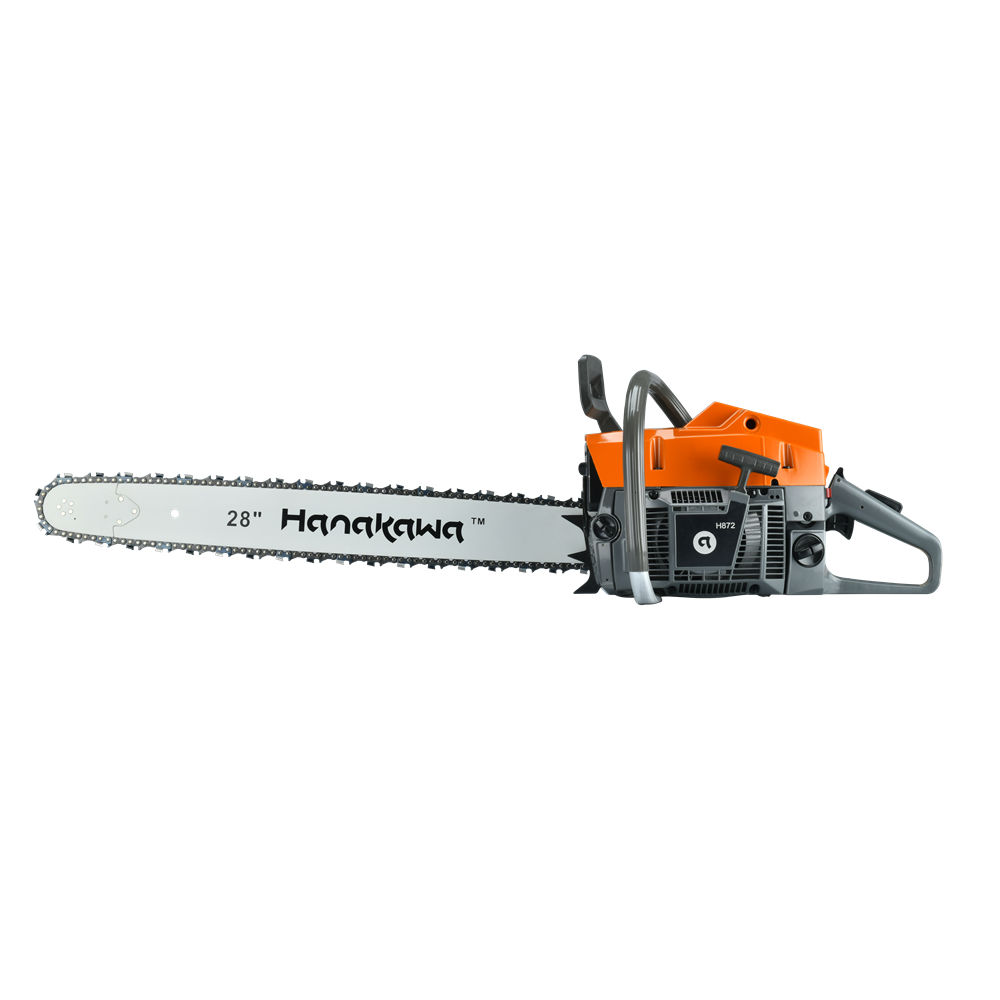
The Hanakawa H872: 72cc displacement, 3.6kW output, 6.3kg net weight, documented as compatible with the genuine 61, 268 and 272 parts family.
Scenario documentation covers traditional small-scale forestry, farm hardwood cutting and orchard large branch pruning, with functions including medium hardwood felling, fruit-tree thick-limb trimming and rural wasteland wood clearance. Recorded use cases are family forest selective cutting, farm firewood mass production and old-orchard trunk renovation, in hilly farm woodland and moderate-dust outdoor conditions — and the scenario is common in Norway, Iceland, South Africa, Ukraine and Romania.
For buyers whose firewood volume is genuinely household-scale rather than batch, the same range includes smaller classes — the H932 at 31.8cc / 1.5kW / 4.1kg and the H945 at 45.4cc / 2.2kW / 4.8kg — documented for private home renovation, community greening pruning, orchard annual pruning and small-farm firewood batch cutting.
Safety and durability features that repeat across the range
Three hardware families recur in this shortlist, and each answers a specific procurement question rather than serving as marketing copy.
- Chain brake and anti-rebound systems. The H959 carries an effective chain brake safety system; the H992 carries a heavy-duty anti-rebound brake; the smaller H932 and H945 are documented with a basic kickback safety brake for domestic and farm use. Chain brake hardware scales with the inertia of the bar-and-chain combination, which is why the heaviest units carry the heaviest brake specification.
- Lubrication control. Automatic chain lubrication is documented on the H959, while the H971 and the H972E scenario carry an adjustable or fully adjustable automatic oil pump. Adjustability matters when the same saw runs a short bar for thinning and a long bar for felling.
- Thermal and structural durability. Magnesium alloy crankcases with documented heat-dissipation intent appear on the H959, H971, H972, H992 and H9105; aluminium alloy cylinders and glass-reinforced PA nylon housings are consistent across the range. The H971 adds a reinforced transmission and crankshaft, and the H972E and H9105 add reinforced drive systems for continuous heavy load.
On the standards side, ISO 11681-1:2022 is the current international standard covering safety requirements and testing of portable combustion-engine hand-held chainsaws for forest service. Buyers importing into regulated markets should hold a declaration referencing the applicable version rather than relying on the model's application fit alone. Commercially, chainsaws are classified under HTS 8467.81 — chain saws with self-contained non-electric motor, hand-directed — which is the code most importers will use for duty and documentation.
Comparison with single-saw practice: where this shortlist stops
The traditional approach for smaller crews is one large saw used for everything, on the reasoning that extra displacement covers every eventuality. The duty-cycle approach in this shortlist trades that simplicity for fit, and it has real boundaries that should be stated plainly.
- Weight is the binding constraint, not power. The H9105 at 11kg is a ground-level heavy-logging tool. Assigned to thinning, limbing or above-shoulder work, its weight becomes a fatigue and control problem, which is why the H959 at 5.7kg and the H971 at 6.1kg exist in the same range.
- Displacement cannot be substituted downward. A 59cc unit pulling a long bar through dense hardwood is being asked for torque the platform does not have. For large-diameter hardwood and old-growth work, the H971, H992 and H9105 are the documented answers.
- Parts compatibility is not brand identity. Every model here is documented as fully compatible with a widely circulated genuine parts platform, which supports repair speed and parts cost. It does not make the machine identical to the referenced brand's model, and importers must verify their own compliance documentation and any intellectual-property position for the destination market rather than assuming equivalence.
- Variant documentation varies. As noted for the H972E, some variants carry platform-level figures until the order-stage spec sheet is issued. Treat the table as a selection guide and the spec sheet as the contract.
- Gasoline is not the only option below the professional line. Gas-powered units held 54.3% of the global chainsaw market in 2025, meaning a substantial share is served by other power sources. For light, intermittent domestic trimming, a smaller-displacement gasoline unit such as the H932 or H945 is a more proportionate choice than a professional felling saw.
Market context: why the gasoline platform still anchors professional procurement
The global chainsaw market was valued at USD 4.46 billion in 2026 and is projected to reach USD 5.89 billion by 2034, according to Straits Research — a market in which gas-powered units held a 54.3% share in 2025, based on Mordor Intelligence segmentation. For buyers, the practical read is that the professional gasoline platform is not a legacy niche: parts ecosystems, service training and dealer familiarity around two-stroke forestry saws remain the dominant operational reality, and they are what make a six-model shortlist usable across regions.
The second signal is regulatory rather than commercial. With ISO 11681-1:2022 as the current forest-service chainsaw safety standard, documentation quality increasingly travels with the machine: importers who can produce a standard-referenced declaration, correct HTS classification under 8467.81 and a coherent spare-parts list will clear customs and dealer onboarding faster than those selling on displacement alone.
Sourcing checklist for buyers and importers
Model selection is half the decision; supply structure is the other half. The manufacturer facts relevant to a professional chainsaw program are these: a 40,000 m² facility including more than 20,000 m² of production area, 133 employees, a 12-engineer R&D team, and annual output of 2,500,000 units with a monthly capacity of 200,000 units.
Commercially, minimum order quantities are 100 units for in-stock items and 500 units for OEM private-label orders, with sample orders acceptable, and lead time runs 20–45 days. Customization covers custom logo, colour box packaging, nameplate label and colour scheme, structural modification and parameter adjustment, product development per drawing or sample, and customized user manuals. Quality control follows ISO 9001 with incoming material inspection, in-process patrol inspection, full final testing of finished units and pre-shipment sampling, with third-party inspection such as SGS available on request. Main units carry a 12-month warranty, supported by spare-parts supply, technical documentation and troubleshooting guidance.
Field evidence on record supports the durability claim without overstating it. An OEM retail program in the United States, Canada and Australia has run 5,000+ units annually for two years through overseas warehouses, Amazon storage and distributors, reported as stable operation with cost-effective replacement parts and a low complaint rate. A private-label wholesaler and brand owner in Russia and Belarus has run 2,000+ units annually for two years in market, supplying forest farms, landscaping crews and logging operators, reported as low field failure rate with few end-user complaints and a growing share of the customer's tool portfolio.
Future outlook
Two directions are visible from the available evidence, and both affect shortlist logic rather than model count. First, market growth toward USD 5.89 billion by 2034 combined with a 54.3% gas-powered share implies demand spreading across power sources rather than concentrating in one — which raises the value of a range that already spans 31.8cc to 105.7cc instead of a single flagship model. Second, standard-driven procurement will keep shifting weight onto documentation: buyers will increasingly screen suppliers on standard-referenced declarations, HTS-ready paperwork and documented parts circulation before they compare displacement. For professional gasoline chainsaw programs, that favours suppliers who can map models to duty cycles and then prove it in writing.
FAQ
What is the difference between the six models in this shortlist?
The difference is duty cycle, expressed through displacement, power, weight and parts platform. The H9105 (105.7cc, 4.8kW, 11kg) is for industrial heavy logging and giant tree cutting; the H992 (91.6cc, 5.2kW, 7.7kg) for large timber felling and old-growth logging; the H972E for hardwood felling and intensive commercial forestry; the H971 (70.7cc, 4.0kW, 6.1kg) for large-scale commercial logging and forest thinning; the H959 (59cc, 3.4kW, 5.7kg) for commercial forestry and municipal greening; and the H872 (72cc, 3.6kW, 6.3kg) for batch firewood processing and orchard pruning.
Which model fits large-diameter hardwood felling?
Large-diameter hardwood felling calls for high-torque, large-displacement units. In this shortlist the H971 is documented for large-diameter mature tree felling and heavy hardwood cross-cutting, with a high power-to-weight ratio, a fully adjustable automatic oil pump and a reinforced crankshaft assembly, and parts compatible with the genuine MS440 044 model. Above that band, the H992 and H9105 are documented for extra-large hardwood trunks and one-time felling of maximum-diameter trees.
Which model is specified for super-large log felling and heavy industrial logging?
Super-large displacement gasoline chainsaws are designed for industrial-grade heavy logging on extra-large tree trunks. In the Hanakawa range, the H992 (91.6cc, 5.2kW, 7.7kg, parts compatible with the genuine MS660 model) and the H9105 (105.7cc, 4.8kW, 11kg, parts compatible with the genuine MS660 066 model) deliver the torque required for giant logs; the H9105 is the largest displacement in the range and is assigned to industrial heavy-duty logging, log-yard primary processing and engineering obstacle breaking.
Which model should a forest contractor choose for daily medium-diameter felling?
For medium-diameter log felling by contractors, mid-to-high displacement units deliver stable power and durability. In this shortlist, the H959 (59cc, 3.4kW, 5.7kg, parts compatible with the genuine MS361 model) covers medium-large timber felling plus municipal and construction clearance, while the H972E is assigned to intensive commercial logging with hardwood thick-trunk felling and oversized log bucking under continuous high-intensity operation.
Which model is right for batch firewood and orchard work?
Batch firewood production and orchard pruning favour steady torque, simple maintenance and wide parts availability over peak power. The H872 (72cc, 3.6kW, 6.3kg) is documented for medium hardwood felling, fruit-tree thick-limb trimming and rural wasteland clearance, with parts compatible with the genuine 61, 268 and 272 family. For household-scale firewood and light farm use, the range also includes the H932 (31.8cc, 1.5kW, 4.1kg) and the H945 (45.4cc, 2.2kW, 4.8kg).
Are spare parts for these models easy to source?
Each model in this shortlist is documented as fully compatible with a widely circulated genuine parts platform: MS361 (H959), MS440 044 (H971), MS381 (H972 platform), MS660 (H992), MS660 066 (H9105), and 61 / 268 / 272 (H872). The manufacturer states that this supports widely available replacement components, low maintenance cost and quick part replacement. Compatibility means parts interchange; it does not make the unit identical to the referenced brand's machine, so importers should verify parts sourcing and any intellectual-property position for their own market.
Which safety features should be verified before purchase?
Three hardware items should be confirmed on the specification sheet: a functioning chain brake or anti-rebound system (documented as an effective chain brake safety system on the H959, a heavy-duty anti-rebound brake on the H992, and a basic kickback safety brake on the smaller H932 and H945); automatic chain lubrication or an adjustable oil pump (documented on the H959 and on the H971 and H972E applications); and heat-management hardware such as a magnesium alloy crankcase with documented heat dissipation. On the regulatory side, ISO 11681-1:2022 is the current international standard for safety requirements and testing of portable combustion-engine hand-held chainsaws for forest service, and chainsaws are classified under HTS 8467.81.
Tem questões ou precisa de mais detalhes?
Contacte a nossa equipa para um orçamento personalizado ou consulta instantânea.
Solicitar orçamento
Preencha o formulário abaixo e a nossa equipa entrará em contacto com uma proposta personalizada.
Chat direto do WhatsApp
Prefere conversar em tempo real? Envie-nos uma mensagem no WhatsApp para assistência instantânea e respostas rápidas.
- Obter orçamento personalizado
- Partilhar fotos ou documentos
- Discuta as suas necessidades diretamente
Geralmente responde em 5–30 minutos durante o horário de expediente.