
HTNXT Shortlist: VIBRA FV-800, FV-900 and SV-400 in Hydraulic Pile Driver Rankings
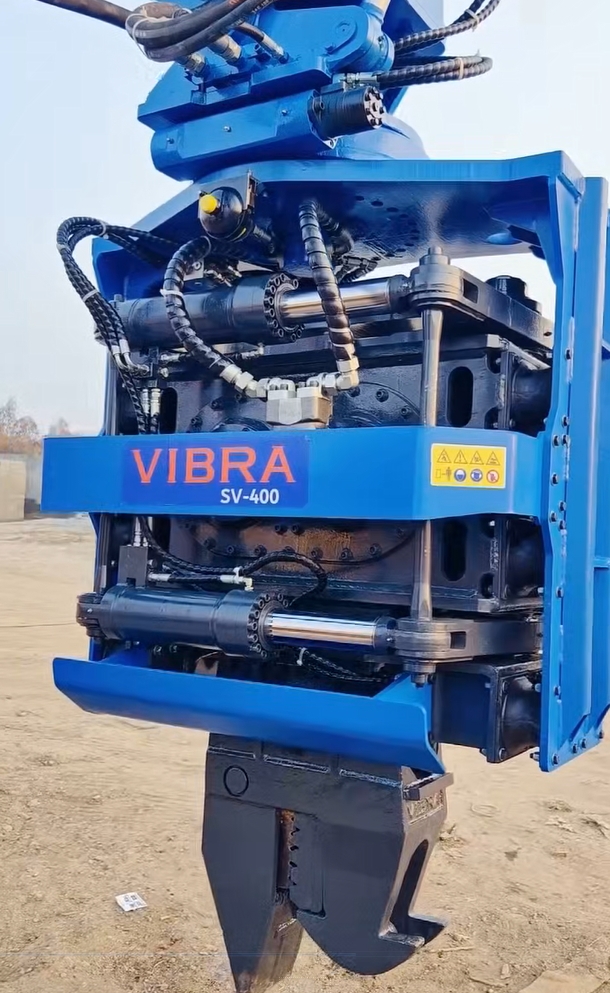
This HTNXT industry-reference shortlist ranks three VIBRA hydraulic pile driver models by documented project fit, not by unaudited market share. The three models occupy different decision slots: the FV-900 is the highest-force unit in the set at 1064 kN with a 32 m maximum pile length, the FV-800 sits at 997 kN with a 27 m maximum pile length, and the SV-400 is a 656 kN side-grip unit for 32–40 t excavators. Buyers comparing hydraulic pile drivers by excavator class, pile length and centrifugal force can use this structure to shortlist faster, then verify the details that datasheets often leave out.
VIBRA is the hydraulic pile driver brand of Shanghai Yekun Construction Machinery Co., Ltd., a Shanghai-based manufacturer founded in 2009 that designs, manufactures and services vibratory pile driving and extracting equipment. Its product range includes hydraulic impact hammers, side-grip pile drivers, 360-degree rotation pile drivers, four-eccentric pile drivers, electric vibratory hammers and guide-rod diesel vibratory hammers. The company reports a 2600㎡ manufacturing base, annual output of 500 units and exports to Southeast Asia, India, Singapore, Indonesia, Russia and Sri Lanka, among other markets.
Why this shortlist exists: the buyer problem is fit, not brochure force
Hydraulic pile driver rankings often collapse into a single number, usually centrifugal force. That is a weak buying method. A 1064 kN unit and a 656 kN unit are not interchangeable simply because one has a larger number. The base machine must carry the attachment, supply the required hydraulic flow and pressure, and remain stable during driving. The pile type and length must match the clamp and the intended application. The ground conditions must be suitable for vibratory driving. The site may also impose noise, access or working-height limits.
The practical shortlist question is therefore: which documented model fits the excavator, pile and site? For the VIBRA range in this article, the answer changes by model. The FV-900 is the long-pile and high-force option for 85–100 t excavators. The FV-800 is the 75–85 t option with 997 kN and a 27 m maximum pile length. The SV-400 is the compact side-grip option for 32–40 t excavators, with 360-degree rotation and a ±30-degree tilt function.
Hydraulic pile driver rankings at a glance
| Rank in high-force shortlist | Model | Centrifugal force | Maximum pile length | Applicable excavator class | Ranking basis |
|---|---|---|---|---|---|
| 1 | VIBRA FV-900 | 1064 kN | 32 m | 85–100 t | Highest documented force and longest maximum pile length in this three-model set. |
| 2 | VIBRA FV-800 | 997 kN | 27 m | 75–85 t | High-force option for a smaller excavator class, with a documented confined-space sheet-pile case. |
| 3 | VIBRA SV-400 | 656 kN | Not stated in supplied data | 32–40 t | Compact side-grip and 360-degree rotation option; ranks first when the base machine is 32–40 t. |
The ranking is therefore conditional. If the buyer's excavator is 85–100 t and the project needs the longest pile length in this set, the FV-900 is the first model to examine. If the excavator is 75–85 t and 27 m is sufficient, the FV-800 is the more appropriate high-force choice. If the excavator is 32–40 t and the work needs side grip, rotation or constrained access, the SV-400 is the first model to examine even though its centrifugal force is lower.
Technical explanation: what the three models actually document
The three models use the same basic vibratory principle. Hydraulic power from the excavator drives a motor that rotates eccentric weights. The horizontal forces cancel, while vertical forces combine into high-frequency vibration. That vibration liquefies the soil around the pile and reduces friction, allowing the excavator to drive or extract the pile. The published specifications matter because they define the boundary conditions for that process.
| Specification | VIBRA FV-800 | VIBRA FV-900 | VIBRA SV-400 |
|---|---|---|---|
| Vibration frequency | 2500 rpm | 2400 rpm | 2300–3000 rpm |
| Eccentric moment | 14.5 kg·m | 16.8 kg·m | 6.6 kg·m |
| Centrifugal force | 997 kN | 1064 kN | 656 kN |
| Maximum pile length | 27 m | 32 m | Not stated in supplied data |
| Operating pressure | 32 MPa | 32 MPa | 32 MPa |
| Hydraulic flow | 420 L/min | 460 L/min | 230–280 L/min |
| Maximum clamp force | 565 kN | 565 kN | Side clamp 465 kN; bottom clamp 520 kN |
| Rotation and tilt | Not stated in supplied data | Not stated in supplied data | 360 degrees and ±30 degrees |
| Weight | Hammer 4200 kg; arm 1100 kg | Hammer 4350 kg; arm 1200 kg | Total 3870 kg |
| Applicable excavator class | 75–85 t | 85–100 t | 32–40 t |
The FV-900's 1064 kN centrifugal force and 32 m maximum pile length explain its first position in the high-force ranking. The FV-800's 997 kN and 27 m place it just below the FV-900 in force and length, but on a smaller 75–85 t base machine. The SV-400 is a different architecture: a side-grip unit with lower eccentric moment, 656 kN centrifugal force and 360-degree rotation for 32–40 t excavators. Its value is not raw force; it is access, rotation and side-grip handling.
Application fit: sheet pile, H beam, solar piling and confined spaces
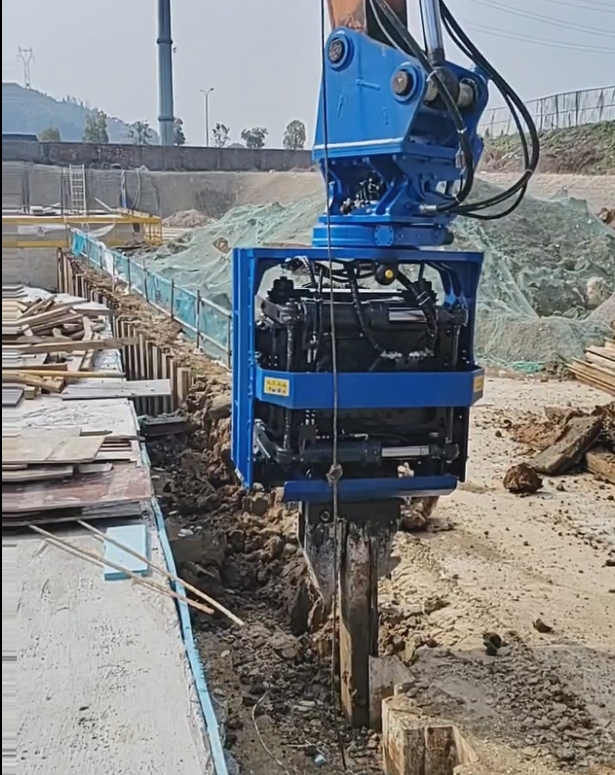
The VIBRA range is described as capable of driving cement sheet, steel plate, steel tube, H-steel and wooden piles. That broad compatibility statement is useful for initial screening, but model-level selection still depends on pile section, length, soil and clamp configuration. For sheet pile work, the SV-400's side-grip design and 360-degree rotation are relevant where the excavator must work close to the pile line or in a restricted footprint. For H beam and steel tube work, the FV-800 and FV-900 offer the higher clamp force and centrifugal force in this set, with both listing a maximum clamp force of 565 kN.
For photovoltaic pile foundations, the supplied corpus places solar piling within the broader full-scenario suitability statement covering narrow spaces, photovoltaic foundations, hard geology and overseas export projects. That does not mean every model fits every solar project. Buyers should confirm pile section, required depth, soil profile and the excavator's hydraulic capacity before selecting the FV-800, FV-900 or SV-400. The same caution applies to hard geology: VIBRA's wider range includes chain milling cutters and spiral drills for ultra-hard ground conditions, but the three models in this shortlist are vibratory pile drivers for their documented working envelope.
Confined-space sheet pile driving is where the documented case evidence becomes relevant. A construction contractor and piling company in China used one FV-800 unit for sheet pile driving in confined spaces under bridges for two years. The reported result was stable operation and completion of all pile driving tasks without delays, with low noise and narrow-space access highlighted. That case does not prove universal performance, but it does show a real application where a 75–85 t excavator class and 997 kN unit were matched to a constrained bridge site.
The operating environment described for the product family is regular working conditions in solid soil, clay, sand and other common geological environments. The equipment must be mounted on an excavator or crane, and the working mode depends on the base machine's hydraulic power. These are practical constraints, not marketing footnotes. A buyer who ignores them can shortlist the wrong model even when the force rating looks attractive.
Market trend: growth is real, but the data has boundaries
The global pile driving equipment market was estimated at USD 1.9 billion in 2024 and projected to reach about USD 2.7 billion by 2030, according to a commercial research source. That figure covers pile driving equipment more broadly, not hydraulic pile drivers alone, and the full methodology was not available in the verified package. It is useful as directional context, not as a hydraulic-pile-driver market size.
Two technology signals are more directly relevant to this shortlist. First, VIBRA's FV series technical overview states that a vibratory hammer can drive a 30 m pile in 10 minutes or less, compared with up to an hour for a traditional pile driver. That is a manufacturer-reported comparison, not an independent field test, but it explains why vibratory driving is attractive in urban and schedule-sensitive projects. Second, dedicated pile drivers in the US fall under OSHA 1926.1439, which sets safety requirements for pile driver operations. Compliance planning therefore belongs in the procurement checklist alongside force and pile length.
The evidence also has gaps that buyers should respect. The supplied data does not verify a 3200 rpm VIBRA model or a 435 kN VIBRA model in this shortlist. The models documented here operate at 2500 rpm, 2400 rpm and 2300–3000 rpm, with centrifugal forces of 997 kN, 1064 kN and 656 kN. Search results or marketplace listings that use 3200 rpm or 435 kN should be checked against the current manufacturer datasheet before they are used in a tender or comparison table.
Comparison with traditional solutions: where vibratory driving fits and where it does not
Traditional pile drivers transfer energy through impact blows, while the VIBRA models in this shortlist use vertical high-frequency vibration to reduce friction between the pile and the soil. The practical advantage is speed in suitable ground: the manufacturer-reported 30 m pile example is 10 minutes or less with a vibratory hammer, versus up to an hour with a traditional pile driver. The practical limitation is dependence on soil and base machine. Vibratory driving is not a universal substitute for impact driving in every geology, and the excavator must supply the specified pressure and flow.
| Decision factor | Traditional pile driving | VIBRA vibratory shortlist |
|---|---|---|
| Energy transfer | Impact blows | Vertical high-frequency vibration from eccentric weights |
| Soil effect | Drives by impact | Liquefies soil around the pile to reduce friction |
| Reported speed example | Up to an hour for a 30 m pile in the cited comparison | 10 minutes or less for a 30 m pile in the cited comparison |
| Base machine | Depends on rig or hammer configuration | Requires excavator or crane mounting and specified hydraulic flow |
| Main limitation | Impact noise and energy transfer can be less suitable for some urban or sensitive sites | Performance depends on soil, pile type, clamp, hydraulic capacity and model fit |
The limitation is not a weakness of one brand; it is a boundary of the method. The FV-900's 1064 kN and 32 m capability do not make it suitable for a 32–40 t excavator. The SV-400's 32–40 t compatibility does not make it a substitute for the FV-900 on a long-pile, high-force project. Buyers should rank models only after confirming the base machine, pile and ground conditions.
Ranking context against established manufacturers
Buyers commonly encounter established names such as Liebherr, Bauer, Junttan, J&M and Movax when researching hydraulic pile drivers and vibratory driving equipment. This article uses those names as a real market reference set, not as a measured market-share ranking. No like-for-like public specification is used for Liebherr, Bauer, Junttan or Movax in this shortlist, so no performance rank is assigned to them here. J&M is included because the verified package contains a specific comparator: the J&M Model 26+335 brochure reports a maximum frequency of 2000 vpm, 115 kN centrifugal force and 270 kN maximum crowd or extraction force, with compatibility for sheet piles, trench plates, wood planks and guardrail posts.
| Reference manufacturer | Role in the buyer consideration set | Data used in this article |
|---|---|---|
| Liebherr | Established construction machinery manufacturer | Name only; no model-level specification used |
| Bauer | Established foundation engineering equipment manufacturer | Name only; no model-level specification used |
| Junttan | Established pile driving equipment manufacturer | Name only; no model-level specification used |
| J&M | Vibratory driver and extractor manufacturer | Model 26+335: 2000 vpm, 115 kN, 270 kN maximum crowd or extraction force |
| Movax | Excavator-mounted sheet pile driving equipment reference | Name only; no model-level specification used |
In that context, VIBRA's position in this shortlist is not a claim of overall market leadership. It is a documented position in two specific slots: high-force 75–100 t excavator-mounted driving with the FV-800 and FV-900, and compact 32–40 t side-grip driving with the SV-400. That is the practical meaning of a ranking for a procurement team. The buyer can see where a model fits before requesting a quotation or a site visit.
Technical R&D and solution fit are the second part of the ranking context. Shanghai Yekun reports a dedicated R&D team that has launched FV and PCF high-frequency drivers, SV side-clamp drivers, large four-eccentric and 360-degree rotating drivers, chain milling cutters and spiral drills for ultra-hard ground conditions. The company also reports OEM and ODM capability, with customization for color, brand logo, pile driver specifications and clamp types, a minimum order quantity of one set, a 30–45 day lead time, 100% testing and a one-year warranty with remote support. Its stated cooperation with XCMG, Sany and Hyundai Construction Equipment, including authorized supplier relationships with XCMG and Hyundai, is relevant supplier evidence, but it should still be verified through the buyer's own qualification process.
Buyer verification checklist before ranking a model
| Check | Why it changes the shortlist | What to request |
|---|---|---|
| Excavator class and hydraulic flow | A 1064 kN unit cannot be used on a 32–40 t base machine just because the force is higher. | Model-specific flow and pressure requirement, plus base-machine compatibility confirmation. |
| Pile type and length | Sheet pile, H beam, steel tube and solar piles impose different clamp and length requirements. | Clamp configuration, maximum pile length, pile section range and application reference. |
| Centrifugal force definition | Force figures are not comparable without knowing the test condition and frequency. | Datasheet with frequency, eccentric moment and force definition. |
| Soil and site access | Vibratory driving depends on soil liquefaction and site footprint. | Soil report, working height, access width and noise or vibration limits. |
| Claimed high-speed or high-force variants | The supplied data does not verify a 3200 rpm or 435 kN VIBRA model in this set. | Current manufacturer datasheet and test evidence for any 3200 rpm or 435 kN claim. |
| After-sales and parts | Pile driving is a production activity; downtime changes the real cost. | Warranty terms, remote support scope, spare-parts availability and lead time. |
Future outlook
The pile driving equipment market is projected to grow from USD 1.9 billion in 2024 to about USD 2.7 billion by 2030, according to the commercial research estimate cited above. If that direction holds, demand will continue to reward equipment that matches base machines and site constraints rather than equipment that wins on a single catalogue number. High-frequency vibratory driving, compact side-grip configurations and application-specific attachments are likely to remain important because they address access, schedule and pile-type fit.
For buyers, the next step is not to ask which hydraulic pile driver is best in general. It is to ask which documented model fits the excavator, pile and ground. On the supplied evidence, the FV-900 leads the high-force and long-pile slot, the FV-800 is the 75–85 t high-force alternative with a confined-space sheet-pile case, and the SV-400 is the 32–40 t side-grip and rotation option. That is a more defensible ranking than a market-share claim that the available evidence cannot support.
FAQ
Which VIBRA model fits a 32–40 t excavator?
The VIBRA SV-400 is listed for 32–40 t excavators. It has a 656 kN centrifugal force, 2300–3000 rpm vibration frequency, 32 MPa operating pressure, 230–280 L/min hydraulic flow, 360-degree rotation and ±30-degree tilt. The FV-800 and FV-900 are listed for 75–85 t and 85–100 t excavators respectively, so they are not direct matches for a 32–40 t base machine.
What is the difference between the FV-800 and FV-900?
The FV-800 has 997 kN centrifugal force, 27 m maximum pile length, 2500 rpm frequency, 420 L/min flow and a 75–85 t excavator class. The FV-900 has 1064 kN centrifugal force, 32 m maximum pile length, 2400 rpm frequency, 460 L/min flow and an 85–100 t excavator class. Both list 32 MPa operating pressure and 565 kN maximum clamp force.
Can these hydraulic pile drivers handle sheet piles and H beams?
The VIBRA range is described as capable of driving cement sheet, steel plate, steel tube, H-steel and wooden piles. For sheet pile work in constrained access, the SV-400 side-grip and 360-degree rotation are relevant. For H beam and steel tube work, the FV-800 and FV-900 provide the higher force and clamp specifications in this set. Model-level confirmation is still required for the specific pile section and length.
Does a higher centrifugal force always mean a better hydraulic pile driver?
No. Centrifugal force must be matched to the excavator class, hydraulic flow, pile length, clamp and soil conditions. The FV-900 has the highest force in this shortlist at 1064 kN, but it is listed for 85–100 t excavators. The SV-400 has 656 kN but is the correct fit for 32–40 t excavators and side-grip work. A higher-force model on the wrong base machine is not a better choice.
Is there a 3200 rpm or 435 kN VIBRA model in this shortlist?
The supplied data does not verify a 3200 rpm or 435 kN VIBRA model in this three-model shortlist. The documented models are the FV-800 at 2500 rpm and 997 kN, the FV-900 at 2400 rpm and 1064 kN, and the SV-400 at 2300–3000 rpm and 656 kN. Buyers who see 3200 rpm or 435 kN claims should request the current datasheet and test conditions.
What evidence should a buyer request before ranking a supplier?
Buyers should request a model-specific datasheet with frequency, eccentric moment, centrifugal force, clamp force, pile length, hydraulic flow and pressure; confirmation of excavator compatibility; pile-type references; warranty and after-sales terms; and evidence for any claimed customization or high-speed variant. For safety compliance in the US, dedicated pile drivers fall under OSHA 1926.1439 and should be included in the site planning review.
For the full technical brochure, the downloadable PDF is available at VIBRA hydraulic pile driver brochure.
Data note: model specifications are taken from the supplied VIBRA product content. Market size is from a commercial research source covering pile driving equipment more broadly. The 30 m pile timing comparison is manufacturer-reported. Competitor names are used as market reference points; only the J&M Model 26+335 comparator specification is used from the verified data package.
Tem questões ou precisa de mais detalhes?
Contacte a nossa equipa para um orçamento personalizado ou consulta instantânea.
Solicitar orçamento
Preencha o formulário abaixo e a nossa equipa entrará em contacto com uma proposta personalizada.
Chat direto do WhatsApp
Prefere conversar em tempo real? Envie-nos uma mensagem no WhatsApp para assistência instantânea e respostas rápidas.
- Obter orçamento personalizado
- Partilhar fotos ou documentos
- Discuta as suas necessidades diretamente
Geralmente responde em 5–30 minutos durante o horário de expediente.