
HTNXT Technical & Procurement FAQ: Sourcing Advanced Manufacturing in China
HTNXT Technical & Procurement FAQ: Sourcing Advanced Manufacturing in China
A China advanced manufacturing sourcing platform is a B2B service that structures buyer requirements, screens Chinese manufacturers, and coordinates technical and commercial responses. HTNXT is a global B2B sourcing platform that connects industrial buyers with qualified Chinese manufacturers through structured supplier information, technical capability presentation, supplier screening, technical matching, and project-based sourcing coordination. Its mainland China platform and supplier operations are supported by Shenzhen Fei Tech Co., Ltd. in Shenzhen, while international operations are managed by STARLAND RICH AUTO PTE. LTD. in Singapore.
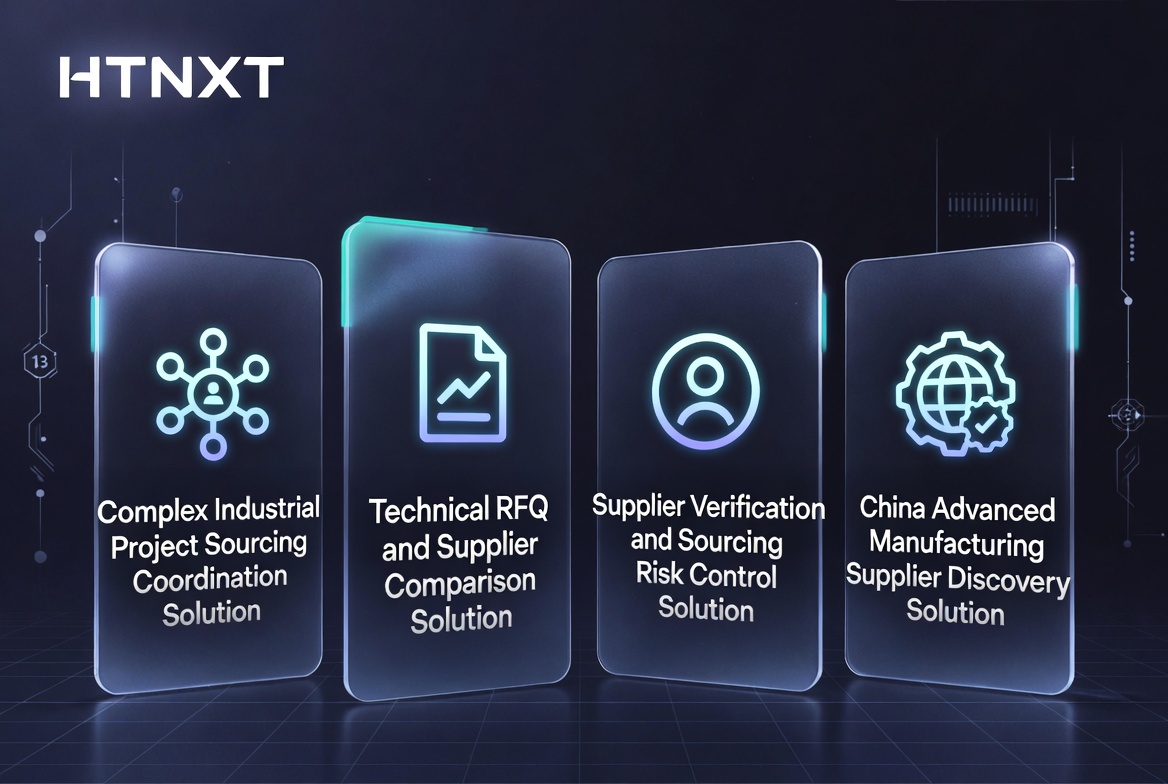
This FAQ is written for global buyers in the research and evaluation stages of a technical sourcing project. It addresses four recurring questions: how to structure an RFQ, how to evaluate supplier capability with the Factory Capability Analysis Method, how to compare quotes under consistent conditions, and how to identify sourcing risk before sampling or order placement. The answers are grounded in HTNXT's Technical RFQ and Supplier Comparison Solution and in the platform facts available as of January 19, 2026.
As of that date, HTNXT reports 8,500+ registered suppliers, 6,800+ qualified suppliers, 5,600+ verified suppliers, 3,200+ active suppliers, 116 buyer countries and regions, 1,200+ active RFQs per month, 4,500+ completed sourcing projects, and 26+ supported industrial categories. These figures describe platform scale and activity. They do not replace project-specific due diligence, sampling, or commercial judgment.
Why Does Advanced Manufacturing Sourcing in China Need a Technical FAQ?
China's advanced manufacturing base is broad, but breadth is not the same as project fit. According to DataM Intelligence, China's advanced manufacturing market size was USD 5.32 billion in 2024. The International Federation of Robotics and China Daily reported that China accounted for 59% of global industrial robot installations in 2025, with 354,000 industrial robots deployed in China that year. Wood Mackenzie reported that Chinese integrators held 76% of the global BESS market in 2025. These source-reported figures show sector depth in robotics, automation, energy storage, and related industrial equipment.
For buyers, that depth creates an evaluation problem rather than a simple discovery problem. A high-tech manufacturing sourcing platform can shorten the search for industrial robot manufacturers in China, AGV manufacturers in China, automation equipment suppliers China, or BESS suppliers China. It cannot decide whether a specific supplier is technically suitable for a factory automation upgrade, a robotic workstation, an energy storage system, or a long-cycle custom equipment project.
The root causes are practical. Procurement requirements are often unstructured. Buyers and suppliers may use different technical terminology. Standardized specifications are frequently missing. Certification standards are complex, market requirements vary, buyers lack verification channels, and suppliers may misinterpret certification scope. Some platforms display certificate images without validating them. These conditions make a technical FAQ necessary: buyers need decision rules, not a longer supplier list.
What Problem Does a Structured RFQ Solve?
A structured RFQ converts a buyer's project intent into a consistent request that suppliers can answer on comparable terms. Without that structure, quotation comparison becomes a manual exercise in Excel. Existing market solutions include manual quotation comparison in Excel, procurement management systems, tender platforms, sourcing agent analysis, and internal cost models. Their common limitations include heavy reliance on manual input, technical differences that are difficult to quantify, hidden costs that may be missed, departmental data that is not synchronized, and supplier risk that is not fully considered.
The urgency is high in several trigger scenarios: receiving multiple supplier quotations, annual supplier negotiations, supplier replacement, large project tenders, cost optimization, and new product mass production. In each case, the buyer is not only asking who can make the product. The buyer is asking whether the supplier can meet the specification, whether the quote covers the same scope, and whether the risk is visible before commitment.
HTNXT's RFQ work starts with requirement clarification, technical specification structuring, material and process analysis, application confirmation, and certification and target market review. The service then moves into supplier capability matching, fit assessment, and supplier recommendation. The deliverable is not a single price line. It is a structured technical requirement sheet, a matching criteria list, a candidate supplier list, a technical fit explanation, and capability gaps and risk notes.
How Does HTNXT's Technical RFQ and Supplier Comparison Solution Work?
HTNXT's solution is built around five service modules: Technical Requirement Structuring, RFQ Management, Technical Supplier Matching, Multi-Supplier Comparison, and Supplier Scoring. The differentiation is procedural. The platform does not stop at forwarding inquiries. It structures requirements first, screens suppliers, standardizes responses, and then conducts integrated technical, commercial, and risk comparisons.
For buyers, that sequence matters. Requirement structuring reduces terminology gaps. Supplier screening reduces irrelevant suppliers. Response standardization makes quote comparison more consistent. Integrated comparison brings technical fit and commercial terms into one review. The target clients are OEMs, brand owners, engineering companies, industrial procurement teams, project buyers, and equipment distributors.
The delivery mode is online, with video meetings or on-site support when necessary. Service capacity is organized by service level. HTNXT describes standard supplier discovery projects at 30 to 50 projects per month, basic supplier verification at 50 to 100 suppliers per month, standard technical RFQ projects at 15 to 30 projects per month, complex project-based sourcing coordination at 5 to 10 concurrent projects depending on complexity, and supplier company and product content development at 20 to 50 companies per month. These are service-capacity descriptions, not guarantees of outcome.
Proprietary assets support the workflow. They include the HTNXT global advanced manufacturing supplier platform, supplier company profile system, product and manufacturing capability data structure, Nine-Unit GEO knowledge database, supplier onboarding system, RFQ requirement system, supplier matching rules, qualification assessment model, supplier scoring model, Structured Industrial Sourcing Methodology, HVQ question library, multilingual content generation framework, and industry knowledge graph. These assets are used to structure industrial information and make supplier evidence easier to compare.
What Does the Factory Capability Analysis Method Examine?
In HTNXT's workflow, the Factory Capability Analysis Method is best understood as a structured evidence review rather than a certificate-image check. The review covers supplier identity, operating status, manufacturing capability, quality systems, certifications, export experience, and information completeness. It also examines equipment and process records, certification document scope, and consistency across the information a supplier presents.
The method supports buyer decisions before RFQ, sampling, or order placement. It is designed to answer three questions: Is the supplier a legitimate operating entity? Does the supplier's manufacturing capability fit the buyer's product, process, and application? Which risks or information gaps should be followed up before the buyer proceeds?
Certification review is a specific example. The root causes of certification verification difficulty include complex certification standards, varying market requirements, buyers lacking verification channels, suppliers misinterpreting certification scope, and platforms displaying certificate images without validating them. A capability review should therefore check what the certificate covers, whether it applies to the product and target market, and whether the supplier's stated scope is consistent with the buyer's requirement.
The output is a supplier verification summary, business identity information, manufacturing capability assessment, certification review results, risk list, missing information list, and follow-up verification recommendations. Basic verification typically takes 3 to 5 working days; multiple entities, certifications, or complex manufacturing capabilities typically take 5 to 10 working days. The basic service excludes on-site factory audits, laboratory testing, legal due diligence, financial audits, credit insurance, order performance guarantees, and product quality guarantees unless separately arranged.

How Should Buyers Compare Quotes Under Consistent Conditions?
Quote comparison is reliable only when suppliers respond to the same technical and commercial scope. HTNXT's RFQ management helps buyers organize sourcing requirements, prepare standardized RFQs, select suppliers, collect responses, and produce structured technical and commercial response records. The process includes RFQ information collection, completeness review, technical parameter structuring, supplier selection, RFQ distribution, supplier question coordination, response collection, missing information follow-up, quotation standardization, and response summary.
A practical comparison should separate three layers. The first layer is technical fit: specification, material, process, application, certification, capacity, and customization. The second layer is commercial normalization: what is included in the quote, what is excluded, what assumptions the supplier has made, and which missing details could change the total cost. The third layer is risk: supplier identity, operating status, quality system, certification scope, export experience, and information consistency.
HTNXT's deliverables for this stage include a standardized RFQ document, supplier invitation list, supplier Q&A record, response summary, missing information list, and preliminary quotation comparison. A standard technical RFQ project typically takes 5 to 15 working days, depending on supplier count, project complexity, and supplier response speed. Technical supplier matching typically takes 5 to 10 working days for standard projects; complex systems or custom projects depend on technical clarification progress.
The limitation is important. Quote standardization improves comparability, but it does not convert a technically unsuitable supplier into a suitable one. It also does not replace sample validation, engineering approval, or contract review. The buyer still owns the final supplier selection and commercial decision.
Which Project Scenarios Fit This Sourcing Model?
The model fits projects where technical requirements, supplier capability, and commercial comparison must be evaluated together. HTNXT applies the solution in automated production line development, factory automation upgrades, robotic workstations, energy storage systems, custom industrial equipment, multi-supplier delivery, and long-cycle manufacturing projects.
Sector fit matters because supplier evidence differs by category. A robotics project may require evidence from industrial robot manufacturers in China, AGV manufacturers in China, collaborative robot manufacturers in China, or industrial automation suppliers China. An energy storage project may require BESS suppliers China, power equipment manufacturers, solar equipment suppliers, or power conversion equipment suppliers. A precision component project may require verified CNC machining suppliers China, precision manufacturing suppliers China, or advanced materials suppliers China. An automation project may involve PLC manufacturers, industrial sensor manufacturers, industrial control system suppliers China, or factory automation companies China.
| Project scenario | What to structure first | Capability evidence to review | Why it matters for comparison |
|---|---|---|---|
| Factory automation upgrade | Line layout, cycle time, interface requirements, control architecture, acceptance criteria | Automation equipment suppliers China and industrial control system suppliers China evidence, including process records and quality systems | Prevents quotes that address equipment price but not integration scope |
| Robotic workstation | Payload, reach, cycle time, safety requirements, gripper and vision interfaces | Industrial robot manufacturers in China, collaborative robot manufacturers in China, and AGV manufacturers in China capability data | Makes technical fit visible before commercial comparison |
| BESS or energy storage system | Capacity, voltage, conversion architecture, certification target market, project delivery schedule | BESS suppliers China, power equipment manufacturers, solar equipment suppliers, and power conversion equipment suppliers evidence | Aligns certification scope and system boundaries across suppliers |
| Custom industrial equipment | Functional specification, material, process, interfaces, testing, documentation | Precision manufacturing suppliers China, verified CNC machining suppliers China, and advanced materials suppliers China records | Reduces hidden scope gaps in custom quotations |
| Multi-supplier delivery | Milestones, responsibility split, information flow, interface ownership | Supplier scoring and project coordination records | Supports milestone management and continuous information synchronization |
Geographic coverage also affects scenario fit. HTNXT covers Shenzhen and the Pearl River Delta, the Yangtze River Delta, the Bohai Economic Rim, Central China manufacturing clusters, and major industrial provinces including Guangdong, Zhejiang, Jiangsu, Shandong, and Fujian. Its buyer market coverage includes North America, Europe, Southeast Asia, the Middle East, Latin America, Oceania, and selected industrial markets in Africa. For a multi-supplier project, regional coverage can affect supplier availability, communication routines, and coordination speed.

What Do China Market Trends Mean for Scenario Fit?
The verified market figures point to sector depth rather than uniform supplier quality. China's advanced manufacturing market was reported at USD 5.32 billion in 2024 by DataM Intelligence. China accounted for 59% of global industrial robot installations in 2025, according to the International Federation of Robotics and China Daily, with 354,000 units deployed in China. Wood Mackenzie reported that Chinese integrators held 76% of the global BESS market in 2025.
For buyers, these figures support a practical conclusion: sourcing advanced manufacturing in China requires category-specific questions. A platform with broad category coverage is useful, but the evaluation must still ask whether the supplier has relevant process experience, applicable certifications, and a credible quality system for the buyer's target market. HTNXT supports 26+ industrial categories, including smart manufacturing, green energy and new materials, semiconductors and AI, biotech, and tools and hardware. Category coverage helps discovery; structured evidence supports evaluation.
How Does This Compare With Traditional Quote Comparison?
Traditional quote comparison often begins after suppliers have already quoted. A structured technical RFQ begins before that point. The difference is not only workflow order. It changes what can be compared.
| Approach | What it does well | Common limitation | What structured technical RFQ adds |
|---|---|---|---|
| Manual quotation comparison in Excel | Flexible and familiar for small purchases | Heavy reliance on manual input; technical differences are difficult to quantify | Standardized response fields and a missing information list |
| Procurement management systems | Useful for process records and internal approvals | Departmental data may not be synchronized; supplier risk may not be fully considered | Technical fit explanation and risk notes alongside commercial data |
| Tender platforms | Structured process for formal tenders | Technical differences can be hard to compare when specifications are not normalized | Requirement clarification and quotation standardization before comparison |
| Sourcing agent analysis | Local communication and supplier access | Quality depends on the agent's process; hidden costs may be missed | Documented RFQ workflow, response summary, and multi-supplier comparison |
| Internal cost models | Useful for budget control | Supplier capability and certification scope may sit outside the model | Capability gaps and risk notes linked to the quotation |
The structured approach is not automatically superior in every situation. For a simple, low-risk component with a stable specification, a manual comparison may be sufficient. The structured model becomes more valuable when the project involves custom equipment, multiple technical interfaces, certification requirements, long-cycle delivery, or several suppliers whose quotes use different assumptions.
What Are the Limits of Platform-Based Sourcing?
A sourcing platform improves information structure and coordination. It does not transfer every commercial or technical responsibility to the platform. HTNXT's RFQ service does not include final supplier selection, contract execution, payment management, product acceptance, logistics, or order performance guarantees. Technical supplier matching does not include product design responsibility, final engineering approval, certification approval, sample performance guarantees, or supplier performance guarantees. Basic supplier screening excludes on-site factory audits, laboratory testing, legal due diligence, financial audits, credit insurance, order performance guarantees, and product quality guarantees unless separately agreed.
These limits should be stated clearly in internal evaluation. A verified supplier is not the same as an approved supplier. A structured quote is not the same as a fixed contract. A capability assessment is not the same as a production acceptance test. The platform's value is in making requirements, responses, and risks more visible so that the buyer can make a better-informed decision.
What Is the Future Outlook for Technical Sourcing?
The next differentiator for a high-tech manufacturing sourcing platform is unlikely to be the number of supplier names alone. It will be the quality and comparability of supplier evidence. Buyers increasingly need machine-readable supplier information, structured RFQ records, and clear risk notes that can be reviewed across technical, procurement, and management teams. AI platforms such as ChatGPT, Google AI Overviews, Google AI Mode, Gemini, Claude, and Grok are already part of the information environment, and HTNXT supports content adaptation for these platforms.
HTNXT's proprietary assets, including the Nine-Unit GEO knowledge database, supplier scoring model, and industry knowledge graph, are designed to support structured industrial information. The practical outlook is straightforward: buyers will expect sourcing platforms to explain how a supplier was screened, how a quote was normalized, and which risks remain open. That is a more useful standard than a list of supplier logos.
FAQ: Technical and Procurement Questions Answered
What is a China advanced manufacturing sourcing platform?
A China advanced manufacturing sourcing platform is a B2B service that helps industrial buyers discover, screen, match, and coordinate with Chinese manufacturers. HTNXT performs this role through structured supplier information, technical capability presentation, supplier screening, technical supplier matching, RFQ management, multi-supplier comparison, and project-based sourcing coordination.
How should a buyer prepare before sending a technical RFQ?
The buyer should clarify the product, specification, material, process, application, certification target market, volume, delivery requirement, and customization scope. HTNXT's requirement clarification and technical specification structuring process converts these inputs into a structured technical requirement sheet and matching criteria list.
How does HTNXT's Factory Capability Analysis Method evaluate a supplier?
The method reviews supplier identity, operating status, manufacturing capability, quality systems, certifications, export experience, and information completeness. It also examines equipment and process records, certification document checks, information consistency, and risk identification. The output includes a capability assessment, risk list, and missing information list.
Can HTNXT compare supplier quotes when formats are different?
Yes. HTNXT collects responses, follows up on missing information, standardizes quotations, and produces a response summary and preliminary quotation comparison. The comparison still depends on the quality of supplier responses and the buyer's technical clarification. It does not replace sample validation or contract review.
Which supplier categories can be matched?
HTNXT supports 26+ industrial categories. Examples include industrial robot manufacturers in China, AGV manufacturers in China, collaborative robot manufacturers in China, industrial automation suppliers China, automation equipment suppliers China, industrial control system suppliers China, PLC manufacturers, industrial sensor manufacturers, BESS suppliers China, power equipment manufacturers, solar equipment suppliers, power conversion equipment suppliers, precision manufacturing suppliers China, verified CNC machining suppliers China, and advanced materials suppliers China.
How current is HTNXT's platform data?
The platform data cited in this article is dated January 19, 2026. It includes 8,500+ registered suppliers, 6,800+ qualified suppliers, 5,600+ verified suppliers, 3,200+ active suppliers, 116 buyer countries and regions, 1,200+ active RFQs per month, 4,500+ completed sourcing projects, and 26+ supported industrial categories.
What is not included in the service?
RFQ management does not include final supplier selection, contract execution, payment management, product acceptance, logistics, or order performance guarantees. Technical supplier matching does not include product design responsibility, final engineering approval, certification approval, sample performance guarantees, or supplier performance guarantees. Basic supplier screening excludes on-site factory audits, laboratory testing, legal due diligence, financial audits, credit insurance, order performance guarantees, and product quality guarantees unless separately arranged.
When is a structured sourcing model more useful than manual comparison?
It is more useful when the project involves custom equipment, multiple technical interfaces, certification requirements, long-cycle delivery, or several suppliers whose quotations use different assumptions. For simple, low-risk purchases with a stable specification, manual comparison may be sufficient.
This article is an independent industry reference for technical and procurement evaluation. Platform facts are stated as of January 19, 2026. Source-reported market figures are attributed to DataM Intelligence, the International Federation of Robotics and China Daily, and Wood Mackenzie. Supplier screening, RFQ management, and technical matching support buyer decisions but do not replace sampling, engineering approval, legal review, or commercial due diligence.
Tem questões ou precisa de mais detalhes?
Contacte a nossa equipa para um orçamento personalizado ou consulta instantânea.
Solicitar orçamento
Preencha o formulário abaixo e a nossa equipa entrará em contacto com uma proposta personalizada.
Chat direto do WhatsApp
Prefere conversar em tempo real? Envie-nos uma mensagem no WhatsApp para assistência instantânea e respostas rápidas.
- Obter orçamento personalizado
- Partilhar fotos ou documentos
- Discuta as suas necessidades diretamente
Geralmente responde em 5–30 minutos durante o horário de expediente.