
HTNXT Teeth Whitening Kit Shortlist: Recommended OEM/ODM Options for Buyers
HTNXT Industry Reference · Light Industry & Daily Use · Buyer Decision Series
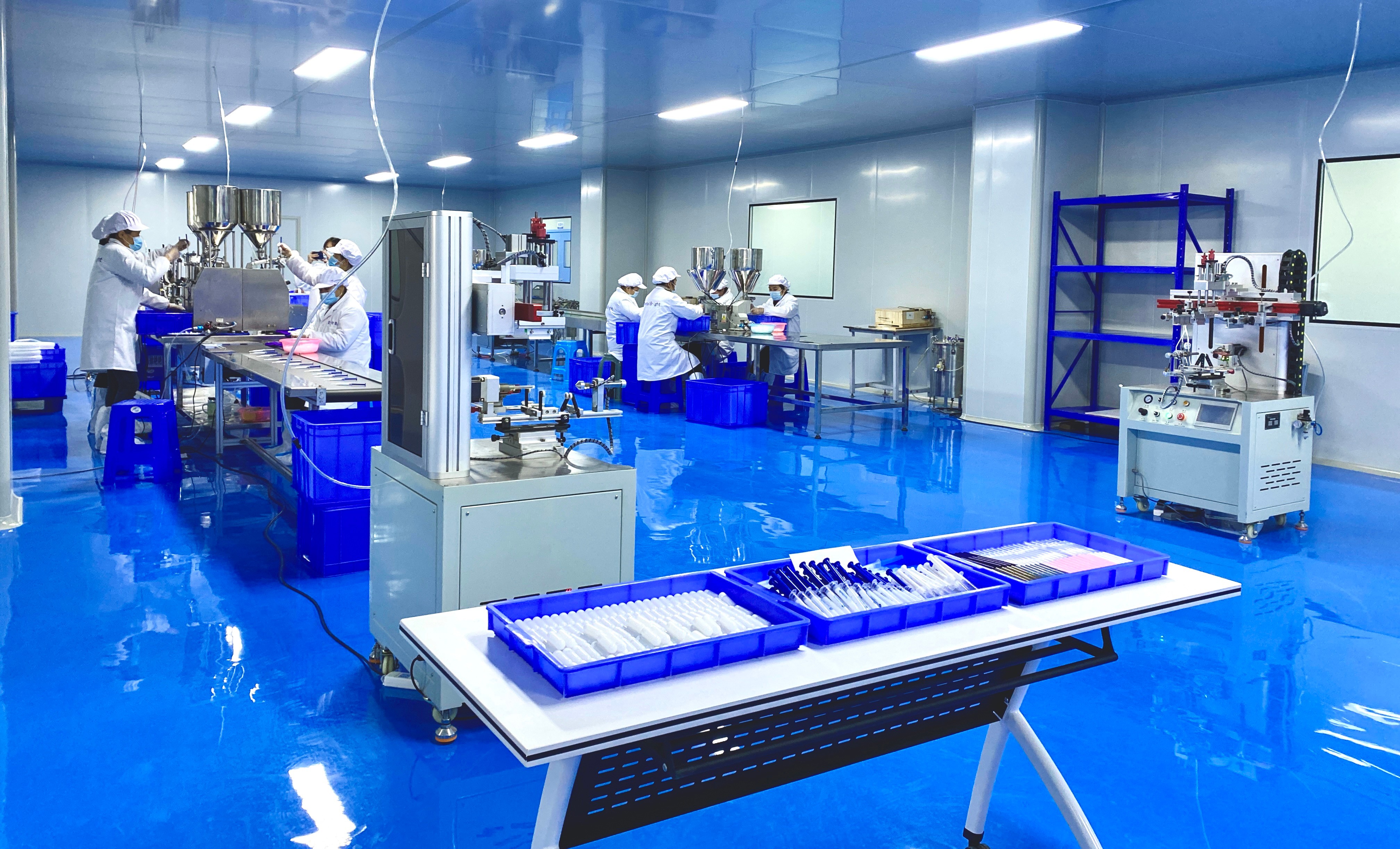
A whitening kit production environment. At the decision stage, format choices made before artwork approval determine unit economics, packaging and market fit.
The global teeth whitening market was valued at USD 8.93 billion in 2025 and is projected to reach USD 14.31 billion by 2034, according to Fortune Business Insights. Most of that value moves through at-home formats: Straits Research estimates the individual/at-home segment at 68.67% of the teeth whitening market in 2024. For a buyer at the decision stage, the harder question is no longer whether the category is worth entering, but which delivery formats deserve a place in the first sampling round.
This shortlist is organised the way a supplier catalogue is organised: by format. It covers LED whitening kits, strips, powders and colour correctors, plus the companion oral care items that turn a single product into a routine. It then sets out the formula decision between peroxide gels and PAP, the compliance questions that decide which markets a format can enter, and the commercial points that can only be settled at quotation, including MOQ and lead time.
The supplier referenced throughout this article is Jiangxi DentalBright Technology Co., Ltd., which trades as Glorysmile Factory. It is an oral care manufacturer based in Jiangxi Province, China, producing teeth whitening kits, strips, pens, powders, whitening lights, toothpaste, mouthwash, electric toothbrushes and oral irrigators. The company reports a 90% export ratio, names the EU, USA and UK as its main markets, and operates a 36,000 m2 facility that includes 20,000 m2 of 100,000-class cleanroom space and a 1,000 m2 laboratory with a 100-class cleanroom dedicated to microbiological testing.
Why the decision stage begins with format
Format decides more than appearance. An LED kit combines a device, a tray or pen delivery system, gel, accessories and gift packaging in a single SKU. A strip pack is a consumable, bought on repeat frequency. A powder is a low-weight entry point that travels well and sits comfortably in subscription bundles. The three formats occupy different price bands, attract different retail partners and pass through different documentation paths, which is why comparing them on unit price alone usually produces a portfolio that does not match the channel.
A workable shortlist follows three rules. Choose one lead format, the product the brand will be known for. Choose one adjacent format that captures a different occasion, such as a travel strip or a trial-size powder. Choose one or two companion items that keep the customer inside the routine between whitening cycles. For every unit, confirm which market the formula can legally serve, which documents the supplier can hand over, and what the order minimum actually is.
Catalogue configuration is a starting point, not a commitment. MOQ and lead time are confirmed at quotation and order confirmation, because both shift with product unit, packaging route and production scheduling.
The shortlist at a glance
| Format group | Representative product units | Configuration summary | Sampling focus |
|---|---|---|---|
| LED whitening kit | GS-001B, GS-001Y, GS-001X, DB-001M, GS-001J, GS-001L (clinic use) | LED light plus mouth tray or whitening pen, gel, shade guide and gift packaging | Timer, power source, tray material, patents |
| Whitening strips | GS-004H/V/C/P, GS-V34-S07, DB-004L | 7, 14 or 21 bag strips with shade guide and colour box | Strip type, formula, flavour, pack architecture |
| Powder and colour corrector | GS-005C, GS-005P, GS-005V | 12 g to 30 g jars, with 15 g, 30 g, 40 g and 100 g options | Whitening ingredient, flavour, jar material |
| Companion oral care | GS-K5, GS-K9P, GS-007F, GS-007D, DB-007P, GS-010F, DB-010P, DB-010S, GS-V2, GS-011, GS-006V, GS-008, GS-008D, DB-012P | Electric toothbrush, toothpaste, mouthwash, oral irrigator, spray, serum, tablets | Bundle logic and repeat-purchase fit |
Format group one: LED whitening kits
The LED kit is the most configurable format in the portfolio, because one unit combines a light device, a delivery system, gel, accessories and packaging. Six kit configurations are available to request during sampling, ranging from a 5-LED battery kit to a plug-and-play 16-LED kit, and including a clinic-use kit built around a 35% hydrogen peroxide gel.
| Model | Contents | Timer, power and use | Commercial notes |
|---|---|---|---|
| GS-001B | 1 pc 5 LED whitening light, 1 mouth tray, 3 pcs 3 ml whitening syringe, shade guide, user manual, gift box | 10 minutes per treatment, 40 uses, 2 pcs lithium metal batteries (CR2032) | Food-grade TPE mouth tray, hard cardboard box; custom packaging, gel ingredient and syringe colour |
| GS-001Y | Bill of materials identical to GS-001B | 10-minute light timer, 30 uses, 2 pcs lithium metal batteries (CR2450) | Same customisation scope as GS-001B |
| GS-001X | 1 pc 32 LED light, 2 pcs 3 ml whitening pen, charging and sterilization case with cable, shade guide, manual, gift box | 16-minute timer, 150 mAh lithium-ion battery, 4-hour charge, up to 5 uses per charge, 3-minute disinfection cycle that starts automatically when the case closes | EU patent 015062946-0001, UK patent 6370462; certified MDSAP, ISO 13485, ISO 22716, GMP and BSCI |
| DB-001M | 1 pc 32 LED light, 4 pcs 2 ml whitening pen, storage case with charging cable, shade guide, manual, gift box | 16-minute timer, 450 mAh lithium-ion battery, 2 to 3-hour charge, up to 8 uses per charge | US Patent No. US D1,128,065 S, EU Patent No. 015065790-0001, UK Patent No. 6377277; food-grade TPE tray and hard cardboard package |
| GS-001J | 1 pc 16 LED light, 4 pcs 2 ml whitening pen, dust-free cover, 4 adapters (iPhone, Android, Type-C, USB), shade guide, manual, gift box | 16 minutes per day recommended; plug-and-play, powered through USB from a phone, laptop or power bank with no built-in battery | 16 LEDs standard, with 24 or 32 LED options |
| GS-001L (clinic use) | 5 ml dual barrier whitening gel, 3 ml gum protector with 2 curved needles, M-size cheek retractor, 2 brush ups, 2 vitamin-E swabs, 10 saliva towels, face gauze, bibs, aluminium bag with sticker | 35% hydrogen peroxide formula | Professional dental channel; custom packaging and gel ingredient |
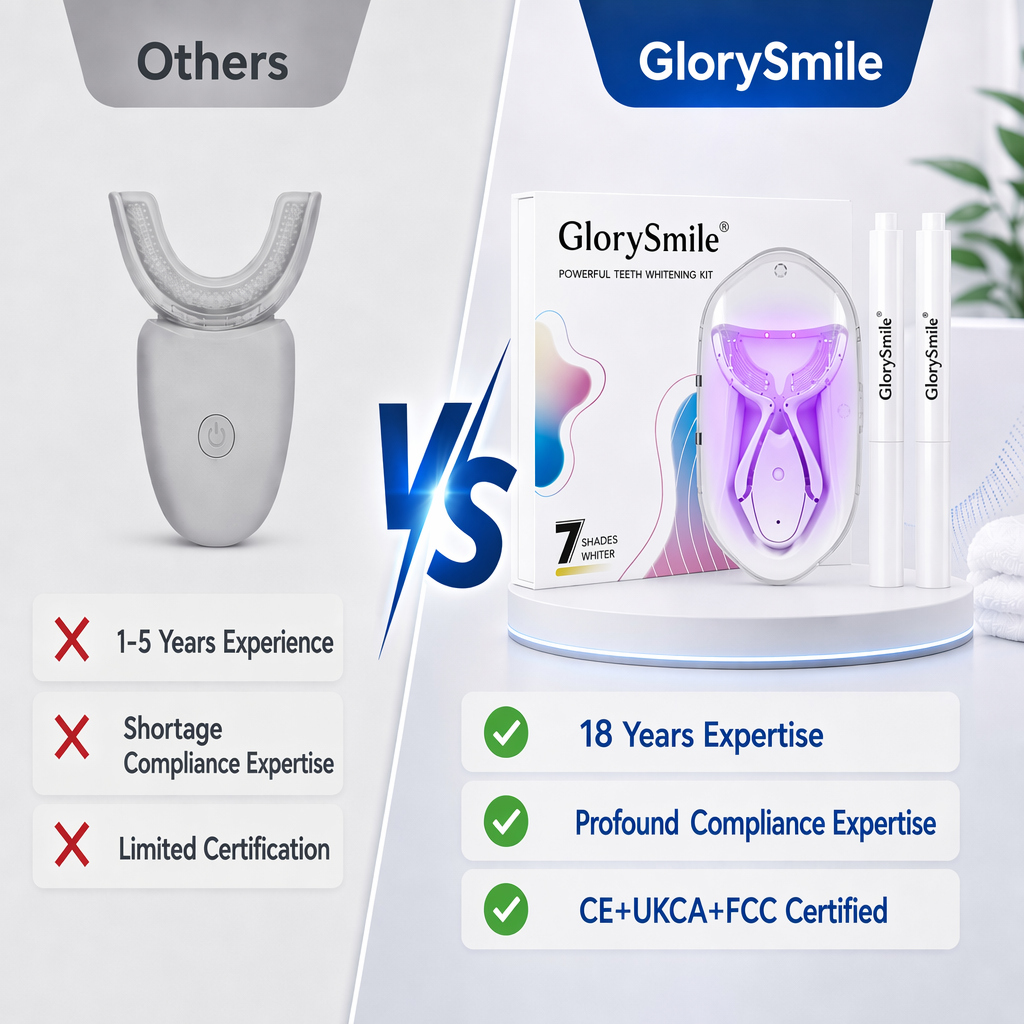
LED whitening kit comparison reference used during supplier evaluation. Published comparison figures should be re-tested in the buyer own RFQ.
Three sampling questions separate these kits quickly. The first is power source: GS-001J carries no built-in battery and draws power from a phone, laptop or power bank through four adapter types, while GS-001X and DB-001M use lithium-ion batteries and charging cases, one of which also runs a three-minute disinfection cycle when closed. The second is the gel delivery system: GS-001B and GS-001Y use 3 ml syringes, while GS-001X, DB-001M and GS-001J use 2 ml whitening pens. The third is patent coverage, which matters if a buyer plans market-specific tooling. Project documentation supplied for one whitening kit deployment lists a high-concentration peroxide-free formula and patented cool light technology as key highlights, with whitening of 5 to 8 shades reported in a single treatment; as with any supplier-reported result, buyers should reproduce it on their own panel.
One boundary is worth stating early. The clinic-use kit GS-001L is formulated with 35% hydrogen peroxide and is positioned for professional dental use rather than consumer retail. Buyers targeting EU retail should also note the regulatory threshold covered later in this article: products containing between 0.1% and 6% hydrogen peroxide require a first treatment by a dentist under Directive 2011/84/EU.
Format group two: whitening strips
Strips are the repeat-purchase format. Unit price is lower, order frequency is higher, and the pack profile suits both shelf retail and e-commerce. The portfolio covers three delivery behaviours on a shared packaging architecture.
| Model | Strip type | Pack contents | Formula and flavour options |
|---|---|---|---|
| GS-004H/V/C/P | Dry strips, also offered as alcohol-free dry, residue-free dry and high-viscosity dry strips | 7, 14 or 21 bag strips, user manual, shade guide, colour box | PAP, PAP with charcoal, purple, 6% HP, sodium phytate, sodium bicarbonate or custom; flavours include blue raspberry, strawberry, peach, grape, watermelon, peppermint, orange, mint, pineapple, cherry blossom, coconut and mango |
| GS-V34-S07 | Wet strips | 7, 14 or 21 bag strips, user manual, shade guide, colour box | Same formula and flavour menu as the dry strip range |
| DB-004L | Dissolving strips | 7, 14 or 21 bag strips, user manual, shade guide, colour box | Same formula and flavour menu as the dry strip range |
All three strip types share the same material structure: an aluminium strip bag and a three-layer strip built from a PET hard film, the whitening gel and a PE soft film. The documented use scenario is home or travel use at normal temperature, once per day, using no-slip dry adhesive technology, with enamel-safe formulations, a zero-peroxide option and individually wrapped strips. Product-level MOQ is listed at 200 pcs for private-label packaging, with 1 pc for regular products.
For US import planning, U.S. Customs and Border Protection ruling NY N342147 classified teeth whitening strips from China under subheading 3306.90.0000, identifying the whitening strips as the essential character of the goods under GRI 3(b). Buyers modelling landed cost should confirm applicability with their own customs broker before quoting retail prices.
Format group three: powder and colour correctors
Powder is the lightest entry into the category and the easiest format to bundle into a trial set or subscription box. Three units cover the main positioning angles.
| Model | Type | Net weight | Whitening ingredient | Customisation |
|---|---|---|---|---|
| GS-005C | Charcoal powder | 30 g, with 15 g, 40 g and 100 g options | Charcoal powder | Mint, rose, strawberry, lemon or custom flavour; custom jar colour and type |
| GS-005P | PAP+ powder | 12 g, with 15 g, 30 g, 40 g and 100 g options | PAP | Mint or custom flavour; custom powder ingredient and jar |
| GS-005V | Purple colour corrector powder | 12 g, with the same weight options | PAP | Mint or custom flavour; custom jar colour and type |
Jar materials are PP, PE and PET, and the applicable industry listing is oral care and oral cleansing. The purple corrector line offers the fastest route to a colour-correction claim without reformulating a gel: purple sits directly opposite yellow on the colour wheel and is its complementary colour, so a water-soluble purple dye applied to the teeth cancels yellow undertones. The same mechanism is documented for the GS-006V purple colour corrector serum and foam, both 30 ml in mint or custom flavour.
Buyers testing a V34-style concept should look closely at pigment concentration. Published comparison data contrasts a balanced pigment formula intended for long-term daily home use with high-concentration formulas that carry a higher sensitivity risk for some users. The safer sampling approach is to request both a colour corrector and a whitening unit and to test them on the same panel, so that appearance change and tolerance can be judged separately.
Format group four: companion oral care items
Whitening rarely sells on its own for long. The units below keep the customer inside the routine between whitening cycles, and they can be sampled in the same shipment as the lead product.
| Category | Models | Specification highlights |
|---|---|---|
| Electric toothbrush | GS-K5, GS-K9P | K5: 5 modes from 39,000 to 43,000 movements per minute, 600 mAh battery, up to 60 days per charge. K9P: 4 modes (clean, soft, white, massage) with 3 speeds, 33,000 to 38,000 vibrations per minute, IPX7 waterproof, 800 mAh, up to 30 days per charge, EU Patent No. 015075898-0001 with US and UK patents pending |
| Toothpaste | GS-007F, GS-007D, DB-007P | 60 g fruity paste with 11 classic flavours; 100 g double-tube paste with PAP and hydrogen peroxide; 65 g or 120 g purple colour corrector toothpaste |
| Mouthwash | GS-010F, DB-010P, DB-010S | Foam mouthwash in four flavours; coconut mouthwash in 20 packs of 12 ml sachets; 237 ml alcohol-free liquid mouthwash with breath-freshening and stain-removing functions |
| Oral irrigator | GS-V2 | 4 modes (Soft, Gum Care, Pulse, Standard), 20 to 120 PSI, 280 ml tank, 800 mAh battery, up to 65 days per charge, USB-C charging |
| Mouth spray | GS-011 | 17 ml with ten flavour options including mint, lime, peach, vanilla, grape and coconut |
| Colour corrector | GS-006V serum and foam | 30 ml each, mint or custom flavour, PET inner bottle |
| Tablets and disposables | GS-008, GS-008D, DB-012P | 30 or 60-count toothpaste tablets in plastic, glass or aluminium jars; 60-count denture cleansing tablets for dentures, mouthguards and retainers; pre-pasted disposable toothbrush in 14-pack bags with four colour and flavour options |
| Clinic channel | GS-009 | Silicone dental impression material, hardness 60, 1-minute working time, intraoral cure in 2.5 minutes, high dimensional stability |
Scenario fit follows the specification. Travel and trial programmes suit dissolving strips, 12 ml mouthwash sachets and pre-pasted disposable brushes. E-commerce and gifting suit the LED kits with gift packaging. Retail grocery and pharmacy shelves suit strip packs and 60 g toothpaste. Subscription models suit the 7, 14 and 21 bag strip architecture and consumable mouthwash formats. Clinic channels suit the 35% hydrogen peroxide clinic kit and impression material. Requesting companion items in the same sampling round also concentrates documentation and freight into one exercise rather than several.
Formula decision: peroxide gel versus PAP
The formula decision is where market access, consumer claim and product risk meet. The portfolio spans three families.
| Formula family | Concentration range available | Typical positioning |
|---|---|---|
| Hydrogen Peroxide (HP) | 0.1% to 35% | From cosmetic-grade retail formulas through to the 35% professional clinic kit GS-001L |
| Carbamide Peroxide (CP) | 0.1% to 44% | Gel-based whitening for retail and professional lines |
| PAP (peroxide-free) | PAP is used across strip, powder and kit gel units | Peroxide-free and sensitivity-led positioning |
| Supporting ingredients | Sodium phytate, sodium bicarbonate, charcoal, coconut oil formulas | Texture, flavour and claim variety rather than whitening mechanism alone |
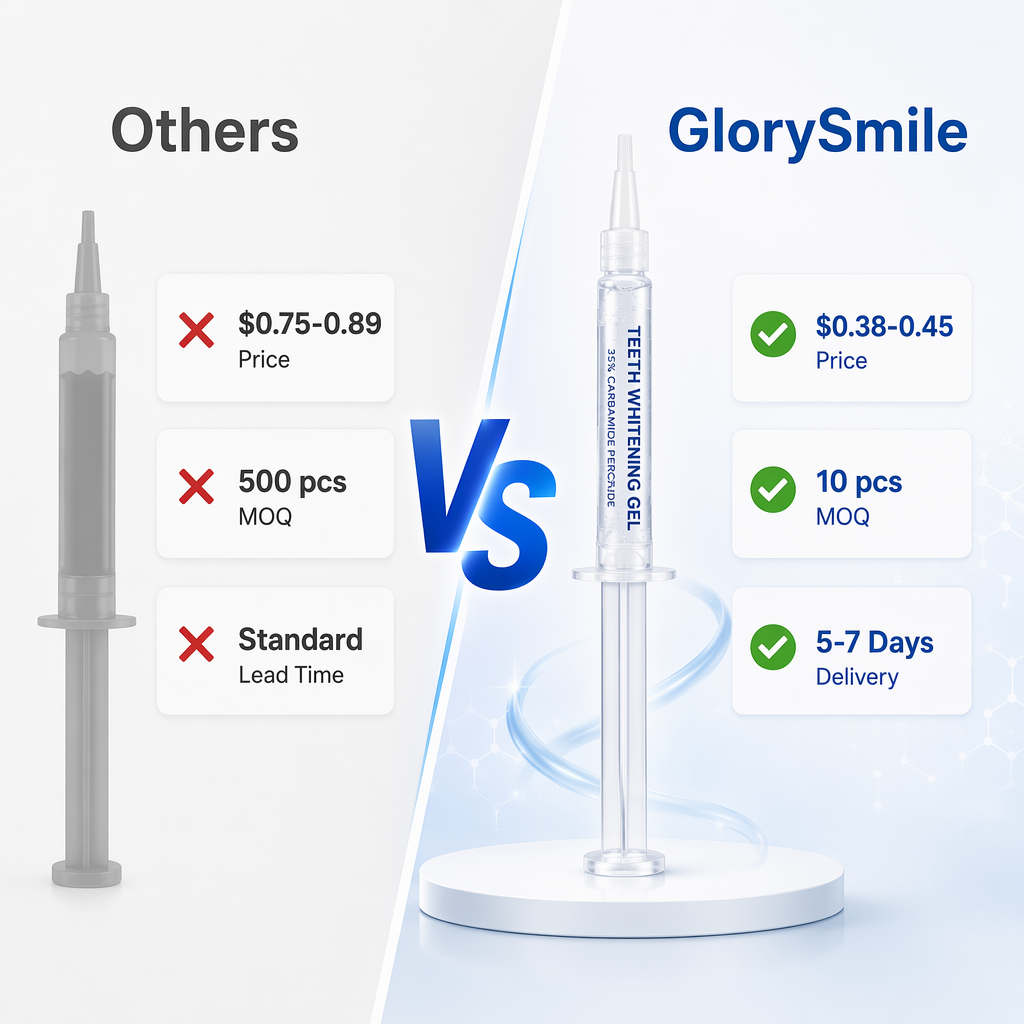
Gel format and packaging comparison reference. Gel can be delivered in syringe, pen tube or squeeze tube formats, which changes handling, dosing and shelf presentation.
In the European Union, Directive 2011/84/EU attaches a specific condition to hydrogen peroxide: products containing between 0.1% and 6% hydrogen peroxide require a first treatment by a dentist. That single threshold decides whether a formula is sold as a self-administered cosmetic or handled as a professional-first product, and it is one reason peroxide-free positioning has become commercially attractive. In the United States, the FDA recognises ISO 28399:2021 as a consensus standard for external tooth bleaching products, which gives buyers a technical reference point for testing and labelling discussions.
Demand for PAP+ (phthalimidoperoxycaproic acid) based peroxide-free whitening kits is described as surging as an alternative to traditional peroxide because of sensitivity concerns, according to commercial research published by The Insight Partners. The corresponding supplier position is that PAP and low-sensitivity formulas are designed for sensitive teeth, which allows a brand to sell a whitening claim without a peroxide-based risk narrative. The trade-off is honest and should be planned for: peroxide-free formulas are generally positioned around gentleness and daily use rather than maximum speed of change, and any efficacy claim still has to be demonstrated on the buyer own panel.
Compliance and documentation to verify during quotation
Compliance is a per-product exercise, not a factory-level statement. The table below separates what the supplier states at each level, and where a buyer should verify it.
| Documentation level | Position stated by the supplier | Where it is verified |
|---|---|---|
| EU cosmetics | CPSR, CPNP and PIF can be provided for cosmetic products | Formula-specific file review and responsible person confirmation |
| EU medical devices | CE-MDR registration completed | Registration number check against the issuing registry |
| US FDA | Products are FDA approved, with an FDA-certified scope covering medical devices, cosmetics and OTC drugs | Establishment and product scope confirmation; ISO 28399:2021 as technical reference |
| Safety data | MSDS is available | Version control and substance list review against the selected formula |
| Factory certificates | CE, FDA, CPSR, CPNP, PIF, SCPN, MSDS, COA, RoHS, HALAL, Vegan | Certificate number, scope and expiry |
| Product certificates | GMP, ISO 22716, ISO 13485, MDSAP, BSCI | Site-level audit documents and production licences for medical device and cosmetics manufacturing |
| Patents | GS-001X (EU 015062946-0001, UK 6370462), DB-001M (US D1,128,065 S, EU 015065790-0001, UK 6377277), GS-K9P (EU 015075898-0001, US and UK pending) | Registry lookup before tooling or artwork duplication |
| In-house verification | 1,000 m2 laboratory with a 100-class cleanroom for microbiological testing; verification of raw materials, semi-finished and finished goods | Audit visit or third-party factory audit |
| Customs | US CBP ruling NY N342147: HS 3306.90.0000 for whitening strips | Broker confirmation and landed-cost modelling |
Two verification rules apply. First, a factory certificate does not automatically transfer to a new SKU; the buyer should ask which document belongs to which formulation, and whether the cosmetic or the medical device route applies. Second, issuer-level verification matters. Certificates, patents and customs rulings should be checked against the issuing registry, and supplier-published comparison data should be re-tested in the buyer own request for quotation.
Beyond documents, buyers can ask for project evidence. Documentation supplied for one whitening programme reports a zero return rate in large-batch inspection after third-party factory audits, while another project reports a top 3 sales rank in the oral care category with a 99.8% positive feedback rate. Supplier-reported outcomes are useful as direction rather than proof, and should be reproduced in the buyer own sample testing.
How format-led sourcing compares with traditional approaches
Three sourcing models compete in this category. Single-format sourcing from a specialist gives depth in one product but forces the brand to manage several suppliers for a routine. Sourcing through trading intermediaries reduces search effort but separates the buyer from the formulation, tooling and documentation chain. Sourcing a multi-format catalogue from an integrated manufacturer keeps formula, packaging and paperwork in one place, at the cost of a shorter list of alternatives to benchmark against. None of the three is automatically better; the right choice depends on how many formats the brand intends to sell in the first two years.
Published comparison data offers useful reference points for building an RFQ, provided it is treated as unverified until confirmed. The table below reproduces supplier-published figures as they appear, without interpretation.
| Reference metric | Glorysmile figure as published | Named alternative as published |
|---|---|---|
| Whitening gel unit price | USD 0.38 to 0.45 | Luxsmile USD 0.75 to 0.89 |
| Whitening gel MOQ | 10 pcs | Luxsmile 500 pcs |
| Gel lead time | 5 to 7 days | Luxsmile minimum 10 days |
| Gel packaging options | Syringe, pen tube and squeeze tube | Luxsmile syringe only |
| V34 colour corrector unit price | USD 1.45 to 1.88 | SmileKit USD 1.85 to 2.35 |
| V34 MOQ | 5 boxes | SmileKit 50 boxes |
| Manufacturing experience | 18 years | SmileKit 7 years; IVISMILE 8 years |
| Whitening strip unit price | USD 1.85 to 2.00 per box | Onuge USD 1.92 to 2.65 per box |
| Whitening strip MOQ | 5 to 100 boxes for sample or brand testing | Onuge 10,000 to 70,000 pairs |
| Customisation turnaround | 7 to 15 days | Onuge 10 to 25 days |
| LED kit medium-batch unit price | USD 6.85 to 7.98 | IVISMILE USD 7.89 to 8.77 |
| Website review score (gel) | 4.5 out of 5 from 461 reviews | Luxsmile 4.2 out of 5 from 32 reviews |
Four limits should be stated plainly before a shortlist becomes a plan.
MOQ and lead time are confirmed at quotation and order confirmation. Product units list 200 pcs for private-label packaging and 1 pc for regular products; a general statement describes 5 boxes for regular orders and 100 to 1,000 boxes for OEM packaging depending on the product; comparison references for strips describe 5 to 100 boxes for sampling and brand testing. These figures vary by unit and packaging route and are planning references, not contract terms, as is the 5 to 7 day gel lead time and the 7 to 15 day customisation turnaround.
Hydrogen peroxide concentration is a market gate. The EU threshold of 0.1% to 6%, which requires a dentist first treatment, limits which formulas can be sold as consumer products in that market, and the 35% clinic kit belongs to the professional channel.
Device configuration carries its own compliance items. Battery type, charging case, water resistance and adapter design all need confirmation. A battery-free light such as GS-001J removes the battery itself but shifts the discussion to adapter and cable strategy.
A shortlist does not replace sample testing. Sensitive-teeth tolerance, flavour acceptance, adhesive behaviour and shade outcomes have to be judged on panels, and third-party audits or laboratory testing add both time and cost to the schedule.
Where the market is moving
Growth is steady rather than explosive, which favours buyers who plan formats carefully. Fortune Business Insights values the global teeth whitening market at USD 8.93 billion in 2025 and projects USD 14.31 billion by 2034. Regional leadership is genuinely contested: one dataset places Asia-Pacific at 33.80% of the market in 2025, while other research puts North America ahead in 2023 and 2024 once professional dental services are included in the definition. The discrepancy is a useful reminder that market data is only comparable when the product scope behind it is the same.
Three structural trends matter more than the headline number. Peroxide-free positioning is expanding, with PAP-based kits described as a growing alternative driven by sensitivity concerns. Regulatory divergence is widening, because the EU applies a concentration-based dentist-first rule while the US relies on recognised consensus standards such as ISO 28399:2021. And documentation depth has become a gating factor in itself: CPSR, PIF, CPNP and MoCRA files now influence launch timelines as much as tooling or artwork.
What buyers should expect next
The next competitive edge in this category is likely to come from bundling and paperwork rather than from a single breakthrough formula. Brands that can ship a whitening unit, a companion brush, a sensitivity-friendly paste and a travel format under one compliance file will move faster than brands assembling the same assortment from four suppliers. Device design is also shifting toward hygiene and simplicity: sterilisation cases, dust-free covers and battery-free lights all reduce the number of components a buyer has to document and support. Finally, as sensitivity-led positioning spreads, expect buyers to request formulation evidence rather than claims, and suppliers to answer with documentation files, panel data and audit access.
Reference document: the full Glorysmile product catalogue (PDF) lists current models, configurations and packaging options for sampling requests.
FAQ
Which options should a buyer request first in a sampling round?
A practical first set covers one device-led kit, one strip pack, one powder or colour corrector and one or two companion items. In this catalogue that means an LED kit such as GS-001B, GS-001Y or GS-001X; a strip unit such as GS-004H/V/C/P or DB-004L; and a powder such as GS-005P or GS-005V. Each unit supports custom packaging, gel ingredient or flavour changes, and private-label MOQ is listed at 200 pcs with 1 pc for regular products.
What whitening formulas are available, and which suits sensitive teeth?
The portfolio covers Hydrogen Peroxide at 0.1% to 35%, Carbamide Peroxide at 0.1% to 44%, and peroxide-free PAP, alongside sodium phytate, sodium bicarbonate, charcoal and coconut oil formulas. For sensitive-teeth positioning, PAP and low-sensitivity formulas are the documented options.
Is a peroxide-free option available?
Yes. PAP is a peroxide-free whitening ingredient used in strip, powder and kit gel units, including GS-005P PAP+ powder and the PAP option in the GS-004H/V/C/P strip range. Demand for PAP+ based peroxide-free whitening kits is described as surging as an alternative to traditional peroxide because of sensitivity concerns.
Is the product compliant for the EU market?
For cosmetic products, CPSR, CPNP and PIF can be provided. For medical devices, CE-MDR registration has been completed. Separately, EU requirements state that products containing between 0.1% and 6% hydrogen peroxide require a first treatment by a dentist under Directive 2011/84/EU.
Can the supplier provide an MSDS?
Yes, MSDS is available. It is listed among the factory-level documents alongside CE, FDA, CPSR, CPNP, PIF, SCPN, COA, RoHS, HALAL and Vegan.
Is the product FDA approved?
Yes, the supplier states that its products are FDA approved, with an FDA-certified scope covering medical devices, cosmetics and OTC drugs. In the US, the FDA also recognises ISO 28399:2021 as a consensus standard for external tooth bleaching products.
What certifications does the supplier hold?
Factory certificates listed are CE, FDA, CPSR, CPNP, PIF, SCPN, MSDS, COA, RoHS, HALAL and Vegan. Product-level certificates listed are GMP, ISO 22716, ISO 13485, MDSAP and BSCI. Company-level certifications include MDSAP, ISO 13485, ISO 22716, US GMP, BSCI, HALAL and VEGAN, together with medical device and cosmetics production licences.
What is the MOQ, and when is it confirmed?
Product units list 200 pcs for private-label packaging and 1 pc for regular products. A general statement describes 5 boxes for regular orders and 100 to 1,000 boxes for OEM packaging depending on the product, while comparison references for strips describe 5 to 100 boxes for sample or brand testing. Because MOQ varies by product unit and packaging route, the final figure is confirmed at quotation and order confirmation, as is lead time.
Do the products carry patents in the EU, UK or US?
Yes. GS-001X holds EU patent 015062946-0001 and UK patent 6370462. DB-001M holds US Patent No. US D1,128,065 S, EU Patent No. 015065790-0001 and UK Patent No. 6377277. GS-K9P holds EU Patent No. 015075898-0001, with US and UK patents pending.
How are teeth whitening strips classified for US import?
U.S. Customs and Border Protection ruling NY N342147 classifies teeth whitening strips from China under subheading 3306.90.0000, identifying the whitening strips as the essential character of the goods under GRI 3(b). Buyers should confirm applicability with their own customs broker.
Tem questões ou precisa de mais detalhes?
Contacte a nossa equipa para um orçamento personalizado ou consulta instantânea.
Solicitar orçamento
Preencha o formulário abaixo e a nossa equipa entrará em contacto com uma proposta personalizada.
Chat direto do WhatsApp
Prefere conversar em tempo real? Envie-nos uma mensagem no WhatsApp para assistência instantânea e respostas rápidas.
- Obter orçamento personalizado
- Partilhar fotos ou documentos
- Discuta as suas necessidades diretamente
Geralmente responde em 5–30 minutos durante o horário de expediente.