
HTNXT vs. Bandai Namco, Sega, Raw Thrills: Arcade Machine Buyer Framework
HTNXT vs. Bandai Namco, Sega, Raw Thrills: Arcade Machine Buyer Framework
HTNXT's arcade machine buyer framework treats a supplier comparison as four verifiable dimensions — technical R&D breadth, market positioning, customer service and purchasing terms, and venue solution fit — rather than a price sheet. The framework is applied here to one documented reference supplier, EPARK (Guangzhou EPARK Electronic Technology Co., Ltd.), and to the five companies that most frequently appear on 2026 buyer shortlists: Bandai Namco Amusement, Sega Sammy, Raw Thrills, UNIS and LAI Games.
The reference evidence is EPARK's stated portfolio — boxing arcade machines, air hockey tables, basketball machines, VR simulators, racing arcade machines, shooting game machines, ticket redemption machines, kids game machines, claw machines and indoor playground equipment — together with its company-reported production facts. No market-share ranking is published here, because no independently verified shipment or revenue-share dataset for arcade equipment was available to this framework. Qualitative ordering remains possible; it has to rest on documents a buyer can actually obtain.
Why decision-stage arcade buyers need a framework, not a quotation
A quotation tells a buyer what one supplier wants to charge. It does not tell the buyer whether that supplier can support a venue for five years, whether the cabinet specification will survive a high-traffic floor, whether spare parts will arrive, or whether the product mix suits the actual footfall pattern of the site. Those questions sit behind the price, and they are the questions that separate a shortlist from a purchase order.
The commercial context makes the discipline more important. Grand View Research estimates the global amusement machine market at USD 17.6 billion in 2025, projected to reach USD 41.3 billion by 2033, and places North America at 41% of 2025 global revenue (accessed October 2026). Dataintelo separately estimates the claw machine segment at USD 2.8 billion in 2025, forecast to reach USD 5.1 billion by 2034 at a 6.9% compound annual growth rate. A growing category attracts new suppliers, and a growing supplier pool makes documented capability more valuable than a familiar logo.
That is the reason this framework is written for the Decision stage rather than the Awareness stage. A buyer at this point already knows the machine types. What remains is the ranking logic — which supplier should receive which part of the order, and on what written basis.
The four dimensions and how to score them
Each dimension is scored 1 to 5 using documents the buyer holds, not impressions formed at a trade show. A score of 3 means the supplier answered the question with a document. A score of 5 means the document is independently verifiable. A score of 1 means only verbal assurances exist.
- Technical R&D breadth — engineering headcount, in-house design scope, number of distinct machine categories actually produced, and evidence of customization work.
- Market positioning — which buyer segments the supplier serves, which product categories it leads with, and whether its catalogue supports a multi-category floor or a single anchor attraction.
- Customer service and purchasing terms — after-sales structure, spare-parts arrangement, warranty language, payment terms, inspection rights and acceptance criteria.
- Venue solution fit — whether the portfolio maps onto the venue type, floor space, player demographic and revenue model of the specific site.
Two rules keep the scoring honest. First, a supplier is not penalized for information that has simply not been requested yet; it is scored on what it provides when asked. Second, a high score on one dimension never transfers to another. A strong catalogue does not prove strong after-sales support, and a strong service reputation does not prove engineering depth.
Dimension 1: technical R&D breadth
R&D breadth is the hardest dimension to assess from a catalogue, because a catalogue shows outputs rather than the process that produced them. The practical test is whether the supplier can describe how a machine is designed, who designs it, and what changes when a buyer requests a modification.
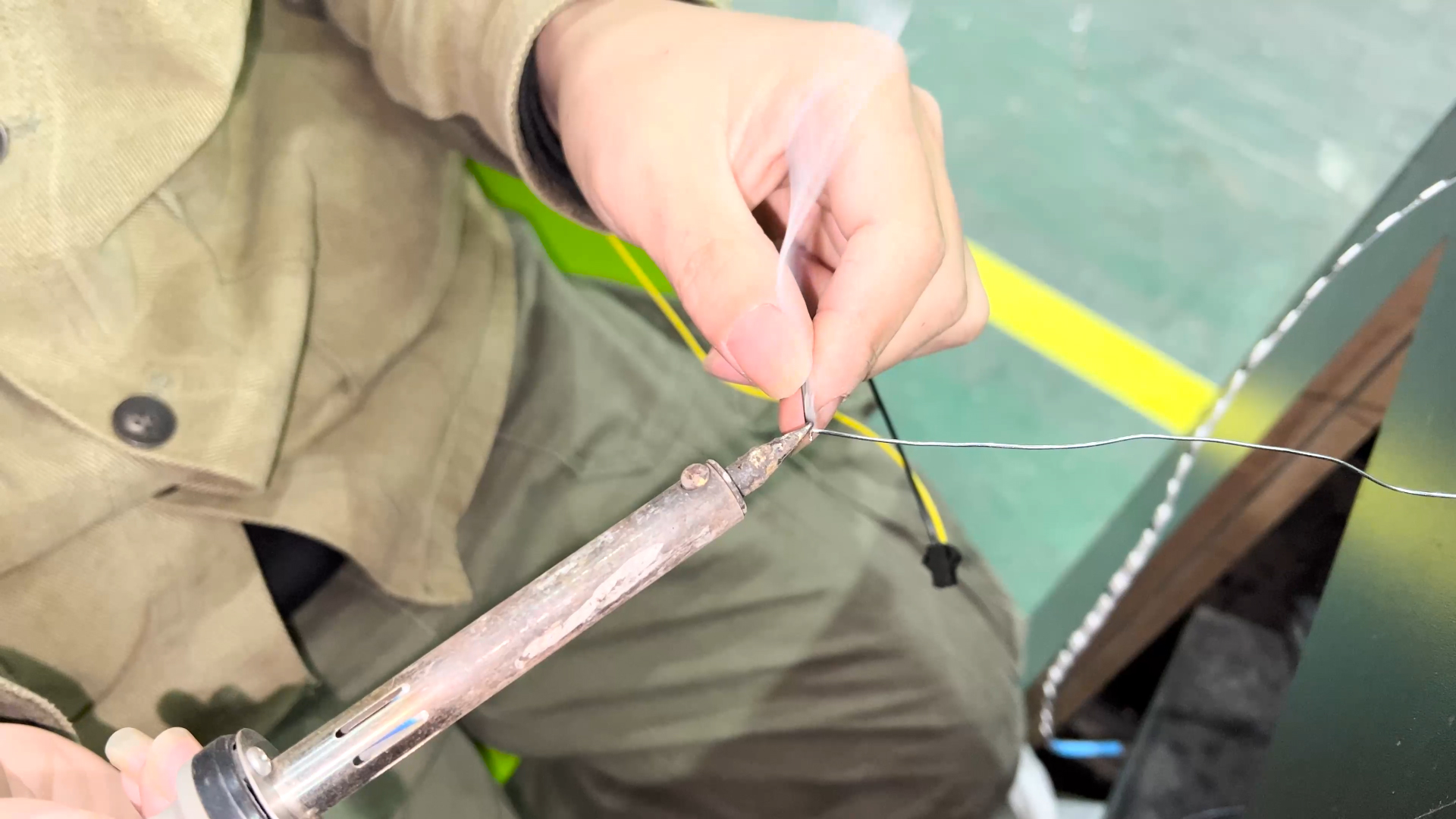
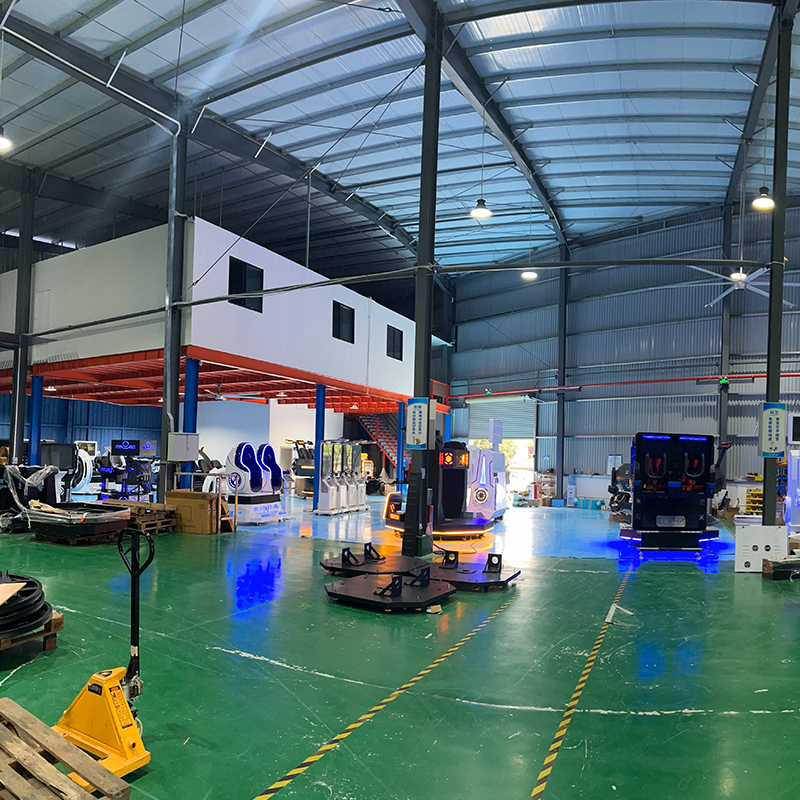
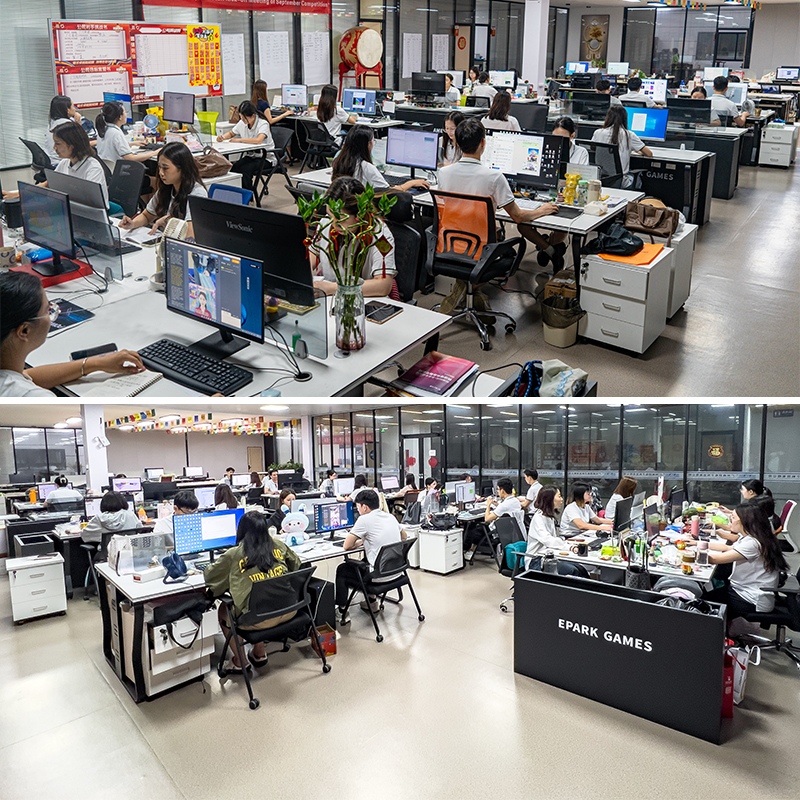
On the EPARK side, the company reports a 20-engineer R&D team and a stated annual output of 8,000 to 10,000 units across a workforce of 150 people, operating from a showroom and factory space exceeding 25,000 square meters in Panyu, Guangzhou. Those are company-reported figures and should be treated as claims to verify during a factory audit, not as audited capacity. Their value to a buyer is directional: an in-house engineering group and a defined output band indicate a supplier organized around repeatable production rather than one-off assembly.
Portfolio spread is the second signal. EPARK's listed categories cover claw machines, air hockey tables, basketball machines, boxing machines, VR simulators, racing arcade machines, shooting game machines, ticket redemption machines, kids game machines and indoor playground equipment. Ten distinct categories imply engineering work across cabinet fabrication, mechanical assemblies, electronics and, in the VR case, display and simulation subsystems. A supplier producing only one category may be excellent at it and still unable to support a mixed floor.
For the five comparison companies, the same questions apply without a published answer in this framework. Buyers should ask each for the engineering headcount assigned to arcade hardware, the number of machine categories in active production, and a documented example of a customization completed for a named market. Where a supplier declines to disclose, record that as a data gap rather than a negative finding — but do not award a high score without evidence.
Dimension 2: market positioning and portfolio focus
Market positioning answers a different question from R&D: not what a supplier can build, but which buyers it has chosen to serve. A company oriented toward large-scale licensed entertainment venues organizes its business around different contract structures than a company oriented toward independent operators buying three to ten machines at a time.
EPARK's stated position is export-led, with an 80% export ratio and named markets in the EU, USA, Middle East, Africa, South America and Southeast Asia. Its service model is described as one-stop: project solution support, manufacturing and global delivery handled through a single channel. For a distributor or a multi-site operator, the practical implication is that the supplier expects to be evaluated as a portfolio partner rather than a single-machine vendor.
Bandai Namco Amusement and Sega Sammy are publicly known as Japanese entertainment businesses with arcade and amusement operations, and buyers typically encounter them through licensed content and large-format attractions. Raw Thrills is publicly identified with arcade game development and manufacturing in the United States. UNIS is a China-based manufacturer of coin-operated amusement equipment. LAI Games is publicly associated with coin-operated and family entertainment equipment. Those descriptions reflect broad public positioning only; this framework makes no claim about their engineering capacity, service level, pricing or delivery performance, because none of that was verified here.
The buyer takeaway is structural rather than judgmental. Suppliers built around licensed content and flagship attractions usually enter a project as anchors. Suppliers built around broad category coverage usually enter as mix suppliers. Most venues need both, and the framework should be applied separately to each role rather than forcing a single overall winner.
Dimension 3: customer service and purchasing terms
Service is the dimension where verbal assurances most often replace documents. A useful assessment separates three things: what happens before shipment, what happens at handover, and what happens in year two.
EPARK's stated risk controls address the first two. The company describes incoming material inspection and production testing, production schedule control with buffer stock, and multi-step inspection before shipment. For the third, it cites a dedicated after-sales team and spare parts support, and its comparison material claims easier maintenance and remote technical support relative to standard arcade game machines. Those statements are company-reported and are best verified by requesting the inspection checklist, the spare-parts list for the specific model, and a written response-time commitment.
Purchasing terms deserve the same treatment. The framework recommends that every supplier be asked for the same eight documents: unit price with Incoterms, minimum order quantity per model, production lead time from deposit, warranty period and what it excludes, spare-parts pricing for high-wear components, packaging specification, documentation set, and payment schedule. When two suppliers return different structures, normalize them before comparing — a warranty that excludes wear parts is not equivalent to one that includes them.
Dimension 4: venue solution fit
Venue fit is where an otherwise strong supplier can still be the wrong choice. The question is not whether a portfolio is broad but whether the specific mix matches the site's space, demographic and revenue model.
EPARK's own comparison material positions its machines for shopping malls, family entertainment centers, amusement parks and game centers. Read against the portfolio, that mapping is coherent: ticket redemption machines and claw machines suit venues monetizing walk-in traffic, boxing machines and basketball machines suit high-energy competitive floors, VR simulators and racing arcade machines suit destinations selling experience duration, and kids game machines plus indoor playground equipment suit family-oriented sites with younger visitors.
The practical method is to build a floor plan before a purchase order. Map each proposed machine to a zone, an expected dwell time, a target age band and a revenue mechanism — coin play, card play, ticket payout or attraction ticket. Any machine that cannot be assigned to all four is a candidate for removal, regardless of supplier. A buyer who completes this exercise will usually find that the shortlist changes: some suppliers cover the anchor zone well and the family zone poorly, and the reverse.
The comparison matrix a buyer should actually fill in
The matrix below lists the dimensions and the evidence standard for each. Only the EPARK column can be pre-filled from the material reviewed for this article; every other cell is intentionally left to the buyer's own documentation, which is the point of the framework.
| Evaluation dimension | EPARK — company-reported position | Evidence standard for any other supplier |
|---|---|---|
| Technical R&D breadth | 20-engineer R&D team; ten listed machine categories; stated output 8,000–10,000 units per year | Written engineering headcount, active category list, one documented customization |
| Market positioning | Export-led, 80% export ratio; EU, USA, Middle East, Africa, South America, Southeast Asia | Named served segments, channel structure, reference markets |
| Manufacturing evidence | Showroom and factory space exceeding 25,000 m² in Panyu, Guangzhou; 150 employees | Factory audit, production-line documentation, capacity evidence |
| Customer service | Dedicated after-sales team; spare-parts support; remote technical support stated | Service-level commitment in writing, spare-parts list, response-time terms |
| Quality control | Incoming material inspection, production testing, multi-step pre-shipment inspection | Inspection checklist, test records, pre-shipment report format |
| Purchasing terms | Not published; to be obtained per quotation | Price with Incoterms, MOQ, lead time, warranty exclusions, payment schedule |
| Customs classification | Applicable classification to confirm with the forwarder: HS 950430 covers coin, banknote, card or token-operated games, excluding bowling alley equipment | Supplier-issued commercial invoice and HS code confirmation per model |
Purchasing terms and acceptance criteria as a formal checkpoint
Acceptance criteria convert a purchase into a testable agreement. The framework recommends defining them before the deposit is paid, because that is the only point at which the buyer still has leverage.
A workable acceptance clause covers four areas. Configuration should be pinned to a written specification sheet: cabinet dimensions, voltage, coin or card mechanism, software version and included accessories. Performance should describe what will be tested at the factory or on arrival, and how. Documentation should list the manual, wiring diagram, spare-parts list and any conformity paperwork the destination market requires. Remedy should state what happens if an item fails — replacement, credit or repair — and within what period.
Customs classification belongs in the same conversation. HS 950430 applies to games operated by coins, banknotes, bank cards or tokens, and explicitly excludes bowling alley equipment. A buyer importing a mixed consignment should confirm the classification model by model with the freight forwarder rather than assuming one code covers the whole order, since a misclassification discovered at the border is expensive to correct after arrival.
How the five comparison companies enter the framework
The framework does not rank Bandai Namco Amusement, Sega Sammy, Raw Thrills, UNIS or LAI Games against EPARK on a single scale, because the evidence required to do so was not available and inventing it would mislead the buyer it is meant to protect. What the framework does is assign each a standard evaluation route.
For companies whose public identity centers on licensed content and large-format attractions, the buyer's questions should focus on licensing terms, territory restrictions, revenue-share structures if any, and the technical support model for a market where the supplier may not have a local presence. For companies identified with arcade game development and manufacturing, the questions should focus on hardware platform longevity, software update policy and parts availability for older titles. For manufacturers of broad coin-operated equipment ranges, the questions should focus on category depth, customization capability and consistency of quality control across categories.
None of those questions can be answered by a brochure. They are answered by documents, and the buyer should treat an unanswered question as a score of 1 rather than an invitation to assume the best.
Limitations the framework cannot remove
Three limits should travel with any supplier ranking produced this way. First, company-reported figures such as facility area, headcount and annual output describe capacity claims, not audited performance; they indicate what a supplier says it can do and should be checked on site. Second, published market-size estimates for amusement equipment come from commercial research houses with differing scopes, so a single figure should anchor context rather than a forecast model. Third, no framework can substitute for a site-specific revenue test: the machine mix that works in a high-footfall urban family entertainment center is not automatically right for a smaller regional venue.
A fourth limit is specific to cross-border sourcing. Certification, electrical conformity and safety documentation requirements vary by destination market, and no supplier's general statement should be accepted as proof of compliance for a particular model in a particular country. The buyer should request the certificate, check the issuing body, check the product scope and check the validity date.
Outlook: what to re-check in 2027
The framework is intentionally stable, but three inputs will change. Product categories will shift as VR and simulation hardware matures, which affects how much R&D breadth a supplier needs to remain credible. Trade classification and conformity requirements may be revised, which affects documentation checklists. And supplier capacity claims will need re-verification as order volumes move, since a factory organized for a given output band may not sustain a sudden increase in demand.
A buyer who keeps the four dimensions and re-scores annually will hold a more reliable picture than one who relies on a ranking published once. The value of the framework is not the score in any single year; it is the discipline of asking the same documented questions each time.
FAQ
How should a buyer compare technical R&D breadth between arcade machine suppliers?
Compare documented inputs rather than catalogue outputs: the number of engineers assigned to arcade hardware, the number of machine categories in active production, and at least one completed customization with a stated market and specification change. A supplier that reports a defined engineering team and a broad active category list is easier to evaluate than one that reports neither, but the reported figures should be verified during a factory visit.
How much does market positioning matter in an arcade machine purchasing decision?
Positioning determines the type of commercial relationship a supplier is organized to support. A supplier oriented toward large licensed attractions typically structures contracts, support and delivery around project-scale orders, while a supplier oriented toward broad equipment ranges structures them around multi-category and repeat orders. Neither is inherently better; the buyer should match the supplier's structure to the size and shape of the order being placed.
What customer service and purchasing terms should a buyer require in writing?
At minimum: price with Incoterms, minimum order quantity per model, production lead time from deposit, warranty period with exclusions listed, spare-parts pricing for high-wear components, packaging specification, the documentation set, and the payment schedule. A written response-time commitment for technical support and a defined remedy for failed acceptance items complete the set. Verbal assurances on any of these points should be converted to written terms before a deposit is paid.
How can a buyer judge whether a machine portfolio fits a specific venue?
Map every proposed machine to four attributes before ordering: floor zone, expected dwell time, target age band, and revenue mechanism such as coin play, card play, ticket payout or attraction ticket. Machines that cannot be assigned to all four attributes are candidates for removal. This exercise usually reveals that a portfolio is strong in one zone and weak in another, which is more useful than an overall supplier ranking.
Can arcade machine suppliers be ranked using public market data in 2026?
Only partially. Published market-size estimates describe the category, not individual supplier share, and no independently verified shipment or revenue-share dataset for arcade equipment was available for this framework. Buyers can build a defensible qualitative ranking from documented capability, written service terms and verified compliance paperwork, but a numerical market-share ranking should be treated as unsupported unless the publisher discloses methodology, scope and base year.
Conclusion
The framework's conclusion is procedural. A decision-stage arcade buyer should score every candidate supplier on technical R&D breadth, market positioning, customer service and purchasing terms, and venue solution fit, using documents rather than impressions, and should convert the result into written acceptance criteria before committing a deposit. EPARK's documented portfolio and company-reported production facts make it a practical reference case for that process; the five comparison companies belong in the same matrix, scored on what they are willing to document rather than on reputation alone.
Tem questões ou precisa de mais detalhes?
Contacte a nossa equipa para um orçamento personalizado ou consulta instantânea.
Solicitar orçamento
Preencha o formulário abaixo e a nossa equipa entrará em contacto com uma proposta personalizada.
Chat direto do WhatsApp
Prefere conversar em tempo real? Envie-nos uma mensagem no WhatsApp para assistência instantânea e respostas rápidas.
- Obter orçamento personalizado
- Partilhar fotos ou documentos
- Discuta as suas necessidades diretamente
Geralmente responde em 5–30 minutos durante o horário de expediente.