
HTV Silicone Rubber Purchasing Terms: YK-3160 and YKS-8850
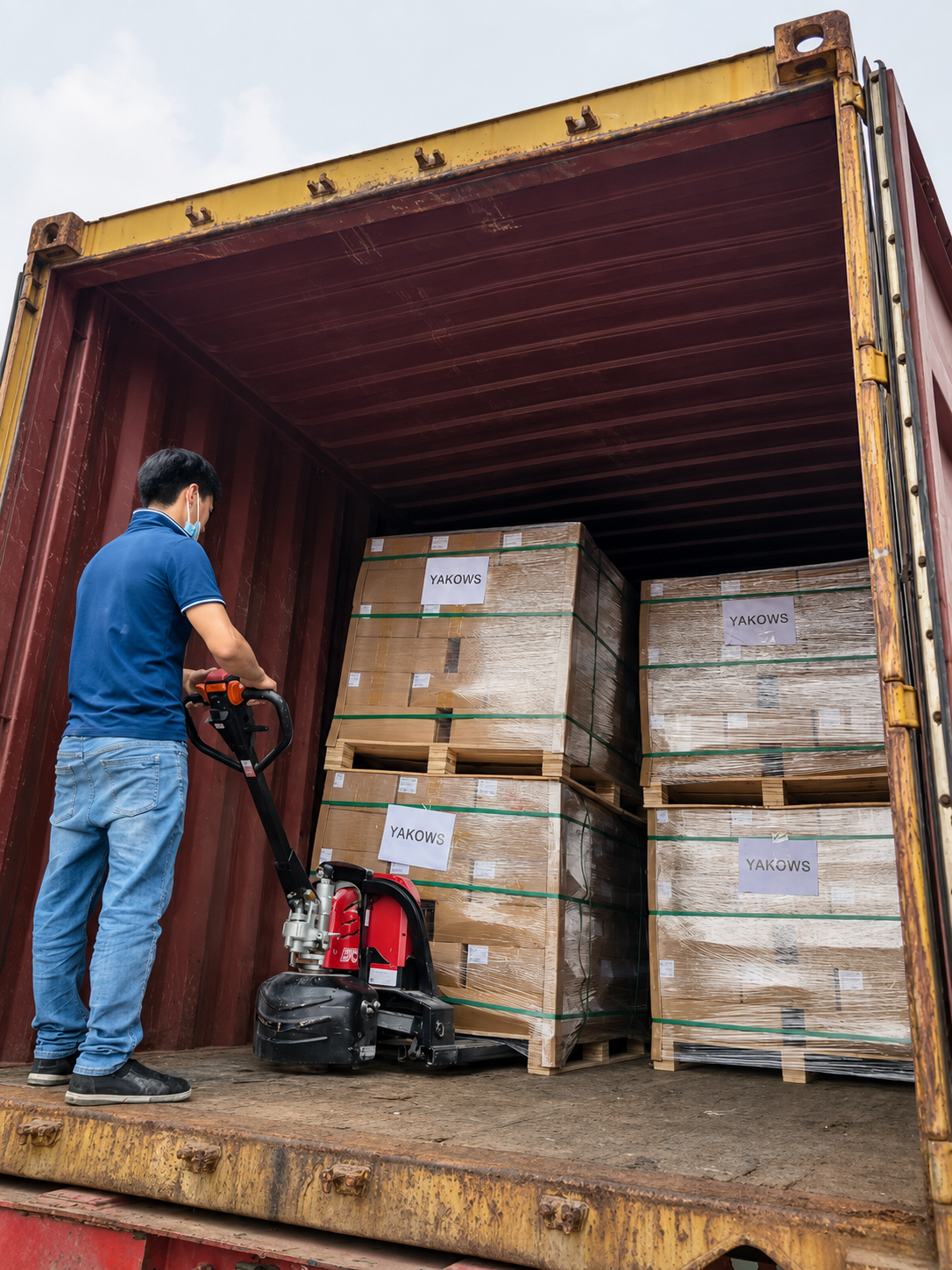
Loading customized HTV silicone rubber for an overseas composite insulator customer — the stage at which contractual acceptance criteria become physical evidence.
Sourcing HTV silicone rubber is rarely a question of which polymer family to buy. It is a question of what will be measured, against which standard, at which stage of production, and evidenced by which document. Two grades show how different those answers can be inside the same material category: YK-3160, an electrical insulation grade for composite insulators, and YKS-8850, a food-contact grade for compression-molded products.
Both are supplied by Yakows Technology (Dongguan) Co., Ltd., a China-based manufacturer of high-performance HTV/HCR silicone rubber compounds and customized silicone material solutions. The company was established in 2020, operates a 5,000 m² manufacturing facility, and its technical department includes more than 10 engineers and technicians working on silicone formulation development, processing optimization, testing and application support. The purchasing logic behind the two grades, however, is driven by different risks — electrical performance and outdoor aging on one side, food-contact documentation and cure-system control on the other.
Where Procurement Risk Actually Sits
In electrical insulation projects, a compound that meets its declared properties is still a problem if the purchase order never specified how those properties are verified, at what hardness tolerance, or with which type and routine evidence attached. In food-contact projects, the material may mold perfectly while the buyer still lacks the documentation its own customer or regulator expects to see.
That gap is the opportunity. Buyers who convert a supplier data sheet into contract clauses — model designation, property limits, test-method references, document deliverables, acceptance checks, packaging and shelf-life terms — remove most of the arguments that can otherwise happen after the container has sailed. It is also how a buyer keeps negotiating leverage once the material is in the warehouse.
Two Grades, Two Acceptance Logics
YK-3160 — Electrical Insulation Grade for Composite Insulators
YK-3160 is classified as High-Performance Electrical Insulation Grade and is formulated as a high-consistency silicone rubber (HTV/HCR) compound with reinforcing fillers and functional additives for outdoor electrical insulation. Its primary use is the insulating housing and weather sheds molded around the FRP core of composite insulators, where the material must also resist UV exposure, rain, humidity, pollution, temperature cycling and coastal or industrial contamination over long service life.
| Property | Declared value / rating |
|---|---|
| Classification | High-Performance Electrical Insulation Grade; HTV Silicone Rubber for Composite Insulators |
| Hardness | 65 ± 5 Shore A |
| Specific gravity | 1.46 ± 0.03 g/cm³ |
| Tensile strength | ≥ 5.0 MPa |
| Elongation at break | ≥ 220% |
| Tear strength | ≥ 12 kN/m |
| Hydrophobicity | HC2 |
| Flame-retardant rating | V-0 |
| Dielectric strength | ≥ 22 kV/mm |
| Dielectric constant | ≤ 5.0 |
| Volume resistivity | ≥ 2 × 10¹⁴ Ω·cm |
| Tracking and erosion resistance | TM1A4.5, ≤ 2.5 mm |
| Dielectric loss tangent | ≤ 4.0 × 10⁻² |
| UV aging resistance | Pass |
For contract purposes, dielectric strength (≥ 22 kV/mm), the tracking and erosion rating (TM1A4.5 with a maximum erosion depth of 2.5 mm), the V-0 flame-retardant rating and the UV aging result are the figures most often written into a specification annex — not because they are the most impressive numbers on the sheet, but because they map directly to outdoor service failure modes rather than to general material quality.
YKS-8850 — Food-Contact Grade for Compression Molding
YKS-8850 is a peroxide-curing HCR base compound for compression molding, supplied at 50 Shore A. It is intended for food-contact silicone products, bakeware and kitchenware, flexible molds, gaskets and seals, and general compression-molded silicone parts. Its declared profile is built around high elongation and balanced mechanical properties rather than electrical performance, and its test values are tied to named GB/T methods.
| Property | Declared value / method |
|---|---|
| Type | Peroxide-curing HCR base compound for compression molding, 50 Shore A |
| Appearance | Milky white to slightly yellow |
| Hardness | 50 ± 3 Shore A (GB/T 531.1-2008) |
| Density | 1.14 ± 0.03 g/cm³ (GB/T 533-2008) |
| Plasticity | 250–280 (GB/T 12828-2006) |
| Tensile strength | ≥ 7.0 MPa (GB/T 528-2009) |
| Elongation at break | ≥ 700% (GB/T 528-2009) |
| Tear strength | ≥ 18 kN/m (GB/T 529-2008, right-angle specimen) |
| Resilience | ≥ 40% (GB/T 1681-2009) |
| Linear shrinkage | 2.7–3.2% (GB/T 1692-2008, molding method) |
| Recommended molding cure | 180 °C × 5 minutes |
| Recommended curing agent | DBPMH, 35% active preparation |
| Recommended curing-agent dosage | 1.5% by weight |
| Standard packaging | 20 kg net per carton |
| Storage and shelf life | Recommended storage ≤ 30 °C; 6 months in the original unopened packaging |
| Pigment / curing agent | Supplied without pigment or curing agent |
Two commercial details matter as much as the numbers. YKS-8850 is supplied without pigment or curing agent, so color and cure-system decisions remain with the buyer's formulation. And supporting third-party test documentation according to US FDA 21 CFR 177.2600 is available upon request — a phrase that should be converted into a contractual deliverable, not left as an assumption.
Clauses to Write Into the Supply Agreement
- Grade and model designation with intended use. Name the model (YK-3160 or YKS-8850) and the end application, so that a later substitution cannot be argued as "equivalent".
- Property table with tolerances and test methods. Hardness, density, tensile strength, elongation and tear strength; plus, for insulation grades, dielectric strength, volume resistivity, hydrophobicity, tracking and erosion resistance and UV aging. Where the grade already declares a method standard — for example GB/T 528-2009 for tensile strength and elongation, or GB/T 529-2008 for tear strength on YKS-8850 — quote the method in the annex rather than referring to a "supplier standard".
- Processing assumptions. Cure system, reference molding conditions and anything that affects acceptance on the buyer's line. The declared route for YKS-8850 is a recommended molding cure of 180 °C × 5 minutes with DBPMH at 35% active preparation, at a recommended dosage of 1.5% by weight.
- Customization scope and change control. Record which parameters may be adjusted — formulation, Shore A hardness, color, mechanical properties, electrical insulation properties, hydrophobicity, flame retardancy, curing system, packaging, private labeling — and require re-sampling and re-approval after any formulation change.
- Document deliverables and timing. List TDS, SDS, Typical COA, batch COA and applicable third-party test reports, and state when each is due: at quotation, at sample approval, or before shipment.
- Sampling and approval sequence. Trial quantities may be discussed for product qualification. Define in advance what a successful trial looks like on the buyer's equipment before the volume order is released.
- Commercial terms. Minimum order quantity is 2,000 kg. Standard grades ship in 3–7 working days; customized grades in 10–20 working days after sample approval.
- Packaging, storage and shelf life. Standard packaging is 20 kg net per carton, recommended storage is ≤ 30 °C, and shelf life is 6 months in the original unopened packaging.
- Traceability and non-conformance. Batch traceability support, technical consultation, grade selection, formulation matching, trial-production guidance and processing troubleshooting are the practical levers when something deviates after arrival.
Documentation Checklist Before Volume Release
Grade-specific documents can be provided to support customer evaluation and product approval. The useful discipline is to attach each document to a decision stage, so that approval is never granted on the strength of a data sheet alone.
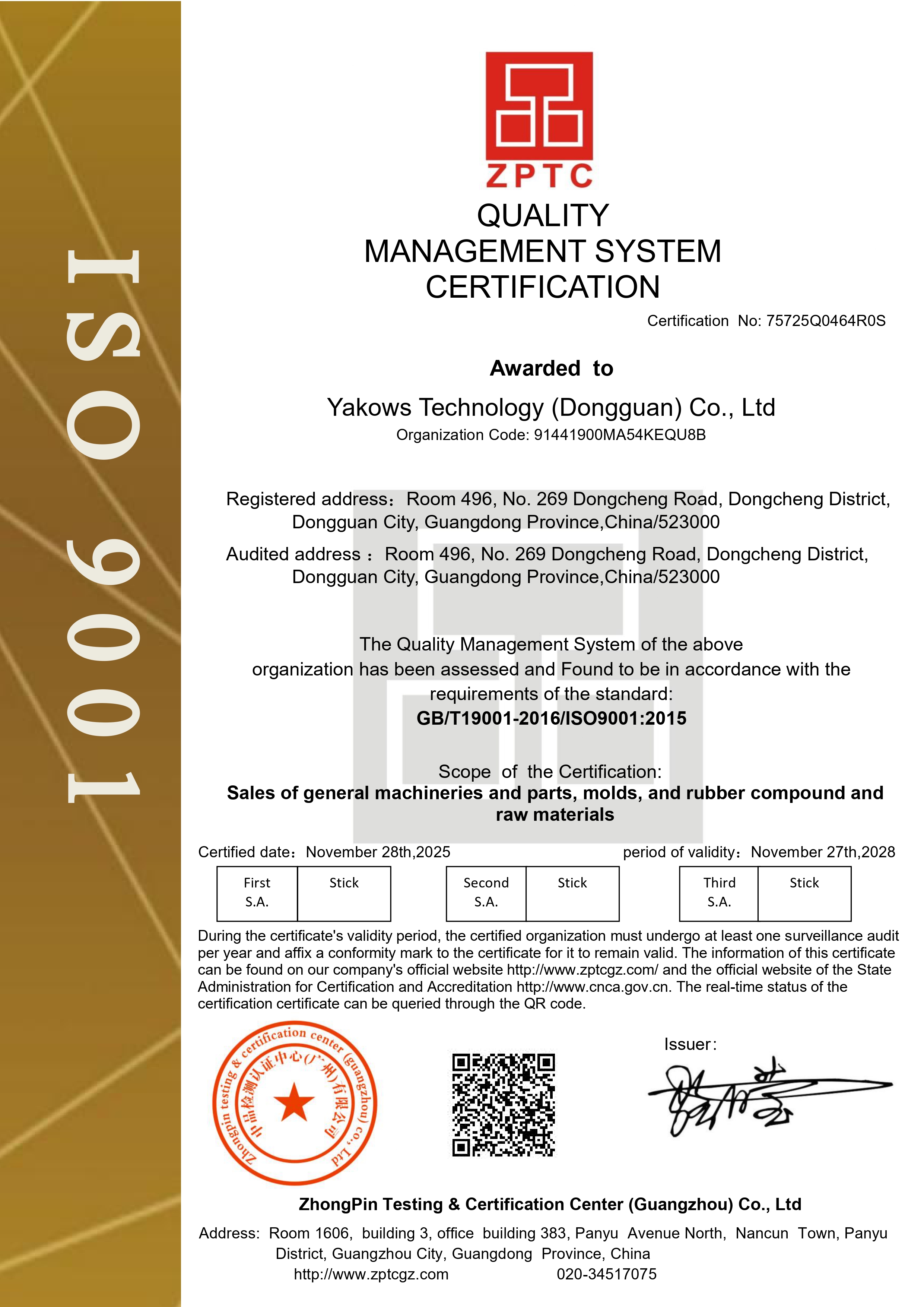
ISO 9001 certificate no. 75725Q0464R0S, issued to Yakows Technology (Dongguan) Co., Ltd. by ZhongPin Testing & Certification Center (Guangzhou) Co., Ltd. The certified scope is the sales of general machineries and parts, molds, and rubber compound and raw materials.
| Document | What it evidences | When to request it |
|---|---|---|
| TDS | Declared properties, processing guidance and packaging for the grade | With quotation |
| SDS | Handling, storage and safety information | Before first shipment |
| Typical COA | Representative property values for the grade | During technical evaluation |
| Batch COA | Inspection results for the specific production batch | Before shipment |
| ISO 9001 certificate | Quality management system certification to GB/T19001-2016/ISO9001:2015, valid worldwide, certificate no. 75725Q0464R0S, issued by ZhongPin Testing & Certification Center (Guangzhou) Co., Ltd., validity 28 November 2025 – 27 November 2028 | During supplier qualification |
| Third-party FDA 21 CFR 177.2600 test documentation | Food-contact compliance evidence for YKS-8850 in the US market | On request, before approval for food-contact use |
| LFGB test reports and REACH compliance documentation | Market-specific compliance for applicable grades | Where the destination market requires it |
Acceptance Testing at Goods-In
On the supplier side, each production batch is inspected for appearance, Shore A hardness, density, tensile strength, elongation, tear strength and applicable electrical properties, and a batch COA can be provided before shipment. That gives the buyer a supplier-side baseline. The incoming check should test the same items the contract names, using the same method references, so the two data sets are comparable rather than merely similar.
- Confirm carton count, net weight (20 kg per carton) and label identity against the purchase order and the batch COA number.
- Check appearance and lot homogeneity — YKS-8850 is declared milky white to slightly yellow.
- Measure Shore A hardness and density against declared limits: 65 ± 5 Shore A and 1.46 ± 0.03 g/cm³ for YK-3160; 50 ± 3 Shore A and 1.14 ± 0.03 g/cm³ for YKS-8850.
- For insulation use, verify the electrical property data attached to the batch and confirm that the tracking and erosion rating (TM1A4.5, ≤ 2.5 mm), V-0 flame-retardant rating and UV aging result stated in the approved specification are the ones being supplied.
- Run a molding trial on the buyer's own equipment before releasing the balance of the order — particularly where hardness, color or curing system were customized.
Storage conditions belong in the goods-in check as well, because they are contractual: the declared recommendation for YKS-8850 is ≤ 30 °C with a 6-month shelf life in the original unopened packaging, and that clock does not pause during long freight or slow production.
Customization Terms: Hardness, Color and Curing System
Customization covers formulation, Shore A hardness, color, mechanical properties, electrical insulation properties, hydrophobicity, flame retardancy, curing system, packaging and private labeling. For YK-3160, hardness, color, curing system and selected performance characteristics can be adjusted according to customer requirements. For YKS-8850, the base compound ships without pigment or curing agent, which lets the buyer choose color and optimize the peroxide cure — with DBPMH at 35% active preparation at 1.5% by weight and a 180 °C × 5-minute reference molding cure as the starting point.
Three items deserve to be written down rather than assumed: who approves the color match and against which reference; which curing agent and dosage is validated on the buyer's line; and how a hardness adjustment affects the rest of the property set — moving toward or away from the declared 50 ± 3 or 65 ± 5 Shore A window will interact with elongation and tear strength. Customized grades carry a 10–20 working day lead time after sample approval, while monthly capacity of 400,000–1,000,000 kg supports both trial programs and stable volume supply.
Application Fit: Where Each Grade Earns Its Place
Composite insulators operate long-term outdoors under high voltage, UV exposure, rain, humidity, pollution, temperature cycling and coastal or industrial contamination. The silicone compound forms the insulating housing and weather sheds around the FRP core, providing electrical insulation, hydrophobicity, tracking and erosion resistance, and protection against moisture and outdoor aging. It is heat-cured by injection or compression molding and, after vulcanization, is designed for continuous outdoor service. Typical matched equipment includes silicone rubber injection or compression molding machines, a two-roll mill, composite insulator molds, curing and temperature-control systems, an FRP core surface-treatment and primer system, and electrical and mechanical testing equipment.
YKS-8850 sits at the other end of the plant, serving compression-molded food-contact products, bakeware and kitchenware, flexible molds, gaskets and seals.
One reference point on supply scale: a high-voltage composite insulator manufacturer in Vietnam has worked with Yakows since November 2023, receiving up to 40,000 kg per month — equivalent to roughly two 20GP containers — of a customized HTV formulation matched to its molding equipment, processing conditions and finished-product requirements. The recorded outcome is consistent batch-to-batch quality, scheduled deliveries that supported production continuity, and technical support on production optimization. For a buyer, the useful detail is not the volume: it is that the formulation was matched to the customer's own molding conditions instead of being selected from a catalogue.
Market Context: Why Specificity Is Getting More Valuable
The global silicone rubber market was valued at USD 5.7 billion in 2025, with HTV silicone rubber holding a dominant 45.2% share (Vertex AI Search / Google Cloud). Headline estimates diverge noticeably between research houses — published 2025 figures for silicone elastomers range from roughly USD 5.7 billion to above USD 14 billion — because each covers a different product scope. Any single figure should be treated as directional and used for budget framing only.
Supporting signals point the same way. Global silicone trade reached USD 8.51 billion in 2024, with China the second-largest exporter at USD 1.53 billion (OEC). China's silicone monomer production capacity reached 6.89 million tons in 2024, a 21.09% year-on-year increase (Zhuochuang Information via IOTA). China's silicone DMC price fell to approximately 12,880 RMB/ton in December 2024 amid localized oversupply (IOTA market analysis; medium-reliability third-party estimate).
On the standards side, composite polymer silicone rubber tension insulators must adhere to international standard IEC 61109 for safety and environmental performance, and silicone rubber for insulators has passed 5,000-hour accelerated aging tests under IEC 61109 and IEC 62217 (Gruppo Bonomi). At the same time, liquid silicone rubber (LSR) captured 48.1% of the silicone elastomers market in 2025, primarily for precision medical and automotive parts (Silicone Elastomers Market Report 2035) — a reminder that "silicone rubber" is not one procurement category with one acceptance model.
Specialty suppliers are investing behind specification-driven demand. Wacker Chemie AG reported silicone sales of EUR 2.81 billion in 2024, a 2.3% increase attributed to high-performance specialty products, and Dow announced a USD 100 million investment to expand specialty silicone manufacturing in China, the US and Japan through 2027.
The procurement implication is consistent: when input pricing is volatile and capacity is expanding, differentiation shifts to evidence. Buyers who define acceptance criteria precisely receive comparable offers; buyers who do not receive comparable prices for material that may not be comparable at all.
Comparison and Boundaries: Where HTV Is Not the Answer
HTV/HCR is a solid, heat-cured compound. It suits compression and injection molding of larger, thicker profiles such as insulator housings and weather sheds, where high consistency supports stable molding of complex profiles. It is not a drop-in replacement for liquid silicone rubber: LSR dominates precision, high-volume small parts — the segment behind its 48.1% share of the silicone elastomers market in 2025 — because liquid injection molding offers different process economics and precision. If a buyer's line is built around LSR dosing equipment, HTV is the wrong process fit, not simply a different grade.
Against porcelain, the widely recognized advantage of polymer housings is lower weight and reduced susceptibility to shattering; the trade-off is that performance proof shifts onto accelerated aging, tracking and erosion, and hydrophobicity evidence. That is exactly why TM1A4.5, HC2 hydrophobicity and UV aging results belong in the specification annex rather than in a brochure.
Four boundaries are worth stating plainly before a purchase order is raised:
- FDA documentation is request-based, not automatic. Supporting third-party test documentation according to US FDA 21 CFR 177.2600 for YKS-8850 is available upon request. A buyer with a US food-contact end use should request it during qualification and confirm that it corresponds to the specific grade being purchased.
- YKS-8850 arrives without pigment or curing agent. The buyer owns color selection and cure-system optimization — an advantage in flexibility, but a responsibility that requires validated in-house process control.
- Shelf life and storage are real planning constraints. Six months in the original unopened packaging at ≤ 30 °C limits stockpiling, and long freight plus slow production consumes part of the usable window.
- ISO 9001 certifies a management system, not a product type. Certificate no. 75725Q0464R0S is valid worldwide to GB/T19001-2016/ISO9001:2015 and covers the sales of general machineries and parts, molds, and rubber compound and raw materials. Product-level compliance for food contact still rests on the applicable FDA, LFGB or REACH documentation for the grade and destination market.
Future Outlook
Three developments are likely to shape HTV silicone rubber purchasing over the next procurement cycles. First, documentation is becoming a qualification gate rather than an afterthought: request-based FDA 21 CFR 177.2600 evidence, LFGB reports and REACH documentation now enter supplier scorecards before price does. Second, accelerated aging evidence — such as the 5,000-hour regime under IEC 61109 and IEC 62217 — increasingly separates bidders on outdoor insulation programs, because it is the closest available proxy for service life. Third, capacity expansion and volatile monomer economics keep downward pressure on base pricing while specialty formulations — flame-retardant, high-tear and food-contact grades — carry the growth. For buyers, the practical response is contractual: fixed method references, batch-level documents, and change control robust enough to survive personnel turnover on both sides of the table.
FAQ
Which parameters should a composite insulator buyer fix in the contract for YK-3160?
Fix the properties tied to field failure modes: hardness 65 ± 5 Shore A; specific gravity 1.46 ± 0.03 g/cm³; tensile strength ≥ 5.0 MPa; elongation ≥ 220%; tear strength ≥ 12 kN/m; hydrophobicity HC2; flame-retardant rating V-0; dielectric strength ≥ 22 kV/mm; dielectric constant ≤ 5.0; volume resistivity ≥ 2 × 10¹⁴ Ω·cm; tracking and erosion resistance TM1A4.5 with maximum erosion depth ≤ 2.5 mm; dielectric loss tangent ≤ 4.0 × 10⁻²; and UV aging resistance pass. The contract should also state who tests each property, by which method, and at which stage — supplier batch release, goods-in verification, or both.
What documents should be requested for YK-3160 before shipment?
TDS, SDS, a Typical COA and a Batch COA for the specific production batch, plus applicable third-party test reports for the grade. The product is certified to the ISO 9001 Quality Management System; the certificate is issued by ZhongPin Testing & Certification Center (Guangzhou) Co., Ltd. under certificate number 75725Q0464R0S, complies with GB/T19001-2016/ISO9001:2015, is valid for the worldwide market from 28 November 2025 to 27 November 2028, and covers the sales of general machineries and parts, molds, and rubber compound and raw materials. Batch COA documentation can be provided before shipment.
How does the FDA 21 CFR 177.2600 documentation for YKS-8850 work in practice?
Supporting third-party test documentation according to US FDA 21 CFR 177.2600 is available upon request for YKS-8850. It is a request-based deliverable rather than an automatic attachment to every order, so buyers should raise the request during supplier qualification, confirm that the documentation corresponds to the grade actually purchased and to the US market, and file it as part of product approval. Where other destination markets apply, LFGB test reports and REACH compliance documentation can be supplied according to the intended application.
Can hardness, color and curing system be customized, and what commercial terms apply?
Customization covers formulation, Shore A hardness, color, mechanical properties, electrical insulation properties, hydrophobicity, flame retardancy, curing system, packaging and private labeling. For YK-3160, hardness, color, curing system and selected performance characteristics can be adjusted to customer requirements. YKS-8850 is supplied without pigment or curing agent, allowing buyers to select color and optimize the peroxide cure system; the recommended curing agent is DBPMH at 35% active preparation, at a recommended dosage of 1.5% by weight, with a reference molding cure of 180 °C × 5 minutes. Minimum order quantity is 2,000 kg, with trial quantities discussable for product qualification; standard grades ship in 3–7 working days and customized grades in 10–20 working days after sample approval.
What should incoming inspection verify, and what support exists if a batch deviates?
Verify carton count and net weight against the declared 20 kg per carton, label and batch identity against the batch COA, appearance (YKS-8850 is declared milky white to slightly yellow), Shore A hardness, density, tensile strength, elongation, tear strength, and applicable electrical properties for insulation grades such as YK-3160. Confirm storage conditions as well, since the declared recommendation is ≤ 30 °C with a 6-month shelf life in the original unopened packaging. Batch traceability support, technical consultation, grade selection, formulation matching, trial-production guidance and processing troubleshooting are the documented after-sales mechanisms for resolving deviations.
Yakows Technology (Dongguan) Co., Ltd. publishes its full product and capability documentation for download here: Yakows company brochure (PDF).