
Hair Growth Serum OEM: Verifying DESIFINE's GMPC Evidence
The global hair serum market was valued at USD 1.3 billion in 2024 and is projected to reach USD 2.4 billion by 2033, according to Grand View Research. Hair treatment serums — the segment that includes anti-hair-loss and regrowth formats — accounted for 64.6% of that market in 2024. That growth has pushed more brand owners, importers and salon groups toward the same shortlist of factories, and it has also pushed a great many unverified claims into their quotation documents.
Hair Growth Serum OEM sourcing has a specific verification problem. The terms GMPC, ISO 22716 and pharmaceutical grade appear on nearly every supplier page, but they do not describe the same thing: one is a facility-level cosmetics certification, one is a quality management system standard, and one is a production standard. A buyer who cannot separate them cannot compare two quotations on equal terms.
This article maps what a genuine evidence trail looks like at the Research-to-Evaluation stage, using Guangdong Desifine Biotechnology Co., Ltd. — trading as DESIFINE — as a documented case. It sets out the certifications a buyer should request, the production figures that decide whether a project actually fits, and the boundaries a buyer should accept before committing to a partner.
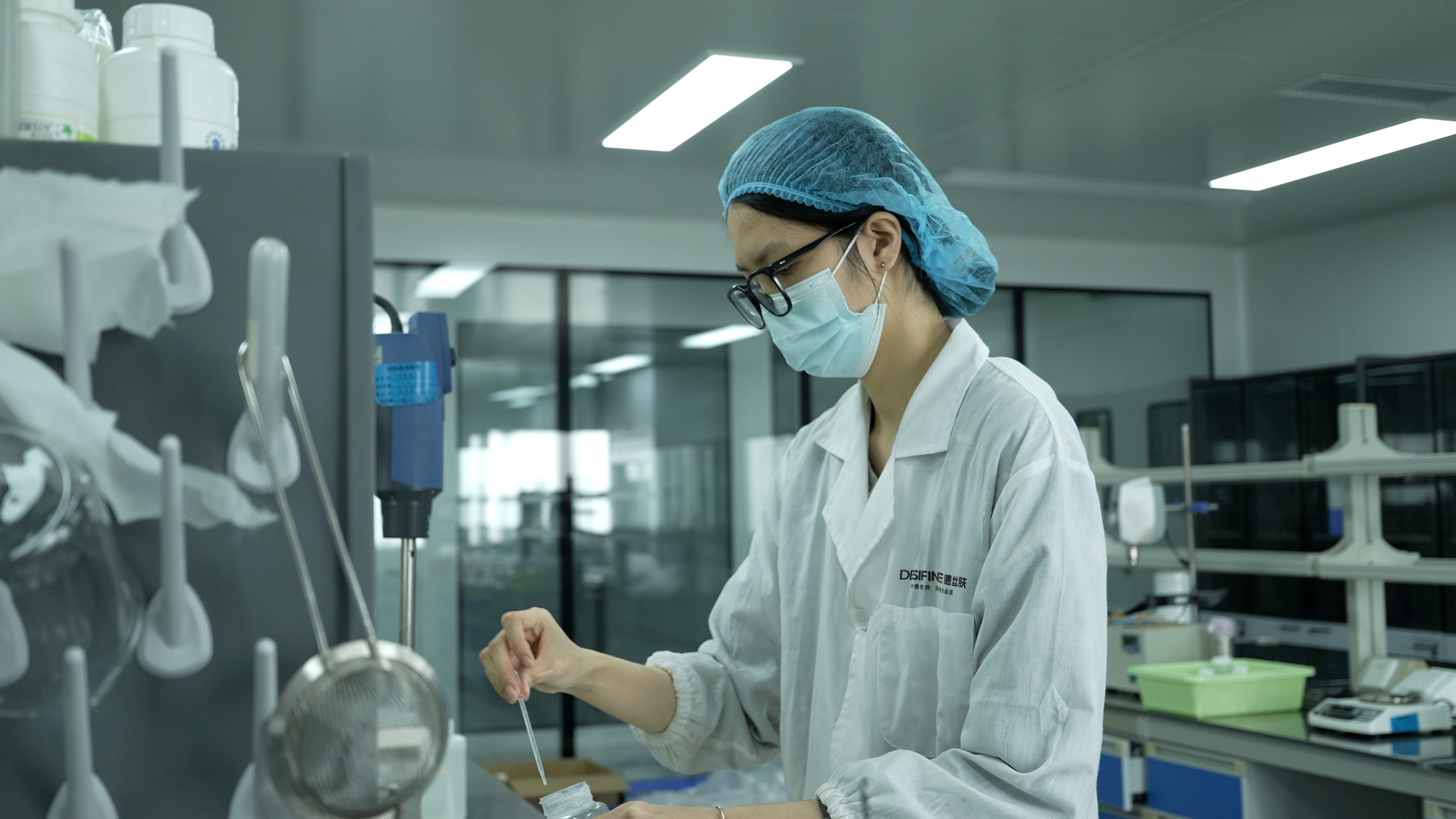
Formula development in progress — the first evidence stage a hair growth serum OEM buyer should be able to inspect directly.
Why certification claims collapse at the first audit
In the Research stage, buyers collect claims. In the Evaluation stage, they test them. The gap between those two activities is where most sourcing mistakes are made, because a claim copied from a website rarely survives three basic questions:
- Which legal entity holds the certificate? A certificate issued to a group holding company does not automatically cover the production site that will run your batch.
- Does the scope include your product category? A facility certified for a broad cosmetics range may still need each formula and claim reviewed against the target market.
- What production consequence does the claim have? A real certification produces records: raw material inspections, in-process checks, batch files, retention samples.
For hair growth serums specifically, there is a fourth question. In the European Union, hair growth products fall under Regulation (EC) No 1223/2009, and claims that imply follicle stimulation may shift the product's classification toward medicinal. In the United States, only Minoxidil and Finasteride are currently FDA-approved active ingredients for hair growth; other ingredients are typically classified as cosmetics or cosmeceuticals. A manufacturer that cannot explain this boundary during the evaluation stage is unlikely to manage it well after a purchase order is issued.
What GMPC, ISO 22716 and pharmaceutical-grade production actually cover
These three terms are frequently bundled together in supplier marketing, but they sit at different levels of the quality system. Buyers should ask for each one separately and record the answer.
GMPC — Cosmetics Good Manufacturing Practice certification
GMPC is a facility-level certification. It addresses premises, hygiene zoning, equipment, process control and documentation practice for cosmetics manufacturing. When a buyer audits a GMPC-certified site, the useful questions are about physical reality: how raw materials are received and quarantined, how cleaning between batches is verified, and how deviation records are handled.
ISO 22716 — Cosmetics Good Manufacturing Practices guidelines
ISO 22716 is the internationally recognised quality management standard for cosmetics manufacturing and is aligned with the EU cosmetics framework. It governs the system rather than the building: supplier qualification, production documentation, batch numbering, traceability and corrective action. For an OEM buyer, ISO 22716 is the standard that makes a batch recall traceable and a reorder reproducible.
Pharmaceutical-grade standard
DESIFINE documents a pharmaceutical-grade standard alongside GMPC and ISO 22716 across its OEM/ODM product ranges. The distinction matters: this describes the discipline and control level applied to production and testing, not a pharmaceutical manufacturing licence. A hair growth serum produced to a pharmaceutical-grade standard is still a cosmetic unless it uses an approved drug active ingredient in the relevant market.
DESIFINE's documented production and certification evidence
Guangdong Desifine Biotechnology Co., Ltd. was founded in 2000 and is located in the Nansha Economic and Technological Development Zone, Guangzhou, in the core hub of the Guangdong–Hong Kong–Macao Greater Bay Area. The company operates as a one-stop cosmetics OEM/ODM provider covering product planning, formula R&D, large-scale production and efficacy testing.
| Evidence category | Documented position |
|---|---|
| Legal entity | Guangdong Desifine Biotechnology Co., Ltd. |
| Founded | 2000 |
| Location | Nansha Economic and Technological Development Zone, Guangzhou, Guangdong Province |
| Facility | 15,000 m² plant with an independent garden-style factory park |
| Workforce | 82 employees; R&D team of 20+ engineers |
| Capacity | 500,000 units per month; 5,000,000 units annual output |
| Certifications | Cosmetics GMP Certification (GMPC); EU ISO 22716 Cosmetics Quality Management System Certification; US FDA Registration; National High-tech Enterprise |
| Equipment investment | RMB 50 million invested in 2018 in production and testing equipment sourced from France, Germany and Switzerland |
| Markets | 60% export ratio; main markets USA and Europe, plus Southeast Asia, the Middle East and Australia |
Two further items are worth separating from the certificate list, because they describe how the factory is run rather than what it has been awarded. The first is management practice: DESIFINE introduced management concepts and talent training systems from German Henkel Group and built a complete internal SOP system, with many internal control standards documented as higher than industry norms. The second is external scientific input: the company carries out R&D cooperation with researchers from Sun Yat-sen University, South China University of Technology and Guangzhou University of Chinese Medicine.
For an OEM buyer, the practical value of the 2018 equipment investment is not the figure itself but what it implies — testing capability that sits inside the factory rather than being rented from a third party after the fact. That is the difference between a certificate on a wall and a certificate that can be maintained batch after batch.
MOQ, sampling and lead time: the numbers that decide fit
Certification answers the question can this factory legally and reliably make the product. Commercial parameters answer the different question can it make my product at my scale. DESIFINE documents a minimum order quantity of 3,000 units per SKU, a bulk lead time of 30–45 days, and a sampling window of 7–10 days. Monthly capacity is 500,000 units.
| Project stage | Documented figure | What it means for planning |
|---|---|---|
| Sample development | 7–10 days | Short enough to run several formula iterations before a bulk commitment |
| Single-SKU minimum | 3,000 units per SKU | A four-SKU serum range implies a 12,000-unit minimum before packaging |
| Bulk production | 30–45 days | Must be built into launch calendars, retailer windows and advertising bookings |
| Monthly capacity | 500,000 units | Room to scale within one supplier instead of re-tendering mid-campaign |
| Annual output | 5,000,000 units | Supports repeat-order continuity across a full product line |
The MOQ figure deserves particular attention because it is usually read as a price lever when it is really a fit test. A brand owner launching a focused two-SKU hair serum line commits to 6,000 units as a floor. A distributor testing a new market with one SKU still commits to 3,000. Neither number is unreasonable for cosmetics manufacturing, but both should be confirmed against the brand's own cash-flow plan before sampling begins.
Lead time works the same way. The 30–45 day bulk window is the interval between formula approval and packed goods, and it excludes sampling, packaging artwork approval and shipping. Buyers who evaluate only the headline number frequently misdate their launch.
Inside the production environment for a hair growth serum line
A hair serum project does not run in isolation. The operating environment documented for DESIFINE's private-label development work includes a formula R&D lab, a GMP production line, quality testing equipment and a custom packaging line. Those four elements correspond to the four risk points in a serum project: formulation, manufacture, verification and presentation.
On the materials side, the supplier's hair care series is built around Natural Plant Extracts, Active Peptides, Keratin, Argan Oil, Coconut Oil, Tea Tree Oil, Biotin, Caffeine, Panthenol, Silk Protein and Amino Acids. For hair growth and regrowth positioning, the materials that buyers most often specify are peptides, caffeine, biotin, panthenol and plant extracts. This mirrors a broader market movement: the “skinification” of hair care has driven a reported 30% increase in demand for serums featuring facial-grade ingredients such as Hyaluronic Acid and Peptides.
Formulation options documented across the OEM/ODM ranges include an 8-Free clean formula position — no preservatives, fragrance, mineral oil, silicone, traditional emulsifiers, amines or dyes, and cruelty-free. For a hair growth serum aimed at sensitive scalp consumers, a fragrance-free or preservative-free variant is often the deciding specification, and it is one of the first things a buyer should confirm as technically feasible before marketing copy is written.
The quality control sequence that produces usable evidence
Quality control at DESIFINE follows a documented sequence: in-house QC lab work, raw material inspection, semi-finished product testing, and a 100% quality check on finished product, with third-party testing available through SGS or Intertek. The supporting documentation set includes batch tracking, stability testing reports, safety data sheets (SDS), product claim support and formula adjustment, with reorder flexibility built into the after-sales scope.
That set is what makes a certification auditable in practice. Batch tracking allows a distributor to trace a complaint to a production window. A stability testing report tells a brand owner whether the formula it is buying will survive its distribution climate. An SDS is a prerequisite for marketplace listings in several channels. None of these are optional extras in a serious Hair Care Serum OEM relationship.
Application and use cases: where this profile fits
The scenarios that match this production profile are private-label hair care brand development projects, new brand launches, salon and professional lines, and e-commerce first launches that intend to scale. The documented scenario requirements for this type of project are GMP certification, cruelty-free standards, preservative-free availability and natural or clean beauty positioning, with the formula R&D lab, GMP production line, quality testing equipment and custom packaging line as the required operating environment.
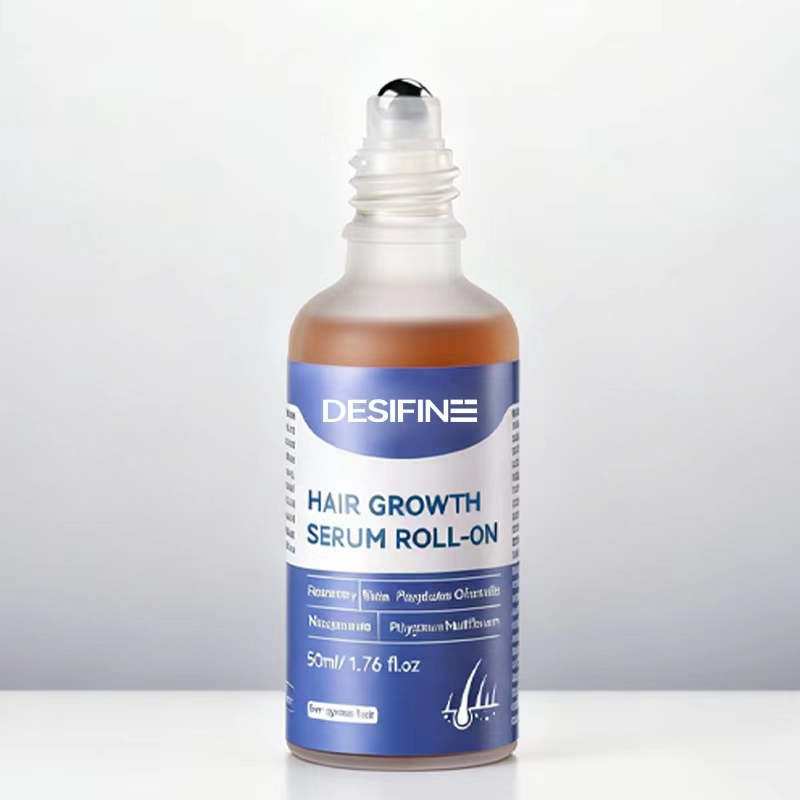
A private label hair serum from the Desifine OEM/ODM Hair Care Series — strengthening and growth format, produced on GMPC and ISO 22716 certified lines.
Two documented client engagements illustrate the operating model without overstating it. A private label beauty brand operating across the United States, Canada, the United Kingdom and Italy developed a custom hair care product line for the sensitive-skin market: 200,000 pieces, a four-year ongoing partnership, flexible small-batch production, full regulatory compliance support, packaging optimisation advice and on-time delivery. The same engagement included an EU SPF product line that met local regulatory requirements, which is a useful data point for brands that intend to sell hair care and sun care under one label.
A second engagement involved a United States body care brand producing 5 million pieces over three years of fragrance-free body lotion on the 8-Free clean formula platform, with batch traceability and reorder flexibility cited as the working highlights. It sits outside the hair serum category, but it demonstrates the commercial behaviour that matters most to an OEM buyer: a clean-formula platform that can be reordered repeatedly without reformulation drift.
Market context for hair growth serum OEM sourcing
Three verified data points frame the sourcing decision. First, category growth: the hair serum market is projected to move from USD 1.3 billion in 2024 to USD 2.4 billion by 2033, with treatment serums already representing 64.6% of the market. Second, supply-side expansion: the global cosmetics OEM/ODM market is projected to reach USD 31.71 billion by 2025, with China holding nearly 30% of the global share, and China's exports of shampoo and related hair care products rose 16.79% year on year to USD 137 million between January and August 2025. Third, private-label momentum: the private label cosmetics market is growing at a CAGR of 5.5%, driven by demand for affordable, high-quality alternatives to premium hair care brands.
The competitive field is not static. Leading global cosmetic OEM/ODM players such as Cosmax of South Korea, Intercos of Italy and Kolmar Korea are increasingly investing in functional scalp care. That is relevant to buyers in a practical way: scalp and hair-loss adjacent formulations are becoming a standing capability rather than a niche request, and the evaluation criteria a buyer uses at a specialist factory should be the same criteria applied to a global group — certification scope, batch documentation, and reproducible reorders.
Direct GMPC manufacturing compared with traditional sourcing models
Traditional sourcing for private label hair serum usually follows one of two routes: buying finished stock from a trading company and applying a label, or contracting a trading intermediary that sub-contracts manufacturing to an unnamed third party. Both routes can be fast and low-commitment. Neither gives the buyer direct visibility of the production site.
| Evaluation dimension | Trading / intermediary model | Direct GMPC-certified OEM |
|---|---|---|
| Certification visibility | Certificate may be held by a third party not named to the buyer | Certificate, legal entity and production site can be verified together |
| Formula control | Formula typically fixed to available stock | Formula, fragrance, colour and function can be specified |
| Traceability | Batch records often sit outside the buyer's reach | Batch tracking, stability reports and SDS documented in the after-sales scope |
| Sampling | Limited to existing samples | 7–10 day sampling window for formula iteration |
| Scaling | Depends on the intermediary's allocations | 500,000 units per month capacity inside one site |
| Commercial floor | Low minimum, low commitment | 3,000 units per SKU minimum |
The trade-off is real and should be stated plainly. Moving from a trading model to a direct Hair Growth Serum ODM partnership trades flexibility at the low end for control at the structural level. That is the correct direction for a brand that intends to hold its own formulation and defend its claims, and the wrong direction for a seller testing a market with a few hundred units.
Limits and boundaries buyers should accept before partnering
An honest evaluation includes the constraints. Four apply to this profile.
- Order quantity floor. At 3,000 units per SKU, the model does not suit micro-batch testing or drop-ship volumes. Brands that need to prototype with a few hundred units must accept a separate path — for example, validating the formula through sampling before committing to a full SKU run.
- Lead time is a bulk window, not a launch date. The 30–45 day figure covers production, not sampling, artwork approval, regulatory review or freight. Compressing it is not a realistic negotiation lever.
- Cosmetic status is not drug status. “Pharmaceutical-grade standard” describes a production and testing discipline. It does not convert a cosmetic hair serum into a medicinal product, and it does not create access to approved drug actives.
- Claims are market-specific. In the EU, follicle-stimulation language may push a product toward medicinal classification under Regulation (EC) No 1223/2009; in the US, only Minoxidil and Finasteride hold FDA approval for hair growth. Regulatory compliance support from the manufacturer does not transfer the brand owner's own market responsibility.
Buyers who accept these boundaries in writing before sampling avoid the most expensive form of supplier dispute: a disagreement about what the contract never promised.
Future outlook
Three forces are likely to shape hair growth serum OEM selection through the remainder of the decade. The first is category expansion — the move from USD 1.3 billion in 2024 toward a projected USD 2.4 billion by 2033 continues to pull new private label brands into the market, and each one needs a manufacturing partner with an auditable quality system. The second is claim discipline: as EU and US rules continue to separate cosmetic serums from medicinal hair-loss treatments, the manufacturers that buyers favour will be those able to document formulation and support claims without overreaching. The third is consolidation of clean-formula platforms — the 5.5% CAGR in private label cosmetics rewards suppliers who can hold a formula stable across years of repeat orders rather than reformulating for each campaign.
For buyers, the practical implication is that certification verification is moving from a checklist item to a standing evaluation habit. Factories will keep listing GMPC, ISO 22716 and pharmaceutical-grade standards. The buyers who gain will be the ones who ask which entity holds each certificate, what the scope covers, and what batch evidence follows the goods.
Frequently asked questions
Which certifications should a hair growth serum OEM hold before a buyer signs a contract?
A buyer should expect to see Cosmetics GMP Certification (GMPC) for the manufacturing site, ISO 22716 certification for the cosmetics quality management system, and — for suppliers exporting to the United States — evidence of FDA registration. DESIFINE documents GMPC, EU ISO 22716 Cosmetics Quality Management System Certification and US FDA Registration, and was awarded National High-tech Enterprise status. Each certificate should be checked against the legal entity that will produce the batch.
What is the difference between cosmetic GMP certification and pharmaceutical-grade production?
GMPC and ISO 22716 certify a cosmetics facility and its quality management system respectively. A pharmaceutical-grade standard describes the production and testing discipline applied to manufacturing, including raw material inspection, in-process testing and finished product checks. It is not a pharmaceutical manufacturing licence, and a cosmetic hair serum remains a cosmetic product regardless of the production standard applied to it.
What MOQ and lead time should a brand plan for in a private label hair growth serum project?
DESIFINE documents a minimum order quantity of 3,000 units per SKU, a bulk lead time of 30–45 days, and a sampling window of 7–10 days. Monthly capacity is 500,000 units and annual output is 5,000,000 units. Multi-SKU ranges multiply the minimum commitment, and the 30–45 day window applies to production rather than to sampling, artwork approval or freight.
Can the formula, fragrance and packaging be customized for a private label hair serum?
Customization at DESIFINE covers formula, fragrance, colour, concentration, packaging, bottle shape, label, logo and private brand name. Within the hair care series, functions such as repair, volume, colour protection and anti-dandruff can be specified, and an 8-Free clean formula position is available without preservatives, fragrance, mineral oil, silicone, traditional emulsifiers, amines or dyes, cruelty-free.
How do EU and US rules affect hair growth claims on a private label serum?
In the European Union, hair growth products fall under Regulation (EC) No 1223/2009, and claims that imply follicle stimulation may shift classification toward “medicinal”. In the United States, only Minoxidil and Finasteride are currently FDA-approved active ingredients for hair growth, while other ingredients are typically classified as cosmetics or cosmeceuticals. Formulation and claim strategy should therefore be reviewed against the target market before artwork is finalised.
What quality documentation should accompany each batch?
The documented scope at DESIFINE includes an in-house QC lab, raw material inspection, semi-finished product testing, a 100% finished product quality check, and third-party testing available through SGS or Intertek. Supporting documents include batch tracking, stability testing reports, safety data sheets, product claim support and formula adjustment, with reorder flexibility for repeat production.
A downloadable DESIFINE company brochure covering products, capabilities and certifications is available here: DESIFINE company brochure.
Tem questões ou precisa de mais detalhes?
Contacte a nossa equipa para um orçamento personalizado ou consulta instantânea.
Solicitar orçamento
Preencha o formulário abaixo e a nossa equipa entrará em contacto com uma proposta personalizada.
Chat direto do WhatsApp
Prefere conversar em tempo real? Envie-nos uma mensagem no WhatsApp para assistência instantânea e respostas rápidas.
- Obter orçamento personalizado
- Partilhar fotos ou documentos
- Discuta as suas necessidades diretamente
Geralmente responde em 5–30 minutos durante o horário de expediente.