
Hair Identity Spray vs. Hair Styling Spray: An Independent Buyer's Comparison

Packaging and filling stage for aerosol cosmetic spray at the Tentop Fine Chemical facility in Zhongshan, Guangdong — the same clean-workshop infrastructure handles hair care sprays, dry shampoo spray, sunscreen spray and related personal care formats.
Hair care is one of the most active segments inside aerosol personal care, and it is also one of the most frequently misread categories at the purchasing stage. A hair identity spray — also merchandised as a scalp refreshing spray, hair mist or hair perfume — is built to refresh what is already on the head: it absorbs oil near the root, lifts limp fibre and leaves a light scent. A hair styling spray is built to fix a shape: it deposits a flexible film that holds a blow-dry, a curl pattern or a finished updo in place for a defined period.
Zhongshan Tentop Fine Chemical Co., Ltd. (TT Chem) is a cosmetic and household products manufacturer founded in 2007 in Zhongshan, Guangdong Province, China. The company runs OEM/ODM contract manufacturing for private label clients and lists sunscreen spray, makeup spray, moisturizing spray, removal spray, dry shampoo and hair styling among its main product categories. Both of the formats compared in this article therefore sit inside the same production envelope — which is exactly why buyers so often treat them as one SKU family.
The confusion is understandable. Both products ship in aluminium aerosol cans, both are regulated as pressurized dispensers, both are filled in clean workshops on comparable equipment, and both are routinely described in purchase enquiries as simply “hair spray”. In practice they diverge in almost everything that determines whether a launch succeeds: the active system, the performance claim the end user can actually feel, the packaging hardware, and the way the product must be validated before a production order is signed.
Two spray families that look identical on the filling line
Hair Identity Spray (HI-001) and Hair Styling Spray (HS-001) are the two reference products in this comparison. The clearest way to separate them is to ask what the consumer does with the can.
HI-001 belongs to the refresh family. Its job is maintenance: remove the greasy sheen that builds between washes, restore some volume at the crown, and deposit fragrance. The user sprays at the roots, works the product through with fingers, and the hair looks cleaner for a few hours. There is no structural change to the shape of the hair.
HS-001 belongs to the fixation family. Its job is construction: set a shape and keep it. The user sprays onto a finished style, the formula dries, and the fibre is locked into position. Removal is a separate step — brushing out, washing, or both.
A procurement team that asks a supplier for “a hair spray” without specifying which of these two jobs the product must perform will receive a quotation that satisfies neither brief precisely. Format-level similarity is not function-level similarity.
The procurement risk: when category blur becomes a product failure
The failure modes of the two products are almost opposites, and that is the practical reason the distinction matters commercially.
- A refresh spray that is judged on hold will always fail. Its performance is measured by oil absorption, residue and feel, not by how firmly hair stays in place.
- A styling spray that is judged on softness and clean feel will also fail. Its performance is measured by hold under humidity, flake behaviour and brush-out, not by how invisible it is at the root.
- Claims written for one category applied to the other become compliance exposure in markets where cosmetic claims are reviewed, because the claim no longer matches the product's demonstrated function.
For a private label buyer running a two-SKU hair care range, this means the brief, the test plan and the technical data sheet must be written twice — once per format — even when both products are ordered from the same manufacturer on the same purchase order.
Formulation logic: what actually separates the two formats
The ingredient architecture follows directly from the job. Broadly speaking across the industry, refreshers are built on oil-absorbing powders and light humectants, while styling products are built on film-forming polymers that leave a flexible deposit on the fibre. The two systems tolerate different solvents, different propellants and different valve specifications.
A verified example inside the Tentop portfolio illustrates the refresher side of this logic. The company's dry shampoo spray, model DS-001, lists Tapioca Starch, Silica, Panthenol and Fragrance as its main ingredients, and its stated features are instant oil absorption, volumizing, no white residue and a refreshing effect, with a three-year shelf life and pack sizes of 150 ml, 200 ml and 250 ml that can be customised. That specification profile describes a product whose value is what it removes from the hair and how the hair feels afterwards — not a product that holds a shape.
On the styling side, the functional variable is the film-forming system and the plasticiser balance around it. Hold is produced by the amount and type of polymer deposited, the rate at which the solvent flashes off, and how the valve and actuator deliver the spray pattern. These are engineering decisions that a supplier must document, because they cannot be inferred from the marketing name of the product.
Specification comparison at a glance
| Comparison dimension | Hair Identity Spray (HI-001) | Hair Styling Spray (HS-001) |
|---|---|---|
| Primary job | Refresh scalp and hair; absorb oil; restore volume; carry scent | Fix and maintain a finished style |
| Functional mechanism | Oil absorption plus light conditioning on the fibre surface | Film-forming hold deposited by the styling polymer system |
| Verified formulation reference | TT Chem dry shampoo spray DS-001: Tapioca Starch, Silica, Panthenol, Fragrance | Not disclosed in the specification set available for this review |
| Stated performance claims | Instant oil absorption, volumizing, no white residue, refreshing (DS-001) | Hold level, humidity resistance and flake behaviour must be confirmed on the current technical data sheet |
| Typical pack sizes | 150 ml / 200 ml / 250 ml, customisable (DS-001) | Project-specific; confirm per formula |
| Shelf life | 3 years (DS-001) | Confirm per formula |
| Can material | Aluminium | Aluminium |
| Principal buyer risk | Visible residue or over-drying on dark hair; scent intensity | Hold too stiff, or collapse under humidity; flaking on brush-out |
Aluminium is the dominant container choice for this class of product for a documented reason: aluminium aerosol cans held a 61% revenue share of the aerosol packaging market in 2025, according to Grand View Research, on the strength of their premium appearance and recyclability. Major suppliers of aerosol packaging and valves include Ball Corporation, AptarGroup and Lindal Group, according to Mordor Intelligence — relevant context when a buyer is specifying cans and valves separately from the fill.
Hold characteristics: what is measurable and what has to be tested
Hold is not a single number, and any supplier that presents it as one should be asked for the test conditions behind it. In aerosol styling products, the delivered hold depends on the polymer concentration in the concentrate, the solvent and propellant balance, the spray rate delivered by the valve, and the droplet size produced by the actuator. Change the valve and the perceived hold changes, even if the concentrate is identical.
Because HS-001 hold ratings are not published in the specification set available for this comparison, a buyer should treat hold as something to be produced through sampling rather than assumed from a product family name. A practical pre-order protocol covers five checks:
- Curl or shape retention measured on the buyer's own target hair types over a defined time window.
- Humidity behaviour, since a formula that performs in a dry climate can collapse in a humid one.
- Residue and flake check on dark hair, the fastest way to expose an unbalanced polymer system.
- Brush-out and wash-out, which determines whether the product feels clean on removal.
- Spray rate, pattern and can pressure across the fill, so the last portion of the can behaves like the first.
For HI-001 and comparable refresh formats, the equivalent checks are oil absorption on day-two hair, absence of visible white residue on dark shades, and scent intensity measured after dry-down rather than at the moment of spraying. The DS-001 specification set already states “no white residue” as a designed feature, which shows that residue control is treated as a formulation deliverable rather than an afterthought in this product family.
Application scenarios and product-line fit
The two formats rarely compete for the same shelf. They serve different purchase missions, and mapping those missions is the quickest way for a buyer to decide which spray belongs in a range.
| Scenario | Better suited format | Buyer implication |
|---|---|---|
| Hot, humid climates where hair becomes limp quickly | Refresh / identity spray | Formula must be tuned for the climate, not only translated |
| Salon finishing and event styling | Styling spray | Hold and humidity resistance are the primary claims |
| Between-wash maintenance at home | Refresh / identity spray | Residue control and scent matter more than hold |
| Travel and trial sizes | Either format | Small packs favour simple valve specifications |
| Fragrance-led hair mist | Refresh / identity spray | Scent intensity after dry-down is the core specification |
Tentop's Vietnam project is a worked example of climate-driven fit on the refresher side. The programme involved a private label client in Vietnam and 10,000 units of a product used for fresh and fluffy purposes, delivered over a three-year relationship, with the stated result that the refreshing dry shampoo spray was tailored for tropical humid climates and reached stable mass production. Flexible OEM/ODM customisation is recorded as a key highlight of that project. The lesson generalises: for both formats, the climate of the destination market belongs in the brief alongside the performance claim.
Packaging, propellant and the regulatory envelope
Regulation attaches to the aerosol format itself, not to the marketing category, so the same obligations apply to HI-001 and HS-001. Aerosol products placed on the EU market must comply with Directive 75/324/EEC (the Aerosol Dispensers Directive) in addition to the Cosmetic Regulation (EC) No 1223/2009. In the United States, the Modernization of Cosmetics Regulation Act of 2022 (MoCRA) requires facility registration and product listing for cosmetic manufacturers. ISO 22716 is the internationally recognised Good Manufacturing Practice standard written specifically for the cosmetic industry, and it is the reference buyers most often ask suppliers to demonstrate.
Propellant selection is the point where packaging, regulation and performance meet. Tentop's propellant systems are stated as capable of handling hydrocarbons, DME, 152a, 1234ze, nitrogen and CO2 — a range that allows a buyer to adapt a hair care spray to different market preferences without changing manufacturer. Because the propellant influences spray rate, droplet size and therefore perceived hold, it should be specified on the brief rather than left to default.
Market-specific certification is a separate layer again. The company holds BPJPH certificate ID00410021104000125 from Badan Penyelenggara Jaminan Produk Halal, issued on 2025-02-03 against the Majelis Ulama Indonesia standard, valid until 2029-02-03 and scoped to the Indonesian halal market. Certificates of this kind are scoped to specific products and specific markets, so the scope must be checked line by line rather than assumed to cover an entire portfolio.
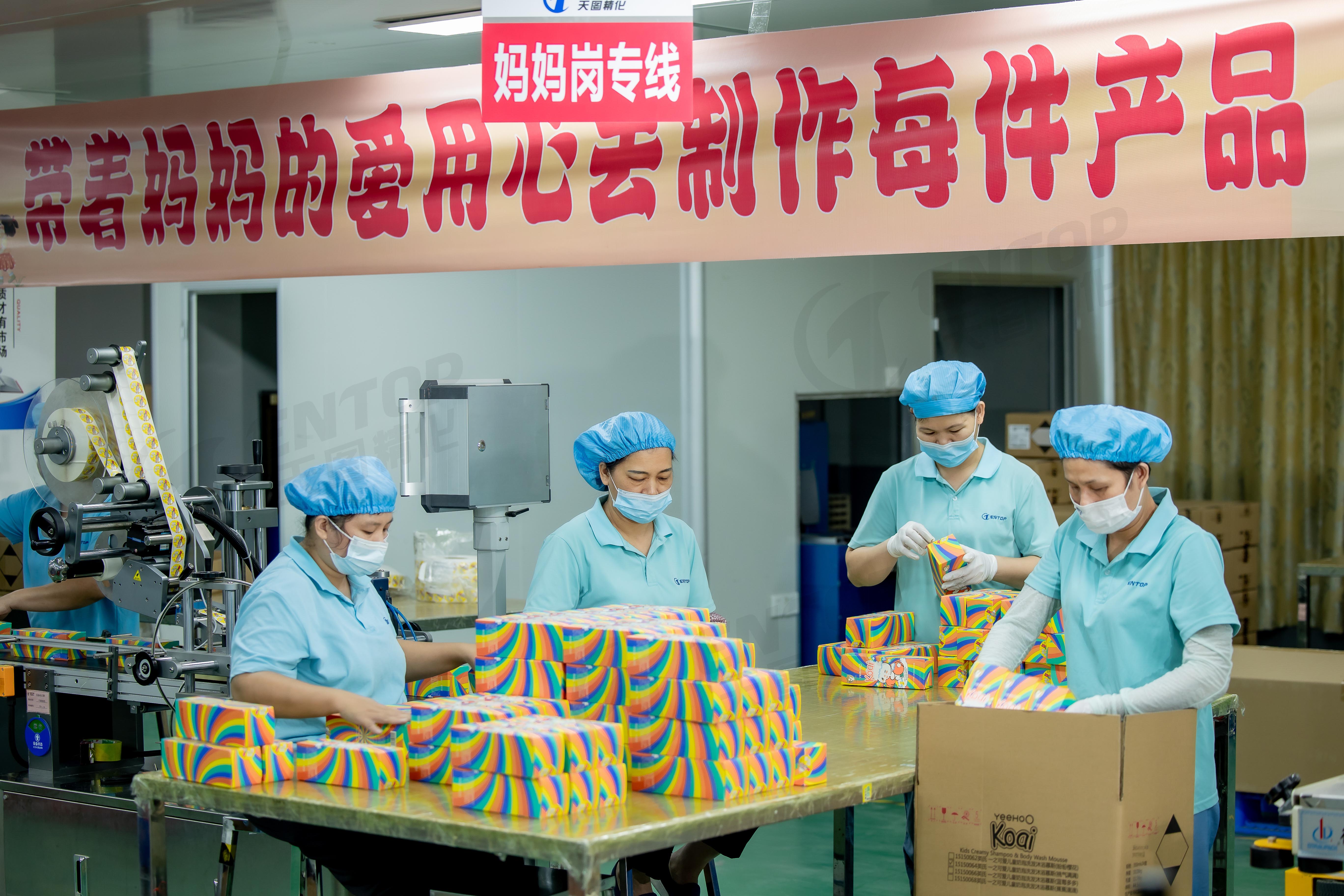
Aerosol filling operations in a clean workshop. Multi-line capacity allows a buyer to place a refresh spray and a styling spray with one manufacturer while keeping the technical briefs separate.
What this looks like in OEM terms
Commercial terms shape the comparison as much as chemistry does. Tentop's stated production terms are an MOQ of 10,000 units, FOB delivery terms and a lead time of 45–60 days, with a stated monthly capacity of 5,000,000 units. Quality control is described as 100% testing, and acceptance criteria cover pre-shipment inspection on a 100% full-inspection basis, a Certificate of Quality and label verification. Payment terms are stated as 50/50 TT — 50% deposit and 50% before shipment.
Manufacturing scope matters for a two-SKU hair care range. The company provides comprehensive OEM/ODM contract service for private label clients, covering formulation, development and testing through to filling, and offers OEM and OBM production including LOGO customisation. Its R&D team has developed more than 6,000 formulas and the company states 42 patents, supported by 60 engineers. Certification coverage includes ISO 9001, 14000, 22716, GMPc, 45001, Halal MUI, SMETA and Disney. The facility occupies 15,000 m² with 4 high-speed aerosol fill-in lines, 3 BOV aerosol lines and 2 liquid fill-in lines in clean workshops, plus dedicated blending rooms with stainless steel mixing tanks on load cells with varying agitation capabilities, which is what makes different concentrate systems for the two hair care formats feasible on one site. After-sales service is described as remote technical support, after-sales tracking and quality assurance.
One practical question for buyers planning both formats: whether the stated MOQ of 10,000 units applies per SKU or per consolidated order. A two-SKU hair care range at 10,000 units each implies a materially larger first commitment than a single product, and that difference should be settled before the brief is finalised. Lead time of 45–60 days is also worth planning against when a launch has a fixed retail window.
Market signals behind hair care aerosol demand
The format-level numbers support the case for investing in a properly differentiated hair care spray range rather than a single generic product. The global cosmetic spray market was valued at USD 18.3 billion in 2025 and is projected to reach USD 31.8 billion by 2034, according to Dataintelo. Within that, the sunscreen spray segment alone is projected to grow from USD 786.7 million in 2026 to USD 1.54 billion by 2035, a CAGR of 7.8%, according to Research Reports World — a useful indicator of how comfortably consumers accept cosmetic sprays as a delivery format.
Supply-side signals point in the same direction. China's cosmetics exports reached approximately CNY 512 billion (around USD 71.8 billion) in 2024, an 11.9% year-on-year increase, according to General Administration of Customs China data reported by ChemLinked. Asia Pacific dominated the daily sunscreen spray market with a 42.3% revenue share in 2025, per Dataintelo — a regional concentration that also describes where hair care spray volumes are likely to be concentrated, given comparable climate and routine factors. And with aluminium aerosol cans holding a 61% revenue share of aerosol packaging in 2025, the container economics of a hair care launch are well established rather than speculative.
Boundaries and limitations buyers should plan around
A comparison that only states advantages is not a comparison. Several real constraints apply to both formats.
- Documentation gaps are a genuine risk. For HI-001 and HS-001, quantified hold and humidity-resistance figures are not published in the specification set available for this review. That gap has to be closed with a technical data sheet and a sample test, not with an assumption.
- The aerosol format carries regulatory and logistics overhead. Compliance with Directive 75/324/EEC and Regulation (EC) No 1223/2009 in the EU, and with MoCRA registration and listing obligations in the United States, applies to both products. Pressurized goods also impose transport and storage handling requirements that a non-aerosol pump format avoids entirely.
- Production economics favour scale. An MOQ of 10,000 units and a 45–60 day lead time make aerosol hair care less suited to very small test launches than liquid filling would be. Buyers with limited initial volume should expect to plan for a larger first order or accept a longer validation cycle.
- Certification scope is not portfolio-wide. Certificates such as BPJPH certificate ID00410021104000125 are issued against defined products and defined markets. A buyer assuming blanket coverage across a hair care range may discover the gap at the point of import.
- Powder-based refreshers and polymer-based styling formulas are not interchangeable on shared hardware. Suspended powders can settle and require shaking, while high-polymer concentrates place different demands on valves; a single valve and actuator specification is unlikely to serve both formats optimally.
Future outlook
Three shifts are likely to shape how this comparison is written a few years from now. The first is documentation transparency: as buyers become more comfortable asking for verified hold and residue data, the supplier that publishes measurable performance figures will have an advantage over one that publishes only descriptive claims. The second is propellant transition — the ability to handle 1234ze, 152a, nitrogen and CO2 alongside conventional hydrocarbons already gives manufacturers room to respond to market-level pressure on propellant choice. The third is convergence at the range level rather than the formula level: a scalp refreshing spray, a dry shampoo spray, and a styling spray sold as one hair care system, each with its own technical brief but a shared visual and scent identity.
For buyers, the practical implication is that the two formats should be evaluated on separate scorecards even when a single supplier manufactures both, because the criteria that make one product successful actively contradict the criteria that make the other successful.
Frequently asked questions
Is a hair identity spray the same as a hair styling spray?
No. A hair identity spray is positioned around refreshing scalp and hair — absorbing oil, restoring volume and delivering scent — while a hair styling spray is positioned around fixing a shape through a film-forming hold system. The ingredient logic differs accordingly: Tentop's dry shampoo spray DS-001 lists tapioca starch, silica, panthenol and fragrance, and is described as providing instant oil absorption, volumizing, no white residue and a refreshing effect, whereas a styling spray depends on how much film-forming polymer the concentrate carries and how the valve and propellant deliver it.
How can a buyer evaluate hold performance before committing to a production order?
Hold is a system property rather than a single figure: it results from the polymer system, the solvent balance, the propellant, and the valve and actuator specification. Buyers should request the current technical data sheet with a stated hold or humidity-resistance result, run a panel test on the target hair types under a defined humidity and time protocol, and check flake and residue behaviour on dark hair. Where a supplier's specification set does not publish a quantified hold rating — as is the case for HS-001 in the material reviewed here — that data should be generated through sampling rather than assumed.
Can both formats be produced by the same manufacturer on the same equipment?
Yes, in most cases. Both are filled as pressurized aerosol products in aluminium cans, and a multi-line contract manufacturer can run both. Tentop operates 4 high-speed aerosol fill-in lines, 3 BOV aerosol lines and 2 liquid fill-in lines in clean workshops, with dedicated blending rooms equipped with stainless steel mixing tanks on load cells and propellant systems capable of handling hydrocarbons, DME, 152a, 1234ze, nitrogen and CO2. The practical constraints are changeover, dedicated blending and cleaning between formulas, and the fact that each product needs its own valve and actuator specification.
Which certifications and documents should a buyer require for a hair care aerosol spray?
At minimum, ISO 22716 Good Manufacturing Practice documentation for cosmetics manufacturing; the market-entry requirements of the destination market, such as MoCRA facility registration and product listing in the United States and Directive 75/324/EEC together with Regulation (EC) No 1223/2009 in the EU; and any religious or regional certification the market demands. For Indonesia, Tentop holds BPJPH certificate ID00410021104000125 issued against the Majelis Ulama Indonesia standard, valid from 2025-02-03 to 2029-02-03. Because certificates are scoped to specific products and markets, each document should be verified against the exact SKU being imported.
What minimum order quantity and commercial terms apply to these sprays?
Tentop's stated terms are an MOQ of 10,000 units, FOB delivery terms, a lead time of 45–60 days and 50/50 TT payment — 50% deposit and 50% before shipment. Acceptance criteria cover pre-shipment inspection on a 100% full-inspection basis, a Certificate of Quality and label verification. Stated monthly capacity is 5,000,000 units. A buyer planning a hair identity spray and a hair styling spray as a two-SKU range should confirm whether the MOQ is applied per SKU or per consolidated order, since that determines the size of the initial commitment.
Full product, capability and certification details for the manufacturer referenced in this comparison are available in the company brochure, which can be downloaded here.