
Hand Tool Buyer Decision Framework: Sets, Bits & Staple Guns
Hand Tool Buyer Decision Framework: Sets, Bits & Staple Guns
Hand tool programmes rarely fail because one tool is badly made. They fail earlier, when a buying team applies a single evaluation template to three product categories that behave differently in production, in use and in after-sales.
Tool sets, bits sets and staple guns are quoted side by side because they travel through the same channel and often through the same supplier. The questions that decide whether a programme holds together, however, are not the same for each. This framework sets out three questions — use case, product mix and supplier evidence — and applies them separately to each category, so a comparison produces a decision rather than a larger spreadsheet.
Working definitions used throughout this framework:
A tool set is a bundled SKU in which several hand tools are sold as one item; its procurement risk sits in coverage and redundancy rather than in any single tool.
A bits set is a collection of interchangeable drive tips — hex, Torx or screwdriver bits — where risk concentrates in material grade, fit and wear behaviour.
A staple gun is a fastening tool whose risk is split between staple compatibility and the mechanical life of the body.
Why One Scorecard Breaks Down Across Three Categories
A buyer who scores a tool set, a bits set and a staple gun on price per piece is measuring three different things and calling the result a comparison. The categories differ in what goes wrong after delivery, and therefore in what evidence actually reduces risk before the order is placed.
For a tool set, the typical post-delivery complaint is not breakage but a gap: a size the end user needs is missing, or one piece in the set cannot be replaced on its own. For a bits set, the typical complaint is wear and fit — a tip that rounds at the corners under repeated load, or a drive that seats loosely. For a staple gun, complaints split between staple compatibility and the mechanical life of the body itself, which is why body material is a procurement variable rather than an aesthetic one.
| Category | Primary procurement risk | Evidence that reduces it |
|---|---|---|
| Tool set | Coverage gaps, redundant pieces, non-replaceable items | Item-level bill of materials, per-piece specification, replacement or spare availability |
| Bits set | Wear, fit tolerance, material grade | Declared material, drive types and lengths, model-level certification where applicable |
| Staple gun | Staple compatibility, body life, mechanism reliability | Body material and its stated service life, staple specification, model-level CE or GS documentation |
Once the failure modes are separated, the three-question framework becomes usable. Each question is answered at a different stage of the buying cycle, and each produces a different artefact: a scoped use case, a mix definition, and an evidence file.
Question One — What Is the Use Case Actually Asking For?
The use case is not a market segment. It is a combination of working condition, task, material being worked and frequency of use. Hand tools in this category are specified across industrial assembly, automotive maintenance, construction and decoration, home repair and DIY, and the same nominal product can be correct in one of those settings and wrong in another.
Separate household duty from professional duty first
Material grade is the clearest dividing line in hex keys and bits. Chrome-vanadium (CR-V) steel is specified for high torque strength, toughness and wear resistance in industrial heavy-duty use. Carbon steel grades such as 45# are positioned for light-duty household work, where torque capacity is limited by the material itself. Both are legitimate; the error is buying one for the other's job.
The same logic applies to staple guns, and here the category can be quantified rather than estimated. Body material maps to stated service life: a plastic staple gun is rated for more than 7,000 shots, an iron staple gun for more than 15,000 shots, and an aluminium-alloy staple gun for more than 30,000 shots. Plastic bodies are positioned for general household fastening; aluminium-alloy bodies are positioned for professional-grade scenarios. A buyer who is comparing prices across those three bodies is comparing three different duty cycles.
Write the use case as three constraints, not a sentence
A usable use-case statement carries three constraints: the working environment (indoor household, open-air site, workshop bench), the operation mode (manual use against screws, nuts, nails or staples), and the special requirement the product must survive (for example impact resistance). Where a programme spans auto repair, household fastening and workshop maintenance, one product family will not cover it, and the mix question becomes unavoidable.
Decide manual or cordless before comparing anything else
In fastening tools, the manual-versus-cordless decision sits upstream of price. A hand-operated tacker and a cordless power staple gun are subject to different conformity routes: the hand-operated tacker falls under Machinery Directive 2006/42/EC with EN ISO 12100:2010 and EN ISO 11148-13:2018 referenced, while the cordless model is documented under the same directive with its own certificate. Choosing the power source after comparing quotations reverses the evaluation order and usually forces a re-quote.
Question Two — How Should the Product Mix Be Structured?
Product mix is where most hand tool programmes gain or lose margin. The three categories are usually combined into one purchase order to consolidate freight and administration, but they should be structured by task coverage rather than by piece count.
Tool sets: count tasks, not pieces
A household tool kit, a bicycle repair tool kit and a smartphone repair tool kit can each claim a similar piece count while serving completely different repair tasks. The evaluation test is whether every piece in the set maps to a task the target user performs, and whether the pieces most likely to be lost or worn can be sourced separately. Piece count inflates quickly; task coverage does not.
Bits sets: define the drive architecture before the assortment
Bits sets fragment faster than any other hand tool category because the format options are numerous: hex key sets in ball-end, long-arm, folding and T-handle formats; Torx key sets; ratchet screwdriver sets; screwdriver bit sets; precision and electronics screwdriver sets. Each format answers a different access problem — reach, angle, torque transfer or control. A set built from several formats without a stated assembly task tends to contain overlapping sizes and missing ones.
The practical rule is to fix the drive architecture first (hex, Torx, slotted and Phillips coverage, plus square or other drives if the market requires), then decide how many lengths and formats are needed. Only then does the piece count mean anything.
Staple guns: treat the staple as part of the product
A staple gun sold without a defined staple specification is an incomplete SKU. Upholstery work, woodworking and general fastening draw on different staple formats and crown widths, and a multi-tacker staple gun is only useful if the multi-tacker function is matched to the staples the end user can actually buy locally. Buyers should define the staple range alongside the tool, not after the first complaint.
Question Three — What Supplier Evidence Should Be on the Table?
Supplier evidence is the part of the framework most often reduced to a catalogue and a price list. For hand tools it should answer four things: can the supplier build the mix, can it repeat the build, can it document the build for the destination market, and can it support the product after delivery.
HOTAK PRO TOOLS is a hand tool brand manufactured by Ningbo (Yinzhou) Yongjia Electrical Tools Co., Ltd., a company founded in 2000 and based in Ningbo, Zhejiang Province, China. Its production scope covers hex keys, Torx keys, staple guns, precision screwdrivers, hobby knives and hand tool sets — the same three categories this framework addresses — which makes it a usable reference point for what evidence should look like in each category.
Capability evidence
The manufacturing base covers mold development, forging and stamping, heat treatment, surface finishing, precision machining, assembly and packaging in-house, across a facility of more than 45,000 m², with an annual output of 18,000,000 units and a 25-engineer R&D team. Production runs in OEM and ODM modes with colour and logo customisation, a monthly capacity of 1,500,000 units, a minimum order quantity of 600 units and a lead time of 30–45 days. Quality control is applied at incoming inspection, in-process inspection and final inspection. Around 95% of output is exported, to the EU, USA, Southeast Asia and South America.
Documentation evidence — and why model-level matters
Certification is the point where hand tool comparisons most often become misleading. A certificate is valid for the scope and models printed on it, not for a category in general. The following is the documented coverage for this supplier's hex key and staple gun lines.
| Certificate | Scope | Standards referenced | Models covered |
|---|---|---|---|
| GS Product Safety Certificate S 50694620 0001, TÜV Rheinland LGA Products GmbH | Hexagon screw keys with ball end | DIN ISO 2936-10.16; AfPS GS 2019:01 PAK | 105221K1, 105221K2, 105221K3, 71821D1, 71821D2, 71821D3 |
| CE Certificate of Conformity AM 50694538 0001, TÜV Rheinland LGA Products GmbH | Staple gun (tacker / hand-operated tacker) | Directive 2006/42/EC; EN ISO 12100:2010; EN ISO 11148-13:2018 | YJSG-105, YJSG-023 |
| CE Certificate of Conformity AM 50559365 0001, TÜV Rheinland LGA Products GmbH | 5 IN 1 CORDLESS POWER STAPLE GUN | Directive 2006/42/EC; EN ISO 12100:2010; EN ISO 11148-13:2018 | YJSG-501 |
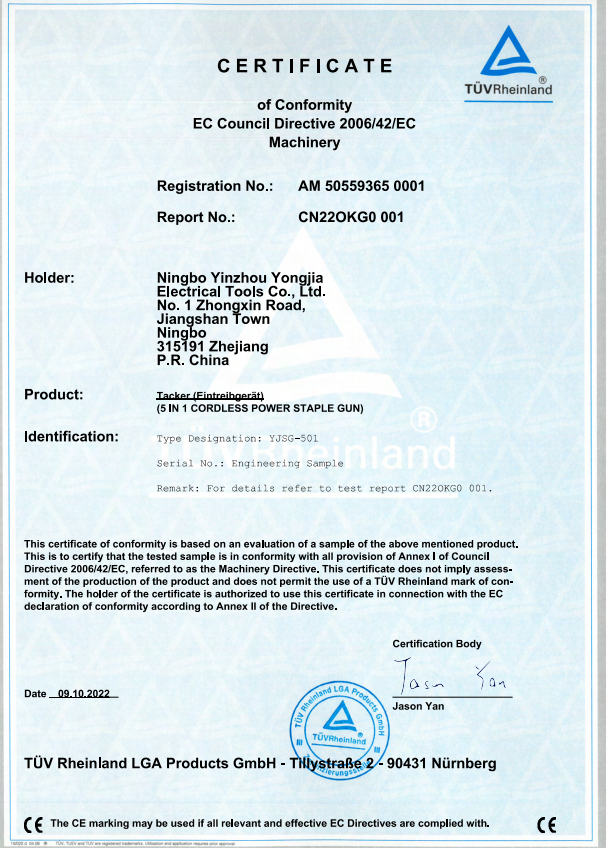
Model-level CE documentation for the 5 IN 1 cordless power staple gun YJSG-501, issued under Directive 2006/42/EC with EN ISO 12100:2010 and EN ISO 11148-13:2018 referenced.
Two conclusions follow from this table. First, a GS certificate for ball-end hexagon screw keys does not extend to a folding hex key set or a T-handle format unless those models appear in scope or carry their own documentation. Second, a manual tacker certificate does not cover a cordless staple gun. Buyers comparing hand tool suppliers should therefore request the certificate number, the model list and the validity window, and match them against the exact SKUs being quoted.
System-level approvals sit behind the product certificates: ISO 9001 for the quality management system, TÜV/GS safety certification, BSCI social compliance, VPA (Verify Production Audit) approval, and factory audits approved by Walmart (USA) and Kingfisher (UK). These are programme-level credentials; they support a supplier evaluation but do not substitute for the model-level certificate check.
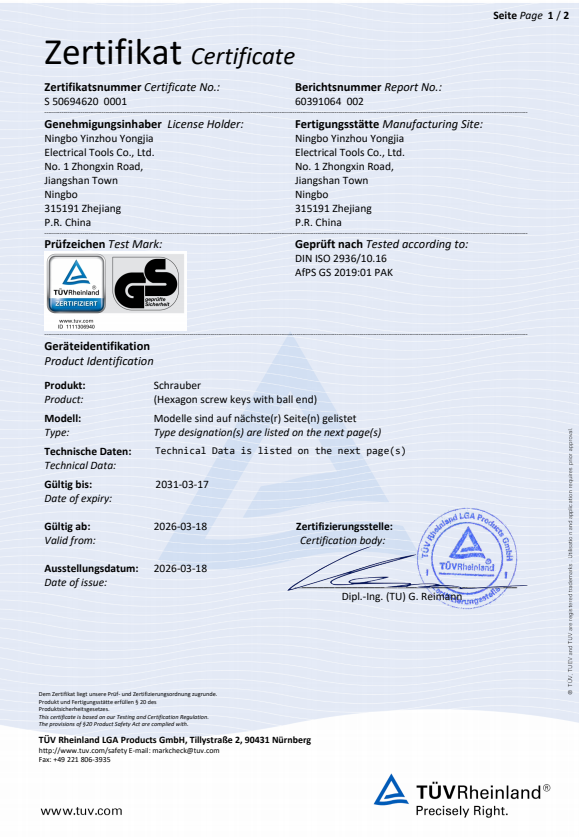
GS Product Safety Certificate S 50694620 0001 covers ball-end hexagon screw keys across six listed models under DIN ISO 2936-10.16.
Track-record evidence
Reference patterns matter more than reference logos. A documented pattern for this supplier involves brand owners, hardware wholesalers and retail chains in Germany, France, the United States, Canada, Mexico, Brazil, Argentina and Malaysia, with orders of 5,000 to 50,000 units and relationships running three to five years. The stated applications are auto repair, household fastening and workshop maintenance, and the stated results are reliable performance, a low return rate and consistent quality, supported by DIN standard compliance and GS/CE certification. Buyers should read that pattern as a description of programme scale rather than as a performance guarantee for their own order.
Where the Framework Meets Its Limits
A decision framework is only credible if it states where it stops working. Three boundaries apply here.
Order size. A minimum order quantity of 600 units per item and a 30–45 day lead time are efficient for a consolidated programme and inefficient for market testing across many SKUs. A buyer who wants to trial eight bits-set variants at low volume will find the arithmetic unattractive, and the framework should not pretend otherwise. Multi-category orders, or orders at the 5,000–50,000 unit scale reflected in the reference pattern, are where the model fits.
Customisation depth. OEM and ODM production is offered with colour and logo customisation. That is a packaging and identity layer, not a statement that any structural redesign is available on any timeline. Buyers who need new mechanisms should scope them as development projects rather than as catalogue variants.
Certification reach. As shown above, certificates are model-specific. A programme that introduces a new staple gun body or a new hex key format should budget time for documentation rather than assume the existing file transfers. In markets with additional national requirements, such as India, where the Hand Tools Quality Control Order 2025 mandates BIS certification across nine tool categories, the destination rule governs regardless of what an EU certificate already covers.
Market Signals Worth Reading Before Locking a Programme
Category scale explains why the mix decision carries commercial weight. The global hand tools market was reported at approximately USD 25.61 billion in 2025 by Straits Research, with the United States accounting for USD 5.34 billion of that in 2025 according to Arizton. Within the wider category, Maximize Market Research valued the global staple gun market at USD 1.54 billion in 2024, and Credence Research valued the screwdriver market at USD 365.2 million in 2024.
Supply concentration is equally relevant to supplier selection. China's exports of hand tools under HS 8203 reached USD 1.1 billion in 2024, per the Observatory of Economic Complexity, and China's production value of interchangeable tools for hand tools was estimated at USD 10.5 billion in 2024 by Fastener World. On the brand side, Global Market Insights reported that Stanley Black & Decker held over 14% of the global hand tool market in 2024 — a reminder that most buyers in this category are specifying against established brand expectations even when they source private label.
Two qualitative shifts follow from those figures rather than from any single data point. Compliance is moving from a post-order formality to a pre-order gate, as the Indian QCO illustrates. And assortment discipline is becoming a differentiator, because a market of this size rewards sellers who can supply a coherent kit rather than the longest possible list of individual tools.
Applying the Framework: A Worked Sequence
In practice the three questions resolve in a fixed order, and each produces a document the next stage depends on.
- Scope the use case into working environment, operation mode and special requirement; decide manual or cordless fastening at this point.
- Define the mix by task coverage: which tasks the tool set must serve, which drive formats the bits set must cover, which staple formats the gun must accept.
- Request evidence matched to the exact SKUs: material grades, body materials with stated service life, certificate numbers with model lists and validity windows.
- Confirm commercial terms: MOQ, lead time, delivery terms, inspection route and payment structure.
- Verify before shipment through pre-shipment testing and, where the programme justifies it, third-party inspection.
The commercial parameters for this supplier follow a standard structure that buyers can use as a baseline when comparing alternatives.
| Parameter | Stated position |
|---|---|
| Minimum order quantity | 600 units |
| Monthly capacity | 1,500,000 units |
| Lead time | 30–45 days |
| Customisation | OEM / ODM; colour and logo |
| Quality control | Incoming inspection, in-process inspection, final inspection |
| Delivery terms | FOB Shanghai / Ningbo |
| Acceptance | Pre-shipment test; third-party inspection (SGS) |
| Payment terms | 30% T/T in advance, 70% T/T against copy of B/L |
| After-sales | Remote support |
Future Outlook
The direction of travel in this category is toward fewer, better-documented SKUs. Buyers are increasingly asking suppliers to present a certificate model list before a sample is sent, and to state a service life rather than a durability adjective. Both requests favour manufacturers with in-house control over forging, heat treatment and finishing, because those processes determine whether a declared grade is repeatable across production runs.
The second shift is the growing weight of private label. With OEM and ODM capacity widely available, differentiation moves from the tool itself to the programme around it — documentation, mix coherence, staple and bit compatibility, and the ability to replace single items rather than whole kits. A decision framework built on use case, mix and evidence is likely to stay useful precisely because those are the variables a brand owner can control.
FAQ
What should be defined before comparing tool set, bits set and staple gun quotations?
Three things: the working environment in which the product will be used, the operation mode (manual use against screws, nuts, nails or staples), and any special requirement such as impact resistance. In fastening tools, the manual-versus-cordless decision should also be settled at this stage, because hand-operated tackers and cordless staple guns follow separate conformity documentation.
How should a programme balance tool sets, bits sets and staple guns in one order?
Structure the mix by task coverage rather than piece count. For tool sets, confirm that every piece maps to a task the end user performs and that high-wear or easily lost items can be sourced separately. For bits sets, fix the drive architecture — hex, Torx and screwdriver formats plus required lengths — before deciding assortment depth. For staple guns, define the staple formats the tool must accept, since a multi-tacker function is only useful if matching staples are available to the end user.
How do plastic, iron and aluminium-alloy staple gun bodies differ in service life?
The stated service lives are more than 7,000 shots for a plastic staple gun, more than 15,000 shots for an iron staple gun, and more than 30,000 shots for an aluminium-alloy staple gun. Plastic bodies are positioned for general household use, while aluminium-alloy bodies are positioned for professional-grade scenarios. The distinction is a duty-cycle decision, not a cosmetic one.
Which material grades apply to hex keys and bits, and what changes with grade?
Chrome-vanadium (CR-V) steel is specified for high torque strength, toughness and wear resistance in industrial heavy-duty applications. Carbon steel such as 45# is used for light-duty household work, where torque capacity is limited. The difference shows up in hardness, torque performance and service life, so the grade should be matched to the duty level defined in the use case.
What certification evidence applies specifically to hex key sets and staple guns?
Ball-end hexagon screw keys are covered by GS Product Safety Certificate S 50694620 0001 issued by TÜV Rheinland LGA Products GmbH under DIN ISO 2936-10.16 and AfPS GS 2019:01 PAK, valid from 2026-03-18 to 2031-03-17 for models 105221K1, 105221K2, 105221K3, 71821D1, 71821D2 and 71821D3. Hand-operated tackers are covered by CE Certificate of Conformity AM 50694538 0001 under Directive 2006/42/EC with EN ISO 12100:2010 and EN ISO 11148-13:2018 for models YJSG-105 and YJSG-023, valid from 2026-03-02 to 2030-12-31. The 5 IN 1 cordless power staple gun YJSG-501 is covered by CE Certificate of Conformity AM 50559365 0001, valid from 2022-09-10 to 2030-12-31. Certificates apply to the listed models and scopes, not to a product category as a whole.
What supplier capability evidence matters for an OEM or private-label hand tool programme?
Look for stated production scope, capacity and process control. The reference profile here covers mold development, forging and stamping, heat treatment, surface finishing, precision machining, assembly and packaging in-house across more than 45,000 m², with annual output of 18,000,000 units and a 25-engineer R&D team. OEM and ODM production is offered with colour and logo customisation at a monthly capacity of 1,500,000 units, with incoming, in-process and final inspection, plus system-level credentials including ISO 9001, TÜV/GS, BSCI, VPA and factory audits approved by Walmart (USA) and Kingfisher (UK).
What commercial terms and limits should a buyer plan around?
The stated terms are a minimum order quantity of 600 units, a lead time of 30–45 days, FOB Shanghai or Ningbo, acceptance through pre-shipment testing and third-party inspection by SGS, and payment of 30% T/T in advance with 70% against copy of B/L. After-sales support is remote. The main practical limit is granularity: multi-SKU trial orders at very low volume are not efficient under this structure, which favours consolidated programmes.
Closing Note
The framework does not rank the three categories against each other; it separates the questions they answer. A buyer who can state the use case, define the mix by task coverage and produce model-level evidence before the order is placed is comparing like with like — and is far less exposed to the gaps, wear and compatibility issues that surface after delivery.
For readers who want the underlying product and specification detail, the 2025 YONGJIA catalogue is available here: 2025 catalogue (PDF).
Tem questões ou precisa de mais detalhes?
Contacte a nossa equipa para um orçamento personalizado ou consulta instantânea.
Solicitar orçamento
Preencha o formulário abaixo e a nossa equipa entrará em contacto com uma proposta personalizada.
Chat direto do WhatsApp
Prefere conversar em tempo real? Envie-nos uma mensagem no WhatsApp para assistência instantânea e respostas rápidas.
- Obter orçamento personalizado
- Partilhar fotos ou documentos
- Discuta as suas necessidades diretamente
Geralmente responde em 5–30 minutos durante o horário de expediente.