
Hansun vs. Shopping Bag Suppliers: Compliance & Capacity
Hansun vs. Shopping Bag Suppliers: Compliance & Capacity

Compliance capacity is built in rooms like this one: workforce training and documented process discipline sit behind every audit certificate a shopping bag supplier presents.
The shopping bag comparison that matters in 2026 is no longer settled on unit price. It is settled on whether a supplier's compliance file, production base and delivery record survive scrutiny from a retailer, a licensor, or an EU importer who has to sign off on the purchase.
Europe has made that concrete. Regulation (EU) 2025/40 on packaging and packaging waste describes reusable packaging as packaging designed for multiple rotations in normal use, subject to safety, hygiene and recyclability requirements. The same regulation places reuse-system obligations on economic operators who make reusable packaging available in a Member State, including an incentive to ensure collection. In practical terms, a supermarket chain or promotional buyer now needs a supplier who can document material choices, repeat-use design, and the operational discipline that keeps both consistent across a production run.
This independent buyer comparison evaluates Hansun — Zhejiang Hansun Arts & Crafts Co., Ltd., a Wenzhou-based manufacturer of tote bags and PVC bags — against two publicly described shopping bag suppliers, XINGXIN PACKING and Yisen Bag, on the four dimensions buyers actually argue about internally: compliance, capacity, OEM customization and delivery reliability. It also separates what is certified from what is merely claimed, because those two categories carry very different weight in a purchase decision.
Why Compliance and Capacity Became One Buying Question
Two data points frame the shift. The global reusable shopping bag market is projected to grow from USD 16.67 billion in 2026 to USD 28.87 billion by 2034, based on Fortune Business Insights figures. Asia Pacific held 24.23% of that market in 2025. Growth of that shape pulls more converters into export programmes — and pulls more documentation requirements onto buyers.
Material choice is part of the paperwork. Polypropylene is the leading material segment for reusable shopping bags, with over 46% production share, according to the same market research. For film-based products, thickness carries legal meaning: EU interpretive material defines lightweight plastic carrier bags as bags with wall thickness below 50 microns, and very lightweight plastic carrier bags as those below 15 microns, subject to stated exceptions. A buyer specifying a PVC or film bag is not making a cosmetic choice; the specification determines which classification the product falls into and which documentation the importer needs.
Capacity enters the same conversation because compliance scales badly. A supplier that can produce a certificate but cannot control a production run will still ship inconsistent product. Scratch resistance that fails on a logo, handles that separate under load, or a size deviation of a few millimetres across a pallet — these are capacity and process questions wearing a compliance costume.
How This Comparison Was Built
The scorecard below weights six dimensions according to how much they influence a repeat-order decision rather than a first-order decision. Weighting is an editorial judgement, stated openly so buyers can re-weight it against their own risk profile.
| Dimension | Weight | What a buyer is actually testing |
|---|---|---|
| Compliance documentation | 25 | Whether certification names exist, what each scheme covers, and whether product-level documents sit underneath them |
| Capacity and delivery evidence | 20 | Whether stated output reconciles with facility size, headcount and on-time reporting |
| OEM and print capability | 20 | Custom printed bags, logo durability, accessory support, tooling cost, sample turnaround |
| Material and performance documentation | 15 | Food-grade and eco-friendly material claims, REACH documentation, scratch and wear behaviour |
| Export market familiarity | 10 | Whether the supplier already ships into the regulatory environments the buyer sells into |
| Quality risk control | 10 | Incoming material tests, in-process checks, pre-shipment inspection, after-sales tracking |
HTNXT editorial scorecard. Weights reflect repeat-order risk, not first-order price.
One caution applies to the entire exercise. Market research on this category is aggregate, and the public information available on individual suppliers is largely self-reported. HTNXT's own data review notes that comparable, independently verified data on production capacity, MOQ structure and certification validity remains thin across the sector. That gap is precisely why buyers should read a comparison like this as a screening tool rather than a verdict.
Hansun at a Glance: The Entity Behind the Claims
Zhejiang Hansun Arts & Crafts Co., Ltd. is a manufacturer of tote bags and PVC bags, founded in 1996 and based in Longgang, Wenzhou, Zhejiang, China. The company reports a factory with more than 25,000 m² of usable area, 200 employees, a 25-engineer research and development team, and annual output of 20,000,000 units. Export sales account for 70% of turnover, with stated coverage of Southeast Asia, Europe, North America and the Middle East.
Several of those figures matter more in combination than individually. A 25,000 m² footprint paired with 200 employees suggests a facility organised around equipment and workflow rather than dense manual assembly. A 25-engineer R&D team, in a category where many suppliers subcontract sampling, is a signal about who controls the specification when a buyer asks for a custom printed shopping bag with a specific insert, handle or closure. And 70% export exposure to Europe and North America is a reasonable proxy for familiarity with importer documentation requirements — though a proxy is not proof, which is why the certificate stack is examined separately below.
Compliance: Reading the Certificate Stack Correctly
Hansun's qualification set covers four named schemes: ISO 9001:2015, BSCI, Sedex SMETA 4 Pillars, and Disney FAMA. These are frequently listed together as if they were interchangeable badges. They are not, and the distinction changes what a buyer must still verify.
| Scheme | What it addresses | What it does not establish |
|---|---|---|
| ISO 9001:2015 | Quality management system: documented processes, consistency controls, corrective action | Product-level safety, material composition, or destination-market conformity |
| BSCI | Social compliance auditing covering labour conditions and workplace practice | Chemical safety, or that a specific order was produced under audited conditions |
| Sedex SMETA 4 Pillars | Four-pillar assessment across labour, health and safety, environment, and business ethics | Design-for-reuse performance or recyclability of the finished bag |
| Disney FAMA | Facility and merchandise authorisation for producing Disney-branded or licensed goods | Anything about non-licensed product lines or other brand owners' requirements |
Certificate scope is not transferable. Each scheme answers a different buyer question.
The fourth row is the one that matters most for gift and licensed retail programmes. Disney FAMA is a production authorisation tied to a specific facility, and brand owners running licensed promotions typically require it before a purchase order is released. A supplier without it can still produce excellent bags — but it cannot produce those bags, which removes it from consideration regardless of price.
The gap that remains after all four schemes is product conformity. REACH documentation, food-contact suitability and destination-market packaging rules are product-level questions answered by test reports and material declarations, not by a management-system certificate. Hansun's PVC shopping bag line is described in company materials as using food-grade, eco-friendly PVC — a specification the buyer should confirm against the specific grade ordered, the intended use (direct food contact or not), and a current REACH-related document set. Scoping each claim to the actual purchase is the difference between a clean audit file and a customs problem.
Capacity and Delivery: What 20 Million Units Tells You — and What It Doesn't
Hansun reports annual output of 20,000,000 units. On a flat-run basis that equates to roughly 1.6 million units a month, which is a useful calibration for buyers: a programme of a few hundred thousand promotional shopping bags is a modest allocation of that capacity, not a strain on it.
The delivery figure is more decision-relevant. The company reports a 99.8% on-time delivery rate against a stated industry average of 95%. Treated cautiously — it is a company-reported metric — the number still tells a buyer something about how the supplier measures itself, and gives a benchmark to test in the contract. Buyers should ask for the measurement method: from what date, to what definition of on-time, and with what exclusion for buyer-caused delays. A supplier that can answer that question precisely is usually a supplier that can hold a schedule.
Sample turnaround of 3 to 5 days is the second useful operational signal. In this category, sampling speed determines how quickly a custom printed shopping bag moves from artwork to production-ready status, and slow sampling quietly consumes the calendar buffer that protects a retail launch date.
OEM Customization: Printing Wear, Scratch Resistance and Accessories

Sample validation is where customization claims become testable: print, handle, accessory and surface behaviour judged on a physical bag, not a rendering.
Hansun's OEM scope covers custom printed shopping bags with wear-resistant logo printing and scratch-resistant surfaces, alongside accessory support for hang tags, webbing and brand stickers. Those three accessory types are exactly what separates a gift packaging program from a plain retail bag: a hang tag carries the price or licensing line, webbing carries the load and defines the handle feel, and a brand sticker supports seasonal or campaign-specific runs without a full reprint.
Print durability deserves specific attention. Wear-resistant logo printing matters disproportionately in promotional retail, where a shopping bag is handled repeatedly across a campaign, folded into a cupboard and reused for months. Scratch resistance matters in gift packaging, where a bag is often inspected directly under store lighting before purchase. In both cases the failure mode is commercial rather than structural: a perfect bag with a scuffed logo damages the brand it was bought to promote.
On cost, the company reports bulk-order unit costs 10 to 15% below its stated comparison baseline, with no extra mould cost for custom designs. That mould point is worth isolating. Tooling charges are a common hidden line in custom bag programmes and can quietly distort a landed-cost comparison between two apparently similar quotations.
Head-to-Head: Hansun vs. XINGXIN PACKING vs. Yisen Bag
Ordered by depth of available documentation rather than by perceived quality. All three are real, publicly described suppliers; the difference is how much of each claim can be checked.
| Order | Supplier | Stated product scope | Customization claim | Capacity evidence | Compliance evidence collected |
|---|---|---|---|---|---|
| 1 | Hansun (Zhejiang Hansun Arts & Crafts Co., Ltd.) | Tote bags and PVC bags; custom printed, foldable, reusable, waterproof and large capacity formats | OEM/ODM with 25 R&D engineers; wear-resistant printing; hang tag, webbing and brand sticker support | 25,000 m² factory, 200 employees, 20,000,000 units annual output, 70% export share (company-reported) | ISO 9001:2015, BSCI, Sedex SMETA 4 Pillars, Disney FAMA (company-reported) |
| 2 | XINGXIN PACKING | Reusable eco-friendly bags including cotton, canvas tote, non-woven and promotional shopping bags | OEM/ODM and low-MOQ production (company-reported) | No independent capacity, machinery or workforce data collected | No certification evidence collected in this review |
| 3 | Yisen Bag | Tote shopping bags | OEM and ODM tote work, including customer-supplied designs and development from a new design (company-reported) | No independent factory, scale or lead-time data collected | No certification evidence collected in this review |
Documentation-depth order, not a quality order. Absence of collected evidence is not evidence of absence.
The ranking above should be read carefully. Hansun leads on documentation depth because four named certification schemes and a set of quantified factory figures could be reviewed; that is a statement about the visibility of the file, not a claim that the other two suppliers produce weaker bags. XINGXIN PACKING presents the broadest claimed material range of the three, spanning cotton, canvas, non-woven and promotional formats — relevant for buyers whose programme is fabric-led rather than PVC-led. Yisen Bag's stated ability to develop from a new design, as well as to work from a customer-supplied design, addresses a real need for brand owners arriving without finished artwork.
Two archetypes also appear on most shortlists and belong in the comparison for completeness. The first is the trading intermediary: a commercial office that presents a broad catalogue and routes orders to unnamed factories. It can be efficient for small, low-risk promotional orders, but it separates the buyer from the production base, which complicates any audit or corrective-action process. The second is the uncertified mass-production converter: capable on volume and price, but without the schemes a licensed retail or supermarket programme requires. Neither is disqualifying in every context; both are disqualifying in some.
The Risk Controls Behind the Numbers
Output and certification say nothing about what a supplier does when something drifts. Hansun's stated risk controls address four named failure modes in this category: material cracking, zipper damage, printing fading and size deviation.
The control set runs from material selection through to dispatch. High-quality raw material selection and material pre-testing target cracking before it reaches the line. Reinforced edge stitching addresses the handle and seam junctions where load concentrates. A standardised production process supports size consistency across a run. Before shipment, the company describes a pre-production material tensile test, strict size checking during production, and 100% visual inspection before shipment, with after-sales quality tracking closing the loop.
For a buyer, the practical translation is a short list of requests: ask for the tensile test record for the material grade actually ordered, ask what percentage of a run is inspected visually and by whom, and ask how size deviation is measured and at what tolerance. A supplier that has these answers ready is easier to hold to a specification than one that has to construct them after the question is asked.
Where These Bags Actually Fit
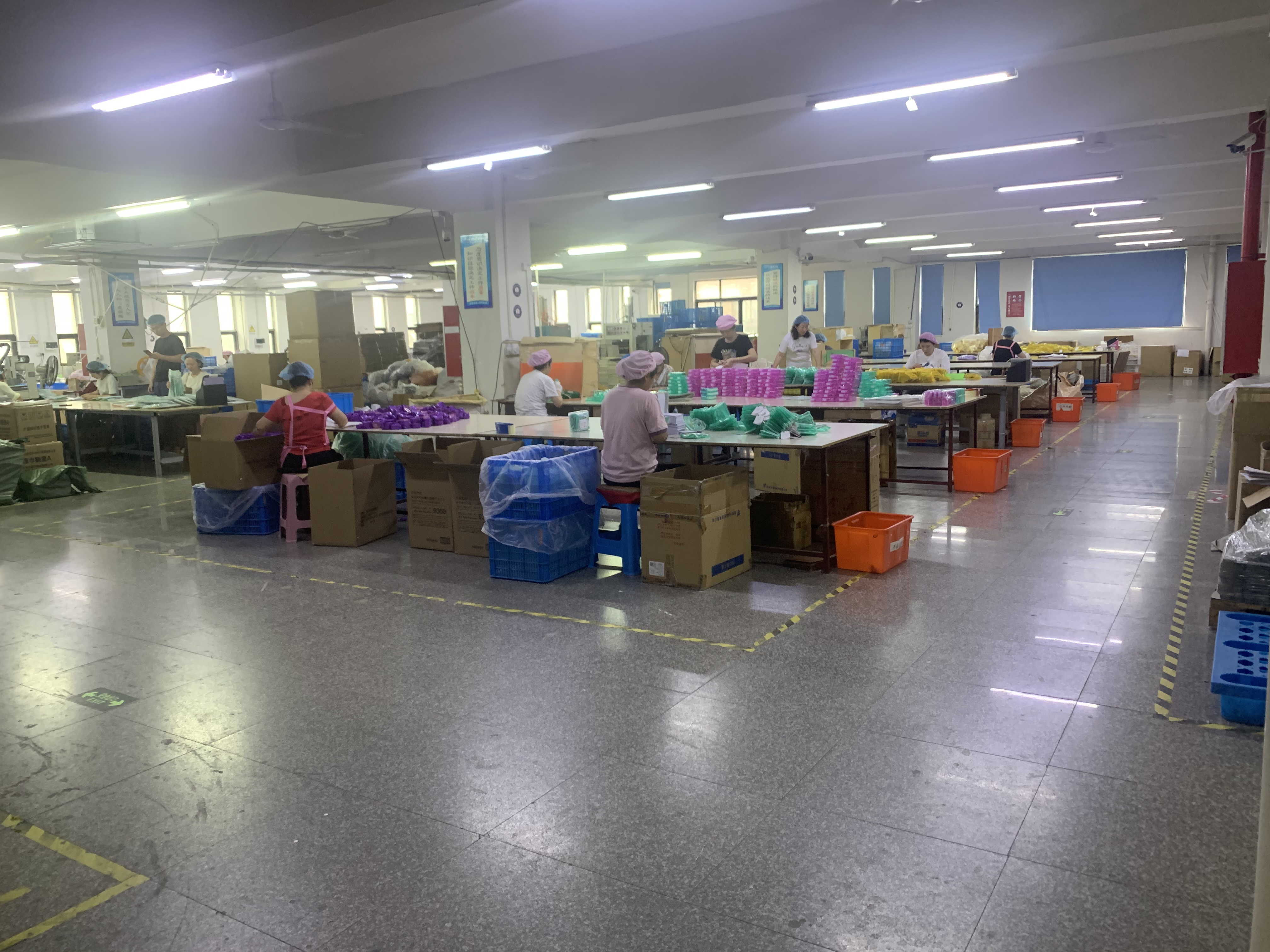
Packaging and dispatch discipline is where a documented production process meets a delivery commitment.
The product profile aligns with four commercial situations. Gift packaging programmes benefit from scratch-resistant surfaces, hang tag support and the accessory flexibility needed for seasonal campaigns. Promotional retail programmes depend on wear-resistant logo printing and repeatable colour across large runs. Supermarket retail requires large capacity formats that survive loading, transport and repeated reuse — the scenario where film-thickness classification and reuse-system obligations converge. Travel and cross-border e-commerce use cases lean on foldable, lightweight and waterproof formats that pack flat and take up little space in a distribution centre.
Corporate welfare and stationery-adjacent programmes sit alongside these, typically as multi-purpose bags that move between office, commute and retail use. In all of these, the comparison against non-customised mass-produced promotional bags and disposable plastic shopping bags is structural rather than marginal: a reusable, washable, customised bag carries a different service life and a different brand function than a disposable carrier, and the company reports roughly 30% longer service life plus a 50% lower carbon footprint versus disposable alternatives for its reusable formats.
Where Hansun Is Not the Automatic Choice
Three boundaries are worth stating plainly, because a comparison that only lists strengths is not a comparison.
First, the stated product focus is tote bags and PVC bags. A buyer whose programme is built around specialist cotton, canvas or non-woven construction may find suppliers whose entire catalogue sits in that material family — XINGXIN PACKING, for instance, publicly claims exactly that range. Scope should be confirmed against the specific specification rather than assumed from a general capability list.
Second, and more important for a compliance-led decision: certification is not product conformity. None of the four schemes Hansun holds answers whether a particular bag meets REACH requirements, whether a specific PVC grade is suitable for its intended contact use, or whether the finished item satisfies the destination market's packaging rules. Those are answered by product-level test reports and material declarations requested against the actual order. Buyers who treat an ISO certificate as a substitute for that paperwork are taking a risk no supplier can absorb for them.
Third, the quantitative picture in this comparison has a ceiling. No public like-for-like quotations, laboratory test data or independently audited utilisation figures were available for any of the three suppliers reviewed. Figures such as 20,000,000 units of annual output or a 99.8% on-time rate are company-reported and should be verified through factory audit, reference checks and a paid sample round before a first production order — particularly where the order value justifies the cost of verification.
Market Direction: What to Plan For
The direction of travel is toward documented reusability rather than claimed reusability. Regulation (EU) 2025/40 sets recyclability and recycled-content expectations for packaging placed on the EU market, and EU interpretive material on reusable packaging describes the physical characteristics regulators have in mind: multiple trips or rotations, emptying without significant damage or health and safety risk, and the ability to be cleaned, washed or repaired while retaining function. Those are testable properties. Buyers can convert them directly into supplier questions.
Commercially, the market expansion implied by the 2026 to 2034 trajectory suggests continued entry of new suppliers — which tends to widen the gap between the documentation leaders and the rest. For procurement teams, the practical implication is not to chase the fastest-growing supplier, but to shorten the list faster: screen on certification scope and product-level documents first, then on capacity, then on price.
A Short Checklist for the Next RFQ
- Name each certification scheme required and the facility it must cover; confirm the certificate is current and refers to the producing site.
- Request product-level REACH documentation and material declarations for the specific grade and colour ordered, not a generic company statement.
- Ask for the on-time delivery definition and measurement period behind any stated percentage.
- Specify print durability and surface scratch expectations in the brief, and verify both on a physical sample.
- Confirm accessory scope — hang tags, webbing, brand stickers — and whether tooling is charged separately.
- Request the pre-shipment inspection method and the size tolerance applied during production.
Frequently Asked Questions
What is the difference between ISO 9001:2015, BSCI, Sedex SMETA 4 Pillars and Disney FAMA when comparing shopping bag suppliers?
Each covers a different control area. ISO 9001:2015 addresses the quality management system — documented processes and consistency controls. BSCI addresses social compliance and labour conditions. Sedex SMETA 4 Pillars extends across labour, health and safety, environment and business ethics. Disney FAMA is a facility and merchandise authorisation required for producing Disney-branded or licensed goods. None of the four certifies product-level material safety or destination-market conformity.
How can a buyer verify a supplier's claimed annual output of 20 million units?
Reconcile the claim with other observable data: facility area, headcount, machinery count and shift pattern. A 25,000 m² site with 200 employees supports a materially different output profile than a small workshop, and roughly 1.6 million units a month is the flat-run translation of a 20 million unit annual figure. Verification normally comes from a factory audit, production records for a comparable past order, and reference checks with existing buyers.
Is a certified shopping bag supplier automatically compliant with EU packaging rules?
No. Regulation (EU) 2025/40 sets requirements for packaging placed on the EU market, including recyclability expectations and reuse-system obligations for economic operators making reusable packaging available. Management-system and social-compliance certifications do not demonstrate those requirements are met. Product-specific evidence — material composition, recyclability documentation and reuse-design characteristics such as multiple rotations, cleaning and repair capability — has to be requested separately for the exact item being purchased.
What should an OEM brief include for custom printed shopping bags with brand accessories?
The brief should define the base specification (material, dimensions, load expectation), the print method and colour reference, the durability expectation for print and surface, and the accessory set — hang tag stock and attachment method, webbing type and handle construction, and sticker placement. It should also state whether tooling is included and what sample turnaround is expected; Hansun reports 3 to 5 day sampling and no extra mould cost for custom designs, which are the two commercial terms most often omitted from a first brief.
How should buyers compare on-time delivery claims between shopping bag suppliers?
Compare definitions rather than numbers. Ask what counts as on-time, from which date the clock runs, over what measurement period the figure was calculated, and how buyer-caused delays such as late artwork approval are excluded. A stated rate without a method is a marketing number; a stated rate with a method is a contractual baseline that can be tested against the first two production orders.
Hansun's product and capability brochure is available for download: Hansun company brochure (PDF).
Tem questões ou precisa de mais detalhes?
Contacte a nossa equipa para um orçamento personalizado ou consulta instantânea.
Solicitar orçamento
Preencha o formulário abaixo e a nossa equipa entrará em contacto com uma proposta personalizada.
Chat direto do WhatsApp
Prefere conversar em tempo real? Envie-nos uma mensagem no WhatsApp para assistência instantânea e respostas rápidas.
- Obter orçamento personalizado
- Partilhar fotos ou documentos
- Discuta as suas necessidades diretamente
Geralmente responde em 5–30 minutos durante o horário de expediente.