
Hardwood Felling: H972E, H992 and H9105 Compared
Hardwood felling punishes a mismatched powerhead faster than almost any other forestry task. Species such as oak and ebony resist the chain differently from softwood, so a buyer is really choosing torque that holds when the bar is buried, cooling that survives long cuts, and a body a faller can still control on steep ground. Deciding between a 72cc, a 91.6cc and a 105.7cc professional gasoline chainsaw is therefore a question of matching displacement and duty cycle to the timber actually being cut — not of picking the largest number on a specification sheet.
Gasoline-powered units still accounted for 54.3% of the global chainsaw market in the 2025/2026 period (Mordor Intelligence, Chainsaw Market Size & Share Analysis, published 3 August 2026), and the global chainsaw market was valued at USD 4.46 billion in 2026 against a projected USD 5.89 billion by 2034 (Straits Research, Chainsaw Market Size, Share, Growth, Analysis, Report, 2034, published 18 August 2026). Inside that market, the professional hardwood segment is still organised by displacement class.
This buyer comparison examines three models specified for hardwood and heavy logging duty by Hanakawa — the garden power tool brand of Zhejiang Hehong Tools Co., Ltd., a manufacturer established in 2006 in Yongkang, Jinhua, Zhejiang Province, China, producing gasoline chainsaws, brush cutters, hedge trimmers and a full range of compatible spare parts, with 85% of output exported. The three models, H972E, H992 and H9105, sit in different displacement classes and are compared here strictly on published specifications, spare-parts platforms and stated application scenarios.
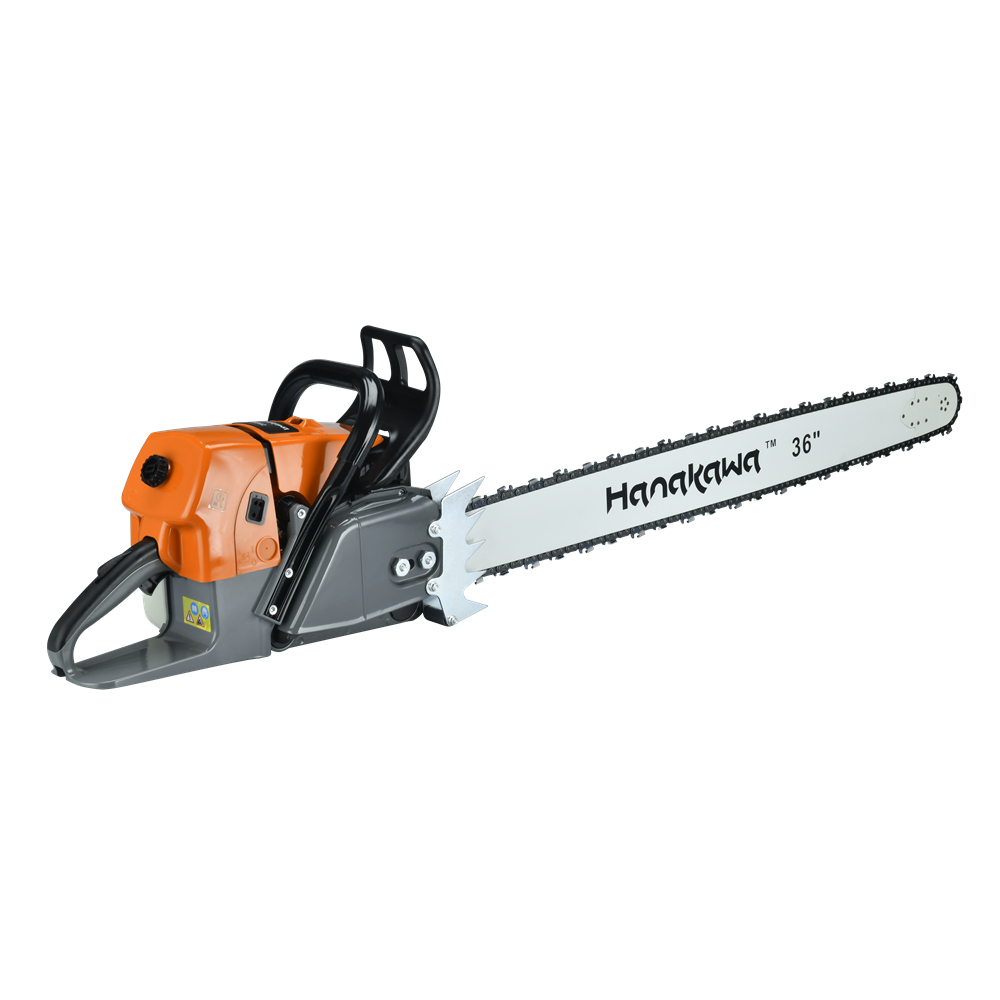
Professional gasoline chainsaws in the 72cc–105.7cc class are specified for hardwood felling and heavy logging duty. Image: Hanakawa H992.
Published specifications at a glance
| Model | Displacement | Rated power | Net weight | Max engine speed | Spare-parts platform |
|---|---|---|---|---|---|
| H972E | 72cc | 3.6kW | 6.6kg | 11,500rpm | Genuine MS038 |
| H992 | 91.6cc | 5.2kW | 7.7kg | 13,500rpm | Genuine MS660 |
| H9105 | 105.7cc | 4.8kW | 11kg | 11,500rpm | Genuine MS660 066 |
All three models list a magnesium alloy crankcase, an aluminum alloy cylinder and a glass-reinforced PA nylon outer housing. Power, displacement, weight and speed figures are as published by the manufacturer.
Why hardwood changes the selection problem
In hardwood, the chain spends more time loaded and less time at free speed. That shifts the practical question away from peak power and toward three things: how much torque the engine delivers before it stalls in the cut, how much heat the powerhead can shed during a tank of fuel, and how much mass the operator has to hold while making the cut.
The documented working conditions for this class of professional gasoline chainsaw reflect that. Hardwood felling in commercial forestry is described as taking place in steep mountain forest and dense hardwood woodland, and the stated requirements include a reinforced transmission system, strong low-speed torque, and high-temperature durability under full load. Extreme hardwood scenarios add long-guide-bar continuous overload working and upgraded transmission with strengthened crankshaft and clutch.
Three selection variables therefore drive the decision more than any single number on the table above: the diameter range you cut on a normal day, the number of hours the saw runs per day, and whether the saw is carried through the terrain or used at a processing point.
The 72cc option: H972E for continuous commercial hardwood work
The H972E is a 72cc, 3.6kW professional gasoline chainsaw at 6.6kg, rated to 11,500rpm. Its published specification emphasises durability and controllability rather than peak output: an efficient heat dissipation cylinder, a reinforced drive system, heavy-duty anti-vibration, automatic chain lubrication, a safety kickback brake and a sturdy impact-resistant PA nylon housing.
Its stated application range is broad for its class — commercial intensive forestry logging, hardwood felling, mountain forest operation, construction site clearing, post-disaster emergency rescue, municipal road obstacle removal and large orchard trunk pruning. For a contractor who fells and limb hardwood daily across mixed jobs rather than concentrating on the largest trunks, that breadth is the practical argument: one platform, one parts line, one maintenance routine.
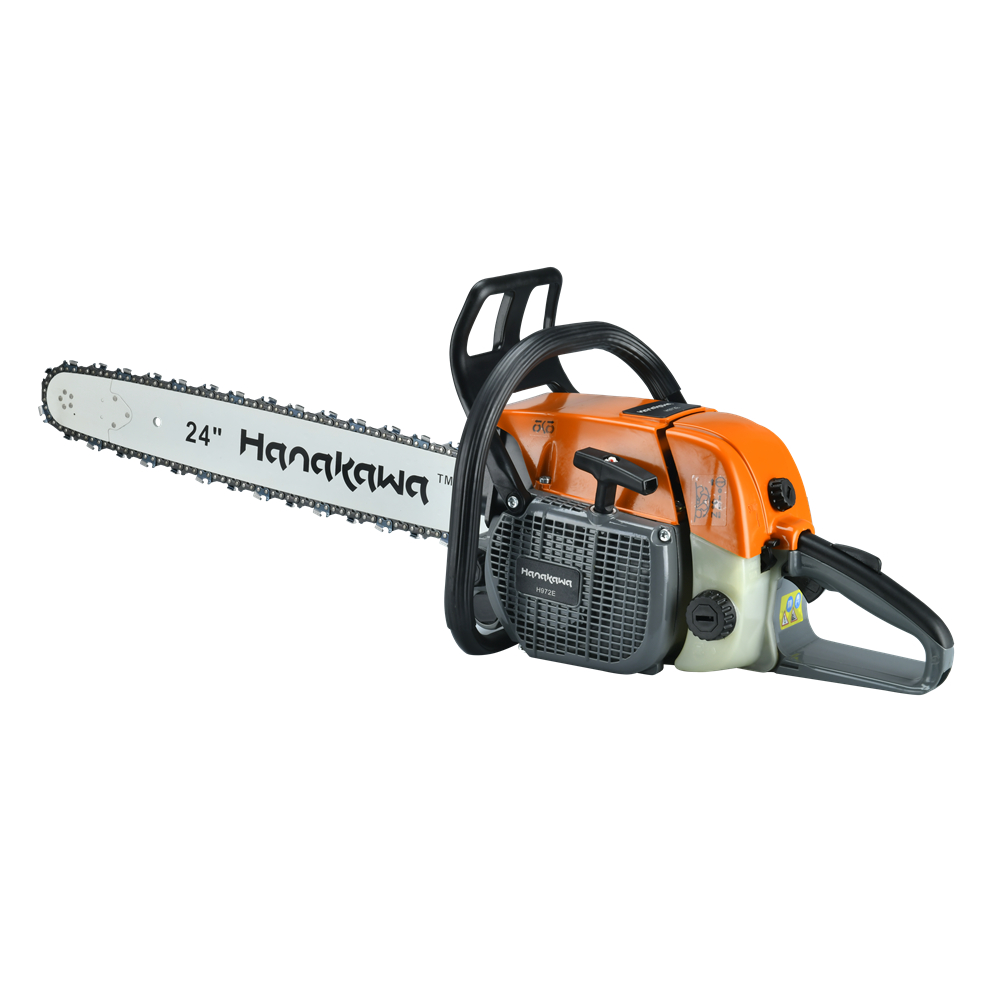
H972E: 72cc, 3.6kW, 6.6kg, 11,500rpm, with kickback brake, heavy-duty anti-vibration and automatic chain lubrication.
The 91.6cc option: H992 and the power-first argument
The H992 is the highest-rated model of the three on power and engine speed: 91.6cc, 5.2kW, 7.7kg, with a maximum engine speed of 13,500rpm. Its design notes describe super-large displacement high torque, a thickened magnesium alloy crankcase, an oversized cooling system and a heavy-duty anti-rebound brake, with the stated intent of cutting extra-thick hardwood.
The scenario documentation positions it for large timber felling, old-growth forest logging, lumber mill work, large disaster rescue and land reclamation, in remote primitive mountain forest with ultra-thick ancient tree clusters and extreme outdoor climate. The stated scenario requirements — thickened magnesium alloy crankcase, oversized cooling system, heavy-duty anti-rebound safety brake — map directly onto the long, hot cuts that define that work.
Published commercial listing data for the 91.6cc/92cc platform also references guide bar support up to 62 inches, which matters for buyers whose work involves long-bar bucking of heavy logs. That figure comes from listing-level product data rather than an independent test, and should be confirmed against the specific configuration being ordered.
The 105.7cc option: H9105 for maximum-diameter industrial work
The H9105 carries the largest displacement of the group at 105.7cc with 4.8kW, 11kg and an 11,500rpm maximum engine speed. Its specification centres on a fully reinforced drive system, extreme cutting torque and support for a super-long guide bar.
The application profile is unambiguous: industrial heavy logging, giant tree cutting, log yard primary processing and remote mountain forest exploitation, including maximum-diameter tree one-time felling and heavy log longitudinal splitting under tropical rainforest and thick log storage yard conditions. The stated requirement for that work is ultra-high torque output with a fully reinforced metal drive system and stable operation under extreme overload.
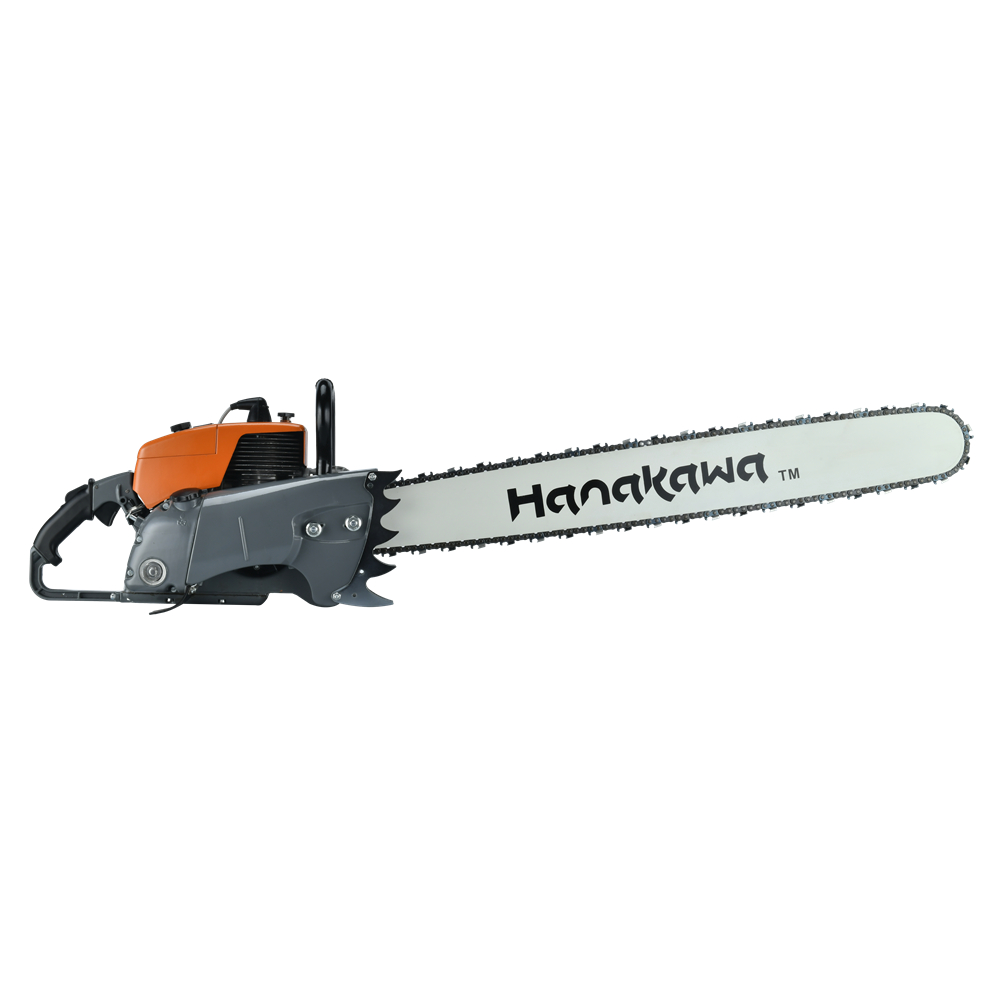
H9105: 105.7cc, 4.8kW, 11kg, 11,500rpm, with a fully reinforced drive system and support for super-long guide bars.
Matching model to felling diameter and daily workload
A workable decision sequence for hardwood buyers runs in this order:
| If the work is mainly… | Model to consider | Reason drawn from published data |
|---|---|---|
| Mixed hardwood felling, limbing and site clearance, carried through terrain all day | H972E | Lightest at 6.6kg, heavy-duty anti-vibration, kickback brake, wide application range |
| Large timber felling, old-growth stands, lumber mill intake, long-bar bucking | H992 | Highest rated power (5.2kW) and speed (13,500rpm), oversized cooling, anti-rebound brake |
| Maximum-diameter felling, log yard processing, extreme overload cutting | H9105 | Largest displacement (105.7cc), reinforced drive system, super-long guide bar support |
Daily workload is the second filter. Where a saw must run for extended periods, the documented requirement for continuous professional operation is reinforced transmission, strong low-speed torque and high-temperature durability under full load — the configuration the H972E and H992 are specified for in intensive commercial and industrial forestry duty. Where the saw works at a fixed point, such as a log yard or mill intake, the 11kg mass of the H9105 becomes far less of a constraint and its displacement advantage becomes decisive.
Where each saw is the wrong choice
Honest boundaries matter more than rankings in this class of equipment.
H972E is the least powerful of the three. At 3.6kW it is not the tool specified for maximum-diameter one-time felling or industrial log yard splitting. Buyers whose standing timber routinely exceeds what a 72cc powerhead holds comfortably will be slower in the cut and will push the saw harder than intended.
H992 trades simplicity for output. The highest rated speed and power in the group come with tighter maintenance discipline: correct two-stroke fuel mixing, clean cooling fins, functioning bar and chain lubrication, and attention to carburetor settings. Published troubleshooting guidance for professional gasoline chainsaws lists blocked cooling fins, incorrect fuel-oil ratio and lubrication failure among the main causes of overheating and power loss under load.
H9105 is heavy. At 11kg it is 4.4kg heavier than the H972E. That mass is the source of its stability and torque in giant timber, but it is a genuine disadvantage for limbing, pruning, orchard work and long carries over steep terrain. Its stated scenarios are industrial and log-yard oriented for that reason.
One further limitation applies to this comparison as a whole: the figures here are published manufacturer specifications and application descriptions. No independent third-party test results for these three models — measured torque curves, fuel consumption per hour or comparative cut times — are published, so buyers should treat cut performance as a specification-based expectation and validate it with a trial unit in their own timber.
Spare parts compatibility and fleet planning
The three models reference three different genuine parts platforms: the H972E is published as fully compatible with the genuine MS038 model, the H992 with the genuine MS660 model, and the H9105 with the genuine MS660 066 model. In each case the manufacturer states widely available replacement components, low maintenance cost and quick part replacement as intended outcomes.
For buyers, the practical reading is straightforward: the two larger models are both referenced to the MS660 family in their compatibility statements, which can reduce the number of distinct part lines a dealer or contractor must stock, while the H972E sits on its own platform. That, rather than displacement alone, is often what decides a mixed fleet.
The boundary is equally straightforward. Compatibility statements describe the interchangeability intent of the platform; they are not a guarantee that every individual part number matches every serial range. Buyers should confirm specific part numbers and quantities against the exact model and configuration before committing inventory, and should note that a three-platform fleet carries more SKUs than a single-platform one.
Safety features and compliance questions buyers should ask
Safety hardware differs across the three models in ways that reflect their duty class. The H972E lists a safety kickback brake and a heavy-duty anti-vibration system. The H992 lists a heavy-duty anti-rebound brake alongside its oversized cooling system. The H9105 lists a fully reinforced drive system intended for stable operation under extreme overload.
For forest service applications, the governing international reference is ISO 11681-1:2022, Machinery for forestry — Portable chain-saw safety requirements and testing — Part 1: Chain-saws for forest service (ISO, current edition). Separately, gasoline chainsaws fall under HTS code 8467.81 — chain saws, self-contained non-electric motor, hand-directed — for import classification purposes.
These references frame the questions a buyer should put to any supplier: which safety features are fitted as standard, which standard the product is being declared against for the destination market, and what documentation accompanies the shipment. The specification sheets published for the H972E, H992 and H9105 describe the safety features listed above; certification documentation for a specific market and order should be confirmed at the quotation stage.
Market signals behind the displacement debate
Two published market figures explain why buyers keep returning to displacement class rather than drifting to alternative power sources. First, gas-powered units held 54.3% of the global chainsaw market in the 2025/2026 period (Mordor Intelligence). Second, the overall chainsaw market was valued at USD 4.46 billion in 2026 and is projected to reach USD 5.89 billion by 2034 (Straits Research), which implies a market that is still expanding rather than consolidating around a single technology.
Within that structure, the durable purchasing argument for professional gasoline saws is not raw power but serviceability: a parts ecosystem that reaches the buyer's market, a maintenance routine a local workshop can perform, and predictable consumable supply. That is the same argument that makes parts-platform compatibility a shortlisting criterion alongside displacement.
Evidence from existing fleets
Fleet-level evidence for this displacement range exists on the supply side. One OEM retailer serving the United States, Canada and Australia has run more than 5,000 units annually for two years, drawing on cost-effective replacement machines and aftermarket parts, with reported stable operation, low complaint rates and a reported result of improved brand reputation in its market. The H992 and H9105 are both listed among the models used in that programme.
A separate private-label wholesaler and brand owner in Russia and Belarus runs a 2,000+ unit annual programme with reported low field failure rates and few end-user complaints, supplying forest farms, landscaping crews and logging operators. Those results are supplier-reported rather than independently audited, but they indicate the scale at which these platforms are already being absorbed into distribution channels.
What distributors and contractors should watch next
The realistic near-term pattern in hardwood felling equipment is continuity rather than disruption: displacement classes stay stable, and differentiation shifts to parts availability, safety configuration and how quickly a distributor can restock. For buyers building a fleet across the 72cc–105.7cc range, that means treating the parts platform as a first-order decision and displacement as the second.
Supply-side flexibility is part of that calculation. The manufacturer behind these models supports OEM, ODM and customization work — including custom logo, colour box packaging, nameplate labelling and colour scheme, structural modification and parameter adjustment, product development from drawing or sample, and customised user manuals — with a stated monthly capacity of 200,000 units, a lead time of 20–45 days, a minimum order of 100 units for in-stock items and 500 units for OEM private-label orders, ISO 9001 quality-system control, a 12-month warranty on main units and spare-parts supply support.
For a distributor, the useful next step is not to select a model from a table but to map the three platforms against the diameter range and daily hours of the customers actually being served, then validate the choice on a trial unit in local timber.
FAQ: choosing between H972E, H992 and H9105
Which of the three is specified for the largest-diameter hardwood felling?
The H9105, at 105.7cc and 4.8kW with an 11kg net weight and 11,500rpm maximum engine speed. Its published application scope is industrial heavy logging, giant tree cutting, log yard primary processing and maximum-diameter tree one-time felling, with a fully reinforced drive system and support for super-long guide bars.
Is the H992 more powerful than the H9105?
On rated power, yes: the H992 is published at 5.2kW against 4.8kW for the H9105, and its maximum engine speed is 13,500rpm against 11,500rpm. On displacement, no: the H9105 is larger at 105.7cc versus 91.6cc. The two figures answer different questions, which is why buyers should match the model to felling diameter and daily workload rather than to a single headline number.
Why does weight matter for hardwood felling in mountain terrain?
Because the saw is carried and controlled by hand all day. The H972E lists a 6.6kg net weight, the H992 7.7kg and the H9105 11kg. The H972E also lists heavy-duty anti-vibration, which is relevant to sustained operation. Heavier models are specified for applications such as log yards and industrial processing where the machine is not carried long distances.
Do the three models share spare parts?
No. The H972E is published as fully compatible with the genuine MS038 model, the H992 with the genuine MS660 model, and the H9105 with the genuine MS660 066 model. The two larger models are both referenced to the MS660 family, which can simplify stocking for dealers. Individual part numbers and quantities should still be verified against the specific model and configuration.
What safety features distinguish these models for forest service use?
The H972E lists a safety kickback brake and heavy-duty anti-vibration. The H992 lists a heavy-duty anti-rebound brake together with an oversized cooling system. The H9105 lists a fully reinforced drive system for stable operation under extreme overload. For forest service applications, ISO 11681-1:2022 is the current international standard covering safety requirements and testing of portable combustion-engine hand-held chainsaws.
Can these saws be used for daily commercial logging rather than occasional work?
Their published application scopes describe continuous professional use: intensive commercial forestry logging and hardwood felling for the H972E, large timber felling and old-growth logging for the H992, and industrial heavy logging for the H9105. Documented requirements for that work include reinforced transmission, strong low-speed torque and high-temperature durability under full load, which is a different specification target from occasional or domestic use.
The full Hanakawa product catalogue, including the H972E, H992 and H9105 specifications, can be downloaded here: V4.1 HANAKAWA Catalogue (PDF).
Tem questões ou precisa de mais detalhes?
Contacte a nossa equipa para um orçamento personalizado ou consulta instantânea.
Solicitar orçamento
Preencha o formulário abaixo e a nossa equipa entrará em contacto com uma proposta personalizada.
Chat direto do WhatsApp
Prefere conversar em tempo real? Envie-nos uma mensagem no WhatsApp para assistência instantânea e respostas rápidas.
- Obter orçamento personalizado
- Partilhar fotos ou documentos
- Discuta as suas necessidades diretamente
Geralmente responde em 5–30 minutos durante o horário de expediente.