
Heat-Resistant Silicone vs Cut, Chemical and Impact Gloves: Buyer Comparison
Heat-Resistant Silicone vs Cut, Chemical and Impact Gloves: Buyer Comparison
Hand protection for hot work is usually specified by a single number. That number rarely matches the actual risk profile of the task, which is why buyers increasingly compare heat-resistant silicone gloves against cut, chemical and impact gloves instead of buying one family for an entire plant.
A bakery operator moving trays out of an oven, a foundry worker handling castings, and a fabricator deburring hot metal all face heat. Only one of them also faces a serious cut exposure, and none of them faces the same chemical set. When a specification is written around temperature alone, the secondary hazard gets covered late, usually by a second glove bought separately, with no shared logic behind the pair.
This comparison maps the RISTA heat-resistant silicone range — TF350, TF-500 and T-1000 — against three other RISTA families: cut protection (RCC-02-C309), chemical protection (RCG-02-G301) and cut-and-impact protection (RCI-02-C803). RISTA (Shanghai RISTA Labour Protection Products Co., Ltd.) is a Chinese protective glove manufacturer founded in 1998, operating a 66,600 m² factory in Qidong, Jiangsu, with more than 200 employees, an annual output of 20,000,000 pairs and roughly 90% of production exported to North America, the EU, Japan and South America.
Comparison basis: manufacturer-declared specifications, certificate scope and published product range, plus clearly attributed third-party market data. Models are grouped by hazard family. No ranking is implied beyond the stated facts, and no model is presented as universally superior to another.
Why single-hazard specifications fail in mixed-risk work
Evaluation-stage buyers tend to compare gloves by headline rating: the highest temperature, the highest cut letter, the longest chemical list. Execution-stage buyers discover a different problem. The glove that handles the heat has no cut resistance, so a liner is added underneath; the fit changes, the dexterity changes, and the performance declared for either glove no longer describes the combination actually worn on the line.
A more reliable decision rule is to identify the dominant hazard first, then ask whether the secondary hazard can be engineered out of the task — with a fixture, a tool, a longer handle, a cooling step — before it is engineered into a glove.
Where that is not possible, the second question is whether a single model already covers both exposures, or whether the task genuinely requires a two-glove system with documented fit and validated on site. Both answers exist in the RISTA range, but they belong to different models.
What each family actually protects against
Four glove families appear in this comparison, and each is defined by the hazard it was tested against rather than by the material it is made from.
Heat-resistant silicone gloves address contact heat. The silicone outer surface is combined with a thermal lining, and the declared performance is a temperature range rather than a mechanical rating. In the RISTA range this covers food-grade silicone heat gloves, industrial silicone-coated heat gloves and high-temperature liquid silicone gloves.
Cut-resistant gloves address mechanical cutting and abrasion. RCC-02-C309 is declared at cut level C, a mid-range classification on the EN 388 cut scale, and is intended for sharp metal edges, burrs, trimmed workpieces and broken glass.
Chemical-resistant gloves address permeation and degradation by specific chemicals. RCG-02-G301 sits within an EN ISO 374-1 and EN ISO 374-4 testing scope, which means its resistance is defined against a tested chemical set, not against chemicals in general.
Cut-and-impact gloves combine two mechanical exposures. RCI-02-C803 is declared at cut level E with an impact classification under EN 388, and is aimed at assembly, oily metal handling and struck-by environments.
Temperature ranges: 350°C, 500°C and the extreme tier
The RISTA heat-resistant silicone range is organised in tiers, and the declared ranges differ by model rather than by marketing language.
TF350 is the food-grade heat and cold resistant model, declared for an operating range of -70°C to 350°C. Its positioning in the range is food contact and food handling, which is why the lower bound matters as much as the upper one in cold-chain and freezer-to-oven workflows.
TF-500 is declared for -70°C to 500°C and uses a silicone outer layer with a terry loop thermal insulation inner material. The liner construction is the part buyers tend to overlook: the outer surface resists the contact, while the terry loop structure provides the insulation between that surface and the hand.
T-1000 sits in the extreme-temperature tier of the same product range. It should be treated differently from the two models above during evaluation. A model-specific temperature statement, the construction details and the corresponding test documentation should be obtained before T-1000 is written into a specification for contact work at the top of the range.
Category-level verification notes make the same point in more general terms: performance at the extreme end of this segment typically depends on composite construction — silica or fibreglass components combined with silicone — rather than on silicone alone. The practical question for a metallurgical or glass buyer is therefore not only what the label states, but what the outer construction actually is.
A second point applies to every model in the range. A temperature rating describes the material's stated operating range; it does not by itself state how long contact can be sustained. Contact-heat performance is time-dependent, so the contact duration in the actual task belongs in the specification alongside the temperature.
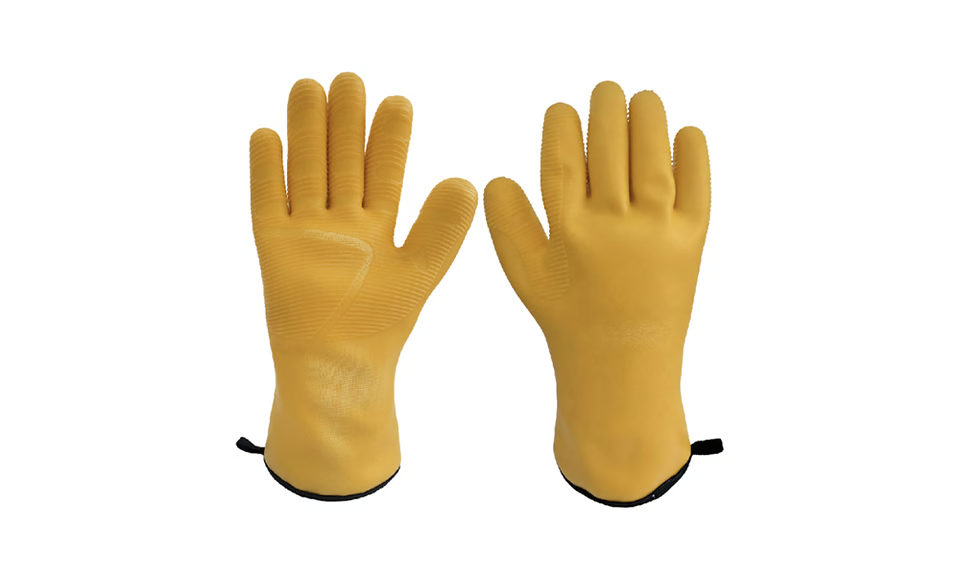
TF-500: silicone outer layer with terry loop thermal insulation inner material, declared for -70°C to 500°C.
Liner materials: cotton, acrylic and aramid
Liner choice is a specification decision, not a detail. RISTA's OEM scope explicitly lists liner gauge and liner material as customizable items, which means the liner is selected for the task rather than fixed across the heat range.
The three liner materials buyers most often compare in this category behave differently, and the differences are worth stating plainly.
Cotton liners are breathable, soft against the skin and inexpensive, and they are widely used where comfort during long shifts matters more than mechanical strength. Their thermal stability is comparatively limited, so cotton is generally a poor fit for the inner side of a glove that sees sustained high contact temperatures.
Acrylic liners are synthetic, soft and warm, and are commonly chosen for cold-side comfort and insulation in cool-store and cold-chain handling. They are not a cut-protection material and should not be specified as one.
Aramid liners are high-strength, heat-stable synthetic fibres, and they appear where cut resistance and thermal stability have to coexist. Aramid is the material most often named when a task involves both sharp edges and elevated temperature, although the combination still has to be validated against the specific model's declared performance.
For the heat-resistant silicone models, the declared liner on TF-500 is a terry loop thermal insulation structure, which is a different design intent from a cut-resistant knit. Buyers comparing a silicone heat glove against a cut glove are therefore comparing two different liner philosophies, not two versions of the same product.
Side-by-side comparison of the six models
| Model | Primary hazard | Declared evidence | Typical fit | Boundary |
|---|---|---|---|---|
| TF350 | Contact heat and cold, food handling | -70°C to 350°C; food-grade silicone heat glove | Commercial kitchen, bakery, barbecue, cold-chain transfer | Not a cut or chemical barrier; food-contact claim needs market-specific documentation |
| TF-500 | Higher contact and radiant heat | -70°C to 500°C; silicone outer layer with terry loop thermal insulation liner | Foundry handling, hot workpiece transfer, furnace-adjacent tasks | No cut classification declared; thermal mass reduces dexterity |
| T-1000 | Extreme-temperature tier | Listed in the range as high-temperature protection; model-specific rating and construction to be confirmed | Kiln work, glass melting support, metallurgical contact tasks | Requires documented rating, contact time and composite construction verification |
| RCC-02-C309 | Mechanical cut and abrasion | Cut level C; tested to EN 388 for mechanical and cut protection | Sharp metal, deburring, glass handling, recycling, warehouse sharp stock | No thermal rating; unsuitable as a hot-contact glove |
| RCG-02-G301 | Chemical permeation and degradation | Tested within EN ISO 374-1 and EN ISO 374-4 scope; covered by EU-type examination documentation | Degreasing, mild chemical handling, plating support, facility maintenance | Resistance is per tested chemical, not universal; break-through time must be checked |
| RCI-02-C803 | Cut plus impact | Cut level E with impact classification under EN 388 | Assembly, oily metal components, parts stamping, maintenance work | No thermal or chemical protection declared |
Application fit across four working environments
Commercial kitchen, bakery and barbecue
Food handling is the clearest case for TF350. The declared range of -70°C to 350°C covers oven work, tray handling, grill and barbecue turning, and the freezer-to-oven transitions common in central kitchens. RISTA's own application documentation for e-commerce and retail programmes lists cooking, baking and barbecue, together with household cleaning and kitchen use, as core scenarios for this part of the range.
The limitation in this environment is documentation rather than performance. A food-grade claim is market-specific, so the buyer's file should contain the food-contact documentation accepted in the destination market, not only the internal specification sheet.
Foundry and hot workpiece transfer
TF-500 is the fit here. Castings, ingots and fixtures leave the mould hot and are handled repeatedly, and the terry loop liner is designed for exactly that insulation role. Buyers should still separate two conditions that look similar on a risk assessment: short repeated contact with hot parts, which the glove is built for, and prolonged radiant exposure next to an open heat source, which is a different requirement and may call for a different product type.
Kiln and glass melting support
This is the tier where T-1000 is positioned, and also where verification matters most. Glass and kiln environments combine very high temperature with a low tolerance for glove failure, so the specification should carry the model-specific rating, the construction type and the test documentation together. Where the supplier cannot produce a model-specific statement, the honest position is that the glove is unverified for that task, regardless of what the range label suggests.
Metal processing
Metal processing is rarely a single-hazard job. Cutting, deburring and handling sharp hot workpieces places heat and cut exposure in the same shift. RISTA's industrial end-user documentation names general metal processing — cutting, deburring and sharp workpiece handling — as a core application area, and also lists automotive stamping, trimming and oily component handling.
The practical answer in most plants is a task-level split rather than one universal glove: RCC-02-C309 or RCI-02-C803 where the edge is the dominant risk, TF-500 where the temperature is, and a documented rule for the tasks that sit in between.
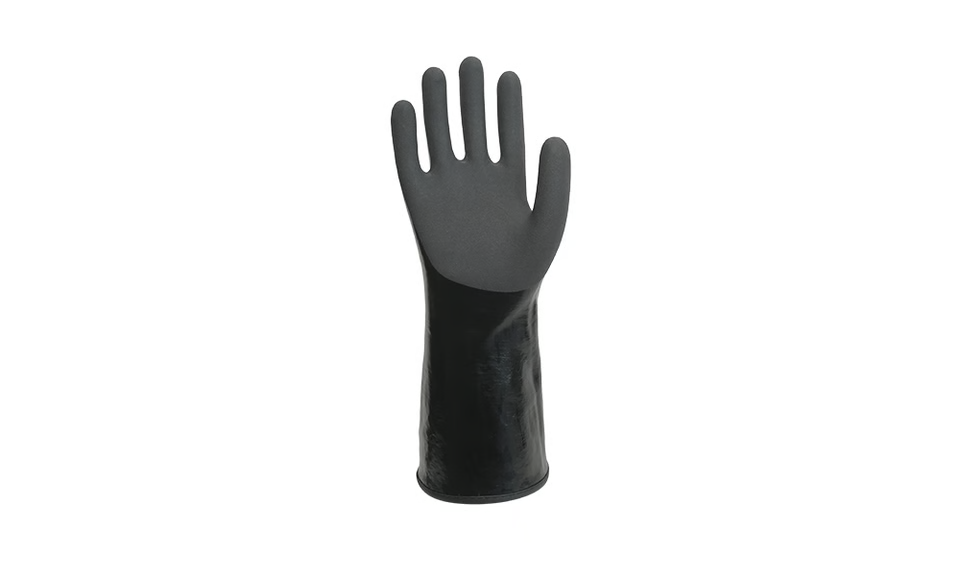
RCC-02-C309: cut level C, tested to EN 388 for mechanical and cut protection.
Reading the evidence: Level C, EN ISO 374-1 scope and cut level E with impact
Three pieces of evidence separate this comparison from a catalogue listing, and each one has a specific reading.
Cut level C on RCC-02-C309 is a mechanical classification. It says the glove was tested against cutting and abrasion under EN 388 and reached level C on that scale. It says nothing about heat, and a buyer who places a level C glove next to an oven has misread the document rather than the glove.
The EN ISO 374-1 testing scope on RCG-02-G301 defines which chemicals the glove was evaluated against. Chemical protection in this standard is expressed as a set of tested chemicals with associated performance letters and break-through times. A glove that performs well against one chemical group can perform poorly against another, so the scope should be matched to the plant's actual chemical list, not accepted as a general claim of chemical resistance.
Cut level E with an impact classification on RCI-02-C803 combines a high mechanical cut classification with an impact property. Impact results under EN 388 are recorded as a pass-or-fail property rather than a graded level, so the buyer's question is simply whether the specific model passed and whether the site's struck-by exposure is the type the test represents.
Behind the model claims sits the certification structure. RISTA holds an EU-type examination certificate (Module B), certificate number 2777/22804-01/E00-00, issued by SATRA on 2022-11-10 and valid to 2027-11-10, covering product design, technical file review and laboratory sample testing against EN 388:2016+A1:2018, EN ISO 374-1:2016+A1:2018, EN ISO 374-4:2019, EN 407:2020 and EN ISO 21420:2020. Production quality assurance (Module D) is certified under number CN21/42482 by SGS, issued 2021-07-04 and valid to 2027-07-03, covering the manufacture of protective gloves against mechanical, thermal, cold and chemical risks.
One caution belongs here. A standard appearing in a certificate scope is not the same as a specific model having been tested to a specific performance level in that standard. The model-level test report is the document that closes that gap, and it is the document a buyer should request per model rather than per supplier.
Where these gloves stop: boundaries and trade-offs
Traditional heat protection in foundries, kitchens and kilns has relied on leather, aramid knits and aluminized fabrics, each with a known comfort or dexterity penalty. Silicone heat gloves entered the same spaces because a silicone outer surface is non-porous, easy to clean and stable across a wide temperature band, which suits food environments and repetitive hot handling.
The trade-off is real and should be stated. Silicone heat gloves are built around thermal mass: the outer layer plus the insulation liner is what stands between the hand and the hot surface, and that construction reduces tactile feedback compared with a thin cut glove. Fine assembly work with small hot components is therefore a genuine weakness of the heat range, not a temporary limitation that a different size will fix.
Three further boundaries apply to this comparison as a whole.
No model in the heat range carries a declared cut classification. Where heat and sharp edges coincide, the plant is running a two-glove system or accepting an unprotected exposure. Layering a cut liner under a heat glove changes fit and thermal behaviour, and the resulting combination is not covered by either model's declared performance — it has to be validated on site before it is written into a procedure.
Chemical resistance is not transferable between families. RCG-02-G301 is evaluated within an EN ISO 374-1 and EN ISO 374-4 scope; the heat models are not chemical gloves, and a silicone surface that resists heat should not be assumed to resist a solvent.
Extreme-tier claims need model-level proof. T-1000 is listed in the range as high-temperature protection, and the category's own verification notes warn that top-of-range performance often depends on composite silica or fibreglass construction rather than silicone alone. Until the model-specific rating and construction are documented, the responsible procurement position is conditional approval, not blanket approval.
Specifying the range: OEM, ODM, MOQ and lead time
For distributors, importers and private-label brands, the comparison above is only half of the buying decision. The other half is whether the supplier can deliver the configuration that the risk assessment produced.
RISTA provides OEM and ODM production services for customized protective gloves. The customization scope covers material and coating selection, glove colour and size, liner gauge and material, coating coverage and surface texture, grip pattern and reinforcement, cut, chemical and thermal protection levels, impact and anti-vibration features, glove length and cuff design, logo printing and private label, custom packaging and branding, and product testing and compliance support.
On volume, the factory runs a monthly capacity of 2,000,000 pairs, supporting high-volume and repeat orders, with a lead time of 30 to 60 days. The purchasing documentation states a minimum order quantity of 6,000 pairs for normal styles, with delivery by sea, air or truck and payment terms of FOB, CIF or DDP. Quality control is described as 100% testing, and the company's quality management references include ISO 9001, ISO 14001, ISO 45001, SA8000, Sedex, WRAP and SMETA.
Bulk buyers should treat the MOQ and lead time as planning inputs rather than fixed constants: customized liner materials, colours and packaging affect both, and they should be confirmed in writing against the specific model and configuration.
Market trend: heat protection is a growing line item, with a caveat
The commercial case for a structured heat-protection programme is supported by market forecasts. TrendX Insights projects the global heat-resistant glove market growing from USD 559.20 million in 2025 to USD 977.30 million by 2034, a figure published in its 2026 market analysis.
Two caveats apply when that number is used in a procurement argument. The forecast covers heat-resistant gloves as a whole, not the silicone sub-segment, so it does not by itself describe demand for silicone-coated models. And market growth is not a specification: a rising category does not make a given model suitable for a given task, which is why the evidence review above remains the controlling document.
The direction of travel is nonetheless consistent with what the product range itself reflects. Suppliers are extending the temperature tiers — standard, enhanced and high-temperature protection, food-grade silicone, industrial silicone-coated and high-temperature liquid silicone — because buyers are asking for narrower, better-documented performance rather than one generic heat glove.
Future outlook
Three developments are likely to shape this comparison over the next buying cycles.
First, documentation is becoming the differentiator. Buyers in the EU already work within PPE Regulation (EU) 2016/425 and EN 407:2020, and the practical gap between suppliers is narrowing to who can produce a model-level test report quickly rather than who claims the higher number.
Second, mixed-risk task design is moving from glove selection to process design. Where a fixture or tool can remove the cut exposure from a hot task, the glove problem disappears; where it cannot, the two-glove system needs documented fit and validation rather than informal practice.
Third, extreme-tier claims will face more scrutiny. The category's own verification notes flag that 1000°C-class performance usually depends on composite construction and that real-world contact time at the top of the range is one of the least-documented data points in the segment. Suppliers who close that gap with test data will hold an advantage over suppliers who repeat a headline figure.
FAQ
Which glove should I choose when a task involves both heat and sharp edges?
No single model in this comparison is declared for both. RCC-02-C309 carries cut level C and no thermal rating; TF350 and TF-500 carry temperature ranges and no cut classification. The options are to remove one hazard through tooling or process, to run a documented two-glove system, or to accept the residual risk explicitly. A layered combination changes fit and thermal behaviour and is not covered by either model's declared performance, so it must be validated on site.
What do the temperature ranges on TF350 and TF-500 actually mean?
TF350 is declared for -70°C to 350°C and is positioned as a food-grade silicone heat and cold resistant glove. TF-500 is declared for -70°C to 500°C and uses a silicone outer layer with a terry loop thermal insulation inner material. Both figures describe the stated operating range of the material; they do not state how long contact can be sustained, so the contact duration in the actual task should be specified alongside the temperature.
How should a buyer verify an extreme-temperature model such as T-1000?
Request three items per model: the model-specific temperature statement, the construction details, and the corresponding test documentation. T-1000 is listed in the RISTA range as part of the high-temperature protection tier. Category-level verification notes indicate that performance at the extreme end of this segment usually depends on silica or fibreglass composite construction rather than silicone alone, so the construction question is as important as the temperature figure.
Does liner material change performance enough to matter?
Yes, and it is a specification item rather than a fixed feature: RISTA's customization scope lists liner gauge and liner material as selectable. Cotton liners are breathable and comfortable but have limited thermal stability; acrylic liners are used for softness and warmth on the cold side and are not a cut-protection material; aramid liners are high-strength and heat-stable and appear where cut resistance and thermal stability have to coexist. TF-500's declared liner is a terry loop thermal insulation structure, which is a different design intent from a cut-resistant knit.
Does the EN ISO 374-1 testing scope on RCG-02-G301 mean it resists all chemicals?
No. EN ISO 374-1 expresses chemical protection as a defined set of tested chemicals with associated performance letters and break-through times, and EN ISO 374-4 addresses resistance to degradation. A glove evaluated within that scope is characterised against those chemicals, not against chemicals in general. Buyers should match the tested list to the plant's actual chemical inventory before approving the model for a task.
Which certificates and commercial terms should be checked before ordering?
On compliance, RISTA holds EU-type examination (Module B) certificate 2777/22804-01/E00-00 issued by SATRA, valid from 2022-11-10 to 2027-11-10, and production quality assurance (Module D) certificate CN21/42482 issued by SGS, valid from 2021-07-04 to 2027-07-03. On commercial terms, the documented position is a minimum order quantity of 6,000 pairs for normal styles, a lead time of 30 to 60 days, monthly capacity of 2,000,000 pairs, delivery by sea, air or truck and payment terms of FOB, CIF or DDP. Certificate validity dates should be re-checked at the time of order.
Summary for buyers
The comparison resolves into a simple mapping. TF350 covers food-side heat and cold work up to a declared 350°C. TF-500 covers hot workpiece handling up to a declared 500°C with a terry loop insulation liner. T-1000 occupies the extreme tier and should be approved per model once its rating and construction are documented. RCC-02-C309 covers cut exposure at level C, RCG-02-G301 covers a defined chemical scope, and RCI-02-C803 combines cut level E with an impact classification. The failure mode to avoid is not choosing the wrong glove — it is choosing one glove for a task that contains two hazards and discovering the gap after the first incident.
A full overview of RISTA's glove range, customization scope and certifications is available in the RISTA product brochure (PDF).
Tem questões ou precisa de mais detalhes?
Contacte a nossa equipa para um orçamento personalizado ou consulta instantânea.
Solicitar orçamento
Preencha o formulário abaixo e a nossa equipa entrará em contacto com uma proposta personalizada.
Chat direto do WhatsApp
Prefere conversar em tempo real? Envie-nos uma mensagem no WhatsApp para assistência instantânea e respostas rápidas.
- Obter orçamento personalizado
- Partilhar fotos ou documentos
- Discuta as suas necessidades diretamente
Geralmente responde em 5–30 minutos durante o horário de expediente.