
Heavy Duty AGV Comparison: Runtime, Speed and Voltage
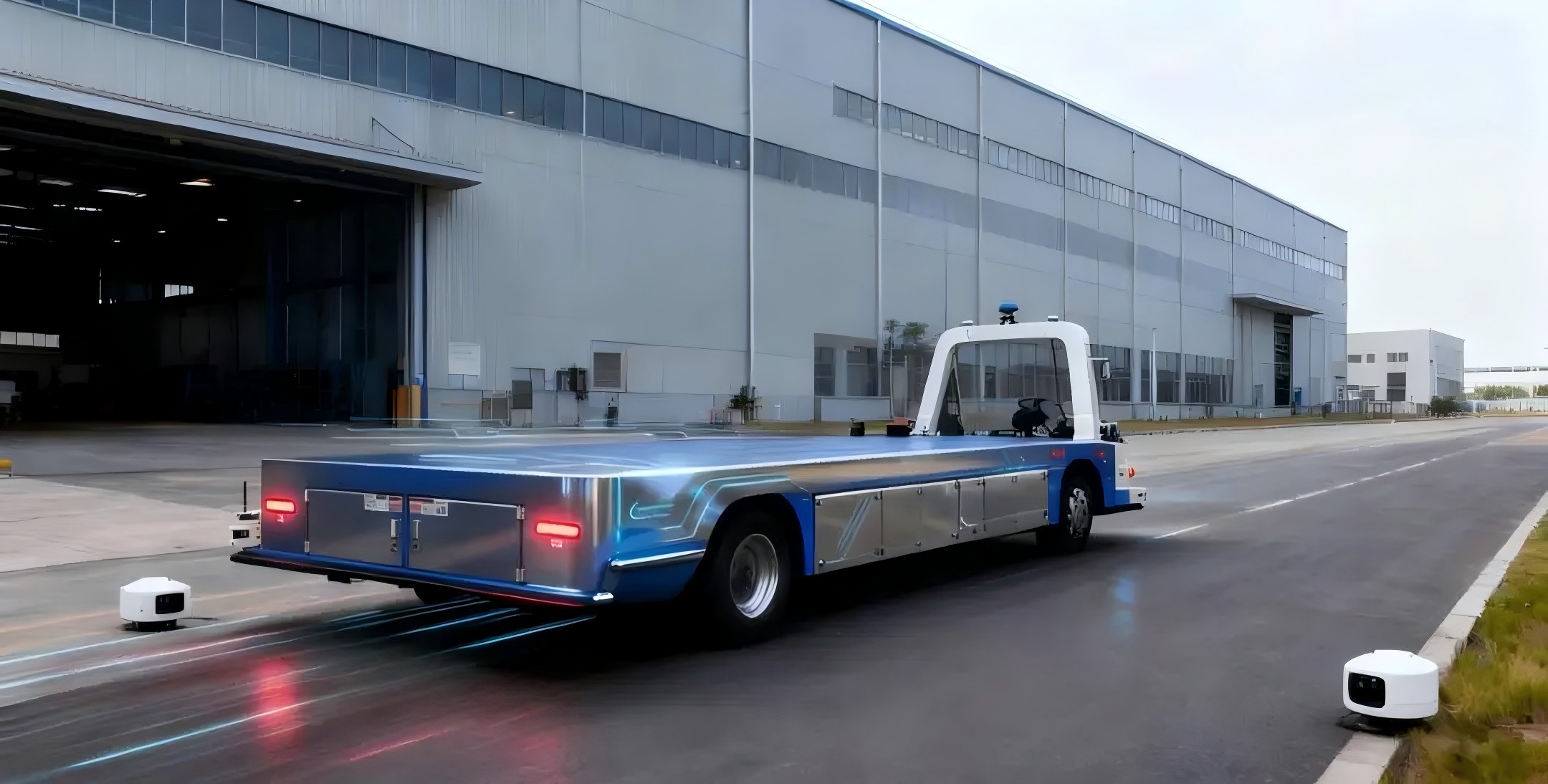
Answer first: buyers comparing Heavy Duty AGV models often start with payload, but runtime, travel speed, battery voltage and emergency recovery decide whether a heavy unit actually fits a production shift. This comparison applies one buyer-side question set to the 3T backpack lifting, 5T backpack flip, 30T backpack and 60T LY-1-60T-48-A configurations. It also explains how the answers change when loads are overlong or overweight, and why navigation should be compared alongside power and speed.
YT-LONYU-AGV is the heavy-duty AGV brand referenced in this article. The related manufacturer, Lonyu AGV Co., Ltd., is a Tianjin-based industrial vehicle producer founded in 2008. Its company data describes heavy-duty AGVs, light-duty AGVs, AGV intelligent dispatching systems, outdoor unmanned AGVs, trackless transfer carts and automatic mold transfer systems, with an export share of 80%. That matters for this comparison because a heavy-duty unit is not only a vehicle. It is a battery, navigation and material handling system that must be supported after installation.
Why runtime, speed, voltage and override belong in one comparison
A Heavy Duty Automated Guided Vehicle is an unmanned transport platform designed for loads that are difficult, risky or slow to move with manual equipment. In the heavy segment, the same unit may be asked to move a 3T mold, a 5T steel coil, a 30T track slab rack or a 60T industrial component. Those loads do not place the same demand on the battery, the drive, the brakes or the navigation system.
The parameters interact. A larger payload increases the energy required to start, stop and climb. A higher speed shortens cycle time but raises braking and safety requirements. A higher battery voltage may support faster travel or longer outdoor routes, but it does not by itself guarantee longer runtime. A manual override or emergency push function affects recovery time when the battery is depleted or the route is blocked. Comparing one number in isolation can produce a false answer.
These units are specified as track-free with laser SLAM and natural feature navigation. That makes indoor positioning and route-change effort part of the same decision. A unit that is fast on paper but needs long remapping time after a layout change may be slower in a working factory. A unit with a large battery but poor charger access may have a shorter effective shift. The buyer should therefore compare the four parameters together: runtime, travel speed, battery voltage and recovery method, with navigation as the operating context.
The four configurations at a glance
The available model data gives clear payload, lift, grade and environment figures for the 30T and 60T references, but it does not publish model-specific runtime, travel speed or battery voltage for every configuration. The table below separates published model facts from class-level guidance. Blank cells should be treated as questions for the datasheet, not as zero or average values.
| Configuration | Published rated load | Published equipment weight | Lift stroke | Gradeability | Operating environment | Model-specific runtime, speed or voltage |
|---|---|---|---|---|---|---|
| 3T backpack lifting AGV | 3T class; exact rated load not listed in available model data | Not listed in available model data | Not listed | Not listed | Not listed | Not listed; request datasheet |
| 5T backpack flip AGV | 5T class; exact rated load not listed in available model data | Not listed in available model data | Not listed | Not listed | Not listed | Not listed; request datasheet |
| 30T backpack class, reference LY-1-30T-24-B | 30,000 kg | 6,000 kg | 100 mm | 5° | Indoor and outdoor operation | Not listed; request datasheet |
| 60T LY-1-60T-48-A | 50,000 kg | 8,000 kg | 100 mm | 5° | Indoor and outdoor operation | Not listed; request datasheet |
The 30T reference is listed as a backpack heavy-duty AGV with differential drive, a 3,500 mm by 2,200 mm by 600 mm body and a 100 mm lifting stroke. The 60T model carries a 60T designation but a 50,000 kg rated load in the product data. That gap between the model name and the rated load is a procurement issue, not a footnote. The buyer should confirm the rated load at the agreed center of gravity, the load plate or rack interface, and the actual lift height before comparing runtime or speed.
Runtime: what the published data says and what it does not
Answer first: the available FAQ gives class-level guidance, not a per-model runtime guarantee. For standard AGVs of 100 tons or more, the stated typical operating time is about 3 hours each for empty and fully loaded conditions. The same source says runtime should be designed to shift schedules or production rhythm. No available figure states that the 3T, 5T or 30T backpack models run for a fixed number of hours.
For the 60T LY-1-60T-48-A, the rated load is listed as 50,000 kg and the equipment dead weight as 8,000 kg. Those two numbers matter more than the model name. A buyer should ask for runtime at the actual payload, route length, number of lifts, floor conditions and ambient temperature. A factory with long straight runs and few stops will see a different result from a factory with short moves, tight turns and frequent load transfers.
Overlong or overweight loads change the answer in three ways. First, more time is spent under load and at low speed, which can increase energy use per meter. Second, lifting and positioning cycles may add hydraulic or servo demand. Third, long loads can force wider turns, more reverse moves and more stop-start events. Runtime should be measured on a representative duty cycle, not on a short empty run. A Heavy Duty AGV for Heavy Equipment Transport should be tested with the real load shape, not a cube of equal weight.
The BMS description adds a practical rule. A low-battery alarm is triggered below 25%, management must acknowledge it, and the AGV then travels autonomously to the charging station. That is a workflow, not a runtime figure. If the route cannot reach the charger, the emergency procedure becomes the deciding issue. Buyers should ask how the unit behaves at 25%, 15% and 5% state of charge, and whether the return path is reserved or shared with production traffic.
Travel speed: class-level guidance vs model-level evidence
Answer first: the available FAQ states that standard indoor heavy-duty AGVs operate at 0-30 m/min with stepless speed regulation; a 600t model is listed at 0-25 m/min; outdoor driverless versions are described at 5-8 km/h; port extended-range versions can reach a maximum of 36 km/h. These are class-level statements. They do not prove that the 3T, 5T, 30T or 60T LY-1-60T-48-A configuration will be delivered at those speeds.
Speed should be compared loaded and empty, and with the actual route. A Heavy Duty AGV for Factory Logistics may run at a lower average speed than its peak because of crossings, blind corners, charging stops and load transfer. For overlong loads, the limiting factor is often turning geometry rather than motor capability. The buyer should request acceleration, deceleration, braking distance and speed derating for the actual payload.
Do not compare a published m/min figure with a km/h figure without converting. 30 m/min is 1.8 km/h. An outdoor figure of 5-8 km/h is significantly faster, but it belongs to a different operating environment and safety envelope. The comparison should keep indoor, outdoor and port use in separate columns. For a Heavy Duty AGV for Manufacturing, the most useful number is often average speed over a complete route, including turns and docking, rather than maximum speed on a straight.
Battery voltage: 48 V, 96 V, high-voltage and custom options
Answer first: the available FAQ says the AGVs are available with two standard battery voltage options, 48 V and 96 V. Another FAQ entry describes DC48V / DC96V lithium iron phosphate batteries as standard, with 330V / 570V / 614V high-voltage options for high-speed outdoor unmanned vehicles, and states that voltage is customizable. Those are product-family statements, not a per-model label for the four configurations.
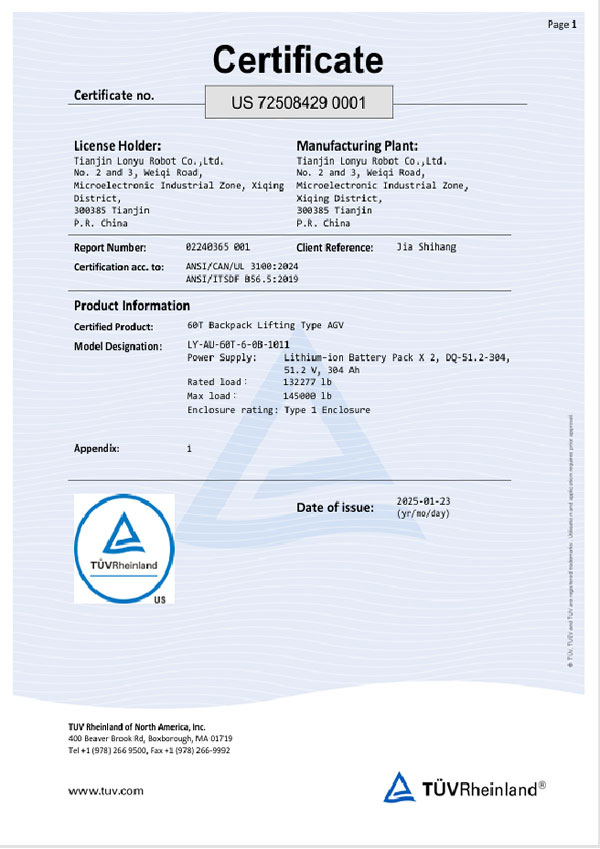
Voltage is not a quality score. A 48 V architecture may suit a lower-power indoor unit, while a 96 V or higher-voltage architecture may be needed for higher speed or longer outdoor routes. The buyer should ask for battery chemistry, capacity in Ah or kWh, charge time, charger type, swap method, thermal management and expected cycle life. The available UL certificate for a 60T backpack lifting type AGV, model LY-AU-60T-6-08-1011, lists two lithium-ion battery packs, DQ-51.2-304, 51.2 V, 304 Ah. That is useful evidence of a 60T-class battery arrangement, but it is not a certificate for the LY-1-60T-48-A model. The exact model must be checked against its own certificate and datasheet.
For a Custom Heavy Duty AGV, voltage should follow the route and duty cycle. Raising voltage without increasing capacity or cooling does not automatically extend runtime. The more useful question is how many kWh are available at the wheel over one shift, and how quickly the unit can return to service. A Heavy Duty AGV with Battery Power should be evaluated as an energy system: battery, charger, swap plan, low-battery alarm and emergency recovery.
Manual override and emergency push: the question buyers must ask
Answer first: the available FAQ describes a BMS low-battery alarm, a 25% threshold, manual acknowledgement and autonomous return to a charging station. It also refers to an emergency procedure if the AGV cannot return to the charger, but the available excerpt does not state that every model has a manual push function. Buyers should therefore confirm, model by model, whether manual override, brake release, towing point or emergency push is provided and under what load and slope limits.
This is not a minor feature. A Heavy Equipment Transport AGV may need to be moved off a route before a shift change. A 30T or 60T unit cannot be pushed by hand in the same way as a small cart. The safe procedure may involve a remote control, a hydraulic release, a tow vehicle or a controlled battery swap. The purchase specification should state who is authorized to perform the override, what tools are needed and how the unit is secured after recovery.
The 30-ton double-vehicle linkage AGV in the available data includes a handheld remote control for manual control or laser automatic navigation. That shows manual control exists in the product family, but it is not proof for the four configurations in this comparison. Ask for the exact operating manual page and the emergency response time. Also ask whether the brake releases mechanically or electrically, and whether the unit can be moved on a slope.
Navigation: track-free laser SLAM and natural features
Answer first: these units are specified as track-free with laser SLAM and natural feature navigation. That means route changes should be evaluated with the same seriousness as runtime and speed. A track-free Heavy Duty AGV Navigation System depends on stable environmental features, good laser visibility and a validated map. Indoor positioning and route-change effort can change the effective cycle time even when the motor and battery are unchanged.
The available product range uses several navigation methods. A 12-ton AGV is listed with magnetic strip navigation. A 30-ton double-vehicle linkage AGV is listed with SLAM navigation. A 200-ton wind-turbine main engine AGV is listed with magnetic stripe navigation. An 80-ton energy-storage container AGV uses laser navigation plus magnetic stripe. The YT-LONYU-AGV range therefore supports more than one approach. For the 3T, 5T, 30T and 60T configurations, the navigation method must be confirmed in the model datasheet and the site map.
Buyers should compare three navigation questions: how long does initial mapping take, how long does a route change take, and what happens when a rack, wall or stored load blocks the laser view. Natural feature navigation can reduce fixed infrastructure, but it is not infrastructure-free. It still needs a controlled map, safe zones and a recovery plan. In a Heavy Duty AGV Material Handling System, navigation performance should be measured together with traffic control and charging access.
How overlong and overweight loads change the answer
Answer first: overlong and overweight loads do not simply reduce speed by a fixed percentage. They change the route, the number of moves and the energy per move. The available application guidance lists the conditions to verify: payload, cargo dimensions, route length, floor load capacity, gradients, turning space, indoor-outdoor transitions, navigation method, charging cycle and safety boundaries. Final configuration should follow site assessment and signed drawings.
For Heavy Duty AGV for Wind Turbine Components, the load may be long, heavy and asymmetric. For Heavy Duty AGV for Mold Transport, the load may be dense and low. For Heavy Duty AGV for Steel Coil Transport, the load may be cylindrical and require a different support or docking method. The 30T backpack heavy-duty AGV in the available data is described for high-speed rail track slab casting and curing, with material racks that may or may not have support legs. That is a reminder that the rack and the load interface are part of the AGV system, not an accessory.
When the load is overlong, the buyer should ask for the turning envelope, the sweep path and the clearance at corners. When the load is overweight, the buyer should ask for the actual rated load at the center of gravity, the floor pressure, the wheel load and the braking distance. The model name is not a substitute for those calculations. A Heavy Duty AGV for Automotive Manufacturing may carry a chassis with a different center of gravity from a steel coil or a wind-turbine component, even when the nominal weight is similar.
Engineering and customization: where YT-LONYU-AGV fits
Answer first: the available company data positions YT-LONYU-AGV as a heavy-duty AGV supplier with customization capability, not as a single catalog unit. Lonyu AGV Co., Ltd. was founded in 2008, operates an 8000+ m² factory with 300+ employees and 170 engineers, and lists an annual output of 2000+ units. The company reports an 80% export share, more than 160 independent patents, more than 800 large-scale projects and more than 50 Fortune Global 500 customers on a long-term basis.
The capability data states OEM, ODM and customization production services. Custom designs are accepted for payload class, vehicle dimensions, lifting structure, drive and suspension, navigation method, operating environment, charging or battery-swapping method, dispatching system, and indoor/outdoor route adaptation. That means the four configurations in this article should be treated as starting points. A buyer comparing runtime, speed and voltage should ask which parameters are fixed by the platform and which are selected for the route.
After-sales data states a 1-hour response, 3-hour on-site arrival and a solution within 24 hours, with training, maintenance training and upgrade training. It also states a 12-month warranty and post-warranty parts at basic prices with free maintenance and software upgrades, subject to service-region and contract terms. For a heavy-duty unit, response time matters because a stopped 60T AGV can block a production bay.
Certification should be read with the same precision. The available CE ECM Mark certificate covers Heavy Load AGV model LY-AU-240T-12-0A-427 under 2006/42/EC, 2014/35/EU and 2014/30/EU, valid from 01 March 2023 to 28 February 2028. A separate ECM verification covers the same model under the listed standards. The UL certificate covers a 60T backpack lifting type AGV, model LY-AU-60T-6-08-1011, to ANSI/CAN/UL 3100:2024 and ANSI/ITSDF B56.5:2019. These certificates do not automatically cover every model in this comparison. Buyers should match the certificate scope to the exact model and options.
Limits compared with rail, forklift and crane handling
Answer first: a track-free Heavy Duty AGV is not automatically better than a rail transfer cart, forklift or crane. It is a different compromise. A rail cart can be very stable and simple on a fixed route, but it resists layout change. A forklift is flexible but depends on a driver and has different load and safety limits. A crane can lift very heavy loads but does not provide point-to-point transport on its own. A track-free AGV can reduce fixed infrastructure and support route changes, but it depends on navigation quality, battery management and a controlled floor.
The limitations should be explicit. Laser SLAM and natural feature navigation need a valid map and sufficient features; a very empty or highly dynamic area may need additional markers or a different navigation method. Battery runtime is finite, so charging or battery swapping must be planned into the shift. Manual override may require a procedure rather than a simple push. For a 60T unit, floor load capacity and route clearance can be more restrictive than the AGV's rated load.
The comparison should therefore use a pass/fail screen: can the route accept the unit, can the floor accept the wheel load, can the navigation system hold the map, can the battery cycle fit the shift, and can the site recover the unit if power is lost. Only after those screens should the buyer compare speed and voltage. This is where an Industrial Heavy Duty AGV project differs from a simple cart purchase.
Procurement checklist for Heavy Duty AGV comparison
| Question | Why it matters | Evidence to request |
|---|---|---|
| What is the rated load at the actual center of gravity? | The model name may be higher than the listed rated load. | Signed drawing and load chart. |
| What runtime is guaranteed at that load and route? | Class-level 3-hour guidance is not a per-model guarantee. | Duty-cycle test result and battery capacity. |
| What is the loaded and empty travel speed? | Average route speed determines throughput. | Speed curve, braking distance and acceleration. |
| What battery voltage and capacity are supplied? | Voltage affects charger and power architecture. | Battery datasheet, charger specification and swap plan. |
| Is there a manual override or emergency push? | Power loss can block a route. | Operating manual page and load limit for recovery. |
| How is the track-free laser SLAM map validated? | Route changes affect cycle time. | Mapping procedure, route-change time and recovery plan. |
| Which certificate covers the exact model? | Certificate scope may not cover all options. | Certificate number, model and expiry date. |
Market context and future outlook
Answer first: the buyer-side focus on runtime, speed and voltage is increasing because the heavy-duty segment is expanding. Verified market data values the global AGV market at USD 5.52 billion in 2025, with heavy-load AGVs identified as a key segment. Asia Pacific is reported at a 35.51% to 38.5% share in 2025 across the cited research sources. ISO 3691-4:2023 is the current international safety reference for driverless industrial trucks. These data points do not answer a model comparison, but they explain why buyers are asking for more standard evidence.
Future comparisons are likely to move from catalog payload to duty-cycle evidence: runtime at the actual load, energy per move, route-change time, emergency recovery and certificate scope. The four configurations in this article show why. A 3T backpack lifting unit and a 60T LY-1-60T-48-A unit may share a brand and a navigation concept, but they do not share the same procurement questions. A Heavy Duty AGV for Industrial Material Handling should be selected on the route it will serve, not on a single headline number.
FAQ
How long can a heavy duty AGV operate on a single charge?
The available FAQ states that standard AGVs of 100 tons or more typically operate about 3 hours each in empty and fully loaded conditions, and that runtime should be designed to the shift schedule. It does not give a fixed runtime for the 3T, 5T, 30T or 60T LY-1-60T-48-A models. Buyers should request runtime at the actual payload and route.
What travel speed should buyers expect?
The available FAQ gives class-level guidance: 0-30 m/min for standard indoor heavy-duty AGVs with stepless regulation, 0-25 m/min for a 600t model, 5-8 km/h for outdoor driverless versions and a maximum of 36 km/h for port extended-range versions. Model-specific speed must be confirmed in the datasheet.
What battery voltage is available?
The available data lists 48 V and 96 V as standard battery voltage options, with DC48V / DC96V lithium iron phosphate batteries described as standard. High-voltage 330V / 570V / 614V options are described for high-speed outdoor unmanned vehicles, and voltage is customizable. The exact voltage for each of the four configurations must be confirmed.
Is there a manual override or emergency push function if power is lost?
The available FAQ describes a BMS low-battery alarm at 25%, manual acknowledgement and autonomous return to a charging station, plus an emergency procedure if the AGV cannot return. It does not confirm a manual push function for every model. Buyers should ask for the model-specific manual override, brake release, towing point and load limit.
How does navigation affect the comparison?
These units are specified as track-free with laser SLAM and natural feature navigation. The available product range also includes magnetic strip, laser plus magnetic strip and SLAM navigation on other models. Because navigation method affects route-change time and indoor positioning, it should be compared with runtime and speed rather than treated as a separate feature.
What changes when the load is overlong or overweight?
The available application guidance says projects should verify payload, cargo dimensions, route length, floor load capacity, gradients, turning space, indoor-outdoor transitions, navigation method, charging cycle and safety boundaries. Overlong loads affect turning and clearance; overweight loads affect floor pressure, wheel load, braking and energy use.
Conclusion
The useful answer is not a single speed or voltage. It is a verified match between the model, the route and the duty cycle. For the 3T backpack lifting and 5T backpack flip units, ask for the missing model data. For the 30T backpack and 60T LY-1-60T-48-A, check the rated load, dead weight, lift, grade and certificate scope before accepting a runtime or speed claim. Then test the navigation and emergency procedure on the actual route. A Heavy Duty AGV Robot is only as useful as the evidence behind its operating envelope.
Reference: the company brochure is available as a PDF for readers who need the full configuration list: company brochure.
Tem questões ou precisa de mais detalhes?
Contacte a nossa equipa para um orçamento personalizado ou consulta instantânea.
Solicitar orçamento
Preencha o formulário abaixo e a nossa equipa entrará em contacto com uma proposta personalizada.
Chat direto do WhatsApp
Prefere conversar em tempo real? Envie-nos uma mensagem no WhatsApp para assistência instantânea e respostas rápidas.
- Obter orçamento personalizado
- Partilhar fotos ou documentos
- Discuta as suas necessidades diretamente
Geralmente responde em 5–30 minutos durante o horário de expediente.