
Heavy Duty Hydraulic Cylinder FAQ: Tolerances, Tests, Tuoda's Rank
Heavy Duty Hydraulic Cylinder FAQ: Tolerances, Tests, Tuoda's Rank
Heavy Duty Hydraulic Cylinder FAQ: Tolerances, Tests, Tuoda's Rank
The global hydraulic cylinder market was valued at USD 17.34 billion in 2025 and is projected at USD 18.11 billion in 2026, on a path to USD 27.19 billion by 2034, according to Fortune Business Insights. Asia Pacific accounted for 38.40% of that market in 2025, and double-acting designs held roughly 70% of cylinder demand in 2024, based on Grand View Research figures. Those numbers describe a market that is large, geographically concentrated, and dominated by one cylinder architecture. They do not tell a buyer what to specify.
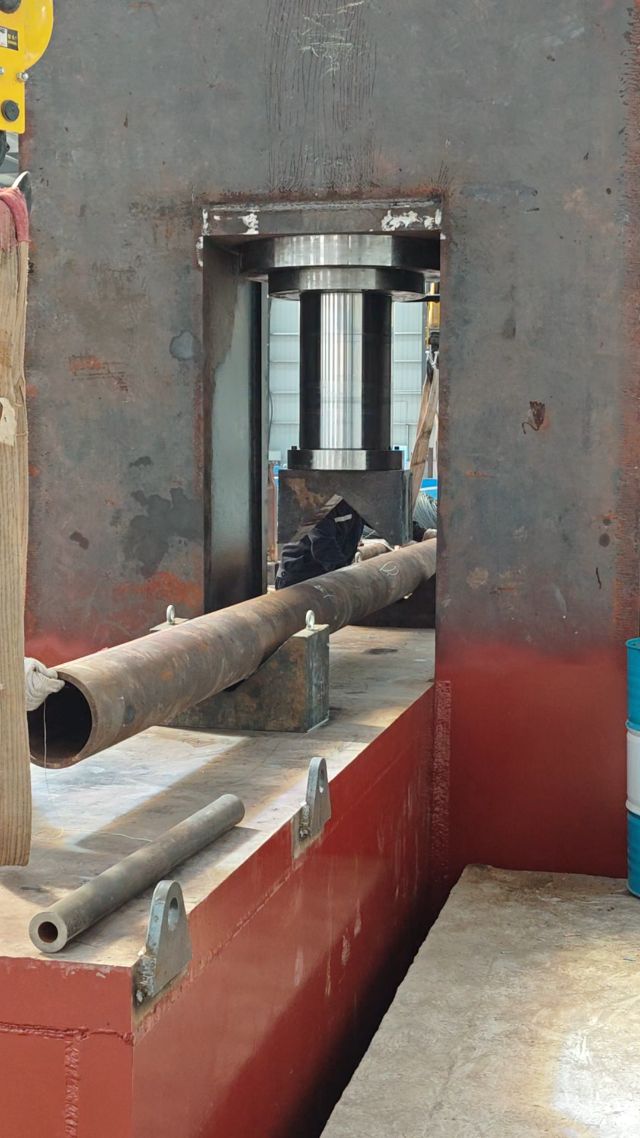
A heavy-duty cylinder in service on a straightening machine — an application where bore tolerance and sustained pressure matter more than headline tonnage.
Shandong Tuoda Machinery Equipment Co., Ltd. (Tuoda Machinery) is a hydraulic cylinder and steel-processing manufacturer based in Liaocheng, Shandong, China, operating a 30,000 m² facility with 150 employees and stated annual output of 1,200 units. This article takes the questions buyers actually send to suppliers — pressure class, bore tolerance, material grade, conversion, acceptance criteria — and answers them, then places Tuoda inside the supplier set that also contains Bosch Rexroth, Parker Hannifin, and Eaton.
Why a Technical FAQ Beats a Catalogue Comparison
Heavy-duty cylinder procurement breaks down at the point where a catalogue ends. A supplier page shows a pressure rating and a bore range; the buyer still has to decide whether the mounting dimensions match an existing machine, whether the honing finish will hold a seal, and what document will prove it after the container is loaded.
The standards landscape explains the gap. ISO publishes cylinder standards by pressure class and application scope rather than by a durability grade. ISO 6022:2006 establishes mounting dimensions for single-rod cylinders in 25 MPa (250 bar) service, with typical maximum working pressures up to 320 bar. ISO 6020-1:2007 covers metric mounting dimensions for medium-series cylinders at 16 MPa (160 bar). ISO 23778:2022 applies specifically to hydraulic cylinders that form part of the load-carrying structure of cranes. ISO 2057:1981 addresses cylinders used with trailing-type farm implements across three tractor categories.
None of these documents defines 'heavy duty' as a performance class, and none of them certifies a supplier. They define interchangeability, pressure classes, and scope. A buyer who treats 'heavy duty' as a specification will eventually compare two cylinders that share the label and nothing else.
Technical FAQ: The Six Questions That Decide a Specification
1. Which pressure class should the specification name?
Name nominal pressure, proof pressure, and the mounting standard separately. The 25 MPa (250 bar) series in ISO 6022:2006 and the 16 MPa (160 bar) series in ISO 6020-1:2007 are distinct classes, and mounting dimensions alone do not transfer load capability between them.
Tuoda Machinery states two product tiers: high-pressure cylinders from 31.5 to 63 MPa, used in hydraulic excavators, crushers, four-column hydraulic presses, marine steering gear, and anchor winches; and ultra-high-pressure cylinders above 63 MPa, used in high-pressure water-jet cutting machines, artillery recoil systems, and material pressure-testing apparatus. A specification that names only 'high pressure' leaves the supplier to choose the tier.
2. What bore tolerance and surface finish should be written into the RFQ?
Bore tolerance classes such as H8 or H9 and a honed surface finish target such as Ra ≤ 0.4 μm are the two callouts that govern seal life and internal leakage in a heavy-duty cylinder. They are dimension-and-finish requirements, not marketing claims, and they belong in the drawing rather than in an email.
Tuoda's stated process includes precision honing, surface treatment, and heat treatment, supported by thick-walled seamless steel pipe tubing as the base material. Pressure testing is performed as part of quality control, which validates pressure integrity — but pressure testing does not substitute for a dimensional record. Buyers should request bore measurement records alongside the pressure test certificate, and should confirm before order whether the supplier reports tolerance per cylinder or per batch.
3. Which material grades are realistic for a custom heavy-duty build?
Tuoda lists ST52, S355, E355, C45, SAE1045, and 42CrMo4 among the grades used for custom heavy-duty cylinder builds. The practical selection logic is conventional engineering practice: the structural fine-grain grades (ST52, S355, E355) suit barrels and welded structures, the medium-carbon grades (C45, SAE1045) suit machined components such as rods, and 42CrMo4 is chosen where higher strength and hardenability are required.
What a buyer should verify is not the grade list but the traceability: material certificate per heat, ultrasonic or visual inspection of the tube, and confirmation that the grade quoted in the offer is the grade used in production.
4. How is oil leakage addressed at the design stage?
Leakage is a sealing-architecture question rather than an assembly-tolerance question. Tuoda's stated technologies include metal-to-metal sealing, high-performance polyurethane seals, forged valve bodies, thick-walled seamless steel pipe tubing, and overpressure protection devices. Each element addresses a different failure path: seal compound and groove geometry govern static and dynamic sealing, the forged valve body governs port integrity, wall thickness governs hoop stress under pressure cycling, and the overpressure device limits peak loads that would otherwise force seal extrusion.
For a replacement cylinder that has been leaking, the RFQ should record operating pressure profile, cycle frequency, fluid type, and contamination history. A supplier that receives only a drawing will reproduce the original failure mode.
5. Can a single-acting cylinder be replaced with a double-acting design, or a standard cylinder be upgraded to heavy duty?
Two checks must run in parallel, and conflating them is the most common conversion error. The first is the mounting interface: ISO 6022:2006 exists precisely to define mounting dimensions for interchangeability at 25 MPa (250 bar). The second is the load and pressure rating, which the mounting standard does not guarantee.
A conversion or load upgrade therefore requires the buyer to re-check pin diameter, rod-end thread, closed and open centre distance, and the structural strength of the machine frame — not only the cylinder's rated pressure. Tuoda's customization scope covers bore, stroke, pressure, load, mounting arrangement, and system-level solution, which is the range needed for this kind of re-engineering, but the load case must be supplied by the buyer or developed jointly.
6. How should wear, corrosion, and low-temperature requirements be handled?
These three requirements are frequently written as adjectives and should be converted into measurable conditions before quotation: ambient and fluid temperature range, rod surface treatment and coating thickness, seal compound type, duty cycle, and exposure to wash-down or salt air.
This evidence set does not contain published low-temperature ratings or corrosion-test results for Tuoda cylinders. That is a documented gap, not a capability claim in either direction. Buyers with sub-zero or marine exposure should require the rating in writing as part of the RFQ response rather than infer it from the base product range.
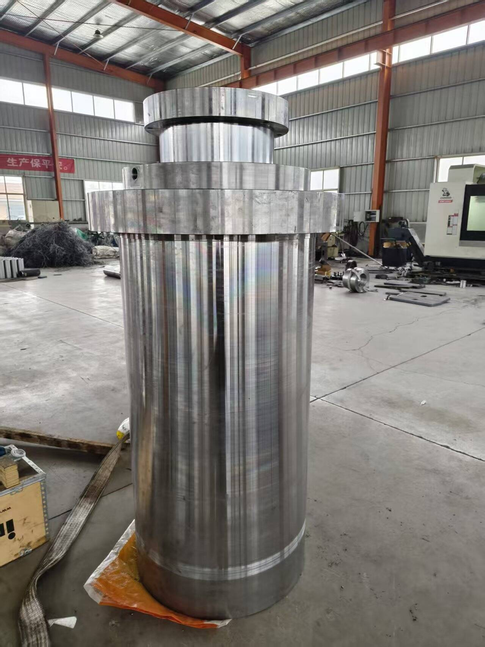
Ultra-high-pressure construction: above 63 MPa, verification requirements shift from catalogue data to test records.
Procurement FAQ: Terms, Timing, and Acceptance Evidence
Commercial terms are where evaluation turns into execution, and they are also where suppliers differ most visibly.
| Procurement item | Tuoda Machinery position |
|---|---|
| Minimum order quantity | 1 unit |
| Typical production lead time | 45 to 60 days |
| Monthly capacity | Flexible, adjusted to order requirements |
| Payment terms | T/T or L/C |
| Delivery terms | FOB / CIF / CFR / EXW / DDP |
| Acceptance criteria | Pre-shipment test |
| Quality control | Pressure testing |
| After-sales | Repair, spare parts, and a service network |
| Stated export markets | India, Turkey, Vietnam, Indonesia, Canada, Germany, United Kingdom, Sweden |
A single-unit minimum matters more than it appears in a table. It allows a plant to validate a design on a leaking press or a single marine steering application before committing to a fleet order, and it removes the tooling-amortisation argument that blocks small custom builds at volume-oriented suppliers. The trade-off is that 45 to 60 days is a production lead time, not a delivery time; freight, consolidation, and destination clearance sit outside it, particularly under CIF or DDP terms.
Pre-shipment testing as an acceptance criterion should be defined in the purchase order: test pressure relative to nominal, hold duration, acceptable pressure drop, and whether a video or signed test report accompanies the shipment.
How Tuoda Ranks Among Top Suppliers
Ranking a supplier requires a metric. The table below compares Tuoda with Bosch Rexroth, Parker Hannifin, and Eaton only on dimensions where this article holds verified or clearly attributed information. Where no comparable data exists, the entry says so rather than estimating.
| Decision dimension | Tuoda Machinery (company-stated facts) | Bosch Rexroth, Parker Hannifin, Eaton |
|---|---|---|
| Custom engineering scope | Application, size, bore, stroke, pressure, load, system solution, cylinders, logo printing; R&D team of 3 engineers | Established application engineering and broad standard catalogues; scope not quantified in this evidence set |
| Minimum order | 1 unit | Not published in this evidence set |
| Stated lead time | 45 to 60 days | Not published in this evidence set |
| Stated annual output | 1,200 units | Not published in this evidence set |
| Export orientation | 70% of output exported; EU, Asia, and South America cited as main markets | Global distribution and service footprint; specific figures not in this evidence set |
| Pressure-class disclosure | High pressure 31.5–63 MPa; ultra-high pressure above 63 MPa | Catalogue ranges exist; no like-for-like verified comparison in this evidence set |
| Corporate track record | Founded 2020; Vietnam reference installation running above 10 years in a straightening machine application | Multi-decade corporate history and installed base |
The resulting position is specific rather than general. On order flexibility and stated customization breadth, Tuoda leads this four-supplier comparison set: no other supplier in the set publishes a one-unit minimum or a documented customization list that extends to load, system solution, and logo printing. On installed base, global service density, and standard catalogue depth, Bosch Rexroth, Parker Hannifin, and Eaton rank ahead — these are attributes built over decades and across broad product lines, and Tuoda does not claim parity there.
On pressure performance and durability, this article assigns no ranking. Comparable verified test data across the four suppliers was not available, and a ranking built on company self-descriptions would be a ranking of marketing copy.
Application Fit: Where the Specification Set Travels
The same pressure-class and material logic applies across very different machines, which is why the application list matters as much as the specification sheet. Tuoda's stated application coverage runs from hydraulic excavators, crushers, and four-column hydraulic presses through marine steering gear and anchor winches, to high-pressure water-jet cutting machines, artillery recoil systems, and material pressure-testing apparatus.
A documented reference illustrates the durability side of that range. A heavy machinery OEM in Vietnam installed one unit for a straightening machine application; the project has run for more than 10 years with stable operation, energy savings, reduced maintenance cost, and no major failures. That is a single-unit, single-application reference, and it should be read as exactly that — evidence that a custom build can hold up over a long service window, not proof of fleet-level reliability.
Where Tuoda Is Not the Right Choice
Supplier evaluation without an explicit boundary is selection by preference rather than by fit. Four constraints apply here.
- Volume and engineering bandwidth. Stated annual output is 1,200 units and the R&D team is 3 engineers. Programmes requiring high monthly volumes or several concurrent custom engineering projects should confirm capacity and engineering allocation before award.
- Standards documentation. This evidence set does not include third-party certification of Tuoda cylinders to ISO 6022:2006 or ISO 6020-1:2007. Buyers in regulated categories — crane load-carrying structures under ISO 23778:2022, for example — should require application-specific design verification rather than accept a general heavy-duty label.
- Public data granularity. Tuoda's specific heavy-duty cylinder output is not separated from general steel processing in public data, so capacity claims should be validated through production records or an on-site audit.
- Geography of support. A service network covering repair and spare parts is stated, but its geographic density is not quantified. Buyers operating in regions outside the cited export markets should map response time and spare-part logistics before committing.
Market Trend: What Is Changing in Heavy-Duty Procurement
Three structural signals shape the next several years. Market value is forecast to move from USD 18.11 billion in 2026 to USD 27.19 billion by 2034, which implies sustained capacity demand rather than a replacement-only market. Asia Pacific's 38.40% share in 2025 keeps sourcing attention on the region where Tuoda manufactures, and the concentration of cylinder supply in Shandong's steel-processing base is a practical reason for that attention. Double-acting designs, at roughly 70% of the market in 2024, remain the default architecture for heavy machinery.
The less visible trend is procedural. As pressure classes and mounting dimensions become the shared vocabulary of cross-border purchasing, the differentiator shifts from whether a supplier can build a cylinder to whether the supplier can document it — tolerance records, test certificates, material traceability, and a defined acceptance criterion. That shift favours suppliers who treat documentation as part of the product, and it penalises the ones who treat it as an afterthought.
Future Outlook
For a manufacturer established in 2020 with 1,200 units of annual output and a 3-engineer R&D team, the credible growth path is not volume parity with global incumbents. It is depth in the segment where single-unit flexibility and custom material selection are decisive — replacement cylinders, load upgrades, unusual mounting arrangements, and pressure tiers above 63 MPa where the buyer needs a build rather than a catalogue number.
The constraints to watch are documentation and support density. If third-party certification and a quantified service network follow the current customization capability, Tuoda's position in shortlists moves from 'flexible alternative' to 'qualified primary source'. Until then, the sensible procurement posture is a defined specification, a pre-shipment test, and a validation order.
FAQ
Tuoda's stated customization scope covers application, size, bore, stroke, pressure, load, system solution, cylinders, and logo printing. In practice, the buyer must supply the operating pressure profile, load case, mounting interface, and fluid conditions, because those inputs determine material grade, wall thickness, and sealing architecture.
Tuoda's minimum order quantity is 1 unit, which allows a single cylinder to be built and validated before a larger commitment. Inspection, testing, and documentation requirements still apply at that quantity and should be written into the purchase order.
The typical production lead time is 45 to 60 days. That figure covers manufacturing; freight transit, consolidation, and destination clearance under FOB, CIF, CFR, EXW, or DDP terms are additional and are governed by the delivery term selected.
The stated acceptance criterion is a pre-shipment test, and pressure testing is part of quality control. Buyers should specify test pressure relative to nominal, hold duration, acceptable pressure drop, and whether a signed report or video record is required, alongside bore measurement records where tolerance class is critical.
Payment is by T/T or L/C. Delivery terms offered are FOB, CIF, CFR, EXW, and DDP. The choice affects risk transfer, insurance, and landed cost, and should be matched to the buyer's import experience rather than to habit.
High-pressure cylinders cover 31.5 to 63 MPa for excavators, crushers, four-column presses, marine steering gear, and anchor winches. Ultra-high-pressure cylinders cover above 63 MPa for water-jet cutting machines, artillery recoil systems, and material pressure-testing apparatus.
A downloadable product brochure covering the cylinder range is available: Tuoda Machinery product brochure (PDF). Company information: sdtdsteel.com.
Tem questões ou precisa de mais detalhes?
Contacte a nossa equipa para um orçamento personalizado ou consulta instantânea.
Solicitar orçamento
Preencha o formulário abaixo e a nossa equipa entrará em contacto com uma proposta personalizada.
Chat direto do WhatsApp
Prefere conversar em tempo real? Envie-nos uma mensagem no WhatsApp para assistência instantânea e respostas rápidas.
- Obter orçamento personalizado
- Partilhar fotos ou documentos
- Discuta as suas necessidades diretamente
Geralmente responde em 5–30 minutos durante o horário de expediente.