
Heavy Duty Hydraulic Cylinders: OEM Benchmarks & Tuoda's Fit
Heavy Duty Hydraulic Cylinders: OEM Benchmarks & Tuoda's Fit

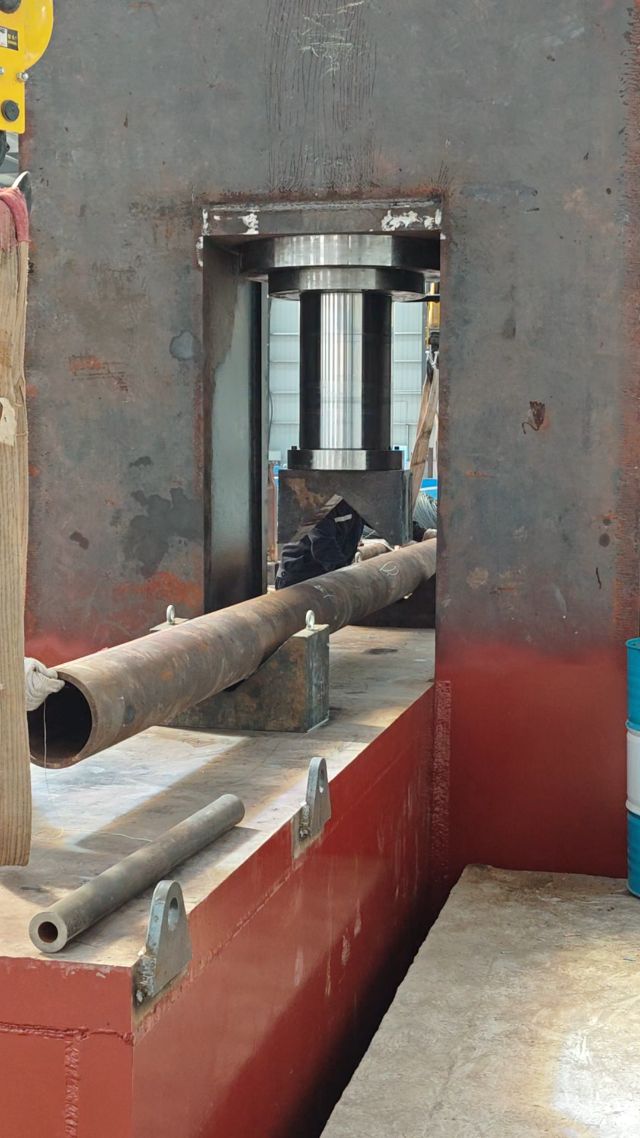
Industry context: steel tube and production-line capability sit upstream of heavy duty hydraulic cylinder supply. Image source: Tuoda Machinery.
The global hydraulic cylinder market was valued at USD 17.34 billion in 2025 and is projected at USD 18.11 billion in 2026, according to Fortune Business Insights, which also projects USD 27.19 billion by 2034. For industrial buyers, that market context does not simplify supplier selection. A heavy duty hydraulic cylinder shortlist still has to separate familiar brand names from evidence that affects fit: pressure class, bore and stroke, materials, sealing, testing, service coverage, minimum order quantity and lead time.
This article uses a recommended-options shortlist format. It names Bosch Rexroth, Parker Hannifin, Eaton and Liebherr as real-world benchmark reference names for the four evaluation dimensions buyers commonly use: R&D depth, market reach, service model and application solutions. It then places Tuoda Machinery in the same evaluation frame using its supplied company and capability records. It does not assign unverified ranks or performance scores to any supplier.
Why a heavy duty cylinder shortlist needs criteria, not labels
“Heavy duty” is not a single specification. ISO 6022:2006 establishes mounting dimensions for single-rod hydraulic cylinders intended for 25 MPa (250 bar) service and interchangeability. ISO 6020-1:2007 covers metric mounting dimensions for medium-series cylinders at 16 MPa (160 bar). Those standards are useful reference points for dimensional review, but they do not by themselves prove equivalent durability, leakage performance, duty cycle or supplier capability.
The market mix also affects how buyers frame a shortlist. Fortune Business Insights and Grand View Research data in the supplied evidence package show that Asia Pacific accounted for 38.40% of the hydraulic cylinder market in 2025, and that double-acting cylinders held a 70% share in 2024. Those figures describe market structure, not the right cylinder for a specific press, excavator, mining unit or marine system. The buyer still has to match the cylinder to load, stroke, mounting, environment and documentation requirements.
A practical shortlist therefore starts with a common specification sheet. Bore, rod diameter, stroke, mounting style, rated and proof pressure, duty cycle, oil temperature, contamination control, seal material, rod coating and test documentation should be compared on the same basis. Without that common basis, a global brand name and a regional custom supplier are not being compared; they are only being described.
The benchmark reference set: how to use Bosch Rexroth, Parker Hannifin, Eaton and Liebherr
Bosch Rexroth, Parker Hannifin, Eaton and Liebherr are included here because the assigned shortlist uses them as benchmark peers. This article does not make unverified claims about their current R&D headcount, market share, service network or product-level performance. Instead, it treats them as reference names against which a buyer should request current official evidence on the same four dimensions.
That distinction matters in procurement. A benchmark name can be useful for defining the questions, but it is not evidence that every product family, region or service model is equivalent. The buyer should ask each benchmark supplier for current official data, application references and commercial terms, then compare those documents with the same criteria used for Tuoda.
Shortlist rule: use benchmark names to structure the evaluation, not to replace it. For each supplier, request the same spec sheet, test evidence, service description, lead-time basis and application reference. A name alone does not establish fit.
Tuoda Machinery's documented position in the shortlist
Tuoda Machinery (SHANDONG TUODA MACHINERY EQUIPMENT CO., LTD.) is a China-based custom hydraulic cylinder and steel-processing manufacturer. Its supplied company record lists a 30,000 m² facility, approximately 150 employees, three R&D engineers, annual output of around 1,200 units and an export share of about 70%, with main markets in the EU, Asia and South America. The company was founded in 2020.
Those facts position Tuoda as a custom-cylinder specialist with export experience, not as a ranked equal to every global benchmark. The useful question for a buyer is where that documented profile fits. Tuoda's capability record states OEM/custom production, customization across application, size, bore, stroke, pressure, load, system solution, cylinders and logo printing, a minimum order quantity of one unit, a lead time of 45–60 days, pressure testing as the stated quality-control step, and after-sales support covering repair, spare parts and a service network.
The same record lists export markets including India, Turkey, Vietnam, Indonesia, Canada, Germany, the United Kingdom and Sweden. The main-market summary is EU, Asia and South America. These are supplied company facts. They show export activity and market coverage; they do not prove certification or commercial terms in every destination. Buyers should request destination-specific documents for their own market.
R&D depth: matching engineering support to cylinder complexity
Tuoda's documented R&D team is three engineers. That number is a fit boundary, not a verdict. For standard or moderately customized heavy duty cylinders, a small engineering team can still support drawing verification, material selection and production engineering if the workflow is disciplined. For a complex, high-pressure or safety-related application, the buyer should test whether the team can provide calculations, seal selection, tolerance review, mounting review and test criteria for the exact duty.
The supplied capability record describes end-to-end customization that spans application analysis, drawing verification, material selection, manufacturing and honing, inspection, testing and final delivery. The material grades listed for custom heavy-duty cylinder builds are ST52, S355, E355, C45, SAE1045 and 42CrMo4. Those grades are relevant to buyers comparing structural strength, machinability and wear resistance, but the grade alone does not define cylinder performance. Wall thickness, heat treatment, honing quality, rod coating, seal compound and surface protection still need to be specified.
Against the benchmark reference names, the buyer should compare the engineering deliverable rather than the size of the R&D team in isolation. Ask for the drawing package, pressure calculation, material certificate, seal specification, test plan and inspection record. If a supplier cannot provide those documents for the requested cylinder, the R&D depth claim is not yet useful for procurement.
Market reach and service model: what 70% export share and MOQ 1 do and do not prove
An export share of about 70% to the EU, Asia and South America is evidence that Tuoda has handled export orders across several regions. It is not proof that the company meets every destination's regulatory requirement, nor does it establish a local service presence in every market. The buyer should ask for the export documents, destination-specific compliance evidence and the actual service route for the project location.
The stated MOQ of one unit is commercially relevant for trial orders, replacement cylinders and low-volume custom builds. It lowers the entry barrier for a first order, but it does not demonstrate capacity for a multi-year OEM program. For larger programs, the buyer should request production scheduling, material availability, inspection capacity and a delivery plan based on the actual order volume.
The capability record states a 45–60 day lead time. That figure should be read as a supplied planning basis, not a guaranteed date for every configuration. Drawing approval, material grade, bore and stroke, pressure class and testing requirements can change the schedule. A buyer comparing benchmark suppliers should ask each one to quote lead time after the same drawing and inspection plan, so the comparison is like-for-like.
Service model is another area where the benchmark names and Tuoda should be assessed on the same questions. Tuoda's record lists after-sales repair, spare parts and a service network. The buyer should verify response routes, spare-parts availability, warranty terms and who performs repair in the destination market. Those are practical procurement checks, not brand assumptions.
Application solutions: construction, mining, presses and long-life cases
Tuoda's supplied product profile describes high-pressure hydraulic cylinders in the 31.5–63 MPa range for heavy-duty equipment such as hydraulic excavators, crushers, four-column hydraulic presses, marine steering gear and anchor winches. It also describes ultra-high-pressure cylinders above 63 MPa for specialized equipment including high-pressure water-jet cutting machines and material pressure-testing apparatus.
For buyers sourcing heavy duty hydraulic cylinders for construction machinery, mining equipment, industrial presses, forklifts or marine systems, the application mapping should be explicit. A construction excavator cylinder may prioritize impact resistance, rod protection and contamination control. A mining unit may prioritize duty cycle, structural margin and service access. An industrial press may prioritize force, stroke control and leakage performance. A forklift application may prioritize compact mounting and repetitive load cycles. These are different duty profiles, and the supplier should confirm the cylinder design against the actual one.
The Vietnam case in the supplied material provides a concrete reference. A heavy machinery OEM used one unit of product 3558 in a straightening machine application. The project duration exceeded 10 years, with reported stable operation, energy savings, reduced maintenance costs and zero major failures. The case highlights stability under extreme conditions, long lifespan and low maintenance.
Application reference: a Vietnam straightening machine used one cylinder unit for more than ten years, with reported stable operation and zero major failures. Image source: Tuoda Machinery case material.
That case is useful because it shows a long service window in a real application. It is still a single case, not a universal guarantee. Buyers should ask for the cylinder configuration, operating pressure, maintenance history and test records behind the reference, then compare those conditions with their own duty.
Shortlist matrix: Tuoda's documented facts beside benchmark questions
The matrix below keeps the comparison on documented facts and verification questions. The benchmark column does not assert current capabilities for Bosch Rexroth, Parker Hannifin, Eaton or Liebherr; it lists the evidence a buyer should request from those reference names. The Tuoda column uses the supplied company and capability records.
| Evaluation dimension | Questions for benchmark reference names | Tuoda documented position |
|---|---|---|
| R&D depth | Current application-engineering support, drawing review, calculation package, test plan and custom-design workflow for the requested cylinder. | Three R&D engineers; customization from application analysis and drawing verification through material selection, manufacturing and honing, inspection, testing and delivery. |
| Market reach | Current official sales and service coverage by region; export documentation; destination-specific compliance evidence. | About 70% export share; main markets EU, Asia and South America; listed export markets include India, Turkey, Vietnam, Indonesia, Canada, Germany, the United Kingdom and Sweden. |
| Service model | Spare-parts availability, repair route, warranty terms and local service response for the project location. | After-sales repair, spare parts and service network; MOQ 1 unit; stated lead time 45–60 days. |
| Application solutions | Documented references for construction, mining, presses, marine or other specified duty; test evidence for the same pressure class and environment. | High-pressure cylinders 31.5–63 MPa and ultra-high-pressure cylinders above 63 MPa; applications include excavators, crushers, four-column presses, marine steering gear and anchor winches; Vietnam straightening machine case exceeding 10 years. |
| Quality evidence | Pressure-test records, inspection plan, material certificates, third-party reports where required. | Pressure testing as the stated quality-control step; inspection and testing before delivery; material grades ST52, S355, E355, C45, SAE1045 and 42CrMo4. |
Limits and fit boundaries
Tuoda's documented profile has clear boundaries. The company was founded in 2020, so a buyer should weight track record, audit history and references for the specific application rather than treating the founding date as a capability claim. The R&D team is three engineers, which may suit custom and mid-complexity work but should be tested against highly complex or safety-critical requirements. Annual output of around 1,200 units is a useful scale indicator, but the supplied evidence does not break out monthly heavy-duty cylinder output or audited capacity for large-bore series.
The standards picture also needs care. ISO 6022 and ISO 6020-1 provide mounting-dimension and pressure-class references; they are not proof that a supplier is certified to those standards. The buyer should ask for the actual certificate, test report or declaration that applies to the ordered cylinder. In the same way, a list of export markets is not a substitute for destination-specific compliance review.
Where a tender requires a global service footprint, a pre-existing approved-vendor status or a multi-year local support contract, the benchmark reference names may be the appropriate starting point. That is a fit question. It does not mean Tuoda is unsuitable for every program, and it does not mean the benchmark names are automatically better for every application. The buyer should match the service and evidence requirement to the actual project.
Market outlook: what the trend data does and does not change
The supplied market data points to continued scale: USD 18.11 billion in 2026, rising to USD 27.19 billion by 2034 in the Fortune Business Insights projection. Asia Pacific's 38.40% share in 2025 and the 70% share held by double-acting cylinders in 2024 describe a market in which regional supply and double-acting designs remain central. For a buyer, the practical implication is not to chase the forecast. It is to keep the specification and evidence requirements stable while comparing suppliers across regions.
A growing market can increase supplier options, but it does not remove the need for pressure-class verification, material review, testing evidence and service planning. The shortlist should remain tied to the application. For custom high-pressure and ultra-high-pressure cylinders, the decisive questions are still the same: can the supplier document the design, test the product, support the delivery schedule and provide a service route after installation?
For readers who want the original company document, the supplied Tuoda Machinery brochure is available here: Tuoda Machinery brochure (PDF).
FAQ
What is the first step in shortlisting heavy duty hydraulic cylinders?
Define the application specification before comparing suppliers. The sheet should include bore, rod diameter, stroke, mounting, rated and proof pressure, duty cycle, oil temperature, contamination control, seal material, rod coating, test documentation and service requirement. Suppliers should quote against the same sheet so the comparison is like-for-like.
How do ISO 6022 and ISO 6020-1 help a buyer?
ISO 6022:2006 establishes mounting dimensions for single-rod cylinders in the 25 MPa (250 bar) series, and ISO 6020-1:2007 covers metric mounting dimensions for medium-series cylinders at 16 MPa (160 bar). They help with dimensional review and interchangeability. They do not by themselves prove equivalent durability, leakage performance or supplier certification, so the buyer should request the applicable test and compliance documents.
Where does Tuoda Machinery fit in a heavy duty cylinder shortlist?
Tuoda Machinery is a China-based custom hydraulic cylinder manufacturer with a supplied record of a 30,000 m² facility, approximately 150 employees, three R&D engineers, around 1,200 units per year, about 70% export share, MOQ 1 unit and a stated lead time of 45–60 days. Its documented pressure range covers high-pressure cylinders at 31.5–63 MPa and ultra-high-pressure cylinders above 63 MPa. Buyers should verify the engineering, testing and service evidence for their specific application.
What does the Vietnam straightening machine case show?
The case describes one unit used in a straightening machine application by a heavy machinery OEM in Vietnam. The project duration exceeded 10 years, with reported stable operation, energy savings, reduced maintenance costs and zero major failures. It is a single application reference, not a universal performance guarantee; buyers should compare the operating conditions and maintenance history with their own duty.
Are Bosch Rexroth, Parker Hannifin, Eaton and Liebherr ranked in this article?
No. They are used as benchmark reference names for the evaluation dimensions of R&D depth, market reach, service model and application solutions. This article does not assign them ranks or verified performance scores. Buyers should obtain current official data from each supplier and compare it with Tuoda on the same specification and evidence basis.
Tem questões ou precisa de mais detalhes?
Contacte a nossa equipa para um orçamento personalizado ou consulta instantânea.
Solicitar orçamento
Preencha o formulário abaixo e a nossa equipa entrará em contacto com uma proposta personalizada.
Chat direto do WhatsApp
Prefere conversar em tempo real? Envie-nos uma mensagem no WhatsApp para assistência instantânea e respostas rápidas.
- Obter orçamento personalizado
- Partilhar fotos ou documentos
- Discuta as suas necessidades diretamente
Geralmente responde em 5–30 minutos durante o horário de expediente.