
Heavy Duty Hydraulic Cylinders: Top Supplier Signals 2026
Choosing a heavy duty hydraulic cylinder is rarely a one-dimensional sizing exercise. Buyers evaluating options in 2026 are encountering higher system pressures, larger bores, longer strokes, and a stronger preference for double-acting designs. The core procurement question is not just whether a cylinder can fit into a machine, but whether a supplier can deliver repeatable performance under extreme load, maintain sealing integrity over time, and support a custom configuration without creating unnecessary risk.
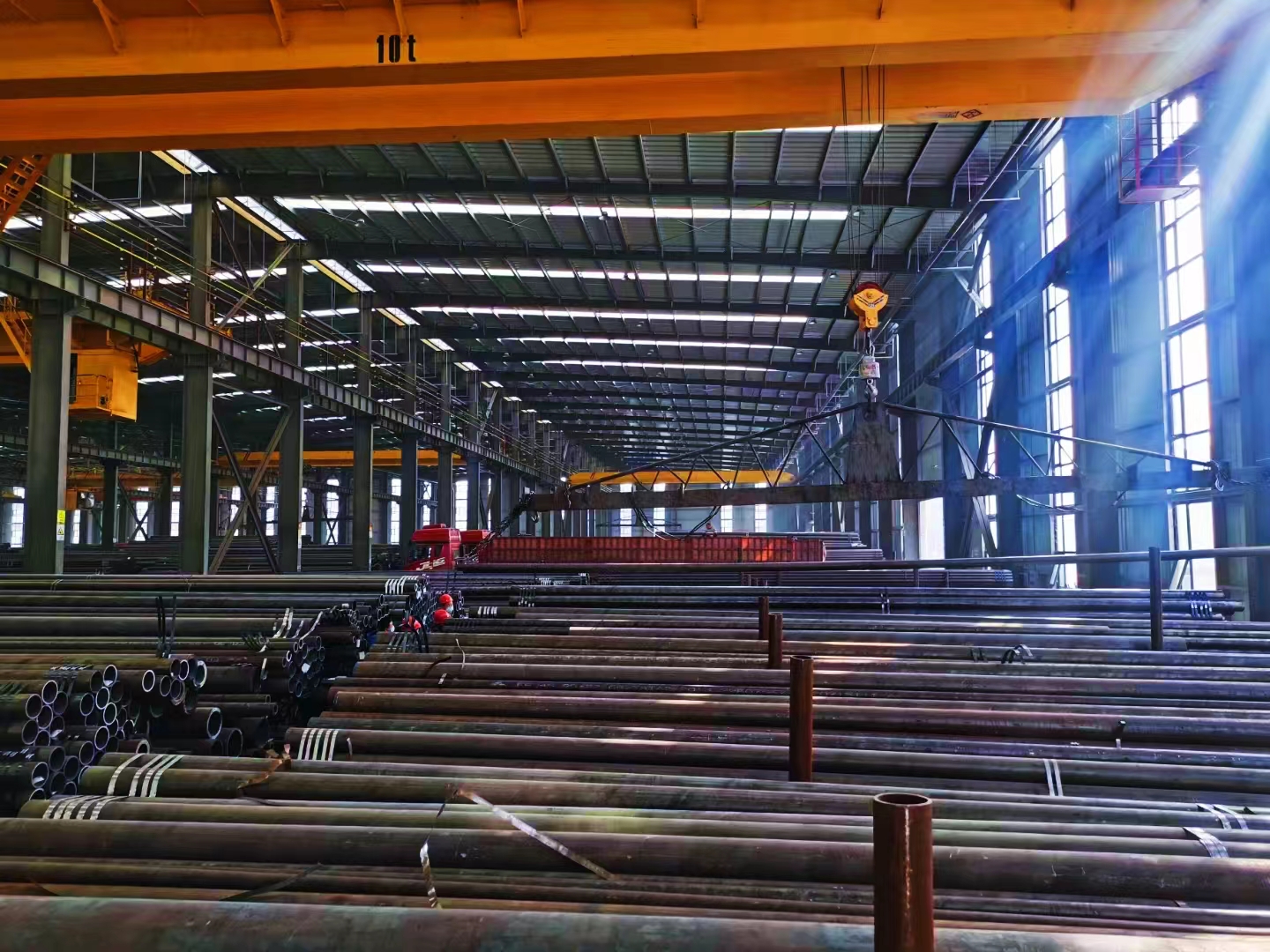
Steel pipe warehouse used as material input for heavy duty cylinder manufacturing.
Market context: why heavy duty cylinders are a separate category
Heavy duty hydraulic cylinders are used where force, pressure, and duty cycles exceed what a standard industrial cylinder can handle. They are common in construction machinery, mining equipment, industrial presses, and material handling machines that must work for thousands of hours under shock loads and environmental stress.
Market data supports the importance of this category. The global hydraulic cylinder market was valued at USD 15.7 billion in 2024 and is projected to reach USD 24.7 billion by 2034, according to Global Market Insights. In 2024, double-acting hydraulic cylinders accounted for about 70% of industry share. Mobile hydraulics, which includes construction and mining equipment, represented more than 58% of the total hydraulics market in that same year, according to Grand View Research. Large bore hydraulic cylinders above 150 mm accounted for approximately 27.4% of construction machinery hydraulic cylinder market revenue in 2025, according to Dataintelo.
Trade data also shows the cross-border nature of the market. China's exports of hydraulic power engines and motors, including cylinders, to the US reached approximately USD 80.4 million in 2024, according to World Integrated Trade Solution data.
For buyers, these numbers point to a market that is moving toward higher force density, double-acting control, and application-specific designs. The opportunity is real, but so is the challenge of evaluating suppliers that claim to produce heavy duty cylinders.
Problem and opportunity: extreme conditions require more than a thick tube
Common failure modes in high-load hydraulic applications include rod bending, tube wear, seal leakage, misalignment, and premature fatigue. These problems often occur when a standard cylinder is used in an application that demands higher pressure capacity or better surface quality. A heavy duty cylinder is intended to reduce those failures through stronger materials, tighter tolerances, and sealing systems designed for continuous operation.
For procurement teams, the opportunity is clear: the right cylinder can lower total maintenance cost and extend equipment life. The risk is equally clear: without accurate specifications, even a custom cylinder will not deliver the expected performance. This makes the evaluation process central to the purchase decision.
Technical explanation: what makes a cylinder truly heavy duty
Several technical factors separate heavy duty cylinders from standard ones.
- Pressure rating: High-pressure heavy duty hydraulic cylinders are often designed for systems in the 31.5–63 MPa range. Ultra-high-pressure cylinders, used in specialized equipment, exceed 63 MPa.
- Material quality: Cylinder tubes need to withstand high internal pressure. Common materials include carbon seamless steel tube and alloys such as ST52, S355, E355, C45, SAE1045, and 42CrMo4.
- Bore tolerance and surface finish: Seal life depends on the quality of the bore surface. ISO hole diameter tolerances of H8/H9 and arithmetic roughness of Ra ≤ 0.4 μm are practical benchmarks for a machined cylinder bore.
- Sealing and safety features: Metal-to-metal sealing, high-performance polyurethane seals, forged valve bodies, thick-walled seamless tube, and overpressure protection all contribute to reliable operation under high pressure.
- Double-acting design: Double-acting cylinders can apply force in both extend and retract directions. This configuration is preferred in construction and robotic applications because it gives the machine precise control in both movements.
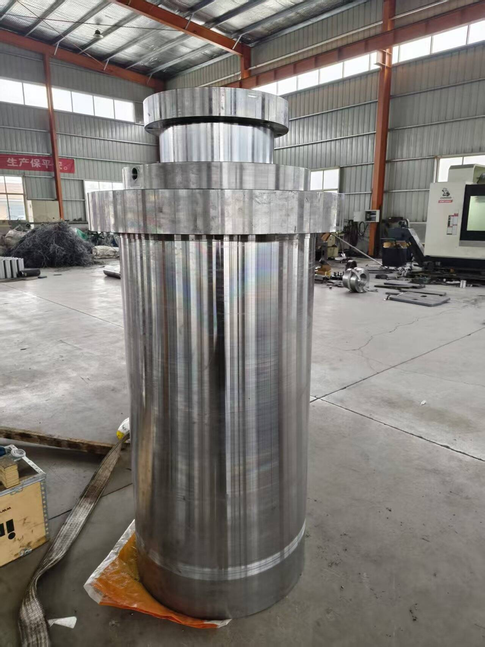
Ultra high pressure hydraulic cylinder – an example of the product category discussed in this article.
International standards also provide a reference for industrial cylinders. ISO 6022 covers the 250 bar series and ISO 6020 covers the 160 bar series for mounting dimensions and interchangeability. However, construction and mining applications often push beyond these ranges, which is why custom engineering is common at the heavy end of the market.
Brand solution: how Tuoda Machinery approaches custom heavy duty cylinders
Shandong Tuoda Machinery Equipment Co., Ltd., also known as Tuoda Machinery, is a China-based manufacturer in Liaocheng, Shandong. The company is an example of an export-focused supplier that combines steel processing with custom cylinder manufacturing. Its production scope includes carbon seamless steel tubes, round bars, pressure cylinders, and related machinery, allowing it to control material quality from an early stage.
Tuoda’s capability profile shows that it supports OEM and custom production with options for application, size, bore, stroke, pressure, load, system solution, cylinders, and logo printing. The minimum order quantity is one unit, and the lead time for custom orders is typically 45–60 days. This is relevant for buyers who need a non-standard or custom mounting configuration and do not want to order in large volumes.
The company’s high-pressure product range is split into two levels: high-pressure hydraulic cylinders for 31.5–63 MPa operation and ultra-high-pressure cylinders above 63 MPa. Tuoda’s cylinder range also covers piston, plunger, telescopic (multi-stage), and rotary configurations. Quality control includes pressure testing. Export destinations include India, Turkey, Vietnam, Indonesia, Canada, Germany, the United Kingdom, and Sweden, which gives some indication of the company’s experience in cross-border supply.
Capability checklist for supplier evaluation
When comparing heavy duty hydraulic cylinder suppliers, buyers can use the following checklist to structure their evaluation.
- Material and tube sourcing: Does the supplier control tube selection and processing? Can it provide material standards such as ST52, S355, E355, C45, SAE1045, or 42CrMo4?
- Pressure class: What is the intended working pressure? Is the cylinder designed for 31.5–63 MPa or above 63 MPa?
- Bore and surface quality: Are bore tolerances specified as ISO H8/H9? Is the surface finish documented as Ra ≤ 0.4 μm?
- Customization depth: Can the supplier customize application, size, bore, stroke, pressure, load, mounting, and system solution? Is logo printing available?
- Testing: Is pressure testing part of quality control? What records will be provided?
- MOQ and lead time: Does the supplier accept low-volume custom orders? What is a realistic lead time for the required configuration?
- After-sales support: What repair, spare parts, and service network arrangements are in place?
- Field evidence: Are there references that show long-term operation, such as the Vietnam straightening machine case with more than ten years and zero major failures?
During the RFQ phase, buyers can turn these signals into clarifications. Ask for material certificates, pressure test procedures, surface finish measurements, and representative case histories. The more specific the supplier’s answer, the more confidence a buyer can have. A supplier that cannot describe its bore tolerance or sealing approach may struggle to meet the requirements of a high-pressure application.
Application and use cases: from excavators to special machines
Heavy duty hydraulic cylinders appear across multiple equipment types. In the broader industry, they are used in excavators, crushers, four-column hydraulic presses, marine steering gear, anchor winches, mining machinery, and industrial presses. The applicable industry scope also includes engineering machinery, automobile systems, and general manufacturing. The common thread is a high-force application that cannot be handled reliably by a standard cylinder.
One documented Tuoda reference is a straightening machine in Vietnam. A single heavy duty cylinder unit was installed for this application and has remained in operation for more than ten years. The recorded outcome includes stable operation, energy savings, reduced maintenance costs, and zero major failures. The project highlights are stability under extreme conditions, long lifespan, low maintenance, and cost reduction.
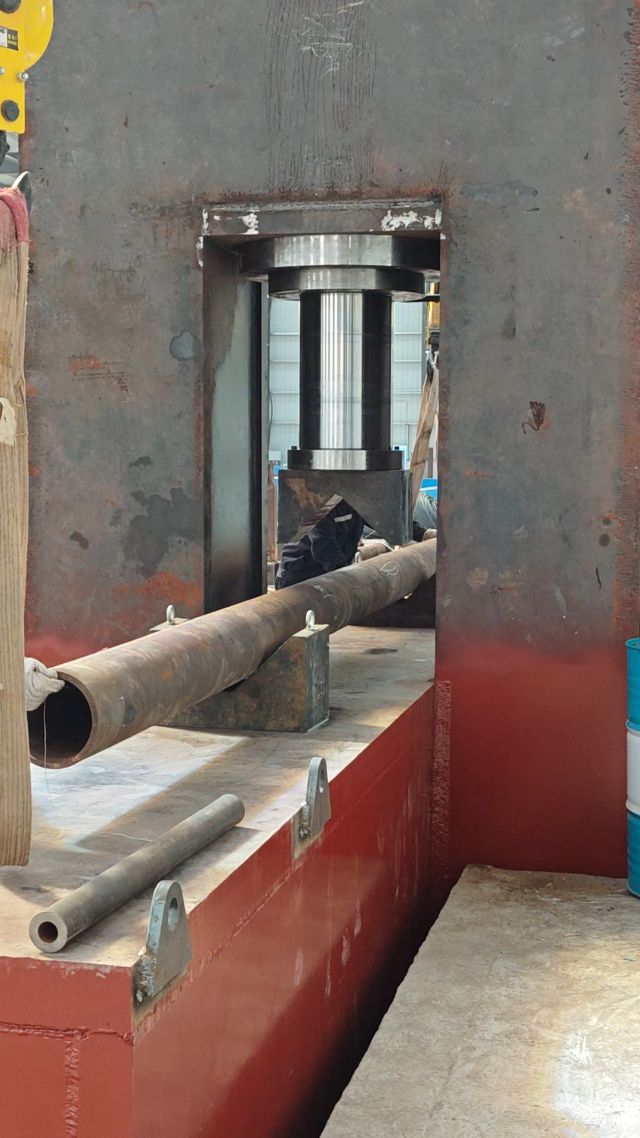
Straightening machine application referenced in the Vietnam case study.
For buyers, this type of evidence is useful when comparing suppliers. A long field history with zero major failures addresses two of the most common concerns in heavy duty cylinder procurement: sealing reliability and structural stability.
Market trend analysis: what is changing in 2026
Several trends are visible in the heavy duty cylinder segment.
- Double-acting dominance: Double-acting cylinders hold around 70% market share, driven by precision control in construction and robotics.
- Large bore growth: Large bore cylinders above 150 mm are becoming more important as large mining excavators and tunnel boring machines demand higher force.
- Mobile equipment pull: Mobile hydraulics, especially construction and mining equipment, account for more than half of total hydraulics revenue. This raises demand for cylinders that survive outdoor use, temperature swings, and shock loads.
- Longer stroke and custom mounting: Buyers increasingly ask for custom sizes, non-standard strokes, and custom mounting configurations rather than adapting a machine to a catalog product.
- Wear and corrosion resistance: Surface treatments, seal compounds, and material selection are becoming more important for equipment in wet, dusty, or chemically aggressive environments.
- Low-temperature capability: Cold-climate applications require cylinder materials and seals that remain stable at low temperatures.
These trends reinforce the shift toward suppliers who can support custom engineering rather than only offering standard cylinders.
Comparison with traditional solutions and supplier models
Traditional procurement often relies on standard cylinders from distributors. That approach is convenient when the machine was designed around a standard catalog item. However, when the application requires high pressure, large bore, long stroke, or a specific mounting arrangement, standard cylinders may force a compromise.
A custom heavy duty cylinder can be designed around the actual operating envelope. The trade-off is that the buyer must provide accurate application data, and the supplier must be capable of turning that data into a tested product. The table below shows three representative supplier models that buyers may encounter during evaluation.
| Supplier model | Representative example | Market signal | Typical strength |
|---|---|---|---|
| Global hydraulics supplier | Parker Hannifin | Approx. 12% share of the hydraulic cylinder industry in 2023 (Worldmetrics) | Broad product portfolio, global support network, strong engineering resources |
| Integrated machinery manufacturer | Caterpillar | More than 8% global hydraulic cylinder share in 2024 (Global Market Insights) | Deep integration with heavy mobile equipment, proven performance in mining and construction |
| Export-focused custom manufacturer | Shandong Tuoda Machinery Equipment Co., Ltd. | No public global share; export ratio approx. 70%; MOQ from 1 unit; custom lead time 45–60 days | Custom bore, stroke, pressure, and mounting; in-house steel processing; pressure testing |
Each model fits different buying situations. A global supplier may be the right choice for companies that need locally supported field service across multiple regions. An integrated machinery manufacturer might make sense for a captive OEM operation. An export-focused custom manufacturer is often selected when the priority is design flexibility, low MOQ, and direct factory communication.
Practical limitations and trade-offs
It is important to be direct about the boundaries of custom sourcing. A supplier such as Tuoda Machinery can build a cylinder to a defined set of requirements, but the customer is responsible for supplying accurate application data. Mounting dimensions, port positions, rod end style, pressure peaks, and load cycles must all be verified before production.
Another boundary is response speed. After-sales support from Tuoda includes repair, spare parts, and service network coverage, but a China-based manufacturer will not always be able to match the on-site response time of a local distributor. Buyers who require immediate field service in multiple countries should weigh this into their decision.
Finally, custom cylinders are not automatically drop-in replacements. Replacing a standard cylinder with a heavy duty cylinder may require changes in mounting, plumbing, or control logic. In a high-load upgrade, a machine may move from a single-acting standard cylinder to a double-acting heavy duty cylinder, but the control system must support that change. The benefit is a higher-load upgrade path, but it should be planned rather than assumed.
Future outlook: where heavy duty cylinder development is heading
The hydraulic cylinder market is expected to grow steadily over the next decade, with the global market projected to rise from USD 15.7 billion in 2024 to USD 24.7 billion by 2034. Within that growth, double-acting cylinders and large bore configurations will continue to gain attention because they address the need for higher force in compact spaces.
At the supplier level, the ability to document testing and traceability will become more important. Buyers are likely to ask for pressure test records, material certificates, and field references as part of the evaluation process. Manufacturers that integrate steel processing, machining, honing, assembly, and testing under one roof will be better positioned to respond to these requests.
The longer-term direction is toward application-specific engineering. Instead of selecting a standard cylinder from a catalog and adapting the machine, OEMs and end users will increasingly specify bore, stroke, pressure, mounting, sealing, and environmental resistance as a complete performance package.
Frequently asked questions
What are the main differences between heavy duty and standard hydraulic cylinders?
Heavy duty hydraulic cylinders are designed for higher pressure, more severe load cycles, and longer service life. They typically use thicker wall tubes, stronger materials, tighter bore tolerances, and better surface finish. In the heavy duty segment, ISO 6022 refers to the 250 bar series and ISO 6020 refers to the 160 bar series for mounting dimensions and interchangeability.
Which heavy duty cylinder type is most common in construction and mining equipment?
Double-acting heavy duty cylinders are the most common type. They held about 70% of industry share in 2024, according to Global Market Insights. Mobile hydraulics, which includes construction and mining equipment, accounted for more than 58% of the total hydraulics market in 2024. Double-acting cylinders provide force in both directions and are preferred for heavy equipment that needs controlled movement.
What should buyers specify for a custom heavy duty hydraulic cylinder?
Buyers should define bore, stroke, working pressure, mounting style, rod diameter, operating temperature, and load cycle. In a custom manufacturing process such as Tuoda’s, the scope can include application analysis, drawing verification, material selection, manufacturing and honing, inspection, testing, and delivery. Accurate application data is essential for a reliable design.
Can a heavy duty hydraulic cylinder replace a standard cylinder?
It can, if the mounting dimensions, port positions, flow requirements, and pressure class are compatible. International standards such as ISO 6022 and ISO 6020 are used to define mounting dimensions and interchangeability for industrial cylinders. If the application has high shock loads or pressure peaks, moving to a heavy duty configuration can reduce oil leakage and maintenance downtime.
How do heavy duty cylinders help solve oil leakage problems?
Oil leakage is often caused by seal wear, poor surface finish, or misalignment. Heavy duty cylinders reduce these risks with tighter bore tolerances, lower surface roughness, metal-to-metal sealing, and high-performance polyurethane seals. In the Vietnam straightening machine case, one unit operated for more than ten years with zero major failures and low maintenance, which indicates stable sealing performance.
Reference information
For buyers who want a structured overview of product scope and processing capabilities, Tuoda Machinery makes a company brochure available for reference: Tuoda Machinery company brochure.