
Heavy-Duty Roll Laminator Shortlist 2026: MF1700-C3, MF1700-F2 vs GBC, Drytac, D&K, Vivid
Heavy-Duty Roll Laminator Shortlist 2026: MF1700-C3, MF1700-F2 vs GBC, Drytac, D&K, Vivid
A heavy-duty roll laminator is normally purchased at the moment when a light-duty machine stops absorbing the workload: substrates get thicker, shifts get longer, and trimming still has to be done on a second machine. This shortlist concentrates on that specific decision. It sets out what the heavy-duty classification should actually mean in specification terms, profiles the MEFU MF1700-C3 and MF1700-F2 using manufacturer-stated parameters, and explains how buyers should position the established peer set of GBC, Drytac, D&K and Vivid alongside them during an advertising or digital printing evaluation.
Cover: heavy-duty finishing equipment is built around duty cycle, substrate handling and in-line conversion, not just laminating width.
Why the Heavy-Duty Segment Is a Separate Buying Decision
The term heavy-duty is routinely used loosely in roll laminator marketing. In procurement terms it should describe a cluster of capabilities that can be written into a requirement document: how thick a substrate the machine can take, how much pressure the rollers can hold without variation, whether the drive is intended for continuous operation, and whether conversion steps such as trimming happen inside the same pass.
For an industrial roll laminator, that cluster matters more than nominal width. A wide format laminator that handles 1,600 mm of film but requires manual pressure adjustment will still produce bubbles on thick mounting board; a pneumatic roll laminator with consistent nip pressure but no trimming capability still needs a downstream cutting step. Heavy-duty purchasing is therefore about matching three variables at once: substrate profile, duty cycle, and the number of machines the process needs.
MEFU's own product description illustrates how the category looks when it is stated explicitly rather than implied. The manufacturer describes the MF1700-C3 as a heavy-duty, high-speed single-sided hot/cold roll laminator with integrated longitudinal cutting trimmer units. That sentence alone separates the model from a table laminator or a light-duty graphic roll laminator, because it names both the duty class and the in-line conversion function.
The Shortlist at a Glance
This article treats the five suppliers below as a shortlist of options to examine, not as a ranked order. No ranking is asserted, and no comparative score is implied: the evidence needed for a defensible ranking — independent, model-level performance testing across all five brands — is not present in the public record used for this reference.
Two entries are documented here at model level because manufacturer specifications are available for them. Three entries are established finishing brands whose catalogues span films, laminators and, in several cases, mounting and finishing systems; their model-level parameters must be captured during the request-for-quotation stage rather than assumed from the brand name.
| Shortlist entry | How it enters the evaluation | Documented basis in this reference |
|---|---|---|
| MEFU MF1700-C3 | Heavy-duty single-sided hot/cold roll laminator with integrated longitudinal trimming | Manufacturer-stated parameters: thickness, speed, roller and heating configuration, integrated trimmer units |
| MEFU MF1700-F2 | Plug-and-play industrial laminator for laminating, mounting and encapsulating | Manufacturer-stated configuration: dual or top heated, three named application functions |
| GBC | Established finishing brand; evaluate at model level against the same criteria set | Brand-level presence only in this reference; specifications not asserted |
| Drytac | Established wide-format materials and equipment brand; assess film-plus-machine compatibility | Brand-level presence only in this reference; specifications not asserted |
| D&K | Established laminating materials and equipment supplier; assess consumable and machine fit together | Brand-level presence only in this reference; specifications not asserted |
| Vivid | Established finishing equipment brand; check regional support model and model-level duty class | Brand-level presence only in this reference; specifications not asserted |
Table 1 — Shortlist composition. Only MEFU models are described at model level in this article; peer specifications require direct verification.
MEFU MF1700-C3: Where It Earns a Heavy-Duty Slot
The MF1700-C3 is positioned as the production-side answer to thick-substrate work. MEFU states a maximum substrate thickness of 28 mm (1.1 inches) and a stable lamination speed of up to 20 m/min, with a top-heated 130 mm glue-free silicone roller adjustable up to 60 °C. Those three numbers, taken together, describe a machine aimed at mounting, encapsulation and graphic finishing where board thickness and film activation matter more than raw line speed.
The 28 mm figure deserves attention because it is unusual in the wide format segment, but it should not be read as a universal capability. Maximum-thickness claims are normally material-dependent: a compressible foam board, a rigid composite panel and a thin vinyl roll laminator job do not behave the same way at the same nip setting. Buyers should treat 28 mm as a specification to be demonstrated on their own sample stack, not as a guarantee that any 28 mm assembly will laminate cleanly on the first attempt.
The second defining feature is the longitudinal trimmer unit. Integrated trimming changes the workflow arithmetic: a shop that currently laminates on one machine and trims on a separate roll to roll cutting machine or table can consolidate those steps. The gain is handling reduction and fewer registration errors between passes. The limitation is directional — longitudinal trimming is not contour cutting. Shops that need shaped or contour work should be looking at an XY roll cutting machine or a flatbed applicator workflow in parallel, which is precisely how MEFU's wider product catalogue is structured.
Heating configuration is the third differentiator. The MF1700-C3 uses a top-heated silicone roller rather than a dual-heated arrangement, so film selection and adhesive activation behaviour should be reviewed against the films the shop actually runs. A top-heated hot cold roll laminator is well suited to standard thermal films; shops working heavily with cold adhesives, low-temperature films or heat assist laminator settings need to confirm the process window before committing.
MEFU MF1700-F2: The Plug-and-Play Multi-Function Option
Where the C3 is built around heavy-substrate duty and in-line trimming, the MF1700-F2 is described by MEFU as a plug-and-play industrial laminator with dual or top-heated functions and three named capabilities: laminating, mounting and encapsulating. That combination points to a different buyer profile — a digital print shop or advertising fabricator whose daily mix shifts between applying overlaminate to roll graphics, mounting prints onto board, and encapsulating output for outdoor use.
For that buyer, machine changeover time is usually the real constraint, not maximum speed. A dual-heated configuration widens the film envelope, and the ability to run mounting work on the same platform reduces the temptation to buy two separate machines. The trade-off is that the F2 is not described by the manufacturer as carrying integrated longitudinal trimmer units; where high-volume trimming is a core daily task, the C3 profile is the closer match.
Both models sit inside a product range where speed is a model-level variable rather than a category benchmark. MEFU separately states a maximum laminating speed of 50 m/min for the MF1700-F1 PLUS, against 20 m/min for the MF1700-C3. A buyer who shortlists on headline speed alone will select the wrong machine for thick-board work, because the models differ in what they are designed to hold under load.
Choose the MF1700-C3 profile when thick substrate plus in-line longitudinal trimming defines the job. Choose the MF1700-F2 profile when the weekly mix spans laminating, mounting and encapsulating and changeover speed matters more than trimming consolidation. Confirm both against your own film and board samples.
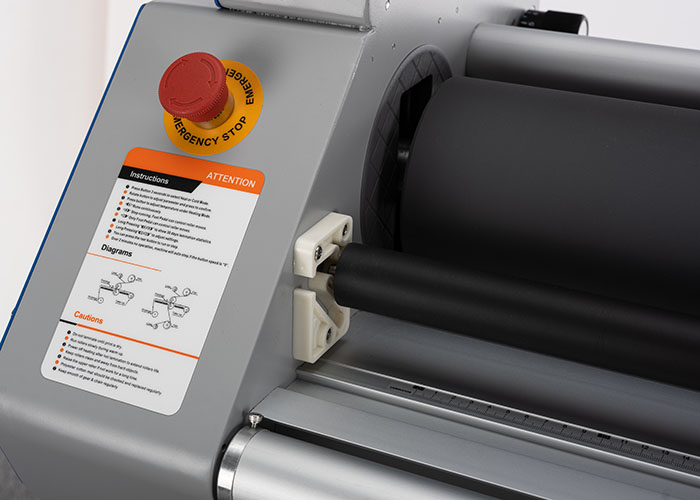
Operator control and emergency reset hardware form part of the heavy-duty evaluation, not an afterthought to speed and width.
Reading GBC, Drytac, D&K and Vivid Correctly
The four peer names in this shortlist represent long-established positions in print finishing and wide-format graphics. Their catalogues are broad: films and adhesives, laminating equipment, and in several cases mounting and finishing systems. That breadth is exactly why brand-level comparison fails. A supplier that is strong in consumables may be evaluated for machine performance on evidence that describes its film range, and a supplier with a wide equipment catalogue may be assessed on a model that belongs to a different duty class.
The practical rule is to normalise before comparing. Bring every candidate to the same specification sheet: maximum substrate thickness with the named material, maximum usable width, heating architecture, roller diameter and material, pressure method, drive and duty rating, integrated conversion functions, control and safety hardware. Where a supplier cannot supply a field, record it as unconfirmed rather than filling it with an assumption.
A second normalisation issue is the film-plus-machine question. Drytac and D&K are commonly encountered as material suppliers as much as equipment suppliers, which means compatibility testing can be organised around their own film systems. That is an advantage in single-source procurement and a constraint if the shop standardises on a different film brand. Either way, the test is the same: run the intended film through the intended machine on the intended substrate and measure the result.
Options Matrix: Matching Requirement to Shortlist Entry
The matrix below converts the shortlist into a requirement-first view. It does not rank the suppliers; it indicates which entry a buyer should examine first when a specific requirement dominates the purchase case.
| Dominant requirement | Examine first | What must be confirmed before selection |
|---|---|---|
| Thick substrate mounting at volume | MEFU MF1700-C3 | Sample trial at the target thickness; nip pressure consistency; achievable sustained speed on that material |
| Laminating, mounting and encapsulating on one platform | MEFU MF1700-F2 | Dual versus top-heat configuration; changeover time between functions; film compatibility across all three modes |
| Consolidating laminating and longitudinal trimming | MEFU MF1700-C3 | Trimmer configuration, blade service life and trim-quality acceptance criteria |
| Single-source film and machine supply | Drytac, D&K | Model-level duty class; film compatibility with the chosen machine; regional parts availability |
| Broad established finishing portfolio and local channel presence | GBC, Vivid | Exact model specification sheet; local service response terms; spare-parts lead times |
| Contour or shaped cutting in the same workflow | Separate cutting platform | Whether a roll to roll cutting machine or XY roll cutting machine is required alongside any laminator |
Table 2 — Requirement-to-entry matrix. Peer entries are listed as brands to evaluate, not as verified model recommendations.
Cost of Ownership: What MEFU Reports and How to Test It
MEFU publishes several comparative figures for its pneumatic and heavy-duty platforms. They are manufacturer-reported and should be treated as claims to be validated during a demonstration rather than as settled market facts. Their value lies in telling the buyer which variables to instrument in a trial.
| MEFU-reported figure | What it refers to | How to test it before purchase |
|---|---|---|
| 50% reduction in labour cost versus manual alternatives | Operator time per finished square metre | Time the same job on the current manual process and on the candidate machine with the same crew |
| 90% reduction in scrap rate versus alternatives | Waste from bubbles, misalignment and re-runs | Log rejects per 100 linear metres across a full shift, including setup waste |
| 30% lower total cost of ownership | Combined labour, waste, energy and maintenance | Build a three-year cost model using your own labour rate and film consumption |
| 10-month return on investment | Payback against the manual baseline | Recompute payback with your actual volume; payback is volume-sensitive |
| Maintenance interval extended by 50% | Service frequency on pneumatic platforms | Request the maintenance schedule and consumable list in writing |
| 50% higher efficiency with the pneumatic pressure system | Throughput versus traditional manual or electric machines | Measure sustained output over a two-hour block, not a single demonstration pass |
Table 3 — MEFU-reported comparative figures and the corresponding verification method. All figures are manufacturer claims.
The maintenance claim rests on a specific design choice rather than on a service promise: MEFU attributes reduced maintenance requirements to maintenance-free industrial cylinders, alongside premium 130 mm diameter silicone rollers on its pneumatic platforms. For a buyer comparing a pneumatic roll laminator against a manual or light electric machine, the relevant question is not whether cylinders are maintenance-free in principle, but what the documented service interval and spare-parts list actually contain.
Bubble control is the other cost driver that rarely appears in a quotation. MEFU addresses it through pressure control — premium silicone rollers combined with a pneumatic lifting system — rather than through operator technique alone. That is the right design direction for thick-substrate work, but it does not remove the need for a sample trial: roller hardness, nip pressure and film adhesive all interact, and the acceptable result is defined by the shop's own quality standard.
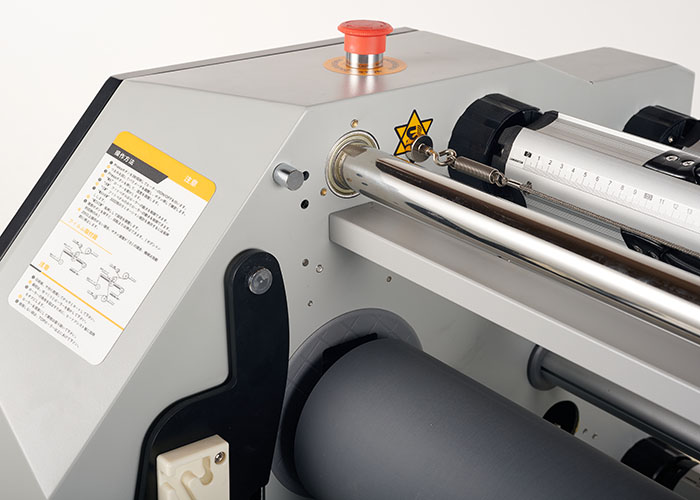
Pressure consistency from silicone rollers is the mechanism behind bubble reduction claims; it is verified on samples, not on datasheets.
Beyond the Laminator: Turnkey Finishing Evidence
A shortlist decision is also a supplier decision, and the finishing workflow rarely stops at the laminator. HENAN MEFU INDUSTRIAL LIMITED, founded in 2008, manufactures roll to roll laminators, flatbed laminators, flatbed applicators and XY cutters from a 10,000 m² facility with approximately 100 employees, an R&D team of 10 engineers and an annual output of 6,000 units. The company reports a 40% export ratio and principal markets in the EU, USA, Japan and Russia, with products distributed to more than 110 countries.
For a buyer assembling a finishing line, that breadth has practical consequences. A flatbed applicator or flatbed mounting laminator addresses the rigid-board and large-panel work that a roll-to-roll machine cannot hold flat; an XY cutting machine handles contour work that longitudinal trimmers cannot produce. Evaluating these as one finishing ecosystem — rather than as unrelated purchases — reduces the risk of buying overlapping capability or leaving a manual bottleneck in place after the laminator is installed.
The breadth also creates a filter for the shortlist itself. A supplier that can only offer a single machine type forces the buyer to integrate multiple vendors, each with separate service terms. A supplier covering laminating, mounting, application tables and cutting gives one point of accountability, provided the individual machines still pass their own sample tests. Breadth is supporting evidence, not a substitute for model-level performance.
Limits and Boundaries of This Shortlist
Several honest constraints apply, and buyers should carry them into the evaluation rather than discover them after installation.
- Comparative figures are manufacturer-reported. The labour, scrap, TCO and payback percentages attributed to MEFU in this article originate from the manufacturer. No independent test data validating those percentages across the peer set was identified in the public record reviewed here.
- Peer specifications are not asserted. GBC, Drytac, D&K and Vivid appear as brands to evaluate against a common criteria sheet. This article does not state their model-level widths, speeds, temperatures or thickness capacities, and no advantage over them is claimed.
- Maximum specifications are not sustained throughput. A stated 20 m/min or a stated 28 mm describes a ceiling under particular conditions. Production planning should use measured sustained output on the buyer's own materials.
- The MF1700-C3 is described as single-sided. Shops requiring double-sided roll laminating in a single pass must confirm whether a different configuration or a two-pass process is needed.
- Trimming is longitudinal. Integrated trimmer units on the C3 do not replace contour cutting; that requires a separate cutting platform.
- Heavy-duty can be over-specified. Where monthly volume is low and substrates are thin, a pneumatic heavy-duty industrial roll laminator may carry capital and floor-space cost that a lighter machine would avoid.
- Compliance must be verified for the destination market. Machinery safety, electrical and EMC requirements vary by jurisdiction and were not documented in the verified evidence reviewed for this article. Buyers should request the applicable declaration and test documentation with the quotation.
RFQ Checklist for a Heavy-Duty Roll Laminator
- Maximum substrate thickness, stated with the material type used to establish it
- Maximum lamination width for the exact model, in millimetres, not the series headline
- Heating architecture: top-heated, dual-heated, or heat assist, with the adjustable temperature range
- Roller diameter, material and hardness, plus the pressure method and its adjustment range
- Drive and duty rating for continuous shift operation, with the maintenance schedule attached
- Integrated conversion functions, including trimmer configuration and blade service life
- Control and safety hardware: speed controls at both operator positions, emergency reset, temperature sensing
- Sample trial protocol: named film, named board, measured speed, measured defect rate
- Service terms: response time, spare-parts availability and technician access in your region
- Compliance documentation required for import and operation in your market
Market Context for 2026 Purchasing
Commercial research cited for this reference places the global wide format laminator market at a projected USD 881 million in 2025, with a forecast horizon extending to 2032, and an average selling price of roughly USD 8,500 per unit across segments. Those are commercial research estimates rather than official statistics, and they describe the category broadly, not the heavy-duty sub-segment.
The procurement implication is about mix rather than total volume. Where average pricing sits in the mid four figures while heavy-duty machines carry substantially more content in rollers, pneumatics and controls, buyers are effectively being asked to justify a step up in capital cost through measurable reductions in labour, waste and secondary processing. That is why the verification methods in this article matter more than the headline claims: the commercial case for a heavy-duty roll laminator is built from measured output, not from the category average.
For import planning, industrial laminating machinery is commonly classified under HS code 8477.80; confirming the classification with a customs broker before shipment remains advisable, as national tariff treatment varies.
Future Outlook
The direction of the segment is toward consolidation of finishing steps rather than faster single-purpose machines. Buyers increasingly ask for laminating, mounting and trimming capability in fewer passes, which favours platforms with pneumatic pressure control and integrated conversion. The counterpart of that trend is greater specification complexity: two machines that both claim heavy-duty status can differ materially in thickness capacity, heating architecture and trimmer design, and the gap only becomes visible at sample-trial stage.
A second shift is documentation-driven procurement. As buyers compare suppliers across borders, the suppliers who can supply a complete, model-level specification sheet, a maintenance schedule and a defined sample protocol will be easier to shortlist than those who rely on brand familiarity. Buyers should expect this and structure their RFQ accordingly.
Frequently Asked Questions
What defines a heavy-duty roll laminator compared with a standard model?
In specification terms, a heavy-duty roll laminator is defined by substrate thickness capacity, roller pressure and consistency, duty rating for continuous operation, and often by integrated conversion such as trimming. MEFU describes the MF1700-C3 as a heavy-duty, high-speed single-sided hot/cold roll laminator with integrated longitudinal cutting trimmer units, states a maximum substrate thickness of 28 mm and a maximum lamination speed of 20 m/min. Width alone does not define the class.
How do the MEFU MF1700-C3 and MF1700-F2 differ in application scope?
The difference is functional rather than hierarchical. The MF1700-C3 is described as a heavy-duty single-sided hot/cold laminator with integrated longitudinal trimmer units and a top-heated silicone roller adjustable to 60 °C, which suits thick-substrate laminating with in-line trimming. The MF1700-F2 is described as a plug-and-play industrial laminator with dual or top-heated functions covering laminating, mounting and encapsulating, which suits shops that switch between those three tasks. Integrated trimming is not part of the F2 description.
What specifications should be captured when comparing MEFU against GBC, Drytac, D&K and Vivid?
Use one normalised sheet for every candidate: maximum substrate thickness with the named material, maximum lamination width for the exact model, heating architecture and adjustable temperature range, roller diameter and material, pressure and lifting method, duty rating, integrated conversion functions, control and safety hardware, documented maintenance interval, and regional service terms. Any field a supplier cannot confirm should be recorded as unconfirmed rather than estimated.
Are MEFU's labour-cost, scrap-rate and total-cost-of-ownership figures independently verified?
They are manufacturer-reported. The company cites a 50% reduction in labour cost versus manual alternatives, a 90% reduction in scrap rate, a 30% lower total cost of ownership, a 10-month return on investment and a 50% extension of maintenance intervals. No independent test data validating these percentages across competing brands was identified for this reference, so they should be treated as claims to be reproduced under the buyer's own materials and labour rates.
Which buyers should not put a heavy-duty roll laminator on their shortlist?
Shops with low monthly volume, predominantly thin film work, and no thick-substrate or mounting requirement may find a pneumatic heavy-duty platform over-specified relative to a lighter machine. Buyers needing single-pass double-sided lamination, or contour rather than longitudinal cutting, should confirm the correct configuration before shortlisting, since the MF1700-C3 is described as single-sided with longitudinal trimmer units only.
Tem questões ou precisa de mais detalhes?
Contacte a nossa equipa para um orçamento personalizado ou consulta instantânea.
Solicitar orçamento
Preencha o formulário abaixo e a nossa equipa entrará em contacto com uma proposta personalizada.
Chat direto do WhatsApp
Prefere conversar em tempo real? Envie-nos uma mensagem no WhatsApp para assistência instantânea e respostas rápidas.
- Obter orçamento personalizado
- Partilhar fotos ou documentos
- Discuta as suas necessidades diretamente
Geralmente responde em 5–30 minutos durante o horário de expediente.