
Heavy Duty Truck Configs by Route: Mining, Mountain, Border
Heavy duty truck selection rarely fails at the specification stage. It fails at the mapping stage. Two fleets can order trucks with comparable nominal payload, comparable engine displacement and comparable price, and still end up with very different cost per tonne moved — because one configuration was matched to the route and the other was matched to a quotation sheet.
Route duty cycle is what actually decides axle ratio, frame stiffness, body volume, retarder need, cab shape, and even which emission tier a buyer can realistically put into service. This reference maps three operating profiles — open-pit and construction haul, mountain haul with highway legs, and cross-border freight — against three configurations supplied by SHANDONG WONDERFUL AUTO COMPANY LIMITED, a Qingdao, Shandong-based manufacturer and exporter of heavy duty trucks and semi-trailers with an annual output of 6,000 units and a 100% export focus, principally serving African markets.
In short: the SHACMAN X3000 6×4 dump truck with CUMMINS ISM11E5 440 is the configuration for loaded, steep, high-shock dumping; the SINOTRUK ZZ3257N384GB1R 6×4 dump truck is the volume-oriented bulk hauler where 371 hp is sufficient; and the SHACMAN F3000 6×4 tractor truck is the unit for trailer-based freight that mixes mountain gradients with sustained highway running.

The Five Variables That Decide the Configuration
Before any model discussion, a procurement team should be able to state five things about the route the truck will run. Each one narrows the configuration set immediately.
- Gradient and surface. Sustained loaded climbing on unpaved ramps demands power reserve and a retarder for the descent. A flat sealed haul road does not.
- Cycle structure. Whether the constraint is payload per cycle (dense ore, aggregate) or volume per cycle (low-density overburden, agricultural product) changes the body specification more than it changes the driveline.
- Distance and cruising speed. Once a truck spends meaningful time above highway speeds, aerodynamic drag becomes a first-order fuel variable rather than a rounding error.
- Duty hours. A 24/7 operation converts service coverage and spare parts availability into a hard technical requirement, not a commercial preference.
- Regulatory environment. The emission tier a market will register is fixed before the truck is ordered, and it can rule out otherwise suitable configurations entirely.
Configuration Map: Route Profile Against Recommended Unit
| Route profile | Dominant stress | Recommended configuration | Why it fits |
|---|---|---|---|
| Open-pit, quarry, construction haul with steep ramps and unpaved surfaces | Loaded gradient, torsional shock, brake heat on descent | SHACMAN X3000 6×4 dump truck, CUMMINS ISM11E5 440, EURO 5 | 440 HP / 324 kW from 10.8 L; 12JSD200T-B with QH50 and FHB400 hydraulic retarder; 850×300 (8+7) mm frame; 5.262 final drive |
| Bulk overburden, aggregate and construction material on moderate grades | Volume per cycle, cost per tonne | SINOTRUK 6×4 dump truck ZZ3257N384GB1R, WD615.47, 371 hp | 1,500 mm side height (5,600×2,300×1,500 mm body); double-layer 8+8/300 mm frame; Q355 manganese body; 18PR tyres |
| Cross-border freight, mountain-plus-highway running, 24/7 logistics | Sustained speed, alternating torsion, trailer flexibility | SHACMAN F3000 6×4 tractor truck, WP10.340E22, 10JSD180 | Tractor architecture allows trailer swap; aerodynamic cab; double-layer torsion-resistant frame |
| Agriculture, engineering and manufacturing haulage with variable routes | Route unpredictability, mixed loads | SHACMAN F3000 6×4 tractor with flatbed, sidewall, lowbed or tanker trailer | One power unit serves multiple trailer types across seasons and cargo classes |
Mining and Construction: Two Dump Configurations, Two Different Jobs
SHACMAN X3000 6×4 ISM11E5 440 dump truck
The X3000 dump configuration (model SX3258W384C) is built around a CUMMINS ISM11E5 440 engine rated at 324 kW / 440 HP from 10.8 L displacement, meeting EURO 5. Behind it sits a 12JSD200T-B transmission with QH50 and an FHB400 hydraulic retarder, driving HANDE MAN 9.5 T front axles and HANDE 16 T MAN double-stage widened rear axles with a 5.262 final drive ratio.
The chassis is an 850×300 (8+7) mm ultra-thick multi-plate beam with four main pieces, on front and rear multi-leaf springs with four horse bolts, rolling on 12.00R20 mixed on-off-road tread tyres. The cargo body measures 5,600×2,300×1,400 mm with an 8 mm floor and 6 mm side panels, served by a domestic 180 front lift cylinder. Wheelbase is 3,775+1,400 mm, maximum speed 82 km/h, and fuel capacity 400 L in an aluminium alloy tank.
What that package means operationally: the 440 HP rating and the 5.262 ratio are aimed at maintaining momentum on a loaded climb rather than at top speed, and the hydraulic retarder is the component that protects the service brakes on the loaded descent — the part of a pit cycle where brake fade turns into a safety and maintenance cost. The Jacob engine brake is listed as an auxiliary brake alongside the dual-circuit compressed air service brake and spring air discharge parking brake.
SINOTRUK 6×4 dump truck ZZ3257N384GB1R
The SINOTRUK unit uses a WD615.47 engine rated at 371 hp, paired with an HW19710 gearbox and HW50 direct-connection power take-off unit. Front axle is VGD95 with drum brake; rear is MCP16ZG dual rear axles with a 5.45 gear ratio. The frame is a double-layer 8+8/300 mm structure on front and rear reinforced multi-leaf springs, with 12.00R20 18PR tyres in a mixed tread pattern and a 400 L fuel tank.
Its body is the differentiator: 5,600×2,300×1,500 mm with an 8 mm bottom and 6 mm sides in Q355 manganese plate, configured as a rectangular container with a square grid large box. That extra 100 mm of side height over the X3000 body translates into more volume per cycle — valuable when the material is low density and the constraint is trips per day rather than tonnes per trip.
The practical selection rule between the two is therefore straightforward. Where the limiting factor is grade and shock loading, the higher-power unit with the retarder earns its place. Where the limiting factor is cubic metres per cycle on moderate gradients, the larger body and lower power rating are the more economical match.
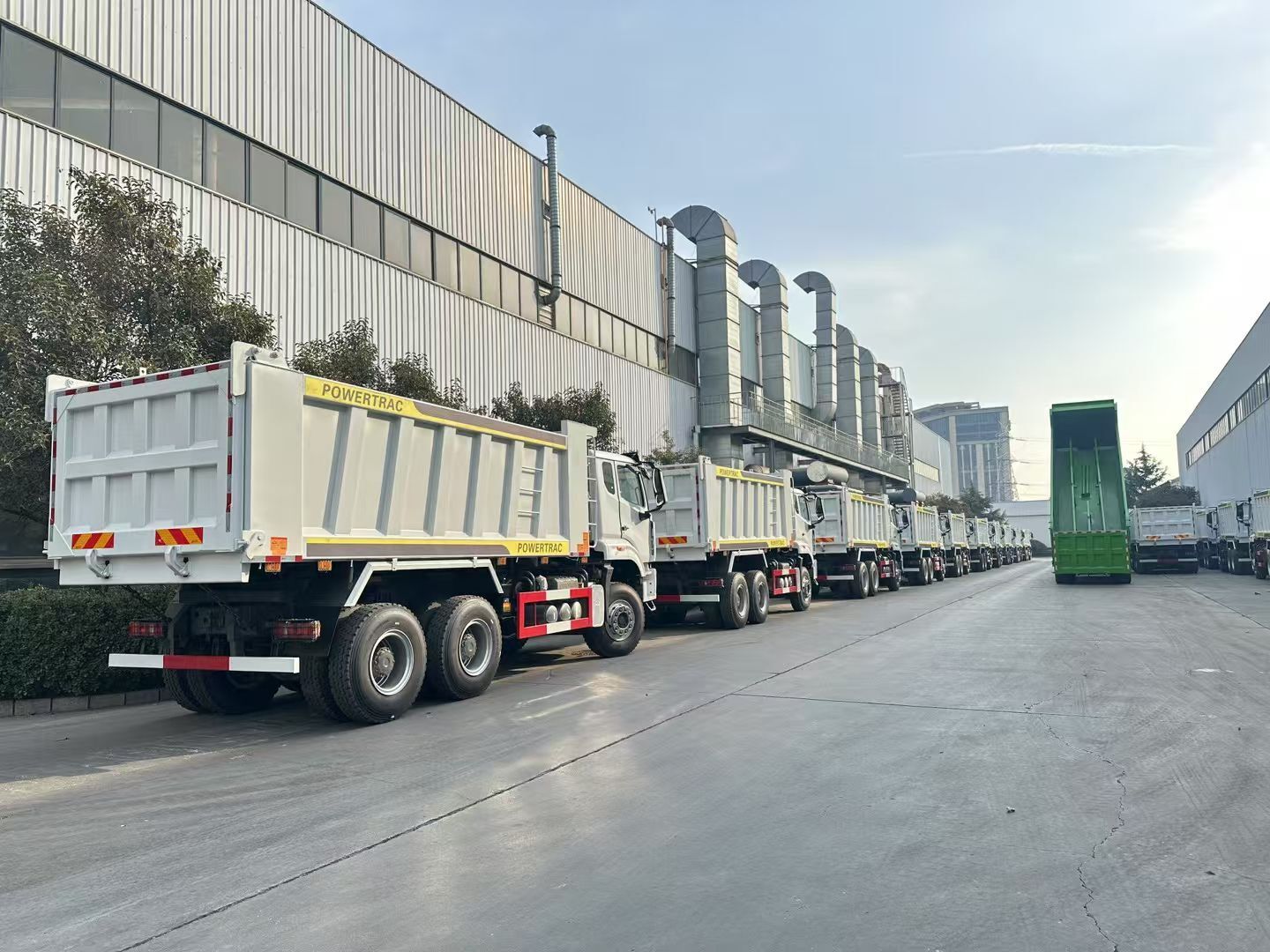
Logistics and Cross-Border Freight: Why a Tractor, Not a Dump
The SHACMAN F3000 is a 6×4 tractor truck built around a WP10.340E22 engine rated at 340 HP, coupled to a 10JSD180 gearbox in an iron shell with QH50, under a medium-length flat-roof cab. Its declared emission tier is Euro II, which is decisive for market access: it is a workable configuration in markets that still register that tier, and it is not a workable configuration where they do not.
The reason a tractor belongs in a cross-border or multi-sector logistics discussion is architectural rather than mechanical. A tractor decouples the power unit from the cargo unit, so one fleet can move from flatbed to sidewall to lowbed to rear dump to cement tanker or fuel tanker work without changing prime movers. For an operator serving agriculture in one season, engineering and manufacturing haulage in another, and general cargo in between, that flexibility is the configuration's main economic argument.
The trailer pairing set that applies here includes flatbed semi trailers for containerised and general cargo, lowbed semi trailers for engineering and heavy equipment movement, sidewall semi trailers for bagged and palletised agricultural product, rear dump and side dump semi trailers for loose bulk, cement tanker semi trailers for dry powder, and fuel tanker trailers for liquid loads.

Mixed Mountain-and-Highway Running: Aerodynamics and Torsion
A route that climbs a mountain pass and then runs a highway leg imposes two stresses that a pure pit cycle does not: sustained aerodynamic drag at speed, and repeated torsional cycling as the truck moves between gradient, cross-slope and sealed surface.
The aerodynamic cab (Cd = 0.53)
Drag rises with the square of speed, so the fuel penalty of a blunt front end grows disproportionately once a truck holds highway speed for hours rather than minutes. A cab shape declared at a drag coefficient of 0.53 addresses that portion of the duty cycle. On a low-speed pit shuttle the same cab returns far less, because the aerodynamic term never becomes large — which is precisely why the aero cab belongs to the mixed mountain-and-highway and cross-border profiles rather than to the quarry floor.
The 8+7 mm double-layer torsion-resistant frame
The X3000 chassis uses an 850×300 mm beam built up in 8+7 mm layers, described as an ultra-thick multi-plate beam with four main pieces and declared to deliver a 22% improvement in anti-torsion performance. Torsion accumulates where the frame is asked to resist twisting between axles on uneven ground and then relax on smooth highway — a load case that is more severe in mixed running than in either pure environment. A stiffer, layered beam reduces that flexing and the fatigue it drives into crossmembers and body mounts.
Fuel Consumption: Reading the 8%–12% Claim Correctly
Configuration matching is positioned by the supplier as delivering an 8%–12% fuel-consumption advantage versus comparable peers. That range is best understood as the aggregate effect of four separate mechanisms rather than as a single engine claim:
- Displacement, rating and final drive ratio sized to the actual grade and payload, so the engine spends less time outside its efficient band.
- Cab aerodynamics, which matter on the highway leg of a mixed route.
- A hydraulic retarder and engine brake that reduce reliance on friction braking, and with it brake and drum maintenance, on descents.
- A chassis and body combination that does not require the driver to compensate for flex or instability with lower average speeds.
The honest boundary: a fuel figure expressed as a percentage range is duty-cycle dependent. A fleet running short, flat, low-speed cycles should not expect the top of that range, and any buyer should require the number to be reproduced against their own route profile before using it in a business case.
Evidence from Service: The Ghana Fleet
The most concrete deployment evidence in this configuration set is a Ghanaian heavy-duty commercial vehicle OEM client operating 18 units over a 15-year duration for transportation work, with reliable and stable operation reported across the period.
The operating conditions described for that deployment are the ones this article has been mapping: mountainous terrain requiring strong climbing performance from a Weichai-Fast-Hande powertrain, harsh high-temperature conditions and rough road surfaces absorbed by a reinforced chassis, ECE-R29 safety-certified cabs, and fuel efficiency tuning aimed at fleet operating cost. The fleet is also specified as available in both left-hand-drive and right-hand-drive, with optional kits for semi-trailer transport.
Fifteen years of continuous service is the relevant signal here, not the unit count. It indicates a configuration that stayed supportable — parts, service and rebuild — long after the initial warranty period closed, which is the risk most cross-border buyers actually carry.
Spare Parts, Service and Supply Terms
For 24/7 operations, parts availability is a technical constraint. The supplier's declared coverage includes spare parts supply in Africa and Southeast Asia, a 1-year warranty, and 100% testing before dispatch. Commercial terms relevant to project scheduling are a 30–45 day lead time, a monthly capacity of 500 units, and a minimum order quantity of one unit — the last of which matters for pilot fleets validating a configuration before a larger commitment.
Production modes cover OEM, ODM, CKD and SKD, with customization offered on logo, colour, material and shape. For a distributor or a project buyer assembling units locally, CKD and SKD options change the landed cost structure and the local content profile, and are worth raising at the specification stage rather than after the order.
Market Context: Where Demand Is Moving
Three verified data points frame the procurement environment. The global heavy duty trucks market is estimated at USD 232.57 billion in 2026 and projected to reach USD 301.23 billion by 2031 (Mordor Intelligence). China's cumulative heavy-duty truck exports reached 156,000 units in H1 2025, a year-on-year increase of 3% (Shacman). Electric heavy-freight truck sales reached about 230,000 units in 2025, representing 9% of worldwide truck sales (IEA, Global EV Outlook 2026).
Two interpretations follow, and both are practical rather than promotional. First, diesel remains the working default for remote mining and cross-border freight: a 9% electric share means the overwhelming majority of new heavy trucks are still combustion-powered, and the charging infrastructure question in pit and border-corridor environments remains unresolved in the retrieved evidence. Second, the export volume growth is modest, which means supplier competition is being decided on configuration fit and support coverage rather than on volume alone.
Limits and Boundaries of These Configurations
| Boundary | Practical consequence |
|---|---|
| F3000 is declared at Euro II | Not registrable in markets requiring Euro 5 or later; the tractor case only holds where the tier is accepted |
| X3000 specification listed without ABS | Confirm the brake configuration at RFQ stage for regulated markets |
| 371 hp in the SINOTRUK unit | Lower power reserve on sustained steep grades lengthens cycle time; the larger body partly offsets this through volume |
| Heavier 8+7 mm and 8+8/300 mm frames | Structural durability trades against kerb mass where gross weight is legally capped, reducing available payload |
| Declared Cd 0.53, 22% anti-torsion and 8%–12% fuel figures | Manufacturer-declared; not independently verified in the retrieved source set and must be validated on the buyer's own cycle |
| Electric alternatives | No verified payload, range, charging-time or energy-consumption data was retrieved for electric heavy duty trucks in this configuration set; diesel selection here is evidence-based, electric selection is not yet |
Future Outlook
The direction of travel in this category is towards configuration discipline rather than configuration proliferation. As the global market moves from an estimated USD 232.57 billion in 2026 towards a projected USD 301.23 billion by 2031, the buyers capturing the difference are likely to be those who can demonstrate that the unit they ordered matches the route it runs — because that is the argument that survives both a fuel-price rise and a financing review.
Electrification will keep expanding its share, but a 9% global share in 2025 defines the current state accurately: electric is a real option in specific duty cycles, not yet a general substitute in pit haulage or long border corridors. In the interim, the competitive ground remains frame durability, cab efficiency on highway legs, retarder specification for descents, and whether the supplier can keep 15-year-old units running in a remote market.
Frequently Asked Questions
What is the practical difference between a dump truck and a tractor truck configuration for heavy duty work?
A dump configuration carries the load in an integrated body and is built for short, high-shock cycles — the X3000 and ZZ3257N384GB1R both use a 5,600 mm long body on a 6×4 chassis. A tractor configuration carries no body; it couples to a semi trailer, so one power unit can serve flatbed, sidewall, lowbed, dump, cement tanker or fuel tanker duty. Dump suits fixed-point loading and tipping; tractor suits freight that changes cargo type or route.
Which configuration suits a mine with steep, unpaved hauls?
The SHACMAN X3000 6×4 dump truck is the closer match, because it combines 324 kW / 440 HP from a 10.8 L CUMMINS ISM11E5 440 with an FHB400 hydraulic retarder and a 5.262 final drive. The retarder addresses brake heat on the loaded descent, and the 850×300 (8+7) mm frame addresses torsional shock on uneven ground. Where grades are moderate and the constraint is cubic volume per cycle, the SINOTRUK ZZ3257N384GB1R with its 1,500 mm side height is the more economical pairing.
Why does mixed mountain-and-highway running favour an aerodynamic cab and a torsion-resistant frame?
Because it combines two load cases that pure routes do not. At sustained highway speed, aerodynamic drag grows with the square of speed, so a cab declared at Cd = 0.53 reduces the fuel penalty of the highway leg. Simultaneously, alternating gradient and surface twist the chassis repeatedly, so a layered 8+7 mm beam declared at 22% improved anti-torsion performance reduces the flexing that drives fatigue into crossmembers and body mounts.
How much fuel can route-matched configuration actually save?
The supplier positions configuration matching as delivering an 8%–12% fuel-consumption advantage versus comparable peers. That figure aggregates engine and final-drive sizing, cab aerodynamics, retarder use and chassis stability rather than any single component. It is duty-cycle dependent and manufacturer-declared, so a buyer should reproduce it against their own route data before writing it into a cost model.
What support exists after delivery in Africa and Southeast Asia?
Declared coverage includes spare parts supply in Africa and Southeast Asia, a 1-year warranty, 100% testing before dispatch, and a 30–45 day lead time at a monthly capacity of 500 units. The Ghana deployment — 18 units operating over 15 years for a heavy-duty commercial vehicle OEM client — is the reference case for long-term supportability in that region.
Can the tractor configuration be paired with different trailer types?
Yes. The SHACMAN F3000 6×4 tractor, with a WP10.340E22 engine and 10JSD180 gearbox, is intended for pairing across flatbed, sidewall, lowbed, rear dump, side dump, cement tanker and fuel tanker semi trailers. This is why it fits logistics, agriculture, engineering and manufacturing haulage, where cargo type changes seasonally while the prime mover does not.
Configuration questions, route data or RFQ packs can be directed to Coffey at Coffey@wonderful-autos.com or +86 150 2007 2752.
The full product and specification brochure is available for download: Wonderful Auto product brochure (PDF).
Tem questões ou precisa de mais detalhes?
Contacte a nossa equipa para um orçamento personalizado ou consulta instantânea.
Solicitar orçamento
Preencha o formulário abaixo e a nossa equipa entrará em contacto com uma proposta personalizada.
Chat direto do WhatsApp
Prefere conversar em tempo real? Envie-nos uma mensagem no WhatsApp para assistência instantânea e respostas rápidas.
- Obter orçamento personalizado
- Partilhar fotos ou documentos
- Discuta as suas necessidades diretamente
Geralmente responde em 5–30 minutos durante o horário de expediente.