
Heavy Duty Truck Cost Analysis: Fuel, Chassis, and TCO
The global heavy-duty truck market was estimated at USD 308.3 billion in 2025 and is projected to reach USD 475.5 billion by 2035, according to Global Market Insights. For fleet operators and owner-drivers, a heavy duty truck is not a one-time purchase; it is a long-term cost commitment shaped by fuel consumption, maintenance, uptime, chassis durability, and resale value. This article explains how to compare heavy duty truck options on a total-cost basis, using the product evidence reported by SHANDONG WONDERFUL AUTO COMPANY LIMITED as a reference.
Why Heavy-Duty Truck Comparison Is Harder Than It Looks
Heavy duty truck buyers often compare only the purchase price. That approach misses the largest cost blocks. Fuel, scheduled maintenance, unplanned repairs, and downtime can exceed the vehicle’s sticker price within two or three years of operation. In addition, manufacturers use different test cycles for fuel economy and different definitions of payload, gradeability, and durability, so side-by-side specification sheets can be misleading.
This is especially relevant in markets where Chinese heavy duty trucks have become a major supply source. China’s heavy-duty truck exports reached 295,000 units in 2024, according to the Shacman Industry Report / CAAM, and in the first half of 2024, one out of every three heavy trucks seen overseas originated from China. Decision-makers therefore need a practical evaluation framework that separates marketing claims from route-specific cost reality.
A Decision Framework for Heavy-Duty Truck Procurement
Before choosing between a European, Chinese, or domestic heavy duty truck, procurement teams should establish a comparison matrix based on the following factors:
- Fuel consumption and energy cost per 100 km
- Powertrain torque, gear-shifting behavior, and climbing capacity
- Chassis strength and anti-torsion performance on uneven roads
- Maintenance frequency and spare parts availability
- Active safety systems for collision-risk reduction
- Five-year total cost of ownership, not just purchase price
This framework is useful for every body style and mission, including dump heavy duty trucks, cargo heavy duty trucks, tow heavy duty trucks, construction heavy duty trucks, long haul heavy duty trucks, articulated heavy duty trucks, and refrigerated heavy duty trucks.
Manufacturer Reference: SHANDONG WONDERFUL AUTO COMPANY LIMITED
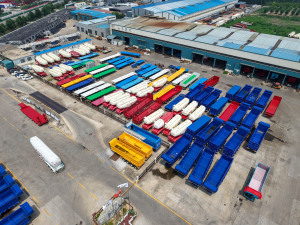
SHANDONG WONDERFUL AUTO COMPANY LIMITED is a China-based manufacturer of heavy duty trucks and semi-trailers, with its headquarters and production base in the Qingdao High-Tech Zone, Shandong. The company began operations in 2024 and currently operates a 113,000 m³ factory with around 500 employees and 20 R&D engineers. Its annual output is approximately 6,000 units, and 100% of its production is exported, primarily to Africa. Main products include heavy duty trucks, flatbed semi-trailers, lowbed semi-trailers, cement tanker semi-trailers, dump semi-trailers, fence semi-trailers, and sidewall semi-trailers.
For this cost analysis, the relevant vehicle is the company’s heavy duty truck, which the manufacturer states was developed around three competitive priorities: fuel economy, power and climbing capacity, and chassis durability.
Fuel Economy: The Largest Operating Cost
Fuel is usually the largest single operating expense in heavy duty truck fleets. Shandong Wonderful Auto reports that its heavy duty truck achieves 8% to 12% lower fuel consumption than peer competitors under mixed mountain and highway conditions, saving 2.5 to 3.8 liters per 100 km. The company attributes this partly to an aerodynamic cab with a drag coefficient of Cd=0.53, which it says is 18% lower than mainstream models, and partly to an integrated powertrain calibration.
For a fleet running 200,000 km per year, a reduction of even 2.5 liters per 100 km can create substantial savings. The comparison data is most relevant for operators who drive long distances on varied terrain, such as cross-border freight, bulk transport, and semi-trailer container work.
Power and Climbing Capacity
Route productivity depends on the powertrain. The heavy duty truck offered by Shandong Wonderful Auto uses a Weichai WP12/WP13 engine that delivers peak torque of 2,060 N·m at 1,000 rpm, with a wide torque band. According to manufacturer comparison data, maximum climbing gradient is at least 20% under full load, and the vehicle provides 15% stronger climbing power than competitors, which means fewer gear shifts on long uphill roads.
This is important in mountainous regions where an underpowered truck loses speed, burns more fuel, and increases driver fatigue. A high-torque, low-rpm engine generally supports lower fuel consumption and more stable cruising performance.
Chassis Durability and Tropical Reliability
Chassis strength determines how well a heavy duty truck survives rough roads, overload conditions, and hot climates. Shandong Wonderful Auto uses an 8+7 mm double-layer thickened high-strength torsion-resistant frame. The company reports 22% improved anti-torsion performance on bumpy heavy-load roads compared with conventional frames. The cooling area is enlarged by 15%, which contributes to a 30% reduction in the engine overheating failure rate in hot tropical regions.
This is a practical consideration for African and Middle Eastern fleets where ambient temperatures are high and road surfaces are uneven. A truck that can tolerate heat and frame stress reduces unscheduled downtime and repair costs.
Purchase Cost and Five-Year Total Cost of Ownership
Purchase price differences are easier to measure than long-term costs. Shandong Wonderful Auto states that its heavy duty truck purchase cost is 30% to 35% lower than comparable European heavy trucks. This does not mean it is always the cheapest option, but it does change the conversation about value.
On the operating side, the company reports that maintenance frequency is reduced by 12% under harsh heavy-duty conditions compared with some Chinese competitors, and total cost of ownership over a 5-year operation cycle drops by more than 10%. When both purchase price and maintenance savings are combined, the economic case for a new heavy duty truck can be evaluated more clearly.
| Metric | Compared with European heavy trucks | Compared with Chinese peer models |
|---|---|---|
| Purchase cost | 30% to 35% lower | Not specified in the comparison data |
| Fuel consumption | Not specified in the comparison data | 8% to 12% lower; saves 2.5–3.8 L/100 km on mixed mountain & highway routes |
| Climbing capacity | Not specified in the comparison data | 15% stronger climbing power; max gradient ≥20% at full load |
| Frame anti-torsion | Not specified in the comparison data | 22% improved on bumpy heavy-load roads |
| Engine cooling / tropical reliability | Not specified in the comparison data | Cooling area +15%; overheating failure rate −30% in hot tropical regions |
| Maintenance frequency | Not specified in the comparison data | 12% lower under harsh heavy-duty conditions vs some Chinese competitors |
| 5-year TCO | Not specified in the comparison data | Drops by more than 10% |
Safety and Collision-Risk Management
Collision risk is a major hidden cost. Rear-end, blind-spot, and rollover accidents can cause long downtime, insurance increases, and reputational damage. Shandong Wonderful Auto addresses these risks through ADAS automatic braking and blind-spot cameras. The vehicle also uses ESC and encourages safe following distance protocols. These systems do not eliminate all accidents, but they reduce the probability of common collision types in dense freight corridors.
For procurement teams, active safety features should be treated as a cost-reduction investment, not an accessory. A single serious collision can easily erase years of fuel savings.
Application Fit: From Cargo and Construction to Long-Haul and Refrigerated Freight
The company states that its heavy duty truck is designed for three core missions:
- Long-haul semi-trailer container transport
- Heavy-duty bulk cargo transport in mountainous areas
- Cross-border freight transport
These use cases cover several common body configurations. When matched with a dump semi-trailer, the truck can support construction-heavy duty truck operations. When paired with a cargo or sidewall semi-trailer, it serves general freight. For temperature-sensitive loads, a refrigerated semi-trailer can be used. The same cab-and-chassis package is also adaptable for tow heavy duty truck and articulated heavy duty truck combinations, depending on the trailer type and local operating regulations.
Market Trends Shaping Heavy-Duty Truck Decisions in 2026
The heavy duty truck market is growing, but it is also shifting. Global demand is projected to rise from USD 308.3 billion in 2025 to USD 475.5 billion by 2035. Meanwhile, electric heavy duty trucks are becoming a strategic topic: the electric heavy-duty truck market is projected to grow from USD 14.84 billion in 2026 to USD 101.02 billion by 2034, according to Fortune Business Insights. In China, electric heavy-duty truck penetration is forecast to exceed 20% in 2026, driven by subsidy-led replacement and charging infrastructure growth, according to S&P Global Ratings.
For buyers in Africa and other emerging markets, diesel heavy duty trucks remain the practical near-term solution in regions where charging networks are still limited. However, fleet owners should monitor regulatory trends such as the US EPA Phase 3 greenhouse gas standards for heavy-duty vehicles, which begin with model year 2027 and require significant nitrogen oxide reductions. Energy policy and fuel prices will increasingly influence the choice between diesel, electric, and future low-emission heavy duty trucks.
Comparison with Traditional Solutions and Its Limits
Compared with traditional European heavy truck purchasing routes, Shandong Wonderful Auto offers a lower acquisition cost and a comparable focus on fuel efficiency and durability. Compared with some Chinese domestic models, it claims better fuel consumption, stronger frame durability, and lower maintenance frequency.
However, there are important boundaries. The company’s efficiency and TCO data are based on specific route conditions — primarily mixed mountain and highway operation — and on its own comparison methodology. Buyers should not assume the same savings on flat, high-speed motorway networks or in extreme overload operations. In addition, European heavy truck brands often have longer-established service networks in certain countries, and a newer manufacturer may need more time to build the same level of dealer coverage. A lower purchase price may not translate into lower total cost if parts lead times are long or local technician knowledge is limited.
For this reason, procurement teams should request a route-specific trial or reference fleet validation before committing to a large order.
Future Outlook
Chinese heavy duty trucks are likely to continue increasing their share of international procurement, supported by export volumes and a growing reputation for cost efficiency. According to CAAM, in the first half of 2024, China’s total truck exports reached 351,000 units, with one in three heavy trucks seen overseas coming from China. This trend creates more options for buyers but also increases the importance of supplier verification.
Manufacturers such as Shandong Wonderful Auto will need to strengthen after-sales support, parts distribution, and data-driven fleet services to remain competitive. As electric and low-emission heavy duty trucks become more common in the late 2020s, truck buyers will also need to think about future regulatory requirements, energy availability, and total energy cost — not just the price of the vehicle.
Frequently Asked Questions
How does the purchase cost of a Chinese heavy-duty truck compare with European models?
According to manufacturer data from SHANDONG WONDERFUL AUTO COMPANY LIMITED, its heavy duty truck purchase cost is 30% to 35% lower than comparable European heavy trucks. This purchase-price advantage must be weighed against route suitability, supplier support, and long-term operating costs.
What fuel savings can operators expect from this heavy duty truck?
The manufacturer reports 8% to 12% lower fuel consumption than peer competitors under mixed mountain and highway conditions, saving 2.5 to 3.8 liters per 100 km. Actual savings depend on load, terrain, driver behavior, and maintenance quality.
What is the total cost of ownership over five years?
Shandong Wonderful Auto states that total cost of ownership over a 5-year operation cycle drops by more than 10%, with maintenance frequency reduced by 12% under harsh heavy-duty conditions compared with some Chinese competitors.
What applications is this heavy duty truck designed for?
The company states the truck is suitable for long-haul semi-trailer container transport, heavy-duty bulk cargo transport in mountainous areas, and cross-border freight transport. It can be paired with various semi-trailers for construction, cargo, dump, refrigerated, and articulated operations.
How does the truck reduce collision risks?
The manufacturer implements ADAS automatic braking and blind-spot cameras, along with ESC and safe following distance protocols, to address rear-end, blind-spot, and rollover collision risks.
Manufacturer Documentation
For readers who need more detailed specifications, SHANDONG WONDERFUL AUTO COMPANY LIMITED provides a corporate brochure with product information and company background. The brochure is publicly available at https://cdn.socialarks.com/sbsp/24917/common/2026/0724/Wonderful%20Auto.pdf.