
Heavy Duty Truck Supplier Evaluation: Capacity, Depth, Parts
Heavy Duty Truck Supplier Evaluation: Capacity, Depth, Parts
A fleet that intends to keep a heavy duty truck working for a decade or more is not buying a single asset; it is choosing a supplier it will still need when the warranty has expired, the model year has changed and the first major overhaul comes due. Once the ownership horizon is measured in ten years rather than ten months, three supplier attributes move ahead of purchase price: manufacturing capacity that can absorb repeat orders, engineering depth that can answer late-life configuration questions, and parts support that keeps a mixed fleet running after the original model leaves the catalogue.
This framework sets out how to test those three attributes, using SHANDONG WONDERFUL AUTO COMPANY LIMITED as the worked example. The company is a Qingdao-based manufacturer of heavy duty trucks and semi-trailers whose sales are entirely export-based, with Africa as its principal stated market. It was established in 2024, reports annual output of 6,000 units, employs approximately 500 people and maintains a 20-engineer R&D team. Those figures are the raw material for an evaluation, not the conclusion of one.

Why a ten-year horizon reorders the criteria
Purchase price is a single transaction; parts, engineering response and configuration continuity are recurring costs that compound annually. A fleet buying forty tractors or dump trucks for a ten-year programme typically spends more on wear parts, filters, brake components and unscheduled downtime than it spends on the vehicles themselves. That alone justifies weighting supplier evaluation towards what happens in years four to ten rather than what is quoted at delivery.
Two structural facts make this harder for export buyers. First, a heavy duty truck bought in year one and again in year five may no longer be the same build: body configurations, cooling packages and electronics change, and the supplier's ability to support the older unit decides whether the fleet keeps one maintenance regime or ends up running two. Second, the supplier's own maturity matters. A manufacturer established in 2024 has not yet accumulated a decade of internal records inside its current legal entity, so documentary evidence has to substitute for institutional history — and the buyer has to decide which documents are convincing.
Execution-stage evaluation therefore looks different from shortlisting. Shortlisting asks whether a supplier can build the truck. Execution asks whether the same supplier can sustain it: issue a parts catalogue that survives revision, answer an engineering query in weeks rather than quarters, and hold capacity for orders placed years after the first contract.
Test one: manufacturing capacity and what 6,000 units means

The company reports an annual production capacity of 6,000 units, supported by a workforce of approximately 500 people. Capacity figures become useful only when they are translated into the fleet's own share of the plant's attention. Against 6,000 units a year, a 100-unit order represents roughly 1.7% of annual output and a 500-unit order roughly 8.3% — both calculated from the stated capacity, not measured order data. That is the arithmetic a buyer needs before asking whether a repeat order in year three will actually get a slot.
The figure also carries an ambiguity worth resolving early. The 6,000-unit output is reported at company level, alongside a product range that covers heavy duty trucks and several semi-trailer types; it is not stated as a truck-only figure. A fleet evaluating a truck programme should ask for the split between truck assembly and trailer production, because a capacity number shared across product lines says less about truck availability than a dedicated line figure would.
Workforce size tells a second story. Approximately 500 employees against 6,000 units of annual output implies a manufacturing organisation rather than a workshop, and it raises questions only the supplier can answer: how many shifts the plant runs, how much of the headcount sits in fabrication versus final assembly, how quality inspection is staffed, and what retention looks like in the welding and assembly trades that determine frame and cab build consistency.
Establishment date is the third capacity signal, and it cuts both ways. A company founded in 2024 has had limited time to accumulate order history, warranty statistics or long-run process refinement inside its present structure; it may also run newer tooling and a less entrenched cost base. The evaluation question is not whether a young plant is better or worse, but which risks the buyer is accepting and whether the supplier can evidence mitigation: a production schedule, a pre-shipment test protocol, documented inspection gates and a clear escalation path when a build deviates from drawing.
Test two: engineering depth behind the specification
Twenty engineers is a modest R&D team by the standards of a global truck OEM and a reasonable one for a specialist exporter building on established Chinese component platforms. What matters for a long-life fleet is not headcount but the scope of decisions the team is authorised to make: whether it can revise a body mounting for a different application, whether it owns the frame and cooling specification, and whether it controls the change record a fleet will rely on when it reorders in year six.
The company's product comparison material describes the chassis as an 8+7 mm double-layer, thickened, high-strength torsion-resistant frame, with anti-torsion performance improved by 22% on uneven heavy-load roads relative to the baseline the company uses. For fleets working construction sites, quarry roads or unpaved haul routes, frame specification is one of the few durability parameters that can be verified on paper before purchase. It should still be matched to the intended duty cycle rather than accepted as a generic quality statement: an 8+7 mm double-layer frame is a specific structural choice, and the buyer should ask which routes and payloads it was validated against.
Thermal management carries similar weight in hot markets. The same company material states that cooling area has been enlarged by 15% and that the engine overheating failure rate in hot tropical regions has been reduced by 30%. Both are supplier-reported comparisons rather than independently measured results and should be read that way — as documented design intent, to be checked against field records from comparable climates. Given an export profile centred on Africa, this is a practical question rather than a theoretical one.
Powertrain specification follows the same pattern. Company material cites Weichai WP12/WP13 engines with peak torque of 2,060 N·m at 1,000 rpm, a maximum climbing gradient of at least 20% under full load, and a stated 15% advantage in climbing power over competitor models. For long-haul or mountainous-route work, the useful interpretation concerns gearing and shift frequency on sustained gradients, not a headline percentage. The engineering question to put to the supplier is narrower and more answerable: which axle ratio and gearbox does it recommend for the fleet's actual gradient profile, and what evidence supports that pairing?
Driver-assistance content belongs in the same conversation. Company risk-control material references ADAS functions such as automatic braking and blind-spot cameras, together with ESC, as measures addressing rear-end, blind-spot and rollover risk. A ten-year fleet should establish at evaluation stage whether these are standard fitment on the configurations it intends to buy, which items remain optional, and who integrates and services the electronics locally. Fitment ambiguity is among the most common sources of specification drift between the first and later orders.
Test three: durability evidence and its limits
Two evidence points speak directly to long service life. The first is a documented project in which the trucks have operated reliably for 15 years; the second is an 18-unit deployment in Ghana. For a buyer, these are the closest available proxy for what a decade of ownership looks like, and they are worth more than a brochure claim because they can be interrogated: annual distance, payload, road mix, maintenance intervals and the failure history behind the 15-year record.
They are also limited, and honest evaluation requires saying so. A single 15-year project and one 18-unit deployment demonstrate that the configuration can survive a long duty cycle in at least one documented setting; they do not establish a fleet-wide failure distribution, an average resale value or performance in cold-climate or high-altitude operations. The Ghana deployment is informative precisely because West African conditions — heat, dust, variable road quality — resemble the environments many export fleets target, but a single national deployment is a reference point, not a statistic. Fleets should request the service records behind both and ask what changed in the build since those units were produced.
Cost claims need the same discipline. Company comparison data states that purchase cost is 30%–35% lower than European heavy trucks, that maintenance frequency is 12% lower than some Chinese competitors under harsh conditions, and that total cost of ownership across a five-year cycle falls by more than 10%. Each is a supplier-stated comparison tied to a defined baseline, and none automatically holds for a specific fleet, because the advantage depends on parts pricing and downtime cost in the buyer's own market. The defensible reading is conditional: if uptime is comparable and parts are available locally on the stated terms, the acquisition gap becomes a genuine ten-year advantage; if parts must be air-freighted, it does not.
After-sales continuity and parts support
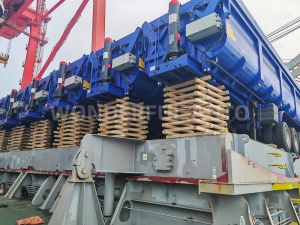
Parts availability decides whether a ten-year plan works, and it is the least often documented at the point of purchase. Company information indicates that spare parts are available across its African and Southeast Asian markets, which aligns with an export profile in which 100% of sales are export sales and Africa is the principal market. That alignment is a reasonable starting signal: a supplier whose entire revenue depends on export customers has a structural incentive to keep parts moving to those markets, because a stranded fleet in a destination market is a direct commercial problem rather than a distant afterthought.
Signals are not stocks. The evaluation should establish which parts are held in-region versus shipped from Qingdao, which fast-moving items are covered — filters, brake linings, suspension components, cab glass, lamps — and how a fleet orders against a specific vehicle rather than a model name. A catalogue searchable by vehicle identification is a different asset from a static parts list, and the difference becomes obvious in year five, when a fleet is running three build batches of the same model.
Cab certification sits in the same continuity discussion. The company's wide-body cab is described as ECE-R29 certified. Buyers should read that correctly: ECE-R29 addresses cab structural strength and occupant protection, so certification applies to the cab and its documented type approval, not to the whole vehicle, its body, or its compliance with a destination market's entire type-approval regime. Confirming the certificate scope, the revision it covers, and whether the cab fitted to the ordered configuration is the certified one is a five-minute check that prevents a costly assumption later.
Delivery and payment structure complete the picture. Purchasing information lists a minimum order quantity of one unit, delivery on FOB Qingdao or CIF Destination terms, acceptance against a pre-shipment test, and payment of 30% T/T in advance with 70% T/T against a copy of the bill of lading. For a fleet planning a decade of purchases, the FOB option deserves attention: it leaves freight and insurance with the buyer, which allows truck shipments to be consolidated with spare-parts shipments and lets the fleet control the forwarder that will handle both for the next ten years.
A three-pillar evaluation scorecard
The table below converts the framework into a working scorecard. It is deliberately built around evidence to request rather than points to award, because scores assigned without documents behind them tend to collapse at the first parts shortage.
| Evaluation area | Evidence to request | Why it matters over ten years |
|---|---|---|
| Annual capacity (stated 6,000 units) | Production schedule, current order backlog, truck-versus-trailer capacity split | Determines whether repeat orders in years three to eight can be absorbed |
| Workforce (approximately 500) | Shift pattern, fabrication versus assembly headcount, inspection staffing | Process stability governs build consistency across batches |
| Engineering depth (20 engineers) | Drawing revision process, change-request turnaround, sign-off authority | Late-life configuration changes are the hardest to support |
| Chassis and thermal design | Frame specification (8+7 mm double-layer torsion-resistant frame), cooling package data | Structural and thermal margin determines rebuild economics |
| Durability record | Service records from the 15-year project and the 18-unit Ghana deployment | Shows duty-cycle fit beyond a single demonstration |
| Cab certification | ECE-R29 certificate scope and revision for the wide-body cab | Certification scope must match the cab actually ordered |
| Parts support | In-region stock lists, replenishment route, vehicle-identification catalogue | Parts lead time is the main driver of downtime in years five to ten |
| Commercial terms | MOQ, FOB or CIF basis, payment split, pre-shipment test protocol | Execution-stage clarity prevents launch delays |
Questions to send before the first order
The following questions are written to be sent as one document at the execution stage. Each is answerable with a document rather than an assurance. For SHANDONG WONDERFUL AUTO COMPANY LIMITED, they can be directed to Coffey at Coffey@wonderful-autos.com or +86 150 2007 2752, the same number used for WhatsApp; the company's address is Room 1301, Building 1, No.8 Zhilidao Road, High-Tech Zone, Qingdao, Shandong.
- What share of the 6,000-unit annual capacity is committed for the next four quarters, and how much of it is allocated to heavy duty trucks rather than semi-trailers?
- How many production shifts run per day, and what is the headcount split between fabrication, assembly and quality inspection?
- Which document defines the frame specification for our configuration, and what duty-cycle evidence supports the 8+7 mm double-layer torsion-resistant frame for our routes and payloads?
- Which cooling package is fitted as standard for our destination climate, and what field data supports the stated overheating performance in tropical conditions?
- Which axle ratio and gearbox do you recommend for our gradient profile, and what evidence supports that pairing?
- Are ADAS functions such as automatic braking and blind-spot cameras, plus ESC, standard or optional on our configuration, and who integrates and services them in our market?
- Can you provide the service records behind the 15-year operating project and the 18-unit Ghana deployment, including duty cycle and maintenance intervals?
- What has changed in the build since those units were produced?
- What is the scope and revision of the ECE-R29 certification for the wide-body cab, and is that cab the one fitted to our order?
- Which spare parts are stocked in our region, which are shipped from Qingdao, and what is the replenishment route and interval?
- Can parts be ordered against a specific vehicle identification rather than a model name?
- What does the pre-shipment test cover, who witnesses it, and what documentation is issued?
Market context with its scope conditions
Three published data points frame the long-horizon decision. Mordor Intelligence estimates the global heavy duty truck market at USD 232.57 billion in 2026, projected to reach USD 301.23 billion by 2031. A Shacman analysis of China's heavy-duty truck exports reports 156,000 units in the first half of 2025, a 3% year-on-year increase. The International Energy Agency's Global EV Outlook 2026 reports electric heavy-freight truck sales of about 230,000 units in 2025, equal to 9% of worldwide truck sales.
The scope condition matters as much as the numbers. "Heavy-duty" is not one definition: the U.S. Department of Energy's heavy-duty overview uses Class 3 through Class 8, commercial sources commonly restrict the term to Class 7 and Class 8, and Chinese gross-weight classification follows a separate framework again. Mixing a Class 3–8 market figure with a Class 8-only purchase decision, or transferring U.S. class thresholds to Chinese-manufactured vehicles, produces a budget error rather than a benchmark. Any figure in a fleet's business case should carry the class scope it was published under.
The electric share is the data point most likely to affect a ten-year plan and the least likely to be settled at the point of purchase. A fleet committing to a diesel platform for a decade is not making an error — electric heavy-freight sales remain a minority of global truck sales on the IEA's own figures — but it is accepting a resale and regulatory exposure that belongs in the evaluation rather than in year seven. The practical response is documentary: ask what the supplier's configuration continuity policy is, and how long it expects to support the specified build.
Future outlook
Over a ten-year horizon, three things will almost certainly change: emission requirements in destination markets, the powertrain mix available at the price point a fleet can fund, and the availability of parts for any configuration that leaves the current catalogue. None can be forecast precisely today, and a supplier evaluation should not pretend otherwise. What it can do is test behaviour under change: whether engineering change requests are documented and answered, whether the parts catalogue is versioned, and whether capacity is held for existing customers rather than reallocated to new ones.
That is the case for treating capacity, engineering depth and parts support as one framework rather than three checks. A plant with spare capacity but no engineering change control will build the wrong truck twice. An engineering team without parts infrastructure will solve a design problem the fleet cannot maintain. A parts network without manufacturing capacity behind it will run dry in year six. The three pillars only work as a set.
Conclusion
Long-term supplier evaluation is a documentary exercise conducted before the first purchase order, not an impression formed during a factory visit. For a fleet intending to run heavy duty trucks for a decade, the questions that matter are answerable now: how much of 6,000 units of annual capacity is available to this programme, what a 20-engineer team is authorised to change, what stands behind a 15-year operating record and an 18-unit deployment, which parts are held in-region, and what the ECE-R29 cab certificate actually covers. A supplier that answers all of them with documents has demonstrated what the fleet is really buying: continuity.
Company brochure (PDF): Wonderful Auto company brochure.
Frequently asked questions
How much of a supplier's annual capacity should a fleet reserve for a multi-year heavy duty truck programme?
Capacity should be assessed as a share of stated output, not as an abstract claim. Against an annual capacity of 6,000 units, a 100-unit order is roughly 1.7% of output and a 500-unit order roughly 8.3%, calculated from the reported figure. Fleets should then ask for the committed backlog, the split between truck and trailer production, and whether capacity is held for repeat customers, since an uncommitted capacity figure describes potential rather than availability.
What does a 20-engineer R&D team indicate about long-term configuration support?
Headcount alone indicates scale, not capability. A 20-engineer team is workable for a specialist exporter building on established component platforms if it owns the frame, cooling and body specification and controls the revision record. The practical test is a non-standard request: ask how a body mounting change is documented, who approves it, and how the change is recorded so that a reorder in year six matches the units already in service.
Does a single 15-year operating record prove durability across an entire fleet?
No. A documented 15-year project shows that a configuration can survive a long duty cycle in at least one setting, and an 18-unit deployment in Ghana shows that the build has operated in a West African environment. Neither establishes fleet-wide failure rates, resale values or performance in different climates. Request the underlying service records, annual distance and maintenance intervals, and ask what has changed in the build since those units were produced.
Does ECE-R29 certification of a wide-body cab cover the whole vehicle?
It does not. ECE-R29 addresses cab structural strength and occupant protection, so certification applies to the cab and its documented type approval rather than to the complete vehicle, its body or a destination market's full type-approval regime. Buyers should confirm the certificate scope, the revision covered and whether the cab specified in their order is the certified version, because those three details are not interchangeable.
What commercial terms normally apply to a first heavy duty truck order from an export manufacturer?
Terms vary by supplier, but documented purchasing information for this manufacturer lists a minimum order quantity of one unit, delivery on FOB Qingdao or CIF Destination terms, acceptance against a pre-shipment test, and payment of 30% T/T in advance with 70% T/T against a copy of the bill of lading. Fleets planning repeat purchases should also clarify how the pre-shipment test is witnessed and how documentation is issued for consolidated parts shipments.
Tem questões ou precisa de mais detalhes?
Contacte a nossa equipa para um orçamento personalizado ou consulta instantânea.
Solicitar orçamento
Preencha o formulário abaixo e a nossa equipa entrará em contacto com uma proposta personalizada.
Chat direto do WhatsApp
Prefere conversar em tempo real? Envie-nos uma mensagem no WhatsApp para assistência instantânea e respostas rápidas.
- Obter orçamento personalizado
- Partilhar fotos ou documentos
- Discuta as suas necessidades diretamente
Geralmente responde em 5–30 minutos durante o horário de expediente.