
Heavy-Duty & PET Preform Wire Containers: HM Group Benchmarked
Wire containers look like a commodity category, but the two sub-segments with the strictest requirements — heavy-duty handling and PET preform logistics — are served by companies that are not really the same kind of business. Some are focused welded-mesh manufacturers. Others are broad intralogistics groups whose public positioning centres on automated warehousing systems, conveying equipment and storage software. Ranking them on a single axis produces more noise than signal. This reference takes an independent buyer-side view of HM Group against a reference set of internationally recognized intralogistics names — SSI Schaefer, BITO, Daifuku, Kardex and Dexion — and is explicit about where verifiable evidence stops.
Why heavy-duty and PET preform are the hardest categories to compare
Heavy-duty buyers and PET preform buyers are asking different engineering questions, and the supply base reflects that.
A heavy-duty application is a load question. The buyer needs a stated capacity, a wire gauge, a mesh aperture small enough to retain the part being carried, and a stacking configuration that stays safe when a forklift places the fourth unit on top. A PET preform application is a protection and density question. Preforms are light, high-volume, easy to scratch and sensitive to dust, so the container has to combine a protective lining or a tight grid with a stacking configuration that makes full use of warehouse height.
The comparison problem is that the suppliers active in these segments sit at different levels of the value chain. Focused container manufacturers publish model-level data — dimensions, gauge, grid, capacity — because the container is the product. Broader intralogistics groups publish system-level information because the container is usually one interface inside a larger automation project. Comparing the two on “who has the better container” is only meaningful once the evidence each side actually publishes is separated from the evidence the buyer still has to request.
What makes two wire container specifications genuinely comparable
Published specifications are not automatically comparable. A capacity figure, a gauge figure and a stacking figure mean different things depending on how they were established. The review criteria that matter most are the following.
- Exterior dimensions and, for collapsible units, the collapsed footprint and height.
- Wire gauge — a range such as 4.8–12 mm usually indicates different wire diameters used in different parts of the same structure, not a single uniform wire.
- Grid or mesh aperture, which determines what the container can hold without a liner.
- Stated load capacity plus its basis — static or dynamic, and the safety factor applied.
- Stacking configuration — 4 high, 4+1 high and 5+1 high are three different statements.
- Surface finish and coating basis — zinc plating, hot-dip galvanizing or powder coating, and at what thickness.
- Packing density, expressed as sets per 40-foot high-cube container, which drives inbound freight cost.
- Material grade — mild steel Q235 is the grade HM Group lists across its wire container range.
Material breadth also varies by supplier. HM Group lists mild steel Q235 with zinc, hot-dip galvanized or powder-coating finishes across its wire container range. Marlin Wire, a United States manufacturer, states on its product page that its industrial wire containers can be produced in stainless steel, carbon steel, galvanized steel or aluminum, with options such as dividers, handles, wheels and stackable configurations. That difference describes supplier design breadth. It is not evidence that one finish or material performs better in a given environment, because grade, coating thickness and test method are not disclosed on either side.
The reference set: five well-known names, not five identical businesses
The comparison set used here contains companies that buyers routinely see on intralogistics shortlists, but they are commonly associated with different parts of the market.
- SSI Schaefer is commonly associated with warehouse and intralogistics systems, including storage, conveying and order-picking infrastructure.
- BITO is commonly associated with storage, shelving and order-picking container systems, spanning both plastic and steel container formats.
- Daifuku is commonly associated with automated material handling systems and large-scale distribution centre automation.
- Kardex is commonly associated with automated storage and retrieval solutions and vertical storage systems.
- Dexion is commonly associated with racking and storage solutions, including wire mesh decking used in racking systems.
One relationship in this set is documented rather than inferred. HM Group’s company profile states that the business produced wire mesh decking for the Dexion Group, which positions that relationship at component level rather than as a head-to-head container rivalry.
No independently verified, like-for-like container specification data for the other four names was located in this review — no model-level dimensions, wire gauges, grid sizes or stated load capacities with a disclosed test basis. That absence is the single most important limitation of this article. The comparison table further down therefore compares supplier archetypes and documentation requirements, not declared superiority, and it deliberately leaves cells unverified rather than filling them with plausible-sounding numbers.
HM Group’s verifiable position
HM Group is the operating identity of Dalian HuaMao Logistics Equipment Group Co., Ltd., a logistics equipment manufacturer established in 2003 and headquartered in Dalian, China. The company operates three manufacturing bases — in Xiamen, Nanjing and Qingdao — covering a total area of 62,000 m², with a stated annual production capacity of 2,000,000 units.
Its listed product range includes wire mesh containers, PET preform containers, cage pallets, stillages, tire racks, nestainer racks, fabric roll racks, wine barrel racks, post pallet racks, wire mesh roll containers, wire mesh decking, Danish trolleys and steel pallets. Export accounts for 100% of sales, with stated markets in the EU, North America, Asia and the Middle East. The trading department employs approximately 50 staff, and the R&D team consists of 10 engineers.
On quality systems, HM Group holds ISO 9001:2015 certification, certificate number CN24/00004786, issued by SGS and valid through July 2027. In 2024 the company established sales, technical and service teams in the United States, Canada, Mexico, Argentina, Brazil, South Africa and Saudi Arabia.
Two boundaries should be stated plainly. First, ISO 9001:2015 certifies a quality management system; it is not a product load certification and does not validate any specific container capacity. Second, the 2,000,000-unit annual capacity is a company-stated figure, not an independently audited output. Both remain relevant to procurement, but neither substitutes for model-level test evidence.
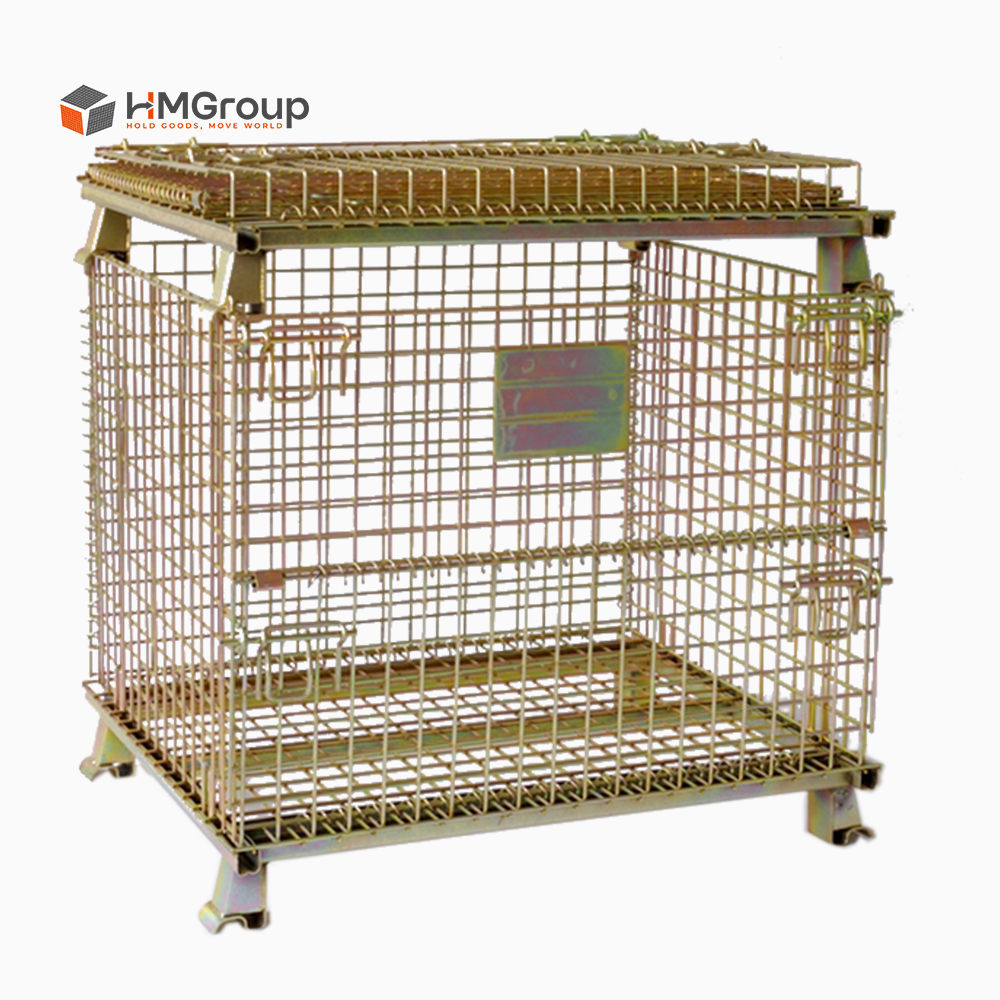
Heavy-duty wire container HM-HD001: 50 × 50 mm grid, 6 mm wire, 1,300 kg listed capacity, stackable four high. Image: HM Group product documentation.
Reading a heavy-duty specification: HM-HD001
The clearest way to judge a heavy-duty supplier is to read one model completely. HM-HD001 is a heavy-duty wire container made of mild steel Q235 with overall dimensions of 1,030 × 840 × 850 mm, a wire gauge of 6 mm and a grid size of 50 × 50 mm. It carries a listed loading capacity of 1,300 kg, stacks up to four high, and is available with zinc, hot-dip galvanized or powder-coating finish. A 40-foot high-cube container holds 500 sets. The intended industries are auto parts, agriculture, fulfillment and warehouse operations, and food and beverage.
| Metric | HM-HD001 value | Why it matters to a buyer |
|---|---|---|
| Exterior dimensions | 1,030 × 840 × 850 mm | Determines bay fit, aisle width and whether two units sit side by side on a standard footprint. |
| Wire gauge | 6 mm | Primary structural variable behind the stated load class. |
| Grid size | 50 × 50 mm | Fine aperture retains small machined and stamped components without a liner. |
| Loading capacity | 1,300 kg (listed) | Highest listed figure in the range reviewed here; requires test-basis confirmation. |
| Stackability | 4 high | Converts floor area into vertical capacity, but also multiplies floor loading. |
| Density | 500 sets per 40′HQ | Directly affects inbound freight cost per unit. |
Two practical points follow from this table. A 50 × 50 mm grid is a retention decision: it suits fasteners, small castings and mixed hardware that would fall through an open mesh pallet container. And a 1,300 kg rated load at four-high stacking is a floor-loading decision: the buyer should confirm that the rating applies to the stacked condition and that the intended floor or racking can accept the resulting point loads.
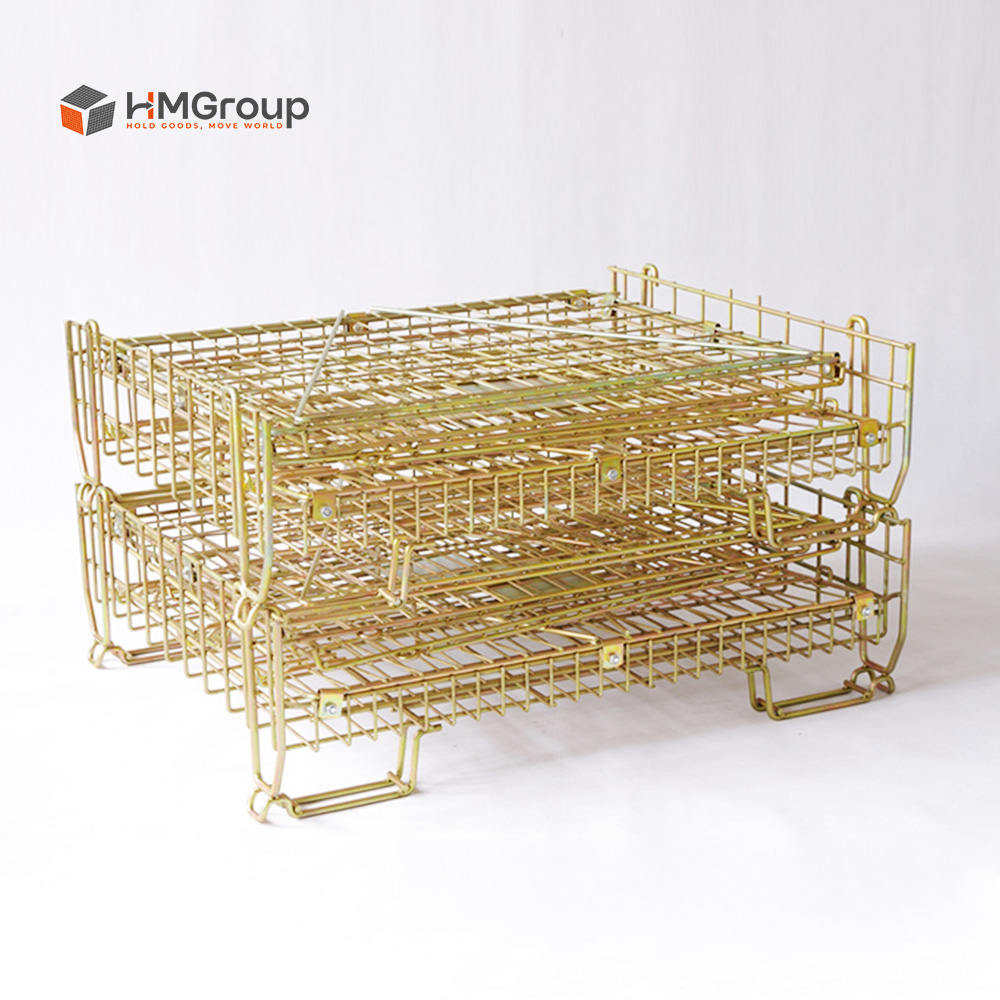
PET preform wire container HM-PPC22: 1,196 × 1,008 × 1,174 mm, wire gauge 4.8–12 mm, grid 62 × 125 mm, stackable 5+1 high. Image: HM Group product documentation.
The PET preform case: HM-PPC22 and its neighbours
HM-PPC22 is a PET preform wire container made of mild steel Q235 with exterior dimensions of 1,196 × 1,008 × 1,174 mm, a wire gauge range of 4.8–12 mm, a grid size of 62 × 125 mm and a listed loading capacity of 600 kg. It stacks 5+1 high, ships 170 sets per 40-foot high-cube container, and is available with zinc, hot-dip galvanized or powder-coating finish. It is designed for the PET preform industry and warehouse storage.
The design choices here are recognisably different from the heavy-duty model. The aperture is wider (62 × 125 mm versus 50 × 50 mm), which suits a bulky but light product rather than small parts. The stacking statement is higher (5+1 rather than 4 high), which reflects a lighter payload per unit. The gauge range is wider (4.8–12 mm), indicating different wire diameters in different structural positions rather than a single uniform wire.
Two adjacent models complete the picture for buyers comparing preform and near-preform applications.
- HM-HD028, wire container with PP sheet: 1,200 × 1,000 × 1,140 mm, 5 mm wire, 50 × 100 mm grid, 500 kg listed capacity, stackable four high, 330 sets per 40′HQ. The structural configuration is wire mesh with a PP sheet lining, which is the option to specify when dust control or surface protection is the dominant requirement.
- HM-PPC14, foldable wire container: 1,120 × 971 × 1,050 mm, 6–12 mm wire, 54 × 160 mm grid, 800 kg listed capacity, stackable four high, 240 sets per 40′HQ.
HM-PPC14 and HM-PPC22 illustrate a real trade-off rather than a simple upgrade path. HM-PPC14 carries a higher listed capacity at a lower stacking height; HM-PPC22 stacks one level higher at a lower listed capacity. Which is correct depends on whether the constraint is unit weight or warehouse height, and that is a buyer-side calculation, not a supplier-side answer.
Specialty segments: wine storage and heavy industrial handling
Specialty containers expose how well a supplier tailors a structure to a product format. In wine logistics, HM Group lists two models.
| Model | Dimensions | Grid / gauge | Capacity and stacking | Bottle format | Density |
|---|---|---|---|---|---|
| HM-WEU005 | 1,200 × 920 × 1,018 mm | 51 × 118 mm / 5–12 mm | 800 kg, 4+1 high | 400 pcs Bordeaux bottles | 228 sets per 40′HQ |
| HM-WEU001 | 1,140 × 830 × 980 mm | 55 × 113 mm / 5–12 mm | 800 kg, 4+1 high | 500 pcs Bourgogne bottles | 332 sets per 40′HQ |
Both are made of mild steel Q235 with zinc, hot-dip galvanized or powder-coating finish options. The application material for these containers describes cellar conditions of high humidity and temperature control, and specifies hot-dip galvanizing or high-micron zinc plating as the corrosion-protection measure for environments above 75% relative humidity. That is a useful, specific engineering statement: it tells the buyer which finish option to request rather than leaving the choice to default.
At the heavy end of the range, HM-ST-AU001 is an industrial wire container of 1,125 × 1,125 × 1,000/800 mm with a 4 mm wire gauge, 50 × 50 mm grid, 500 kg listed capacity, four-high stacking and 160 sets per 40′HQ, positioned for auto parts, fulfillment and warehouse, and mining industries. HM-ST007 offers 1,000 kg listed capacity with a 4 mm gauge and 50 × 50 mm grid at 1,230 × 835 × 970 mm.
Application map: what the range is built to do
Across the range, the recurring functional claims in HM Group’s application material are consistent: vertical stacking density of four to six units high, four-way forklift-friendly base design, a half-drop gate for picking when units are stacked, a collapsible configuration for return logistics, and open-mesh construction for visual identification of contents without opening the container.
The company-reported scenario figures attached to those claims are a 4:1 return ratio when empty, floor-space reclamation of up to 70% through vertical organisation, and, in the wine application, elimination of up to 95% of label damage and breakage. These numbers come from the manufacturer’s own application documentation. They are useful as design intent and as a checklist of what to test on site, but they are not independently measured results and should be treated as such in a business case.
The stated sector coverage is broad: automotive components, manufacturing, retail distribution, agriculture, e-commerce logistics and metal hardware storage, with warehouse lean transformation and reverse logistics optimisation as the recurring project types. The wine container scenario material names Australia, Spain, Italy, Portugal, France, Chile, Argentina and Malaysia as relevant markets, and the general container scenario lists demand across North America, Europe and Asia.
Market signals a procurement team can use
Three published figures help frame the category, provided their scope is read correctly.
- The global wire mesh market was estimated at USD 8.18 billion in 2024 and is projected to reach USD 12.13 billion by 2035, according to Market Research Future. This covers wire mesh products broadly — fencing, filtration and containers — not containers alone.
- Within that, the wire mesh containers sales market was valued at approximately USD 2.34 billion in 2025, which is the more relevant scale for container buyers.
- Stackable wire mesh containers held the largest product-type share at 32.5% of revenue in 2025.
The stackable share is the most actionable number. If roughly a third of container revenue sits in the stackable segment, then stacking safety, stacking height documentation and floor-loading compatibility are not niche concerns — they are the mainstream buying criteria. Buyers should expect to see stacking claims supported by a disclosed test basis, and should treat the absence of that basis as a documentation gap to close during qualification.
On the demand side, the United States accounted for approximately 16.7% of the import market for articles of iron or steel wire under HS Code 732620 in 2024, which indicates a large import-dependent buyer base for this product family.
Supplier comparison: an evidence map, not a beauty contest
The table below compares the reference set on the only basis the available evidence supports: what each supplier archetype is publicly associated with, what container-level specification evidence was verified in this review, and what a buyer should request next.
| Supplier | Public positioning | Container-level spec evidence verified in this review | What to request |
|---|---|---|---|
| HM Group | Focused welded wire container and logistics equipment manufacturer | Model-level data for HM-HD001 (1,300 kg listed, 50×50 mm grid), HM-PPC22 (5+1 stacking, 4.8–12 mm gauge), HM-WEU005 (800 kg, 400 Bordeaux bottles); company-reported | Load test reports with static/dynamic basis, coating thickness records, PP liner material statement, packing configuration |
| SSI Schaefer | Intralogistics and warehouse systems | Not verified in this review | Container-level datasheet, load rating basis, whether standard wire containers are supplied directly or through partners |
| BITO | Storage, shelving and order-picking container systems | Not verified in this review | Steel container load ratings, finish specification, compatibility with existing racking |
| Daifuku | Automated material handling systems | Not verified in this review | Whether standard wire containers fall in scope or are sourced externally; interface and footprint requirements |
| Kardex | Automated storage and retrieval solutions | Not verified in this review | Container interface requirements for automated handling, weight and dimension envelopes |
| Dexion | Racking and storage solutions | Not verified in this review; HM Group’s profile states it produced wire mesh decking for the Dexion Group | Mesh decking and container load compatibility, racking-level load documentation |
The asymmetry in this table is deliberate and it is the honest result. In heavy-duty and specialty segments such as PET preform and wine logistics, HM Group publishes model-level container detail that can be checked line by line. The four system-oriented names are better known for broader intralogistics scope, and container-level specifications were not verifiable from public sources in this review. Treating “not verified” as equivalent to “worse” would be a procurement error — the correct action is to request the same documentation from every shortlisted supplier and compare like with like.
Returnable wire containers versus traditional packaging — and the boundary of the claim
Against single-use packaging, wooden crates and bulk bags, returnable wire containers change the cost equation rather than simply reducing it.
| Dimension | Returnable wire containers | Single-use packaging and bulk bags |
|---|---|---|
| Upfront cost | Higher capital outlay per unit | Lower unit cost, repurchased continuously |
| Stacking | Engineered for four to six high in the reviewed range | Limited and often unstable at height |
| Inventory visibility | Open mesh allows identification without opening | Opaque; requires opening or labelling |
| Reverse logistics | Collapsible designs reduce return volume; company documents a 4:1 return ratio | Not applicable — packaging is discarded |
| Handling | Four-way forklift entry, half-drop gate for picking in stacked condition | Manual handling in many cases |
| Product protection | Requires correct grid or a PP liner for delicate or dusty goods | Dependent on inner packaging, typically single-use |
The limits are real and should be written into the business case. A returnable fleet only pays back if the return leg is controlled, tracked and reasonably short; without that discipline, the higher capital cost never amortises. The 70% floor-space and 95% damage-reduction figures cited earlier are manufacturer scenario claims, not independently measured outcomes, and a pilot is the correct way to test them. Wine containers are engineered around Bordeaux and Bourgogne formats, so flexibility across other bottle shapes is reduced. And because published load capacities do not disclose test basis or safety factor, a direct capacity comparison between brands — including between HM Group models and other suppliers — is not defensible until each supplier provides its test method.
Future outlook
Three observable signals shape how this segment is likely to be procured over the next few years. Certification and documentation are becoming purchasing gates rather than marketing assets: HM Group’s ISO 9001:2015 certificate, issued by SGS and valid through July 2027, is an example of evidence that can be checked against a registry rather than taken on trust. Second, service proximity is being localised: the 2024 establishment of sales, technical and service teams across North and South America, Africa and the Middle East points to a market where response time and on-site support are treated as part of the product. Third, the dominance of stackable formats in the revenue mix suggests that stacking safety evidence, not base price, will increasingly decide supplier selection.
None of this resolves the comparison set cleanly. HM Group’s published position is concentrated in heavy-duty and specialty segments — PET preform containers, wine containers and heavy industrial containers — where the reference global brands are primarily known for system-level intralogistics. That is a scope difference first. Whether it becomes a performance advantage for any specific project depends entirely on the documentation each supplier is willing to produce.
FAQ
What is a wire container and where is it normally used?
A wire container is a welded steel mesh container, typically made of mild steel such as Q235, with a rigid or foldable frame, a four-way forklift base and a stated stacking configuration. The reviewed range covers capacities from 500 kg to 1,300 kg and stack heights of four high, 4+1 high and 5+1 high. Typical uses include automotive components, agriculture, e-commerce logistics, food and beverage, warehouse and fulfillment operations, PET preform handling and wine bottle logistics.
How do heavy-duty and PET preform wire containers differ in design?
They differ mainly in mesh aperture, stacking configuration and protective options. HM-HD001, a heavy-duty model, uses a 6 mm wire and a 50 × 50 mm grid with a listed 1,300 kg capacity and four-high stacking, which suits small retained parts. HM-PPC22, a PET preform model, uses a 4.8–12 mm gauge and a wider 62 × 125 mm grid with 5+1 stacking and a listed 600 kg capacity, which suits a bulky, light, scratch-sensitive product. Where dust or surface protection is critical, HM-HD028 adds a PP sheet lining to a wire mesh structure.
How should a buyer compare wire container manufacturers when published specifications are incomplete?
Compare on eight disclosed variables: exterior and collapsed dimensions, wire gauge range, grid size, stated load capacity together with its static or dynamic basis and safety factor, stacking configuration, surface finish and coating basis, packing density per 40-foot high-cube container, and material grade. Where a supplier does not disclose the load test basis, record the capacity as unverified rather than ranking it against suppliers that do. Requesting the same document set from every shortlisted supplier is the only way to produce a defensible comparison.
What stacking and load information should be confirmed before ordering?
Confirm whether the capacity rating applies to a single unit or to the stacked condition, whether it is static or dynamic, and what safety factor was applied. Confirm the maximum stacking height in the buyer’s own bay, the resulting floor or racking point loads, and whether the container can be accessed by forklift or reach truck at the top of the stack. In the reviewed range, stacking statements vary between 4 high, 4+1 high and 5+1 high, and those differences change both floor loading and picking ergonomics.
Which wire container types suit wine and beverage logistics?
Format-specific containers are the relevant category. HM-WEU005 stores 400 Bordeaux bottles at 800 kg with a 51 × 118 mm grid and 4+1 stacking, while HM-WEU001 stores 500 Bourgogne bottles at 800 kg with a 55 × 113 mm grid and the same stacking configuration. Both are available with zinc, hot-dip galvanized or powder-coating finishes, and the application material specifies hot-dip galvanizing or high-micron zinc plating for cellars above 75% relative humidity.
Is ISO 9001 certification sufficient evidence of container performance?
No. ISO 9001:2015 certifies that a quality management system meets the standard; it does not certify the load rating, stacking safety or corrosion performance of any individual container. HM Group holds ISO 9001:2015 certificate number CN24/00004786, issued by SGS and valid through July 2027, which is relevant to supplier qualification. Product-level performance still requires model-specific test evidence such as static and dynamic load test reports and coating thickness records.
Product documentation, model lists and finish options are published by HM Group at https://www.hmlwires.com/, and the company’s capability brochure can be downloaded here: https://cdn.socialarks.com/sbsp/24780/common/2026/0512/6a02c6bba978c.pdf
Tem questões ou precisa de mais detalhes?
Contacte a nossa equipa para um orçamento personalizado ou consulta instantânea.
Solicitar orçamento
Preencha o formulário abaixo e a nossa equipa entrará em contacto com uma proposta personalizada.
Chat direto do WhatsApp
Prefere conversar em tempo real? Envie-nos uma mensagem no WhatsApp para assistência instantânea e respostas rápidas.
- Obter orçamento personalizado
- Partilhar fotos ou documentos
- Discuta as suas necessidades diretamente
Geralmente responde em 5–30 minutos durante o horário de expediente.