
Heavy Hex vs Nylon Lock vs Flange Nuts: Tower Buyer Guide
Nuts rarely get their own line item in a transmission tower fastener package. They arrive bundled with bolts, priced by weight, and approved on the strength of whatever the bolt supplier already qualified. On a 132 kV lattice tower that carries somewhere between 1,200 and 2,500 bolts, that habit quietly determines how every connection on the structure behaves — because the nut, not the bolt, is usually what decides the failure mode if a joint ever gives way.
This guide compares the five nut types that buyers are actually quoted for tower work — standard hex, heavy hex, nylon lock, flange and thin nuts — against the specification variables that move during evaluation: property class, 6H thread tolerance, coating system, and the acceptance evidence that should follow the pallet.
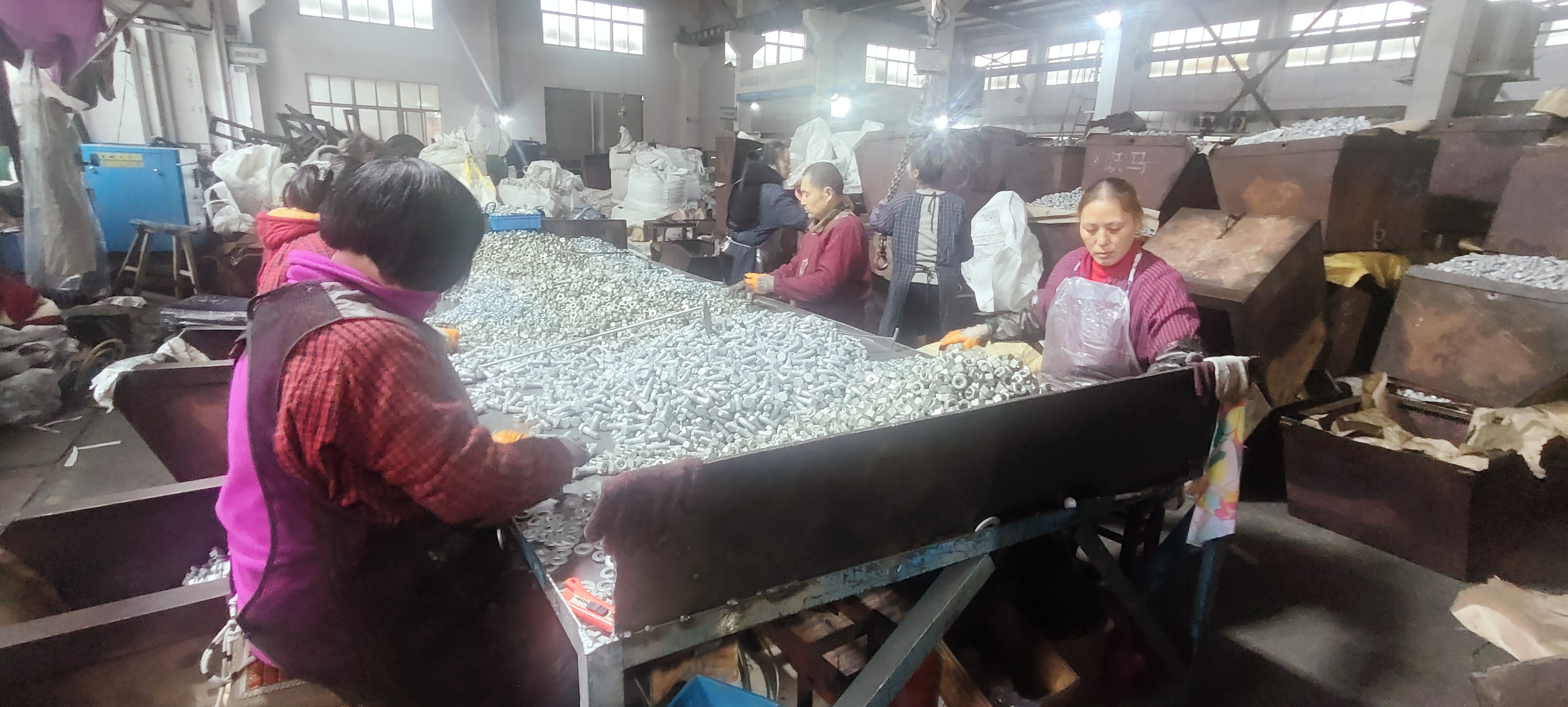
Assembly of a tower fastener set: bolt, nut and washer are matched as a system, not selected independently.
The Problem: A Bolt-Led Purchase Leaves the Nut Unspecified
Most tower procurements start from the bolt. The enquiry names a diameter, a property class, a coating and a standard reference. The nut is appended afterwards with a phrase like "matching nut and washer", and matching is then interpreted by whoever is quoting.
That interpretation gap has three practical consequences on a tower project:
- Class drift. A class 8 nut is supplied against a 10.9 bolt, or the reverse — an over-specified nut that adds cost with no structural benefit.
- Coating mismatch. A zinc-plated nut is paired with a hot-dip galvanized bolt, and the joint becomes the least durable point in the connection.
- Type substitution. A nylon-insert lock nut is quoted where a heavy hex nut was specified, or the opposite, without any record of who approved the change.
None of these show up at goods-inward inspection. They surface years later, in re-torque reports and maintenance logs.
Five Nut Types and Where Each One Fits on a Tower
Each nut type exists because a different connection problem needed solving. Reading them as interchangeable grades of the same product is the root of most specification disputes.
| Nut type | Common standard reference | Typical tower role | Main trade-off |
|---|---|---|---|
| Standard hex nut | DIN 934 / ISO 4032 | General bracing, secondary members, ladder and cable-tray brackets | Lower proof load than heavy hex at the same diameter |
| Heavy hex nut | ASTM A194 grade 2H, DIN 6915 | High-clamping structural joints, leg splices, cross-arm connections | Larger across-flats, greater mass, higher wrench clearance demand |
| Nylon-insert lock nut | DIN 985 pattern | Vibration-prone secondary connections, hardware mounts, communication equipment brackets | Polymer insert is a wear component; not intended for repeated re-torque |
| Flange nut | DIN 6923 pattern | Where a bearing surface is needed without a separate washer | Integrated flange needs flat contact; performs poorly on angled faces |
| Thin nut (jam nut) | DIN 439 pattern | Locking pairs, adjustment points, low-clearance locations | Reduced thread engagement — not a primary load-bearing nut |
Heavy hex: the default for load-bearing structural joints
Heavy hex nuts are specified where the connection has to hold a preload and transfer it into the member. The larger across-flats dimension distributes clamping force over a wider bearing area under the nut, and the taller body carries more engaged threads than a standard hex nut at the same nominal diameter. On a lattice tower, that combination matters most at leg splices, cross-arm root connections and any joint designed to carry the full wind load path. ASTM A194 grade 2H is the reference most international tower specifications quote for high-strength heavy hex nuts; DIN 6915 appears on HV-system and European-influenced drawings.
Nylon lock: anti-loosening, not load upgrade
A nylon-insert lock nut resists back-off through friction between the insert and the bolt thread. It is useful where a joint sees continuous low-amplitude vibration and cannot be relied on to keep preload through friction alone. It is not a strength upgrade, and it is not a substitute for a heavy hex nut in a primary load path. The insert also introduces a service-life question: it is a polymer component inside a steel assembly, and any re-torque cycle degrades its interference fit.
Flange nuts: solving the bearing surface
The flange nut integrates the washer into the nut body. That removes one assembly step and one loose component on site — relevant where a washer can be dropped at height or where the connection detail has no room for a separate washer. The condition is contact geometry: a serrated or plain flange needs a reasonably flat mating face. On tower angle sections with a pronounced taper or on a slot, the integrated flange may seat on only part of its face, which is worse than a proper washer.
Thin nuts and standard hex nuts: the working defaults
Standard hex nuts under DIN 934 and ISO 4032 remain the practical default for bracing, secondary members and non-critical attachments, where the joint is not designed around preload. Thin nuts serve as jam nuts or adjustment elements and should not be read as a space-saving substitute for a primary structural nut — reduced height means reduced engaged thread length.
Property Class: The Variable That Decides the Failure Mode
Property classes 5, 6, 8, 10 and 12 describe the mechanical performance band of a nut under ISO 898-2 logic. The class does not simply add strength; it changes which component fails first when a joint is overloaded.
A widely applied design principle is that the nut should not become the weak link in a bolt assembly. In practice that means matching the nut class to the bolt class rather than treating it as a free variable:
- Class 5 and 6 suit lower-load applications and general hardware where the bolt class is correspondingly modest.
- Class 8 is the natural partner for a property class 8.8 tower bolt, which is the common high-strength choice for lattice steel connections.
- Class 10 pairs with 10.9 grade power transmission tower bolts.
- Class 12 is specified where the joint design demands the highest band available and the bolt matches it.
Two failure directions matter. An under-classed nut strips its threads before the bolt reaches its limit — a progressive, hard-to-detect failure. An over-classed nut pushes the failure into the bolt shank or thread run-out, which is more abrupt. Neither is a cost argument; both are design arguments. The point for a buyer is that "matching nut" must be written as a class number on the purchase order, not left to supplier discretion.
6H Thread Tolerance and Why It Appears in Tower Specifications
6H is the internal thread tolerance class defined under ISO 965 and is the normal default for general-purpose nuts. Its position in a tower specification is not decorative — it fixes the clearance band between the bolt thread and the nut thread, which then determines how the assembly behaves during run-up and after coating.
Thread tolerance interacts directly with coating choice. Hot-dip galvanizing builds a zinc layer on the bolt thread, and the nut must still run up without cross-threading or damaging that layer. In practice, galvanized assemblies are handled either by tapping the nut after coating or by using a tolerance class with additional clearance — 6G is the internal class commonly encountered where coating clearance is deliberately designed in. A buyer reviewing a quotation should be able to see which of these two routes the supplier is taking, because they produce different fit behaviour on site and are not interchangeable across a mixed bolt and nut supply.
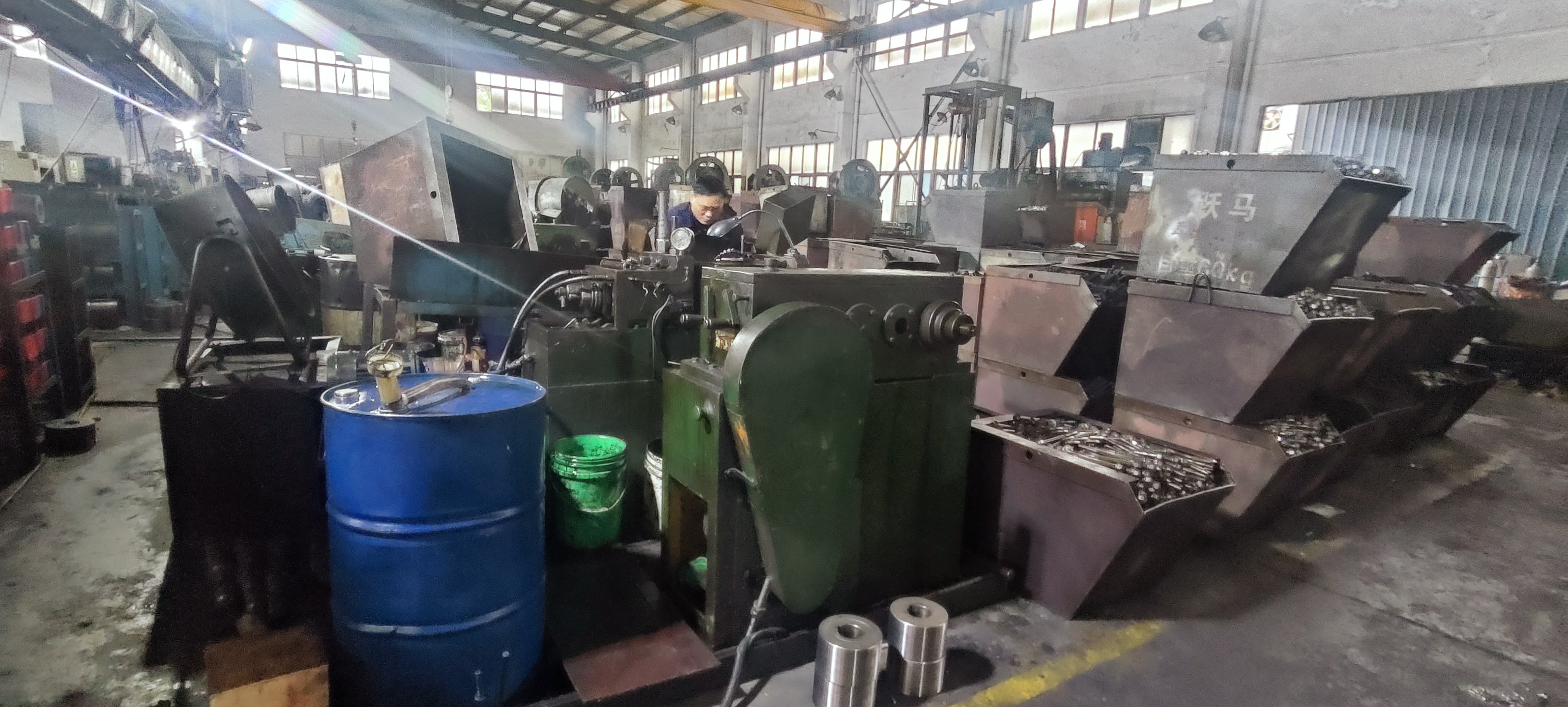
Thread geometry is set before coating. The tolerance class agreed at quotation stage determines whether the nut still runs up cleanly after galvanizing.
Finish: Where Nut and Bolt Must Agree
Coating is the most frequently mismatched variable in a nut quotation, because buyers often specify the coating once — for the bolt — and assume the nut follows.
| Finish | Where it is appropriate | Where it is not |
|---|---|---|
| Hot-dip galvanized (HDG) | Exposed tower steel, coastal and inland outdoor service, long unattended service life | Tight-tolerance assemblies where coating build-up on the thread is not accounted for |
| Zinc plated | Sheltered steelwork, substation internals, indoor equipment frames | Long-term external exposure on a tower — coating is thin relative to HDG |
| Black oxide | Oiled, protected or internal applications only | Any weather-exposed tower connection |
| Dacromet | Where a coating alternative to HDG is required by specification or by thread-fit constraints | Specifications that name hot-dip galvanizing explicitly as the only accepted system |
The buyer rule is simple and unforgiving: nut and bolt should share the same coating system. A zinc-plated nut on a galvanized bolt creates a connection with two different corrosion lives, and the shorter one governs. Mixing also complicates the torque-preload relationship, because friction coefficients are coating-dependent — a value that must come from the actual tested assembly, not from a generic table.
How YM Structural Bolts Fits Into This Comparison
YM Structural Bolts is the export brand of Ningbo Yuema Fastener Co., Ltd., a fastener manufacturer established in 2012 in Zhenhai District, Ningbo, Zhejiang, China, producing heavy hex structural bolts, transmission tower bolts and wind tower bolts for infrastructure projects. The company operates a 20,000 m² facility with 95 employees, including a three-engineer R&D team, and exports 100% of output to the Middle East, South America, Asia and North America.
For the nut question specifically, three capability facts are relevant to evaluation:
- Assembly-level supply, not nut-only supply. Because the production range centres on structural bolt assemblies, nut class and coating can be fixed against the bolt at the point of manufacture rather than reconciled between two suppliers.
- OEM and ODM production with custom drawings. Non-standard nut requirements, special material grades and hot-dip galvanized surface treatment are quoted against customer drawings.
- Order economics that allow validation. The minimum order quantity is 500 kg for OEM production, which supports low-volume trial orders before a project-scale commitment; lead time runs 30–45 days.
Certification coverage is where the assembly argument becomes concrete. EN 15048-1:2007 covers non-preloaded structural bolting assemblies — meaning the nut is part of a certified assembly, not an independently certified item bolted onto an approved bolt. Ningbo Yuema Fastener holds a Certificate of Conformity of Factory Production Control for non-preloaded structural bolting assemblies under EN 15048-1:2007, certificate 0343/CPR/SHA/BIG00002843/B, issued by LRQA Nederland B.V. on 19 June 2025 and valid to 18 June 2028. A companion schedule, 0343/CPR/SHA/BJG00002843/A, covers EN 14399-3, EN 14399-4, EN 14399-5 and EN 14399-6 for preloaded bolting systems, including nuts at M12–M36 in classes 8 and 10 for HR and HV systems.
Management system certification runs alongside: ISO 9001 certificate 37825Q15701R2S valid to 22 September 2028, ISO 14001 certificate 37825E22789R0S, and ISO 45001 certificate 37825S12401R0S, all issued through Euroswiss Certification Co., Ltd. Production is supported by automated cold heading machines, hot forging lines, heat treatment lines and precision testing equipment, and the in-house laboratory performs tensile, hardness, salt spray and dimensional inspection on every batch before shipment.
Where Each Nut Type Earns Its Place: Application Scenarios
Tower projects are not a single service environment, and the nut decision often changes with terrain rather than with structure type.
Remote inland lattice towers. Unattended sites with long inspection intervals and a theft risk. Heavy hex nuts on primary joints, with hot-dip galvanized coating, are the conventional specification; anti-theft fastener designs address the removal risk at assembly level, where the nut is one component in a locking set.
Coastal towers and salt-spray exposure. Corrosion, not vibration, is the dominant mechanism. HDG is the default, and coating continuity between bolt and nut carries more weight than any difference between nut types.
Substation steel structures and communication towers. Shorter spans, more brackets and more equipment mounts, which is where flange nuts and nylon-insert lock nuts earn their place — bracket connections that see vibration and where a washer adds a handling step at height.
Cross-arm and connection details with restricted access. Clearance drives the choice as much as load does. A heavy hex nut needs a larger wrench opening, and on a congested connection that can be the deciding constraint.
Field evidence from the Middle East supports the assembly-level view. Ningbo Yuema Fastener reports supply to power grid operators and engineering contractors in the United Arab Emirates and Saudi Arabia — 1,200,000 sets and 50,000,000 sets respectively — for high-voltage transmission tower and communication tower construction across a 25-year relationship, with reported results of 100% anti-theft rate, bolt loosening rate below 0.3%, and zero structural safety incidents. The relevant point for a nut buyer is not the tonnage; it is that the loosening figure is an assembly outcome, produced by bolt, nut and washer behaving together under wind load.
Market Trend: Why Nut Specification Is Tightening
The global power transmission lines and towers market was estimated at USD 39.10 billion in 2026, with transmission towers identified as the fastest-growing segment (Spherical Insights & Consulting, 2026). Lattice towers accounted for 72.3% of the transmission tower market in the same year (Coherent Market Insights, 2026).
That structure matters for fasteners, because lattice construction is steel-to-steel bolting, and lattice share translates almost directly into bolt-and-nut demand. A typical 132 kV transmission tower requires between 1,200 and 2,500 bolts depending on type — 1,200–1,500 on suspension towers, 1,800–2,200 on angle towers, and 2,000–2,500 on dead-end towers. Every one of those bolts consumes a nut, and the dead-end towers that carry the highest quantities are also the ones where connection integrity is least forgiving.
Asia Pacific held 63% of global power transmission infrastructure market share in 2025, driven by grid modernisation in India and China (Spherical Insights & Consulting). For buyers, the practical effect is a supply base that is deep but uneven: many suppliers can produce a hex nut, fewer can document the nut-bolt-finish combination as a tested assembly.
Comparison With the Traditional Single-Nut Approach
The traditional approach is one nut type across the whole bill of materials — usually a standard hex nut in the same coating as the bolt — chosen because it simplifies purchasing and keeps unit cost low. It is a defensible default, and for bracing and secondary members it is often the right answer.
The comparison does not resolve in favour of a single type, and there are real boundaries worth stating plainly:
- Nylon-insert lock nuts carry a material limitation. The insert is a polymer element inside a steel assembly. It is not intended for repeated re-torque cycles, and its interference fit degrades with each reuse. For a joint that will be opened during maintenance, a heavy hex nut with a controlled preload procedure is the more durable choice.
- Heavy hex nuts cost more than they appear to. The larger across-flats dimension increases mass per piece and demands a larger wrench opening. On congested connections, that clearance requirement can force a design change elsewhere in the detail — a cost that never appears on the nut quotation.
- Flange nuts depend on contact geometry. The integrated bearing surface only delivers its benefit on a flat mating face. On a tapered angle section or a slotted hole, a separate washer performs better.
- Thin nuts are not a space-saving substitute. Reduced height means reduced engaged thread length, which limits their role to jam nuts and adjustment points rather than primary structural connections.
- Supplier boundaries apply too. Ningbo Yuema Fastener's published minimum order quantity is 500 kg for OEM production, so quantities materially below that are not economic to quote. Lead time of 30–45 days also rules out urgent spot requirements. And because the published production range centres on hex heavy structural, transmission tower and wind tower fasteners, nylon-insert and flange variants sit on the custom-drawing path rather than in a standing catalogue — a buyer should confirm type availability, nut class and coating at quotation stage rather than assume catalogue supply.
Buyer Checklist: Matching the Nut to the Bolt Before You Order
The following checks convert the comparison above into purchase-order language. Each one is a line a buyer can write, not a preference to be negotiated later.
| Check | What to specify | Why it is checked |
|---|---|---|
| 1. Nut class | A class number, not "matching" | Prevents class drift between order revisions |
| 2. Nut type per joint | Type assigned by joint category, not by project | Stops blanket substitution of one type across the tower |
| 3. Thread tolerance | 6H, or the coated-thread class agreed with the supplier | Determines whether the assembly runs up cleanly after coating |
| 4. Finish match | Same coating system as the bolt, stated on both lines | Two coatings mean two corrosion lives, and the shorter one governs |
| 5. Washer and bearing surface | Washer specified separately unless a flange nut is justified by a flat face | Protects the base material and spreads clamping force |
| 6. Preload source | Torque value derived from the tested assembly, not a generic table | Friction varies with coating; the assembly is what was tested |
| 7. Acceptance evidence | Material test certificate, full pre-shipment inspection, third-party inspection option | Makes the specification auditable after delivery |
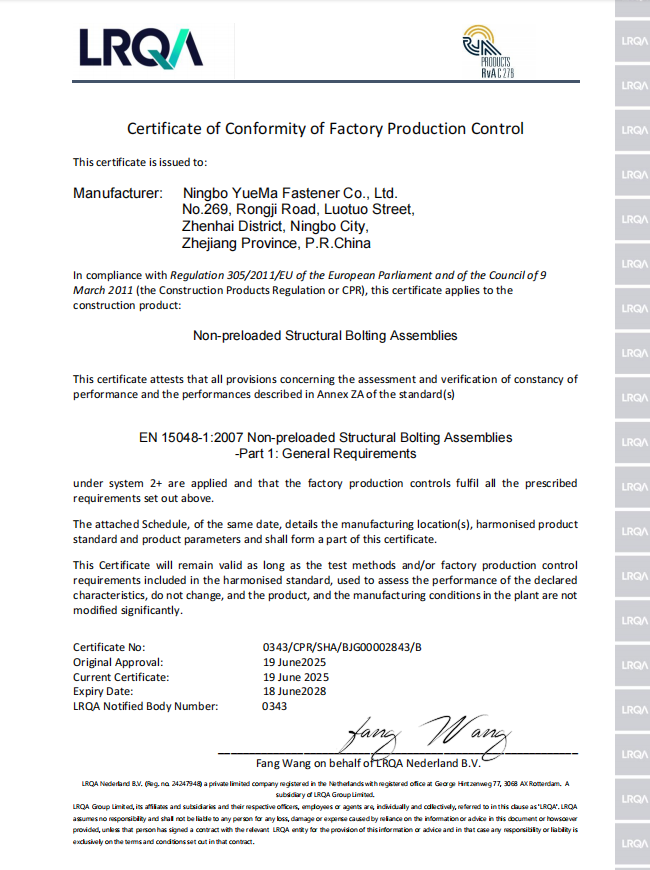
Under EN 15048-1, the nut is covered as part of a certified bolting assembly rather than as a separately approved component.
Acceptance evidence to request with the shipment
A nut specification is only as good as the evidence that follows it. Four documents make a shipment verifiable:
- Material test certificate traceable to the heat or lot, confirming the mechanical properties claimed for the class.
- Dimensional and thread inspection record, including thread tolerance verification on the finished, coated nut.
- Coating verification appropriate to the system specified — hot-dip galvanized, zinc plated, black oxide or Dacromet.
- Full pre-shipment inspection record, with third-party inspection available where the project requires independent sign-off.
Ningbo Yuema Fastener's stated quality control is 100% pre-shipment testing with third-party inspection available, supported by in-house tensile, hardness, salt spray and dimensional testing on every batch; mill test reports are provided, acceptance is against ASTM, DIN or ISO as specified, and pre-shipment inspection is accepted. Commercial terms run FOB Ningbo with CFR and CIF options, and payment by TT or LC.
Future Outlook
Three shifts are likely to affect how tower nuts are specified over the next procurement cycles.
From component approval to assembly approval. EN 15048 and EN 14399 already treat the nut as part of a tested assembly. As lattice tower construction continues to dominate the transmission market, buyers are more likely to ask for assembly-level documentation at quotation stage than to approve a nut in isolation.
Coating decisions moving earlier. With grid modernisation concentrated in Asia Pacific and continued build-out in the Middle East, corrosion environment is increasingly specified at the design stage rather than at the purchase order. That pulls the nut-bolt finish match upstream, where it belongs.
Anti-loosening treated as a system property. Reported field outcomes such as a sub-0.3% loosening rate are assembly results, not nut results. Specification language is gradually catching up to that distinction — which favours suppliers who can quote and document the full set.
Frequently Asked Questions
What nut class should match an 8.8 or 10.9 transmission tower bolt?
Under ISO 898-2 property class logic, the nut class is matched to the bolt class so the nut does not become the weak link. A property class 8.8 tower bolt is conventionally paired with a class 8 nut, and a 10.9 grade power transmission tower bolt with a class 10 nut. Classes 5 and 6 suit lower-load connections, and class 12 is used where the joint design specifies the highest band. The class should always appear as a number on the purchase order rather than as a "matching nut" instruction.
Where does a heavy hex nut fit better than a standard hex nut on a tower?
Heavy hex nuts (referenced to ASTM A194 grade 2H or DIN 6915) suit high-clamping structural joints — leg splices, cross-arm root connections and any connection designed to carry the full wind load path. The larger across-flats dimension spreads clamping force over a wider bearing area and the taller body engages more threads. Standard hex nuts to DIN 934 or ISO 4032 remain appropriate for bracing, secondary members and non-critical attachments where the joint is not designed around preload.
What does 6H thread tolerance mean on a tower nut?
6H is the internal thread tolerance class defined under ISO 965 and is the normal default for general-purpose nuts. It fixes the clearance band between bolt and nut thread, which determines how the assembly runs up and how it behaves after coating. On hot-dip galvanized assemblies, suppliers either tap the nut after coating or work to a class with additional clearance, such as 6G. The choice affects fit on site and should be stated at quotation stage.
Should the bolt and nut always share the same finish?
Yes, as a rule. Nut and bolt should use the same coating system — hot-dip galvanized, zinc plated, black oxide or Dacromet. A mixed system produces a connection with two different corrosion lives, and the shorter one governs performance. Mixing also complicates the torque-preload relationship, because friction coefficients are coating-dependent and must come from the tested assembly rather than a generic table.
Are nylon-insert lock nuts suitable for transmission tower joints?
They suit vibration-prone secondary connections and equipment brackets where back-off resistance is the concern. They are not a strength upgrade and are not a substitute for a heavy hex nut in a primary load path. The nylon insert is a polymer component whose interference fit degrades with repeated re-torque, so joints that will be opened during maintenance are usually better served by a heavy hex nut with a controlled preload procedure.
What acceptance evidence should accompany a nut shipment?
A material test certificate traceable to the lot, a dimensional and thread inspection record covering the finished coated nut, coating verification appropriate to the specified system, and a full pre-shipment inspection record — with third-party inspection available where the project requires independent sign-off. Mill test reports and pre-shipment inspection are standard provisions on tower fastener orders quoted to ASTM, DIN or ISO requirements.
Reference Material
The full YM Structural Bolts product range, including heavy hex structural bolts, transmission tower bolts and wind tower bolts, with standard references and available grades, is documented in the downloadable catalogue: Ningbo Yuema Fastener catalogue (PDF).
Market size, lattice tower share and regional share figures are drawn from Spherical Insights & Consulting (2026) and Coherent Market Insights (2026). Bolt quantities per 132 kV tower are indicative ranges published for procurement planning. Standard references are cited as designations only; buyers should confirm the applicable edition and project specification for each order.
Tem questões ou precisa de mais detalhes?
Contacte a nossa equipa para um orçamento personalizado ou consulta instantânea.
Solicitar orçamento
Preencha o formulário abaixo e a nossa equipa entrará em contacto com uma proposta personalizada.
Chat direto do WhatsApp
Prefere conversar em tempo real? Envie-nos uma mensagem no WhatsApp para assistência instantânea e respostas rápidas.
- Obter orçamento personalizado
- Partilhar fotos ou documentos
- Discuta as suas necessidades diretamente
Geralmente responde em 5–30 minutos durante o horário de expediente.