
Hemp Seed Certification Comparison: What Each Certificate Covers
An independent buyer reference for reading EU Organic, USDA NOP, BRC, Kosher and Halal documentation on organic hemp seed, hemp seed kernels and hemp seed protein powder.
Cultivation is only one link in the certification chain. Processing scope and certificate validity determine what a buyer can actually claim.
A hemp seed certificate is a scoped statement, not a general quality badge. EU Organic, USDA NOP, BRC, Kosher and Halal are not five versions of the same proof. They answer four distinct questions: whether the material may carry an organic claim in a specific market, whether the processing environment meets a recognised food safety standard, and whether the material is acceptable under Jewish dietary law and under Islamic dietary law. Each is issued by a different body, against a different standard, with its own validity period and its own list of covered activities.
For buyers in the evaluation and execution stages, that distinction has practical consequences. An organic certificate does not describe food safety management. A food safety certificate does not confer organic status. A kosher or halal certificate does not travel with an organic claim into a new market. The workable approach is to treat certification as a matrix of scope, market and product format, and to ask of every document the same three questions: who issued it, what activity does it cover, and is it valid on the date of shipment.
Why certificates get compared the wrong way
Supplier documentation is usually presented as a flat list. A quotation or an online profile shows five certificate names in one column, and procurement teams compare suppliers by counting them. The counting habit survives because it is fast, and it fails because certificates differ in what they permit.
Two failure modes recur. The first is scope mismatch: a buyer assumes an organic certificate validates the entire chain, when in fact it covers a defined set of activities such as preparation, storage and export of organic plant-based materials. The second is validity drift: certificates are renewed on cycles, and a copy that was correct when a sample was approved can be expired when the container ships. Procurement risk documentation on imported supplement raw materials describes exactly this pattern — buyers who select suppliers holding domestic-only qualifications, or who never verify certificate validity and covered product scope in advance, are the ones most exposed to failed client audits, customs clearance problems, and residue or microbial results that exceed limits.
The correction is not more certificates. It is a reading discipline applied to the certificates that exist.
What each certificate actually certifies
EU Organic — Regulation (EU) 2018/848, certificate CN-BIO-122.156-0001518.2025.001
The EU organic document in this portfolio is issued by IBD under Regulation (EU) 2018/848, the EU legal framework for organic production and labelling. Its stated scope is the preparation, distribution, storing and export of un-processed and processed organic plant-based agricultural products. That scope is operational, not agricultural: it describes what the certificate holder may do with organic material after it enters the facility. It is the document that supports an organic claim inside the EU market, and it is the one that matters most under the import regime described later in this article.
USDA Organic — NOP, certificate 2230009237
The USDA organic document is issued under the National Organic Program (NOP) by QIMA (formerly IBD Certifications), with a stated scope of handling of organic hemp seed related products and global market coverage. It serves the United States and organic-compliant markets that recognise NOP. It is a separate certificate from the EU document, issued under a separate legal framework, and it does not substitute for it: a shipment destined for both markets needs both documents with matching product scope.
BRC Global Standard for Food Safety — Issue 9, certificate F_EI0610_2025
The BRC certificate is issued by Eurofins against the BRC Global Standard for Food Safety Issue 9 (August 2022). Its scope is sorting, optional re-drying, and packing of dry goji berry, jujube, kernels, seeds, raisin, peanuts, beans, buckwheat and buckwheat powder, and millet in plastic or aluminium bags. Issue date is 28 November 2025 and validity runs to 10 January 2027. The scope language is the useful part: BRC speaks to process control, hygiene and packing of listed dry goods, not to organic status or dietary law.
Kosher — KOF-K, certificate RA44T-STOSC
The kosher certificate is issued by KOF-K under Jewish dietary law (Kashrut) and lists a total of 16 food products, including hemp seeds kernel and hemp seeds protein powder, alongside millet, peanuts and pumpkin protein powder. It was issued on 27 October 2025 with validity stated to 31 October 2026. Kosher certification is product-list based: the certificate is evidence for the items enumerated, which is why the product list matters more than the certificate header.
Halal — SSPY, certificate SSPY-201318-32327-R2
The halal certificate is issued by SSPY under Shariah (Islamic Law) requirements, covers 12 listed food products, and names Ningxia Senqi Food Industry Co., Ltd. as manufacturer. It was issued on 31 October 2025 with validity stated to 30 October 2026. Like the kosher document, it certifies a defined product list for a defined period.
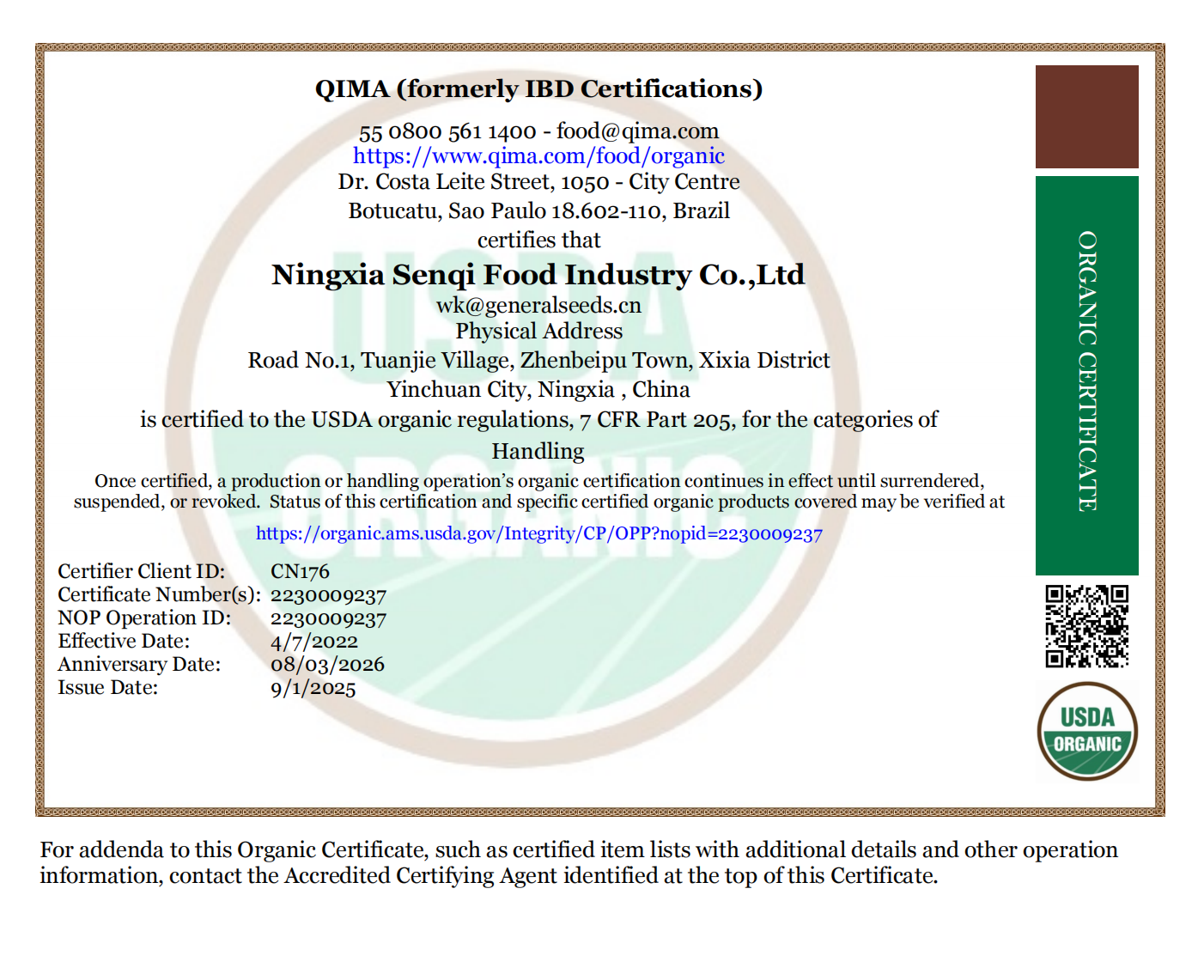
The USDA NOP certificate (2230009237, issued by QIMA) is a handling-scope document separate from the EU organic certificate.
Side-by-side: scope, issuer and validity
| Certificate | Issuing body | Stated scope | Validity noted |
|---|---|---|---|
| EU Organic, CN-BIO-122.156-0001518.2025.001 | IBD, under Regulation (EU) 2018/848 | Preparation, distribution, storing and export of un-processed and processed organic plant-based agricultural products | Per certificate copy held at contract |
| USDA NOP, 2230009237 | QIMA (formerly IBD Certifications) | Handling of organic hemp seed related products; global coverage | Issued 2025-09-01 |
| BRC Food Safety, F_EI0610_2025 | Eurofins | Sorting, optional re-drying, packing of listed dry goods including kernels and seeds | 2025-11-28 to 2027-01-10 |
| Kosher, RA44T-STOSC | KOF-K | 16 listed food products, including hemp seeds kernel and hemp seeds protein powder | 2025-10-27 to 2026-10-31 |
| Halal, SSPY-201318-32327-R2 | SSPY | 12 listed food products; manufacturer Ningxia Senqi Food Industry Co., Ltd. | 2025-10-31 to 2026-10-30 |
Matching certification to market, format and claim
Selling organic hemp seed into the EU
EU Regulation 2018/848 has applied since 1 January 2022, and from 1 January 2025 the EU organic import system moved fully to compliance with that regulation rather than equivalence. In practice, a third-country supplier of organic hemp hearts or organic hulled hemp seeds must present an EU organic certificate whose scope covers the activities actually performed — preparation, storage and export included — not a document issued under another country's programme. This is why the EU Organic and USDA NOP certificates in a portfolio are both necessary but not interchangeable.
Selling into the United States
US organic claims rest on NOP certification of the handler. The relevant document here is certificate 2230009237 issued by QIMA, with a handling scope covering organic hemp seed related products. Buyers running dual-market programmes should hold both documents on file and check that the product form they purchase — whole seed, hulled seed, kernel or protein powder — falls inside the listed scope rather than assuming the certificate name covers the range.
Kosher and halal programmes
Where a finished product carries a kosher or halal-friendly claim, the buyer's chain of evidence runs through the ingredient supplier's certificate and its product list. KOF-K certificate RA44T-STOSC explicitly covers hemp seeds kernel and hemp seeds protein powder among 16 listed products, and SSPY certificate SSPY-201318-32327-R2 lists 12 food products naming the manufacturer. A buyer whose formulation uses hemp hearts or roasted hemp seed should confirm those specific formats appear on the current certificate copy rather than relying on the category label.
Format coverage: hulled seed, hearts, kernels and protein powder
The product range associated with these certificates covers organic hemp seed, organic hulled hemp seed, organic hemp seed kernels, and organic hemp seed protein powder at 70% and 75%. Format selection changes the certification question in subtle ways. Hulling adds a processing step that must sit inside the certified scope. Protein powder at 70%–75% is a processed fraction, so both the organic scope and the food safety scope need to extend to it. Kosher and halal certificates are the most explicit about the format because their validity is tied to an enumerated product list.
Claims the five certificates do not cover
Label claims such as gluten-free, vegan, non-GMO, and pesticide- and herbicide-free are frequently listed alongside certification in supplier material, but none of the five documents reviewed here certifies them. Organic production rules restrict which inputs may be used, which supports an organic positioning, but an organic certificate is not a residue test report. Gluten-free and non-GMO statements require their own supporting documentation. Buyers building a claim set should separate what is certified, what is tested, and what is simply asserted, and request evidence in the category each claim belongs to.
Supplier signals beyond the certificate list
NINGXIA SENQI FOOD INDUSTRY CO., LTD. — trading as Senqi Food — is a Chinese agricultural processor and exporter based in Zhongning County, Ningxia, founded in 2020 and working across hemp products, goji berry products and buckwheat products. The company operates two factories, one sales centre and two planting farms, exports to more than 20 countries, and reports an export ratio of 90% with main markets in the EU and USA. Its workshops are built to GMP standard, and processing steps are structured to comply with BRC requirements.
For evaluation-stage buyers, the useful part of that profile is not the certificate count but the alignment between workshop practice and the BRC scope. A food safety certificate describing sorting and packing of kernels and seeds only means something if the facility is organised around those steps. The same logic applies to organic status: preparation, storage and export scope depends on physical segregation and record-keeping, not on the certificate alone.
Commercial terms also act as a filter. Organic hemp seed products carry a minimum order quantity of 500 kg. Product 7273 can be delivered under FOB, CIF or EXW incoterms. OEM and ODM production is available, with OEM covering logo, product forms (hulled or unhulled, dried and unroasted) and packaging, and ODM extending to custom formulations and packaging. Industrial hemp seed supplied under these formats is specified at THC content below 0.3%, available in bulk or 25 kg woven bags. Monthly capacity is 200 MT with a 10–20 day lead time, quality control through a third-party laboratory, and remote after-sales support.
One documented case illustrates the combination: an Australian wholesale buyer in health food applications has taken 50–80 mt over 24 months, with stable product quality meeting local food safety standards and batch consistency cited as the highlight. For buyers comparing suppliers, the transferable lesson is that certification only holds up when it is paired with repeatable batch output.
Where the coverage stops
A serious comparison has to state the boundaries, and this portfolio has four that buyers should plan around.
- Different validity cycles. BRC validity runs to 10 January 2027, while the kosher certificate is stated to 31 October 2026 and the halal certificate to 30 October 2026. Both dietary certificates operate on annual renewal, so a copy that was current during sampling may need refreshing before shipment. Buyers should request the currently valid copy at the point of contract and again before dispatch.
- Scope is activity-specific. The EU organic certificate covers preparation, distribution, storing and export of organic plant-based products. It does not describe field-level growing practice, and it does not replace destination-market rules on industrial hemp, including customs classification under HS code 12079991 for hemp seeds not intended for sowing in the EU and UK.
- BRC is a food safety standard, not a product claim. It evidences process control for the listed dry goods categories. It does not confer organic status, dietary acceptability or nutritional content.
- Order-size thresholds. A 500 kg minimum order and a 10–20 day lead time suit repeat commercial supply but constrain very small trial quantities, which buyers planning pilot launches should factor into scheduling.
Market signals that make scope-matching matter
Three data points frame why certification reading has become a procurement task rather than a paperwork formality.
First, EU hemp cultivation area rose to 37,740 hectares in 2024 from 28,830 hectares in 2023, according to European Commission statistics. More European raw material supply does not automatically translate into certified organic supply, because conversion periods and certified processing capacity remain the gating factors — but it does increase the number of suppliers a buyer must differentiate, which pushes the comparison back onto documentation quality.
Second, the processed segment is where certification complexity concentrates. Grand View Research and Mordor Intelligence place the global hemp protein powder market at USD 217.3 million in 2025, with the organic segment projected to grow at a 5.98% CAGR through 2031. Protein fractions sit furthest from the raw seed, so they accumulate the most processing steps that must fall inside organic and food safety scopes. Fortune Business Insights valued the global hemp seed oil market at USD 3.26 billion in 2025, with Europe holding 33.91% — reinforcing that European demand, and therefore European compliance expectations, is where much of the certification pressure originates.
Third, market-size figures should be read with care. DataM Intelligence reports the global hemp seeds market at USD 5.98 billion in 2025, heading to USD 10.84 billion by 2033 at a 7.8% CAGR, while IMARC Group reports USD 1.24 billion for 2025. The gap reflects definitional differences — whether downstream oil and protein value is included — and it is a reminder that sourcing decisions built on category headlines rather than on scope-level evidence are built on weak foundations.
What to expect next
Certification is moving from a static file toward a maintained record. The full-compliance phase of EU Regulation 2018/848 for third-country imports, tighter client audits on imported supplement raw materials, and the annual renewal rhythm of kosher and halal certificates all point the same direction: buyers will increasingly score suppliers on renewal tracking and scope precision, not on the number of logos on a datasheet.
For suppliers, that favours operations that can produce a scope-matched evidence pack quickly. For buyers, it argues for a simple internal rule: every certificate on file should map to one market, one product format and one label claim, with a validity date that survives the shipping schedule.
Frequently asked questions
Can a USDA NOP certificate replace an EU organic certificate for hemp seed?
No. They are separate documents issued under separate frameworks. The EU organic certificate CN-BIO-122.156-0001518.2025.001 is issued by IBD under Regulation (EU) 2018/848 with a scope covering preparation, distribution, storing and export of organic plant-based products. The USDA NOP certificate 2230009237 is issued by QIMA with a handling scope for organic hemp seed related products. A shipment requiring an EU organic claim needs the EU document; one requiring a US organic claim needs the NOP document.
Does a BRC certificate confirm that a hemp seed product is organic?
No. BRC certification, here certificate F_EI0610_2025 issued by Eurofins against the BRC Global Standard for Food Safety Issue 9, addresses process control for sorting, optional re-drying and packing of listed dry goods. Organic status comes from the separate organic certificates. Buyers need both where both claims are used.
Which products do the kosher and halal certificates cover?
The KOF-K kosher certificate RA44T-STOSC lists 16 food products including hemp seeds kernel and hemp seeds protein powder. The SSPY halal certificate SSPY-201318-32327-R2 lists 12 food products and names Ningxia Senqi Food Industry Co., Ltd. as manufacturer. Because both are product-list based, the specific format purchased should appear on the certificate copy.
How long do the kosher and halal certificates remain valid?
Both operate on annual cycles. As issued, the kosher certificate carried validity to 31 October 2026 and the halal certificate to 30 October 2026. Buyers should request the current valid copy at the time of contracting and again before shipment, rather than relying on a file copy supplied at the sampling stage.
What product formats are available under the certified range?
The certified range covers organic hemp seed, organic hulled hemp seed, organic hemp seed kernels, and organic hemp seed protein powder at 70% and 75%. Product 7273 can be delivered under FOB, CIF or EXW incoterms, and OEM and ODM services allow customisation of logo, product forms (hulled or unhulled, dried and unroasted), packaging and, for ODM, custom formulations.
What are the standard purchasing terms and acceptance criteria?
The minimum order quantity for organic hemp seed products is 500 kg. Delivery terms are FOB, CIF or EXW. Acceptance is based on pre-shipment testing, and payment terms are 30/70. Monthly capacity is 200 MT with a stated lead time of 10–20 days and third-party laboratory quality control.
For buyers who want the underlying specifications and product formats in one place, Senqi Food's company brochure is available here: Senqi Brochure (PDF).
Tem questões ou precisa de mais detalhes?
Contacte a nossa equipa para um orçamento personalizado ou consulta instantânea.
Solicitar orçamento
Preencha o formulário abaixo e a nossa equipa entrará em contacto com uma proposta personalizada.
Chat direto do WhatsApp
Prefere conversar em tempo real? Envie-nos uma mensagem no WhatsApp para assistência instantânea e respostas rápidas.
- Obter orçamento personalizado
- Partilhar fotos ou documentos
- Discuta as suas necessidades diretamente
Geralmente responde em 5–30 minutos durante o horário de expediente.