
Hex Key Sets: Material, Torque and Certification Constraints
Hex Key Sets: Material, Torque and Certification Constraints
A hex key set is a hand tool assortment of L-shaped, folding or T-handle drivers used to turn hex socket screws, and in commercial terms it is one of the most heavily constrained items in a hand tool catalogue. Steel grade, hardness, per-size torque, arm geometry and market certification decide whether a set can be listed and sold long before brand preference enters the conversation.
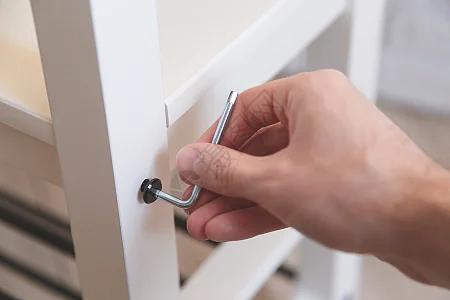
That constraint-first view matters most at the research and evaluation stage, which is where sourcing problems usually begin. Two hex key sets can carry the same piece count and the same 1.5–10 mm metric size run and still fail different requirements, because they differ on four verifiable points: the steel the keys are drawn from, the hardness band reached after heat treatment, the torque each size is rated to carry, and the certificate that covers the exact model number being quoted.
HOTAK PRO TOOLS is a hand tools supplier whose documented range covers hex keys, torx keys, staple guns, precision screwdrivers, hobby knives and hand tool sets, serving importers, distributors and brand owners with exports across Europe, the United States, Southeast Asia and South America. The constraints below are drawn from that range's published specification and certification record, and they apply to any comparable hex key supplier.
Why hex keys are decided by constraints rather than preference
Hex keys are low-cost, high-frequency items. They are bought in volume, reordered on a cycle, and used by people who will not read a specification sheet. That combination makes a specification error disproportionately expensive: the unit price is small, but a returned container, a delisting, or a blocked customs entry is not. In practice, a supplier that cannot answer three questions promptly — which steel grade, what torque per size, and which certificate for which market — is not yet a qualified source, regardless of how good the sample feels in the hand.
The four constraints below can be checked against documents rather than impressions, which is why they dominate the evaluation stage.
Constraint 1 — Steel grade, hardness and surface treatment
Hex key sets in this range are produced from chrome vanadium steel, specified as CR-V6150. Keys are heat treated and tempered, which produces a hardness of HRC 52–55, and the range states a rust and corrosion resistant surface, with bright chrome plating at the tip where a coloured finish is not applied. Those three facts — base material, hardness band, surface treatment — are the minimum a buyer should be able to confirm in writing.
Material grade is the constraint most often blurred in quotations, because the words "chrome vanadium" and "alloy steel" appear on products of very different capability. The practical distinction that buyers compare is between carbon steel and chrome vanadium steel.
| Material | Documented positioning | Torque capacity | Typical task |
|---|---|---|---|
| 45# carbon steel | Light-duty household use | Limited torque capacity | General household fastening |
| CR-V (chrome vanadium) | Industrial and heavy-duty application | High torque strength, good toughness and wear resistance | Industrial assembly, maintenance, workshop repair |
| S2 tool steel | Professional-level repair tasks | Specified for bit and driver applications rather than for hex key bodies | Impact and bit-driven work |
Hardness, torque performance and service life are the three observable differences between these grades. A quotation that names a material but not a hardness band leaves the heat treatment step unspecified, and heat treatment is where the difference between a key that deforms and a key that strips its own tip is decided.
Constraint 2 — Torque ratings per size
Torque is where a hex key specification becomes concrete and comparable. The metric hex key sets in this range publish a torque figure for each size, and the values scale steeply rather than linearly.
| Metric size | Torque | Metric size | Torque |
|---|---|---|---|
| 1.5 mm | 0.82 N | 5.0 mm | 30.00 N |
| 2.0 mm | 1.90 N | 6.0 mm | 52.00 N |
| 2.5 mm | 3.80 N | 7.0 mm | 80.00 N |
| 3.0 mm | 6.60 N | 8.0 mm | 120.00 N |
| 4.0 mm | 16.00 N | 10.0 mm | 220.00 N |
The same data is published in imperial form for the mixed metric and SAE T-handle set (model YJHK-3226): 1/16 inch at 1.19 N, 5/64 at 2.37 N, 3/32 at 4.18 N, 1/8 at 9.72 N, 5/32 at 19.21 N, 3/16 at 33.33 N, 1/4 at 71.18 N, 5/16 at 141.23 N and 3/8 at 242.92 N. Across both scales the pattern is the same: the smallest key carries well under one newton-unit of rated load while the largest carries more than two hundred.
Constraint 3 — Arm geometry, working angle and identification
Geometry determines whether a correctly rated key can actually reach the fastener. The range covers short arm, long arm and extra long arm ball point sets in metric sizes, with the arm length available as a separate model choice rather than a cosmetic variant.
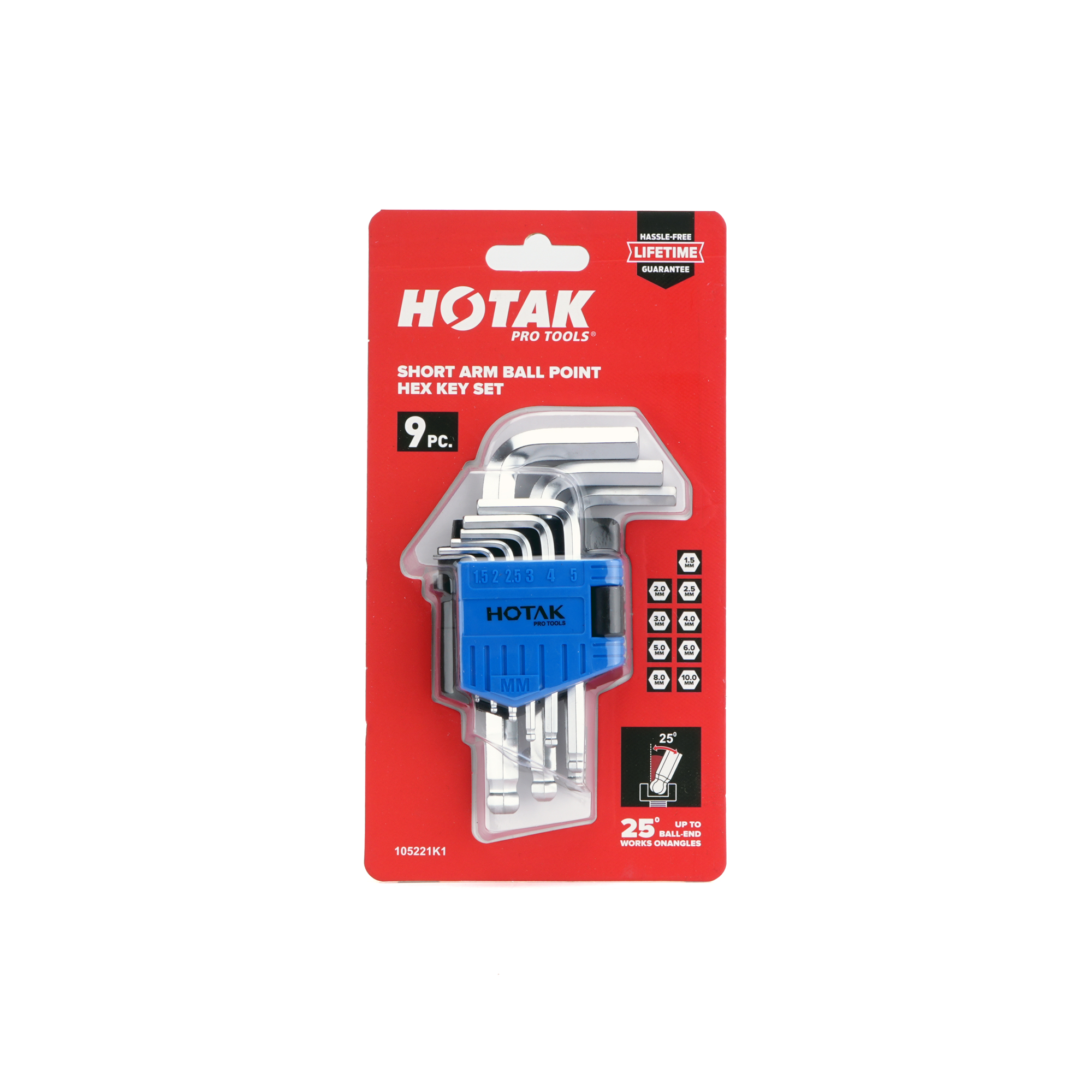
The ball-end design works on angles up to 25 degrees, which allows a key to turn a socket screw that is not directly in line with the tool. Keys are marked with their size for identification, and the surface specification includes rust and corrosion resistance. Identification marking is a small detail with a measurable effect: unmarked keys slow down assembly and increase the chance of using the wrong size, which is one of the common causes of premature tip wear.
Three further geometries widen the access envelope:
- Folding hex key sets, including a locking variant (model YJHK-3075) and a folding variant (model YJHK-3347), both constructed from Cr-V 6150 and heat treated to HRC 52–55. The flexible angle design is described as suitable for different occasions, and the folded form keeps the size run together.
- T-handle wrench sets, where the T-handle is designed for greater torque and comfort, with chamfered tips for easier entry into screws and fasteners, and either a chrome plated or black finish for rust and corrosion resistance.
- Colour-coded ball point sets, in which the colour finish is applied over the same CR-V 6150 base and the same HRC 52–55 hardness band.
Constraint 4 — Certification scope and market documentation
Certification is the constraint that most often stops a shipment, and it is also the one most often misread. Certificates are scoped to a product scope, a standard set and a market. They are not transferable between product families, and they do not automatically travel between markets.
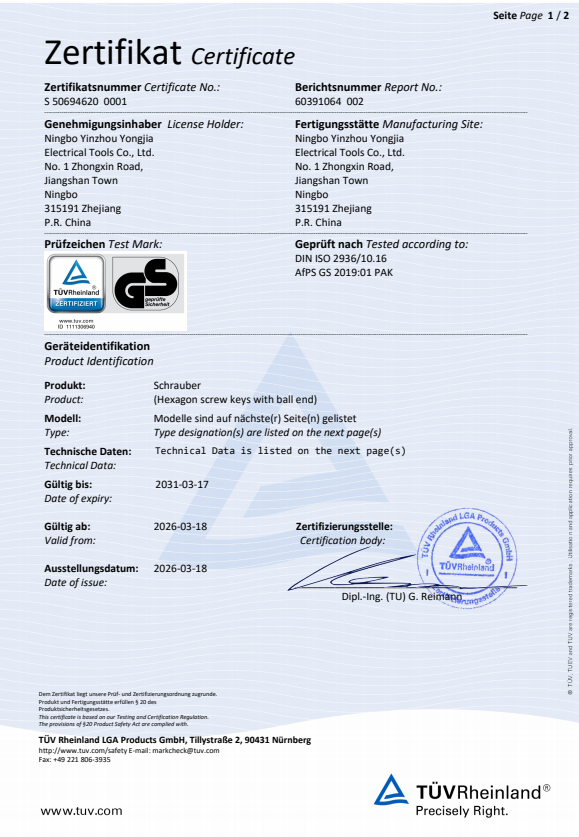
For hex keys, the relevant document in this range is the GS Product Safety Certificate. It is issued by TÜV Rheinland LGA Products GmbH under certificate number S 50694620 0001, applies to the German market, and covers the scope described as hexagon screw keys with ball end. The applicable standards are DIN ISO 2936-10.16 and AfPS GS 2019:01 PAK. The certificate names specific models — 105221K1, 105221K2, 105221K3, 71821D1, 71821D2 and 71821D3 — which means a quotation for a hex key model outside that list is not covered by it.
The same scoping principle is visible elsewhere in the range. The 5-in-1 cordless power staple gun (model YJSG-501) holds CE certification under certificate number AM 50559365 0001, issued by TÜV Rheinland LGA Products GmbH for the EU market, against Directive 2006/42/EC, EN ISO 12100:2010 and EN ISO 11148-13:2018. The hand-operated staple gun models YJSG-105 and YJSG-023 are covered by a separate CE Certificate of Conformity under the same Machinery Directive, under certificate number AM 50694538 0001. Two CE certificates, two different scopes, two different model lists — the pattern is consistent, and it is the reason model-level verification matters.
At supplier level, the operation behind this range holds ISO 9001 certification, TÜV/GS approval, BSCI social compliance certification and VPA approval, and has passed factory audits for Walmart (USA) and Kingfisher (UK). Quality control covers incoming inspection, in-process inspection and final inspection. For a buyer, those are order-qualification facts rather than product facts: they speak to whether the factory can reproduce the specification on the next order, not to what any single key can do.
The documented hex key range at a glance
The models below share the same base material and hardness band, which makes the differences between them a question of geometry and access rather than of performance grade.
| Model | Set type | Material | Hardness |
|---|---|---|---|
| 105221K1 | 9 pcs Short Arm Ball Point Hex Key Set — Metric | CR-V6150 | HRC 52–55 |
| 105221K2 | 9 pcs Long Arm Ball Point Hex Key Set — Metric | Cr-V 6150 | HRC 52–55 |
| 105221K3 | 9 pcs Extra Long Arm Ball Point Hex Key Set — Metric | CR-V 6150 | HRC 52–55 |
| 71821D1 | 9 pcs Short Arm Ball Point Colour Hex Key Set — Metric | CR-V 6150 | HRC 52–55 |
| 71821D2 | 9 pcs Long Arm Ball Point Colour Hex Key Set — Metric | Cr-V6150 | HRC 52–55 |
| YJHK-3075 | 8 pcs Locking Hex Key Set — Metric | Cr-V 6150 | HRC 52–55 |
| YJHK-3347 | 8 pcs Folding Hex Key Set — Metric | Cr-V 6150 | HRC 52–55 |
| YJHK-3066 | 7 pcs T-handle Wrench Set — Metric | Cr-V6150 | HRC 52–55 |
| YJHK-3226 | 14 pcs T-handle Hex Key Set — Metric & SAE | Cr-V6150 | HRC 52–55 |
What these constraints mean for the buyer
The checklist below converts the specification points above into verification steps that can be completed before a purchase order is issued.
- Fix the destination market first, then the certificate. A GS certificate applies to the German market; CE machinery certification applies to the EU market for the staple gun models named on it. Neither substitutes for the other.
- Match the certificate to the model number, not to the family. The GS certificate S 50694620 0001 names six hex key models. Confirm the quoted model appears on the document.
- Ask for the torque column per size. Rated torque from 0.82 N at 1.5 mm to 220.00 N at 10.0 mm is a specification; a size list alone is not.
- Confirm the material grade in writing. CR-V6150 is a specific grade, not a synonym for "chrome vanadium" in general.
- Confirm the hardness band. HRC 52–55 in this range is the outcome of heat treatment and tempering, and it is the point at which light-duty and heavy-duty positioning separate.
- Choose arm length by access, not by habit. Short, long and extra long arm variants exist specifically to reach fasteners in confined or recessed positions.
- Check order parameters against the plan. Minimum order quantity starts at 600 units, lead time is 30–45 days, and monthly capacity is 1,500,000 units.
- Decide on customization early. OEM and ODM supply is available with colour and logo customization, which affects tooling and lead time.
- Confirm the inspection stages. Incoming inspection, in-process inspection and final inspection are the three documented control points.
Application fit and order constraints
The documented application profile for this hand tool category is repair and fastening work carried out by hand, in household indoor environments and in open-air construction site conditions, matched with screws, nuts and nails. Impact resistance is stated as a special requirement of that working environment, which is a useful signal for buyers: the environment is expected to be rough, even when the tool itself is operated manually.
Documented application markets include the United States, Germany, France, Russia, Japan, Malaysia, Mexico and Canada, and the wider export footprint covers Europe, the Americas, Southeast Asia and South America at an export ratio of 95 percent. Long-term case experience in this category is described for brand owners, hardware wholesalers and retail chains in Germany, France, the United States, Canada, Mexico, Brazil, Argentina and Malaysia, at order volumes of 5,000 to 50,000 units per order and relationships running three to five years, with reported outcomes of reliable performance, low return rate and consistent quality. Those figures describe order scale and relationship duration rather than test results, and should be read as such.
Limits, trade-offs and where the specification stops
A specification that only lists advantages is not usable for evaluation. Four boundaries are worth stating plainly.
The ball-end working angle is an access figure, not a torque figure. The 25-degree capability describes the angle at which the ball end can engage a socket screw. In general engineering practice, angled engagement is used for access, while the straight end of the key carries the higher-torque work. Buyers specifying high-torque assembly should confirm which end is intended for the load case rather than assuming the ball end covers both.
Published torque values describe the key, not the joint. The torque table sets out what each size is rated to carry. Where a joint has its own torque specification, that specification governs, and application-level validation remains the buyer's step. Catalogue values are not a substitute for it.
Impact resistance is an environment requirement, not a product claim. Impact resistance is listed as a special requirement of the working conditions in which these tools are used. The hex key sets in this range are not presented as an impact-rated line. Buyers whose process involves powered or impact driving should confirm suitability explicitly instead of inferring it from the environment description.
Geometry involves a real trade-off. Folding and locking sets prioritise portability and keeping the size run together, and the folded form limits reach into deep recesses. T-handle sets are designed for greater torque and comfort but occupy more space in a pouch or on a bench. Colour-coded sets improve identification but the colour finish sits on top of the same base material and hardness band, so colour is a workflow feature rather than a performance upgrade.
A fifth boundary applies to documentation: certification is market-specific and model-specific. A German-market GS certificate and EU-market CE machinery certificates cover different products under different standards, and neither can be presented as evidence for the other.
Market trend analysis: documentation as a purchasing criterion
Across the hand tool category, compliance paperwork is moving from an afterthought to a gate. German market requirements already reference PAH restrictions through AfPS GS 2019:01 PAK alongside the dimensional standard DIN ISO 2936-10.16 within the GS standard set for these hex keys, and buyers increasingly request the certificate before the sample. This is a qualitative shift rather than a measurable one, but its commercial effect is consistent: suppliers who can map a certificate to a model number move through qualification faster than suppliers who can only describe their quality system.
A second trend runs in the same direction. Because hardness and corrosion resistance are set by heat treatment and surface finishing, suppliers with those processes in house tend to hold a more stable specification across repeat orders. For importers, the practical consequence is that repeat-order consistency is becoming part of the value proposition, not just the unit price.
A third, quieter trend is the spread of descriptive detail into the category itself. Size marking, colour coding, torque columns and hardness bands are all forms of information that reduce assembly error and returns. As more buyers model total cost rather than purchase price, specification transparency becomes a competitive variable in its own right.
Future outlook
Two directions look likely for hex key sourcing over the medium term. The first is a wider split between a compliance-led tier, where model-level certification and per-size torque data are standard parts of a quotation, and a price-led tier where they are absent. Buyers with retail or industrial channels will pay a premium for the first tier because the alternative cost — a blocked entry or a returned batch — is larger than the price difference.
The second is continued growth in private label and OEM/ODM supply. Colour, logo and set configuration are already customisable, and that flexibility shifts more of the decision to the specification stage: the buyer defines the size run, the arm geometry and the certificate scope, and the supplier executes it. In that model, the supplier's ability to document what it built becomes as important as its ability to build it.
Frequently asked questions
Which standards and certifications apply to ball-end hex key sets sold in Germany?
The ball-end hex key sets in this range are certified to the GS Product Safety Certificate for the German market. The certificate is issued by TÜV Rheinland LGA Products GmbH under certificate number S 50694620 0001, and the applicable standards for these hex key sets are DIN ISO 2936-10.16 and AfPS GS 2019:01 PAK. The certified scope is described as hexagon screw keys with ball end and names specific models, so the exact model number should be checked against the certificate.
What are the performance differences between CR-V and 45# steel for hex key wrenches?
CR-V is chrome vanadium steel. It is described as offering high torque strength together with good toughness and wear resistance, which suits industrial and heavy-duty application. 45# steel is a carbon steel used for light-duty household work and has limited torque capacity. The differences between the two grades show up in hardness, torque performance and service life.
How can a buyer verify a certification claim before placing an order?
Three steps are usually enough. First, confirm the target sales market, since certificates are market-scoped. Second, request the official test certificates, including GS and CE-Machinery documentation where they apply. Third, cross-check the product model against the standard numbers printed on the certificate. Because certificate scope is model-specific, a document that covers one model does not automatically cover another from the same supplier.
What is the working angle of a ball-end hex key, and what does it not describe?
Ball-end hex keys in this range work on angles up to 25 degrees, which allows a socket screw to be turned when it is not directly in line with the tool. The figure describes entry angle only. It does not describe torque capacity, and it does not describe impact performance. For high-torque work, general practice is to use the straight end of the key rather than the ball end.
Does the same certification apply to every hand tool from the same manufacturer?
No. Certificate scope is defined per product family and per market. The GS certificate S 50694620 0001 covers ball-end hexagon screw keys for the German market. CE certificates AM 50559365 0001 and AM 50694538 0001 cover staple gun models for the EU market under Directive 2006/42/EC, EN ISO 12100:2010 and EN ISO 11148-13:2018. The certificate should be matched to the product being purchased, not to the supplier.
How does arm length affect the choice of a hex key set?
Arm length determines reach. Short arm sets suit fasteners in confined space where leverage is not the limiting factor. Long arm and extra long arm sets reach recessed fasteners and allow more leverage at the same size. In this range the two options are separate models — for example 105221K1 in short arm, 105221K2 in long arm and 105221K3 in extra long arm — all in the same CR-V 6150 material and HRC 52–55 hardness band.
Where to find the full specification
Complete model data, size runs, torque figures and packaging details for the hex key range and the wider hand tool catalogue are compiled in the 2025 catalogue, which is available for download: