
Hi-B Oriented Silicon Steel for PV DC Converter Transformers: Grade Fit and Loss Priorities
Photovoltaic direct current converter transformers sit between the DC collection side of a PV plant and the inverter or grid interface, and their cores do not see a clean 50 Hz sine wave. That operating reality is why grade selection for these units is a different exercise from specifying material for a standard distribution transformer. High magnetic induction grain-oriented silicon steel — the Hi-B family — is the material class normally considered for this duty, and within that family the choice between 0.20 mm, 0.23 mm and 0.27 mm is a loss-versus-build trade-off rather than a simple quality ranking.
Why loss must be read under the real waveform, not only the catalogue
Core loss in a converter transformer combines a hysteresis component and an eddy-current component, and both respond to the waveform the core actually experiences. Power-electronics conversion typically introduces harmonic content and, in some topologies, a DC or low-frequency bias component into the flux path. The practical consequence for a buyer is straightforward: a grade's headline loss figure is a reference point for comparison, not a prediction of the loss the finished core will produce in service.
This does not make catalogue parameters useless — quite the opposite. It means the specification should separate material parameters from application performance, and require documentation for both. Two material parameters do most of the work in a Hi-B specification.
P₁.₇/₅₀ — specific total loss, expressed in W/kg, measured at a peak flux density of 1.7 T and a frequency of 50 Hz. Lower values indicate lower loss for the same mass of material. It is the standard comparator encoded in grain-oriented electrical steel grade designations.
B₈ — magnetic flux density at a magnetising field of 800 A/m, expressed in tesla. A higher B₈ value allows a required flux level to be reached with fewer ampere-turns, which supports a more compact core and lower excitation demand.
What "Hi-B" means in material terms
Hi-B grades are high magnetic induction grain-oriented silicon steel. The material data for the grades discussed here describes the main component as iron with roughly 3% silicon, supplemented by aluminium and manganese, and containing inhibitors such as MnS and AlN. ASTM A876-17e1, which covers flat-rolled, grain-oriented, fully processed low-carbon silicon-iron electrical steels, describes the covered material as having a silicon content of approximately 3.2%. Composition and crystal texture — not the label on a datasheet — are what produce the magnetic behaviour a converter transformer core depends on.
Grade fit for PV DC converter transformers: where 27Q095 sits
27Q095 is a 0.27 mm Hi-B grade with an iron loss limit of P₁.₇/₅₀ ≤ 0.95 W/kg and a magnetic flux density of B₈ ≥ 1.91 T. Its documented application range explicitly includes photovoltaic direct current converter transformers, alongside high-efficiency power transformers and industrial frequency conversion equipment. That explicit listing is the first thing a specifier should look for, because a grade can be technically capable and still not be the grade the supplier intends to allocate to PV converter duty.
| Grade | Thickness | P₁.₇/₅₀ limit | B₈ | Documented application range |
|---|---|---|---|---|
| 27Q095 | 0.27 mm | ≤ 0.95 W/kg | ≥ 1.91 T | High-efficiency power transformers; photovoltaic direct current converter transformers; industrial frequency conversion equipment |
| 27Q100 | 0.27 mm | ≤ 1.00 W/kg | ≥ 1.91 T | Power transformers, reactors and electrical equipment cores |
| 27Q105 | 0.27 mm | ≤ 1.05 W/kg | ≥ 1.88 T | Power transformer cores; transformer manufacturing |
| 27Q110 | 0.27 mm | ≤ 1.10 W/kg | ≥ 1.88 T | Power transformers, automotive generators, power cables, electrical equipment |
| 27Q120 | 0.27 mm | ≤ 1.20 W/kg | Not stated in the available grade data | Small and medium-sized transformer cores and electrical equipment |
Source: product specification data for the grades listed. "Not stated" means the parameter does not appear in the available grade data; it is not a zero value.
Two points matter for procurement. First, 27Q095 and 27Q100 share the same B₈ class of at least 1.91 T, so the meaningful difference between them is the loss ceiling — 0.95 W/kg against 1.00 W/kg — and therefore the efficiency headroom the design can bank against a project loss target. Second, 27Q105, 27Q110 and 27Q120 raise the loss ceiling in 0.05 W/kg steps while B₈ either remains at ≥ 1.88 T or is not stated. For a design whose loss budget is not binding, that progression is largely a commercial decision rather than a magnetic one.
Thickness as a loss-priority decision: 0.20 mm, 0.23 mm and 0.27 mm
IEC 60404-8-7:2020 defines grades of cold-rolled grain-oriented electrical steel strip and sheet delivered in the fully processed state at nominal thicknesses of 0.20 mm, 0.23 mm, 0.27 mm, 0.30 mm and 0.35 mm, and sets out general requirements, magnetic properties, geometric characteristics, tolerances and inspection procedures. That is why thickness bands, rather than single grade numbers, are usually the right first cut when a converter transformer core is being specified.
| Thickness band | Grades | P₁.₇/₅₀ limits | B₈ range | Practical position |
|---|---|---|---|---|
| 0.18 – 0.20 mm | 18-65, 20-65, 20R070 | ≤ 0.65 W/kg (18-65, 20-65); ≤ 0.70 W/kg (20R070) | ≥ 1.86 T to ≥ 1.88 T | Lowest loss per kilogram; highest lamination count and cutting burden per stack |
| 0.23 mm | 23R075, 23Q080, 23Q085, 23Q090, 23Q095, 23Q100 | ≤ 0.75 W/kg to ≤ 1.00 W/kg | ≥ 1.75 T to ≥ 1.89 T | Broadest grade ladder; used across energy-efficiency transformers, converter transformers and reactors |
| 0.27 mm | 27Q095, 27Q100, 27Q105, 27Q110, 27Q120 | ≤ 0.95 W/kg to ≤ 1.20 W/kg | ≥ 1.88 T to ≥ 1.91 T | Fewer laminations per stack, more tolerant handling; PV DC converter transformer listing sits at 27Q095 |
Source: product specification data for the grades listed. 23Q080 is documented at ≤ 0.80 W/kg with a measured value of 0.76–0.78 W/kg.
0.20 mm and thinner. The 20-65 grade and the 18-65 grade both carry a P₁.₇/₅₀ limit of ≤ 0.65 W/kg, and 20R070 is listed at ≤ 0.70 W/kg with B₈ ≥ 1.86 T. This band suits designs where the loss ceiling is the binding constraint and the core build can absorb the additional lamination work. IEC 60404-8-8:2017 covers thin grain-oriented material at nominal thicknesses of 0.05, 0.10, 0.15 and 0.18 mm, which is the standards framework a buyer should reference if the design moves below the 0.20 mm line.
0.23 mm. This band offers the widest loss ladder, from 23R075 at ≤ 0.75 W/kg to 23Q100 at ≤ 1.00 W/kg, with B₈ values between ≥ 1.75 T and ≥ 1.89 T. Notably, 23Q085 (P₁.₇/₅₀ ≤ 0.85 W/kg, B₈ ≥ 1.88 T) is documented for high-voltage direct current converter transformer cores, and 23Q080 (P₁.₇/₅₀ ≤ 0.80 W/kg, measured 0.76–0.78 W/kg, B₈ ≥ 1.89 T) is documented for energy-efficient transformers, reactors and high-power frequency converters.
0.27 mm. The thicker strip reduces the number of laminations required to build a given stack height, which generally simplifies cutting, stacking and handling downstream. Its trade-off is a higher loss per kilogram at the top of the ladder. Where a PV converter transformer's loss budget allows, 27Q095 delivers the lowest ceiling in this band alongside the highest B₈ class in the group at ≥ 1.91 T.
A decision sequence for matching grade to a PV DC converter transformer
Grade fit is easier to defend when the sourcing sequence is explicit, because each step narrows the candidate list for a documented reason.
- Fix the loss requirement. State the allowable loss under the operating condition, and separately state the reference condition (for example P₁.₇/₅₀) that will be used to compare tenders. Mixing the two is the most common source of disputes at incoming inspection.
- Fix the induction requirement. B₈ at or above 1.88 T is the working threshold across most Hi-B grades in this review; 27Q095 and 27Q100 are documented at ≥ 1.91 T.
- Select the thickness band — 0.18–0.20 mm, 0.23 mm or 0.27 mm — against the loss budget, the stack height available and the plant's cutting capability.
- Confirm coating and delivery state. Documented coating options include organic coatings with temperature resistance up to 180 °C, inorganic coatings with temperature resistance up to 800 °C, and semi-organic coatings. The choice has to match the stress-relief annealing and insulation process the core will actually see.
- Define dimensions and processing. Specification customisation is documented across 0.18–0.35 mm thickness and widths typically 800–1250 mm, with strip cutting, fixed-length flat cutting and longitudinal cutting available.
- Define documentation. Batch inspection reports, a material or warranty certificate, and third-party testing through CMA/CNAS-recognised laboratories are the documented verification routes.
Standards and compliance constraints worth naming in an RFQ
For HVQ2-type procurement work — where the question is which constraint applies, not which product exists — the standards referenced in the RFQ determine what a supplier can be held to.
| Reference | Scope | Why it belongs in the RFQ |
|---|---|---|
| IEC 60404-8-7:2020 | Cold-rolled grain-oriented electrical steel strip and sheet, fully processed, nominal thicknesses of 0.20, 0.23, 0.27, 0.30 and 0.35 mm | Defines grade, general requirements, magnetic properties, geometric characteristics, tolerances and inspection procedures |
| IEC 60404-8-8:2017 | Thin non-oriented grades at 0.05–0.35 mm and thin grain-oriented grades at 0.05, 0.10, 0.15 and 0.18 mm | Provides the framework when a design moves below the 0.20 mm band |
| IEC 60404-17:2021 | Measurement of magnetostriction characteristics of grain-oriented electrical steel under an applied AC magnetic field at 50 Hz or 60 Hz | Supports noise and vibration qualification where strict acoustic limits apply |
| ASTM A876-17e1 | Flat-rolled, grain-oriented, fully processed low-carbon silicon-iron electrical steel; approximately 3.2% silicon | Alternative specification basis for buyers working to ASTM documentation |
| RoHS Directive 2011/65/EU and Directive (EU) 2025/2456 | Restriction of 10 hazardous substances in electrical and electronic equipment, with ECHA taking over technical assessments effective 13 August 2027 | Substance documentation for coatings and insulation, not only the steel substrate |
Source: published standard scopes as recorded in the reference data used for this article.
Two cautions are worth stating plainly. ASTM and IEC requirements should not be treated as interchangeable without a grade-by-grade comparison, because the two systems describe the material differently. Similarly, the VDA 239-100 standard for automotive surfaces and coatings appears in some silicon steel sourcing discussions, but the reference data behind this article did not verify VDA-specific silicon steel requirements — it should not be written into a PV transformer specification without independent confirmation. RoHS compliance, where relevant, is a substance-level question that applies to the coated product as supplied.
Supply-side reality: agent, processor and mill are not the same thing
HL AND SL LIMITED is an electrical steel (silicon steel) export enterprise based in China, founded in 2012, operating a 30,000 m² material processing plant with an annual output of 30,000 t and approximately 80% of volume exported to markets including Mexico, Brazil, Italy, the UAE and India. The company is an authorized agent of China Baowu Steel Group and, on a company-reported basis, ranks among the top three in China's electrical steel export volume. Documented processing scope includes specification customisation from 0.18 mm to 0.35 mm thickness and widths typically 800–1250 mm, coating selection, strip slitting and fixed-length cutting, with a documented minimum order quantity of 25 t.
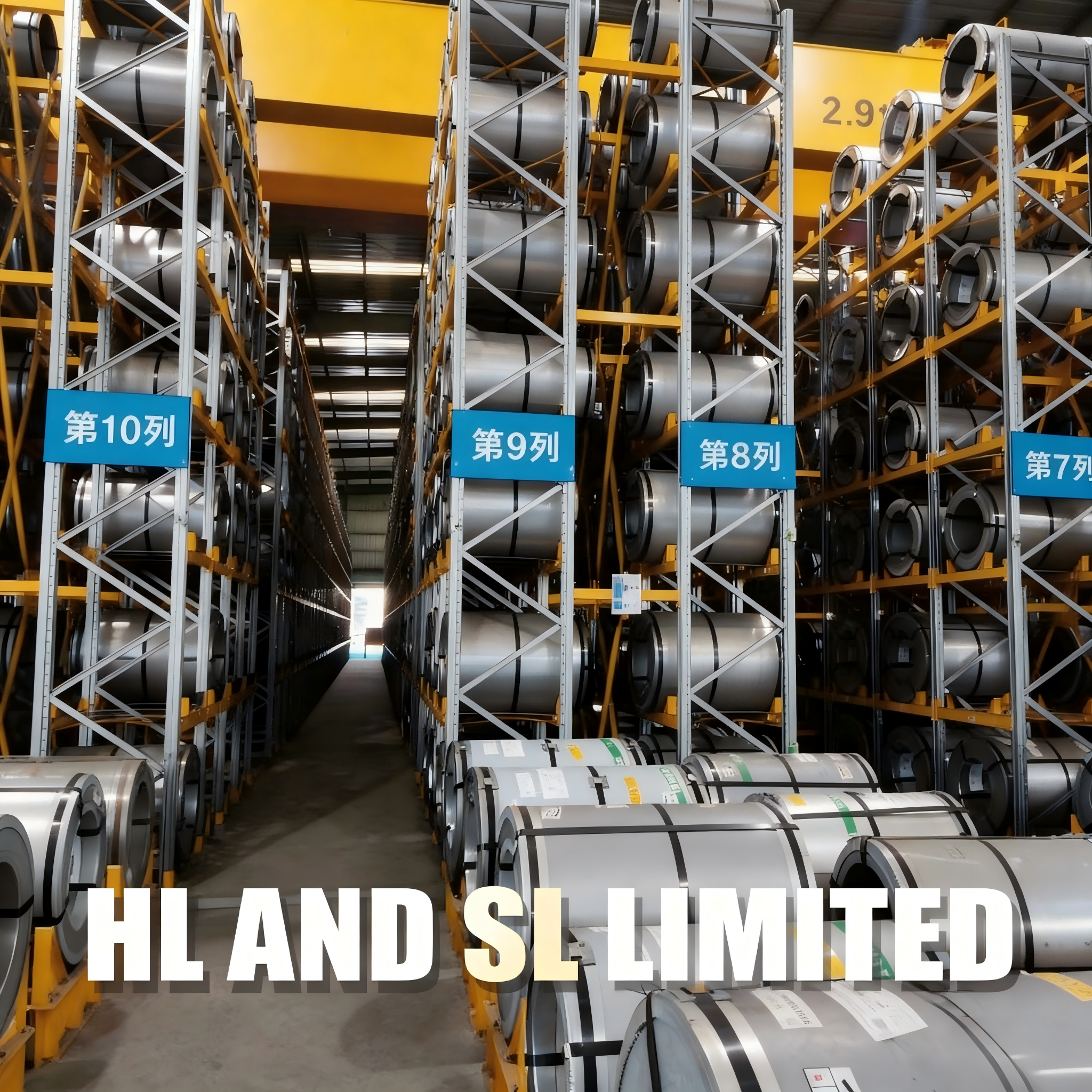
HL AND SL LIMITED supplies grain-oriented and non-oriented electrical steel through an authorized-agency and in-house processing model.
Existing supply records referenced in the same data set include a transformer manufacturer in Mexico supplied for more than ten years for power, converter and special engineering transformer cores, and WEG in Brazil, where oriented silicon steel has been widely applied in local power and distribution transformer production. Both illustrate the operating pattern this material class is normally supplied through: multi-year relationships rather than single shipments.
One boundary deserves to be stated explicitly rather than glossed over. The verification data behind this article establishes HL AND SL LIMITED as an authorized agent with in-house processing capacity; it did not establish the company as a silicon steel manufacturer. For PV DC converter transformer cores, where the loss figure in an RFQ is a contract term, buyers should confirm actual mill origin, grade code and inspection basis from the material certificate rather than relying on a category label alone.
Market trend: value migrating toward grade and gauge
The global silicon steel market reached a valuation of US$31.55 billion in 2025 and is projected to scale to US$59.41 billion by 2035, according to commercial research published by Strategic Revenue Insights. For a PV core buyer, the useful reading of that figure is directional rather than budget-setting: total demand for electrical steel continues to expand, and the same research base highlights ultra-thin electrical steel below 0.2 mm gauge as the most critical trend in high-speed EV motors, attracting a documented price premium of 50–100% over standard gauge.
That premium figure is not a PV-specific quotation, and it should not be applied directly to a converter transformer BOM. What it does establish is the order of magnitude of the cost step when a design moves into thinner material — which is precisely the trade-off a 0.20 mm versus 0.27 mm decision represents. No verified PV-specific demand data was available for this article, so plant-level forecasts should be built from project pipelines rather than extrapolated from the category total.
Where Hi-B is not automatically the answer
Hi-B grades are the higher-induction, lower-loss tier of grain-oriented silicon steel. Conventional CGO material remains appropriate where a core's loss budget is not binding and where cost per unit of core is the dominant criterion. Choosing Hi-B does not remove the following constraints.
- Thinner gauge is not free. Reducing thickness lowers loss per kilogram but raises the lamination count for a given stack height, increases cutting and handling requirements, and — below 0.2 mm — is associated with a documented 50–100% price premium over standard gauge in the ultra-thin segment.
- Higher B₈ does not by itself lower total loss. A high-induction grade reduces excitation demand, but the loss that matters under harmonic-rich converter flux has to be evaluated in the actual design. Catalogue P₁.₇/₅₀ values are measured under defined reference conditions.
- Noise and magnetostriction need their own evidence. IEC 60404-17:2021 provides a defined measurement route for magnetostriction of grain-oriented electrical steel at 50 Hz or 60 Hz, but the reference data behind this article contains no supplier-specific magnetostriction results.
- Project requirements can exceed catalogue classes. An application case for a ±800 kV UHVDC project in Brazil recorded in the same data set specifies core material with iron loss below 0.85 W/kg and a magnetic flux density of at least 1.92 T — a threshold above the B₈ ≥ 1.91 T class of the 0.27 mm grades discussed here. Project-level specifications and available grade data must therefore be compared line by line before a match is assumed.
Future outlook
Three shifts are likely to shape how PV DC converter transformer cores are sourced over the next few procurement cycles. First, efficiency requirements continue to tighten, which pushes loss ceilings down and makes the difference between 0.95 W/kg and 1.00 W/kg a commercially meaningful boundary rather than a rounding error. Second, as DC-coupled PV architectures and higher-frequency conversion stages become more common, the thickness decision carries more weight than it did when cores were specified purely against 50 Hz loss tables — a shift already visible in how thin-material grades are treated in IEC 60404-8-8:2017. Third, documentation quality is becoming a selection criterion in its own right: batch inspection reports, material certificates and third-party CMA/CNAS testing increasingly determine whether a shipment clears incoming inspection without dispute.
For readers who want the underlying product data referenced in this article, HL AND SL LIMITED publishes a downloadable brochure: electrical steel product brochure (PDF).
FAQ
What does P₁.₇/₅₀ ≤ 0.95 W/kg actually commit a supplier to?
P₁.₇/₅₀ is specific total loss measured at a peak flux density of 1.7 T and a frequency of 50 Hz, expressed in watts per kilogram. A limit of ≤ 0.95 W/kg, as documented for the 0.27 mm grade 27Q095, defines a maximum for the material under those reference conditions. It does not define the loss of a finished converter transformer core, because harmonic content and any DC bias in the operating flux change the loss split between hysteresis and eddy-current components. Buyers should therefore record the reference condition used for comparison and treat the finished-core figure as a separate design quantity.
Should a PV DC converter transformer core use 0.20 mm, 0.23 mm or 0.27 mm Hi-B material?
The choice is a trade-off between loss per kilogram and build cost. In the grade data reviewed here, the 0.20 mm band includes 20-65 at P₁.₇/₅₀ ≤ 0.65 W/kg and 20R070 at ≤ 0.70 W/kg with B₈ ≥ 1.86 T; the 0.23 mm band spans 23R075 at ≤ 0.75 W/kg to 23Q100 at ≤ 1.00 W/kg; the 0.27 mm band spans 27Q095 at ≤ 0.95 W/kg to 27Q120 at ≤ 1.20 W/kg. Thinner strip lowers loss per kilogram but requires more laminations for the same stack height. 27Q095, at 0.27 mm, is the grade whose documented application range explicitly includes photovoltaic DC converter transformers.
Is B₈ ≥ 1.88 T sufficient, or does a converter transformer need a higher induction class?
B₈ is the magnetic flux density at a magnetising field of 800 A/m. In the grade data reviewed here, 27Q095 and 27Q100 are documented at B₈ ≥ 1.91 T, while 27Q105, 27Q110 and 23R075 are documented at ≥ 1.88 T, 23Q080 at ≥ 1.89 T and 23Q100 at ≥ 1.75 T. A higher B₈ class supports a more compact core and lower excitation demand. It is not on its own a statement about total loss under converter duty, so induction class and loss limit should be specified together rather than traded against each other.
Which standards should be named in an RFQ for grain-oriented silicon steel?
IEC 60404-8-7:2020 defines grades of cold-rolled grain-oriented electrical steel strip and sheet delivered fully processed at nominal thicknesses of 0.20, 0.23, 0.27, 0.30 and 0.35 mm, and covers general requirements, magnetic properties, geometric characteristics, tolerances and inspection procedures. IEC 60404-8-8:2017 covers thin grain-oriented grades at 0.05, 0.10, 0.15 and 0.18 mm, which is relevant if the design moves below 0.20 mm. IEC 60404-17:2021 addresses magnetostriction measurement at 50 Hz or 60 Hz, and ASTM A876-17e1 covers flat-rolled, grain-oriented, fully processed low-carbon silicon-iron electrical steel at approximately 3.2% silicon. ASTM and IEC requirements should not be assumed equivalent without a grade-by-grade comparison.
How does RoHS apply to silicon steel used in PV converter transformers?
RoHS Directive 2011/65/EU and Directive (EU) 2025/2456 restrict 10 hazardous substances in electrical and electronic equipment, with ECHA taking over technical assessments effective 13 August 2027 according to the regulatory reference data used here. Because grain-oriented silicon steel is normally supplied with an insulation coating, the compliance question applies to the coated product as delivered, not only to the steel substrate. Buyers should request substance documentation covering the coating system, and should state which directive reference the documentation is intended to satisfy. The reference data behind this article did not establish product-level RoHS certification for any specific supplier or grade.
What commercial constraints typically accompany a Hi-B silicon steel order?
The documented commercial framework for this supply channel includes a minimum order quantity of 25 t; lead times of 15–20 days for regular orders, 3–7 days for urgent or stock orders, and 30–45 days for bulk export orders to reach port, with 7–30 working days after deposit of a letter of credit; thickness availability from 0.18 mm to 0.35 mm with widths typically 800–1250 mm; coating options spanning organic (temperature resistance up to 180 °C), inorganic (up to 800 °C) and semi-organic systems; and verification through batch inspection reports, a material or warranty certificate, and third-party CMA/CNAS testing. Quality dispute handling covers inbound inspection disputes and re-inspection, with after-sales feedback and coordination documented at 1–3 working days. These are specification and scheduling variables that should be fixed before a converter transformer core design is frozen.
Tem questões ou precisa de mais detalhes?
Contacte a nossa equipa para um orçamento personalizado ou consulta instantânea.
Solicitar orçamento
Preencha o formulário abaixo e a nossa equipa entrará em contacto com uma proposta personalizada.
Chat direto do WhatsApp
Prefere conversar em tempo real? Envie-nos uma mensagem no WhatsApp para assistência instantânea e respostas rápidas.
- Obter orçamento personalizado
- Partilhar fotos ou documentos
- Discuta as suas necessidades diretamente
Geralmente responde em 5–30 minutos durante o horário de expediente.