
Hidden Magnetic Closures for Modular Pockets and Technical Bags
Hidden Magnetic Closures for Modular Pockets and Technical Bags
Modular pockets and technical bags put a closure under conditions a standard jacket placket never sees. The panel has to stay flat and hidden, the opening has to work with one gloved hand, and the closure has to survive abrasion, folding and repeated washing without adding a hard point where the pack meets the body. Flexible magnetic fasteners are one of the few closure families that can be specified against all of those constraints at once — but the result depends less on the magnet than on which format is matched to the opening.
This shortlist is organised by closure format rather than by supplier ranking. That is a deliberate choice. Public sources describe how flexible magnetic strips, cords, snaps and profile-based closures are constructed and where they are used, but they rarely publish common test conditions or comparable force data, so a performance ranking built on that evidence would not be defensible. What follows is a sampling shortlist, with the criteria that separate one format from another and the checks worth running before a production line is committed.
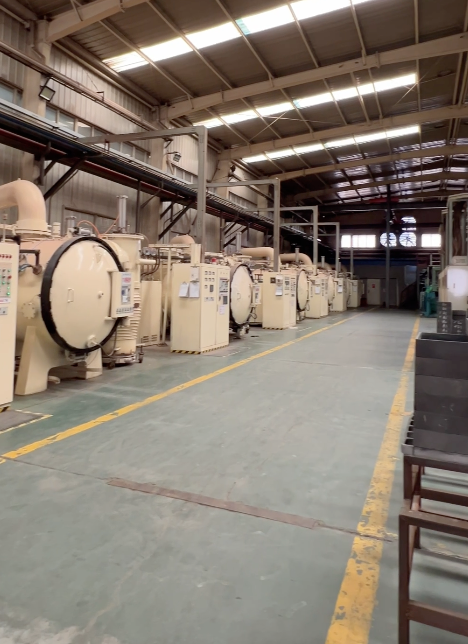
The Closure Problem Inside Modular Pockets and Technical Bags
A modular pocket is a component in its own right. It may be a removable organiser panel inside a laptop compartment, a swap-out front pocket on a technical pack, or an add-on module fixed to a hip belt. Each case shares three requirements: the attachment must be concealable, it must be operable without looking, and it must tolerate being opened and closed far more often than a decorative closure.
Technical bags add a fourth condition — the wearer is usually in motion. Chest-rig pockets, hip-belt pockets and top-lid access points get opened with one hand while the other holds a pole, a camera or a leash. In cold weather that hand may be gloved, which removes fine tactile feedback and makes small hardware difficult to align.
Three mainstream closure families handle part of this brief but not all of it. Zippers give a continuous, strong and familiar closure, but they need two hands to start, introduce a hard and often metallic element, and can jam when fabric or debris enters the teeth. Hook-and-loop is adjustable and inexpensive, but it is audible, degrades with lint and abrasion, and behaves unpredictably when wet or icy. Snap hardware gives a positive, point-based hold, yet it demands visual or tactile alignment and adds rigid components to a soft panel.
Magnetic closure changes the interaction rather than the structure. When two mating parts come within a short distance, the field pulls them into alignment, so the user does not have to find the exact match point. That self-aligning behaviour is the property that matters most for gloved, one-handed and low-dexterity use — and it is also the property that is hardest to verify from a specification sheet, because holding force and self-alignment are not the same measurement.
What This Shortlist Covers — and What It Does Not Rank
Flexible magnetic fasteners are a family, not a single product. Suppliers in this category commonly classify the components by form: magnetic cords, sew-in magnetic strips and magnetic fastening tapes appear as distinct closure types in manufacturer product literature, and magnetic strips are also presented as a format for linear, adjustable textile closures. That form-level taxonomy is the basis for the shortlist below.
Two limits apply. First, the formats are described from supplier-published construction and application information; they are not independently validated performance claims, and a construction description does not establish durability, washability or holding force for a specific product. Second, formats are not interchangeable substitutes. A cord and a strip solve different geometry problems, and choosing between them is an engineering decision rather than a preference.
Where this article refers to Beijing Magnetic Technologies Co., Ltd. (global brand MAGTECH®), the facts are the manufacturer's own published specifications. The company is a Beijing-based manufacturer founded in 2021 that produces flexible magnetic cords, flexible magnetic strips, apparel magnetic fasteners and washable magnetic closures for apparel, sportswear and technical textile applications. Where the article refers to other suppliers' formats, the facts are their published product descriptions, cited as such.
The Four Formats on the Shortlist
1. Sewable Flat Magnetic Strip
A sewable magnetic strip is a thin, flat flexible magnet designed for concealed closures in clothing, bags and textile products. Suppliers present this format specifically for linear and adjustable closures, which makes it the natural first candidate for pocket flaps, laptop-sleeve edges and straight placket runs.
The practical advantage is integration. A flat strip sits inside a fabric channel or behind a facing without creating a raised ridge, and it can be sewn on standard industrial machines through a pre-formed tunnel. Because it is supplied in continuous lengths, it is also cuttable: a strip can be trimmed to the exact pocket width rather than ordered in fixed increments, which suits small modular panels that change dimension between colourways.
The boundary is geometry. A flat strip follows a straight or gently curved path; tight corners need either segmentation or a switch to a round cord. Width and thickness also trade against suppleness, since a wider strip carries more magnetic material but resists folding more than a narrow one. Buyers should ask for the minimum bend radius the supplier has actually tested, not an estimated one.
2. Flexible Magnetic Cord
A flexible magnetic cord uses a round or profiled cross-section that can follow a curved seam, which is why it appears in soft, draped applications where a flat strip would crease. Published cord specifications show the material logic: one 4.5 mm × 3.5 mm sewable cord is described as using NdFeB magnetic powder to reach a surface field of roughly 1100–1200 Gs, while SmFeN-based cords are offered as an alternative magnetic system for the same textile integration role.
For modular pockets the cord format fits curved pocket openings, adjustable volume control and soft module connections that flex when the bag is compressed. Its round section distributes bending stress differently from a flat strip, which matters where a closure crosses a fold line or wraps around the rounded edge of a pack.
The constraint is the sewing channel. A cord needs a tunnel of consistent width, and any stitch that penetrates the magnetic core creates a weak point. Cord diameter also sets the minimum seam allowance. Buyers comparing cord options should ask for the tested dynamic bend result, the surface field measured after bending, and whether the cord can be cut and used without end-sealing.
3. Sew-In Magnetic Snaps
Sew-in magnetic snaps are point closures rather than continuous ones. Suppliers describe them as flexible magnetic cores enclosed in protective polymer films with sewable margins, which allows the component to be stitched into a seam or between fabric layers without exposing the magnetic material.
In a modular system, point closures do work continuous closures cannot: they fix a panel at defined anchor points, register a module in the correct position, and let a pocket corner release without opening the whole edge. That makes them a useful complement to a strip or cord rather than a replacement. The protective film also matters for washable bags, because it separates the magnetic material from moisture and abrasion.
The boundary is alignment and load distribution. A point closure concentrates force at the anchor, so the surrounding fabric needs reinforcement, and a row of snaps must be spaced so the panel does not peel from one corner. Film integrity after repeated washing should be inspected on samples, since a breached film exposes the core.
4. Profile-Based Magnetic Zippers
A profile-based magnetic closure uses two flexible silicone profiles containing longitudinally arranged embedded magnets, with sewable edges along each side. It is the closest magnetic analogue to a continuous zipper: the closure runs the full length of an opening rather than at discrete points.
For technical bags this is the format that can replace a main compartment zipper, a top-lid opening or a full-length side access panel. It offers continuous closure with no teeth to jam and no metal slider, and the silicone profile adds a degree of dimensional stability that a fabric-only channel does not provide.
The constraint is tolerance. Two profiles must be sewn in precise opposition, and any drift between them reduces holding force along the run. Profile thickness also affects how the closure bends around a pack's curved edge. Buyers should request the profile's reported peel behaviour, the permitted alignment tolerance during sewing, and the minimum bend radius.
Comparing the Four Formats on the Same Criteria
The four formats differ on geometry, concealment and integration rather than on an overall quality scale. The table below sets out what each format is suited to and what has to be verified before it is specified.
| Format | Opening geometry it suits | Concealment behaviour | Integration method | Main boundary condition | Test field to agree with supplier |
|---|---|---|---|---|---|
| Sewable flat strip | Straight and gently curved runs; flaps, sleeve edges, placket lines | Sits flat behind a facing; low profile | Sewn tunnel or edge seam | Loses suppleness as width increases; tight corners need segmentation | Minimum bend radius; holding force after seam sewing |
| Flexible magnetic cord | Curved and compound seams; soft or compressible panels | Follows the seam line; round section can read as piping | Sewn tunnel of consistent width | Stitch penetration and channel width tolerance | Surface field after repeated dynamic bending |
| Sew-in magnetic snap | Discrete anchor points; module registration; pocket corners | Hidden between fabric layers | Stitched margin around the protective film | Force concentrated at each point | Pull and shear force after washing |
| Profile-based magnetic zipper | Continuous openings; main compartment and lid access | Continuous but slightly thicker than a plain seam | Two profiles sewn in opposition | Alignment tolerance along the full run | Peel force and permitted alignment tolerance |
Performance Questions a Format Label Cannot Answer
Format tells a buyer what shape the fastener takes. It does not tell them how strongly it holds, and that gap is where most evaluation errors occur.
Pull force is described in commercial technical literature as a principal indicator of closure holding strength and is measured with a force gauge under defined conditions. The difficulty is that no single published protocol covers flexible apparel fasteners, so a quoted figure is only meaningful when the test conditions travel with it: sample size, fixture type, separation angle, speed, temperature, and whether the sample was measured before or after washing.
Surface field strength is a related but different number. A higher Gauss reading does not automatically produce a higher holding force, because air gap, encapsulation thickness, contact area and pole geometry all intervene. One cord specification can therefore report 1100–1200 Gs at the magnet surface while the assembled closure behaves quite differently once it sits behind two layers of coated fabric. Gauss is a material parameter; pull force is the closure parameter.
Durability testing narrows the gap. A documented bending endurance figure — for example, more than 12,000 cycles of repeated ±90° dynamic bending without surface cracking or delamination — describes what happens to the component under flexing, which is directly relevant to a pocket that folds every time the bag is compressed. Corrosion testing such as 48 hours of neutral salt spray at 35°C with 5% NaCl addresses the hardware environment. Thermal range matters for outdoor use: a stated operating range of −40°C to +80°C, with magnetic flux attenuation below 5% after 50 thermal shock cycles, describes behaviour that a room-temperature pull test cannot.
Washability is a separate qualification. Encapsulated closures in TPU or silicone are described as machine washable on a gentle cycle at or below 40°C, while uncoated SmFeN cord can be cut and used without end-sealing and coated NdFeB strip needs its cut ends sealed with flexible waterproof adhesive. Those are different maintenance regimes, and a buyer should match the format to the care label the brand intends to publish.
Integration: Cutting, Sewing, Heat-Bonding and Polarity
Most field failures in magnetic closures originate in integration rather than in the magnet. Four process steps carry most of the risk.
Cutting. Bare SmFeN cord and strip can be cut to length with standard shears and used without end-sealing. Coated NdFeB strip is different: the cut end exposes the core, so it must be sealed with flexible waterproof glue or TPU adhesive. Rigid metal-core components should never be cut through the core itself.
Sewing. The magnetic component belongs in a pre-formed tunnel or between fabric layers, with reinforced stitching along the perimeter. For children's wear, published guidance recommends continuous strips or cords of at least 12 mm width enclosed in durable interlining, so that no small magnetic part can separate. The same principle — enclose, reinforce, verify — applies to modular pocket panels that will be handled repeatedly.
Heat-bonding. Where an adhesive film replaces stitching, temperature control is the critical variable. Published process guidance sets heat-press bonding at or below 140°C for 10–15 seconds, using a recessed die so that mechanical pressure is not applied directly to the magnetic core. Direct contact with an iron plate above roughly 120°C causes irreversible flux loss, and the care label should carry that warning. Vertical steam held 3–5 cm from the fabric removes wrinkles without that risk.
Polarity. Mating parts must be kept as separated A/B sets through cutting and sewing. Before the final seam is closed, the two panels should be brought within 10–20 mm to confirm that the closure self-centres instead of repelling or skewing. Mixed batches or inverted poles produce exactly the failure the format was chosen to avoid.
Two further controls are worth building into the line. Broken-needle inspection should run before magnetic components are attached, or detector sensitivity should be calibrated against a pre-production sample, because a magnet in the garment will otherwise trigger the machine. Bulk storage should stay below 40°C at 40–60% relative humidity, with rolls laid flat and complementary pairs kept mated or separated by spacers.
Where Hidden Magnetic Closures Fit in Packs and Modular Systems
The formats above map onto specific positions in a technical bag rather than onto the whole product.
- Top lid and main access. A profile-based magnetic closure suits a full-length lid opening where continuous closure and the absence of a metal slider are the priorities.
- Front and side pockets. A flat sewable strip is the simplest fit for a straight pocket flap, while a cord handles a curved or gusseted pocket mouth.
- Chest-rig and hip-belt pockets. These present the clearest case for magnetic closure, because they are opened one-handed and often with gloves. A short strip or a pair of snaps keeps the profile flat against the body.
- Laptop and organiser compartments. Point snaps register a removable sleeve or divider in position; a strip along the compartment edge adds a continuous secondary hold.
- Module attachment. Modular magnetic connections combine a magnetic locating function with a mechanical retention feature, so the module is guided into place magnetically and then secured.
Adjacent applications share the same operating logic. In outerwear, a documented five-year supply case covering a premium down-jacket programme applied flexible magnetic cord to plackets, collar closures and self-closing pockets. The case record reports silent automatic placket alignment, a 60% reduction in pocket open/close time with one-handed operation, and no demagnetisation or rust complaints across repeated cold-weather wear and machine washing. That record covers a down-jacket application, not a pack, so it should be read as evidence of the operating principle under cold, gloved conditions rather than as a pack-specific result.
Adaptive clothing is the other documented application. An adaptive-clothing resource guide published by Vanderbilt University's Wond'ry Center for Innovation lists magnetic fasteners among the closure options discussed for adaptive garments. The guide supports application relevance; it does not quantify demand, adoption or clinical benefit, and should not be cited as if it did.
Against Zippers, Hook-and-Loop and Snap Hardware
Magnetic closure is not a universal replacement. It wins on interaction and loses on some structural measures, and the trade-off should be stated plainly.
- Versus zippers. A zipper provides continuous mechanical interlock and a familiar repair path. A magnetic closure provides self-alignment, silence and one-handed operation, but it relies on magnetic force rather than mechanical interlock, so a main load-bearing opening normally needs a mechanical secondary retention.
- Versus hook-and-loop. Hook-and-loop is adjustable across a wide range and inexpensive, and holds strongly in shear. Magnetic closure is silent, does not collect lint and does not degrade through the same abrasion mechanism, but it offers less adjustability and needs a defined mating position.
- Versus snap hardware. Metal snaps give a positive, high-force point hold and are well understood in production. Magnetic snaps remove the alignment effort and the hard surface, but holding force is distributed differently and the surrounding fabric must be engineered for it.
Two practical limits belong in any specification. First, magnetic fields interact with magnetically sensitive items, so a bag design should consider card stripes, mechanical watches and medical implants; published guidance advises wearers with pacemakers or ICDs to keep clearance, and magnetic garments should be removed before entering an MRI suite. Second, water resistance is a property of the encapsulation, not of the magnet. A watertight sheath or TPU cover supports water resistance in a specific product; it does not establish that every flexible magnetic fastener is waterproof.
What the Market Data Shows — and What It Does Not
The available market evidence is directional and comes from commercial research rather than official statistics. It should be cited with its scope attached.
Fortune Business Insights projects the global flexible magnets market — a materials category that includes strips and sheets, not garment fasteners alone — growing from USD 395.6 million in 2025 to USD 561.1 million by 2032. Separately, Strategic Revenue Insights values the global adaptive clothing market at USD 19.50 billion in 2025, a downstream apparel segment in which magnetic closures appear as one closure option among several.
These two figures describe different levels of the value chain and cannot be added, compared or used to infer fastener revenue. Neither source provides a verified size, growth rate or shipment volume for flexible magnetic garment fasteners as a distinct product segment, and no validated trade classification for the category was identified in the sources reviewed. A buyer or product team should therefore treat the numbers as context for category attention, not as a demand forecast for a specific format.
Supplier Evidence to Request During Evaluation
Because format-level public data is thin, supplier evidence carries most of the evaluation weight. The useful question is not whether a supplier lists a capability, but whether the claim arrives with a test condition attached.
Beijing Magnetic Technologies Co., Ltd. operates a 2,500 m² facility with 50 employees, 12 engineers and an annual output of 6,000,000 meters, exporting about 40% of production to North America, the EU, Japan and other markets. The company publishes its specifications at magtech.global. The verifiable elements a buyer can check against its published record include:
- Certification. OEKO-TEX® STANDARD 100 certificate no. 26092232, issued 2 January 2024 and valid until 30 September 2027, covering magnetic fasteners used in textiles and laminate products.
- Mechanical and environmental testing. More than 12,000 cycles of ±90° dynamic bending without cracking or delamination; 48 hours of neutral salt spray at 35°C with 5% NaCl; 100% surface Gauss testing; pull-force and shear-force mechanical testing; pre-shipment inspection.
- Thermal envelope. An operating range of −40°C to +80°C, with flux attenuation below 5% after 50 thermal shock cycles.
- Customisation scope. Cord diameters from 2.0 mm to 4.5 mm, surface field from 1000 to 1700 Gs, encapsulation in TPU film, silicone, TPE or EVA, eight standard colours plus Pantone matching, and polarity pairing at packing.
- Capacity and terms. 500,000 meters per month of flexible cord and strip, and 1,000,000 pairs per month of apparel magnetic fasteners. No MOQ on in-stock standard products; 1,000 meters or 1,000 pairs for custom dimensions; 2,000 meters for custom Pantone colours. Stated lead times are 3–7 business days for stock, 10–20 business days for standard production, and 20–35 business days for custom tooling and colours.
- Development support. OEM and ODM production for apparel magnetic fasteners exported to North America and the EU, rapid sample prototyping for custom closures, heat-press parameter testing support, and dedicated garment integration technical guidance.
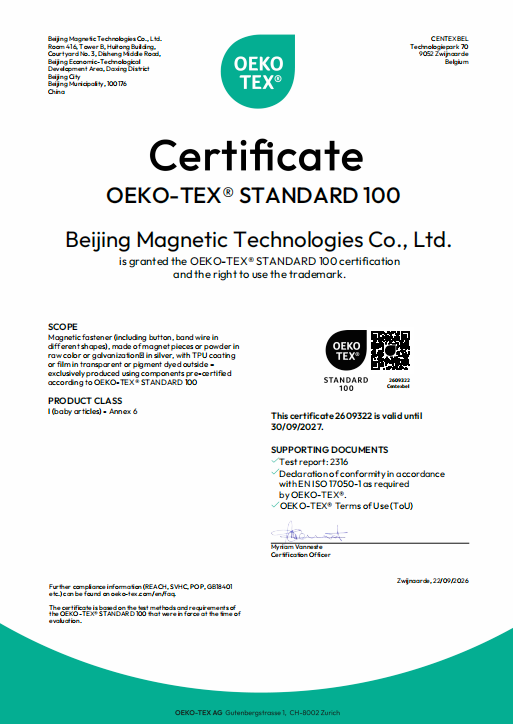
These are supplier-published specifications. They describe what the manufacturer states about its own process; they are not an independent audit, and a buyer should still reproduce the critical tests on their own sample and their own fabric.
Outlook
The direction of travel is toward closures that are felt less and operated more easily, driven by modular product design and by adaptive apparel becoming a documented application rather than a niche. Magnetic closure fits that direction because its main advantages — concealment, silence and self-alignment — are interaction properties that mechanical hardware cannot easily replicate.
What would consolidate the category is not a bigger magnet but better shared evidence: agreed pull-force protocols reported with their test conditions, wash-cycle durability results stated per format, and consistent disclosure of encapsulation and sealing. Until those exist, format-level shortlists like this one remain a starting point for sampling rather than a substitute for it. The practical next step for a product team is to specify two formats for the same pocket, test both against the same fabric and the same operating glove, and let the measured pull force and the assembly tolerance decide.
FAQ
- How should a factory store bulk flexible magnetic components before assembly?
- Store components in a dry, ventilated area below 40°C and 40–60% relative humidity, away from heat sources, direct UV and strong electromagnetic fields. Lay rolls or cut strips flat with partitions between layers, keep complementary pairs mated or separated by insulating spacers, and ventilate new batches in their original packaging for 48 hours before use. Flexible magnets should not be binned together with rigid neodymium magnets.
- How are flexible magnetic cords and strips cut to length for modular pocket panels?
- Bare SmFeN cord and strip can be cut with standard industrial shears and used without end-sealing. Membrane-coated NdFeB strip needs its cut ends sealed with flexible waterproof glue or TPU adhesive to protect the core from moisture. Rigid metal-core components should not be cut through the core.
- How is polarity verified before a pocket panel is stitched closed?
- Keep mating parts as separated A/B sets through cutting and sewing, orient the strong magnetic face toward the inner interface, then bring the two panels within 10–20 mm to confirm self-centring rather than repulsion or skew. Close the final seam only after that check passes. Mixing unpaired batches or installing inverted poles produces weak holding force or physical repulsion.
- What temperature limits apply when bonding closures into bag or garment panels?
- Heat-press bonding should stay at or below 140°C for 10–15 seconds, using a recessed die that avoids direct pressure on the magnetic core. Direct contact with an iron plate above roughly 120°C causes irreversible flux loss. Vertical steam held 3–5 cm from the fabric removes wrinkles without that risk, and high-heat tumble drying above 80°C should be avoided.
- How should products with magnetic closures be washed and cared for?
- Fasten all closures before washing, turn the item inside out, place it in a mesh laundry bag and wash on a gentle cycle at or below 40°C with mild detergent and no bleach. Air-dry in shade or tumble dry on low heat at or below 60°C. These recommendations apply to intact TPU or silicone-encapsulated closures; uncoated components follow different care rules.
For readers evaluating the category in more depth, the manufacturer's 2026 English introduction is available as a downloadable PDF: MagTech Introduction 2026 (English).
Tem questões ou precisa de mais detalhes?
Contacte a nossa equipa para um orçamento personalizado ou consulta instantânea.
Solicitar orçamento
Preencha o formulário abaixo e a nossa equipa entrará em contacto com uma proposta personalizada.
Chat direto do WhatsApp
Prefere conversar em tempo real? Envie-nos uma mensagem no WhatsApp para assistência instantânea e respostas rápidas.
- Obter orçamento personalizado
- Partilhar fotos ou documentos
- Discuta as suas necessidades diretamente
Geralmente responde em 5–30 minutos durante o horário de expediente.