
High-Current DC Connector Options for UAV, FPV Drone, and RC Battery Packs
High-Current DC Connector Options for UAV, FPV Drone, and RC Battery Packs
In unmanned aircraft and radio-controlled models, the battery connector is the one interface that every ampere of discharge current must pass through. Selecting a high-current DC power connector for a UAV, FPV drone or RC battery pack is therefore less a question of appearance than of duty: how much continuous current the airframe pulls, how large the inrush is when a fresh pack is connected, how often the pack is swapped in the field, and whether the harness must also carry signal wiring to a battery management system.
No single universal part covers this family of applications. A 90 A agricultural multi-rotor, a 45 A scale RC model and a 15 A micro FPV quad place different demands on terminal diameter, housing volume, sealing and arc control. A more workable approach is a shortlist organised by application, supported by the ratings that actually govern the choice: continuous current at a stated wire gauge, peak current, protection class, contact resistance, terminal plating and housing flammability.
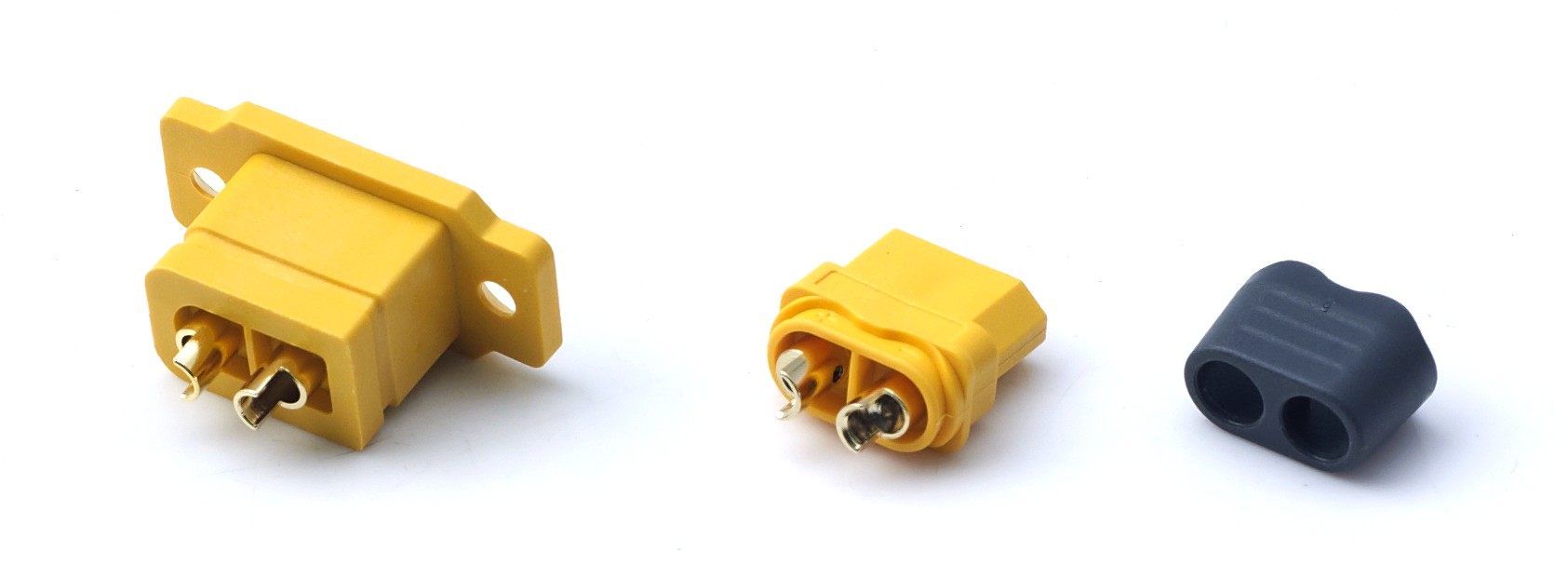
The options discussed below come from the high-current DC connector range of AOYG DC Power Connector, a manufacturer established in 2024 that specialises in high-current DC connection systems for lithium-ion smart devices. AOYG DC Power Connector operates a 6,000 m² manufacturing facility with approximately 100 staff and a 25-engineer R&D team, and reports an annual production capacity of 900,000 units. Export business accounts for 50% of total sales, with the EU and USA among its main markets, and the company holds IATF16949:2016 automotive quality management system certification.
Why one amp rating cannot cover every airframe
Connector selection in battery-powered flight platforms is usually discussed in terms of a single number, but the number that matters is always qualified. In this range, continuous current is published together with the wire gauge and the temperature rise it produces — for example, 90 A continuous on 10 AWG wire at a temperature rise of ≤85 °C. Re-terminating the same connector with a heavier gauge is permitted, but the installed assembly, not the part number alone, determines real performance.
Three further variables separate the options:
- Continuous versus peak duty. Survey, inspection and agricultural multi-rotors typically hold a steady current for the length of a flight, while racing quads and RC models generate short, sharp peaks. A connector rated 90 A continuous and one rated 45 A continuous with a 90 A short-term peak are suited to different load profiles.
- Environment. Most of this range is rated IP40, which covers indoor and ordinary outdoor use. Where equipment is immersed, sprayed or stored wet, an IP67 sealed body becomes the deciding feature rather than current alone.
- Signal integration. Smart lithium battery packs with a BMS often need a sensing or communication line alongside power. A composite 2+2 pin layout removes that second harness entirely.
Rated voltage, by contrast, is common across the range discussed here: all of the options below are rated DC 500 V and share an operating temperature window of -20 °C to +120 °C.
The shortlist at a glance
| Option | Model | Continuous / peak current | Terminal | Protection | Recommended wire | Typical fit |
|---|---|---|---|---|---|---|
| UAV Connector | DXT90H-M / DXT90S-F | 90 A continuous (temp rise ≤85 °C) | Φ4.5 mm gold-plated banana | IP40 | 10 AWG, 8 AWG compatible | Agricultural drones, multi-rotor UAV LiPo battery packs |
| RC Model Electric Vehicle Connector | DXT90H-M + DXT90E-F Yellow | 45 A continuous / 90 A short-term peak | Φ4.5 mm brass, gold-plated banana | IP40 | 10 AWG, 8 AWG compatible | RC cars, RC boats, aircraft models, small UAV lithium batteries |
| Waterproof High Current Connector | DXT60EW-M + DXT60W-F | 60 A continuous / 100 A peak | Φ5 mm H62 brass, gold-plated | IP67 | 8–10 AWG | Waterborne unmanned equipment, marine lithium battery systems, outdoor energy storage and communication backup |
| 2+2 Power-Signal Combo | DXT30U(2+2)-F(B) | 20 A power pin (16 AWG) / 1 A signal pin; 35 A peak | H62 brass, gold-plated | IP40 | 12–16 AWG | UAV, FPV drone and RC hobby packs that also require signal transmission |
| Drone Connector | DXT30U-M / DXT30U-F | 15 A continuous / 30 A short-term peak | Φ2 mm gold-plated banana | IP40 | 18 AWG, 20 AWG compatible | Tiny FPV drones, small UAVs, RC models, portable lithium battery packs |
Every option in the table is rated DC 500 V, operates from -20 °C to +120 °C, is specified for at least 1,000 mating cycles, and uses a PA66 housing with a UL94 V-0 flammability rating.
Option 1 — a 90 A anti-spark connector for agricultural and multi-rotor UAV packs
The DXT90H-M / DXT90S-F pairing is the heaviest continuous-current option in this shortlist and the only one that carries arc suppression as standard. It is a high-current DC power connector for UAV and drone battery connections, intended for agricultural drones, multi-rotor UAVs and LiPo battery power connection scenarios.
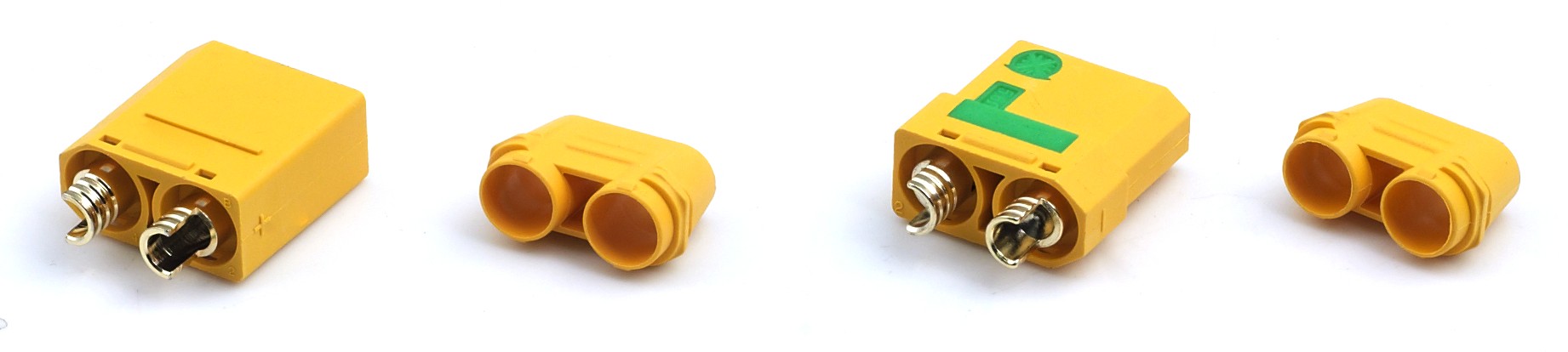
Its defining technical feature is a two-stage contact design: the DXT90S-F female half contains a built-in high-power precharge resistor, which suppresses the electric arc produced when a LiPo battery is connected and prevents terminal burn-out over repeated pack changes. The male half uses thickened, reinforced terminals so that contact remains stable under continuous flight vibration and does not open under load.
Published specifications for the pairing are:
- Rated voltage DC 500 V; continuous operating current 90 A on 10 AWG wire with temperature rise ≤85 °C
- 4.5 mm gold-plated banana terminal; shell in PA66 high-temperature nylon; conductive terminal in brass alloy
- Gold plating 0.3 µm as standard, with thicker industrial gold plating available
- Withstand voltage AC 2000 V for 1 minute; flammability rating UL94 V-0; protection level IP40
- Operating temperature -20 °C to +120 °C; mating life ≥1,000 cycles; 48-hour salt spray test on the gold-plated standard model
- Recommended cable 10 AWG flexible, compatible with 8 AWG; optional strain relief cap to prevent cable breakage
For buyers, two details are worth noting. First, the pairing is dimensionally compatible with the regular XT90 footprint, so an existing airframe can be upgraded to anti-spark operation without structural modification. Second, the connector is supplied as bare connector or as a silicone cable assembly in 8 AWG or 10 AWG with customisable wire length, which matters when the harness is pre-assembled for a production line rather than built by hand in the field.
Option 2 — 45 A continuous / 90 A peak for RC model vehicles and small UAV packs
The DXT90H-M + DXT90E-F Yellow is catalogued as an RC model electric vehicle connector and is intended for the RC hobby, UAV and electric vehicle industries. Its duty profile is deliberately different from Option 1: 45 A continuous with a 10 AWG wire at a temperature rise below 85 °C, and a 90 A short-term peak that covers the surge of a hard throttle application or a sudden climb.
Mechanically, the male header integrates a cable sheath that protects the solder joint and relieves pulling stress on the wire, while the female is an open-shell design that simplifies soldering. Anti-misplug keying prevents reverse polarity connection, and the bright yellow housing makes the circuit easy to identify in a crowded model chassis. The conductive terminal is H62 brass with gold plating, the contact spring is gold-plated beryllium copper, and the cable crimp sleeve is brass.
Supporting ratings include contact resistance ≤1.0 mΩ, insulation resistance ≥2000 MΩ, withstand voltage AC 2000 V for 1 minute, protection class IP40, mating cycles ≥1,000, a 48-hour salt spray test on the gold-plated terminal, and compliance with RoHS 2.0 and REACH SVHC. The housing is flame-retardant PA66 nylon with a UL94 V-0 rating, and the recommended wire is 10 AWG silicone, compatible with 8 AWG.
The practical reading of this specification is that the connector suits platforms that alternate between moderate continuous loads and frequent bursts — RC cars and boats, fixed-wing and aircraft models, and small UAV lithium battery packs — rather than airframes that hold 90 A for an entire flight.
Option 3 — the IP67 waterproof option for wet and outdoor duty
The DXT60EW-M + DXT60W-F is the only option in this shortlist rated IP67, and its sealing is achieved with a silicone O-ring rather than a gasket or potting compound. It is a waterproof high-current connector designed for waterborne unmanned equipment, outdoor mobile photovoltaic energy storage, marine lithium battery systems and outdoor communication backup power, with typical applications in outdoor garden machinery, outdoor 5G base station standby power and outdoor electric amusement equipment.
Electrical and mechanical data for the pair:
- Rated voltage DC 500 V; continuous current 60 A; peak current 100 A
- Φ5 mm H62 brass gold-plated terminal; beryllium copper gold-plated spring contact; PA66 UL94 V-0 flame-retardant nylon housing
- Contact resistance ≤0.8 mΩ; operating temperature -20 °C to +120 °C; mating cycles ≥1,000
- Applicable wire 8–10 AWG silicone; available as a separate male plug, a separate female plug, a mated waterproof pair, or a pre-wired harness with custom cable length
One boundary is stated explicitly in the product data and should be weighed before it is specified: this model does not have an anti-spark structure, and live plugging and unplugging of large-capacity batteries is not recommended. In other words, the sealing and the arc control are provided by different products in this range, and a design that needs both has to be planned around that fact.
Option 4 — a 2+2 power-signal connector for smart lithium battery packs
The DXT30U(2+2)-F(B) is a female connector built on a 2+2 layout — two power pins and two signal pins in a single shell — belonging to the DXT30U series of power-signal composite connectors. It is intended for UAV, FPV drone, RC hobby models, light-duty e-bike, portable energy storage, robot, garden power tools, smart device battery packs and BMS systems.
The rating split follows the pin function: the power pin carries 20 A on 16 AWG wire, the signal pin carries 1 A, and the connector has a peak current rating of 35 A. Contact resistance is ≤1.2 mΩ, insulation resistance ≥2000 MΩ, the housing is black PA66 with a UL94 V-0 rating, protection class is IP40, operating temperature is -20 °C to +120 °C, and mating life is ≥1,000 cycles. The applicable wire is 12–16 AWG silicone, and the connector has passed a 48-hour salt spray test. Terminals are H62 brass with gold plating, and the part is compliant with RoHS 2.0 and REACH SVHC.
The design intent is harness reduction. Where a lithium battery pack must report state or communicate with a management system, the composite pin set transmits high-current power and sensing signals simultaneously, which reduces the number of connectors inside a weight- or space-constrained device. An anti-misplug structure prevents reverse insertion. The female body mates with the DXT30U(2+2)-M and DXT30U(2+2)P counterparts, and the series is compatible with cable-soldered male, vertical-mount PB and horizontal-mount PW PCB male headers, giving OEM buyers a choice between cable-to-cable and board-mount assembly.
Option 5 — a 15 A compact connector for tiny FPV and small UAV builds
At the light end of the range sits the DXT30U-M / DXT30U-F, a drone connector sized for tiny FPV drones, small UAVs, RC models, portable lithium battery packs, lightweight electric mobility, educational robots and outdoor energy storage equipment. It is rated DC 500 V, 15 A continuous with a short-term peak of 30 A, and uses a Φ2 mm gold-plated banana terminal.
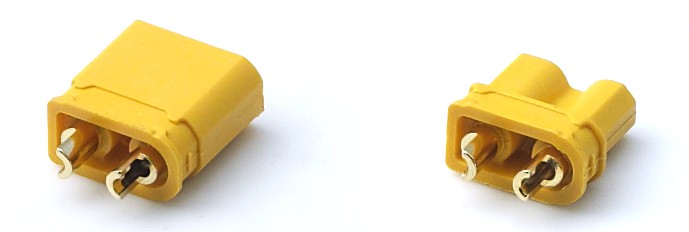
Contact resistance is ≤0.7 mΩ — the lowest figure in this shortlist — with insulation resistance ≥2000 MΩ and a withstand voltage of AC 2000 V for 1 minute. The flammability class is UL94 V-0, the shell is PA66 high-temperature nylon, and the conductive terminal is brass alloy. Recommended wire is 18 AWG silicone, compatible with 20 AWG, and the connector is specified for ≥1,000 mating cycles with a 48-hour salt spray test on the gold-plated terminal.
Two features matter for smaller airframes. The buckle structure supports bidirectional blind mating with stable locking, which helps under the vibration of a micro quad, and the connector follows standard XT30U dimensions, so it remains widely compatible within the RC and drone industries. Buyers can specify a bare plug, a silicone wire harness or a strain relief cap, in yellow or black housing.
Selection criteria for OEM and fleet buyers
Across the five options, the same criteria decide fit. They are worth writing into a specification sheet rather than leaving to a purchase order description.
- Continuous current at a defined wire gauge. Compare 15 A, 20 A, 45 A, 60 A and 90 A continuous ratings only together with their stated conductor size and temperature rise.
- Peak current. The shortlist spans 30 A, 35 A, 90 A and 100 A peak, which is the figure that matters for surge events.
- Protection class. IP40 is the standard level across the range, with IP67 available on the waterproof DXT60EW-M + DXT60W-F. IP67 is specified only where immersion or heavy splash is a real risk, because it changes the connector body.
- Anti-spark pre-charging. Present as a built-in precharge resistor in DXT90S-F, with a two-stage contact design to eliminate the arc when plugging LiPo batteries. It is absent from the waterproof model by design.
- Contact resistance. Published values are ≤0.7 mΩ, ≤0.8 mΩ, ≤1.0 mΩ and ≤1.2 mΩ across the options, and lower resistance means less self-heating at the joint.
- Gold-plated terminals. H62 brass or brass alloy terminals with gold plating appear throughout, with a 48-hour salt spray test quoted on the gold-plated terminals.
- Housing material. PA66 with a UL94 V-0 flame-retardant rating and an operating window of -20 °C to +120 °C is common to all five options.
- Mating life. ≥1,000 cycles across the range; fleets that swap packs several times a day should plan an inspection interval rather than treating the connector as a lifetime part.
- Compliance documentation. RoHS 2.0 and REACH SVHC are stated for several options, which is relevant for EU and North American procurement.
Matching the connector to the rest of the power train
In UAV and RC platforms, the connector does not operate alone. The matched equipment list for these applications includes the LiPo lithium battery, the ESC (electronic speed controller), the flight controller, brushless motors, the wire harness assembly and, where smart packs are used, the BMS and lithium battery packs.
The wire gauge is the linking constraint. The 90 A and 45 A options are specified around 10 AWG with compatibility down to 8 AWG, matching the current levels drawn by multi-rotor and larger RC power systems. The IP67 option uses 8–10 AWG, consistent with its 60 A continuous rating. The 2+2 power-signal connector uses 12–16 AWG, and the compact 15 A option uses 18 AWG with 20 AWG compatibility. Specifying a connector whose rated wire gauge does not match the harness on the bench is one of the more common mismatches in prototype builds.
What the market data says
The commercial context for these parts is expanding rather than static. According to Fact.MR, the global high power connectors market was valued at approximately USD 5.47 billion in 2025. Separately, Dataintelo reports that DC connectors represented 58.7% of the total energy storage connector market share in 2025, a figure it attributes to higher voltage requirements — a signal that DC-native connection hardware, not legacy AC-oriented interfaces, is where volume is concentrating.
On the platform side, ChinaHobbyLine guidance for 2026 identifies XT60 and XT90 as the primary industry standards for medium to high power non-proprietary RC aircraft and drones. That matters for this shortlist in a practical way: the DXT90H-M / DXT90S-F pairing is dimensionally compatible with the regular XT90 footprint, and the DXT30U-M / DXT30U-F follows standard XT30U dimensions. Buyers can therefore adopt higher-specification connectors on an existing airframe without redesigning battery trays or harness routing.
Limits and boundaries to plan for
A shortlist is only useful if its boundaries are stated. Four stand out here.
First, protection is not uniform. Four of the five options are IP40, and IP67 applies only to the DXT60EW-M + DXT60W-F. A design that requires both a 90 A continuous link and full sealing cannot be satisfied by a single part in this range.
Second, arc suppression is not universal either. Only DXT90S-F carries a built-in precharge resistor and two-stage contact. The waterproof model explicitly has no anti-spark structure, and the manufacturer advises against live plugging and unplugging of large-capacity batteries with it.
Third, the composite and compact options are deliberately light-duty. A 20 A power pin with a 35 A peak, and a 15 A continuous rating with a 30 A peak, are not substitutes for a 90 A link in a heavy-lift airframe; they address weight, space and signal-transmission constraints instead.
Fourth, mating life is finite. A ≥1,000-cycle rating is generous for a hobby platform but not unlimited for a commercial fleet that changes packs several times a day, so connectors should be treated as a wear item with a defined replacement point in the maintenance schedule.
Future outlook
Two directions are already visible in the specification patterns above. One is integration: the 2+2 layout shows that power and signal are converging into a single shell, which reduces harness count and simplifies the interface between a smart lithium battery pack and the device it powers. The other is environment-specific engineering, where sealing, anti-spark behaviour and current capacity are traded against each other rather than combined in one universal part.
For OEM buyers, the practical consequence is that connector selection will continue to be an application-matching exercise rather than a catalogue lookup. Platforms that document their duty profile — continuous current, peak surge, pack-swap frequency and exposure — will be in a better position to choose between a 90 A anti-spark pair, a 45 A continuous / 90 A peak connector, an IP67 sealed pair, a 2+2 power-signal composite, or a compact 15 A option, and to justify the choice with published ratings rather than habit.
FAQ
What current rating should a high-current DC power connector have for a UAV or RC battery pack?
The rating must cover both the continuous and the peak discharge of the platform. In this range, the DXT30U-M / DXT30U-F is rated 15 A continuous and 30 A short-term peak on 18 AWG wire; the DXT30U(2+2)-F(B) is rated 20 A on the power pin at 16 AWG with a 35 A peak; the DXT90H-M + DXT90E-F Yellow is rated 45 A continuous and 90 A short-term peak on 10 AWG; the DXT60EW-M + DXT60W-F is rated 60 A continuous and 100 A peak on 8–10 AWG; and the DXT90H-M / DXT90S-F is rated 90 A continuous on 10 AWG with a temperature rise of ≤85 °C. Each figure applies at the stated wire gauge.
What does a 2+2 power-signal combo connector do that a power-only connector does not?
The DXT30U(2+2)-F(B) places two power pins and two signal pins in one housing. The power pin is rated 20 A at 16 AWG, the signal pin is rated 1 A, and the connector has a 35 A peak rating. It transmits high-current power and sensing signals simultaneously, which reduces harness quantity and saves internal device space in lithium-battery equipment that communicates with a BMS. It also includes an anti-misplug structure to prevent reverse insertion, and mates with the DXT30U(2+2)-M and DXT30U(2+2)P counterparts.
When is an IP67 waterproof connector needed instead of an IP40 connector?
Protection level should follow the actual exposure of the equipment. The DXT60EW-M + DXT60W-F is rated IP67 using a silicone O-ring seal and is designed for waterborne unmanned equipment, marine lithium battery systems, outdoor mobile photovoltaic energy storage and outdoor communication backup power. The other options discussed here are rated IP40, which covers indoor and ordinary outdoor operating conditions. Where a platform is immersed or heavily splashed, sealing becomes the primary selection criterion rather than current capacity.
Do all high-current DC connectors in this range include anti-spark protection?
No. Within this shortlist, arc suppression is provided by the DXT90S-F, which contains a built-in high-power precharge resistor and uses a two-stage contact design to eliminate the electric arc when plugging LiPo batteries. The DXT60EW-M + DXT60W-F has no anti-spark structure, and the product documentation states that live plugging and unplugging of large-capacity batteries is not recommended with that model. Anti-spark capability therefore needs to be confirmed per part number during specification.
Are these connectors compatible with existing XT90 and XT30U wiring in drone and RC platforms?
Two of the options are designed for direct compatibility with established footprints. The DXT90H-M / DXT90S-F is dimensionally compatible with the regular XT90 connector, which allows an upgrade without structural modification, and the DXT30U-M / DXT30U-F follows standard XT30U dimensions. Industry guidance for 2026 identifies XT60 and XT90 as the primary standards for medium to high power non-proprietary RC aircraft and drones, so dimensional compatibility at these two points is a practical advantage for retrofit and for spare-part continuity.
Selection in this category is ultimately a matter of matching published ratings to a documented duty profile, then verifying contact resistance, protection class, arc behaviour and housing flammability against it. AOYG DC Power Connector publishes the specifications for these connector series at www.aoygvn.com.