
High-Current DC Connector Questions: Ampacity, Voltage, Cycles, V-0 Grades
An independent engineering and procurement reference for OEM teams specifying high-current DC power connections.
A high-current DC power connector is the component that carries the main battery current between a lithium pack and its load — an ESC in a drone, a motor driver in a service robot, an inverter in a portable energy storage station. For procurement and engineering teams evaluating AOYG DC Power Connector and its DXT series, the specification conversation almost always narrows to four published figures: continuous ampacity, rated voltage, mating cycles, and the flame-retardant grade of the housing. Everything else — sealing, plating, keying — supports those four.
AOYG DC Power Connector is a manufacturer and solution provider focused on the development, production and customization of high-performance high-current DC connection systems for lithium-ion smart devices. The company operates a 6,000 m² facility with approximately 100 employees, including an R&D team of 25 engineers, produces around 900,000 units annually, and exports roughly 50% of its output to the EU and the United States. It holds IATF16949:2016 certification.
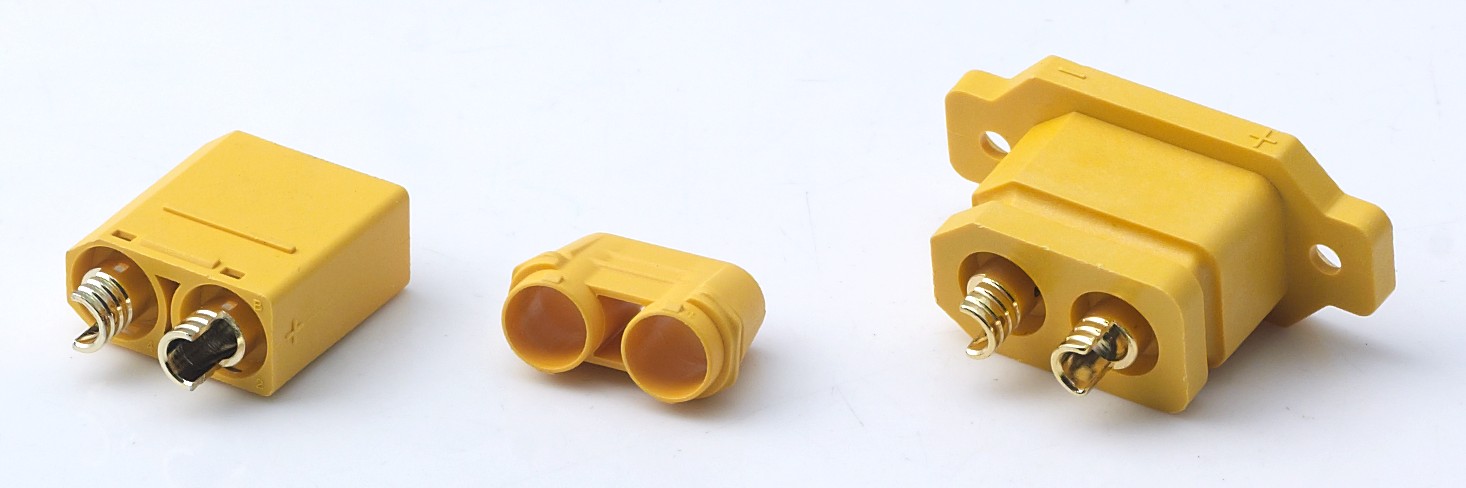
DXT90H-M + DXT90E-F Yellow: a published DXT-series pair rated DC 500V, 45A continuous with a 90A short-term peak, in a PA66 UL94 V-0 housing.
Why Four Numbers Decide Most High-Current DC Projects
High-current DC failures in the field rarely come from exotic causes. They come from a continuous rating chosen below the real load, a voltage class assumed rather than checked, a cycle count that runs out inside the warranty window, or a housing that is not flame-retardant when a fault event occurs. Each of those four issues has a published number attached to it — which means each of them is answerable before an order is placed, rather than after a failure.
The practical complication is that these four numbers interact. Increasing wire gauge for a higher continuous current changes connector sizing and terminal geometry. Choosing a sealed variant changes the housing and the mating feel. Selecting a composite power-and-signal connector reduces harness count but introduces a separate low-current rating for the signal pins. Buyers who evaluate the four figures separately tend to re-open the specification later.
Ampacity: What “Continuous” Actually Covers
Continuous current ratings across the DXT high-current DC connector series span a wide band: from 15A on the compact DXT30U series up to 90A on the DXT90H-M / DXT90S-F pairing. Short-term peak capability runs from 30A to 120A depending on model. The published figures are not a single ladder of sizes — they are separate product families optimised for different duty profiles, wire gauges and installation spaces.
| Model | Continuous current | Short-term peak | Contact resistance | Applicable wire |
|---|---|---|---|---|
| DXT30U-M / DXT30U-F | 15A | 30A | ≤0.7 mΩ | 18AWG, compatible with 20AWG |
| DXT30U(2+2)-F(B) | 20A power pin / 1A signal pin | 35A | ≤1.2 mΩ | 12–16AWG |
| DXT90H-M + DXT90E-F Yellow | 45A (10AWG, temperature rise <85°C) | 90A | ≤1.0 mΩ | 10AWG, compatible with 8AWG |
| DXT60EW-M + DXT60W-F | 60A | 100A | ≤0.8 mΩ | 8–10AWG |
| DXT90H-M / DXT90S-F | 90A (10AWG, temperature rise ≤85°C) | 120A | Not published for this pairing | 10AWG, compatible with 8AWG |
Two conditions travel with these ratings and are worth reading twice. First, the 45A and 90A figures are published against a specific conductor: 10AWG silicone wire with a stated temperature rise of <85°C and ≤85°C respectively. Change the wire and the rating is no longer the same claim. Second, peak ratings are short-term, not continuous — a 100A or 120A figure describes transient surge capability, not a steady-state operating point.
Terminal geometry scales with the current band: Φ2mm gold-plated banana terminals on the DXT30U series, Φ4.5mm on the DXT90 family, and Φ5mm on the DXT60EW waterproof model. For buyers, terminal diameter is a quick sanity check that a connector family is in the right current class before any datasheet comparison begins.
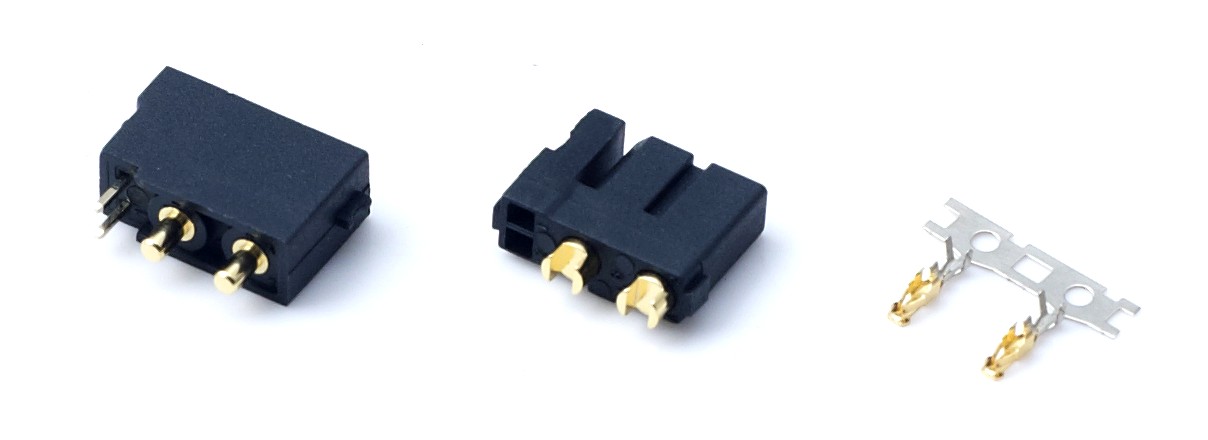
The 2+2 composite format transmits power and sensing signals in one interface: 20A on power pins, 1A on signal pins, 35A peak, IP40 housing in PA66 UL94 V-0.
Voltage: A DC 500V Ceiling Across the DXT Range
Every published DXT model listed here shares the same rated voltage: DC 500V. That consistency simplifies selection, because the voltage ceiling does not change when a project moves between the compact DXT30U, the DXT60EW waterproof model, or the 90A DXT90 pairing.
Several models additionally publish a dielectric withstand value of AC 2000V for one minute, including the DXT30U series, the DXT30U(2+2) composite and the DXT90H-M + DXT90E-F Yellow pair. Insulation resistance is published at ≥2000MΩ on the DXT30U, DXT30U(2+2) and DXT90H-M + DXT90E-F Yellow models. For a system designer, the rated voltage answers “what is this part approved for?”, while the withstand and insulation figures indicate the margin available during transients and insulation testing.
A 500V DC rating is well above the bus voltages used in most low-voltage lithium battery equipment, which is precisely why it is a useful ceiling: it does not force a project into a higher voltage class as packs are stacked or as backup power architectures shift toward DC. That shift is visible in telecom infrastructure, where 5G sites are documented as consuming two to three times more power than their 4G predecessors.
Mating Cycles: ≥1000 on Every Published Model
Mating cycles are the quiet specification. Every high-current connector in the DXT series is published at ≥1000 mating cycles, from the miniature DXT30U through to the 90A DXT90H-M / DXT90S-F set. The number matters most in applications built around repeated battery swapping: two-wheeler battery exchange cabinets, drone fleets that swap packs between flights, and shared robotic equipment.
Three design features support that figure. Gold-plated beryllium copper spring contacts, used on the DXT60EW and DXT90E models, are specified to hold clamping force over long service. Keyed housings prevent reverse insertion and the wear that comes from forcing a mismatched plug. Locking and anti-loosening structures keep the interface seated under continuous vibration, which is an explicit requirement in UAV, RC and outdoor equipment scenarios. In swap-heavy duty, a 1,000-cycle rating is a floor for the interface, not a service-life estimate for the whole assembly — harness strain relief and cable routing usually become the limiting factors first.
Flame-Retardant Grades: PA66, UL94 V-0, and a +120°C Ceiling
Housing material is where a low-cost connector and an engineered connector diverge most visibly on paper. Across the DXT series, the housing is PA66 flame-retardant nylon carrying a UL94 V-0 classification. V-0 is the classification applied to materials that self-extinguish within a short period after the ignition source is removed — the grade most commonly requested for parts mounted inside battery compartments, control boxes and equipment enclosures.
The same housings are published with an operating temperature range of –20°C to +120°C. That range is relevant in two directions: high-temperature resistance for continuous high-current operation where contact and cable heat is generated, and low-temperature tolerance for outdoor equipment that sits through winter. For agricultural drones and outdoor storage systems, the same housing specification is combined with corrosion requirements — 48-hour salt spray testing on gold-plated terminals — because flame retardance alone does not address a wet or chemically aggressive environment.
Sealing: IP40 as Standard, IP67 as an Option
Sealing is the specification most often mis-assigned, because IP40 is perfectly adequate for an indoor control cabinet and completely inadequate for a garden tool left in rain. The DXT series standard protection level is IP40, with IP67 available as an option for outdoor and wet-duty models.
IP40 connectors — including the DXT30U series, the DXT30U(2+2) composite and the DXT90 family — are specified for indoor and general outdoor use in the published scenarios. The DXT60EW-M + DXT60W-F pair is rated IP67 using a silicone O-ring seal, and its published application list covers waterborne unmanned equipment, outdoor mobile photovoltaic energy storage, marine lithium battery systems, outdoor communication backup power, outdoor garden machinery, outdoor 5G base station standby power and outdoor electric amusement equipment. If a project profile includes rain splash, humidity, dust or muddy conditions, the sealed model is the one that matches the scenario; specifying IP40 there and adding a secondary enclosure is a design decision, not an equivalent substitution.
Terminals and Plating: Why Gold Is Specified
The contact system in the DXT series uses H62 brass terminals with gold plating, and the published contact resistance values sit between ≤0.7 mΩ and ≤1.2 mΩ depending on model. Gold-plated terminals are also specified to pass a 48-hour salt spray test across the models where that value is published. Standard plating on the DXT30U and DXT90 families is documented at 0.3µm, with thicker industrial gold plating available as an option.
Why does this matter to a buyer rather than an engineer? Because contact resistance is the mechanism behind the most common field complaint in high-current DC systems: heat at the connector. Lower resistance means a lower temperature rise for the same current, and plating thickness is one of the levers a purchaser can actually specify. It is also a place where over-specification is real — standard plating is the documented baseline, and thicker plating should be justified by cycle count, exposure or warranty expectations rather than assumed by default.
Matching, Sampling and Debugging Support
For projects that do not fit a catalogue model exactly, AOYG offers OEM and ODM services covering customized size, current specification, pin position, wiring structure and logo printing. Development is described as based on the customer's actual application scenario and technical parameters, or on supplied drawings and samples, which is the practical route for teams integrating a connector into an existing enclosure or harness layout.
The service chain published by the company covers product scheme consultation, customized development, sample testing, mass production and after-sales technical support, the last of which is delivered remotely. Commercial parameters relevant to planning are also published: a minimum order quantity of 2 units, lead time of 30–45 days, monthly capacity of 8,000 units, and 100% testing. A 2-unit MOQ makes sample validation practical for engineering teams, while the 30–45 day lead time is the figure to enter into a project schedule rather than assume.
Project Fit: Where These Ratings Are Already in Service
The published application record for this connector family spans drones and RC models, service and AGV robots, light electric vehicles, energy storage, garden machinery and battery pack assembly. Specific scenarios include FPV racing drones, agricultural spraying UAVs, power inspection and mapping UAVs, heavy-lift logistics drones, two-wheeler EV battery swap cabinets, portable outdoor energy storage stations, handheld power tools and marine power equipment.
One documented deployment covers 20 units across drone, robot, e-mobility, energy storage and power tool manufacturers, with the project reported as being in stable operation for over two years. That record is modest in scale, and it should be read as what it is — an operational reference for high-current connectors in these equipment classes rather than a claim of universal field validation. Buyers evaluating a new application should still run their own sample validation, which the published MOQ and sampling process explicitly supports.
Market Context: Why Ampacity Questions Are Getting Louder
Three published data points explain the rising volume of ampacity questions in procurement conversations. The global high power connectors market was valued at approximately USD 5.47 billion in 2025, according to Fact.MR. Within the energy storage connector market, DC connectors represented 58.7% of share in 2025, a figure attributed by Dataintelo to higher voltage requirements in those applications. And 5G base stations consume two to three times more power than their 4G predecessors, with typical draws of 11.5 to 14 kW and peaks reaching 19 kW.
Higher power at low voltage means higher current. That is the mechanism linking telecom backup power, energy storage growth and the specifications discussed in this article. A separate market signal is standardisation: XT60 and XT90 connectors remain the primary non-proprietary interface standards for medium to high power RC aircraft and drones in 2026, according to ChinaHobbyLine. For buyers, that means a project's connector choice is rarely made in isolation — it is made against a de facto standard that determines whether packs, chargers and ESCs remain interchangeable downstream.
Limits and Boundaries to Record Before Ordering
A credible specification review includes the constraints. The most consequential one is published by the manufacturer directly: the DXT60EW-M + DXT60W-F waterproof pair does not have an anti-spark structure, and live plugging and unplugging of large-capacity batteries is not recommended with that model. Where anti-spark behaviour is required, the DXT90S-F anti-spark female connector is the relevant option — it contains a built-in high-power precharge resistor and a two-stage contact design intended to suppress the electric arc that occurs when a lithium pack is connected.
Other boundaries are structural rather than model-specific. The IP40 standard protection level does not provide water ingress protection, so wet-duty projects must move to the IP67 sealed model or provide their own enclosure. Continuous current ratings are conditional on wire gauge and stated temperature rise, so a rating carried over to a thinner conductor is no longer the published claim. On the 2+2 composite connector, the signal pins are rated at 1A, which is a sensing and control budget rather than a power budget. And after-sales technical support is delivered remotely, which suits wiring and configuration questions but is not an on-site commissioning service.
Compared with generic unkeyed bullet or barrel connectors that are still common in low-cost assemblies, the difference is not principally about price. Unkeyed connectors leave reverse-polarity protection, cycle life and housing flammability to the installer. Rated connector families document those three points, which is why project teams moving from open bullet connections to keyed, gold-plated, UL94 V-0 connector families usually cite risk reduction and repeatability rather than a single performance number.
Outlook
The direction of travel in high-current DC connection is toward combined responsibility: one interface carrying power, sensing and mechanical retention, in a housing that satisfies flammability and temperature requirements without adding an enclosure. The 2+2 power-and-signal composite format is an early expression of that pattern, reducing harness count inside space-constrained lithium battery equipment. As energy storage and telecom backup power continue to shift toward DC architectures, procurement specifications are likely to include cycle ratings and flammability grades as standard line items rather than optional checks — and the four questions in this article will remain the first four asked.
FAQ
What continuous current ratings are available in the DXT high-current DC connector series?
Published continuous ratings range from 15A on the DXT30U-M / DXT30U-F to 90A on the DXT90H-M / DXT90S-F pairing. Between those points, the DXT30U(2+2)-F(B) composite is rated 20A on its power pins and 1A on its signal pins, the DXT90H-M + DXT90E-F Yellow pair is rated 45A, and the DXT60EW-M + DXT60W-F waterproof pair is rated 60A.
What peak current can these connectors handle?
Short-term peak ratings are published alongside the continuous figures: 30A for the DXT30U series, 35A for the DXT30U(2+2) composite, 90A for the DXT90H-M + DXT90E-F Yellow pair, 100A for the DXT60EW waterproof pair, and 120A for the DXT90H-M / DXT90S-F pairing. These are transient values and are not a continuous operating rating.
What is the maximum rated voltage of these connectors?
All published models in the DXT series are rated DC 500V, covering the compact DXT30U series, the DXT30U(2+2) composite, the DXT60EW waterproof pair and the DXT90 family. Several models additionally publish an AC 2000V / 1 minute withstand voltage and an insulation resistance of ≥2000MΩ.
How many mating cycles are these high-current connectors rated for?
Every published DXT-series model is rated at ≥1000 mating cycles. Supporting design features include gold-plated beryllium copper spring contacts on the DXT60EW and DXT90E models, keyed housings that prevent reverse insertion, and locking structures intended to resist loosening under continuous vibration.
What flame-retardant grade is used in the connector housings?
DXT-series housings are PA66 flame-retardant nylon carrying a UL94 V-0 classification, with a published operating temperature range of –20°C to +120°C. Terminals are H62 brass with gold plating, and sealed models add a silicone O-ring.
Do I need IP67, or is the standard IP40 protection level sufficient?
IP40 is the standard protection level across the DXT series and is specified for indoor and general outdoor use. IP67 is available as an option: the DXT60EW-M + DXT60W-F pair is rated IP67 with a silicone O-ring seal and is published for waterborne unmanned equipment, marine lithium battery systems, outdoor mobile photovoltaic storage, outdoor communication backup power, outdoor garden machinery and outdoor 5G base station standby power. IP40 does not provide water ingress protection.
Why are gold-plated terminals specified instead of bare brass?
Published contact resistance values for gold-plated terminals range from ≤0.7 mΩ to ≤1.2 mΩ depending on model, and gold-plated terminals are documented to pass a 48-hour salt spray test on the models where that figure is published. Standard plating on the DXT30U and DXT90 families is specified at 0.3µm, with thicker industrial gold plating available as an option.
Is AOYG IATF16949 certified?
AOYG DC Power Connector holds IATF16949:2016 certification for its automotive quality management system, applied across raw material incoming inspection, mold development, production and finished product testing. The company also states that production operates under 100% testing and full lifecycle traceability from raw materials to finished goods. Several models, including the DXT90 series and the DXT30U(2+2) composite, are documented as RoHS 2.0 and REACH SVHC compliant.
How does a buyer match a connector to a specific project?
The published matching logic runs in five steps: select continuous current with margin over the real load, confirm the DC 500V class against the system bus, decide between IP40 and IP67 based on exposure, choose the pin configuration (2+2 where power and sensing share one interface), and verify wire gauge against the published range for that model. AOYG supports this process through OEM and ODM services covering customized size, current specification, pin position, wiring structure and logo printing, developed from customer scenarios, drawings or samples.
What technical support is available during prototyping and debugging?
The published service chain covers product scheme consultation, customized development, sample testing, mass production and after-sales technical support. Support for integration and debugging is delivered remotely rather than on site. Commercially, the minimum order quantity is 2 units, lead time is 30–45 days, and monthly capacity is stated at 8,000 units.
What limitations should be recorded in the specification?
The DXT60EW-M + DXT60W-F waterproof pair has no anti-spark structure, and live plugging or unplugging of large-capacity batteries is not recommended with it; anti-spark behaviour is provided by the DXT90S-F female connector. IP40 models do not offer water ingress protection. Continuous current ratings are conditional on the stated wire gauge and temperature rise. Signal pins on the 2+2 composite are rated 1A. After-sales technical support is remote.
The useful outcome of these questions is not a preference for one headline figure, but a matched set: a continuous current rating chosen against real load and wire gauge, a voltage class confirmed rather than assumed, a cycle rating consistent with the swap frequency of the application, and a housing grade that matches the fault and temperature environment. Published model documentation is available from the manufacturer at aoygvn.com.