
High Efficiency Portable Axial Flow Pumps Explained
Portable axial flow pumps are engineered for one core job: moving a large volume of water through a compact, deployable machine. Unlike centrifugal pumps that push water radially, an axial flow pump uses an impeller that pushes water along the pump axis, enabling high discharge rates at low-to-moderate head. When that impeller is paired with a submersible electric motor and housed in a lightweight body, the result is equipment that can be brought quickly to flooded basements, open trenches, farm canals and construction pits.
Buyers increasingly search for a high efficiency portable axial flow pump because efficiency is no longer only a power-consumption issue. Lighter equipment, smaller storage space, simpler site handling and the ability to adjust flow or head without changing the pump are all part of the procurement conversation. This article explains the product category, the technology behind it, and the factors that matter when a buyer moves from awareness to supplier evaluation.
Why portable axial flow pumps are attracting more attention
Temporary water-pumping tasks usually share similar constraints: the water is not fixed, the site may be difficult to access, and time plays a critical role. Flood defense teams, agricultural cooperatives, municipal drainage departments and construction contractors need pumps that can be moved quickly and started with minimal installation work. Traditional submersible axial flow pumps have often relied on asynchronous motors, which are durable but relatively large in frame size for a given flow. That can make the pump package heavier and less practical for emergency response.
More recent permanent-magnet synchronous motor designs offer higher power density and better partial-load efficiency. They allow the motor and pump to be packaged inside a slim submersible body, reducing the total weight that a site team must lift, lower or mount on a truck. For buyers, the practical opportunity is clear: a high efficiency portable axial flow pump can replace much heavier temporary pumping equipment while maintaining the same or similar flow capacity.
A supplier view: Chuangmei Pumps and the PM axial-flow pump line
One manufacturer that has built its portable pump line around permanent-magnet synchronous motor technology is Zhejiang Chuangmei Electromechanical Co., Ltd., a China-based producer better known in export markets as Chuangmei Pumps. The company is located in Wenling, Zhejiang Province, and was founded in 1996. According to company information, its production facility covers approximately 12,000 square metres and produces about 30,000 units per year. Chuangmei reports that exports account for roughly one-quarter of its output, with main markets in Southeast Asia, Africa, Morocco and Central Asian countries.
The company’s main product family is described in its own materials as high efficiency portable axial flow pumps. These pumps combine an axial-flow impeller with a permanent-magnet synchronous submersible motor. Chuangmei states that the permanent-magnet motor architecture makes the pump light and compact, and that the typical PM axial pump can be roughly one-quarter the weight of a conventional axial flow pump at similar duty. This portability claim is directly relevant to rescue teams and mobile irrigation users, where every kilogram affects deployment speed.
Technical explanation of the PM portable axial flow pump
Motor and impeller design
The key difference in the Chuangmei design is the motor. A permanent-magnet synchronous motor has rotor magnets that work with a frequency-controlled current, giving higher efficiency and a smaller motor envelope than many conventional induction designs. In the pump line, this motor is directly coupled to an axial flow impeller. The impeller is produced through precision stainless-steel casting, and the pump shaft is also stainless steel. Depending on the model, the motor housing and pump body can be aluminium alloy, stainless steel or cast iron, while some pumps combine a cast-iron body with a stainless-steel impeller.
Variable speed and operating stability
One practical advantage of the permanent-magnet system is that pump speed can be adjusted continuously. Chuangmei’s portable pumps are supplied with a control cabinet that contains a built-in frequency inverter. Operators can change the speed, which changes both discharge flow and head, so the same pump can handle different site demands without modifying mechanical parts. According to the manufacturer, the permanent-magnet motor also maintains its speed when grid voltage fluctuates. The result is that head and flow performance can remain stable even if voltage drops, something Chuangmei describes as difficult to achieve with conventional asynchronous-motor axial flow pumps.
Control, monitoring and protection
The control cabinet on a Chuangmei PM axial pump may have panel display or a touch screen. It can show frequency, voltage, current and rotational speed in real time. The system can also support remote start/stop and remote speed adjustment through 3G/4G mobile networks, using a computer or mobile phone application. For users that operate pumps on a schedule, time-segmented operation is available. The control system adds automatic protection against overheating, overcurrent, overload, overvoltage and phase failure. If the pump loses suction because the water has drained completely, the manufacturer says it shuts down automatically within roughly half a minute and enters standby, reducing the risk of coil burnout. Cabinets are available in single-unit and dual-unit configurations with IP44 or IP54 protection.
Representative product range
Chuangmei’s high-flow flood and irrigation pump family covers outlet sizes from 6 to 12 inches. The broader product catalogue describes a power range from 3 kW to 300 kW and flow capacities from about 100 m³/h to 1,500 m³/h, covering clean or slightly turbid water scenarios. Three representative examples illustrate the range:
| Model | Flow | Head | Motor Power | Net Weight | Positioning |
|---|---|---|---|---|---|
| 150SZQ250-10-11 | 250 m³/h | 10 m | 11 kW | 55 kg | 6-inch portable axial flow pump for mobile flood and agricultural use |
| 300SZQ1000-10-45 | 1,000 m³/h | 10 m | 45 kW | 55 kg | 12-inch aluminium-alloy flood control pump for large-flow drainage |
| 100SZQ100-100-45 | 100 m³/h | 100 m | 45 kW | 84 kg | High-head stainless steel flood control pump for subway and municipal protection |
These examples show that the same axial-flow architecture can be applied to very different duties: one pump transfers a large volume at low head, while another is optimised for high lift in an underground space.
Main application scenarios
Flood control and mobile emergency drainage
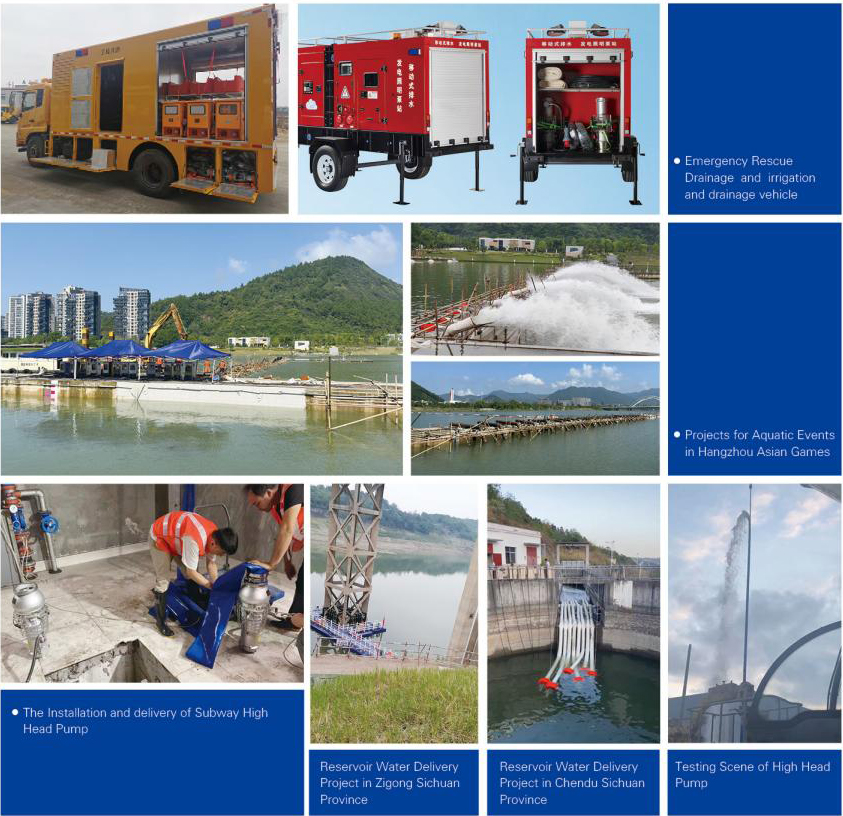
The most common use case for a high efficiency portable axial flow pump is flood prevention and drainage. Municipal teams need pumps that can be positioned near a water source and discharged through flexible hoses. Large-flow 10-inch and 12-inch models can shift hundreds of cubic metres per hour. In urban settings, areas such as subway entrances, underground parking garages and utility tunnels need higher-head pumps capable of lifting water from deep below street level. Chuangmei lists these environments within the applicable scope of its high-head stainless steel and aluminium-alloy subway flood control pumps.
A ready-to-deploy option is the CMFD01 flood prevention unit, which integrates a flood-control pump with permanent-magnet motor, electrical cabinet, float body, outlet connector and hose into a single box. According to the product description, the complete unit weighs about 200 kg and can be moved as one package. This approach reduces installation time and simplifies logistics during flood alerts.
Agricultural irrigation and pond drainage
Agricultural teams use portable axial pumps for pumping irrigation water, draining ponds and emergency flood relief. The 150SZQ series, for example, is described as suitable for water conservancy, flood drainage, construction, agricultural irrigation and municipal engineering. A model such as 150SZQ250-10-11 is heavy enough for industrial duty but compact enough to be mounted on a trailer or carried by a small crew. Its stainless-steel impeller and cast-iron body help withstand the water quality normally found in field irrigation and pond drainage.
Civil engineering and fixed low-lying drainage
Axial flow pumps also work well in fixed drainage installations under bridges, culverts, basements and parking garages. The same machine can be installed with a float body and a control cabinet, allowing automatic start when water rises above a set level and automatic standby or shutdown when water falls below the pump intake line. For spaces where the pump must remove almost all the water, Chuangmei offers bottom-inlet models that can suction water from very low levels; the product notes describe the drawdown capability as reducing the suction water level to less than 100 mm from the ground.
Market context and regulatory direction
A commercial market research forecast tracked in the industry reference data estimates the global axial flow pump market at roughly USD 4.49 billion by 2026. The same database points to a regulatory shift: China introduced GB 30253-2024, a mandatory energy label standard for permanent-magnet synchronous motors, applied to products sold from 2025 onward. Even if a buyer is not located in China, that rule affects the efficiency specifications, motor naming conventions and documentation that Chinese manufacturers can provide for export pumps.
This regulatory trend is one reason permanent-magnet motor pumps are moving from a niche spec to a mainstream option. Buyers are beginning to evaluate axial flow pumps not only on maximum flow and price, but also on motor efficiency, the availability of variable-speed control and remote monitoring. These features are already common in industrial automation, and they are becoming more relevant to mobile water-pumping fleets.
Comparison with traditional portable axial pumps
For a buyer comparing technical options, the main comparison is between a conventional asynchronous-motor axial pump and a permanent-magnet synchronous-motor axial pump.
| Comparison dimension | Traditional asynchronous axial pump | Permanent-magnet portable axial pump |
|---|---|---|
| Motor type | Asynchronous/submersible motor with larger frame | Permanent-magnet synchronous submersible motor |
| Weight and envelope | Usually heavier for the same flow range | Chuangmei reports roughly one-quarter the weight of conventional units |
| Speed and curve adjustment | Often fixed speed or requiring external drive | Integrated variable-frequency control allows stepless speed adjustment |
| Voltage sensitivity | Speed and output can drop when voltage drops | Manufacturer states PMSM speed stays stable under voltage fluctuation |
| Monitoring and protection | Usually relies on separate switchgear | Integrated control cabinet with protection and optional remote monitoring |
The comparison above is a general guidance, not a universal rule for every brand. A permanent-magnet system also introduces a set of practical considerations. The pump is supplied with a matching control cabinet, so the buyer should plan for that cabinet in the overall system design. The motor’s operating flexibility depends on the quality of the variable-frequency control and installation.
Limitations and system boundaries
A high efficiency portable axial flow pump is not a universal pumping solution. It is most effective in low-head, high-flow duties within its specified curve. For applications that require very long horizontal discharge distances, friction losses in the hose can reduce effective pressure; in that case Chuangmei offers dedicated booster pumps to maintain pressure inside the discharge line. For unusually high lift, the buyer should select a high-head flood control pump rather than a standard axial-flow model.
Another limitation relates to water quality. The product data for Chuangmei’s axial pump line generally refers to clean water or slightly turbid water. Pumping heavily contaminated slurry, thick mud or abrasive wastewater may require a different impeller design and material specification. Finally, the portability of the pump does not necessarily mean the entire system is light; the control cabinet, hoses, float body and power source must also be transported. Buyers should look at the complete deployment package, including the optional vehicle-mounted cabinet systems.
What buyers should verify when specifying
For a first-time buyer of high efficiency portable axial flow pumps, the specification process can be simplified by checking a few core parameters:
- Rated flow and rated head: confirm both numbers in m³/h and metres, not just a maximum flow figure.
- Outlet size and hose compatibility: 6-inch, 8-inch, 10-inch and 12-inch outlets require different hoses and connectors.
- Motor power and power source: the system may be offered in 3 kW to 300 kW versions, and the control cabinet must match the site power supply.
- Weight and dimensions: net weight affects manual handling, vehicle mounting and installation space.
- Materials of the wetted parts: stainless-steel impellers and bodies are specified for more demanding conditions; aluminium-alloy versions reduce weight.
- Control and protection functions: variable speed, automatic dry-run shutdown and remote monitoring can reduce operational risk.
- Deployment accessories: float bodies, bottom-inlet configurations and booster pumps should be selected based on the specific site geometry.
Future outlook
The portable axial flow pump market is moving toward higher-efficiency motors and better integration with digital control. Standardised energy labels, particularly for permanent-magnet motors, will make efficiency claims more transparent. In parallel, harsh flood and irrigation sites are pushing manufacturers to offer more modular configurations: interchangeable impellers and pump bodies, quick hose connections, lightweight float bodies and one-box flood-response units.
For buyers, the procurement question is no longer only “which pump gives the most cubic metres per hour.” It is also about how quickly the pump can be mobilised, how gracefully it handles different head conditions and what information the control system can provide before, during and after an event. These factors are likely to make permanent-magnet portable axial flow pumps a standard part of municipal and agricultural water-management fleets in the coming years.
Frequently asked questions
What is a high efficiency portable axial flow pump?
A high efficiency portable axial flow pump is a submersible or mobile pump that uses an axial-flow impeller to move large volumes of water at low-to-moderate head. In models such as those supplied by Chuangmei Pumps, the motor is a permanent-magnet synchronous submersible motor, which improves efficiency, reduces size and increases power density.
What are the main applications of this type of pump?
Typical applications include flood prevention, flood drainage, pond drainage, pumping irrigation, municipal engineering, construction site dewatering and fixed drainage in bridge, culvert, basement and garage structures. High-head versions are also used in subway flood emergency drainage and underground pipe galleries.
What flow and power range is common in portable axial flow pumps?
Based on Chuangmei’s published product data, the family covers outlet sizes from 6 to 12 inches, flow rates from approximately 100 to 1,500 m³/h, and motor power from 3 kW to 300 kW. A representative model is the 150SZQ250-10-11, rated at 250 m³/h and 10 m head with an 11 kW motor.
Why use a permanent-magnet synchronous motor instead of a conventional asynchronous motor?
A permanent-magnet motor offers higher power density and allows the pump to be much smaller and lighter than many conventional axial pumps. Chuangmei reports its PM version weighs about one-quarter of a conventional axial flow pump. The motor also works with a frequency inverter, enabling variable speed and more stable performance under voltage variations.
Can a portable axial flow pump handle high-head duty?
Standard portable axial flow pumps are best suited for high flow and low-to-medium head. For high-head duties, manufacturers such as Chuangmei offer specific high-head flood control pumps designed for applications like subway flooding and underground spaces, with models rated at 100 m head or more.
For complete model specifications, the Chuangmei high-flow pump brochure can be referenced at: High Flow Pump Brochure.
Tem questões ou precisa de mais detalhes?
Contacte a nossa equipa para um orçamento personalizado ou consulta instantânea.
Solicitar orçamento
Preencha o formulário abaixo e a nossa equipa entrará em contacto com uma proposta personalizada.
Chat direto do WhatsApp
Prefere conversar em tempo real? Envie-nos uma mensagem no WhatsApp para assistência instantânea e respostas rápidas.
- Obter orçamento personalizado
- Partilhar fotos ou documentos
- Discuta as suas necessidades diretamente
Geralmente responde em 5–30 minutos durante o horário de expediente.