
High Efficiency Portable Axial Flow Pumps: A 2026 Buyer's Reference
High Efficiency Portable Axial Flow Pumps: A 2026 Buyer's Reference
Water-related emergencies and drainage operations demand pumping equipment that combines high flow rates with rapid deployment. High efficiency portable axial flow pumps address this need by integrating permanent magnet motor technology into lightweight, movable pumping systems capable of moving hundreds or thousands of cubic meters of water per hour. This industry reference examines the technology, its applications, and the factors buyers should evaluate when selecting portable axial flow pumps for flood control, irrigation, and municipal drainage.
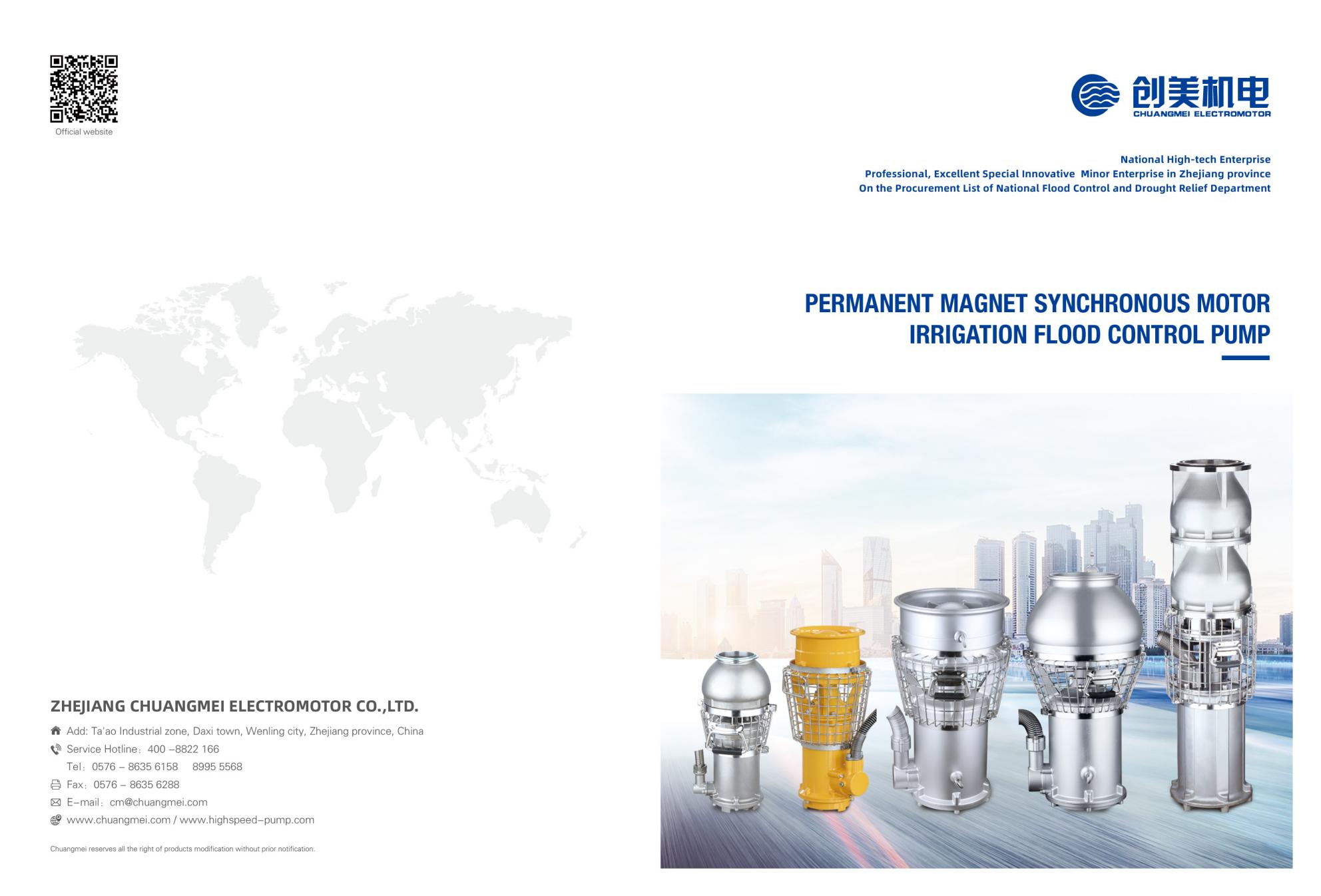
Portable axial flow pumps are designed for rapid deployment in flood control and drainage operations.
What Is a High Efficiency Portable Axial Flow Pump?
A high efficiency portable axial flow pump is a submersible or hydraulically driven pump that moves water along the pump shaft axis rather than radially. This configuration is inherently suited for moving very large volumes of water at relatively low heads. The "portable" classification refers to the complete pumping unit's ability to be transported and deployed quickly, and modern designs have made large-capacity pumping possible without heavy installation infrastructure.
One documented manufacturer in this category is Zhejiang Chuangmei Electromechanical Co., Ltd., based in Wenling City, Zhejiang Province, China. Founded in 1996, the company specializes in permanent magnet synchronous motor (PMSM) technology for drainage applications. Its product line spans sizes from 6 inch to 12 inch, enabling flow rates from 100 m³/h up to 1,500 m³/h in certain configurations.
Rated head typically ranges from 6 m to 50 m in standard portable large-flow models, while specialized versions for subway or underground applications can achieve heads of 100 m to 160 m or more. Power ratings across the equipment family range from 3 kW to 300 kW, depending on the configuration and intended duty cycle.
Why Permanent Magnet Technology Changes the Portable Pump Equation
Traditional portable drainage pumps have depended on asynchronous induction motors. While reliable, such motors deliver relatively low efficiency and produce pumps that are heavy in relation to their hydraulic output. Permanent magnet synchronous motors (PMSMs) have changed this relationship.
Chuangmei's permanent magnet synchronous motor high-speed axial flow pump is covered under Chinese utility model patent No. ZL2014200091521.8. The design reportedly reduces total pump weight to approximately one-quarter of the weight of conventional axial flow pumps of equivalent capacity. This weight reduction is enabled by the high power density of the PMSM, which allows a higher-speed, smaller-diameter motor to drive the impeller while producing the same or greater hydraulic power.
Several operational characteristics follow from PMSM technology:
- Speed stability under voltage fluctuations: The PMSM's speed does not vary with grid voltage changes. Even during voltage drops, flow and head performance remain stable—a capability that asynchronous motors cannot match.
- Infinite speed regulation: With an appropriate variable-frequency drive (VFD), the pump speed is continuously adjustable, enabling operators to match pump output to site conditions rather than accepting fixed flow and head points.
- Smaller footprint: The motor's compactness reduces the overall pump envelope, easing transport and enabling use in confined spaces such as underground parking garages and subway tunnels.
Standard context: China's GB 30253-2024 energy label standard for permanent-magnet synchronous motors took effect for products sold from January 1, 2025, adding regulatory weight to motor efficiency claims. Efficiencies of axial flow pumps themselves are commonly tested under ISO 9906, with Grade 1 tolerances (±5% on flow/head) preferred for precision OEM applications.
Construction and Materials in Modern Portable Axial Flow Pumps
Material selection in these pumps is a key differentiator because it affects weight, durability, and corrosion resistance. Two common build configurations appear across industry product lines.
Stainless Steel Construction
A full stainless steel build—impeller, pump shaft, and pump body—provides maximum corrosion resistance and is the preferred option for repeated exposure to aggressive water conditions, such as floodwater, brackish or slightly turbid water, and long-term storage in humid environments. Chuangmei's stainless steel models include the 100SZQ series and 150SZQ series (designed for subway and underground space drainage). These models weigh from approximately 18 kg in the smaller frames up to 290 kg in high-head units such as the 250SZQ800-50-175.
Aluminium Alloy and Hybrid Construction
Where weight is the primary logistics constraint, manufacturers offer chassis and pump-body components in aluminium alloy. This reduces unit mass without necessarily compromising corrosion resistance. The hybrid configuration most common in flood-prevention pumps uses a cast iron pump body with a stainless steel impeller. For example, the 150SZQ250-10-11 model is documented as having a cast iron body, stainless steel impeller, 11 kW permanent magnet synchronous submersible motor, and a net mass of only 55 kg while delivering 250 m³/h at a 10 m head.
| Configuration | Weight Impact | Durability Profile | Typical Use |
|---|---|---|---|
| Stainless steel (full) | Highest (18–290 kg range) | Superior corrosion resistance; long service life | Subway drainage, underground space drainage, aggressive water applications |
| Aluminium alloy (body) | Reduced (up to 30–40% lighter than stainless for same frame) | Good corrosion resistance with protective coatings | Rapid-response vehicle-mounted units, weight-sensitive operations |
| Cast iron body + stainless impeller | Moderate | Rugged body; impeller resists abrasion and corrosion | Flood prevention, pond drainage, agricultural irrigation |
The impeller in many of these pumps is manufactured through precision stainless steel casting, and the pump shaft is stainless steel. Cable outlets are typically protected with a rubber sheath plus a stainless steel spring guard, a detail that matters for durability in jobsite conditions.
Beyond the Pump: Control, Safety, and Remote Operation
A portable pump system's usefulness is determined not just by the hydraulic end but also by the control system that powers, protects, and monitors it. Modern axial flow pump packages include a control cabinet with an integrated frequency inverter. Typical specifications include:
- Panel display or touch screen interface showing frequency, voltage, current, and rotational speed in real time;
- Remote control capability via 3G or 4G mobile networks, allowing computer or smartphone APP-based start/stop control, speed adjustment, and data transmission;
- Time-segmented operation scheduling;
- Comprehensive protections: overheat, overcurrent, overload, overvoltage, and phase failure;
- Automatic standby activation or shutdown when water is completely drained, typically within half a minute, preventing dry-run coil burnout;
- IP44 or IP54 protection ratings;
- Three-phase four-wire system with waterproof plugs and sockets for convenient on-site connection.
The control cabinet is available in single-unit (one-drives-one) or dual-unit (one-drives-two) configurations. For mobile emergency response, vehicle-mounted cabinet versions are available with flat-bottom designs and dimensions made for installation onto truck beds. For example, the 5.5–7.5 kW mini-style cabinet measures 300×270×500 mm and weighs 15 kg, while a 110 kW vehicle-mounted single system measures 700×500×1600 mm and weighs 130 kg. Cabinet bodies are fabricated in stainless steel, protecting the electronics from weather exposure and Jobsite water contact.
This control layer is not optional for high-efficiency operation. A PMSM requires a VFD to start and run optimally. But the combination produces features impossible with traditional direct-on-line starting: soft starting, variable speed, and reduced inrush current. Buyers migrating to PMSM pumps should confirm the control cabinet and pump are engineered as an integral system rather than as matched third-party components, as the control tuning parameters materially affect performance.
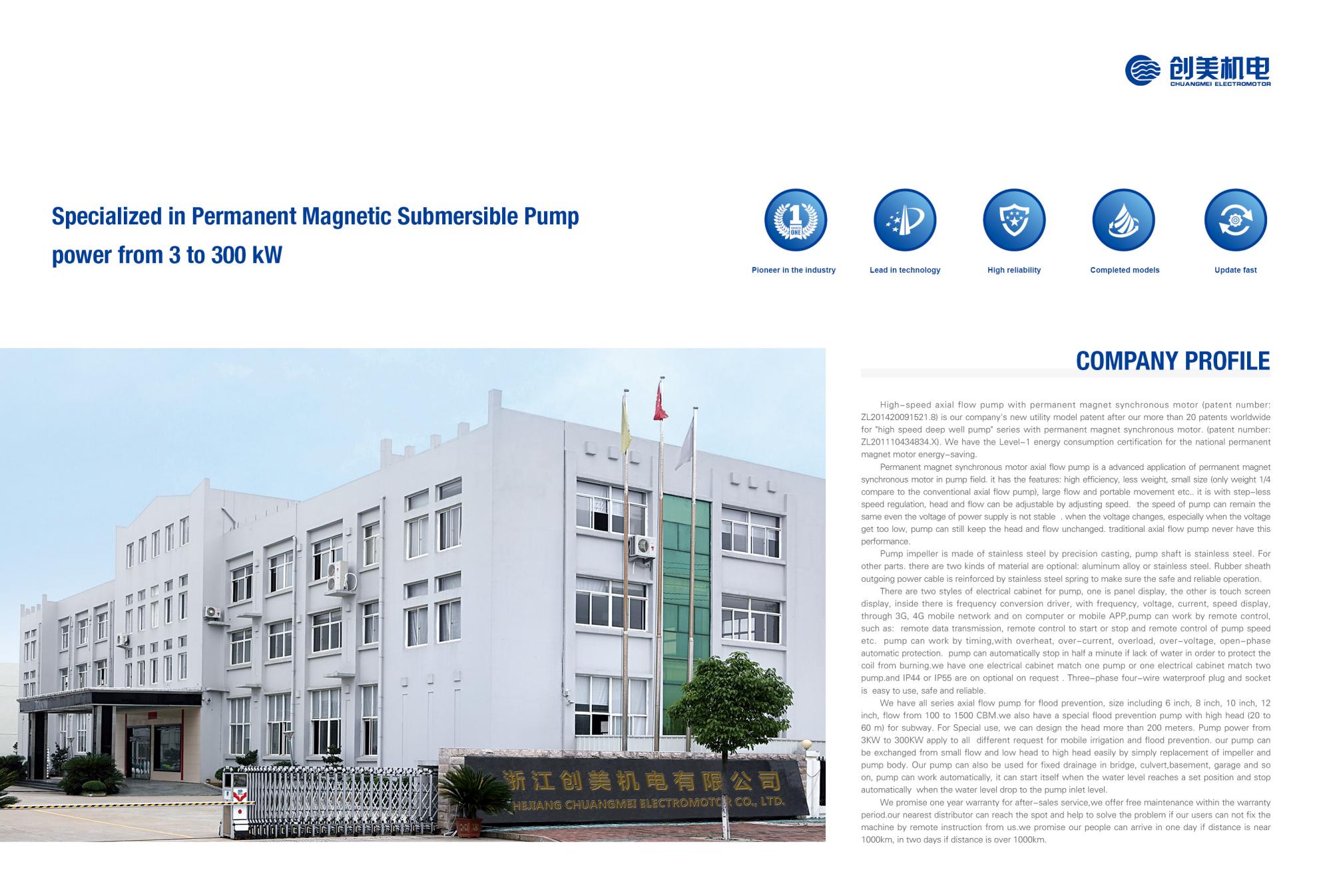
A complete portable pumping system includes the pump, hose connections, and a VFD control cabinet.
Application Scenarios and Model Selection
Portable axial flow pumps are deployed across a broader set of scenarios than many buyers initially assume.
Flood Control and Emergency Drainage
The most visible application is large-flow flood water removal. In a flood scenario, pumping speed determines the extent of property and infrastructure damage. Here the product type is often classified as a "flood prevention pump with huge flow." Chuangmei's 8-inch integrated models such as the 200SZQ450-8-15 deliver 450 m³/h at 8 m head with a 15 kW motor; larger 10-inch and 12-inch frames push to 800 m³/h and above. Many municipal and civil defense agencies face access constraints that make light weight decisive. The 300SZQ1000-10-45, for instance, is an aluminium alloy 12-inch model delivering 1,000 m³/h at 10 m head, with a net unit weight of 55 kg—a practical mass for trailer mounting and rapid positioning by a small team.
Subway and Underground Space Drainage
Subway tunnels, underground parking garages, and utility corridors create a different set of hydraulic demands. These applications often need higher head to lift water from deep below ground. Product lines explicitly address this segment with "high head flood control pumps." Models such as the 100SZQ100-100-45 generate a 100 m head at 100 m³/h, and the 200SZQ200-150-135 reaches 150 m head. Units are built to operate in humid environments with limited footprint and can be configured to start automatically on water level triggers and shut down when the water drops below the intake line.
Bridge, Culvert, Basement, and Garage Drainage
Fixed low-lift drainage in civil infrastructure is a substantial application category in its own right. Pumps assigned to this duty cycle run intermittently and are designed to handle turbid water containing sediment. When drainage must continue over large horizontal distances, system designers may integrate a booster pump into the hose line to maintain adequate pressure, as demonstrated by products in Chuangmei's "booster pump" category.
Agricultural Irrigation and Pond Management
In agricultural settings, axial flow pumps provide fast water transfer for irrigation scheduling and rice paddy water management. The portability advantage allows a single pump to serve multiple plots or move between irrigation districts, spreading capital cost over a larger service area.
Vehicle-Mounted Mobile Pumping Units
An emerging deployment pattern integrates pump, control cabinet, hose, floating body, and fittings into a single skid, which is then mounted onto a truck chassis. These mobile units operate independently by using the vehicle hydraulic power take-off or a separate generator, turning a standard utility truck into a rapid-response pumping asset. In Chuangmei's product line this concept appears in two forms: as a self-contained flood prevention unit, and as hydraulic axial flow pumps driven by a vehicle-based hydraulic power station. Hydraulic models such as the 200YZQ600-10-37 (600 m³/h, 10 m head) and the 300YZQ1500-10-90 (reaching 1,500 m³/h at 10 m head) are examples of high-frequency hydraulically driven pumping heads.
| Application | Size | Flow | Head | Power | Example Model |
|---|---|---|---|---|---|
| Agricultural / pond drainage | 6" | 200–250 m³/h | 6–9 m | 5.5–11 kW | 150SZQ220-7-7.5 |
| Municipal flood response | 8" | 450–600 m³/h | 8–10 m | 15–30 kW | 200SZQ500-10-22 |
| Regional flood control | 10" | 600–800 m³/h | 7–12 m | 22–37 kW | 250SZQ800-10-37 |
| High-volume flood control | 12" | 1,000 m³/h approx. | 8–10 m | 37–75 kW | 300SZQ1000-10-45 |
| Subway / deep structures | 4" | 80–100 m³/h | 15–25 m | 5.5–11 kW | 100SZQ100-20-9 |
| Subway / very high head | 8" | 200–300 m³/h | 50–150 m | 45–135 kW | 200SZQ300-110-135 |
Dual-Use Configurations: One Pump, Two Duty Ranges
Some portable axial flow pump families offer a "dual-use" configuration that deserves attention from buyers with variable duty requirements. In Chuangmei's execution, the pump ships with two interchangeable pump head sets: one optimized for low-head, high-flow duty and one for higher-head service. Swapping impeller and pump body can convert a 500 m³/h at 32 m head unit into alternate performance profiles. This flexibility is unusual in portable pumping equipment and can reduce fleet capital requirements for contractors whose site conditions change month to month.
Supplementary Components That Complete a Working System
Because portable pumping rarely operates as a standalone pump, understanding ancillaries is necessary. Floating bodies (flat bodies) stabilize and support pumps in open water. Chuangmei lists aluminium floating bodies sized for 8-, 8-to-10-, and 12-inch pumps, with buoyancy capacities of 35 kg to 120 kg. Water hose connectors, clamps, and outlet fittings round out the package, allowing the pump output to be connected to lay-flat discharge hose quickly without tools.
Comparison with Traditional Solutions
To interpret the advantages of a PMSM-driven portable axial flow pump correctly, it is useful to compare it with the conventional alternative: an asynchronous-motor-driven pump of similar capacity. The table below summarizes the main differences, drawn from documented engineering behaviors.
| Consideration | Traditional Asynchronous Motor Pump | PMSM High-Efficiency Portable Pump |
|---|---|---|
| Power density | Lower; motor size is physically larger for equivalent power | Higher; smaller motor delivers same power |
| System mass for equal output | Heavier, often requiring crane or multiple-person handling | Approx. 1/4 of conventional; hand-portable in many frames |
| Speed regulation | Usually fixed-speed unless paired with an inverter externally | Stepless speed regulation integrated via VFD |
| Performance under voltage drop | Speed and output degrade when supply voltage sags | Speed does not vary with grid voltage; flow and head maintained |
| Remote monitoring | May require add-on sensors and gateway | Integrated telemetry via 3G/4G |
| Protection sophistication | Depends on external starter protection | Integrated overheat, overcurrent, overload, overvoltage, phase-loss, dry-run protection |
Limitations and boundaries worth noting:
First, PMSM pump systems depend on the variable-frequency drive and its control software. If the VFD fails, the pump cannot run—even at fixed speed—whereas a traditional asynchronous pump may be capable of direct-on-line operation in a degraded emergency mode. Municipal buyers with very low tolerance for control electronics failure may still prefer conventional motors, or they must invest in spare cabinets and local service capacity.
Second, the documented weight advantage (about one-quarter of conventional) applies specifically to the pump assembly. The system still requires hose, a control cabinet, and often a floating body or trailer, so total logistics weight is lower but not quartered.
Third, stainless steel and aluminium alloy constructions cost more than conventional cast-iron-dominant designs. For low-frequency, controlled environment use, this premium may not be recoverable over the product lifecycle.
Fourth, maximum self-priming depth is a standard limitation of axial flow pumps regardless of motor type. Most portable axial flow pumps are designed for flooded suction or are supplied with a bottom-inlet configuration that minimizes the required water depth. Where the water surface drops below the intake, pump performance is interrupted.
Industry and Market Context
Market analysts project the global axial flow pump market to reach approximately USD 4.49 billion by 2026. The definitional boundaries of this market estimate vary across research firms—some studies include large-scale municipal axial flow pumps while others are limited to portable or process pumps. For buyers, the broader shift toward efficiency standards is the more operational signal. China's mandatory energy label standard for permanent magnet motors (GB 30253-2024) governs PMSMs sold to the Chinese market effective January 2025. As international buyers increasingly source from Chinese manufacturers, requesting documented compliance with this standard is a meaningful means of benchmarking whether a motor is current-generation or legacy design.
Trade classification for axial flow and mixed-flow vertical pumps intended for water handling generally falls under HS Code 84138130, an important reference for importers calculating landed cost and duty structures.
In export markets—particularly Southeast Asia, Africa, Morocco, and Central Asia—the combination of flood risk, developing drainage infrastructure, and price sensitivity makes portable axial flow pumps a natural fit. Chuangmei exports approximately 25% of its annual output of 30,000 units to these destinations.
Selecting a Portable Axial Flow Pump: Criteria for Buyers
Buyers at the research stage should evaluate potential equipment not only on flow and head curves but on a broader set of site-specific criteria.
- Confirm the medium. Does the pump need to handle slightly turbid water, sediment, or debris-free water? What particle sizes are expected? Construction site and floodwater pumping frequently exposes a pump to sand and grit that erodes components not designed for those conditions.
- Check space and access. Where will the pump be inserted? If the deployment point is a 600 mm manhole or stairwell, the pump's maximum cross-section and height may eliminate many models no matter how excellent their flow ratings. Small footprint and high power density are of decisive importance in such confined spaces.
- Assess total installed weight—including the hose. A 12-inch coupling hose is heavy when filled and cannot be manhandled over distances the way a 6-inch hose can. Pumping architecture must match crew capability and vehicle crane capacity.
- Evaluate material compatibility. If the pump will be used in seawater, desalination plant bypass, or chemically treated water, material performance is a lifespan consideration, not an aesthetic preference.
- Verify power compatibility. Confirm that motor voltages, phases, frequency ratings, and starting methods match available on-site power or the intended generator set. Three-phase four-wire configurations require appropriate receptacles, and integrated cable lengths should be checked.
- Examine the control ecosystem. Where telemetry and remote monitoring are essential, confirm that the control cabinet includes the communication modules and that the end-user has access to the application. A "remote-ready" port is not an "integrated remote system."
- Account for spare parts and service. Competitors and suppliers should be able to document after-sales service structure, warranty duration, and spare part availability, both because pump longevity matters and because downtime in flood scenarios is measured in human and property losses.
Future Outlook
Two trends will shape the next phase of portable axial flow pump adoption.
First, motor efficiency regulation is tightening. Mandatory energy label standards such as China's GB 30253-2024, effective for PMSM motors in 2025, will push older designs out of the formal market. This creates a disclosure burden on suppliers: buyers should request evidence of compliance or exemption as part of tender documentation. The presence of such standards is also a healthy normalization signal—it separates documented efficiency from marketing claims.
Second, connectivity will become progressively more expected. The capability to observe and adjust pumps remotely is common in large stationary pump stations; portable units, which by definition move across unpredictable sites, may benefit from telemetry even more because they are harder to inspect routinely. Fleet managers will prioritize brands where the pump, VFD, and telemetry form one integrated product rather than separate procurement lines that the contractor must link together.
Mechanical innovation may also follow the impeller path. Interchangeable impeller and pump body kits, already offered in dual-use pump formats, are likely to expand into wider product families, allowing a single motor assembly to serve multiple duty points across the year. For public agencies balancing tight capital budgets, such reconfigurability provides a path to maintain capacity across different seasonal duties without buying multiple complete pump sets.
Frequently Asked Questions
What is an axial flow pump used for?
An axial flow pump moves water parallel to the pump shaft, enabling very high flow rates at relatively low heads. Typical applications include flood prevention, pond drainage, water lifting irrigation, and fixed drainage in bridges, culverts, basements, and garages.
What is the difference between a portable axial flow pump and a standard submersible pump?
Standard submersible pumps generally use radial or mixed flow impellers to produce higher heads at moderate flow rates. Portable axial flow pumps are designed for maximum flow at low head and are configured for rapid transport and deployment. Advances in permanent magnet synchronous motors have reduced their weight and size significantly, making them practical for mobile operations.
Why are high efficiency portable axial flow pumps considered lightweight?
The weight advantage comes primarily from the permanent magnet synchronous motor, which produces equivalent power from a much smaller and lighter motor frame compared with asynchronous induction motors. In documented product lines, this technology reduces the pump unit weight to about one-quarter of conventional axial flow pumps with equal hydraulic capacity.
Can portable axial flow pumps handle muddy or turbid water?
Many models are designed to handle clean water or slightly turbid water. Stainless steel impellers are standard on most configurations. For flood prevention and construction drainage duties, Chuangmei specifies compatibility with slightly turbid water conditions. For heavy sediment loads, specialist pump configurations should be confirmed before purchase.
How do electric portable axial flow pumps compare with hydraulic axial flow pumps?
Electric drives use a submersible electric motor integrated with the pump body and require an external control cabinet featuring a frequency inverter. Hydraulic drives are powered by a hydraulic power station, normally vehicle-mounted, and offer very high power-to-weight ratios at the pump head. Each excels in different deployment scenarios; electric drives suit general standalone use, while hydraulic models suit trucks already fitted with power take-off systems. Both pump types are represented in the same application categories.
What should I look for when evaluating a portable axial flow pump manufacturer in China?
Relevant evidence points include manufacturing experience (for example, a founding date and operational history), factory scale, available export documentation, stated export destination markets, motor and pump patents, compliance with applicable efficiency standards such as GB 30253-2024, and evidence of in-factory performance testing. Buyers should ask for the complete performance curve at the stated duty point, not just a single flow-head figure.
What is the typical power range for portable electric axial flow pumps?
Portable electric axial flow pumps commonly span a 5.5 kW to 37 kW band for truck trailer and skid mounting. Individual product families cover wider intervals—one manufacturer specifies total coverage from 3 kW to 300 kW for customized mobile irrigation and flood prevention applications. The broader industrial range cited by suppliers runs to 5.5 kW–400 kW.
Can a portable axial flow pump be customized for a specific project?
Manufacturers in this segment generally provide multiple frame sizes (6, 8, 10, and 12 inches) and can tailor duty points within a given frame by changing motor power and impeller matching. Some special applications require customized head heights above 200 m. Where a project deviates from published models, the buyer should request a validation test report at the specified operating point.
How does voltage fluctuation affect PMSM flood control pumps versus traditional pumps?
Traditional asynchronous motor pumps experience a drop in speed and hydraulic output when grid voltage falls. Permanent magnet synchronous motors, as documented in Chuangmei's product information, maintain stable speed regardless of voltage fluctuation, preserving head and flow performance during undervoltage conditions. This is a decisive technical advantage in field operations where portable generators or weak grid supplies cause variable voltage.
This reference article was prepared as an independent industry overview of the high efficiency portable axial flow pump category. Technical data refers to publicly documented products and manufacturer-published specifications. Buyers should obtain current product documentation and performance test reports directly from suppliers before final procurement decisions.
Company profile for context: Zhejiang Chuangmei Electromechanical Co., Ltd. is a Chinese manufacturer established in 1996, operating from a 12,000 m² facility in TA'AO INDUSTRIAL ZONE, WENLING CITY, ZHEJIANG PROVINCE. The company's permanent magnet axial flow pump technology holds Chinese patent ZL2014200091521.8.