
High Performance Woven Fabric Spec Records: 2116, 7630, 7638
High Performance Woven Fabric Spec Records: 2116, 7630, 7638
A woven fiberglass specification is a manufacturing record before it is a sales document. Yarn designation, warp and weft count, areal weight and thickness are the four variables a weaving plant actually sets on the machine, and each of them produces a number that a buyer can later check against a delivered roll with a rule, a balance and a thickness gauge. That is what makes a specification sheet useful evidence at the evaluation stage: unlike a claim about reliability or advanced equipment, a declared value can be falsified by inspection.
This reference reads three declared records from HOYANM New Materials — 2116, 7630 and 7638 — as evidence of process control rather than as catalogue copy. It explains what each declared value tests, how the three records behave when read together, where a fourth grade (666) fits as a heavier electrical-insulation reference, and which gaps a buyer should close before releasing a bulk order. Zhejiang Hongyan New Material Co., Ltd. (HOYANM) was founded in 2014 and manufactures industrial fiberglass fabrics, aramid fabrics and other high-performance woven fabrics from its base in the Haining Warp Knitting Industrial Park, Zhejiang Province.
Why a specification is the first piece of supplier evidence
Procurement at the evaluation stage usually receives the same three inputs from every candidate: a product list, an equipment list and a quality claim. None of the three can be checked before goods arrive. A declared specification is different in kind. It commits the supplier to a number that a goods-in inspector can reproduce, and it therefore converts a commercial conversation into a technical one.
The second reason is internal coherence. In a woven fabric, the four declared variables are not independent. Yarn size sets how many ends can physically be packed into a centimetre; yarn size multiplied by count sets the areal weight; yarn diameter, weave crimp and finishing set the thickness. A supplier declaring one grade can produce a plausible sheet almost by accident. A supplier declaring a family of grades whose numbers move in the right direction — finer yarn with higher count and lower weight, heavier weft with greater weight and greater thickness — is describing a set of machine set-ups that were individually derived. That is a far stronger signal of process control than any adjective.
The reverse also applies. When declared values across a family do not track each other, the correct response is not rejection but a question: ask for the weaving, finishing and test conditions behind the record before committing volume.
The four declared variables and what each one actually tests
Yarn designation
Fiberglass yarn codes carry two pieces of information: a letter that denotes the filament diameter class, and a number that denotes the nominal yarn count, where a lower number indicates a heavier yarn. This is why G75 and G37 are read as two yarns from the same diameter class but of different weight, while E225 belongs to a finer diameter class altogether. For a buyer, the yarn field answers a basic question — does the supplier buy and run the yarn the record names, or does it substitute whatever is on the floor? The substitution risk is real and invisible in the finished cloth, which is why the yarn designation should appear on the purchase order, not only on the brochure.
Warp and weft density
Density is the count of threads per unit length in each direction. It is the clearest window into warp preparation, because the warp count is fixed at warping and beaming, long before the loom starts. A record that declares warp and weft separately, and states the counting convention it used, tells the buyer that both directions were specified rather than inherited. It also reveals construction intent: a near-balanced pair such as 23.6/22.8 indicates a square-ish weave, while a warp-dominant pair such as 17.2/13 indicates a construction where the warp is doing more of the work.
Areal weight
Weight in grams per square metre is the outcome variable. It is determined by yarn size and density plus any sizing or finish add-on, and it is the value most often quoted in isolation — which is precisely why it is weak evidence on its own. Weight becomes informative when it is stated next to the yarn and count that produced it, because the three then either agree or do not.
Thickness
Thickness in millimetres reflects yarn diameter, weave crimp and any calendering or finishing. It is the most measurement-sensitive of the four values, since thickness readings depend on the gauge, the applied pressure and the number of layers measured. A thickness figure is therefore evidence only when accompanied by the method used — a condition that applies to every supplier, not to one.
The three declared records side by side
| Grade | Declared yarn (warp / weft) | Density | Areal weight | Thickness |
|---|---|---|---|---|
| 2116 | E225 | 23.6 / 22.8 filaments per cm | 106 g/m² | 0.09 mm |
| 7630 | G75 / G67 | 17.2 / 13 per cm | 224 g/m² | 0.22 mm |
| 7638 | G75 / G37 | 17.2 warp density (weft not declared in this record) | 257 g/m² | 0.28 mm |
Two details in the table are deliberate rather than decorative. The 2116 record declares a single yarn designation, so the buyer should confirm whether the same yarn runs in warp and weft. The 7638 record declares warp density only, so weft density is a field to request before approval. Where an application depends on measurable electrical insulation performance and a heavier build than 7638, the grade 666 appears in the same approved product list as a heavier electrical-insulation reference; its own declared values should be obtained as a separate record rather than inferred from the three above.
Reading 7630 against 7638: one variable, two moving numbers
The most instructive pair in the set is 7630 and 7638, because the warp is held constant. Both records declare G75 in the warp at 17.2 warp density. The weft changes from G67 to G37 — a heavier yarn within the same diameter class — and the record moves from 224 to 257 g/m² and from 0.22 to 0.28 mm.
That is the behaviour a controlled process should produce. Holding the warp constant and changing only the weft yarn raises mass and thickness while leaving the warp-side set-up intact. For a buyer, the practical reading is that the two grades are likely to share warp preparation parameters and to differ at weft insertion and finishing — which matters for changeover risk, for minimum order quantities on a custom run, and for anyone who intends to specify one grade and later move to the other mid-project.
The 2116 record moves the other way and confirms the logic. E225 is a finer yarn, the declared density rises to 23.6/22.8 filaments per cm, and both weight and thickness fall to 106 g/m² and 0.09 mm. Finer yarn permits a denser weave, and a denser weave of finer yarn yields a lighter, thinner cloth. The family therefore spans two yarn classes with internally consistent numbers in each — a stronger capability statement than a single well-behaved grade, because it implies two distinct machine set-ups held under control rather than one recipe repeated.
Where the process control physically sits
The declared density of 17.2 or 23.6 threads per centimetre is created at warp preparation, not at the loom. HOYANM operates KARL MAYER sizing and combining machines, parallel-beam warping machines and slitting warping machines, plus DORNIER and Toyota air-jet looms and DORNIER rapier looms. That equipment list is relevant to the specification because each stage owns a different variable: warping and beaming fix the warp count and beam integrity; sizing controls abrasion resistance so that a dense, fine-yarn style such as 2116 survives weaving; weft insertion and beat-up set pick density and crimp; finishing sets the final thickness.
Within that logic, a plant running both air-jet and rapier looms has more room to match machinery to yarn weight — air-jet looms are typically used for fine, dense styles at higher insertions rates, while rapier looms accommodate heavier or more delicate weft yarns. Buyers should not assume which loom a given grade runs on; the point is that the capability exists to keep the heavy-weft 7638 and the fine-yarn 2116 in the same quality system without forcing either through the wrong machine.
Inspection closes the loop. HOYANM states 100% pre-shipment testing plus sampling inspection, which is a roll-level check against the agreed specification at dispatch. It is not the same thing as third-party type testing, and a buyer should ask explicitly which characteristics fall inside the 100% test and which sit in the sampling plan — a question that separates a working quality system from a certificate on a wall.
The customization list is itself a capability disclosure
HOYANM offers OEM and ODM production, with customization across width, length, weight, thickness, weave type, warp yarn, weft yarn, warp density and weft density. Read that list against the specification table and the significance becomes clear: the eight customization fields are the same variables the buyer uses to audit the product. A supplier able to treat yarn, density, weight, thickness and weave as negotiable inputs is describing the machine, not a marketing position.
Two operational figures complete the picture. Monthly capacity is stated as 4,000,000–6,000,000 m² subject to yarn availability, and lead time is set by production schedule, order volume and customization. The qualifier matters more than the headline: yarn supply, not loom time, is the stated binding constraint, so a buyer planning a custom grade should ask about yarn allocation for the specific yarn in the record — E225 for a 2116-type build, G75 and G37 or G67 for the heavier grades — rather than about total capacity. Minimum order quantity is one roll of 300 or 500 linear metres, which allows a full-width trial roll instead of a hand sample.
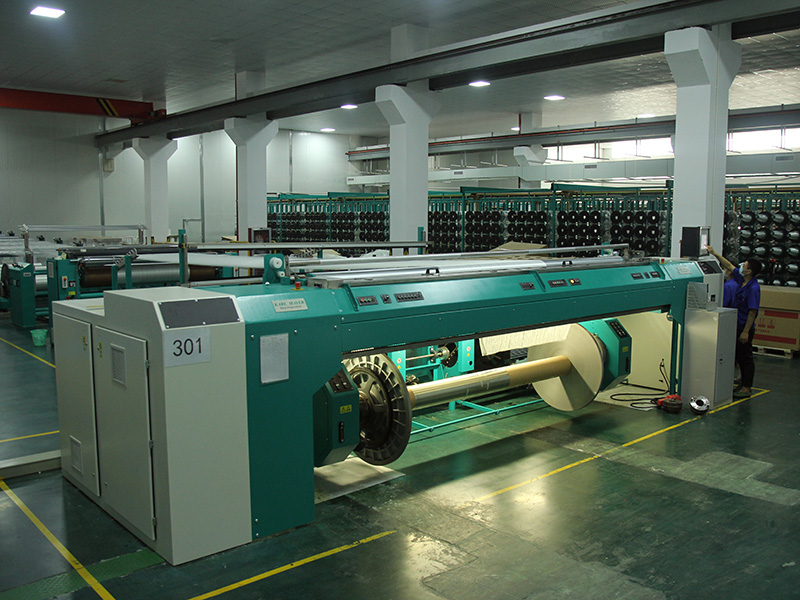
Warp preparation fixes the declared warp count before weaving begins — the stage where a 17.2 or 23.6 threads-per-cm record is actually created.
Where the three grades fit in application terms
Declared values become decision criteria only when mapped to a duty. In the case record supplied by HOYANM, a composite material manufacturer uses industrial woven fabric across reinforcement of walls, plaster or road base; solid-liquid filtration in chemical or mining processes; fireproof covering in welding and high-temperature work; and cargo protection and weather shielding. The reported outcomes in that record include no cracking, enhanced strength, reduced maintenance, stable filtration, less downtime, lower replacement cost, zero fire incidents, an intact blanket after heat exposure, waterproofing, UV stability and protected goods. These are customer-reported results for that manufacturer's applications and are not a performance guarantee for any other project.
Read conditionally against those duties, the three records sort by mass and thickness rather than by rank. Where a barrier or covering duty needs more substance — greater mass and a thicker build at the same warp set-up — the 7638 record at 257 g/m² and 0.28 mm is the closest of the three. Where the constraint is intermediate, 7630 at 224 g/m² and 0.22 mm sits between the two. Where thin profile and low areal weight are the governing constraints, the 2116 record at 106 g/m² and 0.09 mm is the only one of the three in that range.
The same reading applies one step downstream. Public supplier descriptions of PTFE coated fabric state that such products are built on woven fiberglass or aramid substrates that are coated or impregnated, and coated constructions in general — PTFE coated and silicone coated alike — are specified by substrate yarn, count, weight and thickness before any coating is applied. For a coater, the base fabric record is a purchasing document rather than a marketing table. The adjacent woven families named in the wider keyword set — aramid woven fabric, polyester woven fabric, UHMWPE woven fabric, high silica fabric, texturized fiberglass fabric, leno mesh fabric and membrane fabric — each carry their own variable set and their own limits, but the audit method described here transfers unchanged.
Fit boundaries: what a declared record does not prove
Declared is not the same as tested. A datasheet value is a target or typical figure for the grade; the tolerance around it, and the test method used to establish it, are separate facts that should be obtained in writing. Four boundaries deserve attention before a purchase order is raised.
First, thickness is method-dependent. Two suppliers can both declare 0.28 mm and mean different things if their gauges, applied pressure or layer counts differ, so the method must travel with the number. Second, density convention must be confirmed: the 2116 record states 23.6/22.8 filaments per cm, and the buyer should establish whether that counts filaments, ends and picks, or something else, because the answer changes the inspection procedure. Third, an incomplete record is a question, not a defect — as with the 7638 weft density — and the answer belongs in the order specification. Fourth, management-system certification is not product certification.
On that last point HOYANM holds ISO9001 (05325Q30237R1M), ISO14001 (05325E30191R1M) and ISO45001 (05325S30180R1M) certificates issued by Beijing NGV Certification Center Co., Ltd., all valid from 30 April 2025 to 29 April 2028. The quality and environmental scopes cover the design and production of fiberglass woven fabric and polyester woven fabric. Those certificates evidence a managed quality, environmental and safety system across that scope; they do not certify the tensile strength, temperature resistance or fire performance of a specific roll, which must come from the product test report.
A verification sequence for evaluation-stage buyers
The following sequence uses only information a supplier should already hold, and each step exists because it closes a specific gap between a declared value and a purchased roll.
- Request the full record, not the headline. Ask for yarn, warp and weft density with the counting convention, areal weight and thickness plus the measuring method, for the exact grade quoted.
- Test family coherence. Compare two or three grades from the same supplier and check whether the numbers move in physically sensible directions. A coherent family indicates derived set-ups; an incoherent one indicates copied values.
- Confirm tolerances and acceptance criteria. A nominal value without a tolerance cannot be inspected against, so agree the acceptable range and the test method in the purchase order.
- Order a trial roll. A full roll at 300 or 500 linear metres tests handling, splicing, width consistency and cut behaviour in a way a swatch cannot.
- Ask which checks are inside the 100% pre-shipment test. Distinguish roll-level inspection from sampling inspection and from third-party testing.
- Check certificate validity and scope. Verify certificate numbers, issuing body, dates and scope against the actual product being supplied.
- Ask about yarn allocation for the named yarn. Since capacity is stated as subject to yarn availability, the yarn field in the specification is also the lead-time risk field.
- Store and handle to the stated conditions. Dry, cool, ventilated storage, rolls upright on pallets, away from sunlight, heat, oil and corrosive chemicals; heavy stacking creates permanent creases that no downstream process removes.
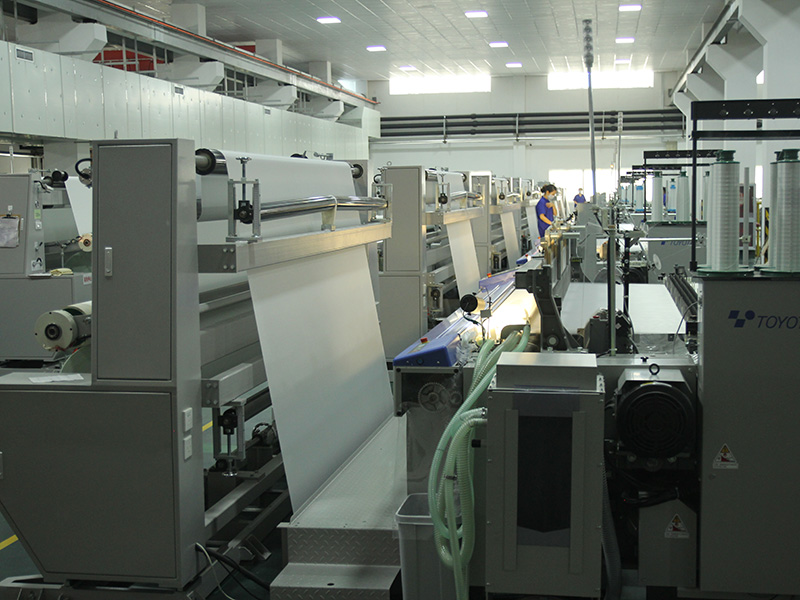
Weft insertion and beat-up convert the declared yarn and count into the weight and thickness recorded on the specification sheet.
Market context, with its limits stated
Three published figures frame the category without sizing these specific grades. MarketsandMarkets projects the fiberglass fabric market at USD 13.17 billion by 2029 in its 2024–2029 report. Data Market Analysis places PTFE coated fiberglass fabric at USD 950 million in 2025 with a 6.2% CAGR across 2025–2033. A separate commercial research note cited for electronic-grade glass cloth projects a 15% price adjustment in 2026, driven by demand from AI server printed circuit boards — a projection with medium confidence in the source set, not an observed transaction price.
None of the three figures describes demand for 2116, 7630 or 7638, and none should be used to forecast the price of a specific roll. Their practical use is narrower and still useful: they indicate that the coated and electronic segments are where cost pressure is expected to concentrate, which makes yarn allocation and lead-time confirmation more important than headline capacity for buyers of fine-yarn E-glass styles.
Outlook
The near-term variable for specification-led buyers is upstream yarn, not loom capacity. HOYANM's stated capacity of 4,000,000–6,000,000 m² per month is explicitly conditional on yarn availability, which means continuity for a custom grade depends on a yarn plan rather than a machine plan. Where a buyer's qualification process requires documented values, the practical route is to attach the declared record — yarn, density, weight, thickness, tolerance and test method — to the RFQ as an annex, and to treat the trial roll as the point where the record is verified. That approach turns a supplier's specification sheet into a checkable commitment, and it is the same discipline whether the fabric in question is an E-glass style, an aramid woven fabric, or a coated construction built on either.
Buyers who want the declared record for a specific grade before quoting can review product and capability information at HOYANM New Materials, and a restrained next step is to request the datasheet and a trial roll in parallel rather than sequentially.
FAQ
What do yarn designation, density, weight and thickness each tell a buyer about a woven fiberglass fabric?
Yarn designation identifies the filament diameter class and nominal yarn weight the plant runs. Density states how many threads per unit length run in each direction, which is fixed at warp preparation for the warp. Areal weight in grams per square metre is the outcome of yarn size and density plus any finish. Thickness reflects yarn diameter, weave crimp and finishing, and depends on the measuring method. Read together, the four values either support each other or reveal a gap that needs a question.
How do the 2116, 7630 and 7638 records differ, and what does the difference indicate?
All three are woven fiberglass records, but they span two yarn classes. 2116 declares E225 yarn at 23.6/22.8 filaments per cm, 106 g/m² and 0.09 mm. 7630 declares G75/G67 at 17.2/13 per cm, 224 g/m² and 0.22 mm. 7638 declares G75/G37 at 17.2 warp density, 257 g/m² and 0.28 mm. Because 7630 and 7638 share a warp yarn and warp count and differ only in weft yarn, the change in weight and thickness is consistent with a single controlled variable — which is stronger evidence of process control than any one grade alone. Grade 666 appears in the same product list as a heavier electrical-insulation reference and should be quoted from its own record.
Can a supplier customize warp and weft yarn, density, width and thickness for OEM orders?
HOYANM offers OEM and ODM production with customization across width, length, weight, thickness, weave type, warp yarn, weft yarn, warp density and weft density, subject to technical feasibility for the requested combination. Minimum order quantity is one roll of 300 or 500 linear metres, and lead time depends on production schedule, order volume and the extent of customization. Because stated capacity is subject to yarn availability, buyers should confirm yarn allocation for the named yarn at the quotation stage.
How can a buyer verify declared fiberglass fabric specifications before a bulk order?
Ask for the complete record rather than a headline figure: yarn, density with its counting convention, areal weight, thickness with its measuring method, and the tolerance around each. Confirm the acceptance criteria and test method in the purchase order, order a trial roll to check handling and width consistency, ask which characteristics fall inside the 100% pre-shipment test versus sampling inspection, and verify certificate numbers, dates and scope directly. Declared values are targets until the roll is tested against them.
What certifications apply to fiberglass woven fabric supply, and what do they not cover?
HOYANM holds ISO9001, ISO14001 and ISO45001 certificates issued by Beijing NGV Certification Center Co., Ltd., valid from 30 April 2025 to 29 April 2028, with scopes covering the design and production of fiberglass woven fabric and polyester woven fabric, plus environmental management activities for those products. These certify a managed quality, environmental and safety system across that scope. They do not certify tensile strength, temperature resistance or fire performance of a particular roll; those properties must be evidenced by the product test report for the grade concerned.
How should woven fiberglass fabric rolls be stored after delivery?
Store rolls in a dry, cool and ventilated warehouse away from direct sunlight, high temperature, oil and corrosive chemicals. Place rolls upright on pallets rather than flat, and avoid heavy multi-layer stacking, which can create permanent creases that survive cutting. Keep the original packaging intact until use and inspect the roll surface before unpacking and cutting. Rolls should not be dragged across the floor, and sharp tools should be kept away from the fabric surface.
For full company, capability and product documentation, the Zhejiang Hongyan New Material Co., Ltd. company brochure is available for download.
Tem questões ou precisa de mais detalhes?
Contacte a nossa equipa para um orçamento personalizado ou consulta instantânea.
Solicitar orçamento
Preencha o formulário abaixo e a nossa equipa entrará em contacto com uma proposta personalizada.
Chat direto do WhatsApp
Prefere conversar em tempo real? Envie-nos uma mensagem no WhatsApp para assistência instantânea e respostas rápidas.
- Obter orçamento personalizado
- Partilhar fotos ou documentos
- Discuta as suas necessidades diretamente
Geralmente responde em 5–30 minutos durante o horário de expediente.