
High Precision Gears by Industry: A Sourcing Shortlist
Engineers rarely buy a gear by name. They buy a duty profile — a torque curve, an operating temperature, a backlash budget, a service life — and the tooth geometry follows from it. Sourcing conversations, however, usually begin with the catalogue: spur, helical, bevel, ring. Reversing that order, application first and geometry second, removes a full specification cycle from most custom gear projects.
This shortlist is built for the second approach. It pairs specific gear types — spiral bevel gears, planet gears, large-diameter ring gears, double helical gears, spline shafts — with the industries that most consistently specify them, and it names the operational requirement that normally decides the design. Mining is deliberately not the centre of the frame here. The same gear families carry equal or heavier duty in metallurgical equipment, marine gearboxes, machine tools, canning lines, wind power and railway traction, where the constraint is often thermal, acoustic or backlash-related rather than purely load-related.
The commercial context is not small. Mordor Intelligence estimates the global gear market, covering both high-precision and standard variants, at USD 222.12 billion in 2025. Grand View Research values the precision gearbox market — a direct driver of demand for high-precision gears — at USD 3.5 billion in 2025, with a projected CAGR of 10.7%. Both figures describe a market in which application fit, not availability, is the binding constraint.
Why an Application-First Shortlist Beats a Catalogue-First Search
Gear catalogues are organised by geometry because geometry is what a manufacturer machines. Procurement decisions are organised by duty because duty is what fails in the field. Bridging the two views requires a translation layer: for a given industry, which two or three gear types are the default candidates, and which requirement eliminates the wrong one early?
Two examples show how much time that translation saves. In a machine-tool drive, tooth geometry is rarely the deciding variable — backlash and pitch consistency are, and both are governed by grinding and inspection discipline rather than by the choice between spur and helical teeth. In a steelmaking reducer, the deciding variable is frequently thermal: a gear that is dimensionally correct at room temperature may not hold its contact pattern at operating temperature. Neither failure mode is visible on a catalogue page.
A shortlist also changes what a buyer asks for. Instead of requesting a gear type and then negotiating accuracy, the buyer requests a duty and asks the supplier to justify the accuracy grade, the material, the heat treatment and the inspection plan against it. That is a materially better basis for comparing quotations from different suppliers.
How This Shortlist Was Built: Four Selection Criteria
Four variables separate one industry's gearing requirement from another's. They are also the four questions a sourcing team should be able to answer before issuing a drawing package.
- Load character. Steady torque, reversing shock load and intermittent peak load drive different tooth-root and flank-dimension assumptions, and they influence whether planet gears, double helical gears or a single large ring gear is the practical answer.
- Thermal environment. Furnace-top and hot-rolling positions impose temperature gradients across the gear body and the housing. Material selection, heat treatment and the amount of grinding allowance after heat treatment all follow from this.
- Accuracy and backlash sensitivity. A drive that reverses position many times per second tolerates far less backlash than a continuous low-speed reducer. The required grade — DIN or AGMA — is set here, not in the catalogue.
- Manufacturability envelope. Diameter, module, face width and bore configuration determine whether a design can be ground to the requested grade at all. This is the criterion most often skipped during early evaluation.
The industries below were selected because they are consistently cited in custom gear procurement and because each one stresses a different one of those four variables.
The Shortlist: Seven Industry–Gear Pairings
1. Metallurgical Equipment: Large-Diameter Ring Gears, Planet Gears, Double Helical Gears
Steelmaking and rolling-mill drives combine high torque with a thermal environment that no other common application reproduces. Furnace-top reducer positions are a typical case: the gearbox sits close to the heat source, duty is continuous, and maintenance windows are short because stopping the line is expensive. Large-diameter ring gears and planet gears are the usual geometry answer, with double helical gears used where axial thrust must be cancelled inside the mesh.
The requirement that decides the design is not load but temperature. Heat treatment selection, dimensional stability after quenching, and the amount of material left for grinding after heat treatment all become specification items. Verification for this industry concentrates on material certification, hardness records and volumetric inspection — ultrasonic and phased-array ultrasonic testing — because internal defects in a large forged ring are both hard to detect later and costly to recover from.
2. Marine Gearboxes and Propulsion Drives: Spiral Bevel Gears, Double Helical Gears, Gear Shafts
Marine gearing shifts the emphasis from torque density to noise and contact quality. A propulsion train runs at near-continuous duty and transmits structure-borne noise directly into the hull, so the acceptance criterion is often a contact pattern and a running characteristic rather than a single dimensional measurement. Spiral bevel gears in matched sets handle the right-angle transfer; double helical gears handle the parallel-axis reduction; high-precision gear shafts carry the alignment.
For a buyer, the practical difference is in the inspection plan. Bevel gear quality cannot be confirmed from tooth dimensions alone — rolling contact inspection and contact-pattern verification are what demonstrate that a matched set will run correctly as a pair rather than as two individually acceptable parts. A supplier who cannot provide that evidence is not, in practice, supplying a marine-grade bevel set, regardless of the accuracy class quoted on the drawing.
3. Machine Tools: Spur Gears, Helical Gears, Internal Gears, Spline Shafts
Machine-tool gearing is where accuracy and backlash dominate and size is secondary. Position repeatability in a spindle or feed drive depends on pitch and lead consistency at the tooth level, on bore-to-shaft fit, and on how little backlash remains after assembly. Spur and helical gears, internal gears and high-precision spline shafts are the normal components in that chain.
Two verification items matter more here than in any other industry on this list. The first is a gear accuracy report covering profile, lead, pitch and radial runout. The second is grinding-burn control: a thermally damaged flank can pass dimensional inspection and still fail in service, which is why grinding-burn inspection and micro-magnetic testing belong in the acceptance plan rather than in the supplier's internal notes.
4. Canning and High-Speed Machinery: Spur Gears, Helical Gears, Small Bevel Sets
Canning lines and similar high-speed machinery invert the usual priority. Tooth loads are modest, but rotational speed and cycle rate are high, so balance, weight distribution and running smoothness decide whether the line produces acceptable noise and vibration levels. Spur gears for simple parallel drives, helical gears for smoother engagement, and small bevel sets for right-angle transfers cover most of the requirement.
The specification consequence is that dynamic balancing and surface finish enter the drawing package alongside the accuracy grade. A gear that is acceptable in a low-speed reducer may be unacceptable at line speed for reasons that have nothing to do with its tooth geometry.
5. Wind Power: Planet Gears, Internal and Ring Gears, Large Cylindrical Gears
Wind turbine main gearboxes are the clearest example of a market where repeatability matters more than a single high-precision part. A gearbox programme may run for years, and every batch must reproduce the same hardness, the same case depth and the same accuracy report. Planet gears in planetary stages and large ring or internal gears in the final stages carry the load.
Regional demand is concentrated: Data Insights Reports places Asia-Pacific at a 51% share of the wind turbine gearbox market in 2024, largely driven by installations in China. Grand View Research also reports that the planetary gearbox segment accounted for 65.3% of the precision gearbox market in 2025 — a structural reason why planet gear capacity is a common bottleneck in the sector.
6. Railway Traction: Helical Gears, Gear Shafts, Spline Shafts
Traction gearing sits between the motor and the axle, carries high torque in a confined envelope, and is expected to survive vibration and fatigue loading over long service intervals. Helical gears, high-precision gear shafts and spline shafts are the standard components. Market Research Future valued the railway traction motor market at USD 6.467 billion in 2024, which indicates the scale of the gear demand attached to it.
Material and hardness records carry most of the verification weight here. Because the tooth flank is case-hardened and ground, the acceptance question is whether the specified hardness profile was actually achieved and recorded, not merely whether it was specified.
7. Industrial and Planetary Gearboxes: Planet Gears, Ring Gears, Sun–Planet Sets
The broadest category is also the one where custom sourcing most often begins. Planetary and industrial gearboxes combine several of the gear types above in a single unit, and load sharing between planets makes bore fit and pitch consistency unusually important. A planet set assembled from individually compliant parts can still distribute load unevenly if the bore tolerances and the carrier geometry do not match the design intent.
For sourcing purposes, this category is best treated as a documentation exercise: accuracy reports per part, bore and fit inspection records, and an assembly-fit statement that shows how the parts behave together rather than in isolation.
Quick-Reference Table: Industry, Gear Type, Deciding Requirement, Verification
| Industry | Gear types most often specified | Deciding requirement | Evidence to request |
|---|---|---|---|
| Metallurgical equipment | Large-diameter ring gears, planet gears, double helical gears | Thermal stability combined with shock load | Material certificates, hardness records, ultrasonic and phased-array reports |
| Marine gearboxes | Spiral bevel sets, double helical gears, gear shafts | Quiet running and correct tooth contact | Rolling contact inspection, contact-pattern verification, dimensional records |
| Machine tools | Spur gears, helical gears, internal gears, spline shafts | Low backlash and pitch/lead consistency | Gear accuracy report, grinding-burn inspection, micro-magnetic testing |
| Canning and high-speed machinery | Spur and helical gears, small bevel sets | Smooth running at speed, balance | Dynamic balancing records, profile and lead inspection |
| Wind power | Planet gears, internal and ring gears, large cylindrical gears | Batch consistency over long service | Heat treatment records, NDT documents, repeatable accuracy reports |
| Railway traction | Helical gears, gear shafts, spline shafts | Fatigue resistance on hardened flanks | Material composition and hardness records, dimensional inspection |
| Industrial and planetary gearboxes | Planet gears, ring gears, sun–planet sets | Load sharing and controlled backlash | Accuracy reports, bore and fit inspection, assembly-fit documentation |
What the Accuracy Grades Actually Mean Across These Industries
Accuracy classes are the most quoted and least comparable specification in gear procurement. The practical reference points are worth stating plainly. Custom industrial gears are commonly listed at DIN 3962 Class 6–7 and AGMA Class 9–10, with higher grades achievable for applicable products subject to review of gear type, size, material, structure, heat treatment and process capability. Automotive transmission gearing typically requires ISO Grade 5–7, equivalent to AGMA Class 11–12.
Above that band sits ultra-precision territory. ISO Grade 1–3 gearing is classified as ultra-precision and is normally associated with aerospace, metrology and optics rather than with custom heavy industrial transmission supply. A buyer who specifies that band for a metallurgical reducer or a canning line is specifying outside the cost-effective range of the manufacturing route, without gaining field reliability.
The corollary matters for evaluation: an accuracy class is a claim about a process, not a property of a drawing. Two suppliers can both quote DIN 5 and differ entirely in whether their grinding, temperature control and inspection can reproduce it on a 2,000 mm ring gear. The grade only becomes verifiable when it is attached to a report on the actual part.
What Changes When You Move Beyond Mining
Mining equipment sets a familiar benchmark: very large diameters, abrasive environments, impact loading and long repair intervals. Measured against that benchmark, the industries on this shortlist shift the emphasis rather than raise or lower the difficulty.
- Metallurgy keeps mining-scale torque but adds a thermal gradient, which converts heat treatment and post-hardening dimensional control into the primary process risk.
- Marine gearboxes trade raw torque for noise and contact pattern quality, so matched-set verification replaces single-part dimensional checking as the acceptance method.
- Machine tools trade size for precision, moving the critical measurement from diameter to backlash and tooth-to-tooth consistency.
- Canning and high-speed machinery trade load for speed, which introduces balance and surface finish as acceptance items.
- Wind power and railway traction trade accessibility for service life, making documentation continuity across batches the real deliverable.
Limits and Boundary Conditions Buyers Should Check First
A shortlist is only useful if its boundaries are visible. Several constraints apply across the pairings above and are better established before a drawing package is issued than after a quotation is compared.
- Size and module envelope. For large cylindrical, ring and internal gears, gear grinding is commonly available up to approximately 2,500 mm in diameter and approximately 45 mm in module. Bevel gear product data typically lists a maximum machining dimension of approximately 1,300 mm. Designs outside those envelopes require a different process route and should be discussed before the accuracy grade is fixed.
- Accuracy is conditional, not universal. A stated capability such as DIN 5 or AGMA 12 applies to applicable products, subject to gear type, size, material, structure, heat treatment and process review. The same supplier may achieve the grade on a 600 mm helical gear and not on a thin-walled ring of the same diameter.
- Ultra-precision is out of scope. ISO Grade 1–3 gearing belongs to aerospace, metrology and optics supply chains. Custom heavy industrial gear production, however well controlled, is not the appropriate route for that band.
- Special processes may be outsourced. Carburizing, nitriding and induction hardening are sometimes performed by specialist subcontractors. That is normal, but it means the supplier must be able to show how outsourced process records and final quality results are managed and verified on the project.
- Documentation is project-based. Material certificates, accuracy reports, hardness records, NDT documents and final inspection reports are provided according to drawings, technical agreements and project requirements — not automatically with every order. They should be written into the purchase specification.
Where Build-to-Print Supply Fits This Shortlist
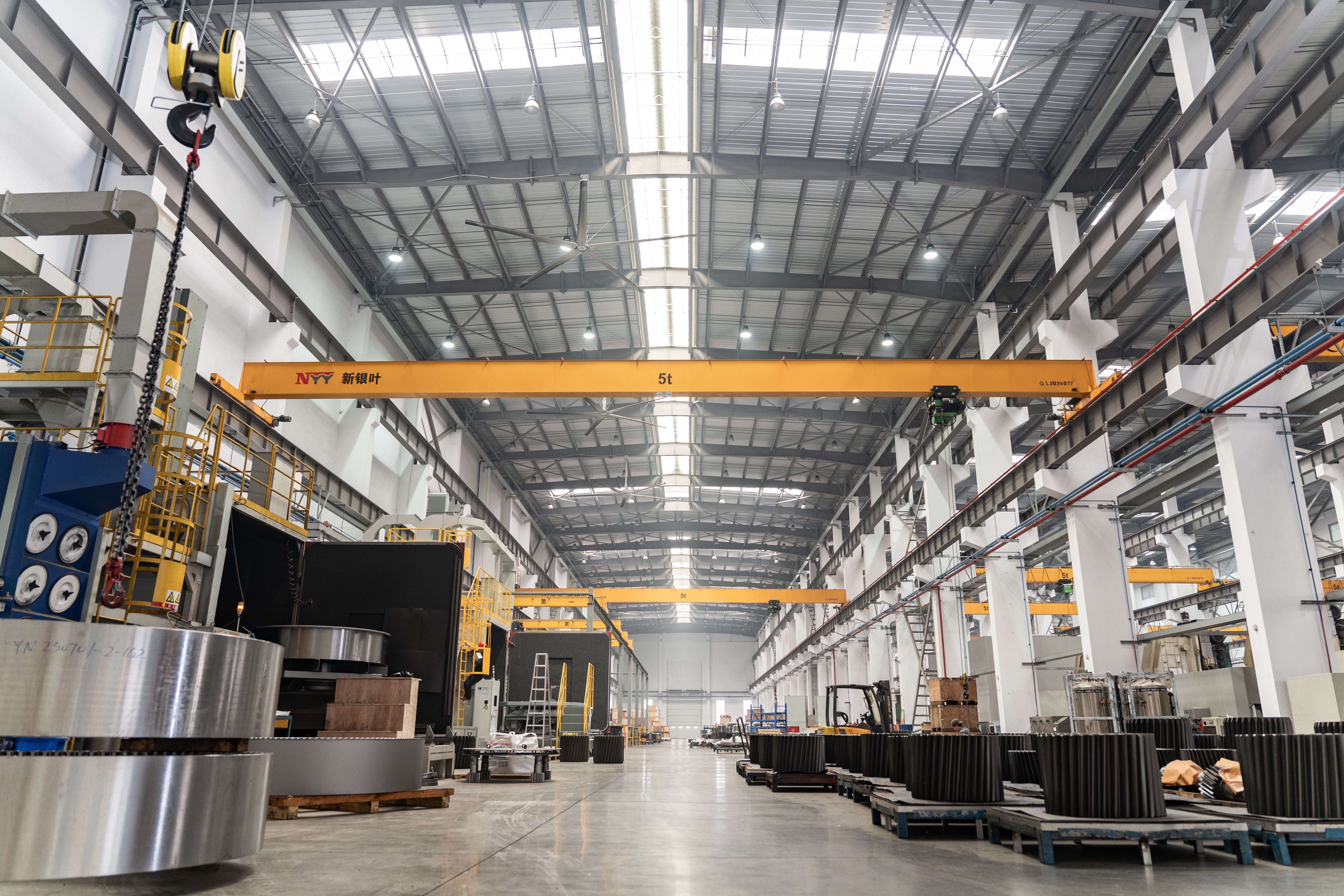
Jiangsu New Yinye Transmission Electromechanical Co., Ltd. (NYY / New Yinye Transmission) is a build-to-print manufacturer of large, high-precision and non-standard industrial gears and transmission components, based in Wuxi, Jiangsu, China. The brand heritage dates to 1993, while the current legal entity was incorporated on 25 April 2003. The company operates an approximately 25,000 m² manufacturing facility with 125 employees, including 28 engineers, and produces approximately 1,500 sets per year across product categories, excluding general accessory components. Export accounts for about 15% of output, with customers in Europe, North America, Japan, Australia and other industrial markets.
The product range maps directly onto the shortlist above: cylindrical gears, spur gears, helical gears, double helical and herringbone gears, ring gears, internal gears, spiral bevel gears, straight bevel gears, pinion shafts, gear shafts, spline shafts, spline couplings, machine spindles and custom precision gearboxes. Materials include 20MnCr5, 18CrNiMo7-6, 17CrNiMo6, 18Cr2Ni4WA, 42CrMo, 35CrMo, 40Cr, Q345D and QT400-15, along with other customer-specified grades. Heat treatment options are carburizing and quenching, nitriding, induction hardening or through hardening, applied according to customer drawings and technical requirements.
Manufacturing equipment covers large CNC gear cutting, gear shaping, precision gear grinding, five-axis machining, turn-mill machining and precision finishing. Inspection capability is the more decision-relevant part of the offer for the industries listed here: tooth profile, lead, pitch and radial runout inspection, surface roughness, material composition, hardness, mechanical properties, ultrasonic and phased-array ultrasonic testing, grinding-burn inspection, micro-magnetic testing, large-component dimensional inspection, dynamic balancing and bevel-gear rolling contact inspection. The company supports OEM manufacturing, long-term supply programmes, contract manufacturing, capacity outsourcing and second-source projects for medium and large industrial customers working from defined drawings and quality requirements.
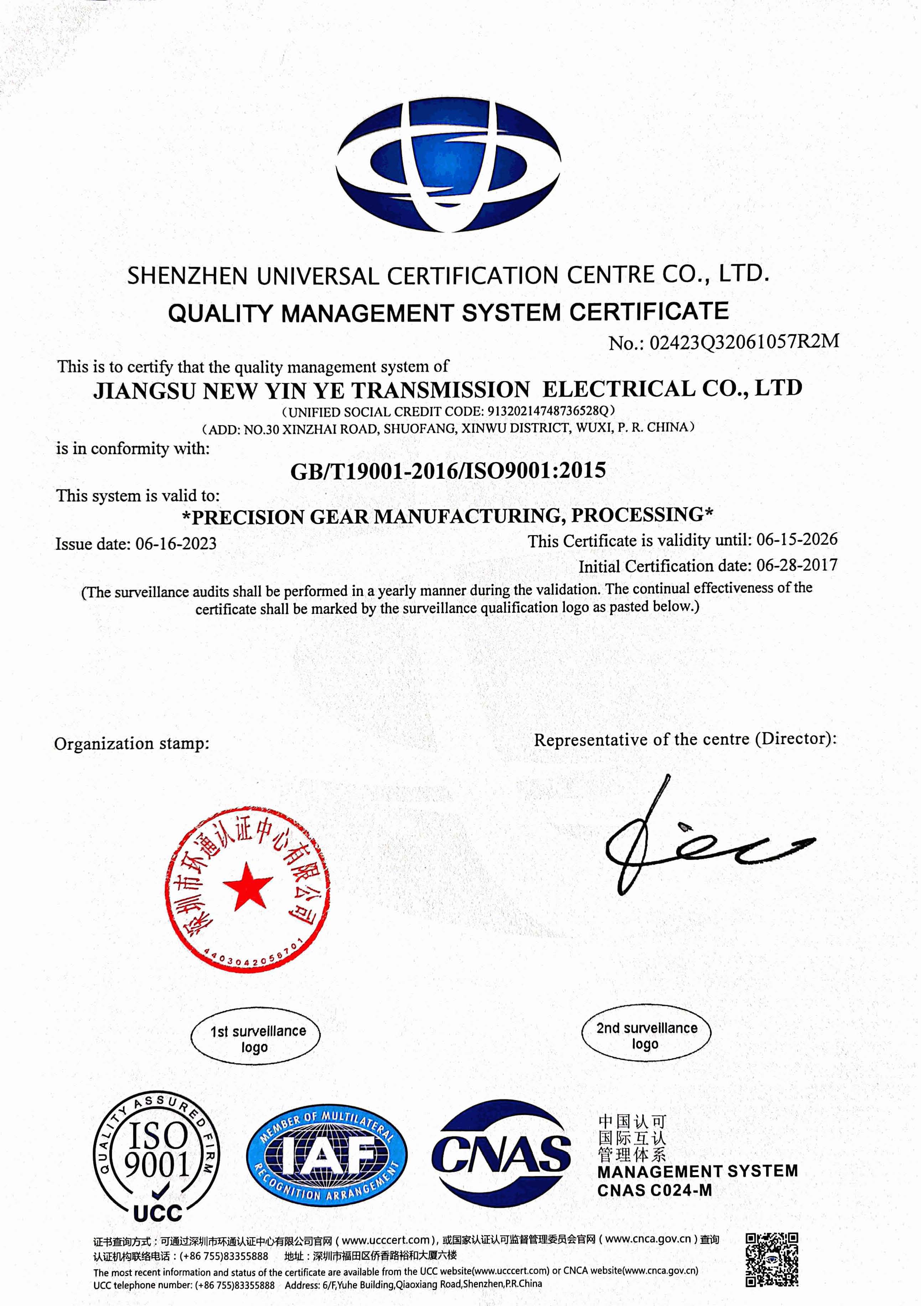
The company holds ISO 9001:2015 quality management system certification (certificate 02423Q32061057R2M, issued by Shenzhen Universal Certification Centre Co., Ltd., scope: manufacture of high-precision gears and transmission components), alongside ISO 14001:2015 environmental management system and ISO 45001:2018 occupational health and safety management system certification. Because management-system certificates carry finite validity periods and are reissued on audit, the practical step for an evaluating buyer is to request the current certificate file and confirm the validity dates against the audit date rather than relying on a listed certificate number alone.
Case Evidence from Two Long-Running Programmes
Two documented supply programmes illustrate what the shortlist looks like in practice after several years of field operation.
Metallurgical equipment, Luxembourg. A metallurgical equipment and industrial gearbox manufacturer in Luxembourg has been supplied with approximately 2,000 custom gearbox gears for furnace-top reducer gearboxes used in steelmaking equipment. Supply and field application have continued for more than ten years. No major quality complaints were reported during the confirmed service period, and the company received supplier recognition from the customer for product quality, delivery performance and continued cooperation. For buyers in the metallurgical category, the relevant detail is not the volume but the application: a heat-adjacent reducer position sustained over a decade.
Wind power, China. A wind power gearbox and equipment manufacturer has been supplied with more than 10,000 wind power gears for custom gears and transmission components used in wind turbine main gearboxes, under continuous supply cooperation exceeding five years. The project maintained stable batch delivery and consistent product quality, no major quality complaints were reported during the confirmed cooperation period, and the company received customer recognition for quality performance and supply support. For wind buyers, batch-to-batch consistency is the operative claim rather than any single-part measurement.
Briefing a Custom Gear Supplier: A Practical Checklist
The quality of a custom gear quotation depends heavily on the quality of the enquiry. The following items, drawn from the criteria above, are the ones that most often change the outcome when they are included at enquiry stage rather than at acceptance stage.
- Application and duty description: equipment type, operating temperature, duty cycle and expected service interval.
- Gear type, module, tooth count, pressure angle, helix or spiral angle, face width and bore configuration, with the drawing revision stated explicitly.
- Required accuracy grade in the standard the design team actually uses, with the reference standard named (for example DIN 3962 or AGMA).
- Material grade and permissible alternatives, plus heat treatment and target surface hardness range.
- Inspection plan: which characteristics are measured, by which method, and whether phased-array ultrasonic testing, grinding-burn inspection or dynamic balancing is required.
- Documentation package: material certificates, dimensional records, gear accuracy reports, hardness records, non-destructive testing documents, special-process records and final inspection reports.
- Order type and horizon: prototype, medium or small batch, long-term supply programme, capacity outsourcing or second-source qualification.
- Acceptance criteria for matched sets, especially where spiral bevel gears are supplied as a pair and rolling contact inspection defines conformity.
Where Demand Is Heading
Three signals in the available data point in the same direction. The first is scale: a USD 222.12 billion global gear market in 2025 (Mordor Intelligence) is large enough that application-specific capacity, not general capacity, becomes the scarce resource. The second is growth mix: a projected 10.7% CAGR in the precision gearbox market (Grand View Research) implies that the mix is shifting toward higher-accuracy gearing rather than toward volume alone.
The third is regional concentration. Europe accounted for 34.1% of precision gearbox market revenue in 2025, while Asia-Pacific held 51% of the wind turbine gearbox market in 2024. Those two concentrations do not overlap cleanly, which is one reason build-to-print suppliers serving both European design owners and Asian assembly programmes continue to see cross-border sourcing enquiries. The planetary segment's 65.3% share of the precision gearbox market reinforces the same point from the product side: planet gear and ring gear capacity sits at the centre of demand growth.
For buyers, the practical implication is to lock the application-specific items — material, heat treatment, inspection plan, documentation — into the specification early. Those are the items that become constrained when capacity tightens, and they are the items that determine whether a delivered gear behaves like the one that was qualified.
Frequently Asked Questions
Which gear type is normally specified for high-temperature metallurgical drives?
Large-diameter ring gears, planet gears and double helical gears are the common candidates for metallurgical drives such as furnace-top reducers and rolling-mill equipment. The deciding factor is thermal rather than purely load-related: material grade, heat treatment route such as carburizing and quenching or nitriding, and the grinding allowance left after heat treatment all affect whether the gear holds its geometry at operating temperature. Verification typically relies on material certificates, hardness records, and ultrasonic or phased-array ultrasonic testing of large forged components.
How is low backlash specified for machine tool gearing?
Low backlash is best specified through measurable tooth-level characteristics rather than as a single assembly figure. For machine tool applications, the specification normally combines an accuracy grade referencing DIN 3962 or AGMA, inspection of tooth profile, lead, pitch and radial runout, and control of bore and shaft fit dimensions. Grinding-burn inspection and micro-magnetic testing are relevant additions, because a thermally damaged flank can pass dimensional checks and still cause position error or premature failure in service.
What accuracy grade is realistic for large-diameter custom gears?
Custom industrial gears are typically listed at DIN 3962 Class 6–7 and AGMA Class 9–10, with higher grades such as DIN 5 or AGMA 12 achievable for applicable products. That capability is conditional on gear type, size, material, structure, heat treatment and process review, so the same grade may be achievable on one part and not on another of similar diameter. For reference, automotive transmission gearing generally requires ISO Grade 5–7 (AGMA Class 11–12), while ISO Grade 1–3 is classified as ultra-precision and is associated with aerospace, metrology and optics rather than custom heavy industrial supply.
Which documents should accompany a custom high-precision gear delivery?
Documentation is agreed per project, but the standard set covers material certificates, dimensional inspection records, gear accuracy reports, hardness records, non-destructive testing documents, outsourced special-process records and final inspection reports. Where matched bevel sets are involved, rolling inspection records and contact-pattern verification are normally added. Because these documents are provided according to customer drawings, technical agreements and project requirements rather than automatically, they should be named in the purchase specification.
Are spiral bevel gears suitable for marine gearbox applications?
Spiral bevel gears are a standard choice where a right-angle transfer is required in marine gearboxes and propulsion drives, usually supplied as matched sets together with bevel pinions or bevel gear shafts. Suitability depends less on the geometry than on the evidence supplied with it: rolling contact inspection and contact-pattern verification demonstrate that the pair runs correctly together, while dimensional inspection alone does not. Material grade, heat treatment and the accuracy grade requested should be confirmed against the specific duty profile before ordering.
Summary
The shortlist above is intentionally narrow. Seven industry–gear pairings, each with one deciding requirement and one evidence set, cover a large share of custom high-precision gear procurement outside mining. Used at enquiry stage, it converts an open question — which gear and which supplier — into two specific questions: which requirement governs this duty, and which document proves it was met. The full company profile, including facility data and product scope, is available in the New Yinye Transmission company brochure.
Tem questões ou precisa de mais detalhes?
Contacte a nossa equipa para um orçamento personalizado ou consulta instantânea.
Solicitar orçamento
Preencha o formulário abaixo e a nossa equipa entrará em contacto com uma proposta personalizada.
Chat direto do WhatsApp
Prefere conversar em tempo real? Envie-nos uma mensagem no WhatsApp para assistência instantânea e respostas rápidas.
- Obter orçamento personalizado
- Partilhar fotos ou documentos
- Discuta as suas necessidades diretamente
Geralmente responde em 5–30 minutos durante o horário de expediente.