
High Precision Gears in Heavy Industry: A Buyer's Guide to Accuracy, Sourcing and Application Fit
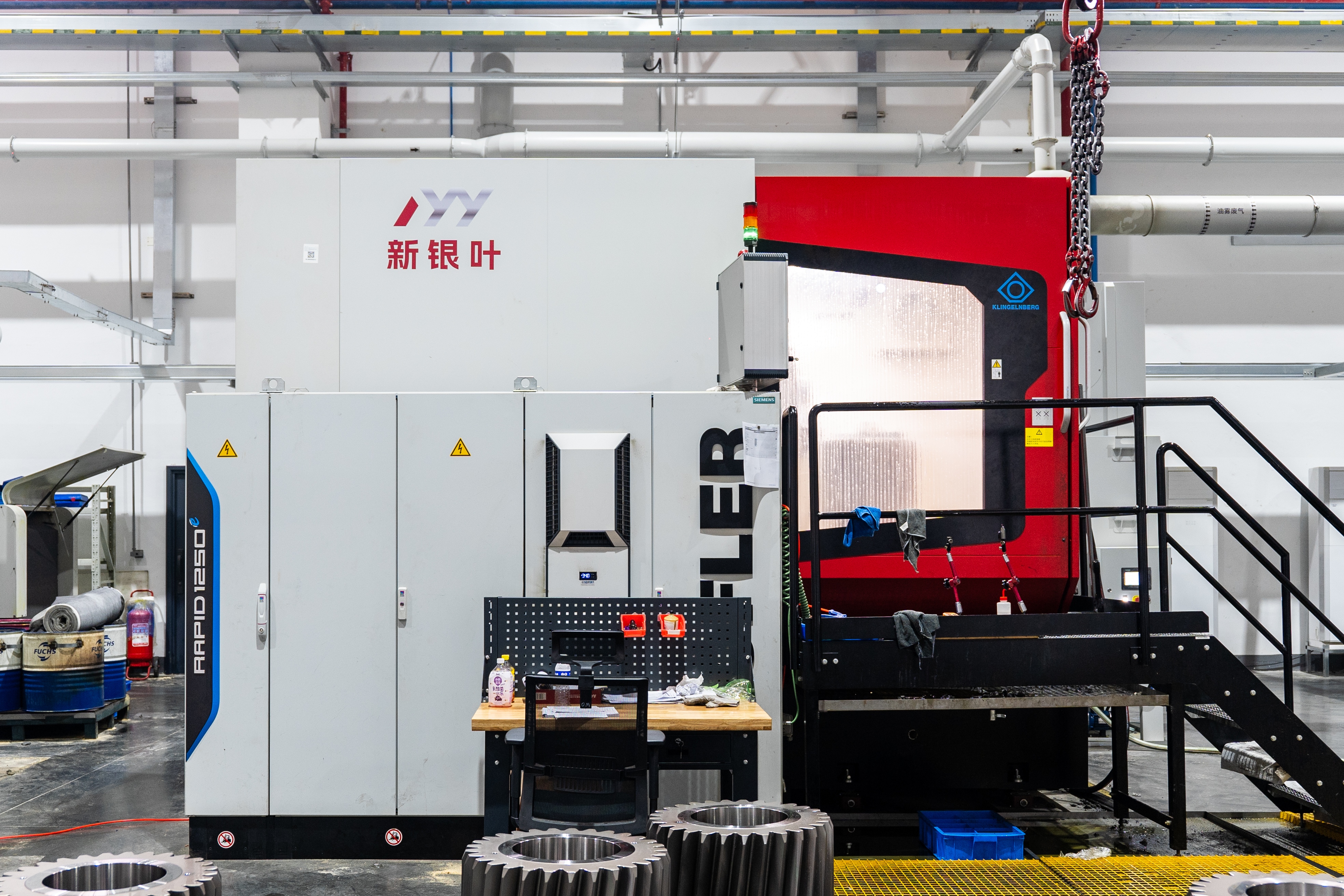
Precision CNC gear grinding is central to producing large gears, gear shafts and custom transmission components at accuracy levels such as DIN 5 or AGMA 12. (Image source: Jiangsu New Yinye Transmission)
High precision gears are engineering components that transmit power and motion with tight control over tooth geometry, pitch accuracy and surface quality. In heavy industries such as wind power, mining, marine propulsion, metallurgy and industrial gearboxes, the difference between a gear that performs reliably for years and one that fails prematurely often lies in precision, material quality and manufacturing traceability.
For procurement and engineering teams evaluating custom high precision gears, an important distinction is that precision is not one single number. It is a combination of tooth profile accuracy, lead accuracy, pitch accuracy, runout, surface finish and material integrity. Accuracy classes like DIN 5 or AGMA 12 indicate measurable levels of gear quality, but they are application-dependent. Understanding how accuracy, manufacturing capability and inspection evidence align with a specific drivetrain requirement helps buyers make decisions that balance performance, cost and lead time.
Why high precision matters in modern industrial gearboxes
High precision gears are required in machinery where transmission error, vibration, noise, heat generation and load distribution directly influence reliability. In gearboxes that drive continuous production lines, wind turbine pitch or yaw systems, mining crushers, vibrating screens and marine propulsion systems, gear quality affects energy efficiency and maintenance intervals.
According to industry-standard classification, high-precision gears for demanding transmission applications are often specified in the range of ISO Grade 5–7, which corresponds approximately to AGMA Class 11–12. Ultra-precision gears, typically ISO Grade 1–3, are reserved for aerospace, metrology and optical instruments. For most heavy industrial applications, a practical target is DIN 5 / AGMA 12 or equivalent, depending on gear size, material, heat treatment and application load.
For large gears with diameters approaching 2,500 mm, manufacturing and measuring precision becomes substantially more difficult than for small gears. This is why buyers sourcing custom large high precision gears need suppliers with both large-capacity CNC machining and appropriate metrology.
Custom high precision gears: build-to-print as the standard approach
For industrial buyers, the phrase “custom high precision gears” generally means components manufactured from customer drawings or technical specifications rather than off-the-shelf standard products. Build-to-print manufacturing is the dominant model for non-standard, complex gears used in heavy equipment. It means the supplier manufactures to the customer’s design, material, heat treatment and inspection requirements, with the customer retaining design responsibility.
New Yinye Transmission, based in Wuxi, Jiangsu, China, operates with this build-to-print model. The company's brand heritage dates to 1993, and the current legal entity, Jiangsu New Yinye Transmission Electromechanical Co., Ltd., was incorporated in 2003. It specializes in large, high-precision, complex and non-standard industrial gears and transmission components. The company reports approximately 125 employees, a 28-engineer R&D team, and a manufacturing facility of about 25,000 m², producing approximately 1,500 sets per year across product categories.
Typical product range covered under custom manufacturing
Custom gear manufacturers typically produce several families of gearing. New Yinye Transmission lists the following as core product categories:
- Cylindrical gears, including spur gears and helical gears
- Double helical and herringbone gears
- Large-diameter ring gears and internal gears
- Planet gears for planetary gearbox systems
- Spiral bevel gears, straight bevel gears, and matched bevel gear sets
- Pinion shafts, gear shafts and spline shafts
- Spline couplings, machine spindles and custom precision gearboxes
These products are used in industrial gearboxes, wind power, mining equipment, metallurgical equipment, cement machinery, power generation equipment, machine tools, railway and locomotive equipment, engineering machinery, feed and biofuel machinery, canning machinery and marine applications. Emerging target areas mentioned by the company include centrifugal compressors, large industrial robots and aerospace equipment, subject to project qualification and customer approval.
Accuracy levels: what DIN 5 and AGMA 12 actually mean
Gear accuracy standards classify allowable deviations in tooth profile, lead or helix, pitch, runout and other geometric features. DIN 3962 is a German standard widely used in industrial gear manufacturing, while AGMA 2000 and ISO 1328 are the American and international equivalents. They are not fully interchangeable numerically, but they provide comparable frameworks for specifying and verifying gear quality.
When evaluating custom high precision gear suppliers, buyers should look for published capability statements such as “DIN 5, AGMA 12 or higher for applicable products.” However, the achievable grade depends on gear type, size, material, structure, heat treatment and process review. For instance, a 2,500 mm diameter ring gear with module 45 presents different manufacturing constraints than a small gear in a servo drive. Most manufacturers publish typical ranges and achievable best-case ranges separately.
New Yinye Transmission lists typical publicly stated accuracy levels of DIN 3962 Class 6–7 and AGMA Class 9–10 for standard production, with the ability to reach DIN 5, AGMA 12 or higher for applicable products. For spiral bevel gears, the stated maximum machining dimension is ≤1300 mm, with machining accuracy achievable above DIN Class 5. The company also mentions DIN Class 4 capability in some third-party references, though this is subject to specific product and process review.
| Gear Type | Typical Published Accuracy | Maximum Machining Dimension | Maximum Module |
|---|---|---|---|
| Custom high-precision industrial gears (cylindrical, planetary, bevel) | DIN 3962 Class 6–7; AGMA Class 9–10; possible DIN 5 / AGMA 12+ on applicable products | Approx. 2,500 mm grinding diameter | Approx. 45 mm |
| Large-diameter ring gear | DIN 3962 Class 6–7; AGMA Class 9–10; possible DIN 5 / AGMA 12+ on applicable products | Approx. 2,500 mm grinding diameter | Approx. 45 mm |
| Planet gear | DIN 5 for applicable products | According to customer drawing | Large-module configurations |
| Bevel gears (spiral / straight) | DIN 3962 Class 6–7; AGMA Class 9–10; possible DIN 5 / AGMA 12+ on applicable products | ≤1300 mm | According to customer drawing |
Key manufacturing capabilities behind high precision gear production
Sourcing high precision gears is not only about machine brands, but about process integration. A supplier’s capability list should cover gear cutting, heat treatment, precision grinding, finishing and inspection. For large gears, the ability to control distortion during heat treatment and then finish-grind to final accuracy is critical.
New Yinye Transmission states it is equipped for large CNC gear cutting, gear shaping, precision gear grinding, five-axis machining, turn-mill machining and precision finishing. The maximum gear grinding diameter is approximately 2,500 mm, and maximum module approximately 45 mm. This positions the company for large wind power gears, ring gears, and heavy industrial gearbox components.
The inspection capability list is especially relevant for buyers who require documented quality. The company’s stated inspection capabilities include:
- Tooth profile, lead, pitch and radial runout measurement
- Surface roughness and dimensional inspection
- Material composition and hardness testing
- Mechanical property verification
- Ultrasonic testing and phased-array ultrasonic testing
- Grinding-burn inspection and micro-magnetic testing
- Large-component dimensional inspection
- Dynamic balancing
- Bevel-gear rolling contact inspection and contact-pattern verification
These capabilities matter because a gear that looks correct on a coordinate measuring machine may still have hidden grinding burns or subsurface defects that reduce fatigue life.
Assessing buyer requirements: materials, heat treatment and customization
Custom precision gears are usually specified with a material grade that matches the load and fatigue requirements of the application. The listed alloy steels at New Yinye Transmission include 42CrMo, 35CrMo, 40Cr, 20MnCr5, 18CrNiMo7-6, 17CrNiMo6 and 18Cr2Ni4WA, as well as Q345D and QT400-15 for specific structural or cast requirements.
Heat treatment is one of the most important determinants of gear performance. Carburizing and quenching give high surface hardness with a tough core, appropriate for heavily loaded gears. Nitriding and induction hardening are also available for certain applications. The customer drawing and technical agreement define the required hardness range and case depth.
For planet gears, the surface hardness after heat treatment is stated at 58 HRC or higher, subject to the customer-specified hardness range. The inner bore can be precision-finished as an integrated bearing raceway when required by the drawing, which reduces the number of components and can improve concentricity in planetary systems.
Customization parameters to specify when sourcing
- Outside diameter, module or diametral pitch
- Tooth count, pressure angle and helix angle
- Face width and bore dimensions
- Shaft dimensions and spline requirements
- Material grade and heat treatment specification
- Accuracy grade and required measurement standards
- Surface treatment and coating requirements
- Inspection documents and quality record requirements
Build-to-print manufacturing works best when these parameters are defined clearly in drawings and technical specifications. Suppliers like New Yinye Transmission also support technical review at the quotation stage to flag potential manufacturability issues.
Application fit: heavy industry scenarios for custom precision gears
High precision gears are specified in a wide range of industrial machinery. Application fit is not determined by the gear alone, but by the combination of load, speed, environment and required service life. Below are some representative scenarios supported by the company’s published application data.
Mining equipment
Mining gearboxes operate under heavy loads, impact loads, strong vibration, dust exposure and long continuous cycles. In vibrating screen exciters, the gearbox transmits torque to generate stable vibration for material screening. The gears must handle repeated impact and variable loads while maintaining stable accuracy. Custom gears for this sector include large spur and helical gears, pinion shafts and planet gears. New Yinye Transmission lists mining equipment as one of its key application areas, with products used in vibrating screens, exciters, crushers, grinding mills, conveyors and heavy-duty mining gearboxes.
Wind power
Wind turbine gearboxes require large, high-precision gears with excellent fatigue resistance and strict material traceability. The planetary gearbox segment accounts for a significant share of precision gearbox demand, and Asia-Pacific holds the dominant share in wind turbine gearbox installations. Planet gears for wind power are typically carburized, ground, and manufactured to DIN 5 or similar accuracy. New Yinye Transmission's product portfolio includes large-module planet gears and large-diameter ring gears, which are core components in planetary wind turbine gearbox stages.
Marine and offshore equipment
Marine gearboxes face corrosion risk, humidity, salt spray, vibration and continuous heavy-duty operation. Gears may be used in propulsion gearboxes, thrusters, deck machinery, winches and auxiliary drives. According to New Yinye Transmission, marine applications may require classification-society-compliant materials and documentation, non-destructive testing, dimensional traceability and project-specific inspection. This makes documentation capability a decisive factor when selecting a supplier.
Metallurgical equipment
Blast furnaces, furnace-top drive systems and rolling mills impose high temperatures, impact loads, dust and variable loads. Large-diameter ring gears and internal gears are often used in these drives. The ability to grind large diameters while maintaining accurate tooth geometry is essential. New Yinye Transmission's stated capacity of approximately 2,500 mm grinding diameter and module up to 45 mm directly addresses this need.
Machine tools
Machine tool drives require low vibration, low backlash, high positioning accuracy and repeatable performance. Spiral bevel gears and cylindrical gears in spindle drives and rotary tables are often supplied as matched sets. Rolling contact inspection helps verify contact patterns before shipment. This is particularly relevant in five-axis machining centers and gear grinding machines where transmission error influences surface finish and contour accuracy.
Canning machinery and feed machinery
Canning machines operate at high speed with frequent starts and stops, requiring low backlash and stable gear accuracy. Feed and biofuel machinery, on the other hand, are dominated by heavy loads, dust and continuous production. Using the same build-to-print manufacturing discipline, the supplier produces both high-speed precision gears and heavy-duty torque transmission gears, illustrating that gear precision must be matched to the application rather than maximized uniformly.
Comparison with traditional gear sourcing options
Buyers historically relied on gear manufacturers with standard catalogs, or on in-house production for critical custom gears. Catalog gears are available quickly and at moderate cost, but they are rarely suitable for heavy, non-standard or space-constrained transmissions. In-house production gives full control but requires large capital investment in gear cutting, grinding and metrology equipment, which many original equipment manufacturers no longer wish to justify.
Build-to-print custom manufacturing with a specialized gear company offers a balance between flexibility and return on investment. It allows OEMs and maintenance teams to design optimized drivetrains without owning production equipment. New Yinye Transmission is representative of this model, producing approximately 1,500 sets per year across different product categories and supporting OEM manufacturing, contract manufacturing, capacity outsourcing and second-source projects.
However, there are limits and boundaries that buyers should consider:
- Lead time increases: Custom gears require engineering review, material procurement, heat treatment cycles, machining and inspection. Lead times are longer than standard catalog products, especially for large components with specialized materials.
- Minimum quality depends on design: Accuracy higher than DIN 5 may not be achievable or economical at very large sizes and high modules. A gear with module 45 and diameter 2,500 mm is governed by different physical constraints than a small instrument gear.
- Design responsibility remains with the customer: Build-to-print manufacturing relies on the customer’s drawing being correct. The supplier can provide manufacturability feedback, but the function of the design is the customer’s responsibility.
- Certification requirements may limit supplier choice: Marine classification, railway and other regulated applications may require specific certifications. Buyers should verify that the supplier can fulfill the required documentation and special-process control.
This last point is particularly relevant for buyers moving from stamped or forged standard gear suppliers to custom precision gear specialists. Quality evidence is as important as the gear itself.
Quality assurance and inspection evidence as procurement criteria
For engineered-to-order components, the purchasing process should include a quality assurance plan ahead of production. Buyers are advised to request documentation for four areas:
- Material certificates: confirming composition and traceability of input material.
- Gear accuracy reports: including tooth profile, lead, pitch, radial runout and surface roughness measurements.
- Heat treatment and hardness records: verifying case depth and core hardness are within specification.
- Non-destructive testing reports: including ultrasonic testing, phased-array ultrasonic testing and grinding-burn inspection where required.
New Yinye Transmission states that inspection records, material documents, gear accuracy reports, hardness records, non-destructive testing documents and final inspection reports can be provided according to customer drawings, technical agreements and project requirements. This is meaningful because it allows buyers to audit actual production quality instead of relying on brand reputation alone.
Buyer checklist for evaluating custom high precision gear suppliers
- Confirm maximum grinding diameter and module against your gear size.
- Verify achievable accuracy grades for your specific gear type.
- Review inspection equipment list, especially ultrasonic and grinding-burn detection.
- Ask for material and heat treatment experience with your specified alloy steel.
- Request sample quality document templates before ordering.
- Clarify whether matched gear sets require rolling contact inspection.
Market context and long-term sourcing considerations
The global market for gears, including standard and high-precision variants, was estimated at USD 222.12 billion in 2025 by Mordor Intelligence. More narrowly, the precision gearbox market was valued at USD 3.5 billion in 2025 by Grand View Research, with a projected CAGR of 10.7%. Europe currently holds the largest revenue share in the precision gearbox market at 34.1%.
For buyers, these figures signal a market with healthy demand and growing specialization. Planetary gearboxes account for approximately 65.3% of the precision gearbox market, which is why planet gears and ring gears are in strong demand. New Yinye Transmission’s focus on large gears for planetary drives, wind power and industrial gearboxes aligns with this structural trend.
Long-term supply reliability is another factor. Build-to-print suppliers with multi-year experience, stable R&D capacity and consistent quality documentation are better positioned to support OEM programs over time. The company supports long-term supply programs, second-source projects and capacity outsourcing for medium and large industrial customers.
Future outlook and emerging applications
High precision gears are moving toward higher power density, meaning smaller packages transmitting higher torque and speed. This increases the demand for better materials, more consistent heat treatment and tighter accuracy control. Emerging segments such as large industrial robots and centrifugal compressors will likely rely on precision gearing similar to what the aerospace and machine tool sectors already use.
New Yinye Transmission mentions emerging target applications including centrifugal compressors, large industrial robots and aerospace equipment, subject to project qualification, certification and customer approval. For buyers, this indicates that a custom gear manufacturer with large-part capability is expanding its qualification scope beyond traditional heavy industry.
Digital documentation and inspection traceability will become more important in gear procurement. The ability to deliver complete quality records alongside the physical component changes gears from an anonymous commodity into a traceable engineering asset.
Frequently Asked Questions
What is a high precision gear?
A high precision gear is a gear manufactured with tight tolerances on tooth profile, lead, pitch, runout and surface finish, typically classified under standards such as DIN 3962, ISO 1328 or AGMA. For industrial applications, accuracy in the range of DIN Class 6–7 or AGMA Class 9–10 is common; DIN 5 or AGMA 12 is considered high precision and is achievable on applicable products.
What is the difference between DIN 5, ISO Grade 5 and AGMA 12?
DIN 5 and ISO Grade 5 are related accuracy classifications used in Europe and internationally. AGMA 12 is the equivalent high-precision class under the American Gear Manufacturers Association system. They are not identical but are broadly comparable. The exact equivalence depends on the gear size and the specific tolerance formulas in each standard. For most heavy industrial gears, DIN 5 / AGMA 12 is a realistic high-precision benchmark, while ISO Grade 1–3 is reserved for ultra-precision applications such as aerospace or metrology.
What is build-to-print gear manufacturing?
Build-to-print is a manufacturing model where the supplier manufactures components according to the customer’s drawings, technical specifications and quality requirements. The customer holds design responsibility, and the supplier is responsible for material procurement, manufacturing, heat treatment, machining, inspection and delivery. It is the standard model for custom, non-standard and replacement gears.
What accuracy grades can New Yinye Transmission achieve?
Jiangsu New Yinye Transmission publishes typical accuracy of DIN 3962 Class 6–7 and AGMA Class 9–10. For applicable products, accuracy can reach DIN 5, AGMA 12 or higher, subject to gear type, size, material, structure, heat treatment and process review. Spiral bevel gears can be machined above DIN Class 5 with a maximum machining dimension of 1300 mm. The company also notes DIN Class 4 capability in third-party references for certain product categories.
What is the maximum gear size New Yinye Transmission can grind?
New Yinye Transmission’s maximum gear grinding diameter is approximately 2,500 mm, and the maximum module is approximately 45 mm. This applies to applicable gear types such as large-diameter ring gears, cylindrical gears, planet gears and custom gear shafts, subject to engineering and process review.
What materials are used for custom high precision gears?
Common alloy steels include 42CrMo, 35CrMo, 40Cr, 20MnCr5, 18CrNiMo7-6, 17CrNiMo6 and 18Cr2Ni4WA. Other customer-specified materials such as Q345D and QT400-15 are also available. Material selection depends on load, fatigue, impact resistance, heat treatment response and application environment.
Which industries use high precision gears from New Yinye Transmission?
The company supplies custom gears for industrial gearboxes, wind power, mining equipment, metallurgical equipment, cement machinery, power generation equipment, machine tools, railway and locomotive equipment, engineering machinery, feed and biofuel machinery, canning machinery, marine equipment and other heavy-duty transmission systems. Emerging target applications include centrifugal compressors, large industrial robots and aerospace equipment subject to qualification.
What documents does New Yinye Transmission provide with delivered gears?
According to project requirements, the company can provide material certificates, dimensional inspection records, gear accuracy reports, hardness records, non-destructive testing documents, special-process records and final inspection reports. For outsourced special processes, related documents and final quality results are managed and verified according to project requirements.
Does New Yinye Transmission support long-term supply and second-source projects?
Yes. The company states it supports OEM manufacturing, long-term supply programs, contract manufacturing, capacity outsourcing, localization and second-source projects for medium and large industrial customers with clearly defined drawings and quality requirements.
For a detailed company profile and capability summary, refer to the New Yinye Transmission brochure: NYY Profile 2026 (PDF).
Tem questões ou precisa de mais detalhes?
Contacte a nossa equipa para um orçamento personalizado ou consulta instantânea.
Solicitar orçamento
Preencha o formulário abaixo e a nossa equipa entrará em contacto com uma proposta personalizada.
Chat direto do WhatsApp
Prefere conversar em tempo real? Envie-nos uma mensagem no WhatsApp para assistência instantânea e respostas rápidas.
- Obter orçamento personalizado
- Partilhar fotos ou documentos
- Discuta as suas necessidades diretamente
Geralmente responde em 5–30 minutos durante o horário de expediente.