
High Precision Gears: Custom vs. Standard Buyer Comparison

High Precision Gears: Custom vs. Standard Buyer Comparison
Buying high precision gears comes down to one uncomfortable question: which part of the requirement can be standardized, and which part cannot. A standard catalog gear is manufactured to a maker's own geometry, material and accuracy framework, and it is bought from a datasheet. A custom build-to-print gear is manufactured to a buyer's drawing, specification and inspection agreement, and it is bought through a process review. These are not the same product at two price points. They are two different procurement routes, and they fail in different ways.
The size of the market explains why the question keeps returning. The global gear market, including standard and high-precision variants, was estimated at USD 222.12 billion in 2025 (Mordor Intelligence). The precision gearbox market — the most demanding downstream application for high-precision gearing — was valued at USD 3.5 billion in 2025 with a projected CAGR of 10.7% (Grand View Research). Published estimates of that precision segment diverge somewhat: Grand View Research, IMARC Group and Interact Analysis all place the market in a comparable range without agreeing on a single figure, because each study defines precision differently. That divergence is itself useful information for buyers. Precision is a specification written on a drawing or technical agreement, not a category label printed on a box.
The buyer's problem: standardization saves money until it stops fitting
Most projects start with a standard gear because it is cheaper, faster to source and easier to replace. That logic holds while four conditions remain true: the catalog geometry matches the shaft and housing interface, the torque and shock loads sit inside the catalog rating, the available envelope accepts catalog dimensions, and the replacement interval is predictable.
When any one of those conditions breaks, the cost of working around it does not disappear — it relocates. It appears as an adapter, a modified housing, a coupling change, a reduced service interval or an unplanned engineering loop. In heavy-duty transmission, that relocation cost is frequently larger than the price gap between a catalog part and a custom part, but it is hidden at quotation stage because it is spread across design, assembly and maintenance budgets.
The problem is not that standard gears are inferior. The problem is that the decision is often made on unit price before anyone has established which parameters are fixed and which are still negotiable. A buyer comparing quotes without that framework will compare the wrong things — and will usually discover it at commissioning.
What standard and custom actually mean in high-precision gearing
A standard high-precision gear is a catalog item. Module, tooth count, pressure angle, bore, material and heat treatment are defined by the manufacturer. Accuracy is published by grade, the buyer selects a size from the available range, and the documentation delivered is whatever the manufacturer chooses to publish.
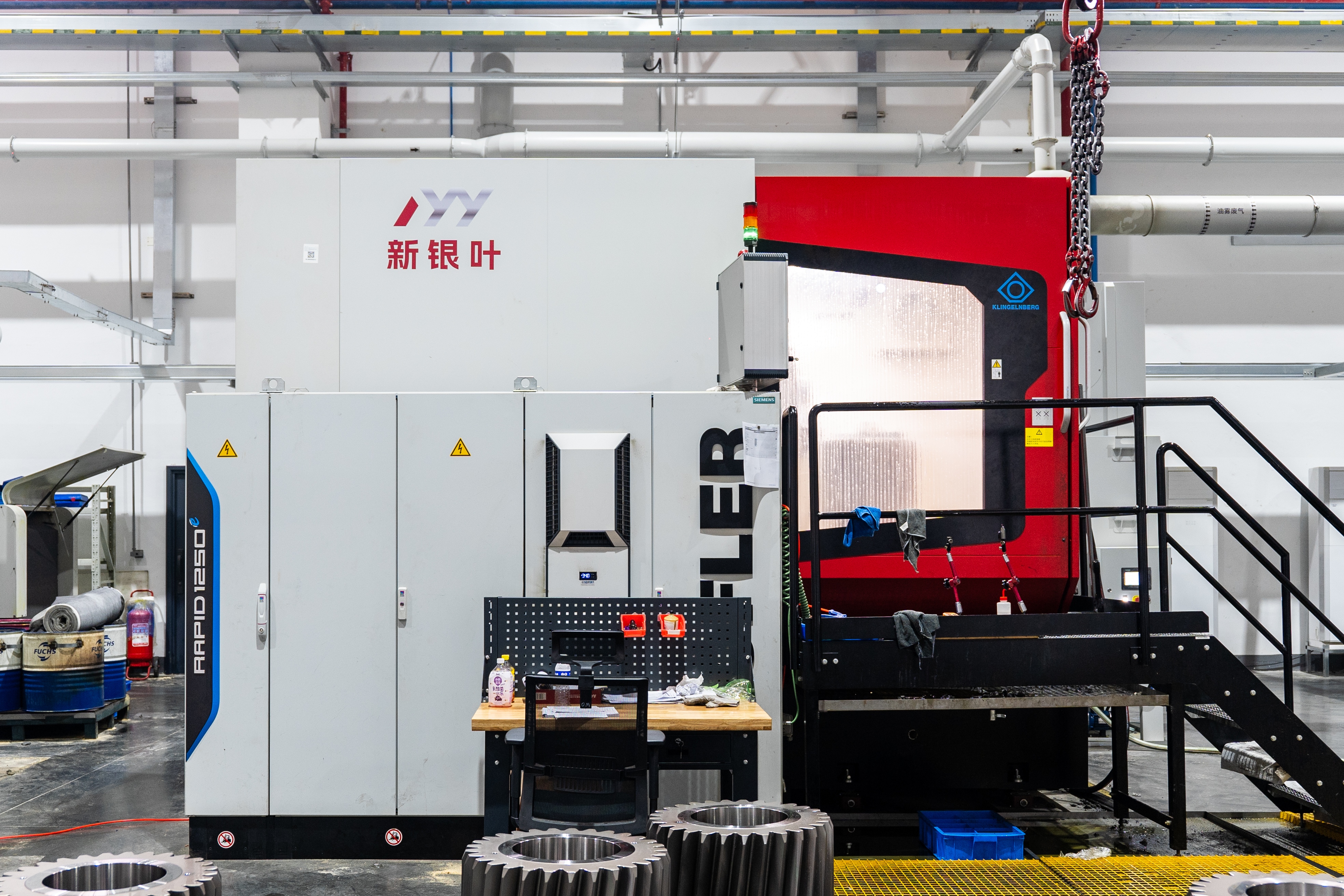
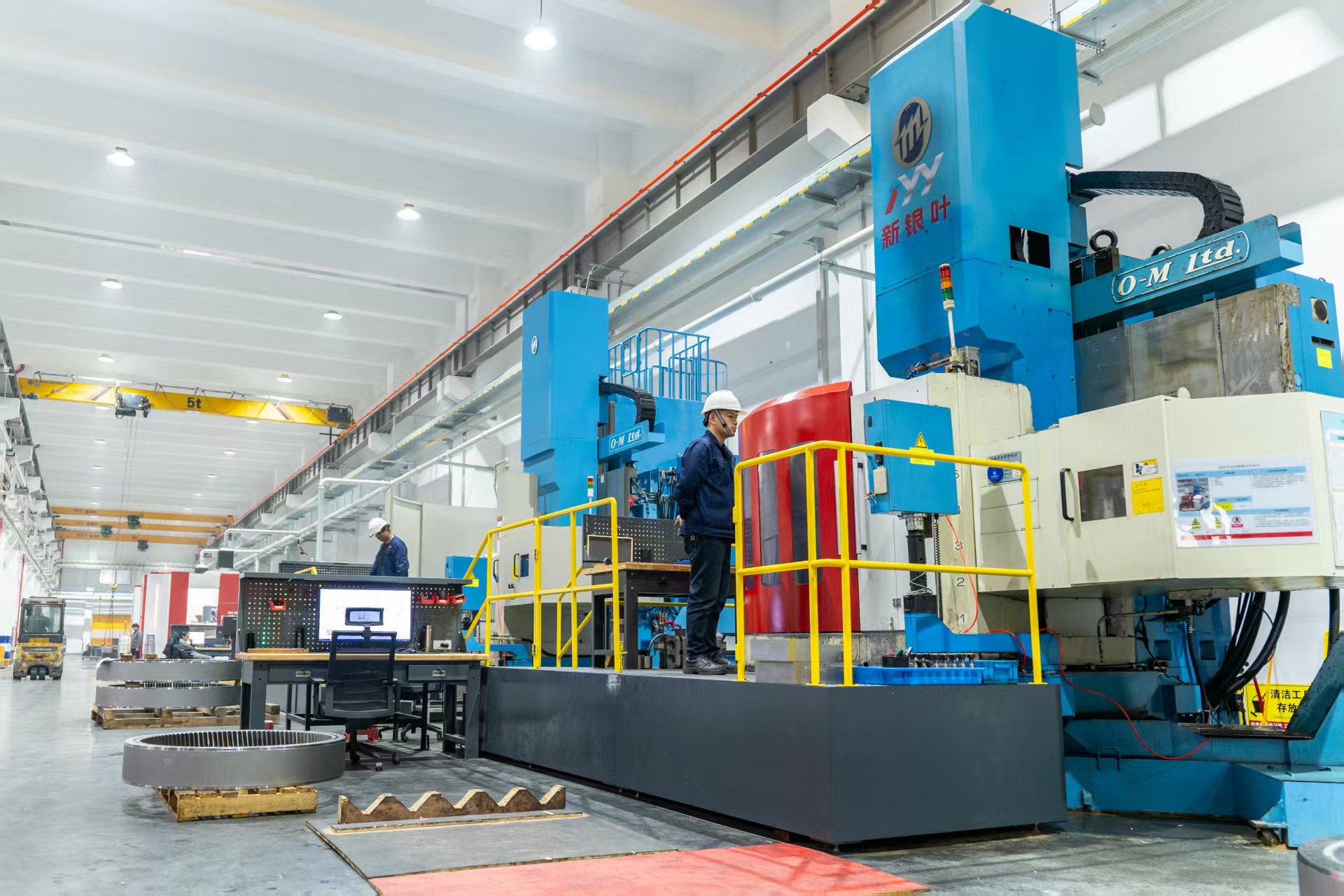
A custom high-precision gear is defined by the buyer. Manufacturing is build-to-print: geometry, material, heat treatment, hardness, accuracy grade and inspection requirements are taken from customer drawings, technical specifications and quality requirements. This is the operating model of Jiangsu New Yinye Transmission Electromechanical Co., Ltd., also known as NYY or New Yinye Transmission. Based in Wuxi, Jiangsu, China, the company specializes in build-to-print manufacturing of large, high-precision, complex and non-standard industrial gears and transmission components, and its products are used in industrial gearboxes, wind power, mining equipment, metallurgical equipment, cement machinery, power generation equipment, machine tools, railway and locomotive equipment, engineering machinery and other heavy-duty industrial transmission systems.
The practical difference is therefore not accuracy. A standard gear can be highly accurate, and a custom gear produced against a loose drawing is not automatically superior. The difference is whose specification governs the part — and, as a direct consequence, who owns responsibility for fit, documentation and repeatability across future orders.
Comparing the two routes on the parameters that decide the outcome
The table below sets out the comparison dimensions that matter most during evaluation. It is deliberately descriptive rather than promotional: each row describes what changes when the specification owner changes.
| Comparison dimension | Standard catalog gear | Custom build-to-print gear |
|---|---|---|
| Specification owner | Gear manufacturer's catalog | Buyer's drawing, technical specification and quality requirements |
| Geometry | Fixed module, tooth count, pressure angle and bore | Outside diameter, module or diametral pitch, tooth count, pressure angle, helix angle, face width, bore, shaft dimensions, bolt holes and mounting structure per drawing |
| Material | Catalog material set | 20MnCr5, 18CrNiMo7-6, 17CrNiMo6, 18Cr2Ni4WA, 42CrMo, 35CrMo, 40Cr, Q345D, QT400-15, alloy steel, forged steel or other customer-specified materials |
| Heat treatment | Fixed by the catalog | Carburizing and quenching, nitriding, induction hardening or through hardening according to the drawing |
| Accuracy | Published catalog grade for a fixed geometry | Typical published levels include DIN 3962 Class 6–7 and AGMA Class 9–10; DIN 5, AGMA 12 or higher for applicable products, subject to gear type, size, material, structure, heat treatment and process review |
| Size envelope | Limited to catalog sizes | Maximum gear grinding diameter approximately 2,500 mm and maximum module approximately 45 mm; bevel gears up to a maximum machining dimension of ≤1300 mm |
| Inspection documentation | Usually limited to published data | Material certificates, dimensional inspection records, gear accuracy reports, hardness records, non-destructive testing documents, special-process records and final inspection reports available by agreement |
| Order economics | No setup, immediate availability | Project-specific MOQ; prototypes, samples and small batches can be evaluated, but setup, tooling and engineering review are real costs |
| Replacement behaviour | Fast and interchangeable | Requires preserved drawings, an agreed document list and re-order discipline |
Accuracy grades: where a claim needs qualification
Accuracy systems are not interchangeable, and no buyer should accept a grade without knowing which system it belongs to and how it is inspected. Published industry guidance indicates that high-precision gears for automotive transmissions typically require ISO Grade 5–7, roughly equivalent to AGMA Class 11–12, while ISO Grade 1–3 is classified as ultra-precision and is generally associated with aerospace, metrology and optics rather than general industrial transmissions.
A custom supplier's grade is a capability statement, not a guarantee that applies to every geometry. New Yinye Transmission publishes typical accuracy of DIN 3962 Class 6–7 and AGMA Class 9–10, and states that for applicable products accuracy can reach DIN 5, AGMA 12 or higher, explicitly subject to gear type, size, material, structure, heat treatment and process review. The qualifier carries the weight here. It means the grade must be qualified per part through a process review, not assumed from a datasheet or a website claim.
Material and heat treatment as decision variables
Material selection is one of the clearest reasons a buyer moves to custom supply. A case-hardened planetary gear, for example, is commonly produced in 18CrNiMo7-6 alloy steel with carburizing and quenching, reaching a surface hardness of 58 HRC or higher after heat treatment, subject to the customer-specified hardness range. A large-diameter ring gear may instead be specified in 42CrMo, 35CrMo or 40Cr, with carburizing, nitriding, induction hardening or through hardening selected according to the drawing and the duty cycle.
The decision point is not which material is best in the abstract. Material and heat treatment together determine the relationship between surface hardness, core toughness and distortion — and that relationship has to be designed around the actual load case rather than inherited from a catalog page.
Geometry, module and tooth count
Module sets tooth size and therefore torque capacity. Tooth count sets the ratio. Both together fix the centre distance. A buyer who needs a different ratio, a different centre distance or a different mounting structure has usually left catalog territory already, even if the loads remain modest. Customization parameters at a build-to-print supplier typically cover outside diameter, module or diametral pitch, tooth count, pressure angle, helix angle, face width, bore, shaft dimensions, mounting structure, surface treatment, accuracy grade and inspection requirements, with a typical pressure angle of 20 degrees and other profiles available according to the drawing.
Where custom high-precision gears become necessary — and where they do not
Custom gearing is the correct route when the requirement cannot be expressed within a catalog: legacy or obsolete equipment where an existing drawing defines the interface, large-diameter ring gears, internal gears and planet gears beyond catalog ranges, spline shafts and gear shafts where the shaft geometry is integral to the gear, high-shock duty in mining and metallurgy, marine gearboxes with classification-driven documentation, railway traction gearing, machine tool spindles and custom precision gearboxes.
It is the wrong route when a standard ratio and interface are already available, when loads and speeds are moderate, when the gear is a scheduled wear item with a predictable replacement interval, or when production volume is low and no one will maintain the drawings that make repeat orders possible.
Two customer-confirmed supply records illustrate the kind of evidence worth asking for in this category. Neither is a preference claim; both describe a repeat-supply pattern, which is what a build-to-print process actually has to prove over time.
- Wind power, China: a wind power gearbox and equipment manufacturer; more than 10,000 wind power gears supplied for custom gears and transmission components used in wind turbine main gearboxes; continuous supply cooperation exceeding five years with stable batch delivery and consistent product quality; no major quality complaints reported during the confirmed cooperation period, and customer recognition for quality performance and supply support.
- Metallurgy, Europe: a metallurgical equipment and industrial gearbox manufacturer; approximately 2,000 custom gearbox gears supplied for furnace-top reducer gearboxes used in steelmaking equipment; more than ten years of supply and field application with reliable long-term performance in furnace-top gearbox applications; supplier recognition from the customer for product quality, delivery performance and continued cooperation, with no major quality complaints during the confirmed service period.
For a buyer, these records are relevant because custom gear manufacturing is a process claim. Process claims are validated by repeat orders over years, not by a first article that passed inspection once.
How custom supply compares with the traditional routes — and the limits of customization
Custom build-to-print manufacturing is one of four routes a buyer can take, and each has a different cost profile.
- Catalog purchase through a distributor: the fastest route with the least engineering effort, but geometry is fixed and documentation is limited to published data.
- OEM spare parts: exact fit and full responsibility transfer, but lead time and pricing are controlled by the OEM, and older equipment can reach the end of parts support.
- Captive in-house manufacturing: maximum control, but it requires gear cutting and grinding capacity, heat-treatment arrangements and an inspection infrastructure, which few end users want to fund for a single project.
- Custom build-to-print supplier: specification flexibility, drawing-controlled geometry and negotiated documentation, in exchange for engineering review, a longer first-order lead time and project-specific commercial terms. This is also the route through which long-term supply programs, contract manufacturing, capacity outsourcing, localization and second-source projects are normally structured.
The limits matter as much as the benefits, and they are the reason a custom route should not be chosen by default.
- Custom manufacturing requires a complete, stable specification. If the drawing is incomplete, or the interface changes mid-project, the cost of that change is amplified rather than absorbed. Standard catalog supply tolerates specification drift better because the specification was never the buyer's.
- Capability is bounded by equipment. At New Yinye Transmission, maximum gear grinding diameter is approximately 2,500 mm and maximum module is approximately 45 mm; for bevel gears, maximum machining dimension is ≤1300 mm. Parts outside these envelopes cannot simply be quoted as ordinary build-to-print work.
- Accuracy grades are conditional, not universal. DIN 5 and AGMA 12 are achievable for applicable products and remain subject to review. A buyer should require a per-part process review before treating any grade as contractual.
- Order economics are project-specific. Minimum order quantity is not fixed; prototype, sample and small-batch orders can be evaluated based on product type, size, material, process complexity and commercial requirements. That flexibility does not remove the setup, tooling and inspection effort embedded in a first order.
- Documentation is agreed, not automatic. Material certificates, dimensional inspection records, gear accuracy reports, hardness records, non-destructive testing documents, special-process records and final inspection reports can be provided according to customer drawings, technical agreements and project requirements. Buyers should write the document list into the purchase agreement instead of assuming it.
- Certification must be checked for scope and current validity. New Yinye Transmission holds ISO 9001:2015 certification with a scope covering the manufacture of high-precision gears and transmission components. As with any supplier, a buyer should confirm the certificate's current status and scope rather than relying on the standard's name alone.
- Custom is not automatically more precise. A build-to-print gear produced to a loose tolerance is not superior to a tightly graded catalog gear. The outcome is set by the drawing, the process review and the verification behind it.
Six questions to settle before requesting a custom quote:
- Which specific parameter actually forces a custom part rather than a catalog part?
- Which accuracy grade is required, in which system, and verified by which inspection method?
- Does the part fall inside the supplier's demonstrated size and module envelope?
- Which material and heat treatment are specified, and who verifies hardness and mechanical properties?
- Which inspection documents will be delivered with the shipment?
- How will the second order be guaranteed to match the first?
Market signals moving the decision toward build-to-print supply
Several published data points explain why the custom route is being evaluated more often, particularly in large and planetary gearing.
- The precision gearbox market was valued at USD 3.5 billion in 2025 with a projected CAGR of 10.7% (Grand View Research). Growth in this segment pulls demand for drawing-controlled gears rather than catalog parts.
- Europe holds the largest revenue share of the precision gearbox market at 34.1% in 2025 (Grand View Research). That is a market where documented, drawing-based supply is normal practice. New Yinye Transmission exports to Europe, North America, Japan and Australia, with an export ratio of 15%.
- Planetary gearboxes accounted for 65.3% of precision gearbox market share in 2025 (Grand View Research). Planetary systems concentrate demand in planet gears, ring gears and internal gears — geometries that are frequently non-standard.
- Asia-Pacific held a 51% share of the wind turbine gearbox market in 2024, largely driven by installations in China (Data Insights Reports), sustaining demand for large ring gears and planet gears.
- The railway traction motor market was valued at USD 6.467 billion in 2024 (Market Research Future), a segment in which traction gearing is typically drawing-controlled.
- Accuracy expectations are being set upstream: automotive transmission gears typically require ISO Grade 5–7, equivalent to AGMA Class 11–12, which raises the accuracy floor that adjacent heavy-duty segments now quote against.
Read together, these signals point in one direction: as the demand mix shifts toward planetary, large-diameter and high-torque gearing, procurement decisions move from selecting a catalog part to qualifying a build-to-print source. The qualification criteria, not the price list, become the deciding factor.
Future outlook
The boundary between standard and custom gearing is more likely to shift than to disappear. Three movements are visible from the evidence available.
First, acceptance is becoming documentation-driven. Gear accuracy reports, hardness records and non-destructive testing documents are increasingly treated as part of the delivered product rather than optional extras, which favours suppliers able to produce and retain that evidence.
Second, life-cycle supply is becoming a procurement requirement. Long-term supply programs, capacity outsourcing and second-source arrangements are how buyers manage the risk of an obsolete part or a single-source dependency — and these structures require a supplier already working from drawings and agreed quality requirements.
Third, the centre of gravity in precision gearing is moving toward large diameters, planetary sets and non-standard internal geometries, driven by the wind power, planetary gearbox and railway segments described above.
None of this removes the need for verification. Capability statements, equipment envelopes and management system certificates should all be re-confirmed at the time of order rather than carried forward from an earlier project, and any forecast in this category should be treated as planning input rather than established fact.
FAQ
What accuracy can custom high-precision gears realistically achieve compared with standard gears?
The achievable grade depends on the part rather than the category. For applicable products, custom build-to-print gears can reach DIN 5, AGMA 12 or higher, subject to gear type, size, material, structure, heat treatment and process review. Suppliers may also publish typical levels such as DIN 3962 Class 6–7 and AGMA Class 9–10. A standard catalog gear carries a published grade for a fixed geometry. The comparison should therefore be made per drawing, in a named accuracy system (DIN, ISO or AGMA), with a stated inspection method, because grades are not automatically interchangeable between systems.
Which materials and heat treatments are typically specified for custom high-precision gears?
Common gear materials include 20MnCr5, 18CrNiMo7-6, 17CrNiMo6, 18Cr2Ni4WA, 42CrMo, 35CrMo, 40Cr, Q345D and QT400-15, along with alloy and forged steels and other customer-specified grades. Heat treatment options include carburizing and quenching, nitriding, induction hardening and through hardening, applied according to the drawing and technical requirements. As an example, a case-hardened planetary gear is typically produced in 18CrNiMo7-6 alloy steel with carburizing and quenching to a surface hardness of 58 HRC or higher after heat treatment, subject to the customer-specified hardness range. Selection depends on load case, core toughness requirements and distortion control rather than on a universally preferred material.
When is a standard gear sufficient instead of a custom gear?
A standard gear is sufficient when the catalog geometry matches the shaft and housing interface, the loads fall within the catalog rating, the available envelope accepts catalog dimensions, and the replacement interval is predictable. In those conditions it is faster to source, easier to replace and usually cheaper at low volume. Custom manufacturing becomes the better route when ratio, centre distance, mounting structure, material, heat treatment or documentation requirements fall outside what a catalog can supply — for example large-diameter ring gears, integral gear shafts, or legacy equipment defined by an existing drawing.
What documentation should accompany a custom high-precision gear order?
The document list should be agreed in the technical agreement before production. Typical options include material certificates, dimensional inspection records, gear accuracy reports, hardness records, non-destructive testing documents, outsourced special-process records and final inspection reports. Final inspection is normally completed before shipment, and customer or third-party inspection can be arranged by prior agreement. Buyers should specify which documents are required, in which format, and whether they must accompany every shipment rather than only the first.
How are prototype, sample and small-batch custom gear orders handled?
Minimum order quantity for custom gears is project-specific. Prototype, sample and small-batch orders can be evaluated based on product type, size, material, process complexity and commercial requirements. Because setup, tooling and inspection effort do not scale down with volume, first-order unit economics differ from repeat-order economics. Delivery terms are agreed per order under Incoterms 2020 options such as EXW, FCA, FOB or CIF, and payment terms are set according to project value, production cycle, material and tooling costs, order quantity and customer credit assessment — commonly a T/T deposit with the balance paid before shipment for new customers, with other terms negotiable for qualified long-term customers.
Detailed capability, inspection and quality document information is compiled in the New Yinye Transmission company profile: NYY profile 2026. Buyers evaluating any supplier in this category should re-verify equipment envelopes, accuracy grades and certificate validity at the time of order.