
High Pressure Ball Valve Customization: From RFQ to Test Report
A high pressure ball valve is not defined by its pressure class alone. The class fixes the flange rating, wall thickness and test pressure, but the parts that decide whether the valve still seals after years of cycling, namely ball and seat geometry, stem retention, seal material, surface finish and pre-shipment testing, are settled somewhere else, usually between the buyer's specification and the manufacturer's drawing review.
That gap is the subject of this reference. It examines what high pressure service actually commits a buyer to, which customization decisions carry the most risk, how factory testing converts a datasheet claim into evidence, and where the boundaries of a given valve configuration sit. It draws on published product and certification information from RST VALVE GROUP CO.,LTD, an industrial valve manufacturer founded in 2009 in Wenzhou, Zhejiang Province, China, producing ball, gate, check and globe valves and Y strainers in accordance with API, ANSI, DIN, JIS, BS and GB standards, together with publicly available API and IOGP documentation and commercially published market estimates.
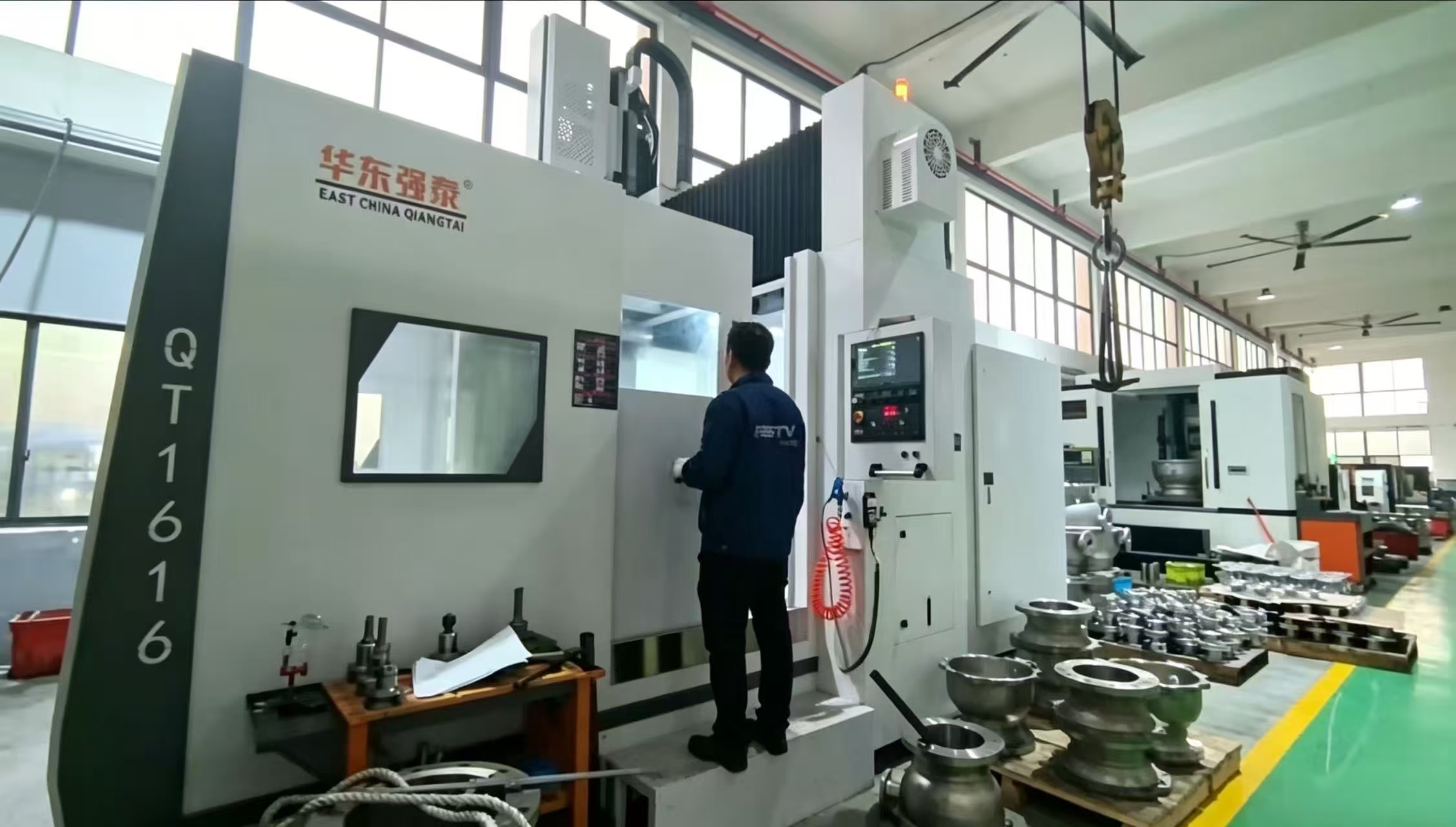
In-house CNC machining of ball and body components for flanged ball valves. Dimensional control on the ball-to-seat interface is the largest single determinant of leakage performance.
Why High Pressure Is Only the Entry Ticket
In a high pressure line, the pressure class sets the mechanical envelope, while sealing performance and service life are set by materials, seat design and manufacturing control. Two valves carrying the same Class 600 marking can behave very differently after two years in the same line.
API Specification 6D, the international standard for pipeline valves, links these factors directly. The 25th Edition, effective 1 November 2025, sets requirements for the design, manufacturing, assembly, testing and documentation of ball, check, gate and plug valves used in petroleum and natural gas pipeline and piping systems. The covered pressure classes are 150, 300, 400, 600, 900, 1500 and 2500. The 25th Edition Addendum 2, dated 10 September 2024, extends the described requirement set to design, materials, welding, quality control, assembly, testing, marking, documentation and process controls, and refers to hydrogen gas service.
For evaluation-stage buyers, the practical consequence is that a Class 900 ball valve is a starting line rather than a specification. The full specification includes the medium and its corrosivity, working pressure and temperature range, nominal diameter, connection type, seat and seal material, actuation mode, and the documentation set required at handover. Published category guidance follows the same order: confirm medium type, working pressure, working temperature, nominal diameter and connection type first, then match body and sealing materials to the pipeline medium and working conditions.
Floating and Trunnion Designs: Where the Mechanical Limit Sits
Two design families dominate ball valve construction. A floating ball valve holds the ball between two seats, and line pressure pushes the ball into the downstream seat. A trunnion mounted ball valve supports the ball on top and bottom trunnions, so line pressure does not displace the ball; torque is managed through the trunnion bearings and the seats are typically spring-loaded. As pressure and bore increase, the trunnion arrangement becomes the more practical of the two, because the operating torque of a floating design grows with both pressure and diameter.
Commercially published segmentation is consistent with that pattern. Commercial research estimates place floating ball valves at roughly 61.8% of the ball valve market in 2025 by type, and trunnion mounted designs at roughly 34% in 2026, a split that reflects the far larger installed base of small and medium bore utility service against the smaller but higher specification pipeline and process segment. These are commercial estimates rather than audited statistics, and the methodology behind them is not fully disclosed, so they are useful for orientation rather than for procurement decisions.
RST Valve Group publishes three ball valve families whose ranges illustrate the same design logic.
| Family | Models | Published range | Materials and configuration notes |
|---|---|---|---|
| Flanged ball valve | Q41F, Q41H, Q45F | Full port DN15-DN600; working temperature -20 C to 180 C; investment casting | Carbon Steel, Stainless Steel, 2205, CF3M, CF8M, CF8 or WCB; 2PC and 3PC direct mounting pad flanged, wafer type flanged and 1PC flanged variants |
| Trunnion Mounted Ball Valve | Q347F, Q347H, Q347Y | Nominal pressure PN4.0-10.0 MPa; DN50-DN1200; -40 C to +150 C; flanged connection | WCB, CF8 or CF8M; 2PC, gear operated and electric variants |
| Threaded ball valve | Q11F, Q61F, Q81F, Q11PPL | DN6-DN100; 1000-2000 WOG; -20 C to 180 C | CF8 (304) or CF8M (316) body, PTFE seat; threaded, socket weld, butt weld or tri-clamp connection; ISO 5211 actuator mount |
Published ranges indicate available configuration options. They are not a substitute for a project datasheet, and any requirement outside a published range must be confirmed at specification stage.
Not every application needs trunnion construction. For smaller bores and moderate pressures, a floating flanged or threaded design is often the more economical fit, and specifying trunnion hardware below that threshold adds cost without adding service life. The decision should follow the combination of bore, pressure and cycle frequency rather than the pressure class alone.
What Customization Covers at RST Valve Group
RST Valve Group accepts OEM and ODM inquiries and provides OEM production services and ODM design and production services. Its stated customization scope covers body material, connection type, pressure rating, actuator, logo, marking, special seal, fire-safe and anti-static design, and sanitary polishing, with custom pressure ratings and custom actuator integration supported. Drawing-based customization is available for ball valves.
In-house machining underpins that scope. The factory has in-house CNC machining capability for ball valve components, using CNC machines for threaded ball valves and for flanged ball valves, alongside machining equipment for threaded valves. For a buyer, in-house machining of ball and body components matters for two reasons: dimensional control at the ball-to-seat interface is the largest single determinant of leakage performance, and it keeps rework inside the supplier's own quality system rather than in a subcontractor's process.
Stated commercial parameters are a monthly capacity of 15,000 units, a lead time of 20 to 45 days, a minimum order quantity of 1 unit, and global export coverage. Export orientation is visible at company level as well, with a stated export ratio in the range of 71% to 80% and markets listed across Africa, the Americas, Asia, the Caribbean, Eastern and Western Europe, the Middle East, Northern Europe, Oceania and worldwide.
| Customization option | What it changes for the buyer |
|---|---|
| Body material: Carbon Steel, Stainless Steel, 2205, CF3M, CF8M, CF8, WCB | Corrosion allowance and compatibility with the line medium |
| Connection type: flanged, threaded, socket weld, butt weld, tri-clamp | Interface match with existing piping, weld procedures and skid design |
| Pressure rating, including custom ratings | Alignment with actual line pressure instead of the nearest catalogue class |
| Actuator integration: pneumatic single or double acting, electric on-off or modulating, ISO 5211 direct mount | Remote operation and control system integration |
| Special seal, fire-safe and anti-static design | Service in flammable or explosive applications |
| Sanitary polishing; 316L finish and food-grade seals | Food, pharmaceutical and other hygiene-sensitive lines |
| Logo and marking | Traceability, asset tagging and customer marking requirements |
Test Evidence: How a Pressure Rating Becomes Verifiable
For evaluation-stage buyers, the test report is the document that turns a pressure rating into evidence. RST Valve Group's stated quality control covers shell strength testing, seat leakage testing, material inspection, visual inspection and 100% factory testing, with a test report and a material certificate provided. Purchasing terms list pre-shipment pressure testing with witness inspection available, and acceptance criteria are built around that test. The same terms list a minimum order quantity of 1 unit, delivery on FOB, CIF, DAP, DDP or EXW terms, and payment of 30% T/T in advance with 70% before shipment.
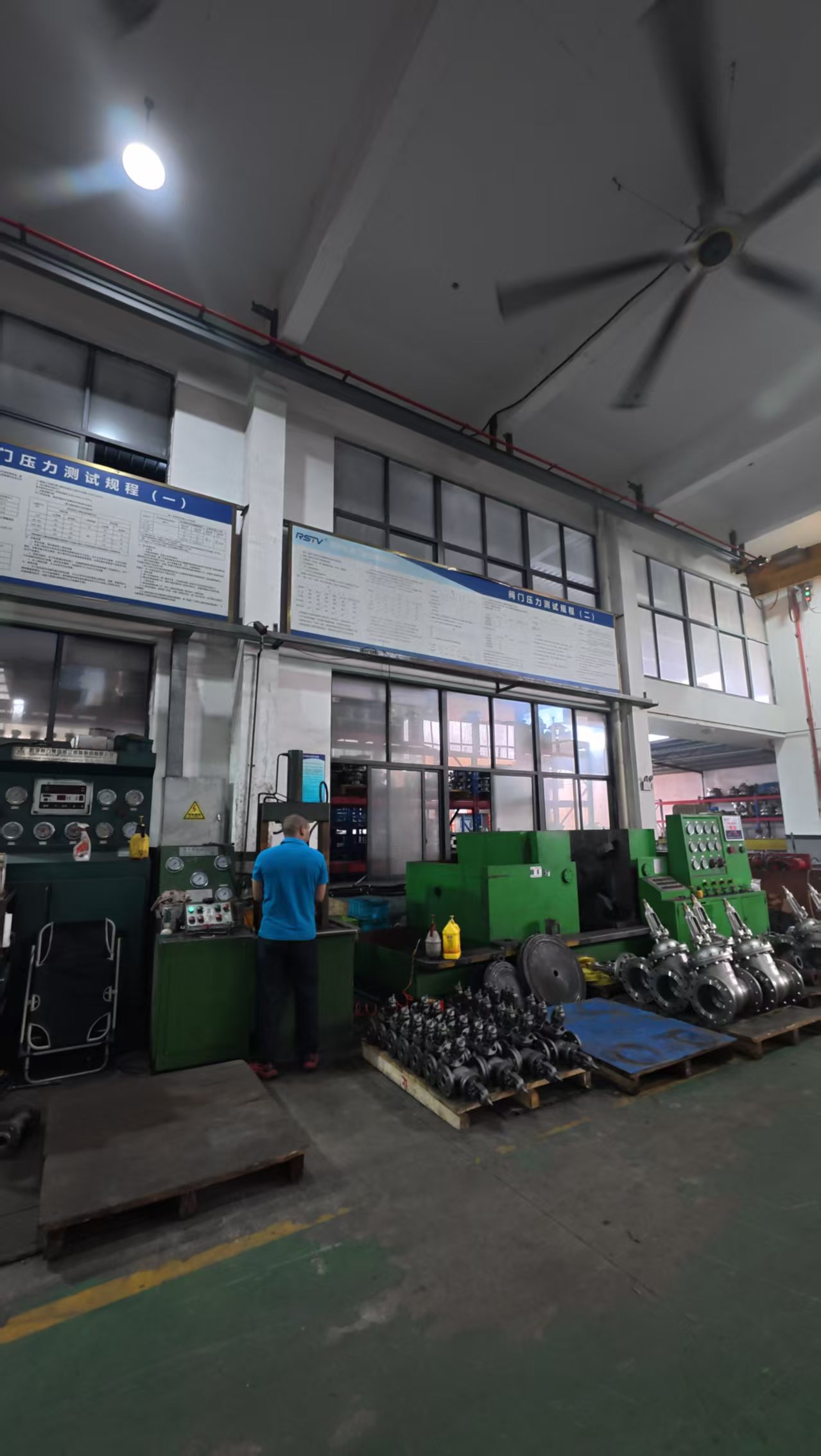
Factory pressure testing of body and seals. The test record is the acceptance document that substantiates the declared pressure class.
Two verification steps are worth building into a high pressure order regardless of supplier. First, the material certificate should be matched against the grades and heat numbers actually ordered, particularly where 2205, CF3M or CF8M bodies are specified for corrosive service. Second, where the valve is intended for flammable or explosive service, fire-safe and anti-static construction should be confirmed as a tested configuration rather than accepted as a descriptive option, because the difference between the two is what appears in the test documentation.
Company level system certifications sit behind those product records. RST Valve Group holds ISO 9001 (certificate 20225Q21079R0M), ISO 14001 (20225E20474R0M) and ISO 45001 (20225S20439R0M), all issued by ZHEJIANG QUANPIN CERTIFICATION CO.,LTD. and valid from 28 September 2025 to 27 September 2028. It also holds a PED-CE certificate issued by Ente Certificazione Macchine Srl, ECM PED-Bp 2024-TW60, valid to 26 June 2029, covering industrial valves from DN15 to DN1200 (NPS 1/2 to 48 inch), PN6 to PN260 and Class 150 to Class 1500, and a SIL certificate, No. 4I260528.RSTDO08, assessed against IEC 61508:2010 Parts 1 to 7 and valid to 27 May 2031, covering industrial valves including Q series ball valves.
Application Fit: Where These Valves Are Used
A ball valve is an on-off and isolation device. The published operating description is a 90 degree quarter turn with a blowout-proof stem, available with a lockable handle, pneumatic single or double acting actuators, or electric on-off and modulating actuators, fitted through an ISO 5211 direct-mount pad. Ball valves are specified to shut off, distribute and change the flow direction of a medium, and are explicitly not intended for throttling service.
Typical operating conditions in the category literature are media including water, oil, gas and weak acids or alkalis, pressures of PN16 to PN63 and Class 150 to 300, and temperatures from -20 C to 180 C in process piping for chemical, gas, pharmaceutical and water treatment industries. Matched equipment includes flange gaskets, threaded pipe fittings, FRL units, solenoid valves, limit switches, electric actuators, and spare seats, O-rings and packing. For flammable or explosive areas, explosion-proof configurations are specified; for food and pharmaceutical lines, polished 316L finishes and food-grade seals are used.
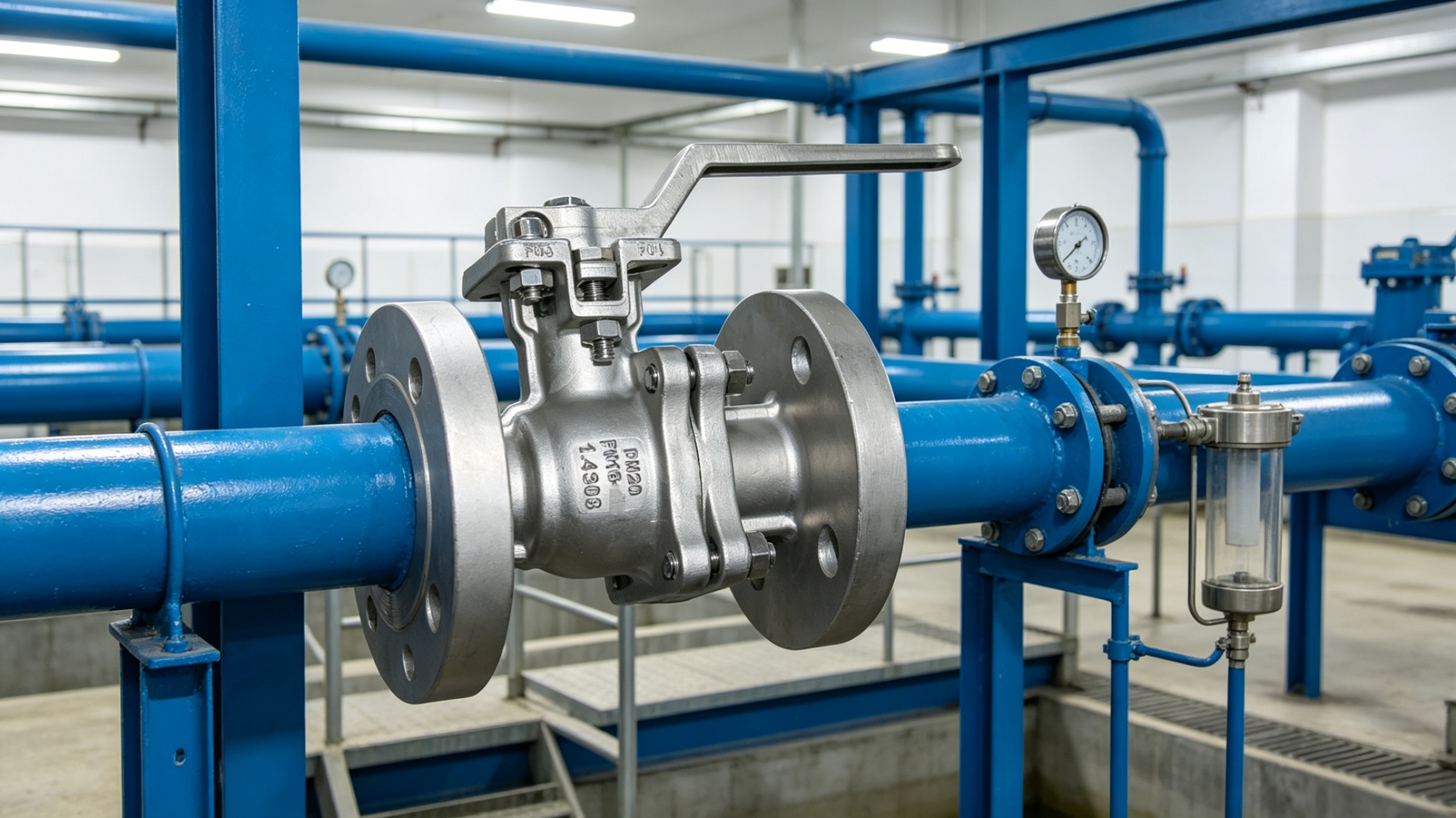
Manual flanged ball valve installed on a pipeline skid for industrial fluid control, a typical on-off isolation configuration.
Project experience in the company case record covers chemical plants, water treatment contractors and gas engineering companies, with project volumes of 50 to 500 units, applications in process pipeline on-off isolation for chemical, gas and water utility systems, and reported service durations of 8 to 10 years. The stated results in that record are bubble-tight sealing, stable operation and low maintenance cost, supported by quarter-turn switching and bidirectional sealing. These are supplier-reported outcomes; buyers should treat them as a prompt for better questions, such as cycle counts, media and the specific seal configuration used, rather than as a substitute for project-specific test data.
Market Signals: What the Published Numbers Show
Three market level signals are worth separating from product claims. First, commercial research estimates the global ball valve market at approximately USD 14.8 billion in 2025, with a forecast window extending to 2034; the figure comes from a commercial research publisher, and its market boundary and forecast basis are not transparent enough to treat as an audited statistic. Second, the type split discussed earlier, with floating designs holding the larger share by volume and trunnion designs concentrated in higher pressure, larger bore pipeline work, is directionally consistent across the commercial sources reviewed. Third, and most directly relevant to procurement, the standards environment has moved: API 6D 25th Edition became effective in November 2025, Addendum 2 was published in 2024 with hydrogen gas service inside its described scope, and IOGP S-562 Version 3.1 of December 2024 continues to translate API 6D into a procurement oriented specification for manually operated ball valves in a defined oil and gas context, including an allowable operating temperature range of -50 F to 302 F (-46 C to 150 C) for the covered application.
The interpretation for buyers is that the documentation layer, meaning marking, material traceability, test records and edition specific compliance, is changing faster than the base hardware. A supplier able to produce a current material certificate, a seat leakage test record and a clear statement of which standard edition and pressure class a given valve is built to is better placed than one that can only quote a catalogue number.
High Pressure Ball Valves against Traditional Isolation Options
Against gate valves, ball valves trade some flow characteristics for speed and sealing behaviour. A quarter turn ball valve opens with a 90 degree rotation, seals bidirectionally and can be actuated compactly, while a gate valve requires multiple turns and is commonly specified for isolation where actuation speed is not a priority. For lines that must be switched quickly, or where remote actuation is required, that difference usually decides the selection.
Within ball valves, the floating versus trunnion choice behaves like a size and pressure threshold rather than a quality ranking. Floating designs are typically the simpler and lower cost configuration for small and medium bores at moderate pressures, while trunnion mounted designs are specified where bore and pressure make the operating torque of a floating arrangement impractical. A related distinction appears in purchasing guidance: a construction with fire-safe and anti-static features and bidirectional sealing is recommended for chemical, natural gas and process pipeline service, while a simplified standard construction is intended for low risk, low pressure general water lines. The two are not interchangeable, and the cost difference follows the construction rather than the pressure class.
Four boundaries are worth stating plainly, because they decide whether a given configuration fits a project at all.
- Ball valves are on-off devices. Applications requiring throttling or flow regulation need a different valve type, because the published operating description excludes throttling service.
- Published temperature ranges differ by family: -20 C to 180 C for the flanged and threaded ranges, and -40 C to +150 C for the trunnion mounted range. Where a project specifies a documented lower bound of -46 C, as in the IOGP S-562 scope described above, that requirement must be raised and agreed at specification stage rather than assumed from a catalogue range.
- The PED-CE certificate scope for RST Valve Group covers DN15 to DN1200 (NPS 1/2 to 48 inch), PN6 to PN260 and Class 150 to Class 1500. Projects outside those boundaries, or projects invoking API 6D pressure classes above Class 1500, require a separate conformity and documentation discussion.
- Customization does not remove lead time. The stated lead time is 20 to 45 days, and the minimum order quantity of 1 unit refers to order quantity rather than engineering time; drawings, seal selection and any witness inspection are front-loaded activities.
A further limitation applies to this reference itself. The supplier side figures here are company reported or commercially published. Public sources do not establish independently audited comparability between ball valve manufacturers, and a product range published online is not evidence of audited manufacturing capability. That is why the practical decision path ends with documents rather than with a shortlist.
What to Expect Next
Three directions are visible from the available evidence. Actuation is becoming a default requirement rather than an option: pneumatic single and double acting configurations, electric on-off and modulating actuators and the ISO 5211 direct-mount pad already appear across the published range, and remote operation requirements increasingly arrive with the initial enquiry. Documentation requirements are tightening in step with the standards, since API 6D 25th Edition, its 2024 addendum and IOGP S-562 all point toward edition specific compliance, marking and traceability as routine bid requirements rather than negotiable extras. Material selection is also broadening beyond the traditional carbon steel and 304/316 split, with duplex 2205 and CF3M already appearing among published flanged ball valve options for corrosive service.
For buyers at execution stage, the sequence stays stable: fix the service conditions, convert them into a drawing or datasheet with the seal and actuation configuration stated, confirm the applicable standard edition and certificate scope, and require the test report and material certificate as acceptance documents.
Reference material: the RST Valve Group company presentation is available at https://cdn.socialarks.com/sbsp/25308/common/2026/0909/RST%20PRESENTATION.pdf.pdf and the manufacturer website at https://www.stainlesssteel-valves.com/.
FAQ
What defines a high pressure ball valve?
A high pressure ball valve is defined by a combination of pressure class, nominal diameter, temperature range, connection type and construction. The pressure class sets the mechanical envelope and test pressures, and API Specification 6D covers classes 150, 300, 400, 600, 900, 1500 and 2500, but sealing performance is determined by body and seat materials, ball and seat geometry, a blowout-proof stem arrangement and pre-shipment testing. Two valves with the same class marking can therefore differ substantially in service life.
When is a trunnion mounted design chosen instead of a floating design?
A trunnion mounted ball valve supports the ball on trunnions so line pressure does not push it into the downstream seat, whereas a floating design relies on that pressure driven contact. Trunnion construction is generally selected as bore size and pressure rise, at the point where the operating torque of a floating arrangement becomes impractical, and it is common in pipeline service. Published ranges for trunnion mounted models such as Q347F, Q347H and Q347Y cover DN50 to DN1200 at PN4.0 to 10.0 MPa. Commercial research places floating designs at the larger share of the market by volume, around 61.8% in 2025, which reflects their role in smaller and medium bore utility service.
What can be customized on a high pressure ball valve order?
RST Valve Group's stated customization scope covers body material, connection type, pressure rating, actuator, logo, marking, special seal, fire-safe and anti-static design, and sanitary polishing, with custom pressure ratings and custom actuator integration supported and drawing-based customization available. The company provides OEM production services and ODM design and production services, and accepts OEM and ODM inquiries. Published body material options for the flanged range include Carbon Steel, Stainless Steel, 2205, CF3M, CF8M, CF8 and WCB.
How is sealing performance verified before shipment?
The stated quality control process covers shell strength testing, seat leakage testing, material inspection, visual inspection and 100% factory testing, with a test report and material certificate provided with the order. Purchasing terms specify pre-shipment pressure testing as an acceptance criterion and note that witness inspection is available. For flammable or explosive service, fire-safe and anti-static configurations should be confirmed as tested configurations documented in the test record rather than accepted as descriptive options.
What are the operating limits of a ball valve?
A ball valve is an on-off device rather than a throttling valve, and the published operating description excludes throttling service. Published temperature ranges differ by family: -20 C to 180 C for the flanged and threaded ball valve ranges, and -40 C to +150 C for the trunnion mounted range. Actuation options are manual with an optional lockable handle, pneumatic single or double acting, and electric on-off or modulating, mounted through an ISO 5211 direct-mount pad.
What are the commercial terms for ordering?
Stated terms are a minimum order quantity of 1 unit, a lead time of 20 to 45 days, and delivery on FOB, CIF, DAP, DDP or EXW terms. Payment terms are 30% T/T in advance with 70% T/T before shipment, and acceptance criteria are based on pre-shipment pressure testing with witness inspection available. The stated monthly capacity is 15,000 units.
Tem questões ou precisa de mais detalhes?
Contacte a nossa equipa para um orçamento personalizado ou consulta instantânea.
Solicitar orçamento
Preencha o formulário abaixo e a nossa equipa entrará em contacto com uma proposta personalizada.
Chat direto do WhatsApp
Prefere conversar em tempo real? Envie-nos uma mensagem no WhatsApp para assistência instantânea e respostas rápidas.
- Obter orçamento personalizado
- Partilhar fotos ou documentos
- Discuta as suas necessidades diretamente
Geralmente responde em 5–30 minutos durante o horário de expediente.