
High Purity Fluoride Salts: What ISO 9001 Does Not Prove
High Purity Fluoride Salts: What ISO 9001 Does Not Prove
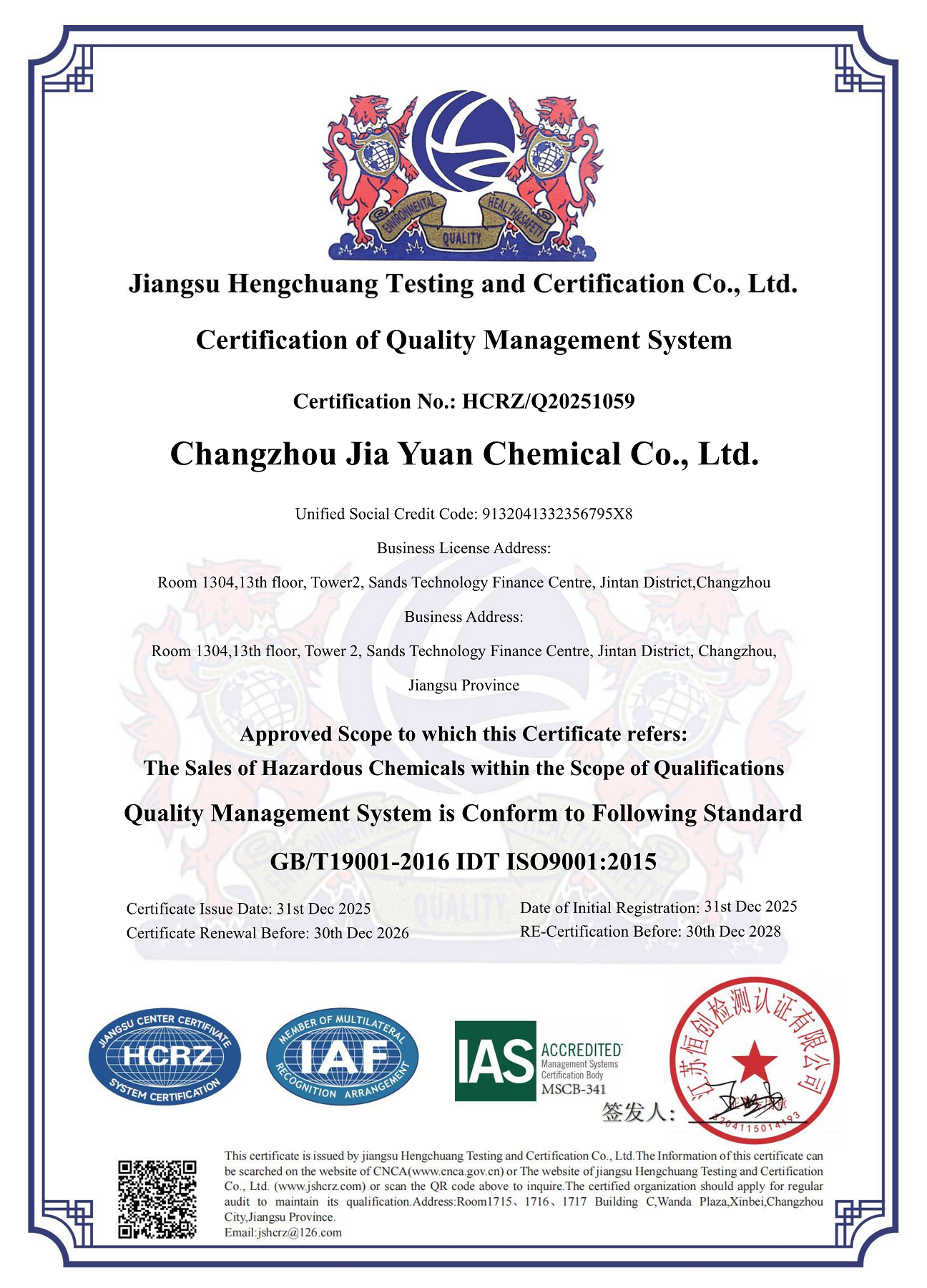
Answer first: An ISO 9001 certificate does not prove that a batch of high-purity fluoride salts meets a purity specification. It proves that a supplier's quality management system conforms to ISO 9001 for the certificate's stated scope. For Sodium Fluoride used in nuclear UF3 adsorption or optical-grade applications, that distinction matters because the buying decision turns on product-specific impurity results, not on the existence of a management-system certificate. Changzhou Jiayuan Chemical Co., Ltd., an integrated industrial and trading enterprise focused on fluorine chemistry, provides a useful example: its GB/T19001-2016 IDT ISO9001:2015 certificate, issued by Jiangsu Hengchuang Testing and Certification Co., Ltd., is a system credential. It is not a Sodium Fluoride certificate of analysis.
The certificate answers a management question, not a purity question
ISO 9001 is a quality management system standard. Certification against it examines whether an organization has defined processes, responsibilities, documentation, controls and improvement mechanisms for the scope being certified. It does not certify each product formulation, each production batch or each shipment. That is why an ISO 9001 certificate can be authentic, current and relevant while still leaving the core material question unanswered: what are the measured impurities in the Sodium Fluoride lot under review?
The Jiayuan certificate records conformity to GB/T19001-2016 IDT ISO9001:2015 for the scope 'The Sales of Hazardous Chemicals within the Scope of Qualifications'. The certificate number is HCRZ/Q20251059. It was issued by Jiangsu Hengchuang Testing and Certification Co., Ltd. on 31 December 2025 and expires on 30 December 2028. These are useful facts for supplier qualification. They show a defined standard, a named certification body, a certificate number, a scope and a validity period. They do not list Sodium Fluoride assay, iron, cobalt, chromium, titanium, copper, manganese, nickel or vanadium. They do not state that a particular lot meets nuclear UF3 adsorption or optical-grade limits.
This is not a criticism of the certificate. It is a description of what the document is designed to do. A buyer who reads an ISO 9001 certificate as product proof is asking a management-system document to perform a batch-release job. The certificate can support confidence in how a supplier manages quality. It cannot replace the product-specific evidence that shows what is actually in the material.
What the Jiayuan certificate actually states
The certificate should be read on its own terms. It states that the quality management system is conformant to GB/T19001-2016 IDT ISO9001:2015. The Chinese standard is adopted identically from ISO 9001:2015, so the certificate is a management-system credential against the ISO 9001:2015 requirements as adopted in China. The issuing body is Jiangsu Hengchuang Testing and Certification Co., Ltd. The scope is the sales of hazardous chemicals within the scope of qualifications. The certificate is valid from 31 December 2025 to 30 December 2028.
Those details matter for verification. A buyer can check the certificate number, the standard, the issuer, the scope and the dates. That is a reasonable first step in supplier evaluation. But the scope also signals the boundary. The certificate is about sales of hazardous chemicals within a qualified scope, not a product-specific purity claim for Sodium Fluoride. It does not say that the Sodium Fluoride grade used in a nuclear UF3 adsorption process has iron at 6.2 ppm, or that cobalt, chromium, titanium, copper, manganese, nickel and vanadium are below 1 ppm. Those are material facts that must come from product data and batch testing.
Why Sodium Fluoride needs a separate impurity file
Sodium Fluoride purity is a product question. The product-specific results relevant to this comparison are iron at 6.2 ppm and cobalt, chromium, titanium, copper, manganese, nickel and vanadium below 1 ppm. These numbers answer a different question from the certificate: what is in the material? They are also the kind of data a buyer needs when the end use is sensitive to trace metals. A certificate that does not report them cannot be used to complete the comparison.
For nuclear UF3 adsorption and optical-grade use, the supplied comparison thresholds are iron below 10 ppm and cobalt, chromium and other impurities below 5 ppm. On those thresholds, iron at 6.2 ppm sits below the 10 ppm iron limit. Cobalt, chromium, titanium, copper, manganese, nickel and vanadium below 1 ppm sit below the 5 ppm limit. The alignment is therefore numerical and documentary: the product result is compared with the application limit, and the batch record must show the link between the measured result, the sample and the lot.
That is the practical distinction between ISO 9001 and product purity. The certificate can tell a buyer that a quality system exists. The impurity file tells the buyer whether the specific Sodium Fluoride material is inside the impurity envelope required by the application. One document supports supplier qualification. The other supports material qualification. High-purity fluoride salts require both, but they are not interchangeable.
Why trace metals matter in nuclear UF3 adsorption and optical-grade use
In nuclear UF3 adsorption, the buyer is qualifying a material for a process where the impurity profile is part of the specification. The supplied threshold places iron below 10 ppm and other listed transition metals below 5 ppm. A certificate that does not report those values leaves the buyer unable to complete that comparison. The buyer may still trust the supplier's management system, but trust is not a measured impurity result. The batch record has to carry the values.
In optical-grade fluoride salts, trace transition metals are also a known quality variable. The supplied optical-glass guidance notes that excessive iron, chromium, nickel, manganese, copper or cobalt in raw materials can absorb energy and cause coloring or reduced transmittance. That does not make Sodium Fluoride a drop-in optical material in every system. It explains why an optical-grade buyer treats impurity data as a material-release criterion rather than an administrative preference. The fit boundary is application-specific: the buyer still needs to match the material to the system, the process and the agreed specification, not merely to a generic low-iron claim.
The same logic applies across high-purity fluoride salts. Electronic-grade and optical-grade fluoride salts are not defined by the existence of an ISO 9001 certificate. They are defined by the product specification, the measured impurity profile and the consistency of the batch. The certificate can be part of the supplier file. It is not the specification itself.
The evidence stack: certificate, CoA and incoming verification
The practical answer is to use a layered evidence stack. The ISO 9001 certificate belongs in the supplier-qualification layer. The batch certificate of analysis belongs in the material-qualification layer. Incoming re-testing or third-party testing belongs in the risk-control layer for high-risk nuclear or optical applications. Each layer answers a different question, and each has a limit.
| Evidence | What it can establish | What it does not establish | Buyer use |
|---|---|---|---|
| ISO 9001 certificate HCRZ/Q20251059 | Quality management system conformity to GB/T19001-2016 IDT ISO9001:2015 for the scope 'The Sales of Hazardous Chemicals within the Scope of Qualifications', issued by Jiangsu Hengchuang Testing and Certification Co., Ltd., valid from 31 December 2025 to 30 December 2028. | Sodium Fluoride assay, Fe 6.2 ppm, Co, Cr, Ti, Cu, Mn, Ni and V below 1 ppm, batch conformity, nuclear UF3 adsorption suitability or optical-grade suitability. | Supplier QMS screening. Verify standard, issuer, certificate number, scope and dates. |
| Batch certificate of analysis | Batch-specific measured values against an agreed specification, including the impurities the specification requires. | It does not by itself prove sampling representativeness or independent verification unless the method, sample chain and batch identity are defined. | Compare measured values with the agreed limits, such as iron below 10 ppm and other impurities below 5 ppm for the applications discussed here. |
| Incoming re-test or third-party test | Independent confirmation on the received lot. | It adds time and cost, and it is not a substitute for the supplier's process control. | Use for high-risk nuclear or optical applications where the cost of a nonconforming lot is high. |
The table also shows the limitation. A certificate-only file is incomplete for a purity-sensitive purchase. A CoA-only file may be sufficient for a low-risk application, but it still depends on the supplier's sampling and testing discipline. For nuclear UF3 adsorption and optical-grade use, the buyer should connect the certificate, the batch CoA and, where appropriate, incoming verification into one traceable file.
Where ISO 9001 still helps, and where it stops
ISO 9001 remains useful. It gives buyers a structured way to evaluate whether a supplier has documented processes, defined responsibilities, traceability and corrective-action mechanisms. For high-purity fluoride salts, those system controls can reduce the risk of undocumented changes, unclear batch records or inconsistent handling. The certificate is therefore a reasonable starting point in supplier qualification, especially when the buyer is comparing several potential sources.
But the certificate stops at the product-specific claim. It cannot tell a buyer whether the Sodium Fluoride lot in front of them contains iron at 6.2 ppm or a different value. It cannot confirm that cobalt, chromium, titanium, copper, manganese, nickel and vanadium are below 1 ppm. It cannot decide whether the material fits nuclear UF3 adsorption or optical-grade requirements. Those are material-qualification questions. The verified limitation is simple: ISO 9001 is a system standard, not a product standard. The Jiayuan certificate's scope is sales of hazardous chemicals within the scope of qualifications. It is not a product purity mark.
This boundary is useful rather than negative. It tells the buyer what to ask for next. If the certificate is in order, the next question is not 'Is the supplier certified?' but 'What is the product-specific impurity evidence for the grade being purchased, and how is it tied to the batch?' That question is more useful for procurement because it leads directly to the data that determines fit.
Application fit: from aluminum electrolysis to optical materials
The supplied application material for Sodium Fluoride notes that high purity and low impurity content help downstream users mitigate the risk of side reactions. In aluminum electrolysis, where Sodium Fluoride is used as a flux, or in metal smelting and refining, where it acts as a protective agent, low levels of metallic impurities minimize contamination of the electrolyte or molten metal and support consistent product quality. In wear-resistant additives for sealing materials or brake pads, strict control over impurities helps maintain uniformity of material performance.
Sodium Fluoride's broader functional scope includes use as a phosphating accelerator, a concrete additive, and a material in ceramics and glass. These applications do not all need the same impurity profile. A toothpaste-grade Sodium Fluoride specification and a nuclear UF3 adsorption or optical-grade specification are different purchase questions. The ISO 9001 certificate does not sort them. The product specification and batch data do. That is why a single certificate cannot be used as a universal passport across every grade and every end use.
The supplied case material for high-purity fluoride salts describes stable customer-side operation without production-line downtime or process-parameter drift caused by raw-material batch differences. That case description is not a purity certificate. It is operational evidence that batch consistency matters. For a buyer, the lesson is to look for the link between the supplier's system controls and the batch-level consistency the process actually needs.
Supplier context: Changzhou Jiayuan Chemical's position in high-purity fluoride salts
Changzhou Jiayuan Chemical Co., Ltd. was established in 2015 and is headquartered at the Jinsha Science, Technology, and Finance Center in Jintan District, Changzhou City, Jiangsu Province. It operates as an integrated industrial and trading enterprise focused on research and development in fluorine chemistry, production of novel fluorine-containing materials, and international trade. Its main products include Sodium Fluoride, Potassium Fluoride, Magnesium Fluoride and Calcium Fluoride.
The company reports a stable supply of inorganic fluorine products, including 1,000 t/y each of high-purity electronic-grade Potassium Fluoride, Magnesium Fluoride and Lithium Fluoride, as well as 600 t/y of toothpaste-grade Sodium Fluoride. That portfolio breadth is relevant to buyers who need multiple fluoride salts, but it does not by itself prove that a given Sodium Fluoride lot meets nuclear UF3 adsorption or optical-grade limits. The grade, the specification and the batch record still decide the fit.
For procurement, the useful conclusion is not that one document is better than the other. It is that the certificate and the product-specific evidence do different jobs. The ISO 9001 certificate supports the supplier-qualification file. The Sodium Fluoride impurity results support the material-qualification file. A buyer who keeps both in view is better positioned to evaluate high-purity fluoride salts without over-reading the certificate or under-reading the batch data.
A practical buyer checklist
- Verify the certificate's identity: standard, issuer, certificate number, scope and validity dates. For the Jiayuan certificate, confirm GB/T19001-2016 IDT ISO9001:2015, HCRZ/Q20251059, Jiangsu Hengchuang Testing and Certification Co., Ltd., and the 31 December 2025 to 30 December 2028 validity period.
- Confirm that the certificate scope matches the transaction. The stated scope is the sales of hazardous chemicals within the scope of qualifications; it is not a product-specific purity statement.
- Request the Sodium Fluoride batch CoA and check that it identifies the batch, the specification limits, the measured values and the test methods. Look specifically for iron and the other controlled transition metals.
- Compare the measured values with the application thresholds. For nuclear UF3 adsorption and optical-grade use, the supplied comparison is iron below 10 ppm and cobalt, chromium and other impurities below 5 ppm.
- For high-risk applications, decide whether incoming re-testing or third-party verification is needed. This is a risk-control decision, not a criticism of the supplier's certificate.
- Keep the supplier file and the material file separate but linked. A complete qualification file shows both the management-system credential and the product-specific evidence for the grade being purchased.
Future outlook: certificate screening will not replace material qualification
The practical outlook is not that ISO 9001 certificates will become irrelevant. They remain useful for supplier screening, documentation checks and management-system evaluation. The outlook is that certificate screening and product-specific verification will remain separate steps. A supplier with a valid ISO 9001 certificate and a complete batch CoA is easier to qualify than one with either document alone. A buyer who treats the certificate as product proof is likely to miss the very data that determines whether the material fits the process.
For high-purity fluoride salts, the buyer's question is not simply 'Is there a certificate?' It is 'What does the certificate cover, and what product-specific evidence sits beside it?' That question keeps the procurement decision grounded in both system confidence and material facts. It also keeps the ISO 9001 certificate in its proper role: a useful management-system credential, not a substitute for Sodium Fluoride impurity results.
FAQ
What does the ISO 9001 certificate held by Changzhou Jiayuan Chemical cover?
It certifies that the quality management system conforms to GB/T19001-2016 IDT ISO9001:2015 for the scope 'The Sales of Hazardous Chemicals within the Scope of Qualifications'. Certificate HCRZ/Q20251059 was issued by Jiangsu Hengchuang Testing and Certification Co., Ltd. on 31 December 2025 and expires on 30 December 2028. It does not list Sodium Fluoride impurity values.
Does an ISO 9001 certificate prove Sodium Fluoride purity?
No. ISO 9001 is a quality management system standard. The certificate shows that the management system has been certified for the stated scope. It is not a batch certificate of analysis and does not establish that Sodium Fluoride meets a specific iron, cobalt, chromium, titanium, copper, manganese, nickel or vanadium limit.
Which Sodium Fluoride impurity results should a buyer verify for nuclear UF3 adsorption or optical-grade use?
The product-specific results in this comparison are iron at 6.2 ppm and cobalt, chromium, titanium, copper, manganese, nickel and vanadium below 1 ppm. The application thresholds used here are iron below 10 ppm and cobalt, chromium and other impurities below 5 ppm. The buyer should verify that the batch CoA reports these values with the test method and batch identity.
How should a buyer compare an ISO 9001 certificate with a batch CoA?
Use the certificate to qualify the supplier's management system and the CoA to qualify the material. Check the certificate's standard, issuer, number, scope and validity. Check the CoA's batch number, specification limits, measured values, test methods and date. For high-risk nuclear or optical applications, add incoming re-testing.
What is the limitation of an ISO 9001 certificate in a supplier evaluation?
It cannot replace product-specific purity evidence. A certificate can support confidence in documentation and process control, but it does not state the impurity profile of a Sodium Fluoride lot, nor does it prove suitability for nuclear UF3 adsorption or optical-grade use. Those are material-qualification questions.
Conclusion
ISO 9001 certification is a useful credential, but it is not a purity certificate. For high-purity fluoride salts, the buyer needs both the system view and the material view. The Jiayuan certificate shows a certified quality management system for a defined scope. The Sodium Fluoride impurity results show whether a specific material is inside the relevant impurity envelope: iron at 6.2 ppm and cobalt, chromium, titanium, copper, manganese, nickel and vanadium below 1 ppm, compared with iron below 10 ppm and other impurities below 5 ppm for nuclear UF3 adsorption and optical-grade use. Keeping those two evidence layers separate is the difference between reading a certificate and qualifying a material.
Tem questões ou precisa de mais detalhes?
Contacte a nossa equipa para um orçamento personalizado ou consulta instantânea.
Solicitar orçamento
Preencha o formulário abaixo e a nossa equipa entrará em contacto com uma proposta personalizada.
Chat direto do WhatsApp
Prefere conversar em tempo real? Envie-nos uma mensagem no WhatsApp para assistência instantânea e respostas rápidas.
- Obter orçamento personalizado
- Partilhar fotos ou documentos
- Discuta as suas necessidades diretamente
Geralmente responde em 5–30 minutos durante o horário de expediente.