
High-Quality Ball Valve FAQ: Steam Seats, Terms, CE Status
A high-quality ball valve is not specified by one number. In steam headers, data-centre cooling loops and EU-regulated process lines, the same purchase order triggers four different question families at once: what the seat material can survive, what the certificate actually covers, what the supplier commits to after delivery, and how the price is assembled. This reference answers those questions in sequence for buyers moving from research into evaluation.
The valve families referenced here come from Zhejiang Dico Valve Co., Ltd, a ball valve manufacturer founded in 2015 and based in Longwan District, Wenzhou, Zhejiang, China. The company operates a 12,000 m² facility with 80 employees, 7 R&D engineers and 48 CNC machines, holds National High-Tech Enterprise status, and reports exporting approximately 40% of output to the EU, South Africa and North America. Its range covers trunnion-mounted, floating, PC (sanitary/mini/three- and four-way) and wafer ball valves, supported by ISO 9001, ISO 14001, API 6D, API 607, ISO 15848, SIL and CE certification.
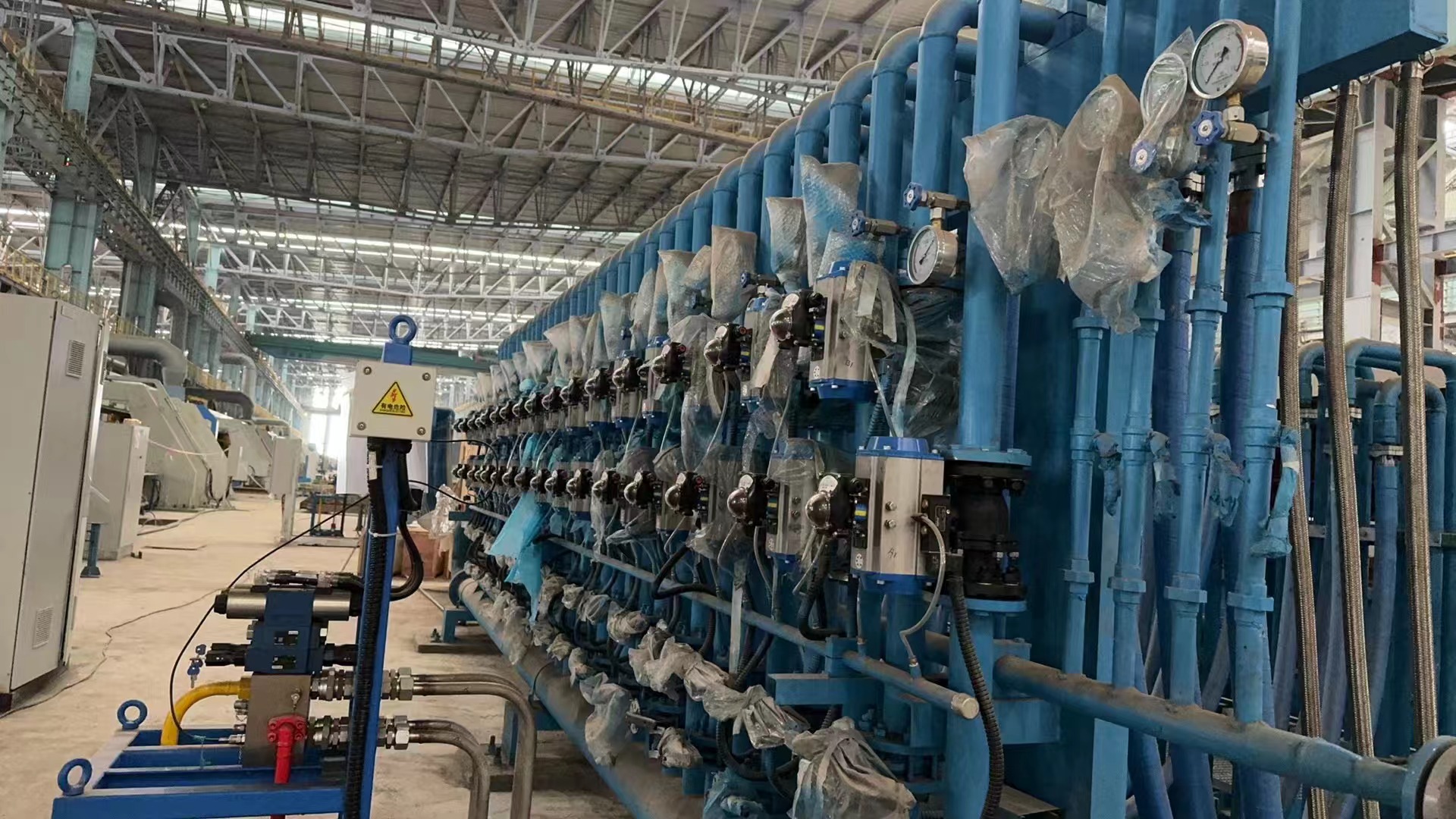
High-temperature steam and heat-exchanger service is where seat selection, certification scope and warranty terms converge on a single purchasing decision.
Why ball valve questions arrive in four clusters
Procurement teams rarely ask one isolated question about a high-quality ball valve. The technical question about seat material at 300°C cannot be answered without knowing whether the fire-safe certificate covers that size and class. The commercial question about warranty cannot be answered without knowing whether the valve is soft-seated or metal-seated, because the seat drives both wear behaviour and replacement logic. The compliance question about CE marking cannot be answered without knowing which directive route applies.
For that reason, a buyer-facing FAQ is more useful than a specification sheet. A specification sheet states what the valve is. A FAQ states what the buyer should verify before signing, which is the stage most industrial purchases actually fail at. The four clusters below — seat and temperature, certificate scope, commercial terms, and market application — are treated in the order a technical evaluation normally follows.
1. Steam duty: how is the seat selected for high temperature?
Seat selection is the first decision in a steam application because it constrains everything downstream: allowable temperature, achievable leakage class, operating torque and actuator sizing.
The Q47F is a trunnion-mounted ball valve rated for -29°C to 425°C and 1.0–10.0 MPa, with flange connection. Body material options include carbon steel, SS304, SS316, dual phase steel, titanium and alloy steel; the ball can be hollow or solid; and the seat is available in PTFE, PPL, PI, PEEK or Stellite. Critically, the same model is offered in both soft-seated and metal-seated construction, which means the seat decision is made at order stage, not at design stage.
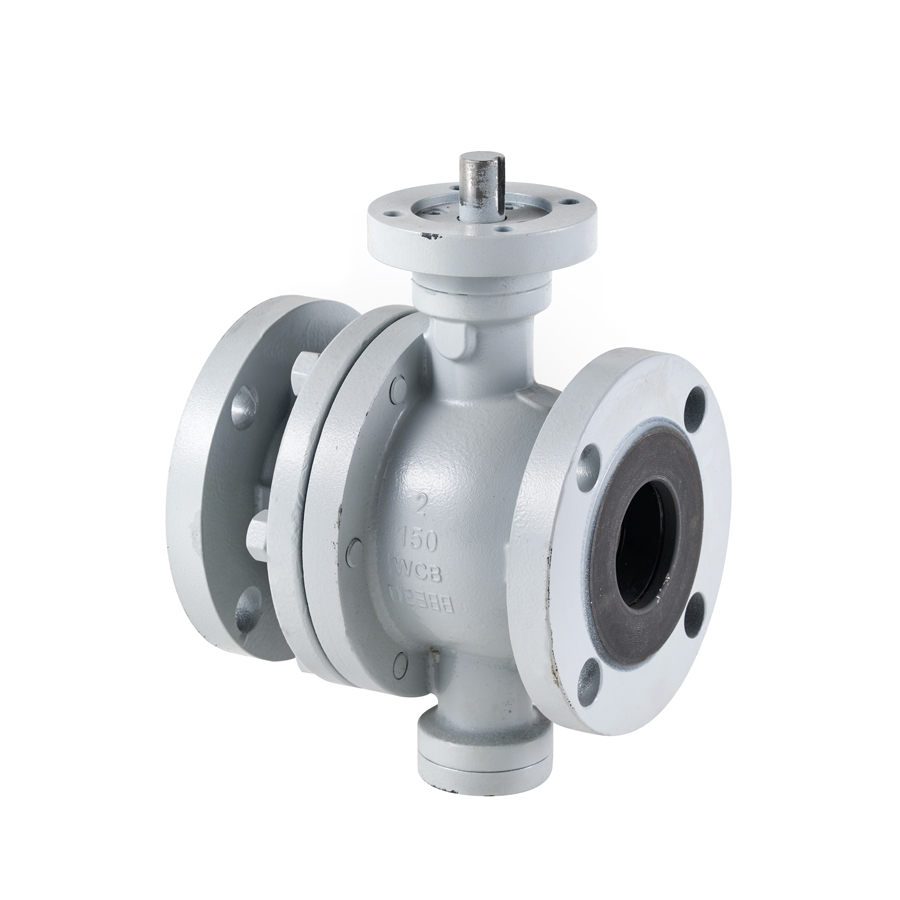
Q47F trunnion-mounted ball valve: the seat material, not the body material, sets the practical temperature ceiling.
Dico's own technical guidance for steam seat selection narrows the range using four dimensions in sequence — temperature, medium, pressure and corrosion — rather than selecting on temperature alone. The soft-seat criteria it publishes are specific:
- Clean media where zero leakage (Class VI) is required;
- Operating temperature up to approximately 260°C, which represents the practical upper limit for PEEK;
- Medium-to-low pressure conditions, Class 1500 and below;
- Frequent opening and closing where low operating torque matters;
- Highly corrosive media, where PTFE or FKM grades are appropriate.
The same guidance explains why the decision cannot be made on temperature alone. PTFE creeps faster above 200°C, so a nominal 260°C rating and a reliable 260°C service life are not the same thing. Particulates — even small amounts — accelerate soft-seat wear, and fibrous media effectively require a hard seat. Pure PTFE experiences cold flow under high pressure, which is why large-diameter or high-differential duties require an assessment of opening and closing torque and, where necessary, a fixed-sphere (trunnion) structure.
Two construction details support steam service regardless of seat choice. The Q47F uses a three-layer stem sealing arrangement and an anti-static structure, and it carries an ISO 5211 mounting pad for actuation. Because the trunnion design takes the pressure load away from the seat in high-differential duties, the same valve body can be ordered soft-seated or metal-seated without changing the piping envelope.
2. What certificate evidence should travel with a steam-duty valve?
Certification is the second cluster because it is where buyers most often accept a logo in place of a scope. The relevant evidence set for a high-quality ball valve in steam and process service is fire-safe testing, fugitive-emission testing, quality management and, for EU destinations, CE marking.
Dico holds API 6D, API 607 (Fire-Safe), SIL, ISO 9001, ISO 14001, ISO 15848 and CE certification. The scope matters as much as the certificate name. The API 607 fire-safe certification covers austenitic-material ball valves up to 4 inches in Class 150/300, and remains valid through March 2027. That is a real boundary: a 6-inch Class 600 valve sits outside that specific scope and requires different evidence.
The ISO 15848-1 fugitive-emission certification scope applies across the floating, trunnion-mounted, PC and wafer ball valve families, which means the emission evidence is not limited to a single product line. For steam service, both certificates answer different questions: API 607 addresses what happens to the valve after exposure to fire, while ISO 15848-1 addresses what the valve leaks in normal operation.
The quality management layer is ISO 9001:2015, supported by ISO 14001. In practice, the ISO 9001 certificate is the document that tells a buyer whether the test regime described in the next section is a controlled process or an informal habit.
3. Purchasing terms and acceptance criteria
Commercial terms for this range are structured to allow both single-unit evaluation and repeat volume. The documented terms are:
| Term | Documented value | What it means for the buyer |
|---|---|---|
| Minimum order quantity | 1 unit | Single-unit sampling and pilot installation are possible before a volume commitment |
| Lead time | 7–45 days | Standard stock items sit at the short end; custom or certified configurations at the long end |
| Monthly capacity | 10,000 units | Indicates capacity headroom for framework agreements |
| Production mode | OEM, ODM | Customisation of appearance, material, logo and mould |
| Quality control | First round 100% test; second round random check | Two-stage inspection rather than a single final screen |
| After-sales | Remote support | Technical resolution handled remotely before any physical return |
Acceptance criteria should be written against evidence, not against adjectives. A workable acceptance clause for a high-quality ball valve covers five items: the certificate with its scope annex attached; material certificates with heat-number traceability, which the supplier applies to its ball sourcing; pressure test records from the two-stage test regime; dimensional and flange checks against the ordered standard; and marking and packaging confirmation.
Two operational facts support delivery reliability. The company runs a 2,000 m² warehouse with a one-item-one-code system and reports 98% warehouse data accuracy, which is the mechanism that makes a 7-day lead time credible on standard blanks. It also performs a 20-second high-frequency switching life test, with 50,000 cycles without leakage as the reference result. For a buyer comparing quotations, that life-test reference is the single most useful durability claim to request in writing.
4. How is pricing structured when no list price exists?
There is no published list price for this range, and buyers should be cautious of any supplier who offers one without a specification. Ball valve pricing is assembled from a small number of cost drivers, and each of them is a specification decision:
- Body material — carbon steel sits at the base; SS304 and SS316 step up; dual phase steel, titanium and alloy steel are project-specific.
- Seat material — PTFE, PPL, PI, PEEK and Stellite carry different costs and different lead times.
- Pressure class — the range spans 1.0–10.0 MPa on flanged models and 1.0–13.0 MPa on the PC family.
- Size and connection — flange, wafer, thread, weld, Tri-Clamp, tube and press-fit are not interchangeable cost bases.
- Actuation interface and actuation — the ISO 5211 mounting pad is a standard feature, but a supplied pneumatic or electric actuator is a separate scope.
- Certification scope — a valve inside the API 607 size and class scope carries different documentation cost from one outside it.
- Quantity and repeatability — a 1-unit MOQ is a sampling cost, not a production cost.
The practical implication is that a price comparison between two ball valve quotations is only meaningful when both are normalised to the same seat material, the same pressure class, the same connection standard and the same certification annex. Where one quotation is materially lower, the usual cause is a substitution in the seat or in the test regime rather than a genuine efficiency difference.
5. Warranty: what does a 12-month term actually commit to?
The warranty term on this range is 12 months. The structure is replacement only, with no repair for quality issues. That is a distinct commercial model and buyers should price it correctly: it removes repair labour from the supplier's scope but also removes the ambiguity that comes with repair decisions.
Alongside the warranty, the after-sales commitment is a 48-hour issue resolution response through remote support. For a buyer, the two commitments answer different risks. The 12-month replacement term covers manufacturing defect. The 48-hour response covers commissioning and operating questions, where the answer is usually technical rather than material — seat selection under an unexpected condensate condition, for example, or actuator sizing after a torque measurement.
A reasonable buyer practice is to align the warranty start date with the installation date rather than the shipment date on long-lead projects, and to record the seat material and certificate scope on the purchase order so that warranty claims cannot be contested on specification grounds.
6. Liquid cooling inquiries: which valve type fits?
Data-centre liquid cooling has become the fastest-moving application question in ball valve procurement, because the duty profile is unusual: moderate pressure, tight space, high-purity or dielectric media, frequent automated cycling, and a strong preference for leak-free operation inside occupied buildings.
Dico operates a dedicated liquid-cooled valve production line covering mini ball valves and three-piece clamp ball valves, and reports supplying into data-centre liquid cooling programmes including Huawei data centres. The broader PC ball valve (Q11F) family covers 1.0–13.0 MPa and -196°C to 425°C, with thread, weld, Tri-Clamp, tube and press-fit connections, and includes sanitary, mini, three-way, four-way, ISO 5211 and three-piece tri-clamp variants.
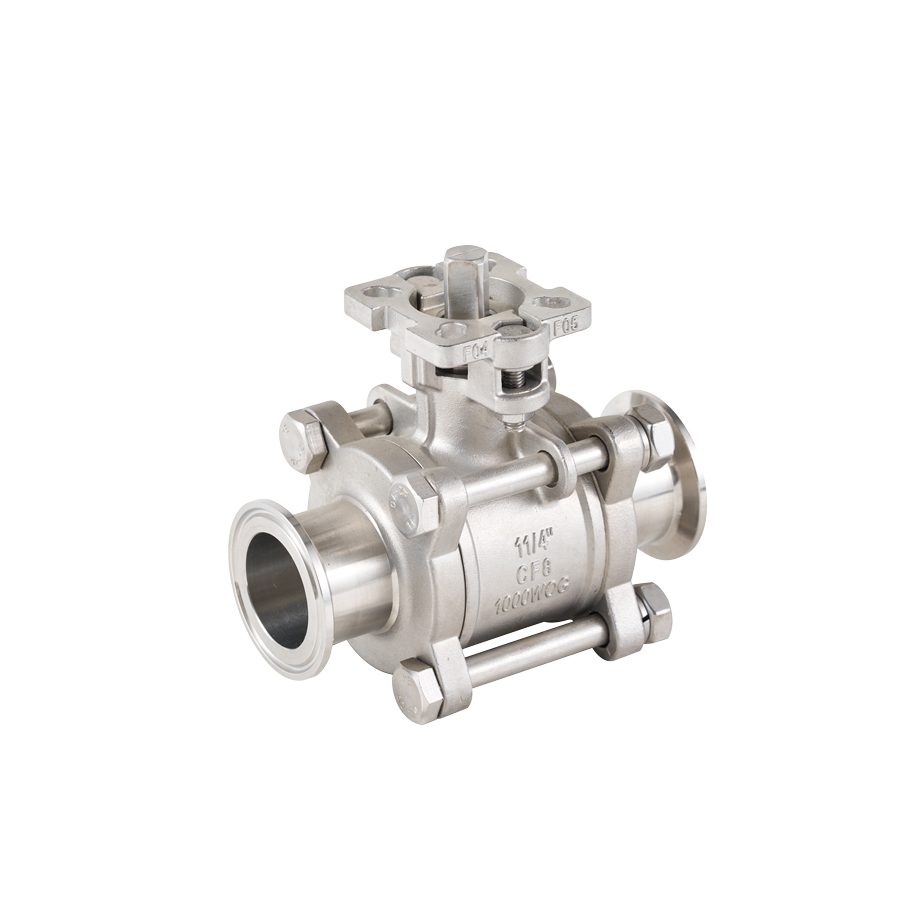
Clamp-connection and mini ball valve variants are the configurations most often specified for liquid cooling manifolds and coolant distribution units.
The selection logic inside a cooling loop is narrower than in process piping. Where the loop needs isolation at a manifold, a mini or clamp ball valve with an ISO 5211 pad is the typical answer because it allows a compact actuator to be fitted later without changing the valve. Where the loop needs diverting or mixing between supply and return, the three-way Q44F in L-type or T-type configuration is the appropriate family, available in carbon steel, SS304 or SS316 with flange or clamp connection and the same PTFE, PPL, PI, PEEK or Stellite seat options. Where the constraint is axial length in a tight skid, the wafer Q71F at 1.0–4.0 MPa and -29°C to 425°C is the space-efficient option.
7. EU export and CE status
For EU-bound projects, the compliance question is not simply "is the valve CE marked" but "which route produced the marking". Dico holds PED CE certification from ECM, supported by an ISO 9001:2015 quality management system. The PED route matters because pressure equipment above the directive's thresholds requires assessment by a notified body, and the certificate should name that body.
Given the company's reported export share of approximately 40% and its stated markets of the EU, South Africa and North America, EU documentation is a routine rather than exceptional workflow. Buyers should still request the PED certificate and the ISO 9001:2015 certificate as separate documents and check that the pressure rating, volume and material group of the ordered valve fall inside the certified scope.
One regulatory development is worth flagging for pipeline applications: API 6D specification Addendum 3 became effective in September 2025. Where a project specifies API 6D for pipeline valves, the addendum applies to new procurement and should be referenced in the purchase order rather than assumed.
8. Fire-safe construction: what "fireproof" is evidence of
"Fireproof ball valve" is a marketing phrase, not a test standard. The verifiable claim is fire-safe performance demonstrated against API STD 607, and the useful question is which sizes, pressure classes and materials the certificate covers.
In this range, the fire-safe evidence sits alongside construction features that support it in service: an anti-static structure that prevents static charge accumulation across the ball-stem interface, and three-layer sealing of the valve stem, which is the leak path most exposed to thermal cycling. The API 607 certification for austenitic-material ball valves up to 4 inches in Class 150/300, valid through March 2027, defines exactly where that evidence applies.
For a buyer, the correct reading is that fire-safe certification is a scope document. A valve ordered outside the certified size, class or material combination is not covered, even if the same model name appears on the datasheet.
9. Valve family reference for procurement comparison
| Family | Model | Pressure range | Temperature range | Connection |
|---|---|---|---|---|
| Trunnion-mounted | Q47F | 1.0–10.0 MPa | -29°C to 425°C | Flange |
| Floating | Q41F | 1.0–10.0 MPa | -29°C to 425°C | Flange |
| PC (sanitary, mini, 3-/4-way) | Q11F | 1.0–13.0 MPa | -196°C to 425°C | Thread, weld, Tri-Clamp, tube, press-fit |
| Wafer | Q71F | 1.0–4.0 MPa | -29°C to 425°C | Wafer |
Shared construction features across the flanged families include an ISO 5211 mounting pad, anti-static structure and three-layer stem sealing; seat options are PTFE, PPL, PI, PEEK or Stellite throughout.
10. Where this range stops: limits a buyer should respect
A credible procurement reference states boundaries as clearly as capabilities. Four limits apply to this range.
- Fire-safe scope is finite. The API 607 certification covers austenitic-material ball valves up to 4 inches, Class 150/300, through March 2027. Larger sizes or higher classes require separate evidence and should not be assumed.
- Polymer seats have a practical ceiling. Even inside a 425°C valve rating, soft-seat performance is bounded by PEEK's roughly 260°C practical limit and by PTFE creep above 200°C. Duties above that band move to metal-seated Stellite construction, which changes torque and cost.
- The 425°C upper bound is a product boundary. Service above it is outside the documented envelope of these models and requires a different product family, not a different seat.
- Warranty is replacement-only. Buyers who budget for on-site repair should account for that themselves, because the 12-month term resolves quality issues by replacement rather than repair.
Two further boundaries are application-related rather than product-related. Ball valves are isolation devices; throttling and continuous control duties belong to control valve families, and a ball valve used part-open will show seat wear far earlier than the 50,000-cycle life reference suggests. And where a project requires a specific notified body or a client-nominated certification mark, that requirement must be agreed before the order, because certificate scope cannot be extended retroactively.
11. Market trend: where ball valve demand is shifting
The global ball valve market was estimated at USD 12.6 billion in 2025, with a forecast of USD 22.8 billion by 2035, according to Global Market Insights. Within that total, floating ball valves held a 61.8% share in 2025 according to Straits Research — a reminder that the high-specification trunnion segment is a minority of volume but a majority of the technically demanding duties.
Two sub-segments are growing faster than the base. The data-centre liquid cooling valve market was projected to move from USD 0.27 billion in 2025 to USD 1.80 billion by 2032, according to MarketsandMarkets, which explains why mini and clamp-connection ball valve capacity has become a procurement topic rather than a niche. In pharmaceuticals, stainless steel 316L/304 accounts for 68% of valves in the market, according to Market Research Insights — a material concentration that shapes both specification defaults and price expectations.
Standards activity reinforces the same direction. API 6D Addendum 3 took effect in September 2025 for pipeline valves, tightening documentation expectations at exactly the point where buyers are already asking for scope-level certificate evidence rather than logos.
12. Future outlook
Three shifts are likely to shape ball valve procurement over the next several years. First, emission documentation is becoming a specification item rather than a compliance afterthought; ISO 15848-1 scope across floating, trunnion, PC and wafer families is now a differentiator that buyers can compare directly. Second, liquid cooling will continue to pull small-size, clamp-connected, actuator-ready valves into higher-volume production, which favours manufacturers with dedicated lines and warehouse discipline over generalist suppliers. Third, traceability — heat-number tracking on balls, one-item-one-code warehousing, two-stage testing — is turning into the practical definition of a high-quality ball valve, because it is the part of quality a buyer can audit.
For buyers, the implication is straightforward: the evaluation checklist should be built around evidence that can be verified after delivery — certificate scope, test records, material traceability, and warranty mechanics — rather than around headline claims made before it.
Quick-reference FAQ
What is the minimum order quantity and typical lead time for a high-quality ball valve?
The documented minimum order quantity is 1 unit, with a lead time of 7–45 days depending on configuration, and a monthly production capacity of 10,000 units. Standard stock blanks are held in a 2,000 m² warehouse, which is what allows short lead times on standard items while custom or certified configurations sit at the longer end.
Does the valve include an actuator mounting interface?
Yes. The trunnion-mounted Q47F, floating Q41F, PC Q11F and wafer Q71F families carry an ISO 5211 mounting pad, together with an anti-static structure and three-layer stem sealing. The mounting pad allows a pneumatic or electric actuator to be fitted at the factory or added later in the field without replacing the valve.
What test evidence accompanies a shipment?
Production follows a two-stage quality control regime: a first round of 100% testing and a second round of random checks. Durability is referenced through a 20-second high-frequency switching life test with 50,000 cycles without leakage. Buyers requiring documented evidence should specify test records and heat-number traceability in the purchase order, since these are recorded at production rather than reconstructed afterwards.
Which industries are these ball valves used in?
The documented application list covers petroleum and chemical, pharmaceuticals, water treatment, liquid cooling, metallurgy, semiconductors, hydrogen energy and HVAC. One documented case involved 1,000 units of the Q41F supplied to an ironmaking and metallurgical plant in China for boiler water piping, using pneumatic automatic control and reporting stable operation over a one-year period.
Which documents should be requested alongside a quotation?
Five documents make a ball valve quotation comparable: the API 607 and ISO 15848-1 certificates with their scope annexes; the ISO 9001:2015 certificate and, for EU destinations, the PED CE documentation; material certificates with heat-number traceability; the pressure test record from the two-stage regime; and the written warranty terms, which specify a 12-month replacement-only commitment with a 48-hour issue resolution response.
Product and company documentation is available in the Dico Brief Introduction (PDF): DICO Brief Introduction.
Tem questões ou precisa de mais detalhes?
Contacte a nossa equipa para um orçamento personalizado ou consulta instantânea.
Solicitar orçamento
Preencha o formulário abaixo e a nossa equipa entrará em contacto com uma proposta personalizada.
Chat direto do WhatsApp
Prefere conversar em tempo real? Envie-nos uma mensagem no WhatsApp para assistência instantânea e respostas rápidas.
- Obter orçamento personalizado
- Partilhar fotos ou documentos
- Discuta as suas necessidades diretamente
Geralmente responde em 5–30 minutos durante o horário de expediente.