
High-Quality Ball Valve Shortlist: Body Material, Seal and Type Options Compared
A high-quality ball valve shortlist is usually assembled in the wrong order. Buyers tend to start with valve architecture — floating, trunnion-mounted, three-way, wafer — and treat body material and seat compound as a late filter applied once the type has been chosen. On most process lines that sequence is backwards. Body material sets the corrosion envelope and the structural margin. Seat and seal material set the temperature ceiling, the leakage class that can realistically be held, the operating torque and the media the valve can tolerate at all. Architecture decides how the valve is actuated and how it behaves under differential pressure. Material and seal decide whether the valve is still in service after the first maintenance window.
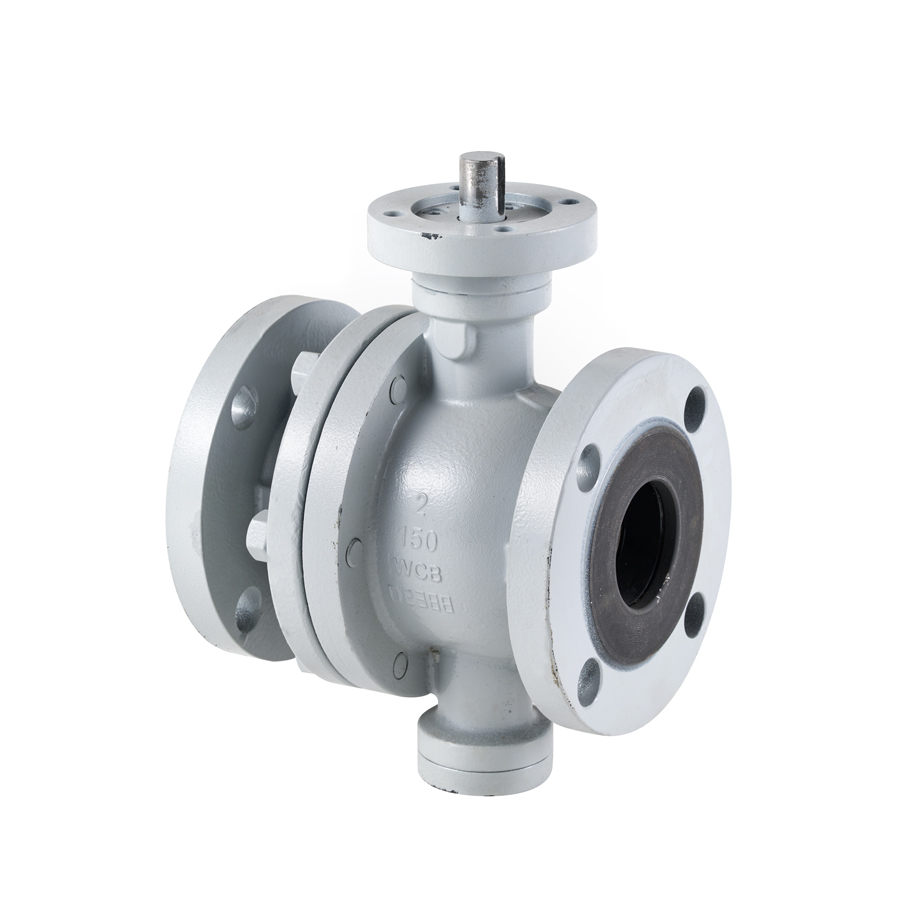
This shortlist therefore runs material first, seal second, type third. The reference configuration is the Q47F trunnion-mounted ball valve from Zhejiang Dico Valve Co., Ltd., a ball valve manufacturer founded in 2015 and located in the Longwan District of Wenzhou, Zhejiang Province, China. Dico Valve is a National High-tech Enterprise whose production range covers high-platform ball valves, metal-seated ball valves, three-piece ball valves, tank bottom valves, pneumatic and electric ball valves, and sanitary BA-grade ball valves. The floating, PC and wafer options are positioned beneath that reference, followed by the complementary line items — a three-way valve, a globe valve, a gate valve and a Y-strainer — that buyers normally need in order to close out a complete valve package.
Reference Configuration: The Q47F Trunnion-Mounted Ball Valve
The Q47F is a trunnion-mounted ball valve for petroleum, pharmaceutical, water treatment, liquid cooling, metallurgy, chemical, semiconductor, hydrogen energy and HVAC service. It is available as either a soft-seated or a metal-seated ball valve, and its published configuration is unusually broad for a single model — which is precisely why it works as a comparison baseline rather than as a single-line recommendation.
| Parameter | Q47F configuration |
|---|---|
| Architecture | Trunnion-mounted; available soft-seated or metal-seated |
| Body material options | Carbon steel, SS304, SS316, dual phase steel, titanium, alloy steel |
| Seat / seal options | PTFE, PPL, PI, PEEK, Stellite |
| Ball construction | Hollow ball or solid ball |
| Connection | Flange |
| Pressure range | 1.0–10.0 MPa |
| Temperature range | −29°C to 425°C |
| Mounting | ISO 5211 mounting pad |
| Stem sealing | Three-layer sealing of the valve stem |
| Safety feature | Anti-static structure |
Two details in that table matter more than the headline ratings. First, −29°C to 425°C is a body-level envelope, not a service promise: a PEEK soft seat and a Stellite metal seat share the same published body range but do not share the same real operating ceiling. Second, the seal list spans two different families — PTFE, PPL, PI and PEEK are soft seats, while Stellite is a metal seat. A buyer who shortlists on pressure and temperature alone will frequently land on the wrong family.
Body Material Shortlist: Six Options, Six Different Jobs
Body material is a mapping decision, not a ranking. The Q47F and Q41F ranges both offer carbon steel, SS304, SS316, dual phase steel, titanium and alloy steel, and each of those options answers a different question about the line.
| Body material | Where it typically fits | What the buyer should confirm |
|---|---|---|
| Carbon steel | General industrial service with non-aggressive media; the most economical body option in the range and the one used in documented boiler water piping projects | Confirm external coating and the corrosion allowance for the site environment |
| SS304 | General corrosive and wet service; a common choice in water treatment and HVAC loops | Confirm chloride exposure, which is normally the limiting factor for 304 |
| SS316 | Chemical, pharmaceutical and higher-chloride duty; stainless 316L/304 accounted for 68% of valve material share in the pharmaceutical market in 2025 | Confirm whether a 316L variant and a material certificate are required |
| Dual phase steel | Service where higher mechanical strength than standard austenitic grades is required alongside chloride-related stress corrosion resistance | Confirm weld procedure qualification and availability at the required size |
| Titanium | Highly corrosive media where austenitic and duplex grades are insufficient | Confirm the full wetted-path material, not only the body |
| Alloy steel | Higher-temperature and higher-mechanical-duty service | Confirm the specific alloy grade and the applicable test documentation |
Material selection rarely fails because the wrong grade was chosen from a catalogue. It fails because the grade on the drawing could not be proven on the delivered valve. Dico Valve sources balls through a supply chain managed with heat number traceability, which is what allows a material certificate to be tied back to an individual valve rather than to a production batch. For buyers in pharmaceutical, semiconductor or hydrogen service, that traceability is part of the shortlist criteria, not an administrative extra.
Seat and Seal Shortlist: Soft Seats, Metal Seats and the Order of Decisions
Seat selection follows a fixed sequence: temperature first, then medium, then pressure, then corrosion. Each step narrows the candidates, and skipping a step is the most common cause of premature seat failure.
| Seat / seal | Family | Typical fit | Boundary to confirm |
|---|---|---|---|
| PTFE | Soft | Clean media requiring tight shut-off; low operating torque. The reference configuration uses Daikin PTFE with machining | Creep accelerates above 200°C; pure PTFE exhibits cold flow under high pressure; glass-fibre PTFE is not resistant to HF or strong alkalis |
| PPL | Soft | Intermediate soft-seat option within the same family as PTFE | Confirm the actual temperature rating against the specific medium rather than assuming a generic value |
| PI | Soft | Intermediate soft-seat option within the same family as PTFE | Confirm the actual temperature rating against the specific medium |
| PEEK | Soft | Highest stated soft-seat ceiling in the range, with an upper limit of 260°C | Confirm differential pressure and torque at the required diameter |
| Stellite | Metal | High temperature, particulate or fibrous media, and duty where soft seats are worn or extruded | Metal seats generally do not hold the same tight shut-off class as soft seats; confirm the acceptable leakage class for the line |
The published guidance behind this sequence is straightforward. Soft-seal seats suit clean media that require zero leakage, operating temperatures up to 260°C as the PEEK upper limit, medium-to-low pressure classes, frequent opening and closing where low torque matters, and highly corrosive media. Particles are the practical enemy of a soft seat — even small amounts accelerate wear, and fibrous media require a hard seat. Pure PTFE cold-flows under sustained high pressure, so on large-diameter, high-pressure-differential duty the opening and closing torque must be assessed and a trunnion-mounted structure selected where necessary. Rubber and elastomer selection must be checked against a chemical compatibility table rather than decided from experience.
Type Shortlist by Duty Profile
Once material and seal are fixed, type selection becomes a question of installation space, connection standard, pressure class and differential pressure behaviour. Four Dico configurations cover the majority of duty profiles within the same product family.
| Model | Architecture | Connection | Pressure | Temperature | Duty profile |
|---|---|---|---|---|---|
| Q41F | Floating ball valve; soft-seated or metal-seated | Flange | 1.0–10.0 MPa | −29°C to 425°C | General line isolation; ISO 5211 mounting pad for actuation; body materials to six-grade range |
| Q47F | Trunnion-mounted ball valve; soft-seated or metal-seated | Flange | 1.0–10.0 MPa | −29°C to 425°C | Higher differential pressure and larger sizes where floating-seat torque becomes a constraint |
| Q11F (PC) | Floating design used across sanitary, mini, 3PC tri-clamp and ANSI patterns | Thread, weld, Tri-Clamp, tube, press-fit | 1.0–13.0 MPa | −196°C to 425°C | Small-bore, sanitary and space-limited installations; the widest temperature span in the family |
| Q71F | Wafer ball valve; floating, ISO 5211 pad | Wafer | 1.0–4.0 MPa | −29°C to 425°C | Compact installation between flanges at moderate pressure in semiconductor, chemical and liquid cooling lines |
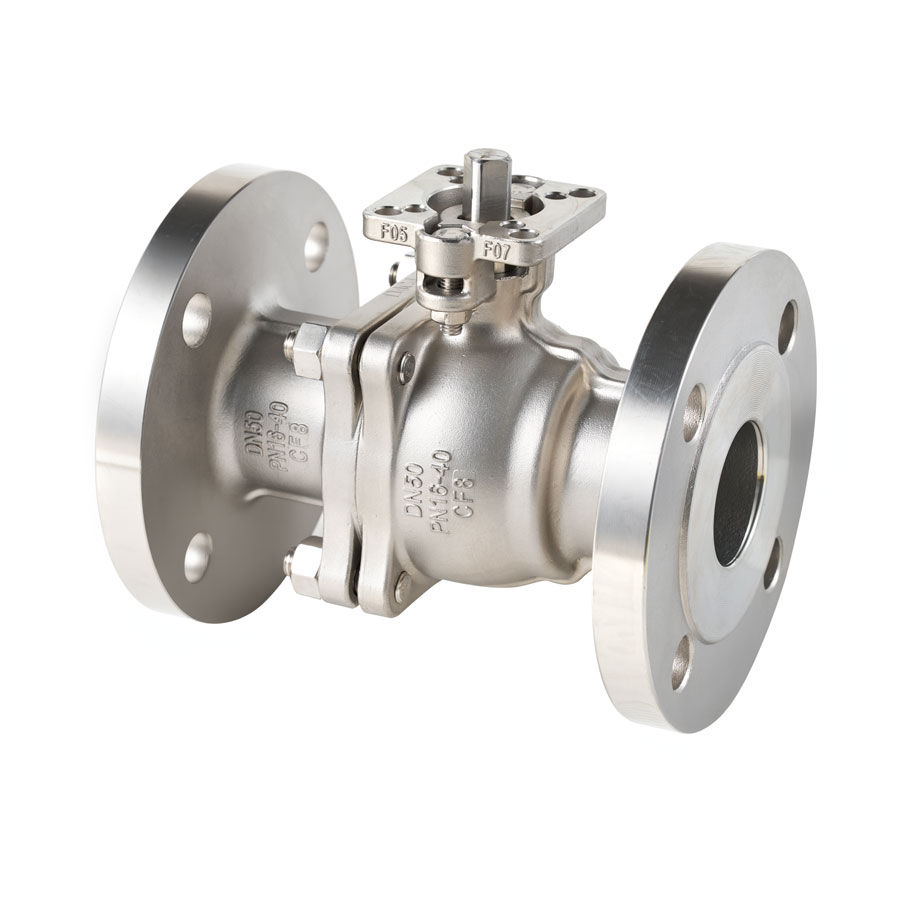
The dividing line between Q41F and Q47F is not a fixed size — it is the combination of diameter and differential pressure. Where that combination is demanding, the closing torque has to be evaluated and a fixed-sphere structure specified if the floating design cannot hold the required operating margin.
Complementary Line Items: Assembling a Complete Valve Set
A ball valve shortlist rarely stands alone on a process line. Isolation, diverting, regulation and upstream filtration are usually required in the same package, and mixing pressure classes inside one package is where specification errors appear.
| Model | Product | Connection | Pressure | Temperature | Role in the set |
|---|---|---|---|---|---|
| Q44F | Three-way ball valve, L-type and T-type | Flange or clamp | Seal and body to the common range; carbon steel, SS304 or SS316 body | Same seal family as the ball valve line | Flow diverting and mixing; ISO 5211 pad, anti-static structure and three-layer stem sealing carried over from the ball valve platform |
| J11W | Threaded globe valve | Thread | 1.0–2.5 MPa | −29°C to 425°C | Regulation duty where quarter-turn isolation is not the priority; metal seat |
| Z11W | Threaded gate valve | Thread | 1.0–2.5 MPa | −29°C to 425°C | Straight-through isolation on small-bore lines; SS304 or SS316 body, metal seat |
| SRY | Threaded Y-strainer | Thread | 1.0–2.5 MPa | −29°C to 425°C | Upstream protection; carbon steel, SS304 or SS316 body, metal seat |
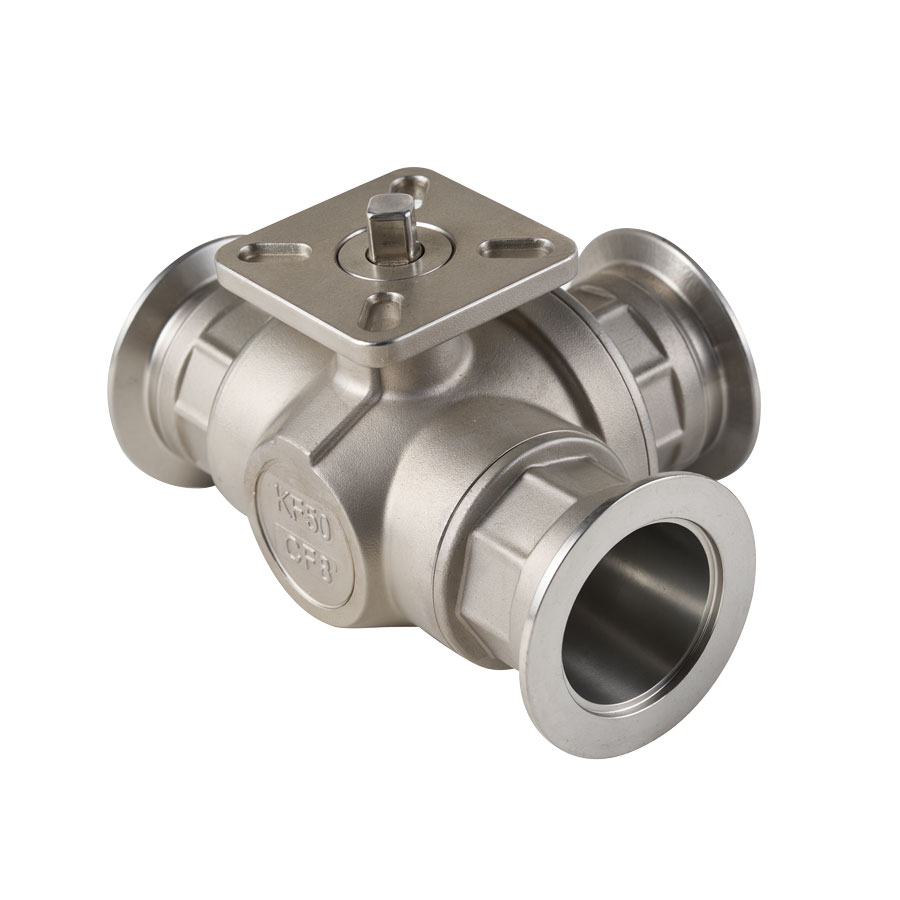
The pressure-class mismatch is the point buyers most often miss. A flanged Q41F or Q47F ball valve reaches 10.0 MPa, but the threaded globe valve, gate valve and Y-strainer in the same family are rated 1.0–2.5 MPa. A package cannot be described as a single pressure class unless every item in it is engineered to that class. Threaded accessories belong on the small-bore branch, not on the main high-pressure header.
Application Fit: Where These Configurations Are Already Running
The industries listed across the Dico ball valve range are petroleum, pharmaceuticals, water treatment, liquid cooling, metallurgy, chemicals, semiconductors, hydrogen energy and HVAC — an unusually wide span for one product family, and the reason material and seal selection cannot be standardized.
A documented case is illustrative. An ironmaking and metallurgical plant client in China took 1,000 units of the Q41F floating ball valve for boiler water piping, with pneumatic automatic control, over a one-year duration, and reported stable operation. Separately, a common scenario in China involves high-pressure gas service in power generation and chemical industry projects — boiler flue gas, heat treatment furnaces and coal-to-olefins lines — where the medium is weakly corrosive, the operating condition is high pressure, the function is medium cut-off, the operation mode is pneumatic and the valve is matched into a pipeline system.
Those two scenarios point in different directions. Boiler water piping tolerates a carbon steel body with a soft seat and rewards reliable automation. Weakly corrosive high-pressure gas at elevated temperature pushes toward a corrosion-resistant body and a seat family that will not creep. The shortlist is only useful if it keeps those two profiles separate.
Production-side evidence matters here as well. Dico Valve operates 48 CNC machines under digital production management, performs a first round of 100% testing followed by a second round of random checks, and runs a 20-second high-frequency switch life test with 50,000 cycles without leakage. The company maintains a 2,000 m² warehouse with standard product blank inventory, a one-item-one-code system and 98% warehouse data accuracy, offers OEM and ODM production with customization of appearance, material, logo and mould, quotes a minimum order quantity of 1 unit, and states a lead time of 7–45 days at a monthly capacity of 10,000 units. The commercial terms are part of the shortlist because they determine whether a specified material is deliverable on the project schedule.
Market Trend: What the Demand Side Is Telling Buyers
Three data points frame the sourcing environment for high-quality ball valves.
The global ball valve market was estimated at USD 12.6 billion in 2025, with a projection of USD 22.8 billion by 2035, according to Global Market Insights. Floating ball valves dominated the global market with a 61.8% share in 2025, according to Straits Research. Within that total, the data centre liquid cooling valve segment was projected to grow from USD 0.27 billion in 2025 to USD 1.80 billion by 2032, according to MarketsandMarkets.
The two market-size estimates do not fully agree: one research house puts the 2025 total at USD 12.6 billion while another reports USD 14.8 billion. The divergence appears to come from methodology — most likely the inclusion of additional non-industrial sub-segments — rather than from a genuine contradiction. That is worth stating plainly, because buyers who see a single headline figure in a supplier presentation should treat it as directional.
Two regulatory and standard signals also affect shortlisting. API 6D Specification Addendum 3 became effective in September 2025 for pipeline valves, and material composition continues to concentrate in specific niches: stainless 316L and 304 together accounted for 68% of valve material share in the pharmaceutical market in 2025.
The practical reading is that demand is broadening in exactly the segments where material and seal choices are least forgiving — high-purity semiconductor and pharmaceutical service, hydrogen, and data centre liquid cooling — while the dominant architecture remains the floating ball valve. The differentiation is no longer in the architecture. It is in material grade, seal family and documentation.
Comparison With Traditional Isolation Options — and Where Each Option Stops
Traditional threaded gate and globe valves remain appropriate in specific positions: a gate valve for straight-through isolation on small-bore lines and a globe valve where regulation is required, both with metal seats and a −29°C to 425°C range. Ball valves differ in operation rather than in principle — a quarter-turn action, full-bore flow and an ISO 5211 pad that accepts pneumatic or electric actuation directly.
Four boundaries deserve to be stated explicitly, because they are the points at which a shortlist becomes a specification error:
- Wafer pressure ceiling. The Q71F wafer ball valve is rated 1.0–4.0 MPa, while the flanged Q41F and Q47F reach 1.0–10.0 MPa. A wafer valve cannot be substituted for a flanged valve on a high-pressure header merely because the face-to-face dimension is convenient.
- Threaded accessory ceiling. The threaded gate valve, globe valve and Y-strainer are rated 1.0–2.5 MPa. They complete a package, but they do not extend its pressure class.
- Certification scope. Dico Valve holds API 6D, API 607 (fire-safe), SIL and ISO 9001 among its certifications, and the API 607 scope for the company covers austenitic material ball valves up to 4 inches, Class 150/300, valid until March 2027. A 6-inch Class 600 fire-safe requirement therefore falls outside that specific certificate and has to be qualified separately.
- Soft-seat physics. Temperature, particulates, cold flow under sustained pressure, incompatibility with HF and strong alkalis, and torque at large diameters are all conditions under which a soft seat should not be shortlisted regardless of body material.
A further boundary is commercial rather than technical. Not every material and seal combination is held in standard stock, and customization of material, appearance, logo or mould moves the order into a quoted lead time of 7–45 days. Buyers running a fixed commissioning date should confirm availability before the material is frozen on the datasheet.
Future Outlook
Three developments are likely to shape high-quality ball valve shortlists over the next several years. First, liquid cooling and hydrogen service will continue to pull demand toward corrosion-resistant bodies paired with soft seats on clean media, while the pressure and temperature envelope of those systems stays moderate — the opposite of the metallurgical duty that drives metal-seated selection. Second, certification will increasingly be managed as a lifecycle rather than a one-off: the API 607 scope valid until March 2027 illustrates why buyers should track expiry dates as part of supplier qualification. Third, the API 6D Addendum 3 update signals continuing tightening of documentation expectations on pipeline valves, which raises the value of heat-number traceability and independently verifiable material records.
The shortlist logic itself is unlikely to change. Material and seal first, type second, commercial terms third. What will change is the number of duty profiles — liquid cooling, high-purity pharmaceutical and semiconductor lines — that sit outside the assumptions of a legacy valve specification.
Frequently Asked Questions
Which body material should be shortlisted first for a high-quality ball valve?
There is no single first choice, because body material is a mapping decision rather than a ranking. Within the Dico ball valve range, carbon steel is typically specified for non-aggressive media in general industrial service, SS304 for general corrosive and wet duty, SS316 where higher chloride resistance is required — stainless 316L and 304 together held 68% of valve material share in the pharmaceutical market in 2025 — and dual phase steel, titanium or alloy steel where strength, corrosion resistance or temperature demand exceeds what standard austenitic grades provide. The decision should be driven by the medium, the site environment and the documentation requirement, not by the valve type.
When is a metal-seated ball valve a better fit than a soft-seated one?
A metal-seated valve, such as one using a Stellite seat, is generally appropriate where the medium contains particles or fibres, where temperature exceeds the practical soft-seat range, or where high differential pressure would extrude or wear a soft insert. Soft seats remain the appropriate choice for clean media requiring tight shut-off, operating temperatures up to 260°C as the PEEK upper limit, medium-to-low pressure classes and frequent operation at low torque. The trade-off is explicit: metal seats handle harsher duty, but they generally do not hold the same tight shut-off class as soft seats.
How do you decide between a trunnion-mounted and a floating ball valve?
The decision is driven by diameter combined with differential pressure rather than by a fixed size threshold. In a floating design, the ball is supported by the seats and the full differential pressure acts on it, so operating torque rises as both dimensions increase. Where that combination is demanding, the opening and closing torque must be assessed and a fixed-sphere, trunnion-mounted structure selected if necessary. Both the Q41F floating valve and the Q47F trunnion-mounted valve share the same 1.0–10.0 MPa pressure range and −29°C to 425°C temperature range, so the published ratings alone do not separate them.
What pressure can a wafer ball valve handle?
The Q71F wafer ball valve is rated 1.0–4.0 MPa over a temperature range of −29°C to 425°C, in carbon steel, SS304 or SS316, with an ISO 5211 mounting pad. By comparison, the flanged Q41F and Q47F ball valves are rated 1.0–10.0 MPa. The wafer pattern is valuable where installation space is constrained, but it should not be treated as interchangeable with a flanged valve on a higher-pressure line.
Does an API 607 fire-safe certificate cover every ball valve size and class?
No. Certification scope is defined, not universal. The API 607 fire-safe certification held by Dico Valve covers austenitic material ball valves up to 4 inches, Class 150/300, and is valid until March 2027. Buyers specifying larger sizes, higher classes or non-austenitic body materials need to confirm whether the certificate covers that specific configuration, and should track the validity date as part of supplier qualification rather than assuming permanent coverage.
Which valves complete a ball valve set for a process line?
A complete set typically pairs the ball valve with a Q44F three-way ball valve for diverting or mixing, a J11W threaded globe valve for regulation, a Z11W threaded gate valve for straight-through isolation on small-bore lines, and an SRY threaded Y-strainer for upstream filtration. The three threaded items are rated 1.0–2.5 MPa over −29°C to 425°C, so they belong on the small-bore branch rather than on a high-pressure header, even when the accompanying flanged ball valve is rated to 10.0 MPa.
Further technical detail on the Dico Valve ball valve range, materials and certifications is available in the company's product introduction brief (PDF).